
 简体中文
简体中文 English
Website review
This review may include AI-generated content and is not individually verified. Domain, certificate and other facts come from the observed data on this page.
What is bytemail?
bytemail is a native email application for macOS. It is built in Swift specifically for the Mac rather than as a web wrapper or bundled browser, and it puts Gmail, iCloud, Outlook, Microsoft 365, Yahoo, Fastmail and any IMAP account into one unified window. Each account keeps its own icon, colour and unread count, so you can tell at a glance where a message arrived.
What it does
- One inbox for every account. Personal, work and side-project addresses sit side by side instead of in separate apps or browser tabs.
- Conversation-style threads. Messages read as clean bubbles, newest at the bottom, with the reply field directly underneath. Accounts can be switched back to a classic quoted-reply layout if you prefer.
- Fast search across accounts. A keyboard shortcut searches senders, subjects, message text and attachment names across all accounts at once, with local results appearing first and older mail filling in from the servers.
- Privacy by default. Mail goes from your provider to your Mac; the app's servers are not in the path. Tracking pixels are blocked and tracking tags are stripped from links.
- On-device AI features. Summaries and rewriting run locally on the Mac rather than in the cloud, and an MCP integration connects inboxes to AI apps such as Claude and Codex.
- iPhone companion. A Mac licence includes the iPhone app, which was in App Store review at the time of writing.
Who it suits
It fits Mac users who juggle several mail accounts and want a single fast window without a browser-based client. The trade-off is platform lock-in: there is no Windows, Linux or web version, and the Mac app requires macOS 14 or later on Apple silicon. Anyone who needs cross-platform access should look elsewhere.
Trying it
A seven-day free trial is available from inside the app, and paid plans are listed at bytemail. The practical next step is to download it, add your busiest two accounts, and test whether the unified inbox and cross-account search actually replace your current setup during the trial.
How does bytemail keep my email private on my Mac?
bytemail keeps your email private mainly by staying out of the path between your mail provider and your Mac. According to the product's own page, your mail goes straight from your provider to your Mac and "never touches our servers." It is a native Swift app rather than a web wrapper, so there is no browser-based middle layer relaying your inbox.
Privacy features described on the site
- Direct connections. Gmail, iCloud, Outlook, Yahoo, Fastmail and other IMAP accounts are fetched directly to your Mac rather than routed through bytemail's infrastructure.
- On-device intelligence. Summaries and Rewrite run locally on your Mac, not in the cloud, so message content used for those features is not sent to a third-party AI service.
- Tracking-pixel blocking. Remote pixels that report when you opened a message are blocked by default.
- Link cleaning. Links are stripped of the tags that tell senders who clicked, so clicking through does not hand over a per-recipient identifier.
A practical scenario
Say a newsletter with a hidden tracking pixel arrives in your iCloud account. In a typical webmail client, opening it can ping the sender's server and confirm your address is live and that you read it. In bytemail, the pixel is blocked and the link you eventually click has its tracking parameters removed, so the sender learns less about your behaviour.
Where the trade-off sits
Privacy here is mostly about architecture and defaults, not about encryption you control. The site does not present bytemail as an end-to-end encrypted or anonymous service — it is a client that talks to your existing providers, so your provider still holds your mail and your account credentials still matter. Local AI features also depend on your Mac's hardware, which is why the app targets macOS 14+ on Apple silicon.
A sensible next step
If you want to verify the claims rather than take them on trust, run a test: send yourself a message containing a tracking pixel from a service you control, open it in bytemail, and check whether the pixel fires. You can start with the 7-day trial inside the app and compare the result against your current client. If you use multiple providers, bytemail may also replace several separate apps with one window, which is a convenience benefit rather than a privacy one.
Does bytemail work with Gmail, iCloud, Outlook, and other IMAP accounts?
Yes. bytemail is built to pull Gmail, iCloud, Outlook, Microsoft 365, Yahoo, Fastmail and any standard IMAP server into a single window, so you can keep a personal iCloud address, a work Outlook account and a side-project Gmail side by side instead of switching between apps or browser tabs. Each account keeps its own colour, picture and unread count, which matters once you have three or more inboxes and need to tell at a glance where a message arrived.
A few practical points worth knowing before you commit:
- One licence covers Mac and iPhone. The iPhone app is listed as in App Store review and included free, so the same licence is intended to follow you across devices.
- Privacy is the design premise, not an add-on. Mail goes from your provider to your Mac without passing through bytemail's servers, and tracking pixels are blocked with link tags stripped. That is a real trade-off if you rely on open-rate or click-tracking data for outbound campaigns — you would lose that signal.
- Search spans accounts. One search covers senders, subjects, body text and attachment names across every account, with local results appearing first and server results filling in older mail.
- AI features run on-device. Summaries and Rewrite are described as running locally rather than in the cloud.
Choosing between this and the alternatives
| If your priority is… | bytemail fits when… | Consider something else when… |
|---|---|---|
| Native Mac feel | You want a Swift-built app, not a web wrapper | You need Windows or Android too |
| Many account types | You mix Gmail, Outlook, Yahoo and IMAP | You only use one provider's own app |
| Privacy | You dislike server-side processing | You need server-side rules or shared inboxes |
| Price model | You prefer a one-off lifetime licence | You want a free tier indefinitely |
The trial is the sensible next step: add two accounts of different types — say an iCloud and a work Outlook — and spend the week testing unified search and the chat-style thread view, since that is where a mail client either fits your habits or does not. If you share mailboxes with a team, or depend on provider-side filtering, check that behaviour early rather than after the trial ends.
What do bytemail's pricing plans cost, and is there a free trial?
bytemail offers three ways to pay, plus a 7-day free trial on its subscription plans.
| Plan | Price | Notes |
|---|---|---|
| Monthly | $3.99 /month | 7 days free, then billed monthly |
| Yearly | $39.90 /year | 7 days free, then billed yearly; shown as saving 17% |
| Lifetime | $69 once (launch offer, normally $99) | Pay once, use forever; 5 devices, one licence |
The trial is the practical starting point: you get full use for 7 days before any charge, and you can also download the app and begin the trial from inside it. The licence covers Mac and iPhone, with the iPhone version described as included free and still in App Store review. Requirements are macOS 14 or later on Apple silicon.
Choosing between monthly, yearly and lifetime
- Monthly suits anyone testing whether a native Mac client fits their habits, or who expects their email setup to change within a few months.
- Yearly makes sense once you know you'll keep it; the discount is modest but real, and it's the cheapest way to stay subscribed long-term.
- Lifetime is the better deal if you dislike subscriptions and expect to stay on macOS for years. At $69 it pays for itself in under two years of monthly billing, and it includes the iPhone app.
One caveat worth noting: the lifetime tier is framed as a limited launch offer with staged pricing ($19 and $29 tiers shown as taken, $49 also taken, then $69 for the next 50 users, then $99). If you want the lower price, deciding sooner matters more than with the subscriptions, which you can start and stop freely.
What the money buys
The pitch is speed and privacy rather than extra storage or server-side features. It's built in Swift for macOS with no web wrapper, mail goes from your provider straight to your Mac without passing through bytemail's servers, and on-device summaries and rewriting run locally rather than in the cloud. It handles Gmail, iCloud, Outlook, Microsoft 365, Yahoo, Fastmail and any IMAP server in one unified inbox, with per-account colours and unread counts. There's also an MCP integration for AI apps such as Claude and Codex.
If you mainly need a single Gmail account on a phone, this is more than you need. If you juggle several accounts on a Mac and care about a fast, private client, the trial is the sensible first step — then pick yearly if you're unsure about commitment, or lifetime if you're confident.
Can I use bytemail's MCP integration with Claude, Codex, or other AI apps?
Yes — bytemail advertises an MCP integration that its page says works with Claude, Codex and other AI apps, giving those tools access to every account from your Mac. MCP (Model Context Protocol) is the connector standard AI assistants use to reach outside data, so the practical effect is that an AI app can query your mail through bytemail rather than you copying and pasting messages into a chat window. The page frames it as "one MCP for every inbox," covering the same Gmail, iCloud, Outlook, Microsoft 365, Yahoo, Fastmail and generic IMAP accounts that feed the unified inbox.
What that looks like in practice
A concrete scenario: you ask Claude or Codex to find the Northwind invoice from a print-production thread, and it pulls the message and attachment name through bytemail instead of you forwarding anything. The page also pairs MCP with on-device Summaries and Rewrite, which it says run on your Mac rather than in the cloud — a meaningful distinction if the AI app you connect is itself cloud-hosted, since the mail content may still leave your machine once the assistant processes it.
Points to check before relying on it
- Which AI apps are officially supported versus merely "works with" — the page names Claude and Codex as examples, not an exhaustive list.
- Whether the MCP server is local-only or exposes an endpoint, since that determines what leaves your Mac.
- Account scope: whether you can limit the connection to one account rather than the whole unified inbox.
- Platform limits: bytemail is macOS 14+ on Apple silicon, so the integration is Mac-bound. The iPhone app is described as in App Store review and included free with a licence.
Decision criterion
If your main goal is letting an AI assistant read and act on mail without exporting it, MCP plus on-device summarisation is the reason to pick bytemail over a web-wrapper client. If your AI tools are all cloud-based and you handle sensitive mail, test the connection with a single low-risk account first and confirm what bytemail sends outward. Compare against Apple's built-in Mail if you only need unified accounts, and against Superhuman if speed and keyboard-driven triage matter more than AI access.
Does bytemail have an iPhone app, and is one licence enough for all my devices?
Yes, an iPhone app is planned, but it isn't available yet. The site states that bytemail for iPhone is "in App Store review, coming soon," so Mac is the only platform you can use today. On licensing, one purchase covers up to 5 devices, and the site says the iPhone app is included free with a Mac licence.
What that means in practice
| Question | Answer from the site |
|---|---|
| iPhone app available now? | No — in App Store review, "coming soon" |
| Devices per licence | 5 |
| Does the licence cover iPhone? | Yes, Mac + iPhone under one licence, included free |
| Mac requirements | macOS 14+, Apple silicon |
| Trial | 7 days free, then billed |
A realistic setup: your Mac plus an iPhone would use 2 of the 5 device slots, leaving room for a second Mac or a replacement machine later. If you own several Macs and an iPhone, count them before buying — five sounds generous until a work laptop, a home desktop and a phone are all in the mix.
How to decide
If you need mobile email right now, this isn't the tool for you yet — you'd be paying for a Mac-only experience while waiting on an App Store review that has no guaranteed date. If your email life happens mainly at a Mac and you can live without phone access for a while, the licence terms are unusually forgiving, since the iPhone app is bundled rather than sold separately.
Before buying, open bytemail and run the 7-day trial from inside the app. Test the two things that decide whether a mail client sticks: whether your accounts (Gmail, iCloud, Outlook, Yahoo or plain IMAP) all connect cleanly, and whether ⌘K search finds old mail across every inbox. Then check the pricing page for the current lifetime tier, since the site shows a launch offer with a limited number of slots at each price.
 Cloudflare
 Google Workspace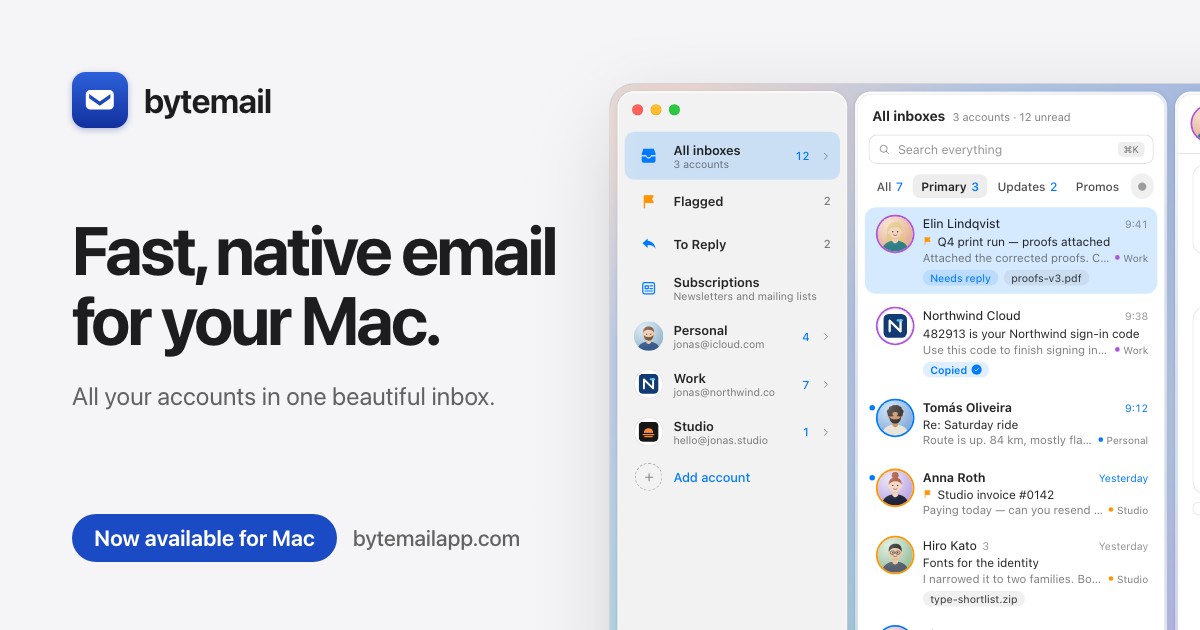

User reviews (0)