Website profiles · Technology insights · Alternatives

cerbos.dev

End-to-end access control for Zero Trust environments and AI systems. Enforce fine grained contextual authorization in every layer of the software you build

Paid content
Visit website
Profile views 10 Outbound visits 2 Normal
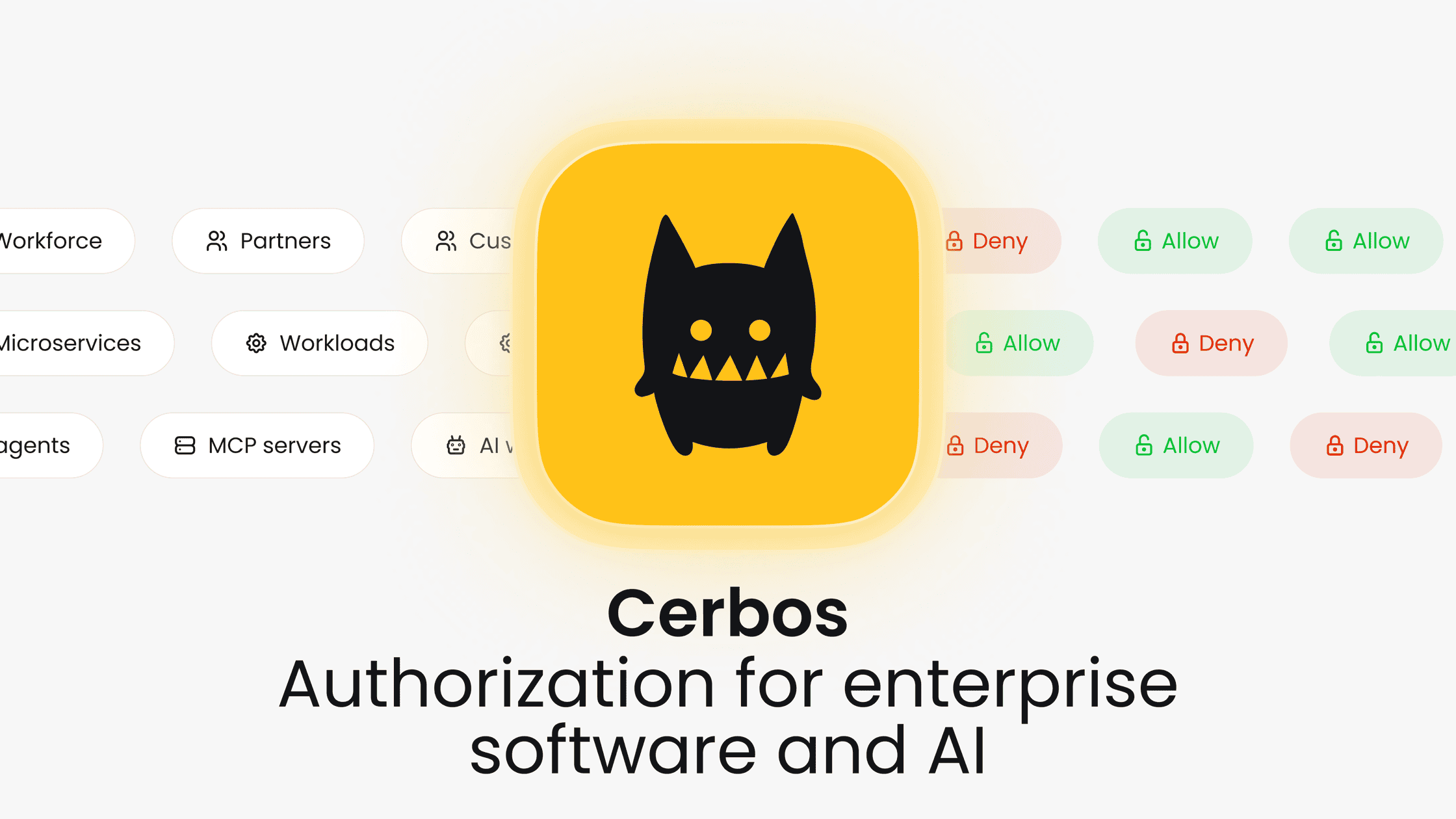
Cerbos Full homepage screenshot

At a glance

Category
Business Services
Language
English
Paid-content signal
Paid contentObserved
Registered
2021
Hosting
VercelInferred
HTTPS certificate trusted
PassedObserved
Last updated

Website review

This review may include AI-generated content and is not individually verified. Domain, certificate and other facts come from the observed data on this page.

What is Cerbos?

Cerbos is an authorization management platform: it decides what an already-authenticated identity is allowed to do, at the moment of the request, rather than leaving that logic scattered across application code.

What it does

  • Centralizes authorization policy so teams define, approve, and update rules in one place instead of duplicating if statements across services.
  • Supports common policy models out of the box, including RBAC, ABAC, ReBAC, and PBAC.
  • Enforces decisions across applications, gateways, workloads, and AI agents, and logs each decision (who, what, when, which policy) for audit purposes.
  • Deploys statelessly in cloud, on-premises, or air-gapped environments, and is described as handling millions of decisions per second across distributed systems.

Where it fits in a stack

Cerbos positions itself as the runtime layer that complements an identity provider (which authenticates) and an identity governance tool (which provisions roles). It answers the resource-level question: given this identity, this resource, and this context, is this action allowed right now?

A notable emphasis is AI agents. Because agents often act on behalf of users through interfaces like MCP clients, the originating identity can be obscured and agents can inherit permissions they should not have. Cerbos frames its value as defining agent boundaries before launch and revoking access through policy changes rather than credential rotation.

Who it is for

Engineering and platform teams who need fine-grained, contextual authorization without rebuilding it per service, plus security and compliance stakeholders who need visibility and audit evidence for frameworks such as SOC 2, ISO 27001, HIPAA, GDPR, NIS2, DORA, and FedRAMP.

A practical next step

If you are evaluating it, pick one real authorization decision in your system — for example, a support agent viewing a customer record, or an AI agent calling an internal API — and ask whether your current code can change that rule without a deploy, and whether you can produce a log of the decision afterwards. Those two questions usually reveal quickly whether a dedicated authorization layer is worth adopting. You can compare approaches on Cerbos.

How does Cerbos improve security for AI agents and MCP clients?

Cerbos addresses the authorization gap that appears after login: it decides what an identity may actually do at the resource level, at runtime. For AI agents and MCP clients, that means defining boundaries before they go live and keeping those boundaries enforceable in policy rather than in scattered application code.

Concrete mechanisms described on the page

  • Predefined agent boundaries: policies define what each AI agent or MCP client can access before deployment, so permissions are explicit rather than inherited by default.
  • Fast revocation via policy: access can be revoked in seconds by changing policy, without rotating credentials or restarting systems.
  • Visibility into agent actions: every decision is logged with who, what, when and which policy applied, so you can see what an agent can access and what it actually did.
  • Centralized policy control: authorization logic lives in one place and is updated without code changes; RBAC, ABAC, ReBAC and PBAC are supported.
  • Identity-type coverage: policies apply across users, service accounts, non-human identities (NHIs) and AI agents in one model.

Why this matters for MCP clients specifically

The page frames the problem as agents acting on behalf of users through MCP clients and other interfaces, which blurs who initiated an action. If the system cannot distinguish the agent from the user, the agent can inherit permissions it should never have. Cerbos's approach is to treat the agent as its own identity with its own policy, so the authorization decision is made per request instead of being baked into a long-lived token.

A practical scenario

A support agent uses an MCP client to query customer records. With policy-based authorization, you can allow read access to a limited field set, deny bulk export, and log each decision. If the agent's behavior changes or a vulnerability is found, you revoke the specific permission through policy and the next request is denied, rather than waiting for token expiry.

Decision criteria

Choose this pattern when you need runtime, per-action control over non-human identities and audit evidence for compliance frameworks such as SOC 2, ISO 27001, HIPAA, GDPR, NIS2, DORA or FedRAMP, as listed on the page. If your agents only need coarse, long-lived access and you already have adequate token scoping, the added policy layer may be unnecessary overhead.

Next step: map one AI agent or MCP client to the exact resources it needs, write that as a policy, and test revocation before production. Compare with Cerbos if you want to see how the policy model fits your stack.

Can Cerbos integrate with existing identity providers and IGA systems?

Yes — Cerbos is designed to sit alongside your existing identity providers (IdPs) and identity governance and administration (IGA) systems rather than replace them. Its own framing is that your IdP authenticates and your IGA provisions roles, while Cerbos controls what identities can actually do at the resource level at runtime. The Cerbos page describes it as "closing the gap in your IAM stack," handling authorization decisions after login.

What that division of labor means in practice

Layer Typical owner What it answers
Authentication Your IdP Who is this user or service?
Role provisioning Your IGA What roles or entitlements were granted?
Runtime authorization Cerbos Can this specific identity perform this specific action on this specific resource, right now?

Cerbos supports RBAC, ABAC, ReBAC and PBAC out of the box, so it can consume the roles and attributes your IdP/IGA already emits and add contextual rules on top — for example, time of day, resource ownership, or whether the request comes from a human or an AI agent. Policies are defined centrally and deployed without code changes, and the engine is described as stateless, deployable in cloud, on-prem or air-gapped environments.

A concrete scenario

A platform team already uses an IdP for SSO and an IGA tool to assign roles. They add Cerbos so that a support engineer's "admin" role does not automatically mean write access to every customer record — the policy can require the record to belong to their assigned region. When an AI agent acts on that engineer's behalf, Cerbos can evaluate the agent's own boundaries separately, and access can be revoked through a policy change in seconds rather than by rotating credentials.

How to decide

  • If your pain is scattered if statements and inconsistent permission logic across services, Cerbos is aimed squarely at that.
  • If your pain is purely provisioning joiner/mover/leaver workflows, your IGA tool likely already covers it; Cerbos complements rather than replaces it.
  • If you need per-action revocation for AI agents or service accounts, that is a specific gap the page claims to address.

Next step

Review your current IdP and IGA outputs — the roles, groups and attributes they can pass in a token or API call — then check the Cerbos documentation for how those map into policy inputs. If your IdP cannot emit the attributes your policies need, that gap is worth resolving before rollout.

What are the pricing options for Cerbos?

Cerbos does not publish its prices on the page we have. The site presents a "Book a demo" path and links to a Pricing page, which is where current commercial terms would live. Treat any figure you see elsewhere as unverified.

What that usually means

  • The vendor likely quotes per deployment, per authorization volume, or per support tier, rather than a flat self-serve price.
  • Because Cerbos can run stateless in cloud, on-prem, or air-gapped environments, an air-gapped or self-hosted enterprise deal will almost always be quoted separately from a hosted one.
  • The page emphasizes scale (millions of decisions per second) and compliance evidence (SOC 2, ISO 27001, HIPAA, GDPR, NIS2, DORA, FedRAMP), which are the kinds of requirements that push buyers toward a negotiated enterprise agreement rather than a public list price.

Practical next step

Before you contact them, write down three numbers: your peak authorization decisions per second, how many distinct policy sets or teams you need to govern, and whether you need self-hosted or air-gapped deployment. Those three answers determine which pricing shape applies to you. If your volume is small and your deployment is standard, ask specifically whether a lower-cost entry tier exists; if you need air-gapped or FedRAMP-relevant controls, expect a custom contract.

For comparison, authorization tools in this category generally sit alongside identity providers rather than replacing them, so it helps to check what your existing IdP already includes before paying for a separate layer.

How does Cerbos handle authorization at scale in distributed systems?

Cerbos is built to keep authorization decisions fast and consistent even when they are needed across many services rather than in one central application. The core idea is to move policy out of scattered application code and into a policy layer that services query at runtime.

Cerbos describes the model as stateless and capable of handling millions of authorization decisions per second across distributed systems and AI agents. Policies are defined, approved and updated centrally, while enforcement happens where the request occurs: applications, gateways, workloads or AI agents. That separation matters at scale because a service doesn't need to ship a new deployment every time a role or permission changes; it calls the authorization layer and gets an allow or deny decision.

What this looks like in practice

A platform team running dozens of microservices can centralize rules for users, service accounts, non-human identities and AI agents. Each service asks "can this identity perform this action on this resource?" and Cerbos evaluates the policy. The page notes support for RBAC, ABAC, ReBAC and PBAC, so teams can combine role checks with attributes such as department, resource owner or request context.

For distributed systems, the operational benefits are:

  • Consistent decisions — the same policy applies whether the request arrives through an API gateway, a backend service or an AI agent.
  • No code redeploys for permission changes — policies are updated centrally and take effect without changing application code.
  • Deployment flexibility — stateless deployment in cloud, on-prem or air-gapped environments.
  • Auditability — every decision can be logged with who, what, when and which policy applied, which helps with compliance frameworks such as SOC 2, ISO 27001, HIPAA, GDPR, NIS2, DORA and FedRAMP.

Where it fits and where it doesn't

Cerbos is not an identity provider or a provisioning system. The page frames it as closing the gap in an IAM stack: the IdP authenticates, IGA provisions roles, and Cerbos controls what identities actually do at the resource level at runtime. If your problem is login or user lifecycle management, this is complementary rather than a replacement.

For a concrete scenario: a fintech with a customer-facing API, internal admin tools and a new AI agent that reads support tickets. Instead of hard-coding permission checks in each service, the team writes policies that say which agent can read which ticket categories and which human roles can export data. When the agent's scope changes, they update the policy rather than redeploying every service. If an agent behaves unexpectedly, access can be revoked through policy in seconds rather than waiting for credential rotation.

Next step

List the authorization decisions your services currently make in code, then identify which ones change often or differ by context. Those are the best candidates to move into a centralized policy layer first.

How does Cerbos help with compliance and auditing?

Cerbos addresses compliance and auditing by making every authorization decision observable and centrally governed, rather than leaving access logic scattered across application code. According to the product page, it logs each decision with the who, what, when and which policy involved, and the platform is described as audit-ready for frameworks including SOC 2, ISO 27001, HIPAA, GDPR, NIS2, DORA and FedRAMP.

What that means in practice

  • Decision-level audit trail — Instead of reconstructing access events after an incident, teams can point auditors to a record of each authorization decision and the policy that produced it.
  • Centralized policy control — Policies are defined, approved and updated in one place, so there is a single source of truth for what any identity is allowed to do. That is easier to evidence during a review than per-service if-statements.
  • Runtime enforcement after login — Cerbos positions itself as the layer that controls what identities actually do at the resource level, complementing an IdP that authenticates and an IGA tool that provisions roles.
  • Coverage of non-human identities — The page says policies apply across users, service accounts, non-human identities and AI agents, which matters for audits that now ask about machine and agent access.

A concrete scenario

A platform team running a healthcare workload needs to show an auditor that only specific roles can read patient records, and that an AI agent acting on a clinician's behalf cannot exceed that clinician's scope. With policy centralized and each decision logged, the team can answer "who could access this, and under which policy?" without instrumenting every service separately.

Practical considerations

  • Logging every decision is only useful if you plan retention, review cadence and alerting around it; volume grows quickly at high decision rates.
  • The compliance frameworks named on the page describe positioning, not a certification you can assume. Verify current attestations and reports directly with the vendor before relying on them in a procurement or audit context.
  • Decide early whether you need cloud, on-prem or air-gapped deployment, since that affects how audit data is stored and who can access it.

Next step

Map your current audit obligations to the specific decisions you cannot currently reconstruct. If the gaps cluster around runtime resource access or AI agent permissions, that is where a centralized authorization layer adds the most compliance value. Start with Cerbos to see how its policy model and decision logs would fit your stack, and confirm the certification details that matter to your auditors.

Related questions

More questions →
How does Cerbos help with compliance and access visibility?

Cerbos helps with compliance and access visibility by centralizing authorization logic and logging every access decision, so you can see who can access what and prove it during an audit. According to Cerbos, it provides "instant logs for every decision: who, what, when, which policy" and is "audit-ready for SOC 2, ISO 27001, HIPAA, GDPR, NIS2, DORA, FedRAMP." This applies if your authorization decisions run through Cerbos; it is not a standalone compliance certification or a replacement for your identity provider or governance tooling.

Access visibility: seeing what every identity can access

Cerbos is positioned to give "full visibility into what every identity can access." The problem it targets is scattered authorization logic: when permission checks are written as if-statements across many services, no single place shows the full picture, creating blind spots.

Cerbos addresses this by letting you "define, approve, and update policies centrally." Instead of embedding authorization rules in application code, you replace them with a single function call to Cerbos. The practical effect for visibility:

  • Authorization logic lives in one place rather than being duplicated per service.
  • You can review what a given identity is allowed to do by reading the policy, not by tracing code paths.
  • Coverage extends across identity types — users, service accounts, non-human identities (NHIs), and AI agents — managed "in one place."

This matters especially for AI agents, which Cerbos notes "act on behalf of users through MCP clients and other interfaces, masking who initiated the action." Centralized policy plus decision logging is how Cerbos makes that activity visible rather than inherited and invisible.

Decision logs: the audit trail

The core compliance mechanism is per-decision logging. Cerbos states you get "instant logs for every decision: who, what, when, which policy." Each authorization decision produces a record covering:

Field What it captures
Who The identity making the request
What The action or resource being accessed
When The time of the decision
Which policy The policy that produced the allow/deny result

Because every decision is evaluated against a named policy, the log ties an outcome back to a specific, reviewable rule. That is what makes the trail useful for auditors: you can show not just that access happened, but which policy permitted or denied it.

Compliance frameworks Cerbos says it supports

Cerbos describes itself as "audit-ready" for the following frameworks:

  • SOC 2
  • ISO 27001
  • HIPAA
  • GDPR
  • NIS2
  • DORA
  • FedRAMP

"Audit-ready" here means Cerbos produces the decision logs and centralized policy records that these audits typically ask for. It does not mean Cerbos certifies your organization — you still need your own controls, processes, and evidence. Treat the framework list as the set of audit contexts Cerbos is designed to feed evidence into, not as a guarantee of compliance.

How this fits your existing IAM stack

Cerbos is explicit that it fills a specific gap rather than replacing your existing tools:

  • Your IdP authenticates (establishes who the identity is).
  • Your IGA provisions roles (assigns entitlements).
  • Cerbos "controls what identities actually do at the resource level, at runtime."

So compliance and visibility from Cerbos cover the runtime authorization layer — the decisions made after login. If your audit questions are about authentication or role provisioning, those come from your IdP and IGA; Cerbos supplies the resource-level decision record.

Where the visibility payoff is largest

The scenarios Cerbos highlights are the ones where blind spots are most costly:

  • Over-permissioned access — agents and services "can do more than they should," and one mistake can expose data or trigger unauthorized actions.
  • AI agents blurring identity lines — when the system can't distinguish an agent from the user it acts for, the agent "inherits permissions they should never have."
  • Standing access that never expires — long-lived tokens and shared credentials stay valid longer than needed.
  • No fine-grained kill switch — without per-action revocation, access continues until credentials are rotated or systems restarted.

Centralized policy plus decision logging is what turns each of these from an invisible risk into something you can see and, where policy allows, revoke "in seconds through policy."

What to verify before relying on it for an audit

  • Confirm that the decisions you care about actually route through Cerbos — decisions made outside it won't appear in the logs.
  • Check that your policy set is complete; visibility is only as good as the policies you've defined and approved.
  • Match the framework list to your specific audit scope and confirm with your auditor which Cerbos outputs satisfy which evidence requirements.
  • Remember that Cerbos covers runtime authorization; authentication and provisioning evidence still comes from your IdP and IGA.

For pricing, deployment specifics, and current capabilities, see the Cerbos site and its pricing page, since those details are not covered here.

How Cerbos Fits Into an Existing IAM Stack

Cerbos is a runtime authorization layer that sits after authentication and role provisioning. Your identity provider (IdP) confirms who a user is, and your identity governance and administration (IGA) tool assigns roles — but neither decides, at the moment of a request, whether this specific identity can perform this specific action on this specific resource. Cerbos fills that gap: it evaluates fine-grained, contextual policies at runtime and returns an allow/deny decision for every access request across applications, gateways, workloads, and AI agents. It's a fit if you already have authentication and role provisioning in place but still find authorization logic scattered across services as if-statements, or if you need to govern non-human identities and AI agents alongside users.

The three layers, and where Cerbos sits

Cerbos describes its position in the IAM stack with a simple division of labor:

Layer Responsibility Example question it answers
IdP Authentication Who is this user?
IGA Provisioning roles What role has been assigned?
Cerbos Runtime resource-level authorization What can this identity actually do, right now, on this resource?

The key distinction is after login. Authentication and role assignment are necessary but not sufficient — Cerbos controls what happens once an identity is already inside, deciding each action at the resource level rather than relying on a static role that may over-permit.

What Cerbos replaces

In many systems, authorization logic lives inside application code as scattered conditional statements. Each service re-implements its own rules, which creates blind spots: no single view of who can access what, and no consistent way to audit or change a decision.

Cerbos replaces that pattern with a single function call against centrally defined policies. Policies are defined, approved, and updated in one place, and roles and permissions can be deployed without code changes. The platform supports RBAC, ABAC, ReBAC, and PBAC out of the box, so you can express rules based on roles, attributes, relationships, or policy conditions as your requirements demand.

What you gain operationally

  • Visibility and governance — See and govern every access decision, with full visibility into what each identity can access, instead of scattered logic creating blind spots.
  • Audit-ready logs — Every decision produces a log recording who, what, when, and which policy applied. Cerbos states this supports audit readiness for SOC 2, ISO 27001, HIPAA, GDPR, NIS2, DORA, and FedRAMP.
  • Scale and deployment flexibility — The engine is stateless and handles millions of authorization decisions per second across distributed systems. It can be deployed in cloud, on-prem, or air-gapped environments.
  • Faster delivery — Because policies are decoupled from application code, roles and permissions ship without code changes.

Governing identities beyond human users

A conventional IAM stack is built around human users. Cerbos extends the same centralized policy model to service accounts, non-human identities (NHIs), and AI agents — managing access across the entire identity fabric in one place.

This matters because AI agents introduce authorization problems that traditional IAM handles poorly:

  • Over-permissioned access — Agents and services can do more than they should, so a single mistake can expose sensitive data or trigger unauthorized actions.
  • Blurred identity lines — Agents act on behalf of users through MCP clients and other interfaces, masking who initiated an action. When the system can't distinguish them, agents inherit permissions they should never have.
  • Standing access that never expires — Long-lived tokens and shared credentials remain valid long after they're needed, increasing compromise risk.
  • No fine-grained kill switch — If an agent exceeds its scope, access typically continues until someone rotates credentials or restarts systems, with no way to revoke a single action in seconds.

Cerbos addresses these by letting you define AI agent and MCP boundaries before they go live, and revoke access in seconds through policy — so you always know exactly what each agent can access.

How to decide whether it fits your stack

Cerbos is likely a fit if:

  • You have authentication (IdP) and role provisioning (IGA) in place, but authorization decisions are still hardcoded or duplicated across services.
  • You need resource-level, contextual decisions at runtime rather than static role checks.
  • You must govern service accounts, NHIs, or AI agents with the same rigor as human users.
  • You need per-decision audit logs for compliance frameworks.
  • You want to change permissions without redeploying application code.

It may be less of a fit if your authorization needs are trivial and fully satisfied by role claims already issued at login, or if you have no requirement to govern non-human identities.

To evaluate it against your own environment, the site offers a demo booking path and a "See how Cerbos works for your team" entry point; pricing details are available on the Cerbos pricing page.

What Is Cerbos and What Does It Do?

Cerbos is an authorization management platform for enterprise software and AI systems. It answers the question that comes after login: not "who is this user?" but "what is this identity actually allowed to do, right now, to this specific resource?" It enforces fine-grained, contextual, and continuous authorization across applications, gateways, workloads, and AI agents — and it does so from a single set of centrally managed policies rather than scattered code.

If you already have an identity provider handling authentication and an IGA tool provisioning roles, Cerbos fills the runtime gap between them: it controls what identities do at the resource level while requests are happening.

The problem Cerbos addresses

Authentication tells you an identity is who it claims to be. It does not tell you whether that identity should be able to read a particular record, call a particular endpoint, or have an AI agent act on its behalf. Cerbos frames this as the authorization gap, and highlights four failure modes it is built to close:

  • Over-permissioned access — agents and services can do more than they should, so a single mistake can expose sensitive data or trigger unauthorized actions.
  • Blurred identity lines — AI agents act on behalf of users through MCP clients and other interfaces, masking who initiated an action. When the system can't tell them apart, agents inherit permissions they should never have.
  • Standing access that never expires — long-lived tokens and shared credentials stay valid long after they're needed, increasing compromise risk.
  • No fine-grained kill switch — if an agent exceeds its scope, access continues until someone rotates credentials or restarts systems, instead of being revoked in seconds.

What Cerbos actually does

Centralizes authorization logic

Instead of scattering if statements across services, you define, approve, and update policies centrally and replace that logic with a single function call. Cerbos supports RBAC, ABAC, ReBAC, and PBAC out of the box, and its materials state you can deploy roles and permissions without code changes.

Governs every identity type

Policies cover users, service accounts, non-human identities (NHIs), and AI agents in one place, so the same control plane manages access across your identity fabric.

Secures AI agents with guardrails

You define what each AI agent can access before it goes live, and revoke that access in seconds through policy if something changes. This is the "define boundaries before launch, revoke after" model rather than relying on credential rotation.

Provides visibility and audit evidence

Cerbos logs every decision — who, what, when, and which policy — so you can see what every identity can access and produce audit-ready records. Its materials cite alignment with SOC 2, ISO 27001, HIPAA, GDPR, NIS2, DORA, and FedRAMP.

Scales across architectures

It handles millions of authorization decisions per second across distributed systems and AI agents, is stateless, and can be deployed in cloud, on-prem, or air-gapped environments.

Where it fits in your stack

Layer Responsibility Example tool
Authentication Verifies identity Your IdP
Role provisioning Assigns roles Your IGA
Authorization (runtime) Controls what identities do at the resource level Cerbos

Cerbos positions itself explicitly as the layer that closes the gap in an existing IAM stack, not a replacement for the IdP or IGA you already run.

When Cerbos is a fit

Cerbos is worth evaluating if you recognize one or more of these conditions:

  • Authorization logic is duplicated across services and creating blind spots.
  • You are deploying AI agents or MCP-based integrations and need to bound what they can reach before launch.
  • You need a fast, policy-driven way to revoke a single agent's or service's access without rotating credentials.
  • You need per-decision audit logs to satisfy compliance frameworks.
  • You run distributed or air-gapped infrastructure and need authorization that scales independently of your application code.

If your needs stop at authentication and coarse role assignment, the runtime layer Cerbos targets may be more than you need.

Getting started

The site offers a demo booking path and a "Try Cerbos" option for hands-on evaluation. Pricing is published on a dedicated pricing page, so check that page directly for current tiers and terms rather than assuming a free or self-serve tier.

How Cerbos Controls AI Agent Access

Cerbos controls AI agent access by letting you define an agent's boundaries and MCP scope before it goes live, then enforcing those boundaries at runtime through centralized policy. If an agent goes out of scope, you revoke its access in seconds by changing policy rather than rotating credentials or restarting systems. This applies to teams running AI agents or MCP clients that act on behalf of users and need a runtime authorization layer on top of their existing identity provider.

The problem Cerbos is aimed at

Cerbos frames authorization as the gap that authentication and role provisioning leave open. Your identity provider (IdP) authenticates an identity; your identity governance (IGA) tool provisions roles. Neither controls what an identity actually does at the resource level, at runtime. For AI agents, four specific failure modes make that gap worse:

  • Over-permissioned access — agents and services can do more than they should, so one mistake can expose sensitive data or trigger unauthorized actions.
  • Blurred identity lines — agents act on behalf of users through MCP clients and other interfaces, masking who initiated the action. When the system can't tell them apart, agents inherit permissions they should never have.
  • Standing access that never expires — long-lived tokens and shared credentials stay valid long after they are needed, increasing the chance of compromise.
  • No fine-grained kill switch — if an agent goes beyond its scope, access continues until someone rotates credentials or restarts systems. There is no way to revoke a single action in seconds.

How the control actually works

Define boundaries before the agent goes live

You define what each AI agent can access before it is deployed, including AI agent and MCP boundaries. Policies are defined, approved, and updated centrally, replacing scattered authorization logic with a single function call. This is the point where you decide scope rather than discovering it after the fact.

Enforce contextual authorization at runtime

Cerbos enforces fine-grained, contextual, and continuous authorization across applications, gateways, workloads, and AI agents. Because policy is evaluated per decision, the agent's access is checked against current policy each time — not granted once and trusted indefinitely.

Revoke through policy, in seconds

If an agent goes beyond its scope, you revoke access in seconds through policy. You do not need to rotate credentials or restart systems to cut off a single action. This is the kill-switch capability the product positions against standing access.

See and govern every decision

Every decision produces a log: who, what, when, and which policy. That gives you full visibility into what every identity can access and what every agent can access, and it supports audit readiness for frameworks including SOC 2, ISO 27001, HIPAA, GDPR, NIS2, DORA, and FedRAMP.

Where it sits in your stack

Cerbos is not a replacement for your IdP or your IGA tool. The division of labor is:

Layer Responsibility
IdP Authenticates the identity
IGA Provisions roles
Cerbos Controls what identities actually do at the resource level, at runtime

It manages access across users, service accounts, non-human identities (NHIs), and AI agents in one place, with centralized policies for the whole identity fabric. Supported models include RBAC, ABAC, ReBAC, and PBAC out of the box, and roles and permissions can be deployed without code changes.

Operational characteristics to weigh

  • Scale: handles millions of authorization decisions per second across distributed systems and AI agents.
  • Stateless: designed to be stateless, which matters for distributed enforcement points.
  • Deployment: cloud, on-prem, or air-gapped.
  • Time to ship: the product claims authorization can ship in one sprint, since policy changes don't require code changes.

When this fits and when it doesn't

Cerbos is a reasonable fit if you already have authentication and role provisioning in place but lack runtime, resource-level control — especially if you are deploying AI agents or MCP clients that act on behalf of users and you need a fast way to revoke a single agent's access. It is less relevant if you have not yet solved authentication or role provisioning, since Cerbos explicitly positions itself as closing the gap in an existing IAM stack rather than replacing it.

For current pricing and plan details, check the pricing page at https://www.cerbos.dev/pricing, since the available material does not specify cost or access terms.

What authorization models and deployment options does Cerbos support?

Cerbos supports RBAC, ABAC, ReBAC, and PBAC out of the box, and it can be deployed in cloud, on-prem, or air-gapped environments. Its stateless architecture is designed to handle millions of authorization decisions per second across distributed systems and AI agents. If you need to centralize authorization logic without changing application code, Cerbos covers both the model and deployment side.

Authorization models supported

Cerbos describes its policy engine as supporting four common authorization models out of the box:

Model What it decides on Typical use
RBAC (Role-Based Access Control) The role assigned to an identity Standard employee or service-account permissions
ABAC (Attribute-Based Access Control) Attributes of the identity, resource, or context Contextual rules such as department, region, or resource state
ReBAC (Relationship-Based Access Control) Relationships between identities and resources Ownership, sharing, and hierarchy-based access
PBAC (Policy-Based Access Control) Centralized policy definitions Governing many resource types under one policy set

The platform positions these as a replacement for scattered if-statements: you define, approve, and update policies centrally, then call a single function from your application to get an authorization decision. According to the site, roles and permissions can be deployed without code changes, and authorization can be shipped in one sprint.

Deployment options

Cerbos lists three deployment environments:

  • Cloud — managed deployment for teams that don't want to run the authorization service themselves.
  • On-prem — self-hosted within your own infrastructure.
  • Air-gapped — isolated environments with no external network access, for high-security or regulated settings.

The architecture is stateless, which is what allows it to scale horizontally across distributed systems and AI agents. Cerbos claims it can handle millions of authorization decisions per second in this configuration.

What this means in practice

If you're evaluating Cerbos against your existing stack, the relevant questions are:

  1. Do you need more than roles? If your access rules depend on attributes, relationships, or centralized policy, Cerbos covers those models without you building a custom engine.
  2. Where must the decision run? Cloud, on-prem, and air-gapped are all listed, so regulated or isolated environments are in scope.
  3. How much traffic? The stateless design is aimed at high-volume, distributed authorization rather than a single monolithic app.

Cerbos also positions itself as filling the gap after authentication: your identity provider authenticates, your IGA provisions roles, and Cerbos controls what identities actually do at the resource level at runtime. That includes users, service accounts, non-human identities (NHIs), and AI agents.

Where to verify specifics

Pricing and plan details are not covered in the available page evidence, so check the Cerbos pricing page directly before assuming cost or licensing terms. For model-specific policy syntax and deployment configuration, the product documentation is the authoritative source.

Website Overview

Page metadata, canonical configuration and social previews work together to provide more consistent search and sharing presentation.

Domain and Registration

Transfer-protection status is present, helping reduce the risk of unauthorized domain transfers. The domain has about 5 years of registration history; its current configuration provides more context than age alone. The registrar is Squarespace Domains II LLC., a widely used domain service provider. The domain uses the common .dev extension, which is not an independent safety signal.

DNS and Email

Nameservers are provided by Google Cloud DNS, indicating managed DNS hosting. MX records point to the Google Workspace email service. DNSSEC is enabled, allowing validating resolvers to authenticate signed DNS data. SPF and DMARC are configured. DKIM status is unknown. The lowest observed DNS TTL is 300 seconds.

TLS and Certificates

The certificate uses an RSA 2048-bit public key, offering broad client compatibility. The server supplied a complete certificate chain. No organization name is present in the certificate; the available fields are consistent with domain validation. The certificate was issued by Let's Encrypt, commonly associated with automated certificate services. The certificate's total validity is about 89 days, consistent with a short renewal cycle.

HTTP and Browser Security

The response lacks these common security headers: Permissions-Policy. CORS permits any origin to read this response. This is common for public resources; sensitive responses need narrower handling. No X-Powered-By header was found, reducing one common source of backend fingerprinting information. No obvious internal addresses or debug information were found in the headers. The Server header contains the custom value Vercel.

Technology Stack Analysis

The public page identifies Next.js, Google Tag Manager, Vercel without precise versions, leaving fewer clues for version-specific scanning.

Search and Social Sharing

Twitter Card metadata is configured. JSON-LD includes Organization data, helping describe the organization as an entity. The title has 61 characters, within a common display range. A meta description is present, with 156 characters. The observed directives allow indexing and link following.

Hosting and Email

DNSGoogle Cloud DNS
HostingVercel
EmailGoogle Workspace
Approximate IP geolocation (inferred; a CDN or proxy may differ from the origin server) United States flagUnited States Inferred 66.33.60.193

Registration details

RDAP / WHOIS

RegistrarSquarespace Domains II LLC.
Registered2021-03-21
Expires2027-03-21
Domain statusclient delete prohibited、client transfer prohibited
Nameserversns-cloud-d1.googledomains.com、ns-cloud-d2.googledomains.com、ns-cloud-d3.googledomains.com、ns-cloud-d4.googledomains.com
DNSSECsigned

DNS records

DNS

TypeNameValueTTLPriority
Acname.vercel-dns.com66.33.60.193300—
Acname.vercel-dns.com76.76.21.241300—
MXcerbos.devaspmx.l.google.com144001
MXcerbos.devalt1.aspmx.l.google.com144005
MXcerbos.devalt2.aspmx.l.google.com144005
MXcerbos.devalt3.aspmx.l.google.com1440010
MXcerbos.devalt4.aspmx.l.google.com1440010
NScerbos.devns-cloud-d1.googledomains.com21600—
NScerbos.devns-cloud-d2.googledomains.com21600—
NScerbos.devns-cloud-d3.googledomains.com21600—
NScerbos.devns-cloud-d4.googledomains.com21600—
TXTcerbos.devv=spf1 include:20289770.spf10.hubspotemail.net include:_spf.google.com include:spf.zoho.com include:transmail.net -all14400—
CNAMEwww.cerbos.devcname.vercel-dns.com14400—
DScerbos.dev56296 8 2 f260eb40e01cf9ccb8d0dac3f0c6452067968e8de70ab0ce38ae28c6fe76cb061800—
DMARC_dmarc.cerbos.devv=DMARC1;p=reject;pct=100;rua=mailto:[email protected];ruf=mailto:[email protected]14400—

TLS and certificates

TLS / SSL

AssessmentNormal configuration
Supported protocolsTLSv1.2、TLSv1.3
Negotiated protocolTLSv1.3
Certificate subjectwww.cerbos.dev
IssuerLet's Encrypt
Valid until2026-11-15T00:32 · Remaining when checked: 47 days
Verification detailsCertificate trust: Passed · Hostname match: Passed

HTTP response headers

HTTP

HeaderValue
content-typetext/html; charset=utf-8
cache-controlpublic, max-age=0, must-revalidate
serverVercel
strict-transport-securitymax-age=63072000
content-security-policyframe-ancestors 'self' https://cms.cerbos.dev;
x-content-type-optionsnosniff
referrer-policystrict-origin-when-cross-origin
access-control-allow-origin*

Identified technologies

Next.jsGoogle Tag ManagerVercel

Pages, Search and Sharing

Meta descriptionEnd-to-end access control for Zero Trust environments and AI systems. Enforce fine grained contextual authorization in every layer of the software you build
Canonical URLhttps://www.cerbos.dev
LanguageEnglish (default)
Twitter Cardsummary_large_image
All bots 1 allowed · 1 disallowed
  • Allow/
  • Disallow/*?*utm_*

User reviews (0)

  • No reviews yet.