
 简体中文
简体中文 English
Website review
This review may include AI-generated content and is not individually verified. Domain, certificate and other facts come from the observed data on this page.
What is ClearML?
ClearML is an AI infrastructure platform aimed at organizations that need to run machine learning and generative AI workloads across their own hardware, the cloud, or a mix of both. Rather than being a single tool for building models, it is positioned as a three-layer system: an infrastructure control plane for managing GPU clusters, a development environment for training and testing models, and a deployment layer for running GenAI applications. The platform is marketed toward enterprise-scale operations, with the site citing adoption by over 2,100 organizations.
What each layer does
- Infrastructure Control Plane: Connects and manages GPU clusters whether they are on-premises, cloud-based, or hybrid. It includes multi-tenancy, role-based access control, quota management, and usage-based billing or chargebacks. A notable detail is support for fractional GPUs and priority-based job scheduling, which helps teams share expensive compute without idle capacity.
- AI Development Center: A workspace for developing, training, and testing models that can be accessed remotely, so data scientists are not tied to a specific machine.
- GenAI App Engine: Deploys large language models onto existing clusters. ClearML handles networking, authentication, and security, and the site describes launching GenAI workloads with a single click while a scheduler manages placement.
Who it is for
The primary audience is enterprise IT and platform teams who need to give multiple internal groups controlled access to shared GPUs, plus ML engineers who want a consistent workflow from experimentation to production. If your team is small and runs everything on a single cloud account with no need for quotas or tenant isolation, the governance features may be more than you need. If you are coordinating several teams, regions, or a hybrid estate, the control-plane approach addresses a real coordination problem.
A practical next step
Before committing, list the environments you actually need to connect (on-prem, AWS, Azure, GCP, hybrid) and check how ClearML handles each. Then decide whether your priority is cost control through fractional GPUs and chargebacks, or speed of GenAI deployment. The platform has a free tier and a demo request option, so a reasonable approach is to trial it against one real project with a defined budget and a small team, then evaluate whether the scheduling and access controls reduce manual coordination.
For context on the broader category, comparable platforms include Weights & Biases for experiment tracking and Kubeflow for Kubernetes-native ML pipelines.
How does ClearML help manage GPU clusters across on-premises, cloud, and hybrid environments?
ClearML approaches GPU management as an infrastructure control plane rather than a single training tool. Its stated role is to connect and manage GPU clusters across on-premises, cloud, or hybrid setups, then expose that capacity to AI teams through a governed layer. The core idea is that IT keeps control of the physical and cloud resources while data scientists and engineers get self-service access.
What the platform does
- Connects heterogeneous clusters. On-prem, cloud and hybrid GPU resources are managed through one control plane, so teams are not locked into a single environment.
- Provides one-click GPU-as-a-service. IT can offer GPU provisioning with minimal configuration, letting end users consume resources without handling cluster setup themselves.
- Shares capacity across teams. Quota management lets admins divide resources among projects and teams, while fractional GPUs allow dynamic allocation so smaller jobs do not monopolise a whole device.
- Schedules by priority. Jobs can be queued and scheduled across any cluster setup based on priority, which matters when demand exceeds available GPUs.
- Isolates tenants. Multi-tenancy provides separate networks and storage per tenant, reducing the risk of data leakage between teams or customers.
- Tracks usage for chargeback. Billing is usage-based, calculated from computing hours and storage, so internal teams or external customers can be charged back accurately.
Where it fits
This is most relevant to platform and MLOps teams in organisations that already have GPUs in more than one place, or that need to serve multiple internal teams from a shared pool. A research lab with a single on-prem cluster and one team has less to gain; a company running burst training in the cloud alongside an on-prem cluster, with several teams competing for capacity, is closer to the target case.
The trade-off is the usual one for a control plane: you gain visibility, quotas and scheduling, but you adopt another layer between users and their clusters. That layer needs to be configured and maintained, and its value depends on how much resource contention and governance pressure you actually have. The GenAI App Engine sits on top of the same infrastructure, deploying LLMs onto managed clusters with networking, authentication and security handled by the platform.
Next step
If you are evaluating it, list your current GPU sources, how many teams share them, and how you allocate capacity today. If the honest answer involves spreadsheets, manual cluster requests or idle GPUs, request a demo and ask specifically how quota, fractional GPU allocation and priority scheduling would map onto your existing clusters. Pricing details are available at ClearML.
Can ClearML streamline AI model development and training workflows?
Yes. ClearML is built around exactly that job: its platform is described as a three-layer solution that carries an AI workflow from development through production, with an AI Development Center for developing, training and testing models that teams can reach from anywhere, and an Infrastructure Control Plane that manages GPU clusters across on-premises, cloud and hybrid setups.
Where it helps most
- Compute access: teams get remote GPU access and one-click GPU provisioning rather than waiting on manual cluster setup.
- Scheduling: priority-based job scheduling runs on any cluster setup, so urgent training jobs can jump ahead of routine ones.
- Sharing and limits: quotas and dynamic fractional GPUs let admins split resources across projects and teams.
- Isolation and cost visibility: multi-tenancy keeps networks and storage separate per tenant, and usage-based chargebacks are calculated from compute hours and storage.
A concrete scenario. A platform team with an on-prem GPU cluster and burst cloud capacity could give each research group a tenant with a quota, let individual engineers launch training jobs remotely, and charge each group back by GPU hours consumed. That replaces a queue managed by email and spreadsheets with a governed, self-service setup.
Trade-offs to weigh. A three-layer platform is a commitment: someone has to own cluster integration, tenant and quota policy, and billing configuration. Smaller teams with a single cluster and no chargeback needs may find lighter experiment-tracking tooling sufficient. The GenAI App Engine is aimed at deploying LLMs onto your own clusters with networking, authentication and security handled for you, which matters if you must keep models in-house rather than calling a hosted API.
Next step: check whether your environment is Kubernetes-based and whether you need multi-tenant chargeback. If both are true, the infrastructure layer is where the value concentrates; if neither is, start with the development and training features alone. Pricing details are listed at ClearML.
How does ClearML simplify GenAI deployment and LLM management?
ClearML's GenAI App Engine is designed to take the operational friction out of getting LLMs onto your own compute. Rather than assembling networking, authentication, and security yourself, you deploy a workload onto a cluster you already control and let ClearML's scheduler place it. A single click launches the workload; the platform handles the surrounding plumbing. That is the core of the simplification: the model-serving layer sits on top of the same infrastructure you use for training, so you are not building a separate stack for GenAI.
What the platform takes off your plate
- Provisioning and placement: The Infrastructure Control Plane connects GPU clusters across on-premises, cloud, or hybrid setups, and priority-based scheduling assigns jobs to clusters. For GenAI, this means you are not hand-managing node allocation for each LLM deployment.
- Access and identity: ClearML manages networking and authentication for deployed apps, so exposing an internal LLM endpoint to the right users does not require bespoke gateway work.
- Multi-tenancy and isolation: Isolated networks and storage per tenant reduce the risk of one team's data or prompts leaking into another's environment — relevant when several business units share a GPU pool.
- Cost governance: Quota management, fractional GPUs, and usage-based chargebacks by compute hour and storage let admins cap sprawl instead of discovering it on the invoice.
Where the trade-off sits
The simplification is real but it is platform-shaped: you get easier deployment because ClearML assumes control of scheduling, identity, and resource policy. Teams that already run a mature Kubernetes and service-mesh stack may find overlap, and the value depends on how much of your compute you are willing to route through one control plane. It is also aimed at enterprise scale — the page cites 2,100+ organizations — so a solo developer with one GPU may find the machinery heavier than the problem.
A concrete scenario
An ML platform team supports three product groups, each wanting its own fine-tuned LLM behind an internal API. Using the control plane, the admin carves the shared GPU cluster into quotas, gives each group an isolated tenant, and lets each team launch its GenAI workload without filing an infrastructure ticket. Networking and auth are inherited from the platform, and monthly usage is charged back per group.
Next step
Before committing, list the deployment steps your team performs today — cluster access, ingress, auth, secrets, scaling — and check which of those ClearML absorbs for your environment. Compare it with your existing orchestration tooling, such as Kubernetes, and review the vendor's own pricing and deployment documentation at ClearML to confirm fit for your cluster topology.
What security and multi-tenancy features does ClearML offer for enterprise AI infrastructure?
ClearML's security and multi-tenancy story is aimed at IT and platform teams that need to give many internal groups access to shared GPU capacity without letting those groups see or affect each other. Based on the product page, the relevant features are:
- Secure multi-tenancy — isolated networks and storage per tenant, explicitly framed as eliminating the risk of data or information leakage between tenants.
- Role-based access control (RBAC) — built into the infrastructure control plane so administrators can scope who can do what.
- Billing and chargebacks — usage-based chargebacks calculated from computing hours and storage consumption, which supports cost accountability per team or project.
- Quota management — admins allocate and cap resources across multiple AI projects and teams.
- Dynamic fractional GPUs — lets administrators govern sprawling compute usage by splitting GPU capacity rather than handing out whole devices.
- Managed access for GenAI deployments — when deploying LLMs, ClearML handles networking, authentication and security, so teams don't wire those up themselves.
How to read this in practice. The multi-tenancy and RBAC features matter most when you have a central GPU cluster serving several business units, regulated data, or external customers. Isolation plus quotas plus chargebacks is the combination that makes a shared cluster politically workable: each team gets a boundary and a bill. If your setup is a single team on a dedicated cluster, RBAC and billing still help with audit trails, but tenant isolation buys you less.
A concrete scenario: an enterprise platform team runs an on-prem Kubernetes cluster plus cloud burst capacity. They create a tenant per department, assign quotas, enable fractional GPUs so small experiments don't monopolize an A100, and turn on chargebacks so each department sees its monthly compute hours. Data science teams then self-serve from the AI Development Center without IT provisioning each environment by hand.
Next step: before committing, ask the vendor two questions — how tenant isolation is enforced (network and storage boundaries versus logical separation only) and whether RBAC and billing integrate with your existing identity provider and cost-allocation system. Those answers determine how much manual administration remains. You can compare tiers and deployment options at ClearML.
How does ClearML's pricing work for different enterprise needs?
ClearML does not publish a single flat rate for enterprise use. Its pricing page is the starting point, and the structure follows the platform's three layers: infrastructure control, AI development, and GenAI deployment. In practice, cost scales with how much of that stack you use and how many people and GPUs you connect.
ClearML
What typically drives the cost
- Compute connected to the control plane. The platform manages GPU clusters across on-premises, cloud, or hybrid environments, and billing features support usage-based chargebacks by computing hours and storage, so your spend tracks actual consumption rather than a fixed seat count.
- Users and tenants. Multi-tenancy and role-based access control mean pricing often reflects the number of teams or isolated tenants you provision, not just individual logins.
- Deployment scope. Using the GenAI App Engine to deploy LLMs onto your clusters adds a layer beyond classic ML training, which can change the commercial conversation.
How to match pricing to your enterprise need
| Enterprise need | What to ask about |
|---|---|
| Small ML team, existing cloud GPUs | Entry-level or free tier limits and whether cloud compute is billed separately |
| Multiple departments sharing clusters | Per-tenant or per-user pricing, quota management, chargeback setup |
| Regulated or air-gapped environment | Self-hosted or on-premises licensing and support terms |
| GenAI/LLM deployment at scale | Pricing for the app engine layer and managed networking/auth |
A practical next step
Before requesting a demo, list your GPU count, number of active users, and whether you need on-prem, cloud, or hybrid. That trio usually determines which pricing tier applies and prevents a vague quote. Review the official pricing page for current tiers, then ask specifically how compute hours and storage are metered.
 Amazon Route 53
 Cloudflare
 Google Workspace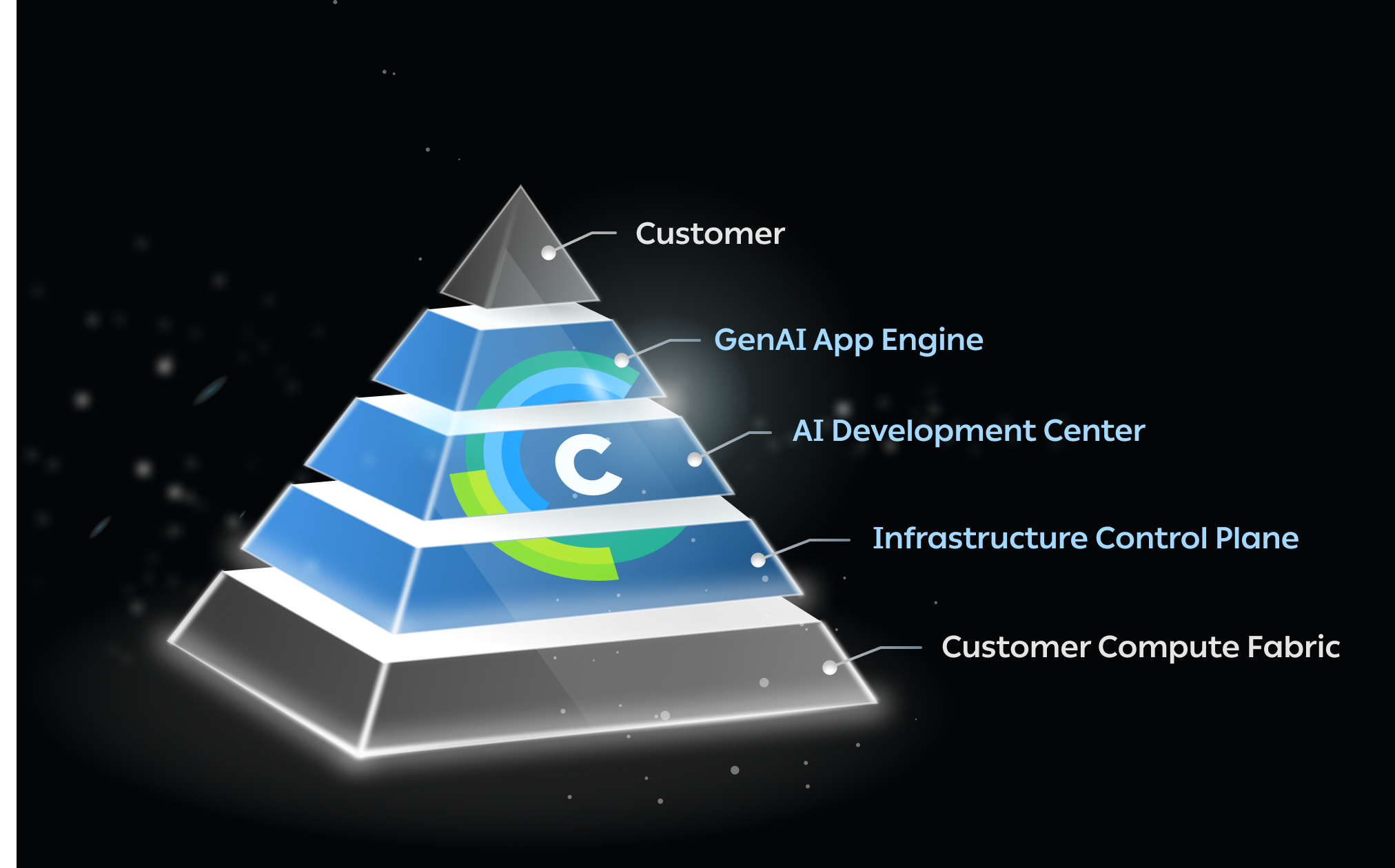
User reviews (0)