Website profiles · Technology insights · Alternatives

dfirdiva.com

Digital Forensics & Incident Response Blog Geared Toward Beginners. Free & Affordable Training Resources. DFIR, OSINT & Cybersecurity Community Events.

Paid content
Visit website
Profile views 2 Outbound visits 1 Normal
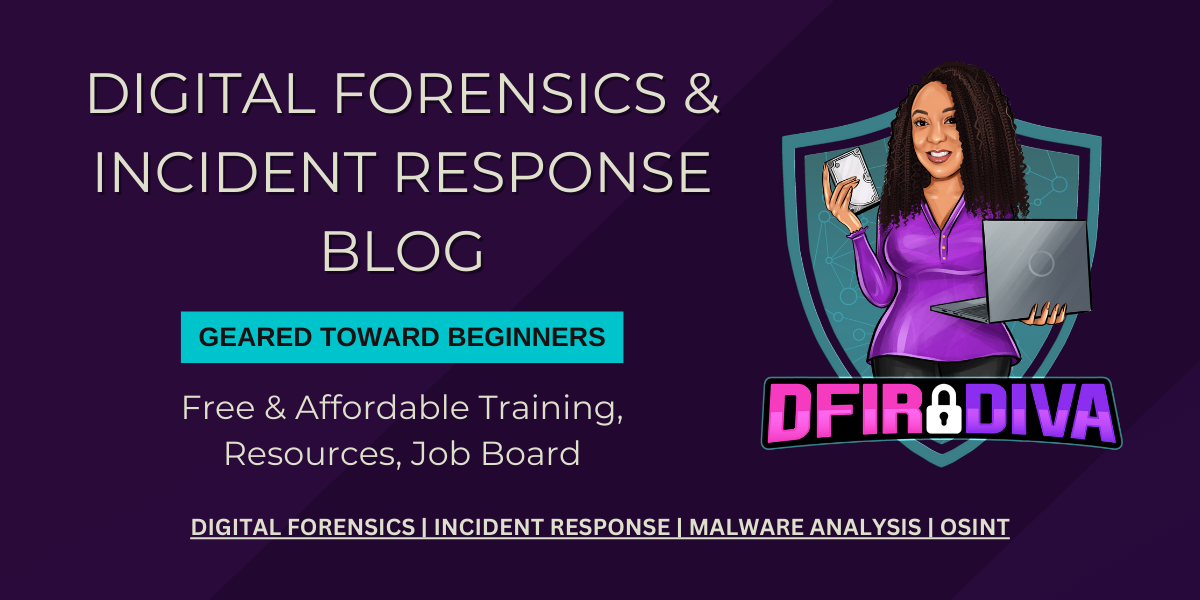
Digital Forensics & Incident Response Blog Geared Toward Beginners Full homepage screenshot

At a glance

Category
Social & Community
Language
English
Paid-content signal
Paid contentObserved
Registered
2020
Hosting
CloudflareInferred
HTTPS certificate trusted
PassedObserved
Last updated

Website review

This review may include AI-generated content and is not individually verified. Domain, certificate and other facts come from the observed data on this page.

What is DFIR Diva?

DFIR Diva is a beginner-focused blog and resource hub for digital forensics and incident response (DFIR), with related coverage of OSINT and broader cybersecurity. Its central promise is free and affordable training: the site catalogs over 500 training resources aimed at people starting from zero IT background through to working practitioners.

What you'll find on the site

  • A training directory — free and low-cost courses, labs, and certifications, organized with a DFIR/blue team emphasis.
  • A structured training plan — a step-by-step DFIR curriculum built from free online courses, explicitly sequenced from "complete beginner" to IT professional.
  • Community listings — events, new releases, discounts, giveaways, scholarships, and job postings, which readers can also submit.
  • Career guidance — advice on breaking into the DFIR field, with pointers to outside resources such as websites, videos, and courses.
  • Personal blog posts — first-person accounts of the author's own path into DFIR, home lab evolution, resume-building with lab experience, and a Trace Labs CTF experience that led to an OSINT interest.

Who it suits

The strongest fit is someone with little or no security background who wants a map rather than a single course: a help-desk technician, a student, or a career changer who needs to know what to study, in what order, and at what cost. Experienced analysts will find less depth here, though the community listings and conference notes can still be useful for staying current.

Trade-off to weigh

The site is a curated guide and personal blog, not a training provider. It points you toward courses, certifications, and labs run by other organizations rather than teaching the material itself, so your actual skill-building happens elsewhere. That's efficient if you want orientation and cost control, but it means progress depends on you following through on the linked resources.

A practical next step: start with the DFIR training plan page and the free/affordable training list, pick one beginner course, and pair it with a home lab project. Then use the resume-focused post to write up what you built — the site's own framing treats lab work as the bridge between coursework and hiring. For structured, hands-on practice alongside that plan, established options include TryHackMe and CyberDefenders.

How can I get started in digital forensics and incident response with no prior experience?

Start with a training plan, not a tool. Digital forensics and incident response (DFIR) rewards people who understand how systems normally behave, so the fastest route for a complete beginner is a structured sequence of free or low-cost courses, followed by small hands-on investigations you can talk about.

DFIR Diva is built around exactly that path. Its stated focus is free and affordable training, with a beginner-to-IT progression, a DFIR/incident response training plan assembled from free online courses, advice on entering the field, and community listings for events, scholarships and jobs. The blog also documents the author's own route into DFIR, including home-lab evolution and turning lab work into resume material.

A workable beginner sequence

  1. IT and networking fundamentals. Learn how operating systems, file systems, TCP/IP, DNS, authentication and logging work. Without this, forensic artifacts are just noise.
  2. Security basics. Understand common attacks, the incident response lifecycle (preparation, identification, containment, eradication, recovery, lessons learned) and where evidence fits in.
  3. Core DFIR skills. Disk and memory forensics, timeline analysis, log and network analysis, and basic malware triage. Practice on deliberately compromised images and challenge datasets rather than live systems.
  4. Hands-on repetition. Work through free labs and CTF-style challenges. Keep notes on what you examined, what you found, and how you reached the conclusion.
  5. Document and share. Write up one or two cases in a portfolio or blog. Hiring managers read reasoning, not tool menus.

Where to practise

Resource type Good for Trade-off
Free online courses and training lists Structured fundamentals at no cost Self-directed; no deadline or mentor
Hands-on labs and challenges Building artifact-recognition speed Often assume basic command-line comfort
Home lab Safe experimentation and resume stories Time and hardware cost; needs a clear goal
Community events and CTFs Feedback, networking, realistic pressure Irregular schedules; can be intimidating at first

For hands-on practice, TryHackMe offers guided, browser-based exercises that suit beginners, and CyberDefenders focuses on blue-team and DFIR challenges and labs. TCM Security provides entry-level security training and certifications, while Blue Cape Security concentrates on DFIR and blue-team training. Compare a few before committing money.

The part beginners underestimate

The author of DFIR Diva has written about moving a home lab from simple break-fix tinkering toward forensics, and about translating that lab experience into a resume — a practical reminder that employers want evidence of methodical thinking, not a list of tools. Treat every lab as a mini case: preserve the evidence, note your assumptions, validate findings from more than one artifact, and write a short report.

A realistic first step this week: pick one free introductory course, set up a virtual machine, and complete a single beginner forensic image exercise end to end. Then write half a page on what you did and what you would do differently. That habit compounds faster than collecting certificates.

What free or affordable DFIR training resources does DFIR Diva recommend?

DFIR Diva is a beginner-oriented directory and blog for digital forensics and incident response (DFIR), and its main free/affordable recommendation is its own curated training list: over 500 free and affordable training resources, sequenced from complete beginner through IT-level material. It also publishes a structured DFIR training plan built from free online courses, plus a "getting into the field" page that links out to outside courses, videos and websites rather than hosting the training itself.

What the site points beginners toward

  • Its own training index — the largest single resource on the site, aimed at people starting with no security background.
  • A free-course training plan — a suggested order of study rather than a random list, useful if you don't know what to learn first.
  • A "getting into DFIR" advice page — context on hiring expectations, alongside links to external resources.
  • Community listings — events, new releases, discounts, giveaways, scholarships and jobs, which is where genuinely cheap or no-cost options tend to surface.
  • Blog posts — personal accounts such as the author's own path into DFIR, home-lab evolution, and turning home-lab work into résumé material.

Where the actual training comes from

The site names partners and affiliates that provide the courses, labs and certifications: TryHackMe, CyberDefenders, TCM Security, Blue Cape Security, TrainSec, DFIR Sherlocks & Hacking Labs, and Humble Bundle bundles. Several of these are known for free tiers or low-cost introductory material, but treat the affiliate relationship as a signal to check each provider's current free offering yourself rather than assuming the DFIR Diva listing is neutral.

How to use it

Start with the training plan if you are pre-career, and use the training index as a menu once you know which area — endpoint forensics, network analysis, OSINT, malware — you want first. Pair it with one hands-on platform so you are practising, not only reading.

Two caveats worth knowing. First, the site is a signpost, not a course: the quality and cost live with the linked providers, and affiliate links mean the site may earn from referrals. Second, the free-resource landscape changes fast — free tiers close, platforms rebrand — so verify availability before committing a study schedule. For a second, independent view of beginner paths, TryHackMe and CyberDefenders publish their own learning tracks directly.

How can I build a home lab for digital forensics and incident response practice?

A home lab for DFIR practice doesn't need to be expensive or elaborate. The goal is to generate realistic artifacts you can investigate, then practice the process of collecting, examining, and reporting on them. Start with one host you can safely break and one place to store evidence.

Start with the basics

  • A virtualisation platform. Run everything in VMs so you can snapshot, infect, and revert freely. VirtualBox and VMware Workstation Player are common free choices; Proxmox or Hyper-V work if you want a dedicated machine.
  • An isolated network. Keep lab VMs on a host-only or internal network with no route to your home LAN. This prevents any malware or misconfiguration from reaching your real devices.
  • A target machine. A Windows VM is the usual starting point because most enterprise DFIR work involves Windows artifacts. Add a Linux VM later for variety.
  • An analysis machine. A separate VM (often Linux, such as SIFT or REMnux) for running forensic tools, away from the target.
  • Storage for evidence. Disk images and memory captures get large quickly. Plan for external storage or a dedicated drive, and keep a write blocker or use software write protection when imaging.

Generate activity worth investigating

A clean VM teaches you tooling but not analysis. Deliberately create artifacts:

  • Log in, browse, download files, plug in a USB device, and create documents so registry, browser, and file system artifacts exist.
  • Run harmless known test files, or use published malware samples only in a fully isolated environment, to practice memory and network analysis.
  • Take a memory capture and a disk image, then investigate what you just did.

Digital Forensics & Incident Response Blog Geared Toward Beginners is built around exactly this kind of self-directed learning. Its author documents a personal journey into DFIR, including an evolution of a home lab from break-fix work toward forensics and advice on turning home lab experience into resume material. The site also curates a large set of free and affordable training resources and a DFIR/OSINT community listings section for events, scholarships and jobs. Treat the training plan and resource lists as a map, then choose the path that matches your current level.

A practical first exercise

  1. Build a Windows VM and snapshot it clean.
  2. Perform a short scripted sequence: create a user, install software, open a browser, copy files to a USB drive.
  3. Image the disk and capture memory.
  4. Answer concrete questions: what accounts exist, what programs ran, what was on the USB drive, what network connections occurred.
  5. Write a short report with findings and timestamps.

Useful complements

  • TryHackMe offers guided, browser-based rooms that remove setup friction while you learn tooling.
  • CyberDefenders provides DFIR and blue team challenges with ready-made evidence, useful when you want to practice analysis without building every scenario yourself.
  • REMnux is a Linux toolkit distribution for malware and forensic analysis, handy as your analysis VM.

Trade-offs to weigh

A fully self-built lab teaches you imaging, isolation and troubleshooting, but costs time and disk space. Hosted challenge platforms get you analysing artifacts in minutes, but you don't control the environment or see how evidence was captured. Most beginners benefit from both: build a small local lab for the end-to-end process, and use hosted challenges to broaden exposure to artifact types and tools.

If you only do one thing, snapshot a Windows VM, perform a handful of actions, image it, and write up what you find. That single loop covers the core DFIR workflow and scales into more complex scenarios as you add memory analysis, network captures and Linux systems.

How do I incorporate home lab experience into my DFIR resume?

Home lab work counts as experience when you can show what you built, what data you worked with, and what you concluded. Hiring managers cannot visit your lab, so your resume has to translate it into evidence of analysis.

Turn lab work into resume bullets

Use the same structure as a real investigation: environment, action, artifact, finding.

  • Built a three-VM Windows and Linux lab to generate and analyze simulated intrusion traffic.
  • Captured and parsed network traffic with Wireshark and Zeek to identify beaconing patterns.
  • Created a timeline in Eric Zimmerman's tools from Windows event logs and MFT records.
  • Wrote up findings in a short incident report with indicators of compromise and recommendations.

Avoid wording like "learned Splunk" or "played with Volatility." Those describe study, not work. State the tool, the artifact, and the outcome.

Where it belongs on the page

A dedicated Home Lab / Projects section works well for career changers and students. If you already have professional experience, fold lab work into your main experience section only when it directly supports the role you are targeting, and keep the projects section shorter. For a first DFIR job, the projects section can sit above unrelated employment.

Make it verifiable

A blog write-up, GitHub repository, or conference lightning talk gives a reviewer something to check. One or two well-documented investigations beat ten half-finished ones. If you have written up a lab, link it at the top of the resume near your contact details.

A concrete reader scenario

Suppose you are an IT support technician applying for a SOC analyst role. Your resume lists "built home lab" under hobbies. Rewrite it as a project entry:

Home Lab: Ransomware Detection Deployed Windows 10 and Windows Server VMs with Sysmon and Splunk Free. Simulated file encryption using a benign test script, then built detection searches on process creation and file modification events. Documented two detection gaps and tuned one rule to reduce false positives.

That entry tells a reviewer you understand telemetry, detection logic, and documentation.

Practical next step

Pick your two strongest lab exercises, write each as three or four bullets using the environment-action-artifact-finding pattern, and cut everything that only describes what you studied. For guidance on framing home lab work and getting into the field, see DFIR Diva, which covers resume topics and entry paths. For hands-on blue team practice to generate that material, TryHackMe and CyberDefenders offer labs and challenges you can write up.

What DFIR, OSINT, and cybersecurity community events, jobs, or scholarships are listed on DFIR Diva?

The site points to a dedicated "DFIR & OSINT Community Listings" section, described as a place to find and submit events, new releases, discounts, giveaways, scholarships, and jobs. So the community listings page is the single hub for all of those categories: it is not just a blog, but a directory that accepts submissions from the community.

What each listing type is for

  • Events — conferences and meetups. A recent post highlights the Techno Security & Digital Forensics Conference (October 27–29, 2025, and October 20–22, 2026), which is the kind of entry you would expect here. The site also notes that "The Events Site is Being Rebuilt," so the events directory may be in transition.
  • Jobs — openings in DFIR, OSINT and adjacent security roles, useful if you are moving from IT into incident response.
  • Scholarships — funding toward training or certifications, aimed at people who cannot self-fund courses.
  • Discounts and giveaways — reduced training, bundles or free seats; the "Black Friday 2025 Edition" post shows this category is actively updated around sales periods.
  • New releases — books, tools, courses and labs worth knowing about.

Who this suits

A beginner weighing a career change into blue team or DFIR. Instead of hunting across many sites, you can scan one listings page for a free training discount, a scholarship deadline and an entry-level job in the same visit. The trade-off: because listings are community-submitted, quality and freshness vary, and you should verify dates, eligibility and legitimacy at the original source before applying or paying.

Practical next step

Open the community listings page first, filter for what you need right now (a scholarship, say, or an event near you), then cross-check the official organiser's page. For broader context on the field, the site's "Getting into the DFIR Field" page and its incident response training plan are useful companions, and you can compare training options at TryHackMe and CyberDefenders.

Related questions

More questions →
What is DFIR Diva (dfirdiva.com)?

DFIR Diva is a blog and resource hub for people who want to get into digital forensics and incident response (DFIR), especially those starting from zero IT or security background. It collects free and affordable training, community event and job listings, and practical advice on entering the field. If you are a beginner looking for a structured, low-cost path into DFIR or blue team work, it is worth bookmarking; if you need hands-on labs or certification exams themselves, it points you toward them rather than hosting them.

What the site actually offers

The homepage organizes its main content into four resource areas:

Resource What it covers
Free and affordable training Over 500 free and affordable training resources, focused on DFIR/blue team, from complete beginner to IT
DFIR & OSINT community listings Events, new releases, discounts, giveaways, scholarships, and jobs — with a way to submit your own
Getting into the DFIR field Advice on entering DFIR, plus links to other resources (websites, training, videos)
Incident response training plan A DFIR training plan built from free online courses, starting from complete beginner to IT

The training plan is the most structured piece: it sequences free online courses rather than dumping a list of links, which matters if you do not yet know what order to learn things in.

Who it is for

The site states its focus is beginners — "starting from complete beginner to IT." That framing shows up in the content itself: featured posts include a personal journey into DFIR, the evolution of a home lab from break-fix to forensics, how to put home lab experience on a resume, and a first Trace Labs CTF experience. These are experience write-ups, not vendor marketing, so they are most useful if you are trying to figure out what the day-to-day of learning DFIR looks like.

If you already work in the field, the community listings and training discounts are likely the more useful parts.

Training partners and affiliations

DFIR Diva discloses that it is a partner or affiliate of several training providers. The homepage lists:

  • Humble Bundle — books and software
  • Cybersecurity training including the SOC Analyst Path and CDSA Certification
  • DFIR and cybersecurity training, certifications, and labs
  • DFIR Sherlocks and Hacking Labs
  • TCM Security certifications, including SOC, OSINT, and Malware Analysis certs
  • GRC and cybersecurity training
  • CyberDefenders — DFIR/blue team training, certification, labs, and challenges
  • DFIR, cybersecurity, and IT courses
  • Mobile and digital forensics training
  • Blue Cape Security — DFIR and blue team training
  • IT and cybersecurity training
  • TrainSec — detection engineering, malware analysis, Windows internals, and hardware hacking
  • OSINT training
  • TryHackMe — hands-on DFIR and cybersecurity training and certifications

Because these are affiliate or partner relationships, treat the recommendations as a starting point and check current pricing and content directly with each provider before buying.

Recent activity and events

The blog is actively maintained. Recent posts include conference announcements (Techno Security & Digital Forensics Conference for October 2025 and October 2026), the launch of the community listings section, a note that the events site is being rebuilt, a Black Friday 2025 training news roundup, and a first-hand write-up of using Alias by SockPuppet. The post archive runs to roughly 12 pages, so there is a substantial back catalog.

Getting updates

The site offers email delivery of blog posts through a subscribe form on the homepage. Enter your email and subscribe if you want new posts delivered rather than checking back manually. The site does not state a price for this, so check the subscribe page for current terms.

Practical next steps

  • Complete beginner: start with the incident response training plan, then work through the free and affordable training list.
  • Looking for a job or event: use the DFIR & OSINT community listings, which also accept submissions.
  • Deciding whether to follow the advice: read the "getting into the DFIR field" section and the personal journey posts first — they set expectations better than a course list alone.
How DFIR Diva Helps Beginners Get Into the DFIR Field

DFIR Diva (dfirdiva.com) is a beginner-focused Digital Forensics & Incident Response blog that helps people break into the field through three main things: a dedicated "getting into DFIR" advice section, a structured training plan that starts from complete beginner level, and a curated list of over 500 free and affordable training resources. It suits you best if you're new to IT or cybersecurity and want a low-cost, self-directed path rather than a paid bootcamp.

What DFIR Diva actually offers

The site is organized around a few core resources, each aimed at a different stage of the beginner journey:

  • Getting Into the DFIR Field — advice on entering the field, with links out to other resources such as websites, training, and videos.
  • Free and Affordable Training — a collection of over 500 free and affordable training resources, focused on DFIR and Blue Team topics, spanning from complete beginner up to IT.
  • Incident Response Training Plan — a DFIR training plan built from free online courses, explicitly designed to start from complete beginner to IT.
  • DFIR & OSINT Community Listings — a place to find and submit events, new releases, discounts, giveaways, scholarships, and jobs.

There's also a blog with featured posts that document real beginner-to-practitioner journeys, such as "My Journey into DFIR," "The Evolution of my Home Lab: From Break-Fix to Forensics," and "How to Incorporate Home Lab Experience into Your Resume."

How to use it as a beginner

If you're starting from zero, the site works best as a sequence rather than a single page to skim:

  1. Read the "Getting Into the DFIR Field" advice to understand what the field involves and what entry paths exist.
  2. Follow the Incident Response Training Plan, which orders free online courses from complete-beginner level upward. This gives you a defined order instead of a random pile of links.
  3. Pull additional material from the Free and Affordable Training list when you want to go deeper on a specific topic.
  4. Use the Community Listings to find events, scholarships, and jobs as you progress.
  5. Read the journey posts (like "My Journey into DFIR") to see how others structured their own path, including home lab work and how to present it on a resume.

The expected result is a self-paced study path you can follow without paying for a formal program, though the site also links to paid training partners if you later want certifications.

What it is not

DFIR Diva is a resource hub and blog, not a training provider itself. It points you to courses, communities, and events rather than delivering its own curriculum. The training plan is assembled from free online courses, so the depth and quality depend on the linked external material. If you want instructor-led, structured certification prep, the site's partner and affiliate links (covering areas like SOC analysis, OSINT, malware analysis, and digital forensics) are the relevant next step.

Who should start here

  • Complete beginners to IT who want a guided, low-cost entry point into DFIR and Blue Team work.
  • Self-directed learners who prefer assembling their own path from free resources over enrolling in a paid program.
  • People exploring the field who want to read real accounts of how others got in before committing.

If you already have IT or security experience and are looking for advanced, specialized forensics training, the beginner-oriented plan will be less useful, and the partner training links will matter more.

Where to Find DFIR, OSINT, and Cybersecurity Community Listings on DFIR Diva

DFIR Diva hosts a dedicated DFIR & OSINT Community Listings section that collects events, new releases, discounts, giveaways, scholarships, and jobs in one place — and it accepts submissions from the community. If you are looking for conferences, training deals, or entry-level opportunities rather than training material itself, that listings page is the page to start from. The site also publishes a running blog where conference announcements and listing updates appear as individual posts.

What the community listings cover

According to the site's own description, the listings section is built to help you "find and submit Events, New Releases, Discounts, Giveaways, Scholarships, and Jobs." That gives you six distinct categories to scan:

Category What you would use it for
Events Conferences, CTFs, meetups, and community gatherings
New Releases Newly published tools, courses, or resources
Discounts Reduced-price training, certifications, or bundles
Giveaways Free seats, licenses, or training access
Scholarships Funded training or conference attendance
Jobs Openings relevant to DFIR, OSINT, and blue team roles

Because these are grouped as listings rather than long-form articles, they are best treated as a directory you check periodically, not a single page you read once.

How to reach the listings and submit an entry

  1. Go to dfirdiva.com and look for the DFIR & OSINT COMMUNITY LISTINGS block on the homepage. The site's own call to action reads "Find and submit Events, New Releases, Discounts, Giveaways, Scholarships, and Jobs. Go There."
  2. Follow that link to browse current entries by category.
  3. To add something, use the same section's submission path — the site explicitly invites you to submit listings, so organizers, trainers, and employers can post their own events, discounts, or openings.
  4. Expect churn: one recent post is titled "The Events Site is Being Rebuilt," so if a link looks stale or a category appears thin, check back rather than assuming the section is gone.

Where conference and listing news shows up in the blog

The listings section is supported by regular blog posts, which is often the fastest way to catch time-sensitive items. Recent posts on the site include:

  • "Techno Security & Digital Forensics Conference: October 20-22, 2026"
  • "Techno Security & Digital Forensics Conference: October 27-29, 2025"
  • "Introducing DFIR, OSINT, & Cybersecurity Community Listings"
  • "The Events Site is Being Rebuilt"
  • "Free & Affordable Training News: Black Friday 2025 Edition"

The pattern is worth noting: conference dates get their own posts, and discount-driven moments (like Black Friday) get roundups. If you are tracking a specific conference or a seasonal training sale, the blog is where the dated details live, while the listings page is where the standing directory lives.

Getting notified instead of checking manually

The site offers email delivery of blog posts. The homepage includes a subscribe prompt — "Would you like to receive blog posts via email? Subscribe below" — with an email field and a Subscribe button, and there is a dedicated subscribe page at dfirdiva.com/subscribe/. Subscribing is the practical way to catch giveaways, scholarships, and job postings that may close quickly. Note that the site describes its training resources as "free and affordable" and lists affiliate and partner relationships, so some listings may involve paid or discounted third-party products; the listings themselves do not imply everything is free.

If your goal is training rather than listings

The listings section is one of four main entry points on the site. The others, per the homepage, are:

  • Free and Affordable Training — over 500 resources focused on DFIR and blue team, from complete beginner to IT
  • Getting Into the DFIR Field — advice plus links to external websites, training, and videos
  • Incident Response Training Plan — a structured path using free online courses, starting from complete beginner to IT

If you are new to the field, the "Getting Into the DFIR Field" and training plan pages will be more useful than the listings; use the listings once you know which conference, certification, or role you are targeting.

Where to Find Free and Affordable DFIR Training on DFIR Diva

DFIR Diva (dfirdiva.com) is a beginner-focused Digital Forensics & Incident Response blog that collects free and affordable training resources in one place. If you're starting from zero or moving into DFIR/blue team work on a tight budget, the site's main value is its training hub — over 500 free and affordable resources, plus a structured incident response training plan and community listings. Everything below is drawn from what the site itself presents.

The four main resource areas

The homepage organizes its content into four entry points. Each serves a different stage of getting into the field:

Area What it gives you Best for
Free and Affordable Training 500+ resources focused on DFIR/Blue Team, spanning complete beginner to IT Finding courses, labs, and materials without paying full price
DFIR & OSINT Community Listings Events, new releases, discounts, giveaways, scholarships, and jobs — with a submit option Staying current and finding funded opportunities
Getting Into the DFIR Field Advice plus links to other resources (websites, training, videos) Understanding the career path before committing
Incident Response Training Plan A training plan built from free online courses, starting from complete beginner to IT Following a sequence instead of collecting random links

If you only have time for one thing, start with the Incident Response Training Plan — it turns the larger resource list into an ordered path. Use the Free and Affordable Training list when you want to branch out or fill a specific skill gap.

How to use the training plan

The plan is described as using free online courses and starting from complete beginner to IT. That means it assumes no prior security background, so you don't need to filter out advanced material first.

A practical way to work through it:

  1. Open the Incident Response Training Plan page and read the sequence end to end before starting any single course.
  2. Work in order rather than cherry-picking — the beginner-to-IT framing implies each stage builds on the last.
  3. When a topic doesn't click, go back to the Free and Affordable Training list and search for a second explanation of the same concept.
  4. Track which resources you finish, since the site also publishes advice on turning home lab and training experience into resume content.

Expected result: a self-directed study path you can follow without paying for a bootcamp. Common snag: the resource list is large, so without following the plan first it's easy to jump between unrelated topics and stall.

Community listings, discounts, and scholarships

The DFIR & OSINT Community Listings area covers events, new releases, discounts, giveaways, scholarships, and jobs, and it accepts submissions. This is the part of the site most likely to change frequently — the blog's recent posts include conference announcements and a recurring "Free & Affordable Training News" edition (for example, a Black Friday 2025 edition).

Use it to:

  • Find scholarships or giveaways if cost is the blocker.
  • Catch limited-time discounts on paid training you'd otherwise skip.
  • Locate events and CTFs to build practical experience.

Because these are time-sensitive, check the listings directly rather than relying on a summary.

Affiliate and partner training providers

DFIR Diva states it is a partner or affiliate of several training providers. These are paid or commercial options, listed alongside the free resources — not free by default. Named providers on the site include:

  • Humble Bundle — books and software bundles
  • TCM Security — certifications including SOC, OSINT, and malware analysis
  • CyberDefenders — DFIR/blue team training, certification, labs, and challenges
  • Blue Cape Security — DFIR and blue team training
  • TrainSec — detection engineering, malware analysis, Windows internals, and hardware hacking
  • TryHackMe — hands-on DFIR and cybersecurity training and certifications
  • Other listings cover SOC analyst paths, CDSA certification, GRC, and mobile/digital forensics training

Treat these as a next step once free resources stop being enough, and check current pricing on each provider's own site — the DFIR Diva listing itself doesn't publish prices.

Staying updated

The site offers email delivery of blog posts via a subscribe option. Subscribing is useful mainly for the community listings and training-news posts, which are the time-sensitive parts. The core training pages and the incident response plan are reference material you can return to without subscribing.

Bottom line

DFIR Diva is a navigation hub, not a course provider. Its strongest asset for a beginner is the incident response training plan built from free courses, backed by a 500+ resource list and a community board for scholarships, discounts, and events. Start with the plan, use the training list to fill gaps, and check the listings when cost or timing is the obstacle.

Website Overview

An established domain and managed infrastructure suggest continuity of operations and may support dependable delivery, although neither guarantees service quality.

Domain and Registration

Registered in 2020, this domain has about 6 years of history. That suggests continuity, although ownership and purpose may have changed. Transfer-protection status is present, helping reduce the risk of unauthorized domain transfers. The registrar is Porkbun LLC, a widely used domain service provider. The domain uses the common .com extension, which is not an independent safety signal.

DNS and Email

Nameservers are provided by Cloudflare, indicating managed DNS hosting. MX records point to the mailspamprotection.com email service. No CNAME was found; the observed records resolve directly to addresses. SPF and DMARC are configured. DKIM status is unknown. TXT records include verification markers for Google. Such markers may also remain after a service stops being used.

TLS and Certificates

The public key uses EC with 256 bits. The server supplied a complete certificate chain. No organization name is present in the certificate; the available fields are consistent with domain validation. The certificate was issued within the Google Trust Services cloud or CDN ecosystem. The certificate's total validity is about 90 days, consistent with a short renewal cycle.

HTTP and Browser Security

No X-Powered-By header was found, reducing one common source of backend fingerprinting information. All six checked browser-security headers are present. Their effectiveness still depends on the policy values and application behavior. The cf-ray response header indicates a CDN or caching proxy in the delivery path. No obvious internal addresses or debug information were found in the headers. The Server header identifies cloudflare without an exact version.

Technology Stack Analysis

The public page identifies WordPress, jQuery, Cloudflare without precise versions, leaving fewer clues for version-specific scanning.

Search and Social Sharing

The title has 66 characters and may be truncated in search results. Twitter Card metadata is configured. JSON-LD includes Organization data, helping describe the organization as an entity. A meta description is present, with 151 characters. The observed directives allow indexing and link following.

Hosting and Email

DNSCloudflare
HostingCloudflare
Emailmailspamprotection.com
Approximate IP geolocation (inferred; a CDN or proxy may differ from the origin server) Location unknown Inferred 104.21.36.9

Registration details

RDAP / WHOIS

RegistrarPorkbun LLC
Registered2020-01-20
Expires2028-01-20
Domain statusclient delete prohibited、client transfer prohibited
Nameserversali.ns.cloudflare.com、colin.ns.cloudflare.com
DNSSECunsigned

DNS records

DNS

TypeNameValueTTLPriority
Adfirdiva.com104.21.36.9300—
Adfirdiva.com172.67.182.175300—
AAAAdfirdiva.com2606:4700:3031::ac43:b6af300—
AAAAdfirdiva.com2606:4700:3036::6815:2409300—
MXdfirdiva.commx10.antispam.mailspamprotection.com30010
MXdfirdiva.commx20.antispam.mailspamprotection.com30020
MXdfirdiva.commx30.antispam.mailspamprotection.com30030
NSdfirdiva.comali.ns.cloudflare.com86400—
NSdfirdiva.comcolin.ns.cloudflare.com86400—
TXTdfirdiva.comgoogle-site-verification=VU50Kur8vUivK7Ud2pzdaJURgUw4RCflDQFhshfeHv8300—
TXTdfirdiva.comv=spf1 +a +mx include:dfirdiva.com.spf.auto.dnssmarthost.net ~all300—
DMARC_dmarc.dfirdiva.comv=DMARC1; p=none; aspf=r; adkim=r; rua=mailto:[email protected];300—

TLS and certificates

TLS / SSL

AssessmentNormal configuration
Supported protocolsTLSv1.2、TLSv1.3
Negotiated protocolTLSv1.3
Certificate subjectdfirdiva.com
IssuerGoogle Trust Services
Valid until2026-12-03T21:09 · Remaining when checked: 52 days
Verification detailsCertificate trust: Passed · Hostname match: Passed

HTTP response headers

HTTP

HeaderValue
content-typetext/html; charset=UTF-8
servercloudflare
strict-transport-securitymax-age=63072000; preload
content-security-policyframe-ancestors 'self';
x-frame-optionsSAMEORIGIN
x-content-type-optionsnosniff
referrer-policystrict-origin-when-cross-origin
permissions-policyaccelerometer=(), autoplay=(), camera=(), cross-origin-isolated=(), display-capture=(self), encrypted-media=(), fullscreen=*, geolocation=(self), gyroscope=(), keyboard-map=(), magnetometer=(), microphone=(), midi=(), payment=*, picture-in-picture=*, publickey-credentials-get=(), screen-wake-lock=(), sync-xhr=*, usb=(), xr-spatial-tracking=(), gamepad=(), serial=()

Identified technologies

WordPressjQueryCloudflare

Pages, Search and Sharing

Meta descriptionDigital Forensics & Incident Response Blog Geared Toward Beginners. Free & Affordable Training Resources. DFIR, OSINT & Cybersecurity Community Events.
Canonical URLhttps://dfirdiva.com/
LanguageEnglish (default)
Twitter Cardsummary_large_image
All bots 1 allowed · 1 disallowed
  • Allow/wp-admin/admin-ajax.php
  • Disallow/wp-admin/

User reviews (0)

  • No reviews yet.