Website profiles · Technology insights · Alternatives

f3d.app

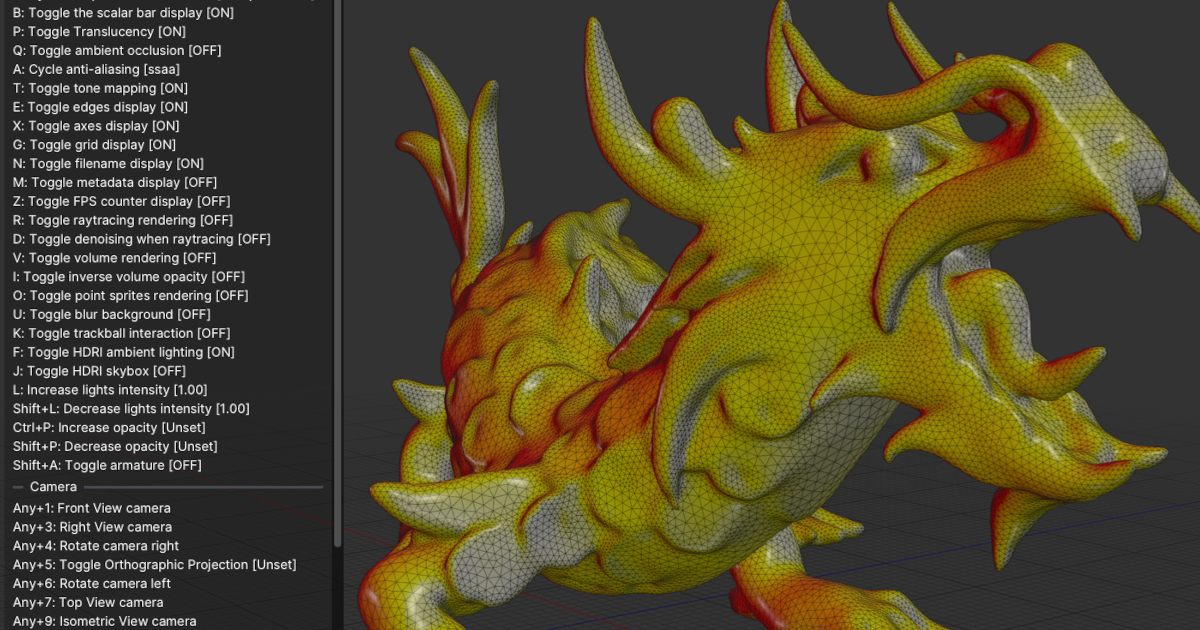
F3D is a fast and minimalist 3D viewer desktop application. It is free to use, open source and cross-platform.

No paid content found
Visit website
Profile views 12 Outbound visits 8 Normal
F3D Full homepage screenshot

At a glance

Category
Development
Language
English
Paid-content signal
No paid content foundObserved
Registered
2022
Hosting
FastlyInferred
HTTPS certificate trusted
PassedObserved
Last updated

Website review

This review may include AI-generated content and is not individually verified. Domain, certificate and other facts come from the observed data on this page.

What is F3D?

F3D is a free, open-source, cross-platform desktop application for viewing 3D data. It is built around a deliberately minimal interface: rather than a full modeling or editing suite, it aims to open a file and show it correctly with as little setup as possible. The project was originally created by Kitware SAS and relies on established open-source libraries such as VTK, OCCT, Assimp, Alembic, Draco, OpenUSD, OpenVDB, PDAL, and OSPRay.

H3 What it can display The feature set points to a viewer that covers more than hobbyist mesh files:

  • Realistic rendering — lighting and materials for previewing models as they are meant to look.
  • Animations — playback of animated assets, with GPU-accelerated skinning for character rigs.
  • CAD — inspection of engineering models and designs.
  • Gaussian splatting — visualization of real-world scans captured in that format.
  • Volume rendering — volumetric datasets such as medical scans and scientific simulations.
  • Scientific visualization — coloring data for accurate scientific views.

H3 Who it suits The natural audience is someone who receives 3D files and needs to check them quickly: an engineer reviewing a CAD part, a researcher inspecting a simulation or scan, an artist previewing an asset with materials and animation, or a developer who wants a lightweight viewer bundled into a workflow. It is less suited to someone who needs to edit geometry, rig characters, or author scenes, since the stated focus is visualization rather than creation.

H3 Practical notes Because it is cross-platform and open source, it can be installed on mixed Windows, macOS, and Linux teams without licensing friction. The trade-off of a minimalist viewer is that convenience comes before depth: expect fast opening and clean rendering, not a deep tool palette. If you want to compare it with other free viewers, Blender is a full creation suite rather than a viewer, while MeshLab leans toward mesh processing and inspection.

A useful next step: download F3D and open one file from each category you actually work with — a CAD export, an animated rig, and a scan or volume — to see whether its default rendering matches how you need to inspect that data.

How do I install F3D on Windows, macOS, or Linux?

F3D is distributed as a desktop application for Windows, macOS, and Linux, and the usual route is to download a ready-to-run package from the official site rather than build it yourself. Start at F3D and look for its download or installation section; that page is the authoritative place for current platform packages.

A practical order of operations:

  1. Open the official site and find the download area for your operating system.
  2. Pick the package type that matches how you normally install software on that platform.
  3. Install it the way that package type expects, then launch F3D and open a sample 3D file to confirm rendering works.

Platform notes:

  • Windows: Expect an installer or a portable archive. If you use a package manager such as winget or Chocolatey, check whether F3D is available there before downloading manually.
  • macOS: A disk image or archive is typical. Because macOS restricts unsigned or unnotarized apps, you may need to allow the app in System Settings after the first launch attempt.
  • Linux: Distributions vary. A Flatpak or AppImage avoids dependency conflicts, while a native package from your distribution's repository is easier to keep updated.

If you prefer building from source, F3D's dependencies are substantial — VTK, OCCT, Assimp, Alembic, and others are named in its acknowledgements — so reserve that route for cases where no prebuilt package fits your system. For most users evaluating F3D as a quick model or scan viewer, the packaged download is the faster path.

Can F3D open and render CAD files such as STEP or IGES?

Yes. F3D is built to open and render CAD files, including STEP and IGES, and its page explicitly lists CAD as a supported use case: "Render CAD designs, allowing you to view and inspect engineering models." That support comes from its integration with OCCT (Open CASCADE Technology), the open-source kernel that handles STEP, IGES and related CAD formats, so CAD import is a first-class capability rather than a side effect of a generic mesh loader.

What that means in practice

  • Inspection, not editing. Expect to open a part or assembly, orbit around it, check geometry and take a visual pass over an engineering model. F3D is a viewer, so it is not the tool for modifying solids, adding features or exporting a revised STEP file.
  • Assembly structure and materials. CAD files often carry part hierarchies and colour or material assignments. A viewer that reads them through a CAD kernel can typically show those, which is what makes it useful for a quick design review rather than just a shape check.
  • Mixed workloads. The same application also handles animations with GPU-accelerated skinning, realistic rendering with lighting and materials, Gaussian splatting, volume rendering for medical or simulation data, and scientific colour mapping. If your work moves between CAD models and scan or simulation data, one viewer covers both.

A quick comparison

Need F3D fits Something else fits better
Open and visually inspect a STEP/IGES part Yes —
Edit geometry or rebuild a feature tree No CAD authoring tools
Review a character animation or rig Yes —
View a CT scan or simulation volume Yes —
Convert CAD to another format at scale Not its purpose Dedicated converters

How to decide

If your task is "someone sent me a STEP file and I need to see it now," F3D is a reasonable default, especially since it is free, open source and cross-platform, so Windows, macOS and Linux colleagues can all open the same file. If your task is "I need to change this model," keep a CAD authoring tool alongside it.

A useful next step: take one representative STEP assembly from your own work, open it in F3D, and check three things — whether the part tree appears, whether colours and materials survive, and how it feels to navigate a large model. Those three checks tell you more than any feature list. For related viewing needs, Kitware is the organisation behind F3D's origins, and the underlying open-source projects such as VTK and OCCT are worth knowing if you later need to script or extend the workflow.

Does F3D support playing animations in glTF or FBX models?

Yes. F3D lists animation playback as a core capability, with GPU-accelerated skinning for smooth playback of complex character rigs. Since glTF and FBX are both common formats for rigged, animated assets, this is the feature you'd rely on for either.

What this means in practice

  • Skinned character rigs (bones driving a mesh) are the target case, not just simple object motion.
  • GPU acceleration matters for long or high-bone-count rigs, where CPU-side skinning would stutter.
  • Animation support sits alongside F3D's other modes — CAD inspection, Gaussian splatting, volume rendering, scientific visualization — so you can use one viewer across mixed asset types.

A quick way to check for yourself

Open your animated glTF or FBX in F3D and look for playback controls or an animation/clip selector. If your file contains multiple clips, confirm you can switch between them and that the timeline scrubs without dropping frames. If a specific rig plays but a morph-target or blend-shape animation does not, that's a narrower limitation worth noting separately.

Decision criterion

If your workflow is "quickly preview and sanity-check animated assets without launching a full DCC tool," F3D fits. If you need authoring, retargeting, or export of animation data, it won't replace Blender or Maya — it's a viewer.

For format-specific caveats, the project's own documentation is the reliable place to confirm which animation features each importer exposes.

How does F3D handle volume rendering for medical scans or scientific simulations?

F3D includes volume rendering as one of its supported visualization modes, aimed at datasets like medical scans and scientific simulations. According to the project's own description, it performs "advanced volume rendering" so you can visualize complex volumetric datasets, and it also supports coloring data to produce accurate scientific visualizations.

What that means in practice: instead of only showing surface meshes, F3D can display the interior structure of a 3D scalar field — for example, density values from a CT or MRI stack, or output from a fluid or climate simulation. Volume rendering typically lets you see through the data and adjust how density or intensity maps to color and opacity, which is how radiologists and researchers distinguish bone, tissue, or flow regions inside a scan.

Where it fits

  • Quick inspection: You have a volume file and want to look at it without launching a full analysis suite.
  • Cross-platform, lightweight use: It is a free, open-source desktop viewer, so it suits students, engineers, and researchers who need a fast preview rather than a heavy pipeline.
  • Mixed data: Because the same application also handles CAD, animations, Gaussian splatting, and scientific visualization, you can review volume data alongside other asset types in one tool.

Trade-offs to weigh

A general-purpose viewer is convenient, but it is not a replacement for dedicated medical imaging or simulation packages. If you need segmentation, registration, quantitative measurement, or clinical reporting, expect to move the data into specialized software after an initial look. Volume rendering is also GPU- and memory-intensive; large scan stacks benefit from a capable graphics card.

A sensible next step: open one representative volume dataset in F3D, check whether the built-in color and opacity controls give you the clarity you need, and keep your existing analysis tool for the deeper work. For related open-source visualization, VTK is the underlying toolkit F3D credits, and Kitware is the organization that originally created F3D.

Is F3D free to use in commercial projects, and what are its licensing terms?

Yes. F3D is free to use, including in commercial projects. The website describes it as free, open source, and cross-platform, and its page_evidence lists no paid tiers or payment platforms. In practice, that means you can install it on work machines, use it to inspect models and datasets during commercial work, and even bundle or modify it, provided you follow the terms of its open-source license.

The practical catch is that "free to use" and "free to redistribute in your own product" are different questions. The page_evidence does not state which specific license F3D is released under, so the exact obligations depend on the license file in the project's source repository. That matters most if you plan to ship F3D inside a commercial application, modify its code, or offer it as part of a paid service.

What this means in practice

  • Internal commercial use: Safe in almost any open-source license. A studio, engineering team, or research group can use F3D to view CAD models, animations, volume data, or Gaussian splatting scans without paying.
  • Redistribution inside a product: Check the license first. Permissive licenses generally allow this with attribution and notice requirements; copyleft licenses can impose stronger conditions on how you combine and distribute code.
  • Modifying the source: Also license-dependent. If you change F3D and distribute the result, you need to know whether those changes must be shared.

A concrete scenario

Suppose a small engineering firm wants a lightweight viewer for clients to open CAD files. Using F3D internally is straightforward. Shipping it as part of a commercial desktop app requires reading the license and possibly the licenses of its dependencies, since the page_evidence credits projects such as VTK, OCCT, Assimp, and OpenUSD, each of which may carry its own terms.

Next step

Open the F3D project on GitHub and read the LICENSE file, plus any third-party notices. If you only need to view files at your desk, no further action is needed. If you plan to redistribute, have someone confirm the license compatibility before you build it into a product.

Related questions

More questions →
What Is Desktop Software and When Should You Use It Instead of a Browser Extension?

Desktop software is a program you install and run directly on your computer's operating system (Windows, macOS, or Linux), rather than inside a browser tab. You should choose it over a browser extension or web app when your task needs deeper system access, steadier performance, or offline capability — for example, real-time meeting transcription that captures audio from multiple apps. Browser extensions are lighter and install in seconds, but they live inside one browser and inherit its limits.

What "desktop software" actually means

A desktop app is installed on the machine and runs as its own process. It can:

  • Read and write local files without a download/upload round trip
  • Access system-level resources like the microphone, speakers, camera, and other running apps
  • Keep working when the browser is closed or the network drops (depending on the app)
  • Persist settings and data locally

This is different from a web app, which runs in a browser tab and depends on a live connection and browser permissions, and from a browser extension, which is a small add-on that modifies or extends one browser's behavior.

Desktop app vs. browser extension vs. web app

Dimension Desktop software Browser extension Web app
Where it runs Installed on the OS Inside one browser In a browser tab
Offline access Often partial or full Rarely Usually none
System permissions Broad (mic, files, other apps) Limited to browser APIs Limited to browser APIs
Performance Uses full local resources Constrained by browser Constrained by browser + network
Updates App-managed or manual Auto via browser store Automatic on reload
Cross-app capture Yes (e.g., system audio) Usually no Usually no

The practical takeaway: extensions and web apps are convenient and low-commitment; desktop apps trade a heavier install for capability and stability.

When a desktop app is the better choice

Pick desktop software when the task depends on one or more of these:

  • Capturing audio from multiple sources at once — a meeting where you're on a call and taking notes. A desktop notetaker can tap system audio and the mic; a browser extension generally can't reach outside its tab.
  • Real-time transcription and live summaries — Otter's Meeting Agent is described as supporting real-time transcription, live chat, automated summaries, insights, and action items. That kind of continuous processing benefits from a local process rather than a single browser tab.
  • Long or resource-heavy sessions — recording and transcribing for an hour is more stable outside a tab you might accidentally close.
  • Working across apps — if your workflow spans a video call app, a document, and a notes tool, a desktop app can sit across all of them.

Choose a browser extension instead when you only need to enhance one website (for example, adding a button to a specific web tool), want zero install friction, and don't need system-level access.

How to choose and install a desktop app safely

  1. Confirm the task fits a desktop app. If you only need to tweak one website, an extension is lighter. If you need system audio, local files, or offline use, go desktop.
  2. Check system requirements. Match the OS (Windows/macOS/Linux) and version. Download only from the vendor's official site — for Otter, that's otter.ai.
  3. Review permissions before granting. A meeting/transcription app will ask for microphone (and possibly screen or system audio) access. Grant only what the task needs.
  4. Install and sign in. Follow the vendor's installer. If the app requires an account, expect a login step.
  5. Verify it works. Run a short test — record 30 seconds and confirm transcription or capture appears as expected.
  6. Check update and pricing terms. Otter lists a pricing page at otter.ai/pricing; check it for current plan limits rather than assuming a free tier.

Troubleshooting common desktop software problems

  • Install fails — confirm OS version meets requirements, free up disk space, and re-download from the official source (a corrupted installer is a common cause).
  • App crashes on launch — update to the latest version, restart the machine, and check whether a security tool is blocking it.
  • No audio captured — re-check microphone/system-audio permissions in OS settings, not just in the app.
  • Sync or login issues — verify your network and credentials; if the app stores data locally, confirm it isn't blocked by a firewall.
  • Extension works but desktop doesn't (or vice versa) — they use different permission models; a feature available in one may not exist in the other.

If your goal is AI meeting transcription with live summaries and action items, a desktop app is usually the more capable choice; if you just need a small tweak inside one website, a browser extension is the faster path.

What Are Open-Source UI Element Libraries and How Do They Differ From UI Frameworks?

An open-source UI element library is a collection of individual, ready-made interface pieces—buttons, cards, inputs, toggles, loaders—that you copy into your own project and adapt. A UI framework, by contrast, is a structured system of components, conventions, and often a theming layer that governs how your whole interface is built. The practical difference: an element library gives you a snippet; a framework gives you a way of working. If you need a polished button in ten minutes, reach for the element library. If you're building a 40-screen product with a team, you probably want the framework.

What "open-source UI element library" actually means

The term gets used loosely, so it helps to separate the parts:

  • Open-source: the code is publicly available, and the license tells you what you may do with it—copy, modify, redistribute, or use commercially.
  • UI element: a single, self-contained piece of interface, usually small enough to read in one sitting. A button with hover states, a pricing card, a search field.
  • Library: a browsable, searchable collection of those elements, typically contributed by many different people.

On a site like Uiverse, elements are shared by a community and written in plain CSS or Tailwind. You find one you like, copy the markup and styles, paste them into your project, and adjust colors, spacing, and text to fit. There's no package to install and no build step required—which is exactly the appeal, and also the source of most of the confusion.

Element library vs. UI framework: the core differences

Dimension Open-source UI element library UI framework / design system
Unit of reuse A single snippet you copy A component you import or call
Installation None; paste into your code Package install, config, sometimes a provider
Consistency Depends on you; each element may look different Enforced by shared tokens and APIs
Theming Manual edits per element Central theme/config file
Updates You own the copy; no upstream updates Version bumps bring fixes and changes
Accessibility Varies per contributor; must be checked Usually tested and documented
Best for Prototypes, landing pages, small sites, one-off needs Multi-page apps, teams, long-lived products
Learning curve Low—read the CSS Higher—learn the API and conventions

The table isn't a verdict. It's a map of trade-offs. Element libraries win on speed and freedom; frameworks win on consistency and maintenance.

Licensing and attribution: what to check before you paste

This is where people get into trouble, and it's worth slowing down for.

  1. Find the license. Every element or collection should state one. Common open-source licenses include MIT, Apache-2.0, and BSD. Some projects use copyleft licenses like GPL, which can impose obligations if you redistribute your code.
  2. Understand what the license permits. MIT and Apache-2.0 are permissive: you can typically use the code in commercial and closed-source projects. Copyleft licenses may require you to release derivative source under the same terms.
  3. Check attribution requirements. Permissive licenses usually require you to keep the copyright notice and license text somewhere in your project. That's a real obligation, not a formality.
  4. Look for per-element terms. On community sites, the site's overall terms and the individual contributor's stated wishes may differ. If a contributor asks for credit, honor it.
  5. When in doubt, ask or avoid. If a snippet has no license at all, you don't have clear permission to reuse it. Treat "no license" as "not open source," even if the code is publicly visible.

This article is general information, not legal advice. For commercial products with real exposure, have someone qualified review the licenses you're relying on.

How to use a community element in your project: a practical workflow

Here's a repeatable process that avoids most of the usual mess.

1. Start from a real need, not a browsing session

Decide what you need first—"a compact primary button with a loading state"—then search. Browsing aimlessly produces a pile of pretty snippets that don't fit together.

2. Copy the smallest version that works

Take the markup and the styles. Strip anything you don't need: demo wrappers, extra animations, decorative layers. Less code means fewer surprises.

3. Convert it to your conventions

If your project uses design tokens or CSS variables, replace hard-coded values:

/* Before: hard-coded */
.button { background: #4f46e5; border-radius: 8px; }

/* After: token-based */
.button { background: var(--color-primary); border-radius: var(--radius-md); }

This one step is what keeps a copied element from looking like a foreign object in your UI.

4. Check accessibility before you ship

Community elements vary widely here. Verify at minimum:

  • Keyboard focus is visible and the element is reachable by Tab.
  • Color contrast meets WCAG AA (4.5:1 for normal text).
  • Interactive elements use semantic HTML (<button>, not a clickable <div>).
  • Form inputs have associated labels.
  • Motion respects prefers-reduced-motion.

5. Test in context

Paste it into a real page with real content. Long labels, small screens, and dark mode break more copied elements than anything else.

6. Note where it came from

Keep a short comment or an internal credits file: source, license, date. Future you—and your legal reviewer—will be grateful.

Where element libraries genuinely shine

  • Prototypes and demos: you need something clickable today, not a design system.
  • Landing pages and marketing sites: a handful of distinctive elements, each custom.
  • Filling gaps: your framework lacks one specific component, and you don't want to build it from scratch.
  • Learning: reading well-made CSS is one of the fastest ways to improve.
  • Small projects: a personal site doesn't need a theming architecture.

Where they fall short

  • Consistency at scale: ten elements from ten contributors rarely look like one product.
  • Maintenance: you own every copy. When your design changes, you edit each one.
  • Accessibility debt: you inherit whatever the contributor did or didn't do.
  • No upstream fixes: a bug fixed in the original won't reach your copy.
  • Integration friction: different naming conventions, different units, different assumptions about resets.

When to choose which

Choose an element library when the scope is small, the timeline is short, or you need a few distinctive pieces rather than a whole system.

Choose a framework or design system when multiple people build multiple screens over months, when consistency is a product requirement, or when accessibility and theming need to be guaranteed rather than checked.

A hybrid works well for many teams: adopt a framework for the structural components—forms, navigation, layout—and borrow individual elements for the places where you want personality. Just route every borrowed element through the same token and accessibility checks, so it lands as part of your system rather than beside it.

The short version: open-source UI element libraries are a fast, flexible way to get good-looking interface pieces into a project. They are not a substitute for a design system, and the license and accessibility details are the part worth reading carefully.

Website Overview

Page metadata, canonical configuration and social previews work together to provide more consistent search and sharing presentation. An active inbound-mail setup with incomplete authentication may leave the domain more open to impersonation. Provider hosting alone does not close that gap.

Domain and Registration

Transfer-protection status is present, helping reduce the risk of unauthorized domain transfers. The domain has about 3 years of registration history; its current configuration provides more context than age alone. The registrar is Gandi SAS, a widely used domain service provider. The domain uses the common .app extension, which is not an independent safety signal.

DNS and Email

The observed email authentication setup is incomplete: DMARC is missing. Nameservers are provided by gandi.net, indicating managed DNS hosting. MX records point to the gandi.net email service. No CNAME was found; the observed records resolve directly to addresses. DNSSEC signatures were not detected, so this additional DNS authenticity protection is not confirmed.

TLS and Certificates

The certificate uses an RSA 2048-bit public key, offering broad client compatibility. The server supplied a complete certificate chain. No organization name is present in the certificate; the available fields are consistent with domain validation. The certificate was issued by Let's Encrypt, commonly associated with automated certificate services. The certificate's total validity is about 89 days, consistent with a short renewal cycle.

HTTP and Browser Security

The response lacks these common security headers: CSP, X-Content-Type-Options, Referrer-Policy, Permissions-Policy, clickjacking protection. CORS permits any origin to read this response. This is common for public resources; sensitive responses need narrower handling. No X-Powered-By header was found, reducing one common source of backend fingerprinting information. The x-cache, x-served-by, via response header indicates a CDN or caching proxy in the delivery path. No obvious internal addresses or debug information were found in the headers.

Technology Stack Analysis

The public page identifies Fastly without precise versions, leaving fewer clues for version-specific scanning.

Search and Social Sharing

The Generator tag identifies Docusaurus v3.10.2, making the publishing system easier to fingerprint. Open Graph is partially configured; og:type is missing. Twitter Card metadata is configured. The page declares 2 language or regional alternatives using hreflang. The title has 10 characters, within a common display range.

Hosting and Email

DNSgandi.net
HostingFastly
Emailgandi.net
Approximate IP geolocation (inferred; a CDN or proxy may differ from the origin server) United States flagUnited States Inferred 185.199.108.153

Registration details

RDAP / WHOIS

RegistrarGandi SAS
Registered2022-11-13
Expires2026-11-13
Domain statusclient transfer prohibited
Nameserversns-62-a.gandi.net、ns-84-c.gandi.net、ns-86-b.gandi.net
DNSSECunsigned

DNS records

DNS

TypeNameValueTTLPriority
Af3d.app185.199.108.15310800—
Af3d.app185.199.109.15310800—
Af3d.app185.199.110.15310800—
Af3d.app185.199.111.15310800—
MXf3d.appspool.mail.gandi.net1080010
MXf3d.appfb.mail.gandi.net1080050
NSf3d.appns-62-a.gandi.net10800—
NSf3d.appns-84-c.gandi.net10800—
NSf3d.appns-86-b.gandi.net10800—
TXTf3d.appv=spf1 include:_mailcust.gandi.net ?all10800—

TLS and certificates

TLS / SSL

AssessmentNormal configuration
Supported protocolsTLSv1.2、TLSv1.3
Negotiated protocolTLSv1.3
Certificate subjectf3d.app
IssuerLet's Encrypt
Valid until2026-11-28T15:08 · Remaining when checked: 58 days
Verification detailsCertificate trust: Passed · Hostname match: Passed

HTTP response headers

HTTP

HeaderValue
content-typetext/html; charset=utf-8
cache-controlmax-age=600
serverGitHub.com
strict-transport-securitymax-age=31556952
access-control-allow-origin*

Identified technologies

Fastly

Pages, Search and Sharing

Meta descriptionF3D is a fast and minimalist 3D viewer desktop application. It is free to use, open source and cross-platform.
Canonical URLhttps://f3d.app/
LanguageEnglish (default)
Twitter Cardsummary_large_image

No robots.txt found

User reviews (0)

  • No reviews yet.