Website profiles · Technology insights · Alternatives

filmonpaper.com

A collection of over 2,000 film posters from the UK, USA, Japan, Thailand and beyond, plus articles by Sim Branaghan, author of British Film Posters: An Illustrated History

No paid content found
Visit website
Profile views 0 Outbound visits 0 Normal
Film on Paper Full homepage screenshot

At a glance

Category
Other
Language
English
Paid-content signal
No paid content foundObserved
Registered
2010
Hosting
CloudflareInferred
HTTPS certificate trusted
PassedObserved
Last updated

Website review

This review may include AI-generated content and is not individually verified. Domain, certificate and other facts come from the observed data on this page.

What is Film on Paper?

Film on Paper is a personal movie-poster archive and reference site, built around a collection of more than 2,000 film posters from the UK, USA, Japan, Thailand and elsewhere. Each entry catalogues a single item in detail — title, year, director, cast, genre, poster type, country of origin, year of poster, designer or artist, dimensions, and whether it is single- or double-sided — followed by a short essay on the film, the artwork and how the piece fits into the wider history of film marketing.

It is the work of Sim Branaghan, author of British Film Posters: An Illustrated History, and that background shapes what the site is for: not browsing pretty pictures, but understanding posters as designed objects with attributions, printings and national traditions.

What you can actually do with it

  • Identify a poster you own. The structured details let you compare format, size and country against your copy, which is the usual first step in working out whether something is an original release item or a later printing.
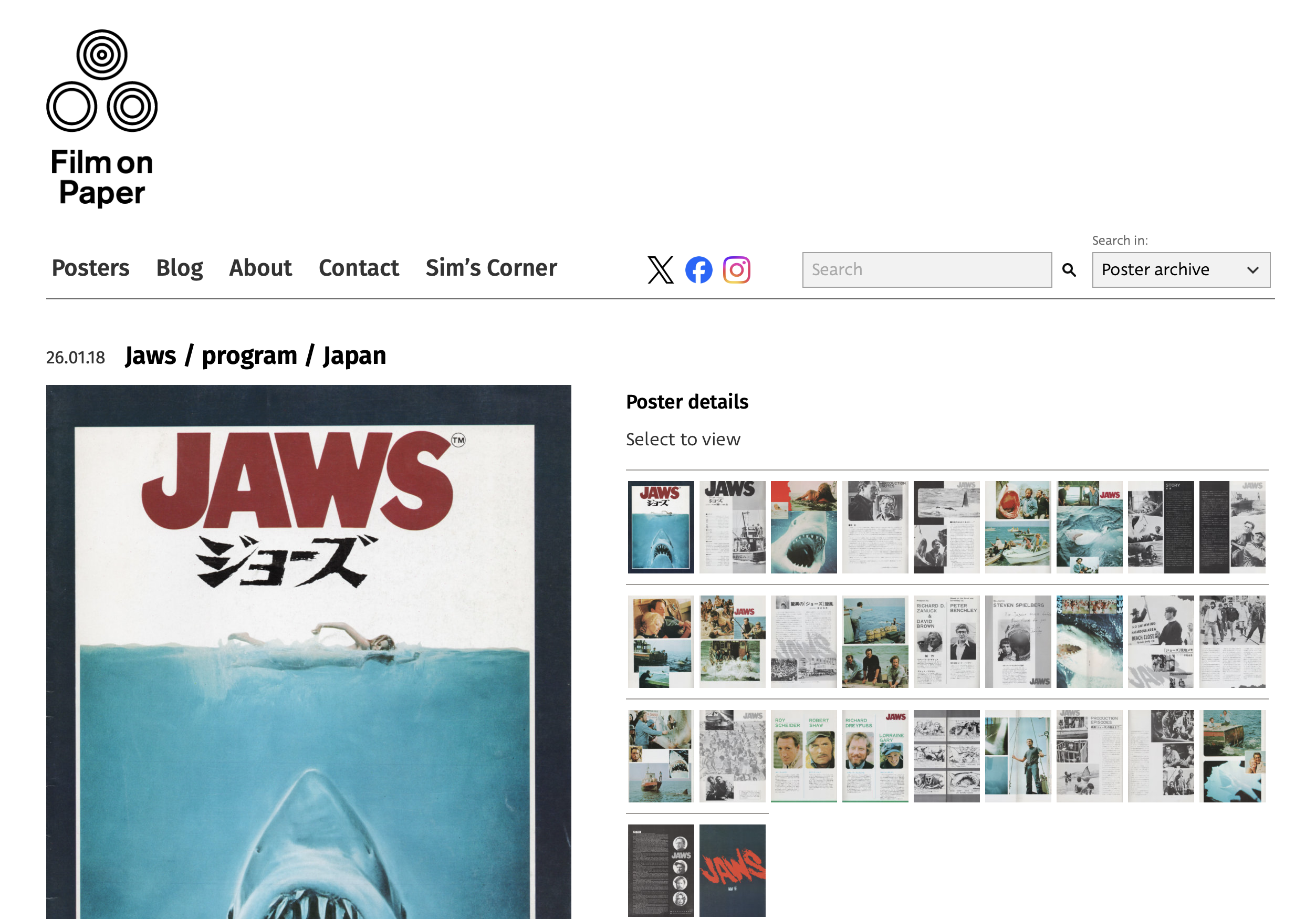
  • Trace an image's history. The Jaws program entry, for example, explains that Roger Kastel's painting was commissioned for Peter Benchley's paperback before Universal bought the rights and turned it into one of the most imitated images in cinema.
  • Research artists and designers. Entries name illustrators where known and admit when they are not, which is useful for anyone following a particular artist's film work.
  • Read around the films. The writing covers production context and marketing decisions, and the archive reaches into corners most poster sites skip — a golf-themed Troma horror film, for instance.

Who it suits

Collectors and dealers checking details before a purchase; designers and illustrators studying how campaigns were built; film historians interested in distribution across different territories; and general readers who enjoy the story behind a familiar image. If you want a shop, an auction tracker or a price guide, this is not that — it is a catalogue with commentary, organised by post date rather than by browsable categories, so you navigate by scrolling the archive or following individual posts.

A practical next step: pick a film you already know well and read its entry end to end. The gap between the poster you remember and the version catalogued here — different country, different artwork, different format — is usually the quickest way to understand what the site is documenting. For a broader frame on British poster history, Branaghan's book sits behind much of the writing; for the wider collector ecosystem, The Poster Appreciation Society and Learn About Movie Posters cover authentication and terminology.

How can I identify the origin and year of a specific movie poster?

Use the poster's own printed details first, then confirm them against a specialist archive such as Film on Paper. A single poster usually carries enough information to pin down both country and year if you know where to look.

Where the clues usually sit

  • Printer's or distributor's mark: Small text near the bottom edge often names a printing house or distributor, and the country in its address or company name is often decisive.
  • Rating box: The shape and wording of a ratings symbol is one of the fastest country tells. US posters use the MPAA box; UK posters use BBFC certificates; other countries have their own boards.
  • Language and title treatment: A translated title, dual-language billing, or non-Latin script points to the market the poster was printed for, not where the film was made.
  • Copyright and release line: A year printed with the studio copyright is a strong anchor, though it can precede or follow the film's release by a year.
  • Size and format: Standard formats differ by country and era, so dimensions narrow down origin even when text is sparse.

Country vs. year: two separate questions

Origin of the film and origin of the poster are not the same thing. A Hollywood title released in Japan will have a Japanese poster with Japanese text and a local distributor mark. Year of the film is also not automatically year of the poster; re-releases, awards campaigns and later printings carry their own dates.

What you see Likely origin Likely year
MPAA rating box, "one sheet", US distributor USA Film year or release year
BBFC certificate, UK distributor address UK Film year or release year
Japanese text, Japanese distributor, B5 or chirashi format Japan Release or re-release year
Dual-language billing, local distributor stamp Depends on the market named Check copyright line

Worked example

Film on Paper's entry for a Jaws Japanese cinema program lists the film as 1975, US origin, and the poster as Japanese, also 1975, with Roger Kastel credited for the cover artwork. That structure is the model to copy: record film title, film year, film origin, poster origin and poster year as five separate fields, then note the poster type (one sheet, program, chirashi) and any designer or artist credit. The archive also holds a US one sheet for the same title, which is exactly the comparison that teaches you how one campaign looks across two markets.

A practical next step

Photograph the bottom edge, any rating box and the copyright line, then search the archive by title and browse the matching entries to compare formats, sizes and credits. If your copy differs from every listed version, treat that as a signal of a re-release or a later printing rather than assuming a mislabel. For deeper context on British posters specifically, the archive's articles are written by Sim Branaghan, author of British Film Posters: An Illustrated History.

What are the differences between a one sheet, program, and other poster types?

Film on Paper's own catalogue entries show the distinction directly: the Jaws entry is logged as a "Program" from Japan, while Blades is logged as a "One sheet" from the USA. The type field describes the format and purpose of the printed item, not the film's fame or the artwork's quality.

The main formats

Type Typical role Where it was used What collectors notice
One sheet The standard cinema advertising poster for a single film US cinemas, and widely imitated elsewhere Large display size, often double-sided for lightbox use, studio and NSS markings, folds from shipping
Program A souvenir or information booklet sold or handed out at screenings Often specific to a country's release, as with the Japanese Jaws program Page count, internal photos and credits, local-language text, cover art reused from the poster campaign
Insert, half sheet, three sheet, quad Alternative display sizes for lobbies and front-of-house Varies by country; the UK quad and US insert are common examples Trimmed or folded dimensions, how much image survives when cropped
Lobby card Small scene stills for display in a lobby set US cinemas, usually in sets of eight Set completeness, studio caption text, condition of individual cards
Teaser and advance Early marketing before release, sometimes with minimal credits Major studio campaigns Date or credit omissions that mark an earlier printing

Why the difference matters

A one sheet is advertising: it was made to sell tickets at a distance and is judged on display impact, printing quality and condition. A program is a keepsake: it was made to be read and kept, so its value often lies in the internal content — production notes, cast details, and in the Jaws case a hand-written message for Japanese filmgoers. The Blades entry illustrates how a one sheet can be a minor film's main surviving artefact, complete with a tagline ("Just When You Thought It Was Safe To Putt") that parodies a much bigger hit.

For a collector deciding what to buy, ask what you actually want. If you want wall display, a one sheet or quad usually wins. If you want to understand how a film was presented in a particular country, a program or press material is often more revealing. If you are researching a specific release, the date, country and format fields matter more than the image alone.

A useful next step is to compare the same title across two countries on Film on Paper and note how the format, tagline and artwork change — that comparison usually teaches more than any single listing.

Who is Sim Branaghan and what is his contribution to the site?

Sim Branaghan is a film-poster historian and the author of British Film Posters: An Illustrated History. On Film on Paper, he contributes articles alongside the site's larger project: an archive of more than 2,000 film posters from the UK, USA, Japan, Thailand and elsewhere.

His value to the site is context. A poster archive can show an image, title, year and size, but Branaghan's writing adds the production history and design background that explain why a particular poster looks the way it does and how it fits into British cinema. For collectors, researchers and design enthusiasts, that turns browsing into something closer to reading a reference work.

How to use the site with that in mind

  • Start with the poster archive if you want to identify a specific title or compare artwork across countries.
  • Read Branaghan's articles when you want background on British poster design rather than just an image.
  • Use the archive's country and format details—such as one sheet, program or Japanese release—to understand how marketing differed by market.

A practical example: someone researching the Japanese program for Jaws can see the Roger Kastel artwork and read that it began as a paperback cover before Universal bought the rights. Branaghan's contribution is the wider British-poster knowledge that helps place such items in a longer design tradition.

Can I find posters from specific countries like Japan or Thailand?

Yes. Film on Paper is organised as a country-spanning archive rather than a single-market collection, and its own description names the UK, USA, Japan, Thailand and beyond among the poster origins represented. Country is also a searchable field in each entry, so a Japanese program or a Thai one sheet sits alongside the American and British material rather than in a separate section.

How country shows up in practice

Each archived poster carries a details block that separates two things worth distinguishing:

  • Origin of Film — where the movie was made (the Jaws entry is USA).
  • Origin of Poster — where the printed item came from (that same Jaws entry is Japan).

That distinction matters more than it first appears. A Japanese poster for an American film is not the same object as a US one sheet for the same title, and the archive treats them as separate records with their own sizes, formats and artwork notes. The Jaws example is a cinema program sold at Japanese screenings, with a hand-written message aimed at Japanese moviegoers — a genuinely local artefact, not an export copy.

What you can realistically expect

If you are researching non-Western poster design, this is a useful starting point rather than a complete national catalogue. Coverage is deepest for UK and US material, with Japanese posters well represented and Thai examples appearing more sporadically. Entries typically give title, year, director, cast, genre, poster type, designer or artist where known, dimensions, and single- or double-sided status — enough to compare how one film was marketed differently across markets.

A practical route: pick a title you know well, open its entry, and compare the poster-origin field across variants. That quickly shows you which countries the archive covers for that film, and whether the differences are in artwork, format or both.

Comparing it with other archives

Source Best for Trade-off
Film on Paper Detailed single-item records, country and format fields, articles on British poster history A curated collection, not a comprehensive national database
IMP Awards Broad, current Hollywood poster coverage by year Thin on non-US material and on physical format detail
Learn About Movie Posters Terminology, authentication and collecting basics Reference site rather than a browsable image archive

If your interest is specifically Japanese or Thai material, expect to cross-check against regional auction records and specialist dealer catalogues, since no single English-language archive covers those markets exhaustively.

How do I navigate the archive to find posters by director or film title?

Film on Paper lists each poster as a dated post with a consistent "Poster details" block, so the fastest route is your browser's find function rather than a built-in search box. Open the archive, press Ctrl+F (Cmd+F on Mac), and type a director's surname or the film title. The detail block repeats the same field labels — Title, Director, Starring, Year of Film, Origin of Poster — which makes matches easy to scan. Individual posts also carry a Permalink, useful if you want to bookmark a specific entry.

What the detail block gives you

Each entry is built around a structured record, so you can filter mentally before you even look at the image:

  • Identification: title, any alternate or translated title, year of film, director, cast
  • Poster specifics: type (one sheet, program, etc.), country of origin, year of poster, designer and artist, size in inches, single- or double-sided
  • Context: genre, tagline, and a short write-up on the artwork and its history

That means a search for a director also surfaces the poster's nationality and format — handy if you collect only UK quads or only Japanese programmes, since the same film can appear in several territories.

A worked example

Suppose you want the Jaws programme rather than the US one sheet. Searching for "Spielberg" or "Jaws" brings up the record for the Japanese cinema programme sold at 1975 screenings, with Roger Kastel credited for the cover art and a note that the artwork originated on Peter Benchley's paperback. The same entry points you to the US one sheet held elsewhere in the collection — a reminder that a single film often has multiple posts.

Practical next steps

  • Search by director when you're researching a filmography; search by title when you already know the film.
  • Expect non-English titles to appear as alternates, so try the original title if the English one draws a blank.
  • If you want broader context on British poster history, the site's articles are written by Sim Branaghan, author of British Film Posters: An Illustrated History.
  • For studio-era US material, the Academy's own collections are worth checking at Academy of Motion Picture Arts and Sciences; the British Film Institute holds related material at BFI.

Related questions

More questions →
What is Film on Paper?

Film on Paper (filmonpaper.com) is a movie poster archive: a collection of more than 2,000 film posters from the UK, USA, Japan, Thailand and other territories, presented alongside detailed catalogue entries and articles by Sim Branaghan, author of British Film Posters: An Illustrated History. It is a reference and browsing resource for people who want to look at posters, identify them, or read about their design and production context — not a shop or a streaming service.

What you'll find on the site

The archive is organised as a blog-style sequence of dated posts, each devoted to a single poster. The most recent entries shown on the homepage carry dates such as 26.01.18, 05.01.18, 11.12.17, 20.11.17 and 03.11.17, so the format is a running log of additions rather than a static gallery.

Each post opens with a title line naming the film and the poster's country of origin — for example, "Jaws / program / Japan" or "Blades / one sheet / USA" — followed by a structured details block.

The poster details block

Every entry records a consistent set of fields, which is what makes the site useful for identification rather than just viewing:

Field Example (Jaws, Japan) Example (Blades, USA)
Title / AKA Jaws / Les dents de la mer (France) Blades
Year of film 1975 1989
Director Steven Spielberg Thomas R. Rondinella
Starring Roy Scheider, Robert Shaw, Richard Dreyfuss, Lorraine Gary, Murray Hamilton, Carl Gottlieb, Jeffrey Kramer, Susan Backlinie Robert North, Jeremy Whelan, Victoria Scott, Holly Stevenson, William Towner, Peter Wray, Charlie Quinn, Bruce Katlin, Lee Devin, Bill Kimble, Donald Jackson
Origin of film USA USA
Genre(s) Horror / Thriller Comedy / Horror
Type of poster Program One sheet
Origin of poster Japan USA
Year of poster 1975 1989
Designer / Artist Unknown / Roger Kastel (cover) Unknown / —
Size (inches) 8 4/16" x 11 10/16" 27 2/16" x 40 15/16"
SS or DS — SS
NSS # — —
Tagline — "Golf – A Game of Hooks, Slices and … Slaughter" / "Just When You Thought It Was Safe To Putt"

Fields that don't apply are left blank rather than filled with guesses, so an empty "Designer" or "NSS #" is itself information: the site doesn't claim to know.

What the write-ups add

Below the details block, each post carries a short essay. These typically cover the artwork's origin, the film's production or reception, and notes specific to the physical item.

The Jaws entry, for instance, explains that Roger Kastel's image was originally commissioned for the paperback cover of Peter Benchley's novel, and that Universal bought the rights to reuse it for the poster after seeing the artwork — after which it became one of the most imitated and parodied images of all time. It also notes that Kastel painted the Empire Strikes Back one sheet, links to his official site, mentions that the author also holds the original US one sheet, and points out that this particular Japanese program includes production images and a hand-written message aimed at Japanese "movie buffs."

The Blades entry identifies the film as a Troma production headed by Lloyd Kaufman and Michael Herz, and describes it as one of the only golfing-related horror films ever made.

Who it's for

  • Collectors and buyers checking what a poster actually is: type, size, single-sided or double-sided, country of issue, and whether a designer or artist is attributed.
  • Researchers and writers looking for poster-specific detail — artist credits, print origins, taglines — that general film databases often omit.
  • Design and film enthusiasts browsing for the artwork itself and the stories behind it.

Practical notes

The site is in British English and is built as an archive with permalinks and comment threads on individual posts, so entries can be linked to and discussed directly. Nothing in the site's own material indicates pricing, membership, or a paywall, and no payment or login mechanism is described — treat it as a reference archive unless you find otherwise on the site itself.

Who writes the articles on Film on Paper?

The articles on Film on Paper are written by Sim Branaghan, author of British Film Posters: An Illustrated History. The site describes itself as a collection of over 2,000 film posters from the UK, USA, Japan, Thailand and beyond, plus articles by Branaghan — so the writing sits alongside the archive rather than being separate from it.

What that means in practice

Because the author is a film-poster historian rather than a general blogger, the articles are positioned to add background and context to the posters themselves. The archive is the core of the site; the articles are the layer that explains or expands on it.

How the two parts fit together

Element What it provides
Poster archive Over 2,000 posters, with entries covering films and releases from multiple countries
Articles Written by Sim Branaghan, author of British Film Posters: An Illustrated History
Combined effect Posters plus written background, rather than images alone

What the poster entries themselves contain

The archive entries are detailed enough to show the kind of material the articles sit alongside. For example, the Jaws Japanese program entry includes:

  • Title and AKA titles (e.g. Les dents de la mer for France)
  • Year of film, director and starring cast
  • Origin of film and genre
  • Type of poster (program), origin of poster (Japan) and year of poster
  • Designer and artist (Roger Kastel for the cover)
  • Size in inches, single-sided or double-sided status, NSS number and tagline

The entry also notes that the program was sold at Japanese screenings, that Kastel's image was originally commissioned for the paperback cover of Peter Benchley's novel, and that Universal bought the rights to use it for the poster. A separate Blades one-sheet entry follows the same structure, listing Troma as the studio behind the 1989 golfing horror film.

Why the authorship matters for readers

If you are using the site to research a specific poster, the value is in the combination: the entry gives you the cataloguing facts (size, origin, artist, year), and the articles give you the historical and design context that a bare listing would not. Knowing the author wrote a standard illustrated history of British film posters is a reasonable signal that the written material is aimed at collectors and researchers rather than casual browsing.

The site's own description does not detail individual article topics beyond stating that articles are by Branaghan, so treat the archive entries as the reliable, checkable part of each page and the articles as the contextual layer.

What Is the Scope of Film on Paper's Poster Collection?

Film on Paper is a movie poster archive of over 2,000 posters drawn from the UK, USA, Japan, Thailand and beyond. Its scope is defined less by a single national cinema than by variety: posters from multiple countries, films spanning decades, several genres, and more than one physical format — from US one sheets to Japanese cinema programs. If you want to know whether a particular kind of poster might appear there, the collection's range is the answer, and the individual entries show how much detail accompanies each item.

What the collection covers

The site describes itself as "a collection of over 2,000 film posters from the UK, USA, Japan, Thailand and beyond." That geographic spread is the first dimension of its scope. Rather than concentrating on one territory's output, it brings together posters produced for different markets, which means the same film can appear in more than one national version.

The second dimension is time. Entries in the archive include films from the 1970s through the 1980s and beyond — the Jaws program is dated 1975, while the Blades one sheet is from 1989. The collection is not limited to a single era of filmmaking or poster design.

The third dimension is genre. The archive's entries cover horror and thriller (Jaws), comedy and horror (Blades), and other categories, so it is not restricted to one kind of film.

Formats represented

Film on Paper's scope includes different types of poster and printed cinema material, not just one standard size. Two examples from the archive show the range:

Film Year Type of poster Origin of poster Size (inches)
Jaws 1975 Program Japan 8 4/16" x 11 10/16"
Blades 1989 One sheet USA 27 2/16" x 40 15/16"

The Jaws entry is a Japanese cinema program sold at screenings, while the Blades entry is a US one sheet. The archive also notes single-sided (SS) versus double-sided (DS) printing where relevant — the Blades one sheet is listed as SS.

What each entry tells you

Scope is also about how much information accompanies each poster. A typical entry records:

  • Title and any alternate titles (for example, Jaws is also listed as Les dents de la mer in France)
  • Year of film and year of poster
  • Director and starring cast
  • Country of origin of the film and of the poster
  • Genre(s)
  • Type and style of poster
  • Designer and artist, where known
  • Size in inches, and SS or DS where applicable
  • NSS number and tagline where present

Entries are dated and categorised under "Poster Archive," and each has a permalink. The Jaws entry, for instance, identifies the cover artist as Roger Kastel and explains that the image was originally commissioned for the paperback cover of Peter Benchley's novel before Universal bought the rights for the poster.

Beyond the posters

The site also carries articles by Sim Branaghan, author of British Film Posters: An Illustrated History. That editorial layer sits alongside the archive and is part of what the site offers, though the poster collection itself remains the core.

How to use this to judge fit

If you are looking for a specific poster, the collection's value lies in its breadth rather than completeness in any one area. It is strongest as a reference for seeing how a film was marketed in different countries and formats — a Japanese program next to a US one sheet, for example — and for the production and artist details recorded with each entry. If your interest is narrowly a single national tradition or a single poster format, the archive will cover it only as part of a wider, multi-country, multi-format collection.

What Details Are Included in Film on Paper's Movie Poster Entries?

Film on Paper's poster entries follow a consistent two-part structure: a Poster details table covering the film and the physical poster, followed by a written description of the poster's artwork, printing and context. The archive holds over 2,000 posters from the UK, USA, Japan, Thailand and beyond, alongside articles by Sim Branaghan, author of British Film Posters: An Illustrated History. Each entry is dated and filed under the Poster Archive category.

The film details block

Every entry opens with the film's identity:

  • Title and AKA — alternate titles, often with a translation. The Jaws program entry lists Les dents de la mer [The teeth of the sea] (France).
  • Year of Film
  • Director
  • Starring — full cast list, not just the leads
  • Origin of Film — the country that produced the film
  • Genre(s) of Film — multiple genres where relevant, e.g. Horror | Thriller for Jaws, Comedy | Horror for Blades

The poster details block

This is where the physical object is documented:

Field What it records
Type of Poster e.g. One sheet, Program
Style of Poster Style variant, where one exists
Origin of Poster Country the poster was printed for
Year of Poster Often matches the film year, but recorded separately
Designer Named where known
Artist The illustrator, e.g. Roger Kastel (cover) for Jaws
Size (inches) Given to fractions of an inch, e.g. 27 2/16" x 40 15/16"
SS or DS Single-sided or double-sided
NSS # National Screen Service number, where applicable
Tagline The poster's marketing line

Fields with no known value are marked with a dash rather than omitted, so you can tell the difference between "unknown" and "not applicable."

The written description

Below the tables, each entry carries a short essay. These typically cover the artwork's history, the film's production or reception, and the poster's specific context. The Jaws program entry, for example, explains that Roger Kastel's image was originally commissioned for the paperback cover of Peter Benchley's novel, that Universal bought the rights for the poster, and that the program was sold at Japanese screenings. It also notes that Kastel painted the Empire Strikes Back one sheet, and flags a detail worth knowing: the program includes a hand-written message for Japanese "movie buffs."

The Blades entry shows the same pattern from the opposite direction — a Troma production described as "one of the only golfing-related horror films ever made," with the tagline quoted in full.

What this means in practice

If you are identifying a poster, the table gives you the fields to match against: size, SS/DS, NSS number, artist and country of origin. If you are researching a film's marketing, the description supplies the provenance — who painted the image, where it first appeared, and how it was reused. Entries also carry a post date, a category and a permalink, and some allow comments.

Website Overview

An established domain and managed infrastructure suggest continuity of operations and may support dependable delivery, although neither guarantees service quality.

Domain and Registration

Registered in 2010, this domain has about 16 years of history. That suggests continuity, although ownership and purpose may have changed. Transfer-protection status is present, helping reduce the risk of unauthorized domain transfers. The registrar is GoDaddy.com, LLC, a widely used domain service provider. The domain uses the common .com extension, which is not an independent safety signal.

DNS and Email

Nameservers are provided by Cloudflare, indicating managed DNS hosting. MX records point to the Google Workspace email service. No CNAME was found; the observed records resolve directly to addresses. SPF and DMARC are configured. DKIM status is unknown. DNSSEC signatures were not detected, so this additional DNS authenticity protection is not confirmed.

TLS and Certificates

The public key uses EC with 256 bits. The server supplied a complete certificate chain. No organization name is present in the certificate; the available fields are consistent with domain validation. The certificate was issued within the Google Trust Services cloud or CDN ecosystem. The certificate's total validity is about 90 days, consistent with a short renewal cycle.

HTTP and Browser Security

No X-Powered-By header was found, reducing one common source of backend fingerprinting information. All six checked browser-security headers are present. Their effectiveness still depends on the policy values and application behavior. The cf-ray response header indicates a CDN or caching proxy in the delivery path. No obvious internal addresses or debug information were found in the headers. The Server header identifies cloudflare without an exact version.

Technology Stack Analysis

The public page identifies WordPress, jQuery, Cloudflare without precise versions, leaving fewer clues for version-specific scanning.

Search and Social Sharing

The meta description has 172 characters and may be shortened in search results. Twitter Card metadata is configured. JSON-LD includes Organization data, helping describe the organization as an entity. The title has 36 characters, within a common display range. The observed directives allow indexing and link following.

Hosting and Email

DNSCloudflare
HostingCloudflare
EmailGoogle Workspace
Approximate IP geolocation (inferred; a CDN or proxy may differ from the origin server) Location unknown Inferred 104.21.2.141

Registration details

RDAP / WHOIS

RegistrarGoDaddy.com, LLC
Registered2010-02-08
Expires2027-02-08
Domain statusclient delete prohibited、client renew prohibited、client transfer prohibited、client update prohibited
Nameserverselsa.ns.cloudflare.com、ian.ns.cloudflare.com
DNSSECunsigned

DNS records

DNS

TypeNameValueTTLPriority
Awww.filmonpaper.com104.21.2.141300—
Awww.filmonpaper.com172.67.129.74300—
AAAAwww.filmonpaper.com2606:4700:3033::ac43:814a300—
AAAAwww.filmonpaper.com2606:4700:3034::6815:28d300—
MXfilmonpaper.comaspmx.l.google.com30010
MXfilmonpaper.comalt1.aspmx.l.google.com30020
MXfilmonpaper.comalt2.aspmx.l.google.com30020
MXfilmonpaper.comaspmx2.googlemail.com30030
MXfilmonpaper.comaspmx3.googlemail.com30030
MXfilmonpaper.comaspmx4.googlemail.com30030
MXfilmonpaper.comaspmx5.googlemail.com30030
NSfilmonpaper.comelsa.ns.cloudflare.com86400—
NSfilmonpaper.comian.ns.cloudflare.com86400—
TXTfilmonpaper.comv=spf1 include:_spf.google.com include:netblocks.dreamhost.com ~all300—
DMARC_dmarc.filmonpaper.comv=DMARC1; p=none;300—

TLS and certificates

TLS / SSL

AssessmentNormal configuration
Supported protocolsTLSv1.2、TLSv1.3
Negotiated protocolTLSv1.3
Certificate subjectfilmonpaper.com
IssuerGoogle Trust Services
Valid until2026-12-16T08:10 · Remaining when checked: 62 days
Verification detailsCertificate trust: Passed · Hostname match: Passed

HTTP response headers

HTTP

HeaderValue
content-typetext/html; charset=UTF-8
cache-controlmax-age=0
servercloudflare
strict-transport-securitymax-age=15552000
content-security-policyupgrade-insecure-requests
x-frame-optionsSAMEORIGIN
x-content-type-optionsnosniff
referrer-policyno-referrer-when-downgrade
permissions-policycamera=(), microphone=(), geolocation=(), payment=()

Identified technologies

WordPressjQueryCloudflare

Pages, Search and Sharing

Meta descriptionA collection of over 2,000 film posters from the UK, USA, Japan, Thailand and beyond, plus articles by Sim Branaghan, author of British Film Posters: An Illustrated History
Canonical URLhttps://www.filmonpaper.com/
LanguageEnglish (default)
Twitter Cardsummary_large_image
All bots 0 allowed · 6 disallowed
  • Disallow/wp-content/uploads/wpo/wpo-plugins-tables-list.json
  • Disallow/?s=
  • Disallow/page/*/?s=
  • Disallow/search/
  • Disallow/wp-json/
  • Disallow/?rest_route=

User reviews (0)

  • No reviews yet.