
 gauzy.co
 Paid content
 Multilingual
Categories: Productivity
Ever Gauzy is an open-source ERP, CRM, HRM, and ATS platform. Manage clients, employees, finances, and projects to improve productivity and sales.
 Visit website
 Updated: 2026-09-30 07:17
Language: English (default)
Updated: 2026-09-30 07:17
Language: English (default)
 Access: Normal
 Profile views 0
 Outbound visits 0
Related questions
More questions →Crossword Weaver vs Other Crossword Puzzle Makers: Which Fits Your Needs?
Crossword Weaver is a Windows-only crossword puzzle maker that produces two distinct puzzle styles: free-form puzzles built from only your words, and themed symmetrical newspaper-style puzzles. It fits you if you work on Windows, want printable and playable output, and are willing to test the demo before deciding on a purchase. It is a weaker fit if you need macOS or web-based tools, or if you want a free alternative without evaluating paid software.
What Crossword Weaver Actually Does
Crossword Weaver is described as a tool for making two styles of crossword puzzles:
- Free-form puzzles — built using only your words, without forcing a symmetrical grid.
- Themed symmetrical newspaper-style puzzles — a more structured layout that resembles traditional published crosswords.
The software targets Windows only. Output is described as printable and playable, and the product is positioned as a maker, builder, and creator tool with automatic features. A demo is available so you can see whether it meets your needs before committing.
The Two Puzzle Styles, Compared
| Dimension | Free-form | Themed symmetrical newspaper-style |
|---|---|---|
| Grid structure | Built from only your words | Symmetrical, newspaper-like layout |
| Best for | Quick custom puzzles, casual use | Publication-style puzzles, formal handouts |
| Theming | Not emphasized | Themed word sets |
| Control | Fewer layout constraints | More structured, traditional appearance |
If your audience expects a classic newspaper look, the symmetrical style is the closer match. If you just want your own word list turned into a solvable puzzle with minimal layout fuss, free-form is the simpler path.
Platform and Compatibility Check
Before anything else, confirm you are on Windows. Crossword Weaver is Windows-only, so Mac, Linux, Chromebook, and browser-only workflows are out unless you have a Windows environment available. This is the single most common reason the tool is the wrong choice — not the puzzle features, but the operating system.
Evaluate With the Demo First
The site explicitly offers a demo to see if the software meets your needs. Use it to test the things that matter for your use case:
- Build one free-form puzzle from a short word list and check the output.
- Build one themed symmetrical puzzle and compare the layout to what you actually need.
- Print or play the result to confirm the output format works for your audience.
- Note any friction in the word-entry or layout process before deciding.
This demo-first path is the intended evaluation route, so treat it as the deciding step rather than relying on feature lists.
How It Compares to Alternatives
Use the same dimensions when weighing Crossword Weaver against other options:
- Platform: Crossword Weaver is Windows-only. Free web-based makers usually run in any browser but may offer less layout control.
- Puzzle styles: The two-style approach (free-form plus symmetrical themed) covers both casual and publication-style needs. Many simple free tools only do one style.
- Output: Printable and playable output is claimed here. Check whether an alternative gives you the same export and play options.
- Cost: Crossword Weaver involves a purchase. Free alternatives exist, so weigh the price against the layout control and Windows-native workflow you get.
- Evaluation: A demo lets you test before buying. Free tools need no commitment but also no trial period.
Which Choice Fits You
- Choose Crossword Weaver if you are on Windows, want both free-form and symmetrical themed puzzles, value printable and playable output, and are willing to try the demo and then purchase.
- Look elsewhere if you are not on Windows, need a free tool, or only need a single simple puzzle style that a browser-based maker already handles.
The deciding factors are platform, the two puzzle styles, and whether the demo output matches your audience or publication. Test those three before committing.
What Does 'Business' Coverage Actually Include on a Site Like Forbes?
Business coverage on a site like Forbes is not one topic but a bundle of related areas: investing, technology, entrepreneurship, leadership, and lifestyle. If you arrive with a broad interest in "business," the fastest way to get value is to decide which of those areas matches your current question, then read within that section rather than skimming everything. This guide breaks down what each area typically contains, how they connect, and how to navigate from a general interest to a specific answer.
The five core areas under one business umbrella
Forbes describes itself as covering business, investing, technology, entrepreneurship, leadership, and lifestyle. Those labels are not random. They map onto the actual decisions people make around work and money.
Investing
This area covers markets, stocks, funds, personal finance, and economic trends. You will find reporting on market moves, analysis of sectors and companies, and opinion pieces on strategy. It is aimed at readers who want to understand where money goes and why.
Technology
Technology coverage focuses on how new tools and platforms change how businesses operate. Expect product and platform news, analysis of industry shifts, and commentary on regulation and competition. The business angle is usually explicit: who gains, who loses, and what it means for companies and workers.
Entrepreneurship
This is about starting and running a business. Typical formats include founder profiles, lessons from building a company, fundraising and operations advice, and interviews. It suits readers who are launching something or want practical models from people who have done it.
Leadership
Leadership coverage deals with managing people, strategy, and organizational culture. You will see executive interviews, advice columns, and analysis of how leaders handle change. It is useful if your question is about how to run a team or organization, not just how to make money.
Lifestyle
Lifestyle is the broadest and most consumer-facing area. It can include travel, cars, real estate, food, and personal pursuits, often framed through a business or wealth lens. Treat it as the human-interest edge of business coverage rather than the core.
How these areas connect
The connecting thread is decision-making under uncertainty. Investing asks where to put capital. Technology asks how tools reshape competition. Entrepreneurship asks how to build something new. Leadership asks how to direct people. Lifestyle asks how success and money show up in daily life. A single story can touch several areas at once—for example, a technology company's IPO involves investing, entrepreneurship, and leadership.
That overlap is why they appear together. A reader interested in "business" is usually interested in at least one of these angles, and often in how they interact.
News, analysis, and opinion: know what you are reading
Forbes, like most business publications, publishes three distinct content types. Confusing them is the most common source of misunderstanding.
| Type | What it does | How to spot it |
|---|---|---|
| News reporting | States what happened | Factual, sourced, often short |
| Analysis | Explains why it happened and what it means | Interpretive, connects events to trends |
| Opinion / commentary | Argues a point of view | First-person or clearly labeled as a column |
When you read a business article, check which type it is before acting on it. A news piece tells you an event occurred. An analysis piece offers a framework. An opinion piece reflects the author's view, not a settled fact.
A simple way to navigate from "business" to a specific topic
Use this three-step routine:
- Name your question in one sentence. For example: "How do I evaluate a company's stock?" or "How do I manage a growing team?"
- Match it to one area. Investing for the first, leadership for the second. If your question spans two areas, pick the one closest to your decision.
- Read two or three pieces in that area, then stop. Business coverage is broad; depth comes from staying in one lane long enough to see patterns, not from reading across all five areas at once.
If you are unsure where to start, begin with the area tied to a decision you actually face this month. That keeps the reading practical instead of abstract.
What to expect and what to watch for
Expect a mix of formats: short news items, longer features, interviews, lists, and columns. Expect some content to be written for a general audience and some for specialists. Watch for the difference between reporting and opinion, and note when a piece is sponsored or contributed rather than staff-written.
Business coverage is a starting point for orientation, not a substitute for primary sources or professional advice. Use it to understand the landscape, then go deeper where your decision requires it.
What Is Web Development and What Does It Actually Involve?
Web development is the work of building and maintaining websites and web applications — turning a design into functioning pages and features that run in a browser. It covers everything from writing HTML, CSS, and JavaScript on the front end to configuring servers, databases, and content management systems on the back end. If you're deciding whether to learn it, hire for it, or scope a project, the key distinction is this: design decides how a site looks and feels, development makes it work.
Web development vs. web design
The two roles overlap, but they answer different questions.
| Web design | Web development | |
|---|---|---|
| Core question | How should this look and feel? | How does this actually work? |
| Typical outputs | Layouts, wireframes, style guides, UI/UX flows | Working pages, templates, integrations, deployed site |
| Main tools | Design software, prototyping tools | Code editors, version control, frameworks, CMS platforms |
| Success looks like | Clear, usable, on-brand experience | Fast, stable, accessible, maintainable build |
A designer might hand off a responsive layout; a developer turns it into HTML and CSS that renders correctly across browsers and devices. On small projects one person may do both. On larger ones they're separate roles with a handoff in between.
The front end and the back end
Web development is usually split into two halves.
Front end (client side) — everything the user sees and interacts with in the browser:
- HTML structures content
- CSS controls layout, color, and responsive behavior
- JavaScript adds interactivity, from form validation to full single-page interfaces
Back end (server side) — everything that happens on the server:
- A server-side language (for example PHP, Python, Ruby, or Node.js) handles logic and requests
- A database stores content, users, and other data
- Server configuration and APIs connect the two
A contact form is a simple example: the front end collects and validates the input, then the back end receives it, stores or emails it, and returns a response. When people say "full-stack," they mean someone comfortable on both sides.
Common types of web development work
Not all projects are the same shape, and that affects who you hire.
- Static sites — fixed pages, often hand-coded or generated. Fast and cheap to host; best for simple, rarely changing content.
- CMS builds — sites built on platforms like WordPress or Drupal so non-technical staff can edit content. Bean Creative lists both WordPress and Drupal among its platforms, which is typical for agencies serving education, non-profit, and association clients that need ongoing content control.
- Web applications — interactive tools with logins, data, and business logic, closer to software than a brochure site.
- Mobile and cross-platform work — responsive design, plus native iOS or Android apps when a project needs them. Bean Creative's scope includes app development alongside web, which reflects how often the two are now planned together.
A typical project workflow
Most builds follow a similar arc, whether in-house or with an agency:
- Planning and discovery — define goals, audience, content, and technical constraints.
- Design — wireframes and visual design, including responsive breakpoints.
- Development — build templates and components, integrate the CMS or back end, connect any third-party services.
- Testing — check across browsers and devices, verify accessibility, fix bugs, and test forms and integrations.
- Deployment — launch on a hosting environment, then monitor and maintain.
The handoff between design and development is where projects most often stall. Agreeing early on how designs translate to real components — and who owns responsive behavior — prevents most of that friction.
Skills and roles on a team
A project may need some or all of these:
- Front-end developer — HTML, CSS, JavaScript, responsive and accessible markup
- Back-end developer — server languages, databases, APIs, security
- Full-stack developer — both, useful on smaller teams
- CMS specialist — platform setup, theming, and editor experience
- Designer / UI-UX — layout, interaction, and visual systems
- Project manager or producer — scope, timeline, and client communication
For a small marketing site, one capable developer may be enough. For a web application with accounts and data, expect at least a front-end and back-end specialist, plus design.
When you need a developer vs. a designer
- You need a designer when the problem is how something looks, reads, or flows — a new brand, a confusing navigation, a redesign.
- You need a developer when the problem is how something functions — a broken form, a slow site, a CMS that won't do what you need, an integration with another system.
- You need both when you're building something new or substantially changing an existing site.
A useful test: if the fix is a picture or a layout, it's design. If the fix is behavior, data, or infrastructure, it's development.
Common pitfalls
- Treating design and development as the same job. They need different skills, and assuming one person covers both can lead to a polished mockup that never ships well.
- Skipping responsive planning. Mobile behavior should be decided in design, not patched in code later.
- Underestimating maintenance. Sites need updates, security patches, and content changes long after launch.
- Choosing a platform before defining requirements. Picking WordPress or Drupal first, then discovering it doesn't fit, is expensive to undo.
If you're learning: start with HTML, CSS, and JavaScript, build a few small projects end to end, then add a back-end language and a CMS. If you're hiring: match the role to the problem, and confirm the team covers both the front end and whatever runs behind it.
What Does 'Management' Mean in Business Consulting?
In business consulting, management means the ongoing work of planning, organizing, leading, and controlling a company's resources—people, money, processes, and technology—so the business meets its goals. It is different from consulting advice, which is outside expertise brought in to improve how that work is done. You need to understand management as a consulting topic when you are deciding whether a problem is a management gap (how the business is run) or a technical gap (a specific tool, system, or skill that is missing).
The four functions of management
Management is usually described through four functions. In a consulting context, each one becomes a place where an outside advisor can add value.
| Function | What it means | Consulting angle |
|---|---|---|
| Planning | Setting goals and deciding how to reach them | Strategy, business transformation roadmaps, IT strategy |
| Organizing | Arranging resources and responsibilities | Org design, process design, role clarity |
| Leading | Directing and motivating people | Leadership coaching, change management |
| Controlling | Measuring performance and correcting course | KPIs, reporting, performance reviews |
A consulting engagement often starts because one or more of these functions is not working well enough to support the business's goals.
Management vs. operations vs. consulting advice
These three are easy to confuse, but they sit in different places:
- Management is internal and continuous. It is the responsibility of the people who run the business every day.
- Operations is the execution layer—the day-to-day activities that deliver products or services. Management sets the direction; operations carries it out.
- Consulting advice is external and usually time-bound. A consultant does not take over management; they help management see problems, design solutions, and build the capability to sustain them.
A useful test: if the issue disappears when the consultant leaves, it was probably a technical fix. If it returns, it was likely a management issue that was never actually solved.
Core management areas a consulting client would recognize
When a consulting firm talks about management, it usually means some combination of these areas:
- Strategy — where the business is going and why
- People — who does what, how they are developed, and how decisions get made
- Processes — how work flows across teams and systems
- Performance — how results are measured and improved
Business transformation and IT strategy sit at the intersection of these areas. A transformation effort fails when it changes technology without changing how people plan, organize, lead, or measure. That is why management is often the real subject of a transformation project, even when the visible work looks technical.
Signs you need management help, not a technical fix
Use these signals to tell the difference before you hire anyone:
- The same problem keeps returning after each fix.
- Different teams have different answers to "what are we trying to achieve?"
- Decisions stall because no one is clearly accountable.
- Tools are in place but people are not using them consistently.
- Performance data exists but does not change anyone's behavior.
If several of these apply, the gap is likely in how the business is managed. If only one narrow system or skill is failing while everything around it works, a technical fix may be enough.
How this applies to choosing a consultant
When evaluating a consulting firm—such as one positioning itself around business transformation and IT strategy—ask what management functions they actually address. A firm that only implements systems is solving an organizing or controlling problem. A firm that also works on planning, leading, and performance is addressing management itself. Match the scope of the engagement to the scope of your problem, and expect the consultant to leave your team better able to manage without them.
What Does Design Mean in Stainless Steel Fabrication?
In stainless steel fabrication, design means engineering the part so it can actually be made: setting dimensions, material grade, joint and weld details, finish and tolerances, then checking that the workshop can cut, form, weld and finish it as drawn. It is not graphic design or product styling. This stage matters whenever you need a bespoke stainless item — a frame, tank, duct, pipework run or enclosure — and it usually starts from your sketch, sample or drawing rather than a finished CAD model.
What the design stage covers
Design work in a fabrication shop turns an idea into instructions the workshop can follow. That normally includes:
- Geometry and dimensions — overall sizes, bend radii, hole positions, and how parts fit together.
- Material grade — which stainless grade suits the environment (for example a grade chosen for corrosion resistance or for weldability). The fabricator should confirm the grade rather than assume it.
- Joint and weld details — where seams run, whether welds are visible or dressed, and how access is provided for the welder.
- Finish — the surface treatment required, such as a brushed, polished or other finish, and which faces are cosmetic.
- Tolerances — how accurate the finished part must be, since tighter tolerances generally mean more work.
How design decisions affect manufacture and cost
Most cost and lead-time differences between two apparently similar parts come from design choices, not from the amount of steel:
| Design choice | Effect on fabrication |
|---|---|
| Complex geometry with many bends | More forming steps, more chances of distortion |
| Welds in hard-to-reach positions | Slower welding, higher risk of defects |
| Visible, dressed welds | Extra finishing time |
| Tight tolerances | More checking and rework |
| Cosmetic finish on all faces | More handling and protection during work |
A design that is easy to weld and finish is usually cheaper and faster than one that only looks simple on paper.
Typical design-to-manufacture workflow
- Brief or sketch — you provide a drawing, sketch, photo or sample, plus what the part must do.
- Design review — the fabricator checks feasibility, suggests changes, and confirms grade, finish and tolerances.
- Agreed drawing — a dimensioned drawing or model is signed off before cutting starts.
- Fabrication — cutting, forming, welding and finishing to the agreed drawing.
- Inspection — the finished part is checked against the drawing and finish specification.
The design review step is where most problems are caught cheaply, before any material is cut.
Common design mistakes that cause delays
- Missing dimensions, or dimensions that do not add up.
- No material grade specified, or a grade that is hard to weld or form.
- Finish left undefined, so the workshop guesses.
- No tolerance stated, leading to disagreement at inspection.
- No allowance for weld distortion on large or thin panels.
- Cosmetic faces not marked, so they get scratched during handling.
Questions to ask a fabricator at the design stage
- Which grade do you recommend for this environment, and why?
- Can this be made as drawn, or would a small change reduce cost or lead time?
- Which faces are cosmetic, and how will you protect them?
- What tolerance can you hold, and how will it be checked?
- Will welds be visible, dressed or hidden?
- What do you need from me before you can quote and start?
Getting clear answers to these before fabrication begins is the practical way to avoid rework and unexpected cost.
Website Overview
An established domain and managed infrastructure suggest continuity of operations and may support dependable delivery, although neither guarantees service quality. Page metadata, canonical configuration and social previews work together to provide more consistent search and sharing presentation.
Domain and Registration
Registered in 2019, this domain has about 7 years of history. That suggests continuity, although ownership and purpose may have changed. Transfer-protection status is present, helping reduce the risk of unauthorized domain transfers. The registrar is GoDaddy.com, LLC, a widely used domain service provider. The domain uses the common .co extension, which is not an independent safety signal.
DNS and Email
Nameservers are provided by Cloudflare, indicating managed DNS hosting. No CNAME was found; the observed records resolve directly to addresses. No MX record was found. A conventional explicit inbound-mail route is not configured. TXT records include verification markers for Google. Such markers may also remain after a service stops being used. DNSSEC signatures were not detected, so this additional DNS authenticity protection is not confirmed.
TLS and Certificates
The public key uses EC with 256 bits. The server supplied a complete certificate chain. No organization name is present in the certificate; the available fields are consistent with domain validation. The certificate was issued within the Google Trust Services cloud or CDN ecosystem. The certificate's total validity is about 90 days, consistent with a short renewal cycle.
HTTP and Browser Security
X-Powered-By exposes backend information: Next.js. The response lacks these common security headers: CSP, Referrer-Policy, Permissions-Policy, clickjacking protection. The cf-ray response header indicates a CDN or caching proxy in the delivery path. No obvious internal addresses or debug information were found in the headers. The Server header identifies cloudflare without an exact version.
Technology Stack Analysis
The public page identifies Next.js, Cloudflare without precise versions, leaving fewer clues for version-specific scanning.
Search and Social Sharing
Twitter Card metadata is configured. The page declares 14 language or regional alternatives using hreflang. The title has 59 characters, within a common display range. A meta description is present, with 146 characters. The observed directives allow indexing and link following.
 Hosting and Email
 Cloudflare
 Hosting
 Location
 unknown
104.26.12.182
Location
Location unknown
104.26.12.182
 Pages, Search and Sharing
| Meta description | Ever Gauzy is an open-source ERP, CRM, HRM, and ATS platform. Manage clients, employees, finances, and projects to improve productivity and sales. |
|---|---|
| Canonical URL | https://gauzy.co/en |
| Language | English (default) · Multilingual |
| Twitter Card | summary |
Social Sharing Preview
18 fields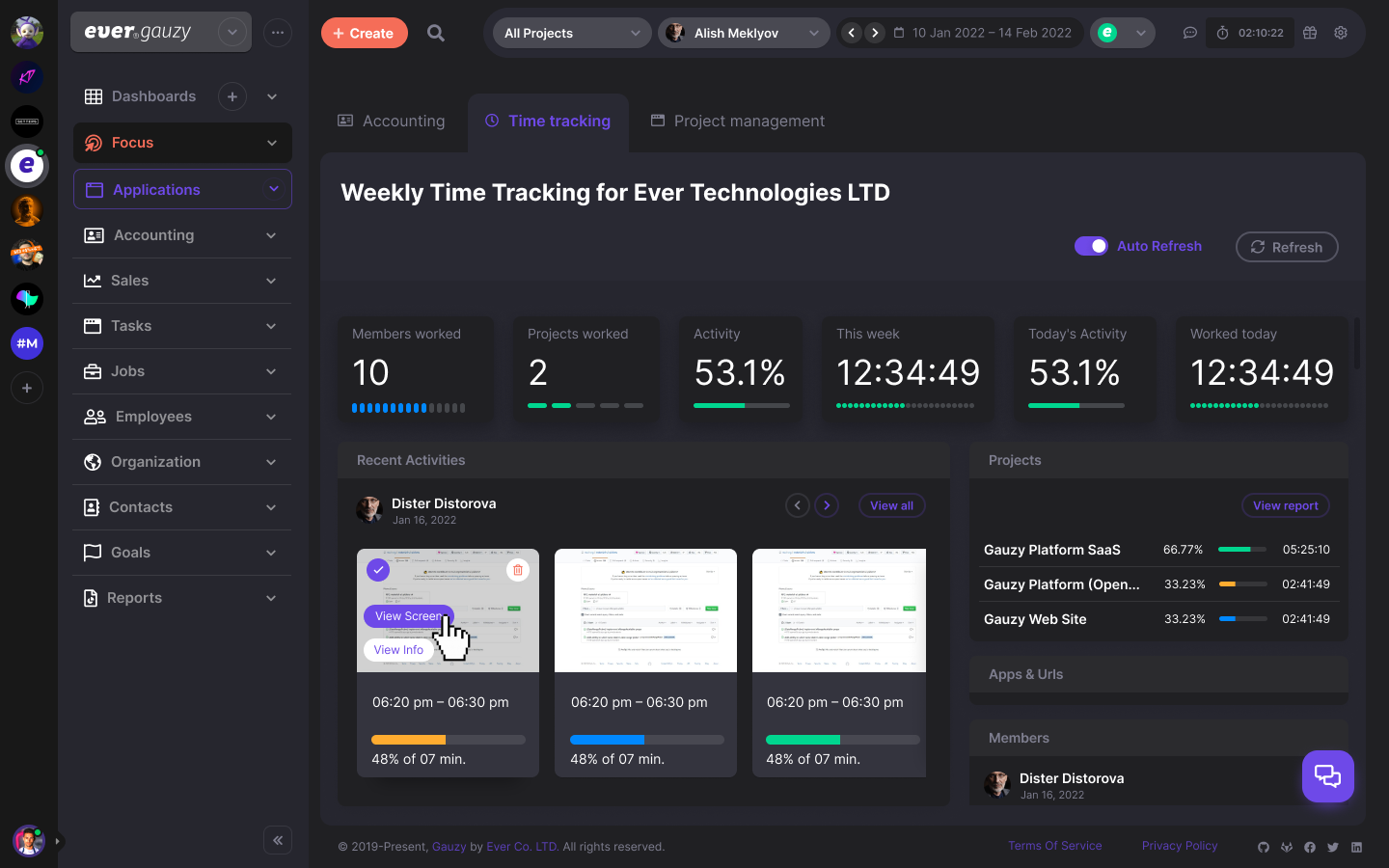

Sharing metadata
| og:url | https://gauzy.co/en |
|---|---|
| og:type | website |
| og:image | https://gauzy.co/assets/overview.png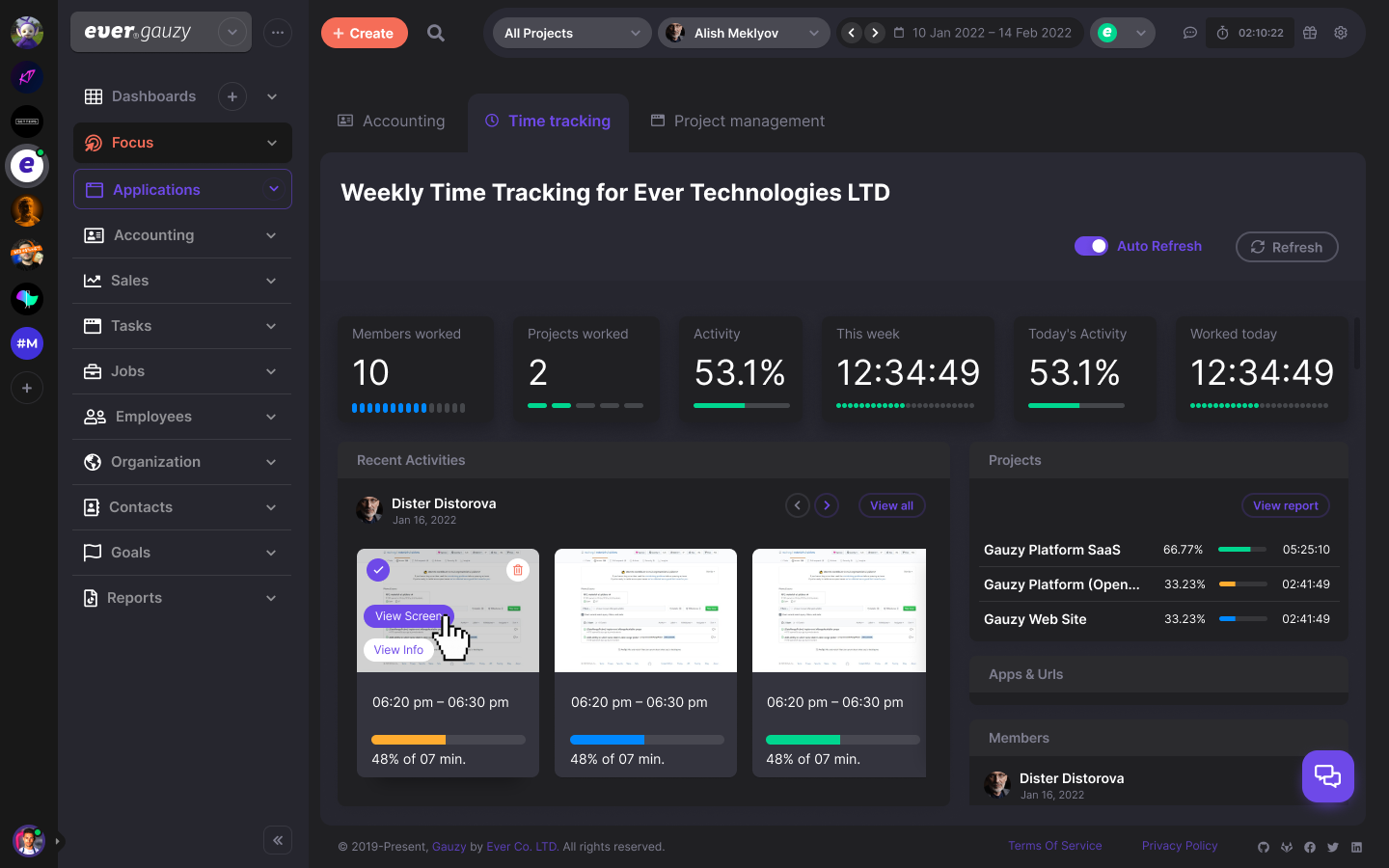 |
| og:title | Ever Gauzy - ERP, CRM, HRM & Project Management Open-Source |
| og:image:alt | Ever Gauzy is an open-source ERP, CRM, HRM, and ATS platform. Manage clients, employees, finances, and projects to improve productivity and sales. |
| og:site_name | Ever Gauzy |
| og:description | Ever Gauzy is an open-source ERP, CRM, HRM, and ATS platform. Manage clients, employees, finances, and projects to improve productivity and sales. |
| og:image:width | 1200 |
| og:image:height | 630 |
| twitter:card | summary |
| twitter:site | @evertech |
| twitter:image | https://gauzy.co/assets/overview.png |
| twitter:title | Ever Gauzy - ERP, CRM, HRM & Project Management Open-Source |
| twitter:creator | @evereq |
| twitter:image:alt | Ever Gauzy is an open-source ERP, CRM, HRM, and ATS platform. Manage clients, employees, finances, and projects to improve productivity and sales. |
| twitter:description | Ever Gauzy is an open-source ERP, CRM, HRM, and ATS platform. Manage clients, employees, finances, and projects to improve productivity and sales. |
| twitter:image:width | 1200 |
| twitter:image:height | 630 |
robots.txt (opens in a new tab)
1 rulesAll bots 1 allowed · 0 disallowed

 All bots

/
No matching rules.
Sitemaps
1 Registration details RDAP / WHOIS
| Registrar | GoDaddy.com, LLC |
|---|---|
| Registered | 2019-06-02 |
| Expires | 2027-06-02 |
| Domain status | clientDeleteProhibited https://icann.org/epp#clientDeleteProhibited、clientRenewProhibited https://icann.org/epp#clientRenewProhibited、clientTransferProhibited https://icann.org/epp#clientTransferProhibited、clientUpdateProhibited https://icann.org/epp#clientUpdateProhibited |
| Nameservers | clark.ns.cloudflare.com、tani.ns.cloudflare.com |
| DNSSEC | unsigned |
 DNS records
| Type | Name | Value | TTL | Priority |
|---|---|---|---|---|
| A | gauzy.co | 104.26.12.182 | 300 | — |
| A | gauzy.co | 104.26.13.182 | 300 | — |
| A | gauzy.co | 172.67.73.37 | 300 | — |
| AAAA | gauzy.co | 2606:4700:20::681a:cb6 | 300 | — |
| AAAA | gauzy.co | 2606:4700:20::681a:db6 | 300 | — |
| AAAA | gauzy.co | 2606:4700:20::ac43:4925 | 300 | — |
| NS | gauzy.co | clark.ns.cloudflare.com | 86400 | — |
| NS | gauzy.co | tani.ns.cloudflare.com | 86400 | — |
| TXT | gauzy.co | google-site-verification=aMzOqCDDoVvKrW4Zfk1wH-GZ2Qb-3Queox4-NjNiioQ | 300 | — |
| TXT | gauzy.co | google-site-verification=nw1_ew46uGNQMCqZPW1dgcs4ir8Q74qVhaZzTUmWfaE | 300 | — |
| TXT | gauzy.co | loaderio=47f81dbf36b6210a7855d492f6702b8a | 300 | — |
| TXT | gauzy.co | v=spf1 include:_spf.google.com include:servers.mcsv.net include:spf.mtasv.net include:sendgrid.net include:_spf.mx.cloudflare.net -all | 300 | — |
| DMARC | _dmarc.gauzy.co | v=DMARC1; p=quarantine; sp=quarantine; rua=mailto:[email protected]; pct=100 | 300 | — |
 TLS and certificates
| Assessment | Normal configuration |
|---|---|
| Supported protocols | TLSv1.2、TLSv1.3 |
| Negotiated protocol | TLSv1.3 |
| Certificate subject | gauzy.co |
| Issuer | Google Trust Services |
| Valid until | 2026-12-15T21:58 · Remaining when checked: 76 days |
| Verification details | Certificate trust: Passed · Hostname match: Passed |
 HTTP response headers
| Header | Value |
|---|---|
| content-type | text/html; charset=utf-8 |
| cache-control | public, max-age=3600, must-revalidate |
| server | cloudflare |
| strict-transport-security | max-age=86400 |
| x-content-type-options | nosniff |
 Identified technologies
User reviews (0)