
 getgrav.org
 Paid content
Categories: Development
Grav is a Modern, Crazy Fast, Ridiculously Easy and Amazingly Powerful Flat-File CMS, now with a first-party REST API and MCP server for headless and AI use.
 Visit website
 Updated: 2026-09-28 22:52
 Language: English (default)
 Access: Normal
 Profile views 3
 Outbound visits 1
Related questions
More questions →What Is OpenAPI-Generated API Documentation and How Does It Work?
OpenAPI-generated API documentation is reference documentation that is produced automatically from an OpenAPI description file rather than written by hand. You write (or generate) a machine-readable specification of your API — endpoints, parameters, request bodies, responses, schemas, and auth — and a documentation tool reads that file and renders a browsable, often interactive reference site. The spec becomes the single source of truth; the docs become a build artifact.
This differs from manually written docs in one fundamental way: with hand-written docs, the prose is the source of truth and the API is described separately. With spec-driven docs, the API description is the source, and every page, table, and code sample is derived from it.
How the workflow actually runs
A typical spec-driven documentation pipeline has five stages:
- Author or generate the spec. You either write an OpenAPI document by hand (YAML or JSON), or generate it from code annotations, framework metadata, or a design-first editor. Design-first means the spec is written before implementation; code-first means it is extracted from existing code.
- Validate and lint. The spec is checked against the OpenAPI schema and against style rules — consistent naming, required descriptions, no undocumented
4xxresponses, no orphaned schemas. - Bundle and transform. Multi-file specs are combined,
$refpointers are resolved, and the document is optionally split into per-tag or per-version outputs. - Render. A documentation tool converts the spec into HTML: an endpoint list, a sidebar of operations, parameter tables, response schemas, and a "try it" console.
- Publish and version. The rendered site is deployed, and each API version gets its own snapshot so consumers can read docs matching the version they call.
Steps 2 through 5 are usually automated in CI. If the spec fails validation, the docs build fails — which is the point.
Spec-driven vs. hand-written documentation
| Dimension | OpenAPI-generated | Hand-written |
|---|---|---|
| Source of truth | The spec file | The prose |
| Consistency with the API | High, if the spec is accurate | Drifts as the API changes |
| Effort per endpoint | Low after setup | Repeated for every endpoint |
| Narrative and tutorials | Weak; needs separate pages | Strong |
| Code samples | Generated per language from schemas | Written and maintained manually |
| Customization | Bounded by the tool's templates | Unlimited |
| Failure mode | Accurate spec, poor docs, or stale spec | Beautiful docs that describe an API that no longer exists |
The practical conclusion most teams reach: generate the reference, write the guides. Reference material is repetitive and mechanical, which is exactly what generation is good at. Conceptual explanations, migration notes, and tutorials carry judgment that a spec cannot express.
What you get out of the box
Generated reference pages commonly include:
- An operation list grouped by tag or path, with HTTP method and path.
- Parameter tables showing name, location (path, query, header, cookie), type, required flag, and description.
- Request and response schemas rendered as expandable trees, including nested objects and arrays.
- Authentication details pulled from the
securitySchemessection. - Interactive request consoles that let a reader send a real call from the browser.
- Generated code samples in several languages, derived from the same schemas.
- Multiple output formats, such as a static site, a single HTML file, or a mock server.
Because all of these come from one document, changing a field name in the spec updates the parameter table, the schema tree, and every code sample at once.
Where spec-driven documentation breaks down
Generation is not free. The trade-offs are real:
Spec quality becomes documentation quality. A field with no description produces a table row with an empty cell. A vague summary produces a vague heading. Tools can enforce presence of descriptions via linting, but they cannot enforce that the description is useful.
Customization has limits. If you need a page that does not map to an OpenAPI concept — a conceptual overview, a pricing explanation, a comparison of two endpoints — you write it outside the generator and link to it.
Not everything is expressible. Webhooks, streaming responses, long-polling behavior, and complex multi-step flows are awkward or impossible to describe fully in OpenAPI. Those need prose.
The spec can go stale. If the spec is maintained separately from the implementation, it drifts just like hand-written docs. The mitigation is to generate the spec from code, or to test the implementation against the spec in CI.
Interactive consoles need care. A "try it" button that hits a production API with real credentials is a security and rate-limit problem. Point it at a sandbox, or disable it.
Deciding whether to adopt it
Adopt spec-driven reference documentation if most of these are true:
- Your API has more than a handful of endpoints, or changes frequently.
- You ship client SDKs or code samples in more than one language.
- Multiple teams consume the API and need a consistent, always-current reference.
- You already have, or are willing to maintain, an OpenAPI description.
Stay with hand-written docs, or a hybrid, if:
- Your API is small and stable, and the reference fits on one page.
- Your documentation is mostly conceptual and contains little endpoint-level detail.
- You cannot commit to keeping the spec in sync with the implementation.
A reasonable middle path: generate the reference from the spec, and hand-write the getting-started guide, authentication walkthrough, and error-handling page. Link the two directions so readers can move from concept to endpoint and back.
A minimal starting checklist
- Produce one valid OpenAPI document for a single API version.
- Add a linter with rules for descriptions, operation IDs, and error responses.
- Wire the docs build into CI so a failing spec fails the build.
- Render the reference and review it as a reader, not as the author.
- Write the two or three conceptual pages the generator cannot produce.
- Version the published docs alongside the API version.
The core idea is simple: describe the API once, in a format both machines and humans can read, and let the reference documentation fall out of that description. Everything else — tooling, hosting, interactivity — is a detail on top of that decision.
What Can You Actually Do With a Free Hosted REST API Like ReqRes?
A free hosted REST API like ReqRes gives you a real HTTP endpoint you can call immediately—no signup, no local server, no database setup. You get predictable JSON responses for users, resources, login, and registration, which makes it useful for front-end demos, integration tests, learning HTTP clients, and prototyping. What it is not is a production backend for your app: the data is shared, resets periodically, and you don't control the schema. If you need persistent, private data with auth and logs, that's where an account-based backend or a commercial licence comes in.
What "free REST API for testing and prototyping" actually means
The phrase sounds vague, so it helps to separate two things people often conflate:
- A mock/sample API — a public, hosted service with fixed or semi-fixed endpoints that return realistic-looking JSON. You don't own the data. It exists so you can point code at a URL and get a response.
- A real backend you configure — a service where you define collections, schemas, authentication, and logging, and where your data persists and belongs to you.
ReqRes's landing page describes both: a free REST API for testing and prototyping with real responses and no signup, plus an option to build your own backend with collections, auth, and logs at app.reqres.in. Those are different products with different trade-offs. The free public endpoints are the "point and go" part; the account-based backend is the "own your data" part.
What you can do with the no-signup public endpoints
1. Front-end demos without a backend
If you're building a UI and need data to render, you can fetch from a public endpoint instead of hardcoding arrays. This keeps your demo code closer to real fetch logic:
async function loadUsers(page = 1) {
  const res = await fetch(`https://reqres.in/api/users?page=${page}`);
  if (!res.ok) throw new Error(`HTTP ${res.status}`);
  const { data, total, page: current } = await res.json();
  return { users: data, total, page: current };
}
You get pagination fields, a data array, and support metadata—enough to build list views, loading states, and empty states.
2. Integration and contract tests
You can assert that your HTTP layer handles status codes, headers, and JSON shapes correctly. Typical checks:
GET /api/users/2returns200with adataobject.GET /api/users/23returns404(a non-existent user).POST /api/loginwith valid credentials returns a token; with missing fields returns400.
This is useful for testing your client wrapper, retry logic, error handling, and serialization—without spinning up your own server.
3. Learning HTTP clients and tooling
If you're new to fetch, Axios, curl, Postman, or HTTPie, a hosted API is a low-friction target. You can practice:
- Sending query parameters (
?page=2,?delay=3). - Setting headers and reading response headers.
- Handling
POST,PUT,PATCH,DELETE. - Observing status codes for success and failure.
4. Deliberate failure and latency testing
Endpoints that return 404 on purpose, or that accept a delay parameter, let you test how your app behaves when things go wrong or slow down. That's hard to do reliably against a happy-path local mock.
What the public endpoints are not good for
| Use case | Public sample endpoints | Account-based backend |
|---|---|---|
| Persistent, private data | No — shared and reset | Yes |
| Custom schema/collections | No | Yes |
| Authentication you control | Limited (demo login) | Yes |
| Request logs and debugging | No | Yes |
| Production traffic | Not intended | Depends on plan/licence |
| Team collaboration | No | Yes |
The key limitation: you don't own the data, and other people are hitting the same endpoints. Treat responses as illustrative, not authoritative.
When you'd move to an account-based backend
Consider app.reqres.in (collections, auth, logs) when any of these are true:
- You need your own collections and fields, not the fixed demo schema.
- You need data to persist between sessions and belong only to you.
- You need real authentication flows you can rely on in a demo or internal tool.
- You need request logs to debug what your client actually sent.
- You're working with a team and need shared, stable endpoints.
The trade-off is setup and, eventually, cost. The public endpoints require none; the backend requires an account and configuration.
Where pricing and licensing become relevant
The site signals a commercial licence and an upgrade path (with Stripe as the payment platform), but specific prices, plan tiers, and limits aren't stated here—so don't assume numbers. What you can reason about:
- Prototyping and learning → free public endpoints are usually enough.
- Internal tools, demos for clients, or anything you don't want reset → an account-based backend is the natural next step.
- Production or commercial use → check the licence terms and any paid plan, because "free for testing" and "free for commercial production" are not the same thing.
Before committing, read the current terms on the site rather than relying on secondhand summaries, since pricing and licence scope change.
A quick decision checklist
- Do you need data that persists and is private? If yes → account-based backend.
- Do you need a custom schema? If yes → account-based backend.
- Are you only testing HTTP behavior, UI rendering, or learning a client? If yes → free public endpoints.
- Will this touch real users or revenue? If yes → review the licence and any paid plan first.
- Do you need logs and team access? If yes → account-based backend.
If you answer "no" to 1, 2, 4, and 5, the free hosted API is likely all you need. If you answer "yes" to any of them, plan for the account-based path.
What Is a CMS and What Does It Actually Do?
A CMS (content management system) is software that lets you create, store, edit, and publish content without hand-coding each page. You need one when more than one person publishes content regularly, when the same content has to appear in more than one place, or when you want to change how your site looks without rewriting the content itself. If you publish a single static page once and never touch it again, a CMS adds overhead you don't need.
The core problem a CMS solves
Without a CMS, every page is a file. Changing the headline on 50 articles means editing 50 files. Adding a byline format means touching every page again. A CMS separates the content from the presentation, so you write the article once and the system assembles the page around it.
That separation is the whole point. It means:
- Editors work in a writing interface, not in HTML.
- Designers change templates, and every page updates.
- The same article can feed a website, an app, and a print layout.
The main components
Most CMS platforms, including media-focused ones like BLOX Digital, are built from the same four parts.
| Component | What it does | What to check |
|---|---|---|
| Content storage | Holds articles, images, video, metadata in a structured database | Can you model your content types, or are you stuck with "post" and "page"? |
| Editing interface | Where writers create and format content | Does it support the workflow your team actually uses? |
| Templates / themes | Control how stored content renders on each channel | Can you change layout without touching content? |
| Publishing workflow | Draft, review, schedule, publish, unpublish | Are roles and approvals built in, or bolted on? |
A CMS that only does the first two is really just a writing tool. The value shows up in the last two.
CMS vs. website builder vs. DMP vs. VMS
These get confused because they overlap at the edges.
- Website builder — drag-and-drop page design, usually for a small fixed site. Weak on structured content, workflows, and multi-channel output.
- CMS — built around content items and their relationships. Better when you have many authors, many articles, and more than one destination.
- DMP (data management platform) — collects and organizes audience data. It doesn't publish content; it tells you who's reading it.
- VMS (video management system) — stores, transcodes, and delivers video. A CMS may embed a VMS, but they solve different problems.
BLOX Digital, for example, describes itself as covering CMS, digital publishing, advertising, engagement, and video management together — which is typical of platforms aimed at media organizations rather than general websites.
The choice depends on content type and channel
This is where most CMS evaluations go wrong. People compare feature lists instead of asking what they publish and where it has to go.
- Text-heavy news site — needs fast publishing, scheduling, taxonomy, and archive search.
- Broadcast or video-first — needs a VMS that integrates with the CMS, not a CMS with a video field.
- Print plus web — needs one content store that can output to both, or you'll retype everything.
- College or small media — needs low setup overhead and simple roles more than deep customization.
If your content lives in one channel and one format, a simple CMS is enough. The moment you add a second channel, integration between the CMS and the other tools becomes the deciding factor.
Practical criteria for evaluating a CMS
- Ease of use for non-technical staff. Have an actual editor try to publish a story with an image and a scheduled time. Time it.
- Scalability. Ask how the system handles a traffic spike and a content archive of tens of thousands of items.
- Integrations. List the tools you already use — ad server, video, analytics, paywall — and confirm each one connects.
- Cost model. Pricing is often subscription-based and quoted per organization, so ask directly rather than assuming. BLOX Digital, for instance, lists a "BLOX Pay" product and uses subscription language, but does not publish rates on the pages reviewed here.
- Migration path. Ask what it takes to move your existing content in — and back out.
What to do next
Write down your content types, your publishing channels, and the number of people who touch a story before it goes live. That list, not a feature comparison, tells you whether you need a CMS at all and which category of platform fits. Then evaluate two or three options against the same list, using a real publishing task as the test.
What Is a Headless CMS and How Is It Different From a Traditional CMS?
A headless CMS is a content backend that stores and models your content, then exposes it through APIs (typically REST and GraphQL) instead of rendering finished web pages itself. The "head" — the presentation layer — is removed, so any frontend (website, mobile app, kiosk, or another service) can fetch the same content and decide how to display it. You should consider one when you need to deliver content to more than one channel, want full control over the frontend stack, or need to customize backend behavior. A traditional, coupled CMS is usually simpler when you only need a single website and want editing and publishing to work out of the box.
The core difference: coupled vs. decoupled
A traditional CMS bundles two jobs into one system: managing content and rendering the pages visitors see. The theme or template layer is part of the CMS, so content and presentation are tightly linked.
A headless CMS splits those jobs. The content model, editorial workflow, and storage stay in the CMS; the rendering moves to whatever frontend you build. The CMS becomes a content API rather than a website builder.
| Dimension | Traditional (coupled) CMS | Headless CMS |
|---|---|---|
| Content delivery | Rendered HTML pages | REST / GraphQL APIs |
| Frontend | Built into the CMS (themes, templates) | Any stack you choose |
| Channels | Usually one website | Web, mobile, apps, services |
| Customization | Limited to the CMS's plugin/theme system | Framework-level: controllers, services, middleware |
| Editorial preview | Native, since rendering is built in | Requires wiring a preview frontend |
| Setup effort | Lower to launch a site | Higher — you build the frontend |
How the API layer works
In a headless setup, you define content types (for example, an article with a title, body, author, and tags). The CMS turns that model into endpoints. A frontend then requests content over HTTP and renders it however it wants.
Strapi illustrates this pattern: you design content types, components, and dynamic zones in a no-code builder, and the system exposes them as REST and GraphQL APIs "instantly, fully typed." Because it is a Node.js/TypeScript application, you can also write custom controllers, services, and middleware on the backend and reshape the admin panel — extending it "like a framework" while still running it "like a CMS."
A typical request flow looks like this:
- An editor creates or updates an entry in the CMS admin.
- The CMS stores it against the content model.
- A frontend calls the REST or GraphQL endpoint for that content type.
- The frontend renders the response for its specific device or context.
The same content can feed a marketing site, a mobile app, and an internal tool without duplication, because each consumer just calls the API.
What you gain
- Frontend freedom. You pick the framework and rendering strategy instead of inheriting the CMS's theme system.
- Omnichannel delivery. One content source serves web, mobile, and other devices through the same API.
- Framework-level control. With an open-source, self-hostable option like Strapi, you own the code (MIT-licensed), the content model, and the data — and can customize the admin, APIs, and data layer.
- Deployment flexibility. The same codebase can run on managed hosting or your own servers, which matters when data residency or infrastructure control is a requirement.
What you give up
- You build the frontend. There is no ready-made site; the presentation layer is your responsibility.
- Preview and editorial workflow need wiring. Because rendering lives elsewhere, live preview and some editorial conveniences that a coupled CMS provides natively require extra setup.
- More moving parts. You now operate a content API plus a frontend, which adds build and deployment complexity compared with a single coupled system.
When headless is the right fit
Choose headless when:
- You need to publish to multiple channels or devices from one content source.
- You want to use a specific frontend stack rather than a CMS's built-in theming.
- You need to customize backend logic (custom controllers, services, middleware) or the admin experience.
- You want to own the code and data, and possibly self-host for control over data residency.
Choose a traditional coupled CMS when:
- You only need a single website and want it live quickly.
- You prefer editing and preview to work without additional frontend work.
- You don't need to serve content to apps or other services.
A quick way to evaluate
Ask two questions. First: does this content need to reach more than one kind of frontend? If yes, a headless CMS removes duplication. Second: do you have (or want) the engineering capacity to build and maintain a frontend? If not, the coupled model's built-in rendering is the simpler path. If both answers point toward flexibility and control, a headless CMS like Strapi — open-source, TypeScript-based, and deployable either to managed cloud or your own infrastructure — is built for exactly that trade-off.
What Does "Open Source" Mean for a Zen Cart Online Store?
Open source means the software's source code is publicly available, so anyone can inspect, modify, and redistribute it. Zen Cart, the platform running this reptile supply store, is open-source e-commerce software: the store owner can read and change the code, and no license fee is paid to a vendor. That matters to a small shop because it removes per-sale or monthly software fees and allows deep customization — but it also means the owner (or a developer they hire) handles hosting, updates, and security. Note that "open source" here describes the store software, not the reptile foods and supplements sold on it.
Open source in plain terms
Proprietary store platforms typically charge a subscription or a percentage of sales and keep their code closed. Open-source platforms publish the code under a license that permits use and modification. In practice, for a store like this one:
- No license fee. You pay for hosting and your own time, not for permission to run the software.
- Full access to the code. Layouts, checkout flow, and product pages can be changed beyond what a theme editor allows.
- Community development. Fixes and add-ons come from contributors and other store owners, not only from one company.
What it looks like on this store
The page evidence shows a typical Zen Cart storefront: category navigation (Bee Pollen, Cat Grass, Chia Seeds, Dandelion, Sprouting Seeds, Supplements), an "All Products" listing, reviews, and an information block with About Us, Shipping & Returns, Privacy Notice, Conditions of Use, Order Status, Site Map, Gift Certificate FAQ, and Discount Coupons. That structure — categories, reviews, coupons, gift certificates, order status — is what the platform provides out of the box. The store also publishes care guides (Russian Tortoise Care, Box Turtle Care, Redfoot Tortoise Care) and growing instructions, which are content pages the owner added rather than built-in store features.
Benefits for a small pet supply shop
- Cost control. No platform subscription means a low fixed cost that doesn't scale with order volume.
- Custom catalog logic. A shop selling seeds, dried weeds, and supplements by weight can adjust product options, units, and shipping rules directly in the code.
- Content and commerce in one place. Care guides and growing instructions sit alongside the catalog, which supports the store's stated role of helping customers find foods for herbivore reptiles.
- No vendor lock-in on data. You can export and migrate your catalog if you decide to move.
Trade-offs to plan for
| Concern | What it means in practice |
|---|---|
| Hosting | You arrange your own web host and domain; the platform doesn't host the store for you |
| Security updates | You apply patches yourself or pay someone to; skipping them is the main risk |
| Technical maintenance | Theme changes, add-ons, and upgrades need someone comfortable with PHP-based code |
| Support | Help comes from forums, documentation, and paid developers rather than a single support line |
| Add-on quality | Third-party modules vary; test before relying on them for checkout or payments |
Deciding whether it fits your store
Choose an open-source cart like Zen Cart if you want no license fees, need code-level customization, and have either technical skills or a developer you can call. Choose a hosted subscription platform instead if you'd rather not manage hosting, patches, and upgrades, and you're comfortable paying monthly for that convenience. A middle path works for many small shops: run the open-source cart on managed hosting that handles server updates, and keep a developer on retainer for store-level changes.
If you're evaluating this specific store as a model, the useful signal is that a niche reptile supply shop can run a full catalog, reviews, coupons, and care content on open-source software without a platform fee — the cost shifts from subscriptions to maintenance.
Website Overview
An established domain and managed infrastructure suggest continuity of operations and may support dependable delivery, although neither guarantees service quality. Page metadata, canonical configuration and social previews work together to provide more consistent search and sharing presentation.
Domain and Registration
Registered in 2014, this domain has about 12 years of history. That suggests continuity, although ownership and purpose may have changed. Transfer-protection status is present, helping reduce the risk of unauthorized domain transfers. The registrar is GoDaddy.com, LLC, a widely used domain service provider. The domain uses the common .org extension, which is not an independent safety signal.
DNS and Email
Nameservers are provided by Cloudflare, indicating managed DNS hosting. MX records point to the Cloudflare Email Routing email service. No CNAME was found; the observed records resolve directly to addresses. SPF and DMARC are configured. DKIM status is unknown. TXT records include verification markers for Google. Such markers may also remain after a service stops being used.
TLS and Certificates
The public key uses EC with 256 bits. The server supplied a complete certificate chain. No organization name is present in the certificate; the available fields are consistent with domain validation. The certificate was issued within the Google Trust Services cloud or CDN ecosystem. The certificate's total validity is about 90 days, consistent with a short renewal cycle.
HTTP and Browser Security
No X-Powered-By header was found, reducing one common source of backend fingerprinting information. All six checked browser-security headers are present. Their effectiveness still depends on the policy values and application behavior. The cf-ray response header indicates a CDN or caching proxy in the delivery path. No obvious internal addresses or debug information were found in the headers. The Server header identifies cloudflare without an exact version.
Technology Stack Analysis
The public page identifies GravCMS, Alpine.js, Google Analytics, Cloudflare without precise versions, leaving fewer clues for version-specific scanning.
Search and Social Sharing
The Generator tag identifies GravCMS, making the publishing system easier to fingerprint. Twitter Card metadata is configured. JSON-LD includes Organization data, helping describe the organization as an entity. The title has 50 characters, within a common display range. A meta description is present, with 157 characters.
 Hosting and Email
 Cloudflare
 Hosting
 Location
 unknown
104.26.2.204
Location
Location unknown
104.26.2.204
 Pages, Search and Sharing
| Meta description | Grav is a Modern, Crazy Fast, Ridiculously Easy and Amazingly Powerful Flat-File CMS, now with a first-party REST API and MCP server for headless and AI use. |
|---|---|
| Canonical URL | https://getgrav.org/ |
| Language | English (default) |
| Twitter Card | summary_large_image |
Social Sharing Preview
16 fields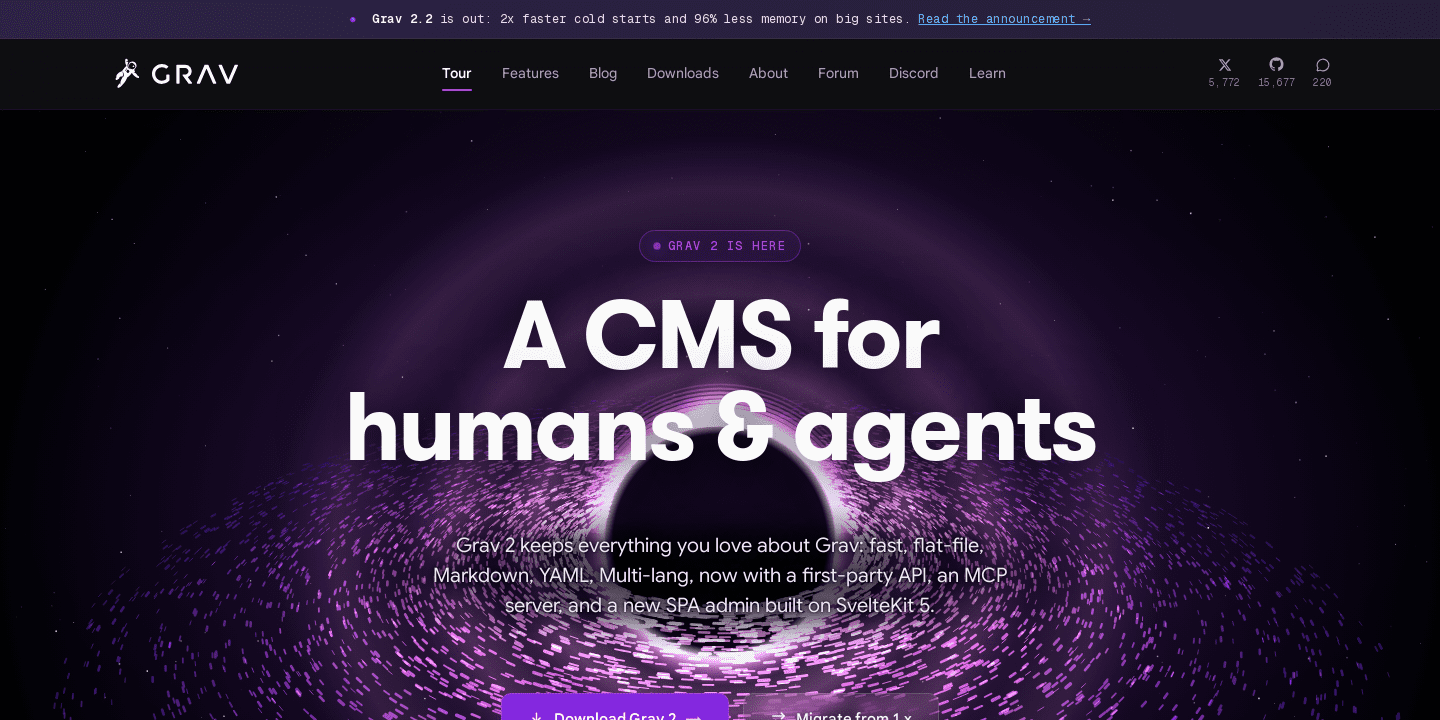

Sharing metadata
| og:url | https://getgrav.org/ |
|---|---|
| og:type | website |
| og:image | https://getgrav.org/seomagic-image.jpg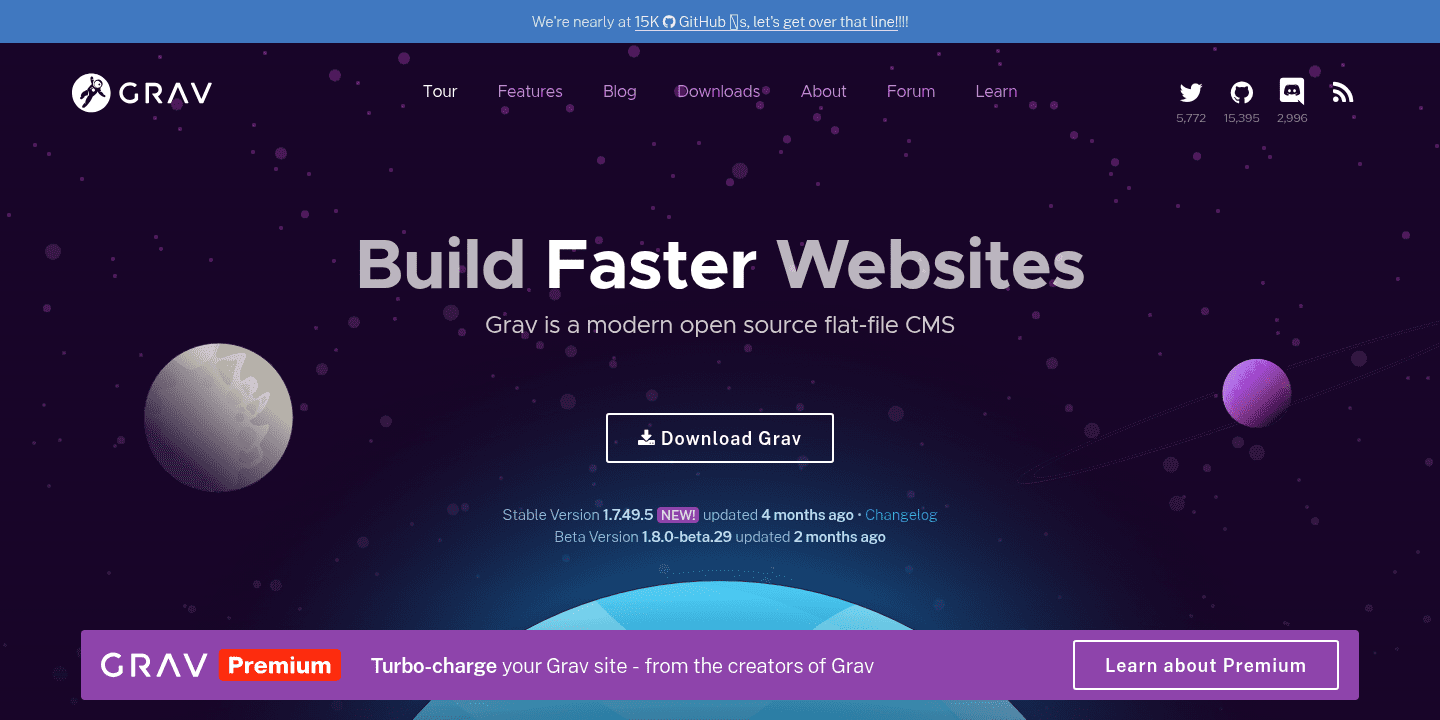 |
| og:title | Grav - Modern Flat-File & API-First CMS | Grav CMS |
| og:locale | en_US |
| og:image:alt | Grav - Modern Flat-File & API-First CMS | Grav CMS |
| og:site_name | Grav CMS |
| og:description | Grav is a Modern, Crazy Fast, Ridiculously Easy and Amazingly Powerful Flat-File CMS, now with a first-party REST API and MCP server for headless and AI use. |
| og:image:width | 1440 |
| og:image:height | 720 |
| og:image:secure_url | https://getgrav.org/seomagic-image.jpg |
| twitter:card | summary_large_image |
| twitter:image | https://getgrav.org/seomagic-image.jpg |
| twitter:title | Grav - Modern Flat-File & API-First CMS | Grav CMS |
| twitter:image:alt | Grav - Modern Flat-File & API-First CMS | Grav CMS |
| twitter:description | Grav is a Modern, Crazy Fast, Ridiculously Easy and Amazingly Powerful Flat-File CMS, now with a first-party REST API and MCP server for headless and AI use. |
robots.txt (opens in a new tab)
3 rulesAll bots 1 allowed · 2 disallowed

 All bots

/
/download//forum/search
No matching rules.
Sitemaps
1 Registration details RDAP / WHOIS
| Registrar | GoDaddy.com, LLC |
|---|---|
| Registered | 2014-02-22 |
| Expires | 2027-02-22 |
| Domain status | client delete prohibited、client renew prohibited、client transfer prohibited、client update prohibited |
| Nameservers | arch.ns.cloudflare.com、pat.ns.cloudflare.com |
| DNSSEC | unsigned |
 DNS records
| Type | Name | Value | TTL | Priority |
|---|---|---|---|---|
| A | getgrav.org | 104.26.2.204 | 85 | — |
| A | getgrav.org | 104.26.3.204 | 85 | — |
| A | getgrav.org | 172.67.72.160 | 85 | — |
| AAAA | getgrav.org | 2606:4700:20::681a:2cc | 300 | — |
| AAAA | getgrav.org | 2606:4700:20::681a:3cc | 300 | — |
| AAAA | getgrav.org | 2606:4700:20::ac43:48a0 | 300 | — |
| MX | getgrav.org | route2.mx.cloudflare.net | 300 | 21 |
| MX | getgrav.org | route3.mx.cloudflare.net | 300 | 78 |
| MX | getgrav.org | route1.mx.cloudflare.net | 300 | 82 |
| NS | getgrav.org | arch.ns.cloudflare.com | 86400 | — |
| NS | getgrav.org | pat.ns.cloudflare.com | 86400 | — |
| TXT | getgrav.org | google-site-verification=4ETIa6esb5f0GxKPZLBmmVytuFJ_CXWI9IHUg2wFJSw | 300 | — |
| TXT | getgrav.org | google-site-verification=TmkA2Zcea-O7X5coOsbMglfG1mgL02-rI8m5Ssf3Q0c | 300 | — |
| TXT | getgrav.org | v=spf1 include:_spf.mailersend.net include:_spf.mx.cloudflare.net ~all | 300 | — |
| DMARC | _dmarc.getgrav.org | v=DMARC1; p=none; rua=mailto:[email protected],mailto:[email protected]; rf=afrf; sp=none; fo=0:1:d:s; adkim=r; aspf=r | 300 | — |
 TLS and certificates
| Assessment | Normal configuration |
|---|---|
| Supported protocols | TLSv1.2、TLSv1.3 |
| Negotiated protocol | TLSv1.3 |
| Certificate subject | getgrav.org |
| Issuer | Google Trust Services |
| Valid until | 2026-11-28T19:45 · Remaining when checked: 60 days |
| Verification details | Certificate trust: Passed · Hostname match: Passed |
 HTTP response headers
| Header | Value |
|---|---|
| content-type | text/html; charset=utf-8 |
| cache-control | no-store, no-cache, must-revalidate |
| server | cloudflare |
| strict-transport-security | max-age=15552000; includeSubDomains |
| content-security-policy | upgrade-insecure-requests |
| x-frame-options | SAMEORIGIN |
| x-content-type-options | nosniff |
| referrer-policy | strict-origin-when-cross-origin |
| permissions-policy | camera=(), geolocation=() |
| set-cookie | Redacted |
 Identified technologies
Recent Updates
- Website images
- Screenshots
- Network details
- Website Technologies
- Pages and Search Information
- HTTP Response Information
- TLS and certificates
- DNS Information
- Domain Registration
- Website profile
- Website Description
- Website Name
- Website profile
- Website Description
- Website Name
User reviews (0)