Website profiles · Technology insights · Alternatives

guesswhereyouare.com No paid content found Multilingual

Categories: Other

Guess Where You Are is a free, unlimited, and open alternative to GeoGuessr. Enjoy guessing locations and improve your geography skills — all for free!

Visit website

Updated: 2026-09-30 02:38 Language: English (default) Access: Normal

Profile views 1 Outbound visits 0
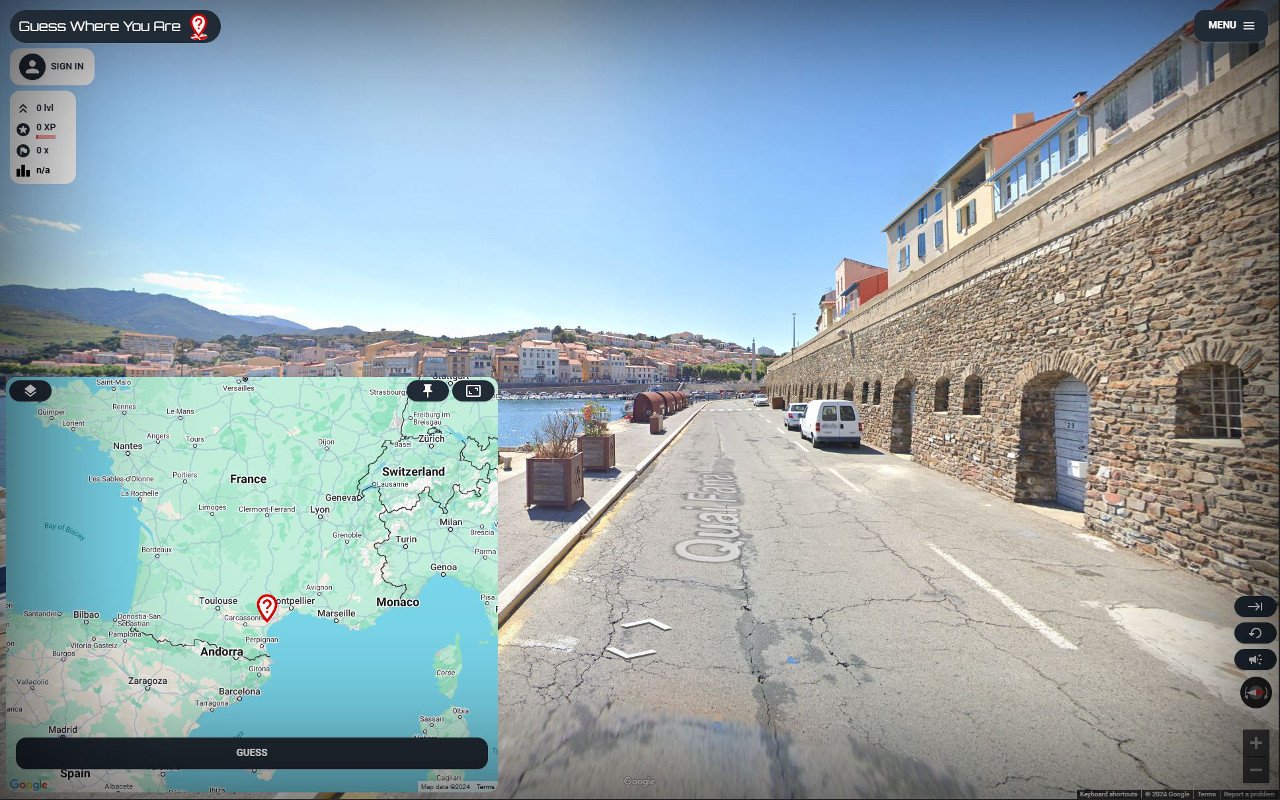
Guess Where You Are Full homepage screenshot
Editorial Review

Website Review

What is Guess Where You Are?

Guess Where You Are is a free browser-based geography guessing game positioned as an open alternative to GeoGuessr. You are dropped into a location and use the visual clues around you — road markings, signage, architecture, landscape, driving side — to work out where in the world you are.

According to its own description, the main draw is that it is free and unlimited, so you can play as many rounds as you like without a paywall or round cap. It also presents itself as an open project and frames the goal as improving geography skills rather than just scoring points.

Guess Where You Are

Who it suits

  • Casual players who want a few rounds without committing to a subscription.
  • Geography learners using real street-level scenes to build recognition of countries and regions.
  • GeoGuessr users looking for a no-cost alternative for practice between paid sessions.

A useful next step

Open the site and play one round with a deliberate method: scan for language on signs, then driving side, then vegetation and road quality, and only then guess. Compare your reasoning against the actual answer each time — that habit, more than raw play volume, is what improves location intuition.

How does Guess Where You Are compare to GeoGuessr?

Guess Where You Are is positioned as a free, unlimited, open alternative to GeoGuessr: the core loop is the same — you're dropped somewhere in the world and you guess the location from street-level imagery — but the emphasis is on no paywall and no round limits, which matters if you play often or in long sessions.

The practical difference comes down to what you're optimizing for:

Your priority Better fit
Practicing geography daily without a subscription Guess Where You Are
Unrestricted rounds, casual or marathon play Guess Where You Are
Polished competitive modes, rankings, structured multiplayer GeoGuessr
A large established player base and community maps GeoGuessr

For a concrete scenario: a teacher running a weekly geography warm-up with a class, or a student drilling country recognition for 30 minutes a night, gets more value from an unlimited free game than from a limited free tier. Someone chasing leaderboard placement or playing organized duels against a wide pool of strangers is likely better served by the paid incumbent.

A sensible next step is to test both on the same task: play five rounds on Guess Where You Are and five on GeoGuessr, and note whether the map coverage or scoring feedback teaches you faster. If the free option covers the regions you care about, the subscription becomes hard to justify; if you find yourself missing specific modes or a ranked ladder, that's your signal to pay.

Is Guess Where You Are completely free to play?

Yes — Guess Where You Are is described as a free, unlimited, open alternative to GeoGuessr, so there is no paywall standing between you and a round. That "unlimited" part is the meaningful difference: many location-guessing games meter your plays per day or lock extra modes behind a subscription, whereas this one presents itself as open-ended.

What "free" actually changes for you

  • No daily cap. You can play as many rounds as you like in one sitting, which matters if you're drilling a weak region rather than just killing five minutes.
  • No commitment to test it. You can try a round, decide the map style or difficulty isn't for you, and walk away without a cancelled trial to worry about.
  • Practice-friendly. Geography improvement comes from repetition — guessing, being wrong, and seeing where you actually were. A play limit works directly against that loop.

Where the trade-off sits

Free and unlimited usually means the experience is leaner than a paid competitor: fewer hand-curated map sets, less polished multiplayer, and no formal ranking ladder. If your goal is casual practice or a quick game with friends, that's a fine trade. If you want structured competitive play or niche regional maps, a paid tool may still earn its cost.

Next step: open a round, note which continent you misjudge most often, then play ten rounds deliberately focused on that region. That turns "free and unlimited" into actual skill rather than just volume.

What game modes are available in Guess Where You Are?

The site's own listing describes it simply as a free, unlimited, open location-guessing game, and the page evidence provided does not name or enumerate specific game modes. So the honest answer is that the available information does not confirm a mode list — any claim about a "Daily Challenge," "Battle Royale," or similar would be speculation.

What the description does support is the core loop: you are shown a location and you guess where it is, with unlimited rounds and no paywall. That framing points to a single continuous practice-style mode rather than a menu of separate competitive formats.

How to check for yourself

  1. Open Guess Where You Are and look at the home screen for mode buttons or tabs before starting a round.
  2. Note whether there is a timer, a round limit, or a score — those are the usual markers of distinct modes.
  3. Play one round and see what appears on the results screen; options like "play again," "next round," or a map review often reveal whether other formats exist.

What usually differs between modes

Mode type Typical audience Trade-off
Unlimited casual rounds New players, casual practice No pressure, but no ranking incentive
Timed rounds Players training speed Faster recall, more frustration
Multiplayer or duel Competitive players Fun pressure, depends on having other players online
Daily or fixed set Players who want a shared challenge One attempt per day, less replay value

If you mainly want to build geography recognition without cost or round limits, the unlimited free format is the relevant draw. If you want head-to-head play or a shared daily puzzle, verify those exist on the site before committing, since the supplied description does not confirm them.

Can I play Guess Where You Are without creating an account?

Yes. Guess Where You Are is presented as a free, unlimited, open alternative to GeoGuessr, and nothing in the page evidence points to a required sign-up. The typical pattern for this kind of browser game is that you land on the page, get dropped somewhere in the world, and start guessing — no email, password or profile needed.

What you can expect without an account

  • Instant play. No registration wall before your first round.
  • Unlimited rounds. The "unlimited" framing suggests you are not capped by a free-tier round limit.
  • No payment step. There are no pricing or payment signals on the page, so you should not be asked for card details.
  • No saved history. Without an account, expect your scores and streaks to live only in your current session or browser.

When an account would actually matter

If you want a persistent score history, a leaderboard rank, or progress that follows you across devices, an account is usually the mechanism for that. If you only want to practise map reading for twenty minutes, skipping it costs you nothing.

A quick way to decide

Open the site and try one round. If you reach the first location without being asked to log in, you have your answer, and you can judge the map quality before committing to anything.

How can Guess Where You Are help improve my geography skills?

It turns scattered map knowledge into active recall. Instead of reading about a country, you're dropped into a random street view and must reason your way out: road markings, driving side, vegetation, architecture, license plates, sun position. That retrieval practice is what makes place knowledge stick.

Guess Where You Are is positioned as a free, unlimited, open alternative to GeoGuessr, so the main practical benefit is repetition without a round limit — you can play many short rounds in one sitting, which matters more for geography learning than any single hard round.

What it actually trains

  • Country and region recognition — matching visual cues to places, not memorizing lists.
  • Spatial relationships — learning that certain landscapes, languages on signs, or road styles cluster in particular regions.
  • Direction and scale — estimating distance and hemisphere from sunlight, climate and terrain.
  • Vocabulary in context — place names, script systems and language families you meet on signs.

A concrete way to use it

Play ten rounds and, after each guess, write down why you chose that spot. Keep a running list of cues: "left-hand traffic + red soil + eucalyptus = Australia," "Cyrillic signage + Mediterranean coast = Bulgaria." Review the list before your next session. This turns a guessing game into a study loop, and it's the fastest way to convert lucky guesses into reliable pattern recognition.

Who benefits most

Player Best use
Student revising world geography Short daily sessions to reinforce regions and capitals
Quiz or trivia enthusiast Building fast recall of flags, languages and terrain
Casual player Learning passively while playing for fun
Teacher Warm-up activity or classroom competition

Trade-offs to expect

Random rounds are unpredictable, so you may get several locations from the same country and learn unevenly. If your goal is exam-style coverage, deliberately seek out regions you keep failing rather than just playing more rounds. And because it's a visual game, it strengthens recognition and inference more than it teaches political boundaries, population data or history — pair it with an atlas or textbook for those.

A useful next step: pick one continent per week, play only until you can name the country from a single glance, then move on.

Related questions

More questions →
What Is Guess Where You Are and How Do You Play It?

Guess Where You Are (guesswhereyouare.com) is a free, unlimited, open alternative to GeoGuessr. You're shown a street-level location somewhere in the world, you drop a pin on a map where you think it is, and you score based on how close your guess is to the real spot. It's aimed at anyone who wants to practice geography or just play a location-guessing game without a paywall or round limit.

How a Round Works

The core loop is simple and consistent across most location-guessing games:

  1. View a location. You're placed in a street-level or panoramic view somewhere in the world. Look around, pan, and zoom to gather clues.
  2. Drop a guess. Open the map and place a pin where you think the location is.
  3. Score by distance. Your guess is compared to the actual location, and you're awarded points based on how close you got. Closer guesses score higher.

That's the whole mechanic. The skill comes from reading the environment — signs, language, driving side, vegetation, architecture, license plates, and road markings — to narrow down a country and region before you commit to a pin.

Game Modes and Difficulty

Free alternatives like this typically offer a few ways to play, and difficulty usually scales with how much freedom you have:

  • Standard/world mode — guess anywhere on the globe with no restrictions.
  • Region or country modes — restrict the map to a specific area, which is useful for focused practice.
  • Timed vs. untimed — some modes add a clock, others let you take as long as you want.
  • Difficulty options — often control whether you can move/pan, zoom, or rotate, or whether the map is limited.

Because the site positions itself as free and unlimited, you can generally play as many rounds as you like without hitting a cap. Check the in-game menu for the exact modes available, since these can change.

How It Compares to GeoGuessr and Other Free Alternatives

Dimension Guess Where You Are GeoGuessr Other free alternatives (e.g., OpenGuessr, WorldGuessr)
Cost Free Free tier + paid plans Free
Round limits Unlimited Limited on free tier Varies
Openness Open positioning Proprietary Varies
Core mechanic View → guess → score by distance Same Same
Best for Unlimited casual practice Polished competitive play Casual practice

The main draw of free, open alternatives is removing the two things that push people away from paid games: round limits and subscriptions. If your goal is volume — lots of reps to build geography intuition — an unlimited free game is the better fit. If you want ranked competition and a large polished ecosystem, the paid option may still appeal.

Tips for Improving Accuracy

Accuracy comes from building a mental checklist you run through every round:

  • Language and script. Signs and text narrow down countries fast.
  • Driving side. Left-hand traffic eliminates many countries immediately.
  • License plates and road markings. Colors and formats are strong regional signals.
  • Vegetation and terrain. Climate zones point you toward latitude and region.
  • Architecture and infrastructure. Building styles, poles, and bollards are distinctive per country.
  • Sun position and shadows. Can hint at hemisphere and time of day.

Practice deliberately: after each round, note why the real location was where it was, and add that clue to your mental library. Over many unlimited rounds, this compounds quickly.

Common Issues and Troubleshooting

Loading problems are the most common complaint with browser-based street-view games. If a round won't load:

  • Refresh the page and try again — temporary view-fetch failures are common.
  • Check your connection. Street-level imagery is data-heavy.
  • Try a different browser or disable extensions that block scripts.
  • Clear cache if views consistently fail to appear.
  • Wait and retry if the imagery source itself is slow.

If a specific location is blank or broken, it's usually a bad panorama rather than a problem on your end — skip or reload the round.

Bottom Line

Guess Where You Are is a free, unlimited, open location-guessing game: view a spot, drop a pin, score by distance. It's a solid choice if you want unrestricted practice to build geography skills, and a reasonable free alternative to GeoGuessr if round limits or subscriptions are what's holding you back.

What Are the Best Free GeoGuessr Alternatives?

Guess Where You Are is a free, unlimited, open alternative to GeoGuessr, and it's the most direct answer if you want to play a location-guessing game without hitting a paywall or a daily round limit. Other names that come up in the same search — OpenGuessr and WorldGuessr — are also positioned as free GeoGuessr-style games. The right pick depends on whether you care most about unlimited play, no account requirement, or a specific map and game mode. If you just want to start guessing, open a free alternative in your browser and play; no download or payment is implied by any of these.

What "free" actually means for these games

"Free alternative" gets used loosely, so it helps to separate two very different things:

  • Free and unlimited — no cap on how many rounds or games you play, and no paywall blocking core features. Guess Where You Are describes itself this way: free, unlimited, and open.
  • Free with limits — you can play, but the free tier restricts rounds per day, locks certain modes, or pushes you toward a subscription.

GeoGuessr itself is the reference point here: it's the best-known game in this category, and its paid model is exactly why people search for alternatives. When a site calls itself a "free GeoGuessr alternative," the useful question is whether that means unlimited or free until you hit a wall.

The main free alternatives

Option Positioning What to expect
Guess Where You Are Free, unlimited, open alternative to GeoGuessr No round cap described; play in the browser
OpenGuessr Free GeoGuessr-style guessing game Free-to-play location guessing
WorldGuessr Free world guessing game Location guessing with a world map focus

All three sit in the same genre: you're dropped somewhere in the world via street-level or map imagery, you look around for clues, and you place a pin on a map to guess where you are. The scoring loop — closer guess, more points — is the same across them.

The practical difference between them is less about the core mechanic and more about how much you can play before something stops you, and which maps or modes are available.

Which one should you pick?

  • Pick Guess Where You Are if unlimited play is your priority and you don't want to create an account or pay. Its own description emphasizes free, unlimited, and open, which directly targets the main frustration with GeoGuessr.
  • Pick OpenGuessr if you want a well-known free option in the same style and are fine with whatever limits its free tier has.
  • Pick WorldGuessr if you specifically want a world-map guessing experience and a free entry point.

If you're unsure, start with the one that advertises unlimited play, since running out of rounds is the most common complaint that sends people searching in the first place.

How to start playing without an account or payment

The general flow for any of these:

  1. Open the site in a browser (desktop or mobile).
  2. Start a game — most drop you straight into a location.
  3. Look around: read signs, license plates, road markings, architecture, vegetation, and language.
  4. Click or tap the map to place your guess.
  5. Submit and see how close you were, then continue to the next round.

Expected result: you're guessing locations within seconds of loading the page, with no signup step required for the free options described here. If a site does ask you to register, that's a signal its "free" tier may be gated — worth noting before you commit.

Common limitations and how to work around them

  • Daily round caps. The most common free-tier limit. Workaround: use an option that advertises unlimited play, like Guess Where You Are.
  • Locked game modes or maps. Some free tiers restrict certain regions or modes. Workaround: check which modes are open before you get attached to one, or switch to a site that includes them.
  • Ads. Free games often carry ads. There's usually no way around this short of paying, so treat it as the cost of free.
  • No account = no saved stats. If you play without registering, progress may not persist between sessions. If tracking improvement matters to you, keep your own notes on regions you keep missing.

The bottom line

For a genuinely free, unlimited GeoGuessr alternative, Guess Where You Are is the clearest match, with OpenGuessr and WorldGuessr as solid free options in the same genre. All of them let you start guessing immediately in a browser. The deciding factor is almost always the same: how many rounds you get before a limit kicks in, and whether the modes you want are unlocked.

What Is OpenGuessr and How Does It Compare to Other Free GeoGuessr Alternatives?

OpenGuessr is a free, browser-based location guessing game in the same genre as GeoGuessr: you're dropped into a street-level view somewhere in the world and have to work out where you are. It's one of several free alternatives — alongside sites like Guess Where You Are and WorldGuessr — and the main reason people pick any of them is to play without paying or hitting a round limit. If you want unlimited guessing sessions at no cost, a free alternative is the right category; if you specifically want GeoGuessr's official map pool and competitive ladder, you'll need GeoGuessr itself.

What OpenGuessr actually is

OpenGuessr belongs to the "openguessr / worldguessr / geoguesser" family of free location guessing games. The core loop is consistent across all of them:

  1. You're placed at a random street-view location.
  2. You pan, zoom, and read clues — road signs, language, driving side, vegetation, architecture, license plates.
  3. You drop a pin on a world map.
  4. The game scores your guess by distance from the real location.

The "open" framing matters: these sites position themselves as free and unlimited, in contrast to the paid tiers and round caps that define the official GeoGuessr experience for most casual players.

How OpenGuessr compares to GeoGuessr

The honest comparison comes down to cost and limits versus polish and content depth.

Dimension OpenGuessr-style free alternatives GeoGuessr (official)
Cost to play Free Free tier exists, but full access is paid
Round limits Positioned as unlimited Limited on the free tier
Map/content pool Community or third-party sourced Official, curated map pool
Competitive structure Varies by site; often lighter Established ranked/competitive modes
Account requirement Often playable without one Account needed for most features

The practical takeaway: choose a free alternative when your goal is unlimited casual play or geography practice. Choose the official game when you want its specific maps, ranking system, or community features and are willing to pay for them.

How OpenGuessr compares to other free alternatives

The free tier of this genre is crowded, and the differences between sites are smaller than the marketing suggests. The names that come up most often are OpenGuessr, Guess Where You Are, and WorldGuessr.

  • Guess Where You Are describes itself as a free, unlimited, and open alternative to GeoGuessr, aimed at guessing locations and improving geography skills at no cost.
  • WorldGuessr is another entry in the same free, unlimited category.
  • OpenGuessr sits in the same group and is often searched for under the "openguessr" spelling.

Because all three target the same promise — free, unlimited location guessing — the deciding factors are usually practical rather than ideological:

  • Does it load reliably and run smoothly in your browser?
  • Are the locations varied enough to stay interesting?
  • Does it have the game modes you care about (single-player practice, timed rounds, multiplayer, region-specific maps)?
  • Is there any account or login friction before you can play?

Test two or three and keep the one that feels best on your device. There's no cost to switching.

What to check before committing to one

Feature checklists for this genre tend to overpromise, so verify these directly on the site you're considering:

  1. Unlimited rounds — play several rounds in a row and confirm nothing gates you.
  2. Game modes — check whether there's a practice mode, a timed mode, or multiplayer, depending on how you like to play.
  3. Map variety — a handful of rounds should show you genuinely different countries and terrains.
  4. Login requirement — see whether you can start playing immediately or need to create an account.
  5. Performance — street-view loading speed is the single biggest factor in whether a free alternative is enjoyable.

How to start playing

  1. Open the site in a desktop or mobile browser.
  2. Start a round — you'll be placed at a street-view location.
  3. Explore using pan and zoom; look for text, signs, and environmental clues.
  4. Open the map, drop your pin where you think you are, and submit.
  5. Read your score and distance, then start the next round.

What to expect: the first few rounds are usually rough, and scores improve as you learn to recognize recurring signals — language scripts, which side of the road cars drive on, road-marking styles, and climate. That learning curve is the actual appeal of the genre, and it's the same whether you play OpenGuessr, Guess Where You Are, WorldGuessr, or the official game.

If your priority is unlimited free practice, any of these alternatives will do the job — pick the one that runs best for you. If your priority is the official GeoGuessr experience with its maps and competitive structure, no free alternative replaces that, and you should budget for the paid version instead.

Which Free GeoGuessr Alternatives Are Worth Playing?

FreeGuessr is a free GeoGuessr alternative that offers unlimited play, multiplayer with friends, and daily challenges, according to the site's own description. It's worth considering if you want location-guessing rounds without a per-day cap and you mainly play in a browser. Before committing to any free alternative, check the same handful of things across options: whether rounds are truly unlimited, whether multiplayer works with people you invite, whether daily challenges exist, how much map variety you get, and what device or browser you'll be playing on.

What to compare across free alternatives

Use the same dimensions for every option so the comparison is actually useful:

Dimension What to check Why it matters
Round limits Is play unlimited, or capped per day/session? A cap changes how you use it for practice vs. casual play
Multiplayer Can you play with friends via private lobby or invite link? Determines whether it works as a social game
Daily challenges Is there a recurring challenge mode? Gives a reason to return and a shared benchmark
Map variety Which map styles or regions are available? Affects replay value and difficulty range
Access model Which modes are free vs. gated? Tells you what you actually get without paying
Device/browser Does it run in a standard browser, on mobile, etc.? Avoids picking something you can't play where you want

Where FreeGuessr fits

Based on the site's description, FreeGuessr positions itself around three things:

  • Unlimited play — no stated round cap, which is the main draw versus capped free tiers.
  • Multiplayer — described as playing "with friends," so the social mode is part of the core offer.
  • Daily challenges — a recurring challenge mode is listed as a feature.

It also describes itself as a "world map game" and "geography trivia" style experience, so expect a global-map guessing format rather than a single-region quiz.

How to check an alternative before you commit

  1. Open it in your normal browser and start one round. Expected result: the game loads and you can place a guess without an account wall. If it demands sign-up first, note that as an access condition.
  2. Play a few rounds back to back. Expected result: no "come back tomorrow" message if it claims unlimited play. If you hit a cap, the "unlimited" claim doesn't hold for your use.
  3. Try to start a multiplayer game with one other person. Expected result: you can create a lobby or share an invite link and both players see the same round. If multiplayer requires a paid tier, that's a gating detail to record.
  4. Look for a daily challenge entry point. Expected result: a distinct mode separate from free play. If it's missing, the daily-challenge dimension is unmet.
  5. Repeat on a phone or tablet if that's where you'd play. Expected result: the map and guess controls are usable on a touchscreen.

Common snags

  • "Free" can still mean gated modes. A site can be free to start while locking multiplayer or extra maps. Check each mode you care about individually.
  • Unlimited play and unlimited modes aren't the same. You might get endless solo rounds but limited multiplayer.
  • Multiplayer needs a second person to verify. A lobby that only works with random opponents isn't the same as playing with friends.
  • Browser support varies. Test on the device you'll actually use rather than assuming desktop behavior carries over.

Picking one

If unlimited solo rounds plus multiplayer with friends and a daily challenge are your priorities, FreeGuessr matches all three on paper and is a reasonable first stop. If you mainly want solo practice, any alternative with unlimited rounds will do. If the social side matters most, verify the invite/lobby flow with a friend before settling in — that's the feature most likely to be gated or awkward.

Website Overview

Page metadata, canonical configuration and social previews work together to provide more consistent search and sharing presentation. An active inbound-mail setup with incomplete authentication may leave the domain more open to impersonation. Provider hosting alone does not close that gap.

Domain and Registration

Transfer-protection status is present, helping reduce the risk of unauthorized domain transfers. The domain has about 2 years of registration history; its current configuration provides more context than age alone. The domain uses the common .com extension, which is not an independent safety signal.

DNS and Email

The observed email authentication setup is incomplete: DMARC is missing. Nameservers are provided by dns-parking.com, indicating managed DNS hosting. MX records point to the titan.email email service. No CNAME was found; the observed records resolve directly to addresses. TXT records include verification markers for Google. Such markers may also remain after a service stops being used.

TLS and Certificates

The certificate uses an RSA 2048-bit public key, offering broad client compatibility. The server supplied a complete certificate chain. No organization name is present in the certificate; the available fields are consistent with domain validation. The certificate was issued within the Google Trust Services cloud or CDN ecosystem. The certificate's total validity is about 90 days, consistent with a short renewal cycle.

HTTP and Browser Security

X-Powered-By exposes backend information: Express. The response lacks these common security headers: CSP, X-Content-Type-Options, Referrer-Policy, Permissions-Policy, clickjacking protection. The x-cache, x-served-by response header indicates a CDN or caching proxy in the delivery path. No obvious internal addresses or debug information were found in the headers. The Server header contains the custom value Google Frontend.

Technology Stack Analysis

The public page identifies Fastly, Express without precise versions, leaving fewer clues for version-specific scanning.

Search and Social Sharing

Twitter Card metadata is configured. JSON-LD includes Product or Offer data, potentially supporting eligible product search features. The page declares 31 language or regional alternatives using hreflang. The title has 48 characters, within a common display range. A meta description is present, with 151 characters.

Hosting and Email

DNSdns-parking.com
HostingFastly
Emailtitan.email
Location United States flagUnited States 199.36.158.100

User reviews (0)

  • No reviews yet.

Pages, Search and Sharing

Meta descriptionGuess Where You Are is a free, unlimited, and open alternative to GeoGuessr. Enjoy guessing locations and improve your geography skills — all for free!
Canonical URLhttps://guesswhereyouare.com
LanguageEnglish (default) · Multilingual
Twitter Cardsummary_large_image
All bots 0 allowed · 1 disallowed
  • Disallow/__/auth/

Registration details RDAP / WHOIS

RegistrarHOSTINGER operations, UAB
Registered2024-07-09
Expires2027-07-09
Domain statusclient transfer prohibited
Nameserversns1.dns-parking.com、ns2.dns-parking.com
DNSSECunsigned

DNS records

TypeNameValueTTLPriority
Aguesswhereyouare.com199.36.158.1003600—
MXguesswhereyouare.commx1.titan.email360010
MXguesswhereyouare.commx2.titan.email360020
NSguesswhereyouare.comns1.dns-parking.com86400—
NSguesswhereyouare.comns2.dns-parking.com86400—
TXTguesswhereyouare.comfirebase=guesswhereyouare-548e614400—
TXTguesswhereyouare.comgoogle-site-verification=JCBok8l3wZkHirfyoH8_pr_OzaBARV-6vhqgrEsMIt814400—
TXTguesswhereyouare.comhosting-site=guesswhereyouare-548e614400—
TXTguesswhereyouare.comv=spf1 include:_spf.firebasemail.com include:spf.titan.email ~all14400—

TLS and certificates

AssessmentNormal configuration
Supported protocolsTLSv1.2、TLSv1.3
Negotiated protocolTLSv1.3
Certificate subjectfreeguessr.com
IssuerGoogle Trust Services
Valid until2026-12-17T02:15 · Remaining when checked: 77 days
Verification detailsCertificate trust: Passed · Hostname match: Passed

HTTP response headers

HeaderValue
content-typetext/html; charset=utf-8
cache-controlno-cache, must-revalidate
serverGoogle Frontend
strict-transport-securitymax-age=31556926

Identified technologies

FastlyExpress