Website profiles · Technology insights · Alternatives

hackerearth.com

Transform tech hiring with AI-powered assessments, automated interviews, and access to 10M+ developers. Streamline screening, interviewing, and engagement.

No paid content found
Visit website
Profile views 9 Outbound visits 1 Normal
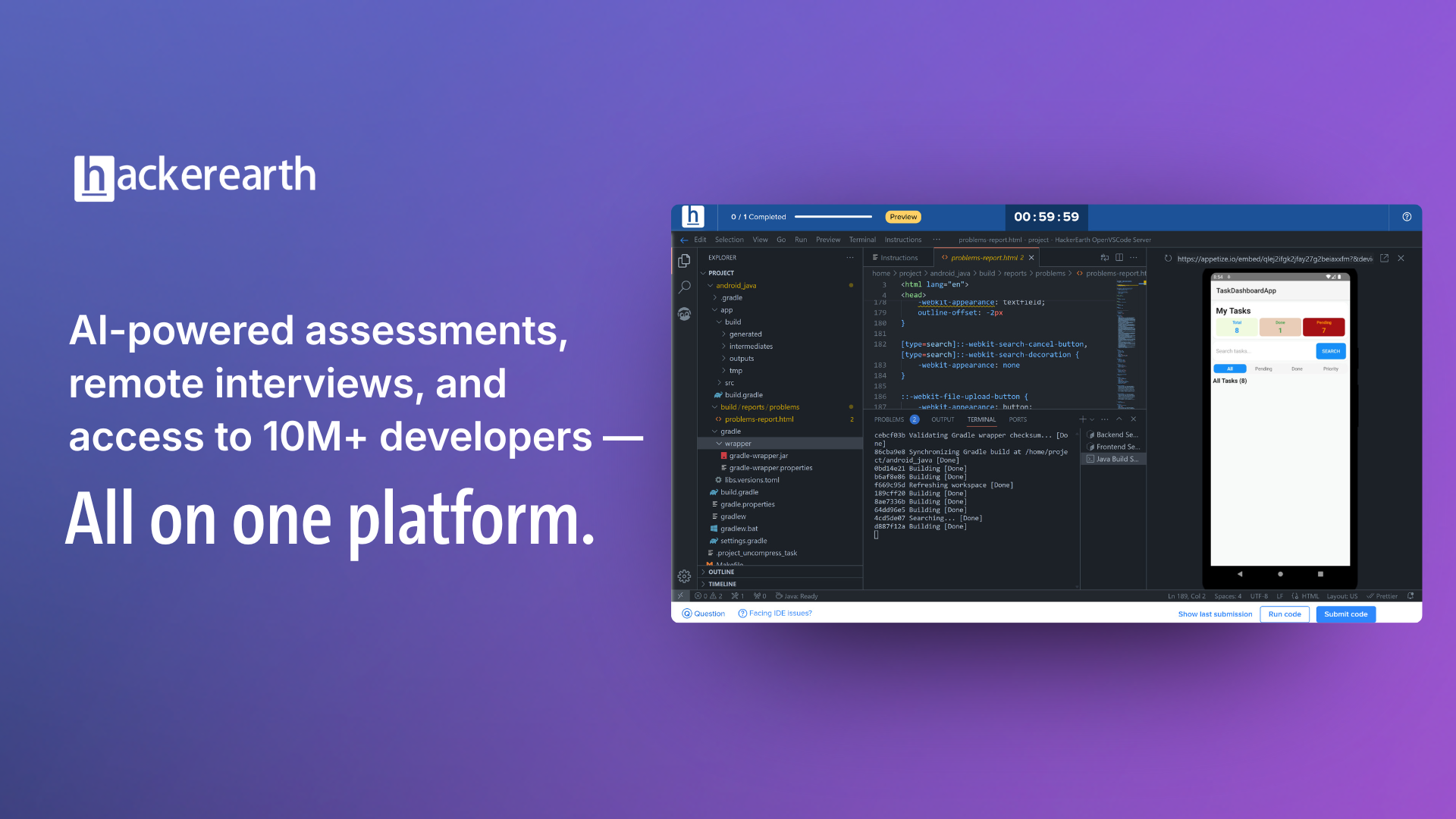
HackerEarth Full homepage screenshot

At a glance

Category
Artificial Intelligence
Language
English
Paid-content signal
No paid content foundObserved
Registered
2012
Hosting
CloudflareInferred
HTTPS certificate trusted
PassedObserved
Last updated

Website review

This review may include AI-generated content and is not individually verified. Domain, certificate and other facts come from the observed data on this page.

What is HackerEarth?

HackerEarth is a technical hiring platform built around AI-powered assessments and automated interviews. Its goal is to help companies screen, interview and engage software developers at scale, and it also gives employers access to a large developer community for sourcing and employer branding.

H3 What it does The platform covers the main stages of a technical hiring pipeline in one place:

  • Assessments — online coding and skills tests used to screen candidates before live interviews.
  • Automated interviews — recorded or AI-assisted interview formats that reduce scheduling overhead.
  • Sourcing and engagement — access to a developer community, plus hackathons and challenges that double as recruiting pipelines.
  • Evaluation and integrity — rubric-based scoring and a built-in integrity layer to keep remote tests fair.

H3 Who it is for It suits engineering hiring teams that receive more applicants than they can interview manually, especially those hiring for coding-heavy roles. Small teams with low hiring volume may find a lighter tool or a plain take-home test sufficient. Large enterprises tend to value the native integrations and security/compliance posture more than startups do.

H3 How it compares

Approach Best for Trade-off
HackerEarth High-volume technical screening plus interviews in one platform More setup and process than a single-purpose tool
Plain take-home tests Small teams, few roles Manual grading, weak anti-cheating controls
General interview platforms Non-technical or mixed roles Shallower coding-specific evaluation

H3 A concrete scenario A company hiring ten backend engineers might run a HackerEarth assessment as the first filter, invite top scorers to an automated interview, then use the community and a coding challenge to build a talent pipeline for future roles.

Next step: decide which stage of your funnel is the bottleneck — screening volume, interview scheduling or sourcing — and evaluate the platform against that specific stage rather than as an all-or-nothing purchase. For official details, see HackerEarth.

How does HackerEarth's AI-powered assessment platform improve tech hiring?

HackerEarth improves tech hiring by putting assessment, interviewing and developer engagement on one platform, so screening and evaluation share the same skills library and rubric-based scoring instead of being stitched together from separate tools. For a hiring team, that means a candidate's assessment result and interview performance can be judged against the same definition of a skill, which reduces the usual mismatch between a coding test score and what an interviewer actually observes.

Where it helps most

  • Screening at volume: AI-powered assessments and automated interviews let a small recruiting team process many applicants without scheduling an interviewer for every first-round call. This matters most for graduate hiring, internship pipelines and high-volume backend or data roles.
  • Consistency: Rubric-based evaluation gives reviewers a shared scale, which is useful when several engineers interview for the same opening and you want comparable notes rather than ad hoc impressions.
  • Integrity: A built-in integrity layer addresses the common worry that remote candidates may use outside help, which is a real trade-off of moving first rounds online.
  • Workflow fit: Native integrations matter if your applicant tracking system already holds candidate records; without them, assessment results become another manual copy-paste step.
  • Sourcing: Access to a large developer community can help teams that struggle to attract applicants in the first place, not just filter the ones they have.

Trade-offs to weigh

AI-assisted scoring and automated interviews speed up early stages, but they work best on skills that can be tested in a structured way — coding, debugging, SQL, data tasks. For senior or highly collaborative roles, treat automated results as a filter and keep substantive human conversation in the loop. Also check how the platform's integrity signals are reviewed: automated flags are a prompt for a human look, not a verdict.

Practical next step

Pick one role you hire repeatedly and run a small pilot: define the skills and rubric first, then compare assessment scores against your interviewers' independent ratings for the same candidates. If the two line up, expand; if not, the rubric — not the candidates — is usually what needs fixing. You can see how the platform frames this at HackerEarth.

What types of assessments and interviews can I create on HackerEarth?

HackerEarth supports two main formats for evaluating technical candidates: assessments (timed or untimed coding and skills tests) and interviews (AI-powered or live technical interviews). Both run on the same underlying platform, which the site describes as combining a skills library, rubric-based evaluation, an integrity layer, native integrations, and enterprise-grade security.

H3 What you can create

Assessments

  • Coding challenges in multiple programming languages, scored against test cases
  • Skills-based tests covering programming, data, and other technical domains drawn from the platform's skills library
  • Rubric-based evaluation, so non-code answers can be graded against defined criteria
  • Integrity features to flag or deter cheating during a test

Interviews

  • AI-powered automated interviews, useful for screening many candidates without scheduling a live session
  • Live technical interviews where a candidate solves problems while an interviewer observes

H3 Choosing between them

Goal Better fit
Screen a large applicant pool quickly Automated assessment
Compare candidates on the same problems fairly Assessment with fixed test cases
Understand a candidate's reasoning and communication AI or live interview
Deep-dive on one senior candidate Live technical interview

A practical next step: decide what you need to learn first. If it's "can this person code to a standard," start with an assessment; if it's "how do they think and explain," move to an interview. Many teams use an assessment as the filter and an interview as the final stage.

For a concrete scenario, a hiring manager with 200 applicants might send a timed coding assessment, shortlist the top scorers, then run AI interviews for the next round and reserve live interviews for finalists.

If you want to compare platforms before committing, look at HackerRank for a similar assessment-and-interview model, or Codility if coding tests are your primary need.

How can I integrate HackerEarth with my existing applicant tracking system?

HackerEarth connects to applicant tracking systems through native integrations and APIs rather than manual exports. According to the platform's own description, every HackerEarth product runs on one shared platform with "native integrations" alongside its skills library, rubric-based evaluation and integrity layer — so ATS connectivity is treated as a core platform capability, not an add-on.

What integration typically involves

  • Native connectors. HackerEarth lists native integrations as a platform feature. You enable the connector for your ATS, authenticate both accounts, and map fields such as candidate ID, job requisition, stage and test score.
  • API-based workflows. Where a pre-built connector does not exist, the API lets you push assessment results and pull candidate records into your own pipeline. This is the usual route for in-house or niche ATS tools.
  • Result and status sync. The practical goal is that a test score, interview outcome or integrity flag appears on the candidate record inside the ATS, so recruiters do not switch tools.

Choosing your route

Situation Sensible approach
Your ATS is a mainstream, widely used product Ask HackerEarth support to confirm a native connector first
Your ATS is custom or regional Plan for API work; budget developer time on your side
You only need score pass-through A lightweight API push may be enough
You need stage automation and rejection reasons Insist on two-way sync, not one-way export

A concrete example

A recruiter shortlists 40 applicants for a backend role. With a working integration, the ATS sends those candidates to an assessment, scores return automatically, and the candidate record moves to "Tech screen passed" or "Rejected" without anyone copying a spreadsheet. Without integration, that same step costs a recruiter an hour per batch and invites transcription errors.

Next step

Contact HackerEarth with your ATS name and version, and ask three questions: is there a native connector, which fields sync in each direction, and what the API rate limits and authentication model are. If you are still comparing platforms, HackerEarth is the source for its own integration list, and your ATS vendor's marketplace or partner directory is the fastest place to confirm support from the other side.

What measures does HackerEarth take to ensure assessment integrity and security?

HackerEarth addresses assessment integrity and security through a built-in integrity layer that sits on the same platform as its skills library, rubric-based evaluation, and native integrations. In practice, that means proctoring-style controls, identity and environment checks, and monitoring signals are part of the assessment flow rather than separate tools bolted on. For enterprise buyers, the platform also emphasizes enterprise-grade security and compliance, which matters when candidate data and hiring decisions need to satisfy internal risk and legal reviews.

What this means in a real hiring scenario

A typical use case is a high-volume technical screening where candidates take an online coding or skills assessment from different locations. The integrity layer is meant to flag or deter behavior that undermines a fair result, while rubric-based evaluation keeps scoring consistent across reviewers. The security and compliance posture is aimed at organizations that need to demonstrate controls over candidate data and assessment records.

How to evaluate it for your team

Ask HackerEarth directly for the specifics that matter to your process:

  • Which integrity signals are available, and how they are surfaced to reviewers
  • How identity verification and environment checks are configured
  • What audit logs, retention controls, and access management exist
  • Which compliance certifications or reports are available under NDA

For general context on assessment security practices, you can compare approaches with other hiring platforms such as Codility or SHL, but treat their features as separate from HackerEarth's.

Next step: request a security and integrity briefing from HackerEarth, then map their controls against your own candidate-data and compliance requirements before running a pilot.

How does HackerEarth help engage and hire from its community of 10M+ developers?

HackerEarth connects hiring to a large developer community through one platform: a deep skills library, rubric-based evaluation, a built-in integrity layer, native integrations, and enterprise-grade security and compliance all run across its products. In practice, that means the same environment used for assessments and automated interviews can also be used to reach and evaluate developers at community scale.

What that looks like for a hiring team

  • Top-of-funnel reach: Instead of only sourcing from job boards, you can run challenges, hackathons or assessments that attract developers who already use the platform.
  • Consistent screening: Rubric-based evaluation gives reviewers a shared standard, which matters when a community campaign produces hundreds or thousands of submissions.
  • Interview automation: Automated interviews reduce the manual load of first-round screening, so a small team can process a large applicant pool.
  • Integrity and compliance: A built-in integrity layer and enterprise-grade security are relevant when candidate volume is high and personally identifiable data is involved.
  • Workflow fit: Native integrations matter if you already use an applicant tracking system or collaboration tools; otherwise, expect manual export and coordination.

H3. A concrete scenario A mid-size company wants to hire three backend engineers. It runs a public coding challenge through HackerEarth, screens submissions with a shared rubric, then invites the strongest performers to automated interviews. The community provides the reach; the platform provides the screening and interview structure. The trade-off is that community-sourced pipelines favor candidates who are active in public challenges, which may underrepresent strong engineers who don't participate in such events.

H3. Decision criterion Choose this approach when you need volume plus a repeatable evaluation standard and can invest time in designing a challenge. If your roles are niche, senior, or better filled through referrals, a community campaign may add overhead without improving candidate quality.

For a practical next step, define the role's must-have skills, map them to specific assessment tasks, and set a rubric before launching anything. If you want to compare approaches, look at how other platforms structure developer communities and challenges, such as Devpost or Topcoder, and check whether their evaluation model matches how your team actually makes hiring decisions.

Related questions

More questions →
Who Is HackerEarth Best Suited For?

HackerEarth is best suited for organizations that hire technical talent at volume and want to standardize how they screen and interview those candidates. Its platform combines AI-powered assessments, automated interviews, and access to a large developer community, so the strongest fit is a company with recurring engineering hiring needs, a defined evaluation process, and enough candidate flow to justify automating it. If you hire one or two engineers a year and rely on small, hand-run interview loops, the platform is likely more than you need.

The core platform, in one view

Every HackerEarth product runs on the same underlying platform, which includes:

  • A deep skills library
  • Rubric-based evaluation
  • A built-in integrity layer
  • Native integrations
  • Enterprise-grade security and compliance

That shared foundation matters for fit: the value comes from running assessments, interviews, and candidate engagement on one system rather than stitching together separate tools.

Who gets the most value

1. Teams screening technical candidates at scale

If your pipeline regularly produces more applicants than your engineers can interview, the bottleneck is usually the first screen. HackerEarth's assessments are designed to filter technical candidates automatically, which is most useful when you have a steady flow of applicants for roles like software engineering, data, or similar technical positions.

Good fit when: you run the same role repeatedly, receive high applicant volume, and want consistent first-round signals.

Weaker fit when: you hire a handful of senior specialists through referrals and already know the candidates well.

2. Companies automating interview workflows

HackerEarth offers automated interviews alongside assessments. This suits teams that want to move candidates through structured, repeatable interview stages without scheduling a live engineer for every step.

Good fit when: your interview process is defined enough to encode into rubrics and automated stages.

Weaker fit when: your hiring depends heavily on open-ended, unstructured conversations that are hard to standardize.

3. Organizations that want access to a large developer pool

HackerEarth states it provides access to 10M+ developers. That is relevant if part of your strategy is sourcing and engaging technical talent through a community rather than only through inbound applications.

Good fit when: you want both an assessment tool and a channel for reaching developers.

Weaker fit when: you only need an assessment engine and already have a full pipeline.

4. Enterprises with security and compliance requirements

Because the platform is positioned with enterprise-grade security and compliance, it fits organizations where procurement, data handling, and compliance review are part of the buying process.

Good fit when: your company requires vendor security review and standardized, auditable hiring workflows.

Weaker fit when: you are a very small team with no formal compliance obligations and want the lightest possible tool.

Quick fit check

Your situation Likely fit
High-volume technical screening Strong
Automated, rubric-based interviews Strong
Need developer community access Strong
Enterprise security/compliance needs Strong
Occasional hires, small volume Weak
Fully unstructured interview style Weak

What to verify before deciding

The platform description does not specify pricing, plan tiers, or login requirements, so treat those as open questions and confirm them directly with HackerEarth. Before committing, check:

  • Whether the skills library covers your specific technical roles
  • How the integrity layer works for your assessment format
  • Which native integrations match your existing ATS or HR stack
  • What security and compliance certifications apply to your region and industry

If most of your answers point to high-volume, standardized technical hiring, HackerEarth is built for your scenario. If your hiring is low-volume and relationship-driven, the platform's strengths will not offset the overhead.

What is HackerEarth and what does it do?

HackerEarth is a platform for tech hiring that combines AI-powered assessments, automated interviews, and developer engagement. It is built for recruiting teams and technology companies that need to screen candidates at scale, run structured interviews, and stay connected to a large developer community. If your goal is to evaluate technical skills efficiently while keeping the process consistent and secure, HackerEarth is designed for that use case.

Core purpose

HackerEarth addresses the end-to-end technical hiring workflow. Instead of juggling separate tools for coding tests, live interviews, and candidate outreach, teams use one platform to:

  • Screen candidates with assessments that measure coding and technical skills.
  • Run automated interviews to reduce manual scheduling and evaluation effort.
  • Engage developers through a community of more than 10 million developers, which supports sourcing and employer branding.

What the platform is built on

Every HackerEarth product runs on the same underlying platform. According to the site, that foundation includes:

Capability What it provides
Deep skills library A broad set of technical skills to build assessments around
Rubric-based evaluation Structured scoring so different reviewers apply the same criteria
Built-in integrity layer Safeguards against cheating and unfair advantages during assessments
Native integrations Connections to existing hiring and HR tools
Enterprise-grade security and compliance Controls and standards suitable for larger organizations

This shared foundation matters because it means assessment, interview, and engagement products are not disconnected features. They draw on the same skill definitions, scoring logic, and security model.

Who it is for

HackerEarth is aimed at:

  • Recruiting teams that need to screen many technical candidates quickly.
  • Technology companies hiring for software engineering, data, and related roles.
  • Organizations that want a repeatable, rubric-based way to compare candidates rather than relying on unstructured interviews alone.

What to keep in mind

The platform's value depends on how well your hiring process maps to structured, skills-based evaluation. If your roles require deep technical screening and you want automation plus a developer community in one place, the combination is relevant. If you only need lightweight resume filtering, the assessment and interview layers may be more than you need.

For current pricing, plan limits, and specific feature availability, check HackerEarth directly, since those details are not covered in the source material here.

What Features Does the HackerEarth Platform Include?

HackerEarth is a technical hiring platform whose products share one underlying system. According to the site, every HackerEarth product runs on the same platform: a deep skills library, rubric-based evaluation, a built-in integrity layer, native integrations, and enterprise-grade security and compliance. If you are evaluating it for screening, interviewing, or developer engagement, those five areas are the feature set to check against your own process.

Deep skills library

The skills library is the content foundation for building technical assessments. Instead of writing every question from scratch, teams draw on a catalog of skill-based material to assemble tests that match the role.

  • Useful when you hire across many stacks and need consistent coverage.
  • The practical question to ask is whether the specific skills you test are represented, not just the total size of the library.

Rubric-based evaluation

Evaluation is structured around rubrics rather than a single opaque score. A rubric defines what a good answer looks like, which makes scoring more consistent across reviewers and candidates.

  • Helps when multiple people review the same submission.
  • Makes it easier to explain to a candidate or hiring manager why a result was scored a certain way.

Built-in integrity layer

The platform includes an integrity layer intended to protect assessment results. This matters most for remote, unsupervised testing, where verifying that the person who took the test is the person you are hiring is the core risk.

  • Relevant for high-volume screening where you cannot proctor every session.
  • Treat it as one signal among several, not a replacement for your own verification steps.

Native integrations and enterprise-grade security

HackerEarth states that its products include native integrations plus enterprise-grade security and compliance. In practice this means the platform is designed to plug into the rest of your hiring stack rather than stand alone.

  • Native integrations reduce manual export and import between tools.
  • Security and compliance claims are the ones to verify against your own requirements, since the level you need depends on your industry and data.

How the pieces fit together

Feature area What it is for Who cares most
Deep skills library Building technical assessments Recruiting and engineering teams hiring across many skills
Rubric-based evaluation Consistent, explainable scoring Reviewers and hiring managers
Integrity layer Protecting assessment results Teams running remote, high-volume tests
Native integrations Connecting to existing tools Teams with an established hiring stack
Security and compliance Meeting enterprise requirements Larger or regulated organizations

What to confirm before deciding

The shared-platform description tells you the architecture is consistent across products, but it does not tell you which specific skills, integrations, or compliance certifications apply to your case. Before committing:

  1. List the exact skills and roles you need to assess, then check them against the library.
  2. Identify the tools you already use and confirm the integrations you need exist.
  3. Match the security and compliance requirements of your organization against what the platform supports.

If your hiring is small-scale or you only need a single assessment type, the breadth of the platform may be more than you need. If you screen technical candidates at volume across multiple skills and want evaluation, integrity, and integrations in one system, the shared-platform design is the main reason to consider it.

How Recruiters Can Get Started with HackerEarth

HackerEarth is a technical hiring platform that combines AI-powered assessments, automated interviews, and access to a large developer community. Recruiters typically start by reviewing the product lineup on hackerearth.com, then request a demo or contact sales to evaluate fit for their hiring workflow. Because pricing and plan details are not published on the site, treat the first step as evaluation rather than self-serve signup.

What HackerEarth Covers

According to the site, every HackerEarth product runs on the same underlying platform, which includes:

  • A deep skills library for building role-relevant questions
  • Rubric-based evaluation for consistent scoring
  • A built-in integrity layer for assessment security
  • Native integrations with existing hiring tools
  • Enterprise-grade security and compliance

This shared foundation matters for recruiters because it means assessment, interview, and engagement products are designed to work together rather than as separate tools.

Steps to Get Started

1. Review the product pages

Visit hackerearth.com and read through the assessment and interview product descriptions. Match each product to a specific stage of your hiring funnel — for example, screening vs. live technical interviews.

2. Check integration and compliance fit

Confirm whether the native integrations listed match your applicant tracking system or scheduling tools. If your organization has security or compliance requirements, review the enterprise-grade security and compliance information before going further.

3. Request a demo or contact sales

Since pricing is not published, the practical path is to request a demo. Prepare a short list of roles you hire for and your current screening volume so the conversation focuses on whether the platform fits your workflow.

4. Explore the developer community

HackerEarth also provides access to a large developer community. If sourcing is part of your goal, ask during the demo how community access connects to your hiring pipeline.

Common Questions Recruiters Ask

Question Where to find the answer
Who is it best suited for? Product pages and demo conversation
What features are included? Platform overview on the site
How is AI used in hiring? AI assessment and interview product pages
What does it cost? Not published — ask sales

What to Prepare Before a Demo

  • A list of the technical roles you hire most often
  • Your current screening and interview steps
  • Any integration or compliance constraints
  • Whether you also want access to a developer talent pool

This preparation lets you test the platform against real requirements instead of a generic walkthrough.

How does HackerEarth use AI for technical hiring?

HackerEarth applies AI across the technical hiring pipeline through three connected capabilities: AI-powered assessments for automated screening, automated interviews that reduce manual first-round effort, and rubric-based evaluation that keeps scoring consistent. These run on a shared platform that also includes a skills library, an integrity layer, native integrations, and enterprise-grade security and compliance. This explainer is for anyone evaluating whether HackerEarth fits a technical hiring workflow — recruiters, engineering managers, or talent acquisition teams comparing screening tools.

The shared platform underneath every product

According to HackerEarth's own description, every product it offers runs on the same foundation:

  • A deep skills library
  • Rubric-based evaluation
  • A built-in integrity layer
  • Native integrations
  • Enterprise-grade security and compliance

That matters because it means AI screening, automated interviews, and candidate engagement aren't separate tools stitched together — they draw on the same skill definitions and scoring logic. A candidate screened on one skill area is evaluated against the same rubric later in the process.

AI-powered assessments for automated screening

The assessment layer is where AI does the heaviest lifting on volume. Instead of a recruiter manually reviewing every submission, assessments score candidates automatically against defined criteria.

What this changes in practice:

Without AI screening With AI-powered assessment
Manual review of each submission Automated scoring against a rubric
Inconsistent reviewer standards Same criteria applied to every candidate
Slow turnaround on large applicant pools Faster shortlisting at scale

The practical benefit is throughput. When a role attracts hundreds of applicants, automated screening decides who advances without a human reading each one first.

Automated interviews to cut manual first-round load

The second stage is automated interviewing. Rather than scheduling a live screen for every candidate who passes assessment, automated interviews handle the initial round. This removes the scheduling bottleneck and the interviewer hours that a first-round call normally consumes.

The trade-off to weigh: automated interviews standardize the early round, but they suit structured, comparable questions better than open-ended conversations where a human interviewer would probe follow-ups. Teams typically use them to filter, then bring humans in for deeper rounds.

Rubric-based evaluation for consistency

Consistency is the mechanism behind the AI claims. Because evaluation is rubric-based, candidates are measured against the same defined standards rather than each reviewer's individual judgment. This is what makes scores comparable across a cohort — and it's the reason the same rubric can carry from assessment through interview.

If your current process suffers from different interviewers grading the same answer differently, rubric-based scoring is the specific feature that addresses it.

The built-in integrity layer

AI-driven screening only works if results are trustworthy. HackerEarth includes an integrity layer as part of the shared platform, aimed at maintaining confidence in assessment results. For teams hiring remotely or at volume, this is the component that keeps automated scores meaningful rather than gameable.

How to decide if it fits your workflow

HackerEarth is a reasonable fit when:

  • You screen technical candidates at volume and need automated shortlisting
  • You want the same evaluation criteria applied across screening and interviews
  • You need native integrations with existing hiring tools
  • Enterprise security and compliance requirements apply to your organization

It's a weaker fit when your early rounds depend on open-ended, exploratory conversation rather than structured, comparable evaluation.

What to verify before committing

The platform description covers capabilities, not commercial terms. Pricing, plan limits, and login requirements aren't specified in the available material, so confirm those directly with HackerEarth rather than assuming free access. Also check which integrations you specifically need, since "native integrations" covers a range that may or may not include your stack.

Website Overview

Identifiable technologies and additional version or configuration signals make the service easier to fingerprint, which may help targeted scanners narrow their checks. An established domain and managed infrastructure suggest continuity of operations and may support dependable delivery, although neither guarantees service quality.

Domain and Registration

Registered in 2012, this domain has about 14 years of history. That suggests continuity, although ownership and purpose may have changed. The domain uses the common .com extension, which is not an independent safety signal.

DNS and Email

The lowest TTL is 60 seconds, supporting rapid record changes at the cost of more frequent lookups. Nameservers are provided by Amazon Route 53, indicating managed DNS hosting. MX records point to the Google Workspace email service. CAA records restrict which certificate authorities are authorized to issue certificates. No CNAME was found; the observed records resolve directly to addresses.

TLS and Certificates

The certificate uses an RSA 2048-bit public key, offering broad client compatibility. The server supplied a complete certificate chain. No organization name is present in the certificate; the available fields are consistent with domain validation. The certificate was issued within the Amazon cloud or CDN ecosystem. The certificate is valid for about 197 days in total, with 146 days remaining.

HTTP and Browser Security

The Server header exposes the software version: nginx/1.29.4. This makes version-targeted checks easier, but is not proof of an exploitable vulnerability. The response lacks these common security headers: X-Content-Type-Options, Referrer-Policy, Permissions-Policy. No X-Powered-By header was found, reducing one common source of backend fingerprinting information. The cf-ray response header indicates a CDN or caching proxy in the delivery path. No obvious internal addresses or debug information were found in the headers.

Technology Stack Analysis

The public page identifies Webflow, Google Tag Manager, Cloudflare, nginx 1.29.4, with exact versions exposed for 1 technologies. These details can narrow vulnerability checks, although exposure alone is not a vulnerability.

Search and Social Sharing

Twitter Card metadata is configured. JSON-LD includes Organization data, helping describe the organization as an entity. The title has 50 characters, within a common display range. A meta description is present, with 155 characters. The observed directives allow indexing and link following.

Hosting and Email

DNSAmazon Route 53
HostingCloudflare
EmailGoogle Workspace
Approximate IP geolocation (inferred; a CDN or proxy may differ from the origin server) India flagMumbai, Maharashtra, India Inferred 13.204.166.134

Registration details

RDAP / WHOIS

RegistrareNom, LLC
Registered2012-08-28
Expires2027-08-28
Domain statusactive
Nameserversns-1300.awsdns-34.org、ns-1709.awsdns-21.co.uk、ns-73.awsdns-09.com、ns-989.awsdns-59.net
DNSSECunsigned

DNS records

DNS

TypeNameValueTTLPriority
Awww.hackerearth.com13.204.166.13460—
Awww.hackerearth.com3.111.225.11460—
Awww.hackerearth.com35.154.114.8860—
MXhackerearth.comaspmx.l.google.com3001
MXhackerearth.comalt1.aspmx.l.google.com3005
MXhackerearth.comalt2.aspmx.l.google.com3005
MXhackerearth.comalt3.aspmx.l.google.com30010
MXhackerearth.comalt4.aspmx.l.google.com30010
NShackerearth.comns-1300.awsdns-34.org3600—
NShackerearth.comns-1709.awsdns-21.co.uk3600—
NShackerearth.comns-73.awsdns-09.com3600—
NShackerearth.comns-989.awsdns-59.net3600—
TXThackerearth.comMS=89A0E65BEF3B296118117B7CAFEF1CCE9BF135CB300—
TXThackerearth.com_globalsign-domain-verification=yMOGr8PalNMtvZPeSrDGFdvgJfngIvOKMbvhlujB3j300—
TXThackerearth.comatlassian-domain-verification=iJg9j49kkL2w1HPxyc56QeBtuUIVXL6Btv5OhN0nHYwYtK5zFftkKpEDuzBUlYtK300—
TXThackerearth.comatlassian-sending-domain-verification=a561d1f3-43a6-4390-9fcf-ce46af96f399300—
TXThackerearth.comgoogle-site-verification=5q235ZsXv4KQaaDLLSWFytZhVkLWSY76YydB8LEFtIY300—
TXThackerearth.comgoogle-site-verification=CmluVCwhfIR5Staa5TT8I57RYtLwfaL9ObzjpTCHqsA300—
TXThackerearth.comgoogle-site-verification=aGiyiIcIIocjmKdZ1yQEjz-4WUpxZqbxfZ_Qzm8PhZg300—
TXThackerearth.comgoogle-site-verification=j_XVYaoq429ZymP7y2V5cG2Z1cP_j74aMfXsdteV9DQ300—
TXThackerearth.comv=spf1 include:_spf.google.com include:sendgrid.net include:_spf.salesforce.com include:2586902.spf10.hubspotemail.net ~all300—
CAAhackerearth.com0 iodef "mailto:[email protected]"300—
CAAhackerearth.com0 issue "amazon.com"300—
CAAhackerearth.com0 issue "digicert.com"300—
CAAhackerearth.com0 issue "letsencrypt.org"300—
CAAhackerearth.com0 issue "pki.goog; cansignhttpexchanges=yes"300—
CAAhackerearth.com0 issuewild "amazon.com"300—
CAAhackerearth.com0 issuewild "digicert.com"300—
CAAhackerearth.com0 issuewild "godaddy.com"300—
CAAhackerearth.com0 issuewild "pki.goog"300—
CAAhackerearth.com0 issuewild "sectigo.com"300—
DMARC_dmarc.hackerearth.comv=DMARC1; p=reject; pct=100; ruf=mailto:[email protected]; ri=864003600—

TLS and certificates

TLS / SSL

AssessmentNormal configuration
Supported protocolsTLSv1.2、TLSv1.3
Negotiated protocolTLSv1.3
Certificate subject*.hackerearth.com
IssuerAmazon
Valid until2027-02-28T23:59 · Remaining when checked: 146 days
Verification detailsCertificate trust: Passed · Hostname match: Passed

HTTP response headers

HTTP

HeaderValue
content-typetext/html; charset=utf-8
servernginx/1.29.4
strict-transport-securitymax-age=31536000; includeSubDomains; preload
content-security-policyframe-ancestors 'self'
x-frame-optionsSAMEORIGIN
set-cookieRedacted

Identified technologies

WebflowGoogle Tag ManagerCloudflarenginx 1.29.4

Pages, Search and Sharing

Meta descriptionTransform tech hiring with AI-powered assessments, automated interviews, and access to 10M+ developers. Streamline screening, interviewing, and engagement.
Canonical URLhttps://www.hackerearth.com
LanguageEnglish (default)
Twitter Cardsummary_large_image
All bots 1 allowed · 9 disallowed
  • Allow/
  • Disallow/*?login=
  • Disallow/*&login=
  • Disallow/*AJAX
  • Disallow/ru/*
  • Disallow/fr/*
  • Disallow/de/*
  • Disallow/zh/*
  • Disallow/pt-br/*
  • Disallow/ja/*

User reviews (0)

  • No reviews yet.