Website profiles · Technology insights · Alternatives

hlido.eu

Hlido is a technology consulting and implementation practice in Prague: strategy, advisory, design, development, delivery and post-production support, with AI where it earns its place. Cybersecurity delivered with channel partner IrisInfosec.

No paid content found
Visit website
Profile views 0 Outbound visits 0 Normal
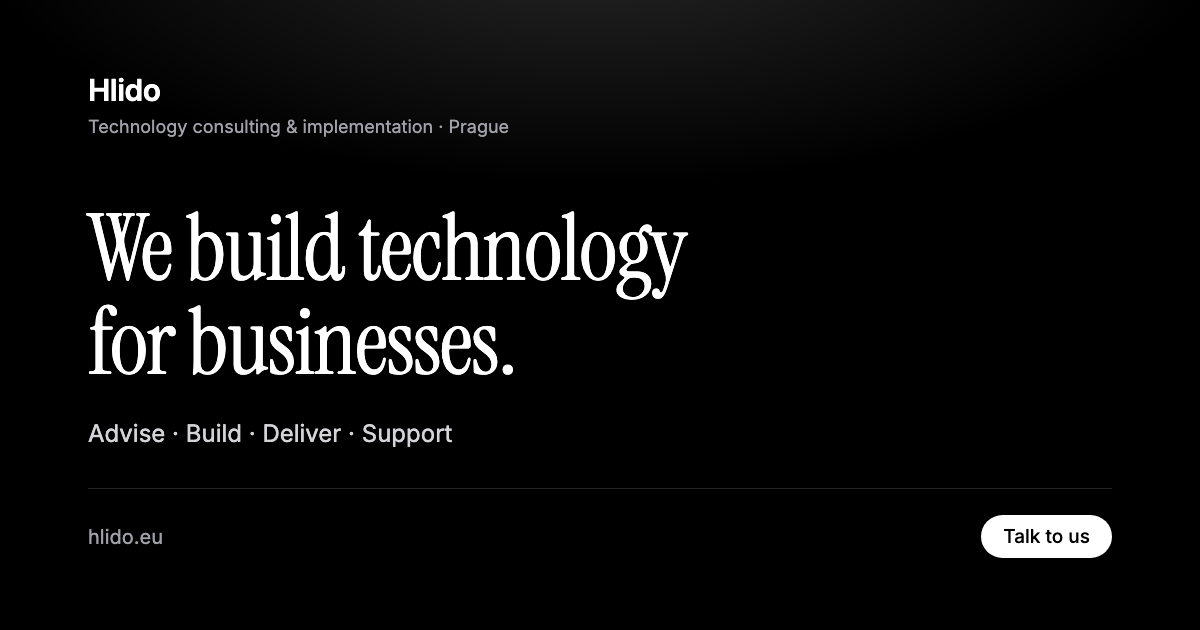
Hlido Full homepage screenshot

At a glance

Category
Other
Language
English
Paid-content signal
No paid content foundObserved
Registered
Unknown
Hosting
CloudflareInferred
HTTPS certificate trusted
PassedObserved
Last updated

Website review

This review may include AI-generated content and is not individually verified. Domain, certificate and other facts come from the observed data on this page.

What is Hlido?

Hlido is a technology consulting and implementation practice based in Prague. It works across the full lifecycle of a technology project: advising on strategy, designing and building the system, delivering it into production, and supporting it afterward. Its stated approach is to use AI "where it earns its place" rather than by default, and cybersecurity is delivered through a specialist channel partner, IrisInfosec.

What it actually does

  • Advisory: technology strategy and roadmaps, architecture decisions, build-versus-buy and vendor selection, cost-to-build versus cost-to-run estimates, AI adoption, and governance including EU AI Act readiness. This is aimed at leadership, procurement and compliance teams.
  • Implementation: taking an idea through design, development and integration with existing systems, with written milestones and acceptance against an agreed list of what the system must do before go-live, plus training and a maintainable hand-over.
  • Post-production support: monitoring, fixes, small changes, regression checks when a vendor ships an update, and a named point of contact, on a cadence the client chooses.

Who it suits, and the trade-off

It fits a mid-sized business or public-facing organisation that has a concrete problem but no in-house CTO-level guidance, or that needs a system built and then looked after rather than handed off and forgotten. The trade-off is breadth: a single practice covering strategy through support means fewer hand-offs between firms, but you should check depth in your specific domain (for example, a particular regulated sector) during the first call. A useful next step is to prepare a short written problem statement and a rough budget range, since Hlido's process starts with a scoped written assessment of what to build, buy or leave alone.

How does Hlido's engagement process run from ideation to post-production support?

Hlido runs engagements as a four-stage sequence, scoped and quoted in writing before work begins: ideation and strategy, design and development, delivery, then post-production support. Each stage produces a written artifact, and delivery is accepted against an agreed list of what the system must do rather than an open-ended sign-off.

The four stages

Stage What happens What you get
Ideation & strategy A short call on the problem, followed by a written assessment of what to build, buy or leave alone, and what it costs to run A documented recommendation
Design & development Architecture, build and integration with systems you already operate Milestones in writing
Delivery Acceptance against the agreed requirements list; your team is trained A hand-over you can maintain yourselves
Post-production support Monitoring, fixes and improvements on a cadence you choose Ongoing coverage after go-live

What distinguishes it

The advisory stage is explicitly a filter, not a sales step: the written assessment can conclude that you should buy or leave something alone rather than build it. That matters most for leadership, procurement and compliance teams weighing AI adoption or EU AI Act readiness, where Hlido frames the output as a gap list with owners and dates.

Support extends beyond what Hlido built. It covers systems you already run, including regression checks when a vendor ships a change, so a break is caught before customers notice, plus a named point of contact. Cybersecurity is delivered through channel partner IrisInfosec, and automation through AutomationEdge, so security and automation work is routed to specialists rather than handled in-house.

Choosing it or not

This model suits a Prague-based or EU business that wants one accountable partner from first idea to running system, and that values written scoping over exploratory billing. It is a weaker fit if you need a pure staff-augmentation arrangement or a fixed-price build with no advisory phase.

As a next step, ask for the written ideation assessment as a standalone deliverable before committing to build. That single document — build/buy/leave-alone plus running costs — is where most of the risk in this process is resolved, and it tells you quickly whether the later stages are worth pursuing.

Should my company build, buy, or leave alone a given technology, and how does Hlido help decide?

Hlido frames this as an advisory question first, not a build question: its technology strategy and roadmap work explicitly covers "build-versus-buy, vendor selection," and it sets out to show "what it costs to build and what it costs to run." The practical value is that the decision is written down with reasoning before anyone commits to development.

How the decision usually breaks down

Option Fits when Main cost to weigh
Build The capability is close to how your business actually differentiates itself, and off-the-shelf tools force workarounds Upfront engineering plus ongoing maintenance, hosting and change requests
Buy The need is common across companies and a vendor already carries the compliance and integration burden Licence and integration effort, vendor lock-in, and rework when the vendor changes the product
Leave alone The problem is real but small, or the process should change instead of being automated Mostly opportunity cost; the discipline is saying no

Hlido's stated sequence is a short call on the problem, then a written assessment of what to build, buy or leave alone and what it costs to run. Engagements are described as scoped and quoted in writing, with delivery accepted against an agreed list of what the system must do, followed by optional post-production support (monitoring, fixes, regression checks when a vendor ships a change, and a named contact).

A concrete scenario

A mid-sized firm wants an internal tool for a workflow that is annoying but not strategic. Buying a configured SaaS product is usually the cheaper path; building only pays off if the workflow is genuinely unusual or feeds a customer-facing advantage. Hlido's "what it costs to run" framing is the useful test here: a cheap build with heavy maintenance is often worse than a licence fee.

Decision criteria to bring to the first call

  • Differentiation: would this capability set you apart, or just keep you level with competitors?
  • Total cost over three years: build, integrate, run and maintain, not just the first release.
  • Exit cost: how hard is it to switch vendors or replace a custom system later?
  • Regulatory exposure: if AI is involved, ask for the governance and EU AI Act readiness view, which Hlido describes as a gap list with owners and dates.

For cybersecurity specifically, Hlido delivers it with channel partner IrisInfosec, so treat security as a separate specialist track rather than assuming it is bundled into the build decision. Start by writing your own one-page version of the table above; it makes the first advisory conversation far more productive.

How can Hlido help my organization prepare for EU AI Act readiness and AI adoption?

Hlido addresses EU AI Act readiness and AI adoption through its advisory practice, then can carry the work into implementation if you decide to build. Two distinct offers sit side by side: a governance & EU AI Act readiness track that produces a gap list with named owners and dates, and an AI adoption track that assesses where AI pays back in your operation and where it does not. Both are framed for leadership, procurement and compliance teams rather than only engineering.

What the two tracks give you

Your situation Relevant Hlido offer What you get
You need to know which systems fall under the Act and what is missing Governance & EU AI Act readiness A gap list with owners and dates
You are unsure whether AI is worth it in a given process AI adoption advisory An assessment of where it pays back and where it does not
You need a first technical leadership view or a build-versus-buy call Technology strategy & roadmap Written reasoning, architecture and vendor selection, cost to build and cost to run
You have decided to proceed Design & development, then delivery Architecture, integration, milestones in writing, acceptance against an agreed list, team training and a hand-over you can maintain
The system is live and regulation or vendors change Post-production support Monitoring, fixes, regression checks when a vendor ships a change, and a named contact

How to use this in practice

A realistic sequence for a mid-sized organisation: start with the readiness gap list, because it tells you which of your existing tools are in scope and who must act. Use the adoption assessment in parallel on one or two processes where you suspect a payoff, so the governance work is anchored to something concrete rather than abstract policy. If a process passes that test, the same practice can design and deliver it and then support it after go-live, which reduces the handover risk of splitting advice from build.

Decision criteria

  • Choose the readiness track first if you sell into the EU, handle sensitive data, or your procurement team is already receiving AI-related questions from customers.
  • Choose the adoption assessment first if your pressure is operational—cost, throughput, manual review—and compliance is not yet a blocker.
  • Ask for the written output early. Hlido describes scoped and quoted work in writing with milestones, so request the assessment format before committing.
  • Check the security boundary. Cybersecurity is delivered with channel partner IrisInfosec and automation with AutomationEdge, so clarify which firm owns each part of your scope.

For comparison when shortlisting, established practices with published AI governance material include Deloitte and EY; smaller Prague-based engineering firms are worth weighing on hands-on delivery. Ask each candidate for a sample gap list and a named contact for post-go-live support, since those two artefacts reveal more about fit than a capabilities page.

What does Hlido's post-production support include after go-live?

Hlido's post-production support covers four things after go-live: monitoring and incident watch across the systems and tools a client depends on; fixes, improvements and small changes to the delivered system as processes change; checks when a vendor ships a change, so a regression is caught before customers notice it; and a named point of contact for questions. The work runs on a cadence the client chooses, and it applies both to systems Hlido built and to systems the client already runs.

That mix suits a team without in-house operations coverage, or one that wants a single accountable contact rather than a ticket queue. The trade-off is scope: support is framed around monitoring, small changes and regression checks, so a large new feature would likely need a separate project rather than a support request.

As a next step, when scoping support, list the systems you depend on and the vendor updates you expect in the coming year; that gives a concrete basis for agreeing the cadence and what counts as a small change versus new work.

How does Hlido deliver cybersecurity through its partnership with IrisInfosec?

Hlido treats cybersecurity as a specialist service delivered with channel partner IrisInfosec, rather than as something its own team covers in-house. The site frames this as a deliberate split: Hlido handles strategy, design, development, delivery and post-production support, while security is "delivered with channel partner IrisInfosec" and positioned alongside its other delivery specialisms (AutomationEdge for automation). The practical effect is one engagement that spans building and securing a system, with the security work coming from a dedicated partner.

The site does not spell out the mechanics of the arrangement — who contracts with the client, how work is divided day to day, response times, or which certifications or standards apply. Treat those as questions for a scoping call rather than assumptions.

What this means in practice

  • For a build project: security can be addressed during design and delivery rather than retrofitted after go-live, which is the point where fixes are most expensive.
  • For existing systems: post-production support already covers monitoring and incident watch across the systems you depend on, with checks when a vendor ships a change. A security partner fits naturally alongside that cadence.
  • For leadership and compliance teams: advisory covers governance and EU AI Act readiness, producing "a gap list with owners and dates." If your security obligations are regulatory, ask how IrisInfosec feeds into that gap list.

How to decide if it fits

Your situation What to ask Hlido
Building a new system with sensitive data Will IrisInfosec review the architecture before development, or only test at the end?
Running existing systems, no in-house security lead Who is the named point of contact for a security incident, and on what cadence?
Facing EU AI Act or procurement scrutiny Does the gap list include security controls, or only AI governance items?
Already have a security vendor Can the partner work alongside your existing provider, or does it replace them?

A useful next step is to ask for a written scope that states explicitly which security activities IrisInfosec performs, at which stage, and who owns each deliverable. Hlido's stated model is scoped and quoted in writing with milestones and an agreed acceptance list, so security should appear in that same document rather than as a side arrangement.

Related questions

More questions →
Can Hlido Support Systems It Didn't Build?

Yes. Hlido's post-production support covers both systems it built and systems you already run. According to the company's site, support includes monitoring and incident watch across the systems and tools you depend on, fixes and small changes, checks when a vendor ships a change, and a named point of contact — delivered on a cadence you choose. That makes it a viable option if you need an ongoing support partner for an existing stack, not just for a project Hlido delivered itself.

What support actually covers

Hlido describes four elements of post-production support:

Support element What it means in practice
Monitoring & incident watch Ongoing watch across the systems and tools you depend on
Fixes, improvements and small changes Changes to the delivered system as your processes evolve
Checks when a vendor ships a change A regression is caught before your customers find it
A named point of contact A specific person to call with questions

Two details matter when deciding. First, the vendor-change check is the element most relevant to systems you already run: third-party updates are a common source of breakage, and Hlido positions this as catching regressions before customers do. Second, the cadence is your choice — the site does not publish fixed tiers or response-time commitments, so the specific rhythm and scope are things to agree in writing.

When Hlido is a good fit for existing systems

  • You run a system that depends on several third-party tools and want someone watching for breakage when vendors ship changes.
  • You want a single named contact rather than a ticket queue.
  • You need small, steady changes rather than a large new build.
  • You want support arranged on a schedule that matches your operations, not a vendor's standard package.

When it may not be the right fit

  • You need round-the-clock incident response with published SLAs. The site describes monitoring and a named contact but does not publish response-time guarantees, so confirm this directly.
  • You want support priced from a public rate card. No pricing is listed on the site; engagements are described as scoped and quoted in writing.
  • Your need is a large new build rather than maintenance. That falls under Hlido's implementation and delivery work, which follows a separate four-stage process: ideation and strategy, design and development, delivery, then post-production support.

How to evaluate it before committing

  1. List your systems and dependencies. Note which third-party tools ship changes frequently — those are where vendor-change checks earn their place.
  2. Define the cadence you need. Decide how often you want monitoring reviews, fix windows and check-ins, then ask Hlido to quote against that rhythm.
  3. Ask what "small changes" includes. Get the boundary between included fixes and separately quoted work in writing.
  4. Confirm the named contact and escalation path. Ask who the contact is and what happens when they are unavailable.
  5. Request the scope and quote in writing. Hlido states that engagements are scoped and quoted in writing; use that document to verify coverage before signing.

The main open questions are commercial rather than capability-based: cadence, the size limit on included changes, and response expectations. All three are things to settle in the written scope rather than assume from the website.

What Hlido Covers in Its Technology and Strategy Advisory

Hlido's advisory phase covers four things: a technology strategy and roadmap, architecture and build-versus-buy decisions with vendor selection, a build-cost versus run-cost view, and AI adoption guidance including governance and EU AI Act readiness. It is aimed at leadership, procurement and compliance teams, and the output is a written assessment of what to build, buy or leave alone — with a gap list, owners and dates where governance is involved. It suits a company deciding whether and how to invest in a system before committing to a build engagement.

The four advisory areas

Hlido, a technology consulting and implementation practice based in Prague, describes its first phase as advising "on strategy and technology" — specifically "where technology earns its place, what to build, buy or leave alone, and how to run it."

Technology strategy and roadmap

This ranges from "a first CTO-level view to a specific project." In practice, that means a company without a technology leader can get an outside view of its overall direction, while a company with a defined project can get advice scoped to that project.

Architecture, build-versus-buy and vendor selection

The advisory covers architecture decisions and the build-versus-buy question, plus vendor selection. This is the decision layer that precedes any development work: whether to construct something in-house, buy an existing product, or leave the need alone.

What it costs to build versus what it costs to run

Hlido explicitly frames cost in two parts: "what it costs to build and what it costs to run." The run-cost side matters because a system that is cheap to launch can be expensive to operate — and Hlido's own delivery model includes post-production support, so the run phase is treated as a real, ongoing cost rather than an afterthought.

AI adoption and governance

AI guidance is scoped to where it pays back: "where it pays back in your operation, and where it does not." On governance, Hlido offers "EU AI Act readiness" support that produces "a gap list with owners and dates" — a concrete artifact rather than a general opinion.

Who the advisory is for

Hlido names three audiences for advisory work: leadership, procurement and compliance teams. That maps to the three decision types above — direction (leadership), vendor and buy decisions (procurement), and AI governance (compliance).

What you get and how the engagement starts

The advisory output is a written assessment: what to build, buy or leave alone, and what it costs to run. Hlido states that an engagement is "scoped and quoted in writing," and the process begins with "a short call on the problem" followed by that written assessment.

Advisory question What Hlido provides
Where should technology investment go? Technology strategy and roadmap, from a first CTO-level view to a specific project
Build, buy or leave alone? Architecture, build-versus-buy and vendor selection advice
What will it cost? Build cost and run cost, stated separately
Should we adopt AI, and are we compliant? AI adoption guidance plus EU AI Act readiness with a gap list, owners and dates

How advisory connects to the rest of the engagement

Advisory is step one of a four-step model: ideation and strategy, design and development, delivery, then post-production support. The written assessment from the advisory phase becomes the basis for scoping any build, and delivery is later accepted "against an agreed list of what the system must do." If you only need the decision input — not a build — the advisory phase stands on its own as a written assessment.

For cybersecurity, Hlido delivers through channel partner IrisInfosec, and for automation it works with AutomationEdge; those are separate from the core advisory described above.

Practical checkpoints before you engage

  • Confirm the advisory output will be written, since Hlido's model centers on a written assessment rather than verbal recommendations.
  • Ask that build cost and run cost be separated in the quote, matching how Hlido frames the cost question.
  • If AI is in scope, request the governance gap list with named owners and dates as a deliverable.
  • Clarify whether the advisory is scoped to a specific project or to a broader CTO-level view, since Hlido offers both.

Pricing for advisory work is not published on the site; engagements are described as scoped and quoted in writing, so cost should be confirmed directly with Hlido.

What is Hlido and what does the company do?

Hlido is a technology consulting and implementation practice based in Prague. It works with businesses from the first idea through to a system running in production, and stays involved after go-live. Its services cover strategy and advisory, design and development, delivery, and post-production support, with AI applied only where it earns its place. Cybersecurity is delivered together with channel partner IrisInfosec. If you need a partner to help decide what to build, build it, and keep it running, Hlido's model is designed for that end-to-end role.

The four stages of an engagement

Hlido describes its work as a sequence that can start at the beginning or plug into an existing project.

1. Ideation and strategy

A short call on the problem, followed by a written assessment covering what to build, buy or leave alone, and what it costs to run. This is the stage to bring in if you need a first CTO-level view, a technology roadmap, or help with architecture and build-versus-buy decisions.

2. Design and development

Architecture, build and integration with the systems you already run. Milestones are set out in writing, so progress is checkable rather than assumed.

3. Delivery

Acceptance happens against an agreed list of what the system must do before go-live. Your team is trained and the hand-over is something you can maintain.

4. Post-production support

Monitoring, fixes and improvements on a cadence you choose, plus checks when a vendor ships a change so regressions are caught before customers find them. A named point of contact is part of the offer.

What the advisory work covers

The consulting side is aimed at leadership, procurement and compliance teams. Stated areas include:

  • Technology strategy and roadmap — from a first CTO-level view down to a specific project.
  • Architecture, build-versus-buy and vendor selection — including what it costs to build and what it costs to run.
  • AI adoption — where it pays back in your operation, and where it does not.
  • Governance and EU AI Act readiness — delivered as a gap list with owners and dates.

The EU AI Act readiness work is relevant if your organisation uses or ships AI features and needs a structured view of gaps rather than a general policy statement.

Who it fits

If your situation is… Hlido's relevant offer
You have an idea but no technical leadership to scope it Ideation and strategy, written assessment
You need a system built and integrated with existing tools Design, development and delivery with written milestones
You already run systems and need ongoing cover Post-production support, monitoring, vendor-change checks
You need security handled alongside delivery Cybersecurity via partner IrisInfosec
You are assessing AI use or EU AI Act exposure AI adoption advice and governance gap list

What to check before engaging

The site does not publish pricing, so scope and cost need to come from the written quote that Hlido says it provides for each engagement. Ask for that assessment early — it is the document that defines what will be built, what it costs to run, and how acceptance will be judged. If cybersecurity is part of your requirement, confirm how the IrisInfosec partnership is structured in your contract. And if you are coming with an existing system rather than a new idea, ask specifically what post-production support would cover for code Hlido did not write.

How does Hlido approach AI adoption and EU AI Act readiness?

Hlido treats AI as a tool to be justified rather than a default, and treats EU AI Act readiness as a governance exercise that ends in a written gap list with named owners and dates. Both sit inside its technology and strategy advisory, aimed at leadership, procurement and compliance teams. The approach fits organisations that need a defensible decision on where AI belongs in their operation — and a concrete record of what still has to be fixed before compliance deadlines — rather than a vendor pushing a model.

Where AI fits in the advisory

Hlido describes its advisory as covering "where technology earns its place, what to build, buy or leave alone, and how to run it." AI adoption is handled as one part of that picture, alongside technology strategy and roadmap work, architecture and build-versus-buy decisions, and vendor selection.

The stated principle is "AI where it earns its place." In practice, the advisory is framed around two questions:

  • Where it pays back in your operation — the tasks or processes where an AI deployment produces a return worth the cost of building and running it.
  • Where it does not — cases where the same problem is better solved without AI, or not solved at all for now.

That second half matters as much as the first. An adoption recommendation that only lists opportunities is not a decision document; Hlido's framing explicitly includes the "leave alone" option.

Cost is part of the AI case

The advisory covers "what it costs to build and what it costs to run." For AI specifically, running cost is often the part that surprises teams — inference, integration upkeep and monitoring continue after go-live. Hlido's post-production support offering (monitoring, fixes, improvements, checks when a vendor ships a change) is the operational counterpart to that running-cost question, and is available for systems Hlido built as well as systems you already run.

How EU AI Act readiness is handled

Hlido lists "Governance & EU AI Act readiness" as a distinct advisory item, and describes its output precisely: a gap list with owners and dates.

That format is worth understanding before you engage, because it sets expectations:

Element What it implies
Gap list The deliverable is a list of specific shortfalls against readiness requirements, not a general maturity score
Owners Each gap is assigned to a person or role, so responsibility is not left with "the business"
Dates Each gap carries a target date, making the list trackable over time

This is a remediation-planning output. It assumes you want to know what is missing and who will close it, rather than receive a narrative assessment. If your organisation needs a formal legal opinion on classification under the Act, that is a different engagement — Hlido's contribution is the technology and governance gap analysis that compliance and procurement teams can act on.

Who the advisory is for

Hlido names three audiences for this work: leadership (deciding where to invest), procurement (judging what vendors offer and what a system must do), and compliance (tracking readiness obligations). The same gap list serves all three, which is why the owners-and-dates format is central rather than incidental.

What happens after the advice

Adoption advice is not a standalone report. Hlido's engagement model runs ideation and strategy → design and development → delivery → post-production support, with each stage scoped and quoted in writing and delivery accepted against an agreed list of what the system must do before go-live.

For an AI deployment, that means the "where it pays back" conclusion from the advisory can carry through to a built system, an acceptance checklist, team training and a hand-over you can maintain — with support continuing afterwards on a cadence you choose. Cybersecurity is delivered with channel partner IrisInfosec, and automation with AutomationEdge, so security review of an AI system sits with a specialist partner rather than being folded silently into the build.

Deciding whether this fits

The approach suits you if:

  • You want a written recommendation that includes not adopting AI where it doesn't pay back.
  • You need an EU AI Act readiness artefact your compliance and procurement teams can track — gaps, owners, dates.
  • You expect advice to lead into implementation and ongoing support, not stop at a slide deck.

It is a weaker fit if you already have a fixed AI product decision and only need development capacity, or if you need a legal classification opinion rather than a technology and governance gap analysis. In either case, the first step Hlido describes is the same: a short call on the problem, followed by a written assessment of what to build, buy or leave alone and what it costs to run.

How a Hlido Engagement Runs, from Ideation to Post-Production Support

A Hlido engagement runs in four written, sequential stages: ideation and strategy, design and development, delivery, and post-production support. The work is scoped and quoted in writing, milestones are set in writing, and delivery is accepted against an agreed list of what the system must do. This structure suits businesses in Prague and elsewhere that want a technology project or AI deployment taken from an idea to a system running in production, then supported after go-live.

Stage 1: Ideation and strategy

The engagement opens with a short call on the problem. Hlido then produces a written assessment covering what to build, buy or leave alone, and what it costs to run. This is the point where the commercial shape of the project is fixed: scoped and quoted in writing before development begins.

The advisory work behind this stage includes technology strategy and roadmaps, from a first CTO-level view to a specific project; architecture, build-versus-buy and vendor selection; the cost to build versus the cost to run; AI adoption where it pays back in your operation and where it does not; and governance and EU AI Act readiness, delivered as a gap list with owners and dates.

Stage 2: Design and development

Once the assessment is agreed, Hlido handles architecture, build and integration with the systems you already run. Milestones are recorded in writing, so progress is checkable against agreed points rather than informal updates. AI is included where it earns its place in the design, not as a default component.

Stage 3: Delivery

Delivery is accepted against an agreed list of what the system must do before go-live. The stage also includes training your team and a hand-over you can maintain. The acceptance list is the practical control here: it defines what "done" means and gives both sides a concrete basis for sign-off.

Stage 4: Post-production support

Hlido stays after go-live, supporting both what it built and what you already run. Support covers:

  • Monitoring and incident watch across the systems and tools you depend on.
  • Fixes, improvements and small changes to the delivered system as your processes change.
  • Regression checks when a vendor ships a change, so a regression is caught before your customers find it.
  • A named point of contact for questions.

Support runs on a cadence you choose, so the level of ongoing involvement is a decision you make rather than a fixed package.

The engagement at a glance

Stage What happens What you get
Ideation and strategy Short call on the problem, then written assessment Scope and quote in writing; build/buy/leave-alone view; running costs
Design and development Architecture, build, integration with existing systems Written milestones
Delivery Acceptance testing, training, hand-over Sign-off against an agreed capability list; a system your team can maintain
Post-production support Monitoring, fixes, improvements, vendor-change checks Support on your chosen cadence; a named contact

Who this structure fits

This model suits a business that wants one practice to carry a project from the first idea through production and beyond, with commitments documented at each stage. It also fits organisations that need advisory input first — for example, a leadership or procurement team weighing build versus buy, or a compliance team preparing for the EU AI Act — before committing to development.

Two related capabilities sit alongside the core engagement: cybersecurity is delivered with channel partner IrisInfosec, and automation with AutomationEdge. If security or automation is part of your scope, raise it during the ideation call so it is reflected in the written assessment and quote.

What to prepare before the first call

To make the ideation call productive, bring the problem statement, the systems the new work must integrate with, and any constraints on budget or timeline. The output of that call is a written assessment, so the clearer the problem, the more specific the scope and quote you receive.

Website Overview

Several search or sharing settings need attention. Together they may make snippets, preview images or preferred URLs less consistent across platforms.

Domain and Registration

The registrar is Name: GoDaddy.com, LLC, a widely used domain service provider. The domain uses the common .eu extension, which is not an independent safety signal.

DNS and Email

Nameservers are provided by Cloudflare, indicating managed DNS hosting. MX records point to the GoDaddy email service. No CNAME was found; the observed records resolve directly to addresses. SPF and DMARC are configured. DKIM status is unknown. TXT records include verification markers for Google. Such markers may also remain after a service stops being used.

TLS and Certificates

The public key uses EC with 256 bits. The server supplied a complete certificate chain. No organization name is present in the certificate; the available fields are consistent with domain validation. The certificate was issued within the Google Trust Services cloud or CDN ecosystem. The certificate's total validity is about 90 days, consistent with a short renewal cycle.

HTTP and Browser Security

The response lacks these common security headers: HSTS, CSP. CORS permits any origin to read this response. This is common for public resources; sensitive responses need narrower handling. No X-Powered-By header was found, reducing one common source of backend fingerprinting information. The cf-ray response header indicates a CDN or caching proxy in the delivery path. No obvious internal addresses or debug information were found in the headers.

Technology Stack Analysis

The public page identifies Cloudflare without precise versions, leaving fewer clues for version-specific scanning.

Search and Social Sharing

The title has 79 characters and may be truncated in search results. The meta description has 242 characters and may be shortened in search results. Twitter Card metadata is configured. JSON-LD includes Organization data, helping describe the organization as an entity. The observed directives allow indexing and link following.

Hosting and Email

DNSCloudflare
HostingCloudflare
EmailGoDaddy
Approximate IP geolocation (inferred; a CDN or proxy may differ from the origin server) Location unknown Inferred 104.21.71.99

Registration details

RDAP / WHOIS

RegistrarName: GoDaddy.com, LLC
RegisteredUnknown
ExpiresUnknown
Domain statusUnknown
NameserversUnknown
DNSSECunknown

DNS records

DNS

TypeNameValueTTLPriority
Ahlido.eu104.21.71.99300—
Ahlido.eu172.67.144.95300—
AAAAhlido.eu2606:4700:3034::6815:4763300—
AAAAhlido.eu2606:4700:3037::ac43:905f300—
MXhlido.eusmtp.secureserver.net3000
MXhlido.eumailstore1.secureserver.net30010
NShlido.euirena.ns.cloudflare.com86400—
NShlido.eutadeo.ns.cloudflare.com86400—
TXThlido.eugoogle-site-verification=LrLRVbdMdfouuZMgX9c4jLonxiHxA_caz3md-g5UEb8300—
TXThlido.euv=spf1 include:secureserver.net -all300—
DMARC_dmarc.hlido.euv=DMARC1; p=quarantine; adkim=r; aspf=r; rua=mailto:[email protected];300—

TLS and certificates

TLS / SSL

AssessmentNormal configuration
Supported protocolsTLSv1.2、TLSv1.3
Negotiated protocolTLSv1.3
Certificate subjecthlido.eu
IssuerGoogle Trust Services
Valid until2027-01-05T13:51 · Remaining when checked: 79 days
Verification detailsCertificate trust: Passed · Hostname match: Passed

HTTP response headers

HTTP

HeaderValue
content-typetext/html; charset=utf-8
cache-controlpublic, max-age=0, must-revalidate
servercloudflare
x-frame-optionsDENY
x-content-type-optionsnosniff
referrer-policystrict-origin-when-cross-origin
permissions-policycamera=(), microphone=(), geolocation=()
access-control-allow-origin*

Identified technologies

Cloudflare

Pages, Search and Sharing

Meta descriptionHlido is a technology consulting and implementation practice in Prague: strategy, advisory, design, development, delivery and post-production support, with AI where it earns its place. Cybersecurity delivered with channel partner IrisInfosec.
Canonical URLhttps://hlido.eu/
LanguageEnglish (default)
Twitter Cardsummary_large_image
claudebot 1 allowed · 3 disallowed
  • Allow/
  • Disallow/internal/cc/
  • Disallow/space/
  • Disallow/api/ground-movement
anthropic-ai 1 allowed · 3 disallowed
  • Allow/
  • Disallow/internal/cc/
  • Disallow/space/
  • Disallow/api/ground-movement
gptbot 1 allowed · 3 disallowed
  • Allow/
  • Disallow/internal/cc/
  • Disallow/space/
  • Disallow/api/ground-movement
google-extended 1 allowed · 3 disallowed
  • Allow/
  • Disallow/internal/cc/
  • Disallow/space/
  • Disallow/api/ground-movement
perplexitybot 1 allowed · 3 disallowed
  • Allow/
  • Disallow/internal/cc/
  • Disallow/space/
  • Disallow/api/ground-movement
amazonbot 1 allowed · 3 disallowed
  • Allow/
  • Disallow/internal/cc/
  • Disallow/space/
  • Disallow/api/ground-movement
ccbot 0 allowed · 1 disallowed
  • Disallow/
bytespider 0 allowed · 1 disallowed
  • Disallow/
All bots 1 allowed · 3 disallowed
  • Allow/
  • Disallow/internal/cc/
  • Disallow/incidents/_template
  • Disallow/incidents/_template.html

User reviews (0)

  • No reviews yet.