Website profiles · Technology insights · Alternatives

invitria.com

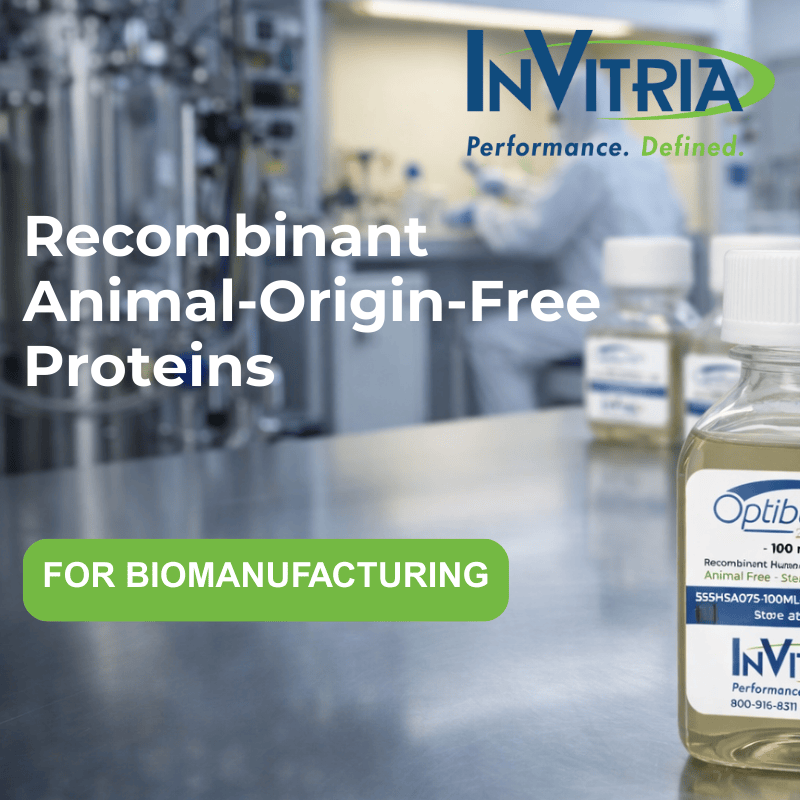
InVitria's recombinant, animal-origin-free proteins are used in over 30 on-market products, including the first FDA-approved vaccine containing rHSA.

No paid content found
Visit website
Profile views 8 Outbound visits 1 Normal
InVitria Full homepage screenshot

At a glance

Category
Other
Language
English
Paid-content signal
No paid content foundObserved
Registered
2006
Hosting
CloudflareInferred
HTTPS certificate trusted
PassedObserved
Last updated

Website review

This review may include AI-generated content and is not individually verified. Domain, certificate and other facts come from the observed data on this page.

What is InVitria?

InVitria is a manufacturer of recombinant, animal-origin-free proteins and cell culture media supplements used in biomanufacturing. Its products are made with a proprietary rice grain–based expression platform (ExpressTec®) rather than animal or human-derived materials, and are produced at an ISO 9001:2015 certified facility in Kansas, USA.

Its catalog covers three main groups:

  • Recombinant proteins — albumin (rHSA), transferrin, lysozyme and interleukins
  • Cell culture supplements — insulin-transferrin supplements and other components
  • Blood-free complete media — chemically defined alternatives to serum-containing formulations

Typical applications listed on the site include antibody production, vaccine production, gene therapy, cell therapy, T-cell immunotherapy, final formulation and medical devices. The core pitch is consistency: eliminating serum variability, lowering contamination risk and making supply more predictable as processes scale.

A practical way to judge fit is to ask where animal-derived components sit in your workflow. If you are replacing serum or human serum albumin in a clinical-stage process, a recombinant, chemically defined source can simplify regulatory documentation and reduce batch-to-batch variability. If you only need a research-grade supplement for early screening, the compliance advantages matter less and cost or assay compatibility will drive the decision.

As a next step, download the product catalog and match the specific protein or supplement to your cell line and application, then confirm format and specification details directly before qualifying it in your process.

How does InVitria's recombinant albumin compare to human serum albumin for cell culture?

InVitria's recombinant albumin (rHSA) is designed as a direct replacement for human serum albumin (HSA) in cell culture, with the key difference being origin and consistency rather than function. Both proteins perform the same core roles—carrier for lipids and small molecules, stabilizer, and osmolarity/pH buffer—but InVitria's version is produced recombinantly in a rice-grain expression platform, so it contains no human or animal-derived material.

Practical differences that matter

  • Contamination and regulatory risk: Human-derived HSA carries theoretical risks of adventitious agents and batch-to-batch donor variability. An animal-origin-free recombinant version removes that risk, which simplifies regulatory filings and donor-screening documentation.
  • Lot consistency: Recombinant production in a defined system tends to give more reproducible performance than pooled plasma-derived albumin, where donor sourcing can shift composition. For process development and scale-up, this reduces re-validation work.
  • Supply chain: InVitria states metric-ton capacity and global distribution, which matters if you are scaling from bench to commercial manufacturing and cannot tolerate plasma-supply fluctuations.
  • Traceability: A chemically defined, non-mammalian source is easier to document for regulators and for customers auditing your process.

Trade-offs to weigh

Plasma-derived HSA has decades of published performance data and established use in many approved processes, so switching means re-qualifying your media and possibly re-running comparability studies. Recombinant albumin may also behave slightly differently in some assays—for example, fatty-acid binding or specific drug-binding studies—so confirm equivalence in your own system rather than assuming interchangeability.

Who this suits

Teams in gene therapy, cell therapy, vaccine production, and antibody manufacturing who need to eliminate serum or blood-derived components, or who are preparing for clinical/commercial scale where supply reliability and regulatory simplicity matter most. InVitria notes its proteins are used in FDA- and EMA-approved biologics, including the first FDA-approved vaccine containing rHSA, which is useful precedent when building your own justification.

Next step

Run a side-by-side comparison in your specific cell line and medium: same seeding density, same supplement level, measure growth, viability, and product titer or yield over several passages. If performance matches, the recombinant version gives you the cleaner regulatory and supply story. Review the product catalog and application notes at InVitria to match the right format to your workflow.

Which cell culture applications can use InVitria's animal-origin-free supplements instead of serum?

InVitria's animal-origin-free, chemically defined proteins are positioned for serum replacement across several cell culture and biomanufacturing applications, including gene therapy, cell therapy, vaccine production, T-cell immunotherapy, antibody production, final formulation and medical device work. The product types listed for these workflows are recombinant albumin, transferrin, lysozyme, interleukins, insulin-transferrin supplements, and blood-free complete media.

Where serum-free substitution tends to matter most

Application Why serum-free protein supplements are used Practical consideration
T-cell immunotherapy and cell therapy Serum variability can complicate reproducible expansion of primary cells Match the supplement to the specific cell type and activation protocol
Gene therapy Viral vector and producer cell cultures need consistent, defined inputs Verify performance at your scale before committing
Vaccine production Regulatory scrutiny favors animal-origin-free processes Document the change carefully if replacing serum in an existing process
Antibody production Consistent protein supply supports batch-to-batch reproducibility Test titers and product quality, not just growth
Final formulation and medical device Animal-origin-free components reduce contamination and immunogenicity concerns Confirm compatibility with your formulation buffer

A useful next step

Start with a small-scale side-by-side comparison: run your current serum-containing process against the same process using the relevant InVitria supplement (for example, recombinant albumin or an insulin-transferrin supplement). Track growth, viability, productivity and product quality, then decide based on whether the serum-free version matches or improves on your baseline. InVitria's own product catalog and knowledge base let you filter by cell line or application, which is the fastest way to identify the right starting point for your specific culture — see InVitria.

Decision criterion

Choose serum replacement when reproducibility, contamination risk or regulatory pressure outweighs the cost and revalidation effort of changing a proven process. If your current serum-based method is already approved and stable, the trade-off may not justify switching unless supply or safety concerns force the issue.

How does the ExpressTec rice-based expression platform work to produce recombinant proteins?

InVitria's ExpressTec platform produces recombinant proteins by expressing them in rice grain rather than in animal-derived or mammalian cell systems. The company describes it as a proprietary, non-mammalian expression system: the rice plant is used as the production host, and the target protein is recovered and purified from the grain. The result is a recombinant, animal-origin-free protein made in a scalable, ISO 9001:2015 certified facility in Kansas, USA.

The practical appeal is what the platform avoids. Because no animal or human components enter the process, products such as recombinant albumin, transferrin, lysozyme and interleukins are chemically defined and blood-free. InVitria states this reduces serum variability, lowers contamination risk, and supports more consistent biomanufacturing — the reasons these proteins appear in cell culture, gene and cell therapy, vaccine production, antibody production and final formulation workflows.

The platform's trade-off is that it is a plant-based system, so purity, batch consistency and regulatory acceptance all depend on the downstream purification and quality systems around it. InVitria's evidence for that is commercial rather than purely technical: the company says its proteins are used in over 30 on-market products, including the first FDA-approved vaccine containing recombinant human albumin, and cites 1,000+ active customers and 300+ customer clinical programs across 40+ countries.

If you are evaluating it for a specific process, start by naming your cell line or application — for example T-cell immunotherapy or vaccine production — then check the product catalog for the matching recombinant protein, its format and its documentation. That tells you quickly whether the animal-origin-free claim solves a real problem in your workflow or is simply a nice-to-have.

What regulatory documentation and quality certifications does InVitria provide for biomanufacturing?

InVitria states that its recombinant proteins are manufactured at an ISO 9001:2015 certified facility in Kansas, USA, and that its products are animal-origin-free and chemically defined. The site also says its proteins are used in FDA- and EMA-approved biologics, including the first FDA-approved vaccine containing recombinant human albumin (rHSA).

For regulatory filing support, the specific documents you will need are typically:

  • Quality management certification — ISO 9001:2015 is the certification named on the site; confirm the current certificate scope and expiry directly.
  • Origin and safety statements — animal-origin-free (AOF) and chemically defined declarations, plus a TSE/BSE risk statement.
  • Manufacturing documentation — details of the ExpressTec® rice grain–based expression system, host cell line, and purification process.
  • Analytical and release data — certificate of analysis (CoA), purity and identity methods, and stability data.
  • Regulatory support letters — drug master file (DMF) references or regulatory support files, if available for your product and region.

InVitria's site does not list a downloadable regulatory document pack, so the practical next step is to request a regulatory support package and a current CoA for the exact catalog number and lot you plan to use. Ask specifically whether a DMF or equivalent regulatory file exists for that product, and whether the AOF and ISO 9001:2015 statements can be provided as signed declarations for your submission.

As a decision criterion: if your process is already in clinical or commercial filing, prioritize products with a referenced regulatory file and lot-specific documentation over general quality claims. For early research, the AOF and chemically defined attributes alone may be sufficient to reduce serum variability and contamination risk.

How can I switch my existing cell culture process to InVitria's blood-free media and supplements?

Switching to InVitria means replacing animal- or human-derived components—typically serum, plasma-derived albumin, or native transferrin—with recombinant equivalents and, where appropriate, a blood-free basal medium. InVitria's catalog is organized around the components you would substitute: recombinant albumin (rHSA), recombinant transferrin, recombinant lysozyme, recombinant interleukins, insulin-transferrin supplements, and blood-free complete media. Because these are chemically defined and animal-origin-free, the switch is mostly a reformulation and re-qualification exercise, not a change of platform.

A practical switch sequence

  1. Map what you currently add. List every serum, albumin, transferrin, insulin, or blood-derived supplement in your process and its function (carrier, iron delivery, detoxification, growth factor).
  2. Match function to a recombinant replacement. Albumin is usually swapped for recombinant albumin; iron delivery for recombinant transferrin or an insulin-transferrin supplement; whole serum for a blood-free complete medium plus targeted supplements.
  3. Run side-by-side small-scale cultures. Keep your existing process as the control and titrate the recombinant component concentration, since protein concentration and lot behavior can differ from serum-derived material.
  4. Check critical quality attributes. Compare growth, viability, productivity, and product quality (glycosylation, aggregation) before scaling.
  5. Re-qualify and document. Update batch records, supplier qualification, and any regulatory filings that reference animal-derived materials—removing them can simplify your risk documentation.

Where to start on the site

  • Use the Product Catalog and its PDF download to review specifications, formats, and applications before choosing a replacement.
  • Use the Search Our Knowledge Base tool, selecting your cell line or application (gene therapy, cell therapy, vaccine production, T-cell immunotherapy, antibody production, final formulation, medical device) to find the relevant product.
  • Review the Product Applications and Product Types sections to confirm which recombinant protein fits each step of your workflow.

Trade-offs to weigh

Consideration Blood-derived components InVitria recombinant components
Variability Lot-to-lot serum variability Consistent, defined composition
Contamination risk Higher risk from animal/human origin Reduced risk; animal-origin-free
Supply Can be constrained or ethically sensitive Scalable, non-mammalian expression
Effort to adopt — Requires reformulation and re-qualification

The main cost of switching is the validation work, not the concept: expect to spend time on titration and comparability studies. If your process is already in late-stage clinical or commercial production, plan the change against your regulatory timeline. For early-stage or research-scale work, a side-by-side comparison in your own hands is the fastest way to judge whether the recombinant replacement performs equivalently. InVitria states its proteins are used in FDA- and EMA-approved biologics, which is useful context for a regulated switch, but your own comparability data remains the deciding factor.

Next step: download the catalog and run a small-scale side-by-side with one recombinant component before converting the whole process. For background on serum-free and chemically defined culture practice, see InVitria.

Related questions

More questions →
What Supply Chain and Quality Credentials Does InVitria Offer for Biomanufacturing?

InVitria manufactures recombinant, animal-origin-free proteins at an ISO 9001:2015 certified facility in Kansas, USA, with metric-ton production capacity and distribution to more than 40 countries. Its products are used in FDA- and EMA-approved biologics. If you are qualifying an upstream raw-material supplier for cell culture, biomanufacturing, or final formulation, these are the credentials to weigh — and the sections below show what each one does and does not tell you.

Manufacturing and Quality Credentials

Credential What InVitria states Why it matters for supplier qualification
Facility certification ISO 9001:2015 certified facility in Kansas, USA A recognized quality-management benchmark; supports audit and documentation requests
Production system Non-mammalian recombinant expression (ExpressTec® rice grain–based platform) No animal or human-derived components in the production route
Product positioning Chemically defined, animal-origin-free, blood-free Reduces serum variability and contamination risk versus animal-derived inputs
Regulatory track record Used in FDA- and EMA-approved biologics Evidence the materials have passed review in regulated drug programs
Made in USA Stated on the site Relevant if you need domestic manufacturing for supply or regulatory reasons

The ISO 9001:2015 certification applies to the Kansas facility where these proteins are produced. ISO 9001 covers quality management systems, not product-specific GMP certification — so if your process requires GMP-grade raw materials, confirm the specific grade and documentation for the exact product rather than assuming it from the facility certification alone.

Supply Chain Scale and Reliability

InVitria presents four supply-side signals:

  • Metric-ton capacity — production volume at the ton scale, which matters if you are scaling from bench to commercial batches.
  • Global distribution across 40+ countries — relevant for multi-site manufacturing and international regulatory filings.
  • 1,000+ active customers — a broad installed base, which you can use as a reference point when checking commercial traction.
  • 300+ customer clinical programs — indicates the materials are used in programs progressing through clinical stages, not only research use.

For a supplier qualification file, these numbers support a scalability argument but do not replace your own checks: request a certificate of analysis, a quality/technical agreement, and lead-time or capacity commitments for your forecast volumes.

Regulatory and Application Track Record

The site states InVitria's recombinant proteins are used in over 30 on-market products, including the first FDA-approved vaccine containing recombinant human albumin (rHSA), and that they appear in FDA- and EMA-approved biologics. This is the strongest single credential for a biomanufacturing buyer, because it shows the materials have been accepted in approved drug applications.

Two caveats when using this in your own qualification:

  1. Approval of a product containing these materials does not automatically qualify them for your process — you still run your own comparability and performance testing.
  2. Confirm which specific product (for example, recombinant albumin versus transferrin) is referenced in each approved application, since the portfolio spans multiple protein types.

Product Scope Relevant to Supply Planning

InVitria's catalog covers:

  • Recombinant proteins — albumin, transferrin, lysozyme, interleukins
  • Cell culture components — insulin-transferrin supplements
  • Blood-free complete media

Applications listed include gene therapy, cell therapy, vaccine production, T-cell immunotherapy, final formulation, medical device, and antibody production. If your workflow falls in one of these areas, the application pages and downloadable catalog are the fastest way to check formats and specifications before requesting samples.

How to Verify These Credentials for Your Own Qualification

  1. Download the product catalog from the site to review specifications, formats, and applications across your workflow.
  2. Search the knowledge base by cell line or application to find supporting data for your specific process.
  3. Request quality documentation — ISO 9001:2015 certificate, certificate of analysis, and origin statements — for the exact catalog numbers you intend to use.
  4. Confirm supply terms — lead times, minimum order quantities, and capacity allocation against your forecast, since metric-ton capacity is a facility-level figure, not a per-product commitment.
  5. Run your own evaluation — performance and comparability testing in your cell line or formulation, since third-party regulatory use is supporting evidence, not a substitute.

Bottom Line

InVitria's credentials — ISO 9001:2015 certified US manufacturing, metric-ton capacity, 40+ country distribution, 1,000+ active customers, 300+ clinical programs, and use in FDA/EMA-approved biologics — are sufficient to justify moving to sample evaluation and documentation review for most cell culture and biomanufacturing raw-material needs. They are not sufficient on their own to skip your internal qualification, particularly if you need GMP-grade material or product-specific regulatory support.

What is InVitria and what does the company provide?

InVitria is a manufacturer of recombinant, animal-origin-free proteins used in cell culture, biomanufacturing, and final formulation. The company produces its proteins with a proprietary ExpressTec® rice grain–based expression platform, which avoids animal- or human-derived components. Its products are used in FDA- and EMA-approved biologics, including the first FDA-approved vaccine containing recombinant human albumin (rHSA), and are made at an ISO 9001:2015 certified facility in Kansas, USA.

What InVitria makes

InVitria's catalog is built around recombinant proteins and the cell culture products formulated from them. All are described as chemically defined and free of animal or human components.

Category Examples
Recombinant proteins Recombinant albumin (rHSA), transferrin, lysozyme, interleukins
Cell culture components Insulin-transferrin supplements
Complete media Blood-free complete media

The catalog is available as a downloadable PDF covering product specifications, formats, and applications.

How the products are made

The differentiator is the expression system. Instead of plasma sourcing or mammalian cell expression, InVitria uses ExpressTec®, a rice grain–based recombinant platform. The stated consequences are:

  • No animal or human components in the production chain, which removes a common source of batch variability.
  • Consistency and scalability — the company cites metric-ton capacity and global distribution.
  • Reduced contamination risk compared with serum- or blood-derived inputs.
  • Lower carbon footprint relative to animal-derived sourcing, per the company's sustainability positioning.

For process developers, the practical appeal is replacing serum or plasma-derived albumin and transferrin with a chemically defined recombinant equivalent, which simplifies regulatory documentation around adventitious agents.

Who uses it

InVitria lists seven application areas:

  • Gene therapy
  • Cell therapy
  • Vaccine production
  • T-cell immunotherapy
  • Antibody production
  • Final formulation
  • Medical devices

The company reports 1,000+ active customers, 300+ customer clinical programs, and distribution in 40+ countries.

When InVitria is a fit

InVitria is worth evaluating if your process needs a blood-free or animal-origin-free albumin, transferrin, or supplement, particularly if you are preparing for clinical or commercial stages where raw-material traceability and batch consistency matter. If your workflow already specifies a serum-derived component and no regulatory or yield pressure exists to change it, switching carries requalification cost. The company provides a knowledge base searchable by cell line or application, which is the fastest way to check whether a specific product is documented for your system.

Why Use Animal-Origin-Free Recombinant Proteins in Cell Culture and Biomanufacturing?

Animal-origin-free recombinant proteins are used in cell culture and biomanufacturing to remove the variability and contamination risk that come with serum and other animal- or human-derived components, while keeping the process chemically defined and scalable. InVitria produces this class of proteins — recombinant albumin, transferrin, lysozyme, and interleukins — using a proprietary rice grain–based expression platform called ExpressTec®, at an ISO 9001:2015 certified facility in Kansas, USA. This approach is most relevant if you are developing a biologic, cell therapy, gene therapy, or vaccine process where lot-to-lot consistency, regulatory acceptance, and supply reliability matter.

The core problem with animal-derived components

Traditional cell culture often relies on fetal bovine serum (FBS) or human-derived proteins such as plasma-derived albumin. These materials introduce several well-known issues:

  • Batch variability. Serum composition shifts between lots and suppliers, which can change growth rates, productivity, and product quality.
  • Contamination risk. Animal- and human-derived raw materials carry the potential for adventitious agents, including viruses and prions.
  • Undefined composition. Serum is not chemically defined, which makes process characterization and regulatory filing harder.
  • Supply fragility. Serum availability and pricing fluctuate with the animal supply chain.

Recombinant, animal-origin-free proteins address these points directly: they are produced in a non-mammalian expression system, so no animal or human components enter the manufacturing chain.

What "animal-origin-free" and "chemically defined" actually mean here

These two terms are related but not identical, and both matter for process design:

Term What it means Why it matters
Animal-origin-free No animal- or human-derived raw materials used in production Reduces contamination risk; simplifies regulatory review
Chemically defined Composition is known and consistent, not a complex biological mixture Improves reproducibility and process control
Recombinant Protein is produced from a defined genetic sequence in a host system Enables scalable, consistent supply

InVitria's proteins are described as recombinant, chemically defined, and animal-origin-free, produced in a scalable, non-mammalian recombinant expression system.

Benefits across the biomanufacturing workflow

1. Eliminating serum variability

Because the proteins are chemically defined and produced recombinantly, they avoid the lot-to-lot drift that comes with serum. This supports more consistent cell growth and product quality — a key requirement when you move from research scale to clinical and commercial production.

2. Reducing contamination risk

Removing animal- and human-derived components from the process reduces the risk of introducing adventitious agents. This is especially important for cell therapy, gene therapy, and vaccine workflows, where the final product may be administered to patients.

3. Supporting scalable, blood-free processes

InVitria's portfolio is positioned around "chemically defined blood-free products," enabling development and production of therapeutics without any blood-derived components. The company cites metric-ton capacity and global distribution, which speaks to supply chain reliability at scale.

4. Regulatory precedent

InVitria states its recombinant proteins are used in FDA- and EMA-approved biologics, and that its recombinant human albumin (rHSA) is used in the first FDA-approved vaccine containing rHSA. For teams preparing regulatory submissions, existing use in approved products can support the case for adopting animal-origin-free components.

Where these products are applied

InVitria lists the following application areas for its portfolio:

  • Gene therapy
  • Cell therapy
  • Vaccine production
  • T-cell immunotherapy
  • Final formulation
  • Medical device
  • Antibody production

The product types span recombinant albumin, recombinant transferrin, recombinant lysozyme, recombinant interleukins, cell culture components, insulin-transferrin supplements, and blood-free complete media.

When this approach is the right fit

Animal-origin-free recombinant proteins are worth prioritizing when:

  • You need regulatory-friendly, chemically defined raw materials for a clinical or commercial process.
  • Serum variability is causing inconsistent results in your cultures.
  • You are building a blood-free or animal-component-free manufacturing chain.
  • You need scalable supply with documented quality systems (InVitria's facility is ISO 9001:2015 certified).

They may be less of a priority for early-stage, non-regulated research where cost sensitivity outweighs consistency and traceability requirements — though even there, reproducibility benefits can justify the switch.

How to evaluate a supplier

If you are comparing animal-origin-free recombinant protein suppliers, check:

  1. Expression system — non-mammalian and animal-origin-free, as with InVitria's rice-based ExpressTec® platform.
  2. Quality certification — e.g., ISO 9001:2015.
  3. Regulatory track record — use in FDA- or EMA-approved products.
  4. Scale and supply — stated capacity and distribution reach.
  5. Documentation — product specifications, formats, and application data; InVitria offers a downloadable catalog covering these.

InVitria reports over 1,000 active customers, 300+ customer clinical programs, and distribution in 40+ countries, which gives a sense of its installed base and reach.

How does InVitria's ExpressTec® platform produce recombinant proteins?

InVitria uses its proprietary ExpressTec® platform — a rice grain–based recombinant expression system — to produce highly pure, consistent proteins without animal- or human-derived components. The proteins are manufactured at an ISO9001:2015 certified facility in Kansas, USA, and the platform is designed for scalable supply, with metric ton capacity and global distribution. This matters if you're sourcing recombinant proteins for cell culture, biomanufacturing, or final formulation and want to avoid serum variability and reduce contamination risk.

What ExpressTec® is

ExpressTec® is InVitria's proprietary expression platform built on rice grain. Instead of using mammalian or other animal-derived expression systems, InVitria expresses recombinant proteins in this non-mammalian system. The result is a suite of recombinant protein products that are completely free of animal or human components.

The platform underpins InVitria's positioning around three attributes it states directly: Recombinant, Scalable, Sustainable.

How the production approach works

Based on InVitria's description, the process follows this logic:

  1. Expression in rice grain — the target protein is produced via the ExpressTec® rice grain–based expression platform.
  2. No animal or human inputs — because the system is non-mammalian and animal-origin-free, the resulting proteins avoid animal- or human-derived components.
  3. Manufacturing at a certified facility — production takes place at an ISO9001:2015 certified facility in Kansas, USA.
  4. Scalable output — the platform supports metric ton capacity and global distribution.

The stated outcome is proteins that are highly pure and consistent, which InVitria frames as a way to eliminate serum variability, reduce contamination risk, and improve process consistency.

What this means in practice

If your workflow depends on recombinant proteins, the practical implications InVitria highlights are:

  • Animal-origin-free, chemically defined proteins — relevant when you need to avoid blood-derived or animal-derived components.
  • Consistent, scalable supply — supported by metric ton capacity and global distribution.
  • Reduced contamination risk — a direct consequence of removing animal/human-derived components.
  • Proven in regulated products — InVitria states its proteins are used in FDA- and EMA-approved biologics, and that its recombinant proteins are used in over 30 on-market products, including the first FDA-approved vaccine containing rHSA.

Product types produced on the platform

InVitria's catalog of recombinant, animal-origin-free products includes:

Category Examples
Recombinant proteins Albumin, Transferrin, Lysozyme, Interleukins
Cell culture components Insulin-Transferrin supplements
Media Blood-free complete media

These are applied across gene therapy, cell therapy, vaccine production, T-cell immunotherapy, final formulation, medical device, and antibody production.

Where to verify specifics

For product specifications, formats, and application details, InVitria provides a downloadable catalog covering recombinant proteins, cell culture supplements, and blood-free cell culture media. Because formats and specifications vary by product, check the catalog or the relevant product page before selecting a protein for your workflow.

How to Find InVitria Products and Resources for Your Cell Line or Application

Start with the application, then narrow to the product type, then pull the technical detail. InVitria organizes its site around three entry points that map to how most people actually search: Product Applications (gene therapy, cell therapy, vaccine production, T-cell immunotherapy, final formulation, medical device, antibody production), Product Types (recombinant albumin, transferrin, lysozyme, interleukins, cell culture components, insulin-transferrin supplements, blood-free complete media), and a Knowledge Base you can search by cell line or application of interest. If you already know your application, the application pages are the fastest route. If you know your molecule or supplement need but not the workflow, go through Product Types. If you are troubleshooting or matching a specific cell line, the Knowledge Base is the intended tool.

Route 1: Start from your application

InVitria's Product Applications section is organized by the downstream use case rather than by catalog number. The listed applications are:

  • Gene Therapy
  • Cell Therapy
  • Vaccine Production
  • T-Cell Immunotherapy
  • Final Formulation
  • Medical Device
  • Antibody Production

Each application page is described as showing how the products set standards in biologics manufacturing for that specific workflow. This is the right entry point when your question is "what do I use for X process" rather than "what formats does product Y come in."

Route 2: Start from the product type

If your constraint is the component itself — for example, you need a recombinant albumin or a transferrin supplement — the Product Types section lists the portfolio directly:

Category Products listed
Recombinant proteins Albumin, Transferrin, Lysozyme, Interleukins
Cell culture components Insulin-Transferrin Supplements
Media Blood-Free Complete Media

All of these are described as completely free of animal or human components, produced in a scalable, non-mammalian recombinant expression system at an ISO9001:2015 certified facility in Kansas, USA. That single sentence answers the most common screening question — origin and certification — before you open a spec sheet.

Route 3: Search the Knowledge Base by cell line

The Knowledge Base is the only entry point explicitly built for cell-line-level queries. The site instructs you to "select the cell line or an application of interest" to find more. Use this route when:

  • You have a specific cell line and need to know which supplement or media fits.
  • You are comparing your current serum-containing process against a blood-free alternative.
  • You need background on why a recombinant component replaces a serum-derived one.

Getting the specifications: download the catalog

The Product Catalog page is the place to get concrete detail rather than marketing-level claims. It covers three groups — Recombinant Proteins, Cell Culture Supplements, and Blood-Free Cell Culture Media — and the site provides a Download PDF action. The stated purpose is to "review product specifications, formats, and applications across your workflow." If you need formats or specs to make a sourcing decision, this is the document to pull rather than reading individual pages.

What the site claims, so you can weigh it

These points are worth knowing before you commit to a route, because they tell you what evidence exists behind the catalog:

  • Proven in approved biologics. InVitria states its recombinant, animal-origin-free proteins are used in over 30 on-market products, including the first FDA-approved vaccine containing rHSA, and that its products are used in FDA- and EMA-approved biologics.
  • Scale. The site cites metric ton capacity, global distribution, and Made in the USA manufacturing.
  • Adoption signals. 1,000+ active customers, 300+ customer clinical programs, and distribution in 40+ countries.
  • The platform. Proteins are made using the proprietary ExpressTec® rice grain–based expression platform, which is the mechanism behind the animal-origin-free and chemically defined claims.

If your selection criteria include regulatory precedent or supply-chain scale, those claims are the ones to verify against the catalog and spec sheets rather than the homepage.

A practical sequence

  1. Identify whether your question is application-driven or component-driven.
  2. Application-driven: open the matching Product Applications page.
  3. Component-driven: open the matching Product Types page.
  4. Cell-line-specific or troubleshooting: search the Knowledge Base.
  5. Before requesting or specifying anything, download the catalog PDF to confirm specifications and available formats.

Common sticking points

  • The catalog is a PDF, not a filterable database. You will not get a live product selector; you get a document to review offline.
  • Pricing is not published on the pages described here. No pricing links or payment platforms appear in the site data, so treat cost as a direct inquiry rather than something you can look up.
  • "Animal-origin-free" and "chemically defined" are distinct claims. The site uses both; check which applies to the specific product you need, since supplements and complete media may differ from the recombinant proteins on this point.

Website Overview

An established domain and managed infrastructure suggest continuity of operations and may support dependable delivery, although neither guarantees service quality.

Domain and Registration

Registered in 2006, this domain has about 20 years of history. That suggests continuity, although ownership and purpose may have changed. Transfer-protection status is present, helping reduce the risk of unauthorized domain transfers. The registrar is GoDaddy.com, LLC, a widely used domain service provider. The domain uses the common .com extension, which is not an independent safety signal.

DNS and Email

Nameservers are provided by GoDaddy, indicating managed DNS hosting. MX records point to the Microsoft 365 email service. No CNAME was found; the observed records resolve directly to addresses. SPF and DMARC are configured. DKIM status is unknown. TXT records include verification markers for Google, Microsoft. Such markers may also remain after a service stops being used.

TLS and Certificates

The public key uses EC with 256 bits. The server supplied a complete certificate chain. No organization name is present in the certificate; the available fields are consistent with domain validation. The certificate was issued by Let's Encrypt, commonly associated with automated certificate services. The certificate's total validity is about 89 days, consistent with a short renewal cycle.

HTTP and Browser Security

X-Powered-By exposes backend information: WP Engine. The response lacks these common security headers: HSTS, X-Content-Type-Options, Referrer-Policy, Permissions-Policy, clickjacking protection. The cf-ray, x-cache response header indicates a CDN or caching proxy in the delivery path. No obvious internal addresses or debug information were found in the headers. The Server header identifies cloudflare without an exact version.

Technology Stack Analysis

The public page identifies WordPress, HubSpot CMS, jQuery, Google Tag Manager, Google Analytics, Cloudflare without precise versions, leaving fewer clues for version-specific scanning.

Search and Social Sharing

The title has 67 characters and may be truncated in search results. Twitter Card metadata is configured. JSON-LD includes Organization data, helping describe the organization as an entity. A meta description is present, with 149 characters. The observed directives allow indexing and link following.

Hosting and Email

DNSGoDaddy
HostingCloudflare
EmailMicrosoft 365
Approximate IP geolocation (inferred; a CDN or proxy may differ from the origin server) United States flagUnited States Inferred 141.193.213.10

Registration details

RDAP / WHOIS

RegistrarGoDaddy.com, LLC
Registered2006-08-22
Expires2028-05-31
Domain statusclient delete prohibited、client renew prohibited、client transfer prohibited、client update prohibited
Nameserversns33.domaincontrol.com、ns34.domaincontrol.com
DNSSECunsigned

DNS records

DNS

TypeNameValueTTLPriority
Ainvitria.com141.193.213.10600—
Ainvitria.com141.193.213.11600—
MXinvitria.cominvitria-com.mail.protection.outlook.com36000
NSinvitria.comns33.domaincontrol.com3600—
NSinvitria.comns34.domaincontrol.com3600—
TXTinvitria.comMS=ms213488301800—
TXTinvitria.comgoogle-site-verification=X7MSZFnPeLlxYIZPVQ-Wgy3MZPOcQ84DWzNjhvfkxcE1800—
TXTinvitria.comgoogle-site-verification=zFUq4LhsBbS6dUhL9GfIbxvLMT1QH28UCFRhyKpfxEw1800—
TXTinvitria.compardot886443=ac904c74d874decad84aeee7056386cc275160b0f26e84be5c63b88ec96ad27e1800—
TXTinvitria.comv=spf1 include:spf.protection.outlook.com include:_spf.google.com include:smtp1.uservoice.com include:mail.zendesk.com ip4:204.14.234.64/28 ip4:204.14.232.64/28 ip4:182.50.78.64/28 ip4:96.43.144.64/31 ip4:96.43.148.64/31 include:48200196.spf10.hubspotemail.net ~all1800—
DMARC_dmarc.invitria.comv=DMARC1; p=quarantine; rua=mailto:[email protected]; ruf=mailto:[email protected]; ri=84600;3600—

TLS and certificates

TLS / SSL

AssessmentNormal configuration
Supported protocolsTLSv1.2、TLSv1.3
Negotiated protocolTLSv1.3
Certificate subjectinvitria.com
IssuerLet's Encrypt
Valid until2026-11-30T03:08 · Remaining when checked: 56 days
Verification detailsCertificate trust: Passed · Hostname match: Passed

HTTP response headers

HTTP

HeaderValue
content-typetext/html; charset=UTF-8
cache-controlmax-age=600, must-revalidate
servercloudflare
content-security-policyupgrade-insecure-requests
set-cookieRedacted

Identified technologies

WordPressHubSpot CMSjQueryGoogle Tag ManagerGoogle AnalyticsCloudflare

Pages, Search and Sharing

Meta descriptionInVitria's recombinant, animal-origin-free proteins are used in over 30 on-market products, including the first FDA-approved vaccine containing rHSA.
Canonical URLhttps://invitria.com/
LanguageEnglish (default)
Twitter Cardsummary_large_image
oai-searchbot 1 allowed · 0 disallowed
  • Allow/
chatgpt-user 1 allowed · 0 disallowed
  • Allow/
All bots 1 allowed · 4 disallowed
  • Allow/wp-admin/admin-ajax.php
  • Disallow/wp-content/uploads/wc-logs/
  • Disallow/wp-content/uploads/woocommerce_transient_files/
  • Disallow/wp-content/uploads/woocommerce_uploads/
  • Disallow/wp-admin/

User reviews (0)

  • No reviews yet.