
 简体中文
 English

Website review
This review may include AI-generated content and is not individually verified. Domain, certificate and other facts come from the observed data on this page.
What is Iridium Consulting?
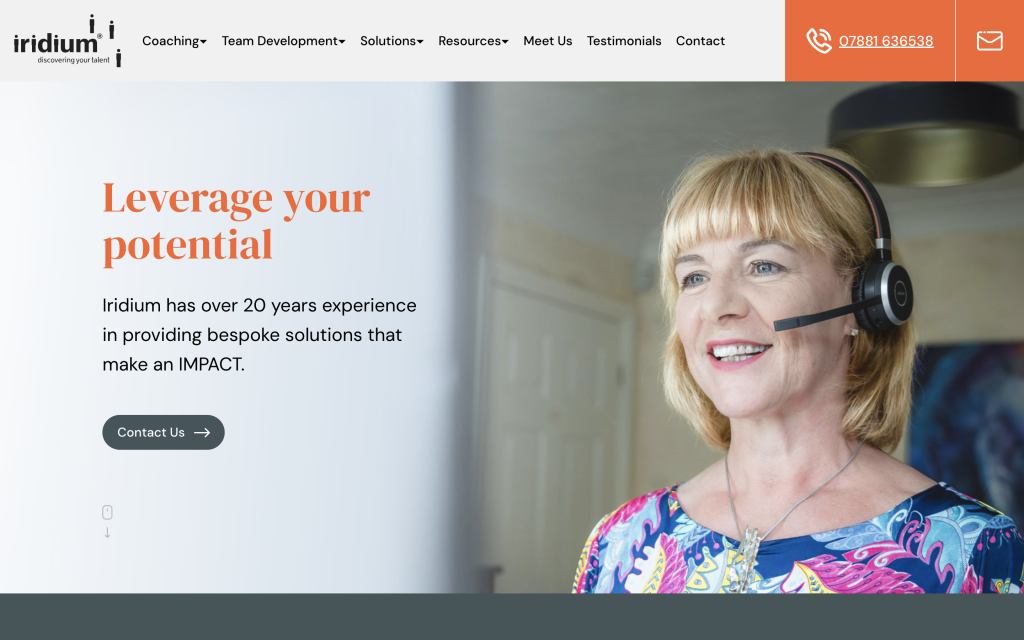
Iridium Consulting is a UK-based coaching and development firm led by Dr Gill Graves, working with leaders, managers, teams and individual coaches. Its core services are team coaching, executive coaching, coaching skills development and coach supervision, alongside personality and team-profiling tools such as Insights Discovery and the Myers-Briggs Type Indicator. The practice describes itself as small and bespoke, with a co-owner managing each project, and cites more than 25 years of experience.
Who it is for
- Senior leaders and executives wanting one-to-one support, for example stepping into a bigger role.
- Teams seeking facilitated development rather than one-off training.
- Internal coaches and coaching programmes needing supervision or skills development.
- Organisations that want profiling tools (Insights Discovery, MBTI) woven into wider development work.
What distinguishes it
The emphasis is on tailored engagements rather than off-the-shelf courses, and on continuity: the same senior person stays close to the project. Testimonials on the site come from clients including the University of Leicester, NHS Gloucestershire ICB and The Nature Conservancy, and describe a style that is warm and supportive while still challenging—one internal-coach client credits supervision sessions with developing their coaches over several years.
A practical next step
If you are weighing providers, decide first whether you need individual coaching, team coaching or supervision, since these are different purchases with different success measures. Then ask any provider how they would tailor an engagement to your context and who would actually deliver it. For broader comparison, the professional bodies EMCC UK and Association for Coaching list accredited coaches and supervision standards, which helps you judge credentials alongside a provider's own claims.
How do I choose between team coaching and executive coaching for my organisation?
Choose team coaching when the shared performance of a group is the problem or opportunity—how a leadership team communicates, makes decisions, handles conflict or works across functions. Choose executive coaching when the work is primarily about one leader's capability, transition or behaviour, such as stepping into a senior role, sharpening judgement or raising personal impact.
A practical way to decide
| Question | Points to team coaching | Points to executive coaching |
|---|---|---|
| Who needs to change? | The group's dynamics, alignment or collective results | One individual's skills, confidence or leadership style |
| What is the presenting issue? | Silos, unclear roles, poor handovers, low trust between functions | A promotion, a difficult stakeholder relationship, personal effectiveness |
| Who owns the outcome? | The whole team, with shared accountability | The individual, supported by their manager |
| How visible is the need? | Others notice the team's behaviour and results | The leader and their line manager see the development need |
Iridium's own positioning is useful here: it describes itself as a specialist in team coaching, executive coaching and coach supervision, and says its work is bespoke and managed by a co-owner. That suggests a fit for organisations wanting a tailored programme rather than an off-the-shelf course, but the choice of format still depends on the issue, not the provider.
When the answer is both
Many organisations need the two to run in parallel. A leadership team may benefit from team coaching to improve how it works together, while one or two members take up executive coaching for individual transitions. The risk is treating team coaching as a series of one-to-one conversations in a group room; it works best when the team's real work—decisions, meetings, projects—is the material being coached.
A concrete next step
Before commissioning anything, ask the sponsor to describe the outcome in observable terms. "The team will make decisions within one meeting rather than deferring them" points to team coaching. "The new director will run effective board presentations within three months" points to executive coaching. If the answer names both a group result and an individual, consider a combined brief with separate goals and measures.
For context on how coaching bodies describe these distinct disciplines, see EMCC UK and Association for Coaching.
What does coach supervision involve and who is it for?
Coach supervision is a structured, recurring conversation between a coach and a more experienced supervisor about the coach's client work. It is not therapy and not line management: the focus is on the coach's practice — what they noticed, what they chose to do, what they avoided, and how their own reactions shaped the work. Sessions typically combine reflection on live cases, exploration of the coach's internal responses, attention to ethical and contracting questions, and deliberate practice of new approaches.
What it usually covers
- Case reflection: reviewing specific coaching relationships and the choices made in them.
- Self-awareness: noticing patterns, triggers and blind spots that affect the work.
- Ethics and boundaries: confidentiality, dual relationships, competence limits, when to refer on.
- Contracting and endings: agreeing outcomes with clients and sponsors, and closing well.
- Skill development: rehearsing questions, frameworks and ways of handling difficult moments.
- Professional accountability: keeping standards, continuing development and reflective records.
Who it is for
It suits practising coaches at any stage, but the need differs by situation:
| Coach's situation | Typical supervision need |
|---|---|
| Newly qualified, building hours | Confidence, technique, safe handling of tricky cases |
| Experienced internal coach | Reflection, challenge, guarding against routine and drift |
| External coach with a busy portfolio | A confidential space separate from clients and sponsors |
| Coach moving into senior or team work | Support for more complex, higher-stakes assignments |
| Internal coach network with a lead | Group supervision that develops several coaches at once |
Group supervision is a common format for organisations with internal coach pools; individual supervision gives more room for personal patterns and confidential case detail. The Iridium page describes supervision as one of its specialist areas alongside team and executive coaching, and a testimonial from Lisa Hallam at the University of Leicester describes six years of group supervision for internal coaches, with sessions adapted to different proficiency levels. That observation is the client's, not an independent evaluation; practically, it points to a useful criterion — ask whether the supervisor can flex between a novice and an experienced group without the session becoming a lecture for one and a repeat for the other.
A practical next step
Before choosing a supervisor, write down three coaching situations from the past few months that you handled less well than you would like. Share them in an initial conversation and see whether the supervisor responds with curiosity and structure rather than advice-giving. For organisational buyers, ask how group supervision will handle confidentiality when participants coach colleagues who know each other, and how progress will be reviewed across a cohort.
For broader context on coaching standards and supervision expectations, the professional bodies are worth consulting directly: EMCC UK and Association for Coaching.
How can I become an accredited Insights Discovery practitioner?
Accreditation as an Insights Discovery practitioner is delivered through Insights itself, not through individual coaching firms. You complete the official Insights Discovery accreditation programme, which combines pre-work, an intensive workshop (typically several days), practice sessions and a final assessment before you are licensed to use the profiles and materials. The exact route, prerequisites and costs are set by Insights, so confirm them on its official site rather than relying on a coach's summary.
A practical route
- Check the current accreditation requirements and scheduled programmes with Insights directly.
- Confirm your organisation will sponsor the licence and the ongoing costs of using the materials.
- Prepare by getting familiar with the Discovery language (colour energies) so the workshop time goes on practice rather than orientation.
- Plan how you will use it afterwards — internal team development, one-to-one coaching, or both — because the licence terms and business case differ.
Iridium, the site in your notes, lists Insights Discovery among its solutions and publishes an article on becoming a practitioner. It may be a useful source of practitioner perspective or a route to a programme, but the accreditation itself and its terms come from Insights. For comparison, other coaching providers such as The Coaching Academy cover related psychometric tools, though you should verify their current offerings.
As general advice: the accreditation is worthwhile if you will run multiple sessions a year and can commit to the licence; if you only need occasional team profiling, hiring an accredited practitioner is usually more economical.
What does Gill Graves' book 'Team Coaching With Impact at Work' cover?
The page does not describe the book's contents. It only announces that Gill Graves' book Team Coaching With Impact at Work is available, with no chapter list, themes or summary. Anything specific about what it covers would be guesswork from the title and from Iridium's stated focus on team coaching, executive coaching and coach supervision.
What can reasonably be inferred
- Likely subject: practical team coaching — how to coach leadership teams and working groups so the coaching produces measurable change ("impact") rather than comfortable conversation.
- Likely audience: team coaches, internal coaches, HR/L&D leads and managers who commission or run team coaching.
- Reasonable expectation, not a claim: given Iridium's positioning as a bespoke provider with over 25 years' experience, the book may lean toward practitioner case material rather than academic theory — but confirm this before buying.
Practical next step
If you are deciding whether it fits your needs, check the book's own description or look-inside sample for chapter headings and whether it addresses your context (e.g. senior leadership teams, public sector, remote teams). As a benchmark, compare it with established team coaching texts such as those from Amazon UK listings or publisher pages, and see Iridium Consulting for the author's own framing of her team coaching approach.
How does Iridium tailor its coaching programmes to a specific organisation's needs?
Iridium tailors its coaching programmes by treating every engagement as bespoke rather than offering fixed packages. According to the company, a co-owner personally manages each project, so the person scoping the work stays accountable for delivering it. The stated aim is to understand the client's exact requirements and design coaching around them, spanning executive coaching, team coaching and development, coaching skills, and coach supervision, with psychometric tools such as Insights Discovery and the Myers-Briggs Type Indicator available where useful.
What "tailored" appears to mean in practice
The page evidence points to customisation at several levels: the mix of services (individual, team, or supervisor development), the choice of diagnostic tools, and the relationship with the client. Testimonials describe this flexibility concretely. Lisa Hallam of the University of Leicester notes that Gill adapted supervision sessions to a group with varying levels of coaching proficiency. Una Rice of NHS Gloucestershire ICB describes coaching that was personalised to her while retaining structure and purpose. A director at The Nature Conservancy highlights time taken to build relationships with each group. These are clients' observations, not independent evaluations, but they suggest tailoring happens through listening and adjusting the format, not just choosing a course title.
How to judge fit for your organisation
A practical next step is to ask, in an initial conversation, how the programme would change if your team were, say, a newly formed leadership group versus a long-standing function with entrenched habits. Useful criteria:
- Diagnosis before design: Does the provider explore your context (strategy, team dynamics, prior interventions) before proposing an approach?
- Tool choice justified: Are psychometrics like Insights Discovery or MBTI recommended for a reason, or offered by default?
- Adjustment during delivery: Can sessions flex as group proficiency or goals shift, as in the supervision example above?
- Continuity: Will the person who scopes the work also deliver and review it?
For comparison, larger providers such as CIPD publish general guidance on coaching standards, and professional bodies like EMCC UK outline supervision and ethics frameworks that can help you set expectations. A small, owner-led practice like Iridium suits organisations wanting a close, adaptable relationship; very large rollouts across many sites may need a provider with broader delivery capacity.
 GoDaddy
 Microsoft 365
 United Kingdom
User reviews (0)