
 简体中文
简体中文 English
Website review
This review may include AI-generated content and is not individually verified. Domain, certificate and other facts come from the observed data on this page.
What is Korbit AI?
Korbit AI is an automated code review tool that works inside GitHub, GitLab and Bitbucket. It reviews pull requests before a teammate does, flags likely bugs, and explains how to fix them, then hands the PR on for human approval. In practice it acts as a first-pass reviewer that is always available, so senior engineers spend their time on design and logic rather than routine checks.
Who it suits
- Small teams without dedicated reviewers. The page's customer quotes describe it as a stand-in lead reviewer that catches issues early and cuts critical support tickets.
- Teams onboarding junior developers. Several quoted customers say it doubles as a training aid, because the feedback explains fixes rather than just flagging lines.
- Shops on GitHub, GitLab or Bitbucket that want review comments where the code already lives, without a separate dashboard.
Trade-offs to weigh
- It complements, not replaces, human review. The vendor's own framing is "review first, then submit for team review," and one quoted CTO notes it caught issues that had slipped past human reviewers—useful, but it also means you still need people in the loop.
- Value depends on how much your team argues about style versus substance. Automated comments are most useful for logic and bug detection; if your team already has strong linting and CI checks, overlap is the main risk.
- Adoption is measurable. One customer cites 47% of suggestions being implemented, which is a reasonable metric to track in a trial rather than trusting headline claims.
Next step
Pick one active repository and run a two-week trial on real pull requests, then compare review turnaround time and the share of bot comments your developers actually act on. If most comments are noise, the tool is not earning its place; if they catch real bugs before testing, it is. For a broader comparison of review approaches, see GitHub's own code review and Copilot documentation.
How does Korbit AI integrate with GitHub, GitLab, and Bitbucket for pull request reviews?
Korbit AI reviews pull requests inside the version-control platforms your team already uses—GitHub, GitLab and Bitbucket—rather than in a separate dashboard. According to the site, it works "directly" in those tools and gives real-time, actionable feedback on each pull request, finding bugs and explaining how to fix them. The intended flow is that Korbit reviews the PR first, then the team reviews and approves it, with Korbit continuing to assist at that approval stage. The site also describes PR summaries and review comments as part of the experience.
What that means in practice
- Setup: you connect Korbit to your repository host; the site frames the value as seamless operation inside GitHub, GitLab and Bitbucket, so reviewers stay in their normal PR view.
- Trigger: a pull request is opened or updated, and Korbit posts its review on that PR.
- Output: bug findings with suggested fixes, plus a summary of the change—useful for reviewers opening a large PR cold.
- Team step: humans still approve and merge; Korbit is positioned as a first-pass reviewer, not a replacement for sign-off.
A concrete scenario
A backend team with a shared GitHub repo and two senior reviewers is the bottleneck. A junior developer opens a PR touching order logic. Korbit comments on a null-handling bug and a confusing TypeScript type, and posts a summary. The juniors fix the flagged issues before the seniors look, so senior time goes to design questions. This matches customer observations on the site: Dan Gordon of Sonr says Korbit caught issues that had slipped through human reviews, and Mark Osborn of Gladstone Software describes it removing a bottleneck on key developers and acting as a training tool for juniors. Those are their experiences, not guarantees; expect value to depend on how noisy the suggestions are for your codebase.
Choosing between the three
| Host | Best fit | Trade-off to weigh |
|---|---|---|
| GitHub | Teams already using GitHub PRs and Actions-style workflows | Little beyond confirming repo permissions and review-comment behavior |
| GitLab | Organizations standardized on GitLab merge requests | Verify merge-request coverage and comment formatting match your process |
| Bitbucket | Teams in the Atlassian ecosystem (Jira, Confluence) | Check how review comments surface alongside existing Atlassian tooling |
The main decision criterion is not which host is "best" but how much review friction your current process has: if PRs sit for days waiting on a few reviewers, a first-pass AI reviewer helps most. If your team already reviews quickly, weigh the cost of extra comment noise.
Next step: pick one active repository, connect it, and run a two-week trial on real PRs. Track how many Korbit comments your developers accept versus dismiss—the site cites a 47% implementation rate among one customer's suggestions, so measure your own. If you also evaluate alternatives, compare against GitHub's built-in code review tooling and GitLab's merge request features before committing.
How accurate is Korbit AI at catching bugs compared to human code reviewers?
Korbit AI is best understood as a first-pass reviewer, not a replacement for human judgment. Its page evidence shows it is designed to find bugs in pull requests and explain how to fix them before a person reviews the code, and customer testimonials describe it catching issues that had slipped through human review. But "accuracy" depends on bug type: it is likely strongest on pattern-based problems (null checks, logic slips, obvious edge cases) and weaker on design intent, business rules, and context that lives outside the diff. No independent benchmark is provided here, so treat claims of catching human-missed bugs as vendor and customer observations, not a measured error rate.
Where each tends to do better
| Bug type | AI reviewer (Korbit) | Human reviewer |
|---|---|---|
| Repetitive logic errors, null/edge cases | Fast, consistent, 24/7 | Slower, attention-limited |
| Unclear or messy TypeScript logic | Testimonials cite logical bugs in hard-to-read code | Depends on reviewer skill |
| Architectural and design trade-offs | Limited by diff context | Strong |
| Business-rule correctness | Needs explicit context | Strong if reviewer knows the domain |
| Review speed and coverage | Near-instant on every PR | Bottleneck on key engineers |
Practical takeaway
The realistic accuracy gain is coverage and speed: every PR gets a consistent first look, so humans spend time on judgment rather than routine defects. The risk is false positives and missed context-dependent bugs, which is why the page's own framing is "review first, then submit for team approval."
Next step: before trusting it, run it on a sample of your last 20–30 merged PRs and count how many of its comments you would have acted on, plus any real bugs it missed. That gives you a concrete precision/recall sense for your codebase rather than a general accuracy claim. Teams evaluating similar tools often compare against GitHub's built-in code scanning or SonarSource for rule-based static analysis, since those catch different classes of defects than an LLM reviewer.
What does the 14-day free trial include and what happens after it ends?
The page advertises a 14-day free trial but does not itemize what it includes or state what happens when it ends. The only concrete details are the product itself: AI pull-request reviews that work inside GitHub, GitLab and Bitbucket, flag bugs with suggested fixes, and summarize each PR before a human reviewer steps in. Treat the trial as a full-product evaluation rather than a limited feature demo, and confirm the post-trial terms directly with Korbit before you commit a team.
What the page supports
- Scope: context-based PR reviews in GitHub, GitLab and Bitbucket, including bug detection with fix guidance and PR summaries.
- Audience signals: the page cites 22K+ developers and testimonials from CTOs, VPs of Technology and engineering leads, so it is positioned for teams rather than solo hobby projects.
- No details on: seat limits, repository count, review volume, data retention, or whether billing starts automatically.
What to verify before day 14
- Conversion terms — whether the trial converts to a paid plan automatically, and what the cancellation window is.
- Plan fit — how pricing scales with seats and repos, since a trial rarely exposes cost pressure.
- Data handling — where code is processed and retained, which matters for regulated or proprietary codebases.
- Workflow fit — whether your team uses GitHub, GitLab or Bitbucket, since all three are listed as supported.
A practical trial plan
Run the trial on one active repository with real PRs for the first week, and log how many Korbit comments your reviewers accept versus dismiss. In week two, compare review turnaround against your baseline and check whether junior developers find the explanations useful. That gives you evidence for a renewal decision instead of a gut call.
For broader context on AI review tooling, see GitHub for its native review features and Bitbucket for its pull-request workflow.
Can Korbit AI help junior developers learn and upskill through code review feedback?
Yes. Korbit AI is explicitly positioned as an upskilling tool as well as a reviewer: its page says it "upskills developers," and customer quotes describe it acting as a training aid for junior staff. The mechanism is that it comments on pull requests inside GitHub, GitLab or Bitbucket before a human reviews them, so a junior developer gets an explanation of a bug and how to fix it at the moment they open the PR, rather than waiting for a senior colleague's time.
What the page evidence shows
- Explanations, not just flags: the site says it "finds bugs and explains how to fix them," which is the part that matters for learning. A bare "this is wrong" comment teaches little; a fix suggestion plus reasoning teaches a lot.
- Summaries per PR: one customer, Mike de la Fuente of Payground, singled out the per-PR summaries as a liked feature. For a junior, a plain-language summary of what a change does is useful rehearsal for writing their own PR descriptions.
- Catching what humans miss: Dan Gordon of Sonr noted it caught issues that had slipped through human review. For a learner, that means the feedback loop is not limited by how thorough a busy reviewer was that day.
- Training-tool framing: Mark Osborn of Gladstone Software said it "started to act as a training tool for some of the more junior developers" and removed a bottleneck on key developers. That is his observation from his team, not a guarantee.
- Adoption signal: the page states 47% of Korbit's suggestions get implemented, per Brent Mikkelsen. A high accept rate suggests suggestions are concrete enough to act on, which is what makes them learnable.
A practical way to use it for juniors
- Have the junior open the PR and read Korbit's comments first, then attempt fixes themselves before asking a human.
- Require a one-line note in the PR on what they learned from each accepted suggestion. This converts passive fixes into retained knowledge.
- Reserve human review for design, naming and architecture questions, which automated review handles less well.
Trade-offs to weigh
AI review feedback is strongest on local, mechanical issues — logic bugs, error handling, unclear types — and weaker on intent, domain context and team conventions. A junior who only ever hears from the bot may learn to satisfy the tool rather than the codebase's design taste. Pairing it with periodic human review keeps that balance.
As a next step, run a two-week trial on a small team that includes at least one junior and compare the volume and type of comments they receive against your current human review. Korbit's page advertises a 14-day free trial, and it lists GitHub, GitLab and Bitbucket as supported hosts, so the integration cost is low if you already use one of them.
How do teams measure the impact of Korbit AI on review times and code quality?
Teams typically measure Korbit AI's impact by comparing pull-request review cycles and defect rates before and after adoption, using both platform data and developer feedback. From the page evidence, the intended outcomes are clear: slash review times, increase code quality, and catch bugs before human review in GitHub, GitLab and Bitbucket. The evidence also cites customer observations that Korbit caught issues that had slipped through human reviews and that roughly 47% of its suggestions were implemented, which points to the kind of metrics teams track.
Practical metrics to track
- Review cycle time: Median time from PR opened to first substantive comment, and to final approval. Korbit's first-pass review should shorten the gap before a human weighs in.
- Human review effort: Number of reviewer comments per PR and time senior engineers spend on routine feedback versus design decisions.
- Suggestion adoption: Share of Korbit comments that are implemented or resolved, a signal of relevance rather than volume.
- Defect leakage: Bugs found in testing or production that originated in reviewed code, plus escaped-defect trends over time.
- Rework and stability: Reopened PRs, follow-up fix commits, and build stability indicators. One cited customer linked more stable builds to improved retention, though that is their observation, not a universal measure.
- Developer experience: Survey junior and senior developers on learning value and review burden; several cited customers describe Korbit as a training aid for junior staff.
How to run the comparison
Establish a baseline of four to eight weeks before rollout, then compare the same repositories and team segments afterward. Segment by PR size and complexity, since AI review tends to help most with routine logic checks and least with architectural judgment. Pair quantitative data with a short qualitative review of which comments were accepted or dismissed, because adoption rate alone does not prove quality.
A useful next step is to pilot on one or two high-traffic repositories, define the baseline metrics above, and review results after a month. For context on how other AI review tools frame similar measurements, see GitHub Copilot code review documentation and CodeRabbit.
 Amazon CloudFront
 Google Workspace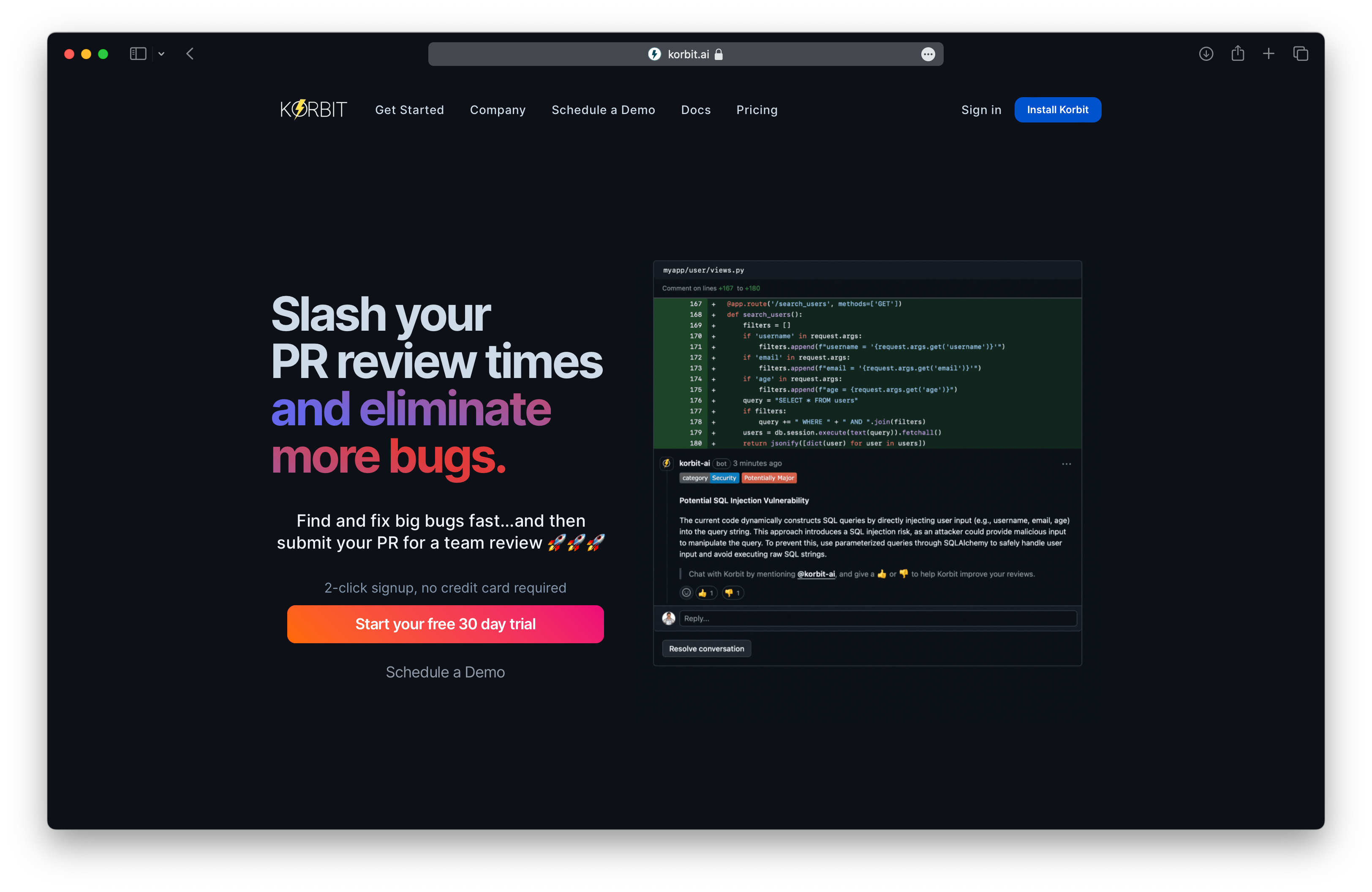

User reviews (0)