
 webmaker.app
 Paid content
Categories: Development
Build, experiment, and prototype HTML, CSS, and JavaScript instantly in your browser. Works offline. Supports SCSS, TypeScript, Pug, and more. Free Chrome extension.
 Visit website
 Updated: 2026-10-03 22:41
 Language: English (default)
 Access: Normal
 Profile views 1
 Outbound visits 0
Related questions
More questions →What Can an Amazon Seller Browser Extension Actually Do for Your Listings?
An Amazon seller browser extension is a small piece of software that runs inside Chrome, Edge, or Firefox and adds information or shortcuts directly onto Amazon pages you already visit. In practice, it can overlay demand and competition data on a product page, pull quick numbers while you browse a niche, flag missing or weak listing elements, and save you from switching between tabs. What it cannot do is replace a full listing engineering or growth platform: extensions are lightweight, page-level helpers, while serious listing work — keyword architecture, AI-readiness, bulk optimization, and performance tracking over time — needs a dedicated toolset. The useful question is not "extension or platform" but "which jobs belong to each."
What a browser extension typically does well
Most seller extensions cluster around a few repeatable, on-page tasks. If your workflow involves a lot of browsing, these are where the time savings are real.
On-page data overlays
While you're on a product detail page, the extension can display estimated sales, revenue, review velocity, seller count, and price history in a panel next to the listing. This turns "open a separate research tab and paste the ASIN" into "read the number where you already are." For quick sanity checks on a competitor or a potential product, that's a genuine speed gain.
Quick product and niche research
Extensions often let you scan a search results page and see metrics for every listing at once, or export a batch of ASINs. This is useful for early filtering: you can spot which results have thin review counts, unstable pricing, or a dominant seller, and decide which few are worth deeper analysis.
Listing checks and basic audits
Some extensions highlight on-page elements — title length, bullet presence, image count, whether A+ content appears, whether key fields look empty. This is a fast visual audit, not a scoring system. It tells you what's there, not whether your listing is engineered to match how Amazon discovery works now.
Convenience features
Coupon and deal finders, price-drop alerts, review-request shortcuts, and quick links to seller tools fall into this bucket. They're small quality-of-life wins rather than strategy.
Where extensions fall short
This is the part sellers most often underestimate. An extension sees the page in front of you; it doesn't hold your catalog, your history, or your strategy.
| Job | Browser extension | Full listing/growth platform |
|---|---|---|
| On-page competitor snapshot | Yes, fast | Yes, often deeper |
| Keyword architecture across a listing | No | Yes |
| AI-readiness / discovery optimization | Rarely | Core function |
| Bulk edits across many ASINs | No | Yes |
| Tracking your own listings over time | Limited | Yes |
| Historical trend and seasonality | Usually shallow | Yes |
| Team workflows and permissions | No | Yes |
The pattern: extensions are read-and-react tools for pages you're already on. Platforms are build-and-manage tools for your own catalog. If your bottleneck is "I need to know if this niche is worth entering," an extension helps. If your bottleneck is "my listings aren't converting or aren't being surfaced the way Amazon discovery now works," an extension won't fix that — you need listing engineering, not a data overlay.
Scenarios: when an extension earns its place
- Early product research. You're scanning dozens of search pages a day. An overlay that shows demand and competition inline saves hours of tab-switching. Worth it.
- Competitor spot-checks. You want a fast read on a rival's pricing and review momentum before a pricing decision. An extension gives you that in seconds.
- Quick listing sanity checks. You're about to publish and want to confirm images, bullets, and title are all present. A visual audit extension is handy.
- Ongoing listing optimization. You need to align titles, bullets, and backend terms with how Amazon's discovery systems interpret intent, and to keep that consistent across a catalog. This is platform territory — an extension can't hold or apply that structure.
- Scaling a catalog. Once you're managing many ASINs, bulk operations, version history, and team access matter more than any single-page overlay.
What to check before installing any extension
Extensions can read the pages you visit, and some request broad permissions. Before you install:
- Read the permission list. Does it need access to all sites, or only Amazon domains? Broader access than the job requires is a yellow flag.
- Check what data leaves your browser. Does it send your browsing or seller data to a server? Is that disclosed?
- Confirm the vendor. Prefer extensions from established sellers/tool providers with a real product behind them, not anonymous one-off add-ons.
- Test on a non-critical account first. If it touches your Seller Central session, verify behavior before relying on it.
- Know the exit. Can you disable it cleanly, and does uninstalling remove stored data?
How to decide if it fits your stage
Ask three questions:
- Is my main pain "I browse a lot and want data inline"? An extension is likely worth it.
- Is my main pain "my listings underperform and I need to engineer them properly"? Skip the extension-first mindset; look at a listing/growth platform.
- Am I managing more than a handful of ASINs? You'll outgrow page-level tools quickly; extensions become a supplement, not the system.
A practical setup for many sellers is both: an extension for fast on-page research, and a dedicated platform for the listing work that actually moves rankings and conversion. ZonGuru, for example, positions its toolset around listing engineering and AI-readiness rather than page overlays — the kind of work an extension structurally can't do. If you want to see where a full platform picks up, its pricing page outlines the options, and there's a free trial to test the workflow before committing.
The short version: a browser extension is a fast, cheap way to see more while you browse. It is not a listing strategy. Use it for the browsing jobs, and bring in a real platform for the engineering jobs — that division is what keeps your time and your listings both working.
What Does a Postal Code API Return? Fields, Formats, and Common Use Cases
A postal code API returns structured location data for a given ZIP Code or Canadian postal code. A typical response includes the code itself, city, state or province, county, latitude/longitude, and — where available — ZIP+4 detail. More complete services add time zone, area codes, boundary geometry, and demographic fields. You send a code (or an address), and the API sends back a machine-readable record you can store, validate, or display.
This article explains what those responses contain, how requests are usually shaped, and where postal code data fits into real applications.
First, clear up the word "code"
The keyword "code" is overloaded, and that causes real confusion for developers:
- Postal code — the ZIP Code (U.S.) or postal code (Canada) that identifies a delivery area.
- API key — the credential you use to authenticate your requests. It is not postal data.
- Source code — the program you write to call the API.
When someone searches for "postal code API code," they usually want example request/response code for a postal code service. The rest of this article treats it that way.
What a postal code API actually returns
Response fields vary by provider and endpoint, but the core set is fairly consistent. A single-code lookup commonly returns:
| Field | Example | Notes |
|---|---|---|
| Postal code | 90210 |
The code you queried |
| City | Beverly Hills |
May be one of several acceptable place names |
| State / Province | CA |
Two-letter abbreviation |
| County | Los Angeles |
Useful for tax, territory, and reporting logic |
| Latitude / Longitude | 34.0901, -118.4065 |
Usually the centroid of the area |
| ZIP+4 | 90210-1234 |
Present only when a specific delivery segment is known |
| Time zone | America/Los_Angeles |
Helps with scheduling and display |
| Area codes | 310, 424 |
Regional phone context |
Richer datasets add 90+ fields: boundaries, population, income, elevation, and more. You rarely need all of them — request only what your application uses.
A representative JSON response
{
  "postal_code": "90210",
  "city": "Beverly Hills",
  "state": "CA",
  "county": "Los Angeles",
  "latitude": 34.0901,
  "longitude": -118.4065,
  "timezone": "America/Los_Angeles",
  "area_codes": ["310", "424"]
}
XML responses carry the same information in tag form. Choose based on what your stack parses most easily; JSON is the common default.
Common request patterns
Most postal code APIs support four patterns. Knowing which one you need prevents wasted calls.
1. Lookup by code
You have a code and want its details. This is the simplest and fastest call.
GET /lookup?code=90210
2. Reverse lookup by address
You have a street address and want to confirm or complete the code. This is the pattern behind checkout address validation.
GET /validate?street=...&city=...&state=...
3. Radius search
You have a center point and want all codes within a distance. Useful for store locators and delivery zones.
GET /radius?code=90210&miles=10
4. Batch validation
You have a file of addresses and want them cleaned in bulk. Batch endpoints trade latency for throughput and usually have their own limits.
Handling missing and ambiguous matches
Real data is messy. Plan for these cases:
- No match — the code doesn't exist or the address is malformed. Return a clear error rather than a silent empty object.
- Multiple matches — a city name may map to several codes, or a code may span several acceptable city names. Decide whether to pick the primary or return a list.
- Partial match — the street is valid but the ZIP+4 isn't. Fall back to the 5-digit code.
- Stale data — codes are added, retired, and reassigned. Refresh your dataset on a regular schedule.
A practical rule: validate at the point of entry, store the normalized result, and never re-derive it later from raw user input.
Practical use cases
- Checkout address validation — catch typos before shipping, reduce failed deliveries.
- Shipping zone lookup — map a code to a zone, carrier route, or rate table.
- Data enrichment — append county, coordinates, or demographics to existing records.
- Store and service locators — radius search to find nearby branches or coverage areas.
- Territory and tax logic — county and boundary data drive jurisdiction rules.
Licensing and data-source considerations
Postal code data originates with national authorities — USPS in the United States and Canada Post in Canada. Providers license and repackage it, which is why accuracy, update frequency, and field coverage differ between services. Before committing:
- Confirm the data source and how often it refreshes.
- Check whether ZIP+4 and boundary data are included or sold separately.
- Review usage limits and whether batch processing is allowed.
- Read the license terms for redistribution and storage.
Pricing and plan details change, so check the provider's current documentation rather than relying on secondhand figures.
Getting started
- Decide which request pattern you need (lookup, reverse, radius, or batch).
- Pick the fields you'll actually store.
- Write a small test call and inspect the raw response.
- Add error handling for no-match and ambiguous cases.
- Cache results where the same codes repeat.
A postal code API is ultimately a translation layer: you give it a code or an address, and it gives back structured location facts. Understand the fields, match them to your use case, and handle the messy edges — that's most of the work.
Website Overview
An established domain and managed infrastructure suggest continuity of operations and may support dependable delivery, although neither guarantees service quality. An active inbound-mail setup with incomplete authentication may leave the domain more open to impersonation. Provider hosting alone does not close that gap.
Domain and Registration
Registered in 2018, this domain has about 8 years of history. That suggests continuity, although ownership and purpose may have changed. Transfer-protection status is present, helping reduce the risk of unauthorized domain transfers. The registrar is CloudFlare, Inc., a widely used domain service provider. The domain uses the common .app extension, which is not an independent safety signal.
DNS and Email
The observed email authentication setup is incomplete: DMARC is missing. The lowest TTL is 60 seconds, supporting rapid record changes at the cost of more frequent lookups. Nameservers are provided by Cloudflare, indicating managed DNS hosting. MX records point to the Cloudflare Email Routing email service. No CNAME was found; the observed records resolve directly to addresses.
TLS and Certificates
The public key uses EC with 256 bits. The server supplied a complete certificate chain. No organization name is present in the certificate; the available fields are consistent with domain validation. The certificate was issued by Let's Encrypt, commonly associated with automated certificate services. The certificate's total validity is about 89 days, consistent with a short renewal cycle.
HTTP and Browser Security
The response lacks these common security headers: CSP, X-Content-Type-Options, Referrer-Policy, Permissions-Policy, clickjacking protection. No X-Powered-By header was found, reducing one common source of backend fingerprinting information. No obvious internal addresses or debug information were found in the headers. The Server header contains the custom value Netlify. No explicit CDN or WAF marker was found in the response headers.
Technology Stack Analysis
The public page identifies Google Analytics, Netlify without precise versions, leaving fewer clues for version-specific scanning.
Search and Social Sharing
The meta description has 169 characters and may be shortened in search results. Twitter Card metadata is configured. JSON-LD includes Organization data, helping describe the organization as an entity. The title has 61 characters, within a common display range. The observed directives allow indexing and link following.
 Hosting and Email
 Cloudflare
 Hosting
 Netlify
 Location
 United States
 Pages, Search and Sharing
| Meta description | Build, experiment, and prototype HTML, CSS, and JavaScript instantly in your browser. Works offline. Supports SCSS, TypeScript, Pug, and more. Free Chrome extension. |
|---|---|
| Canonical URL | https://webmaker.app/ |
| Language | English (default) |
| Twitter Card | summary_large_image |
Social Sharing Preview
8 fields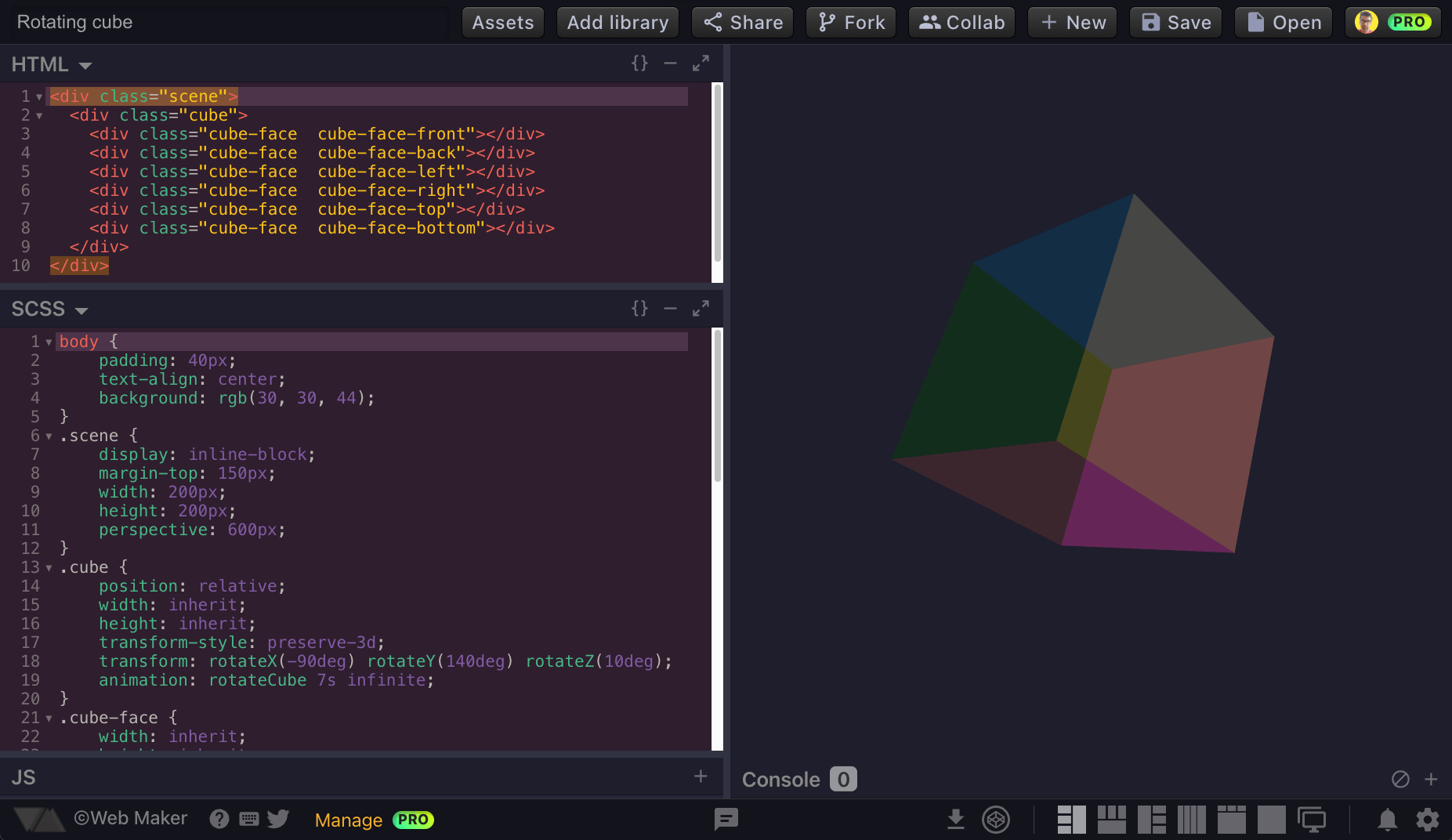

Sharing metadata
| og:url | https://webmaker.app/ |
|---|---|
| og:type | website |
| og:image | https://webmaker.app/images/ss1-new.png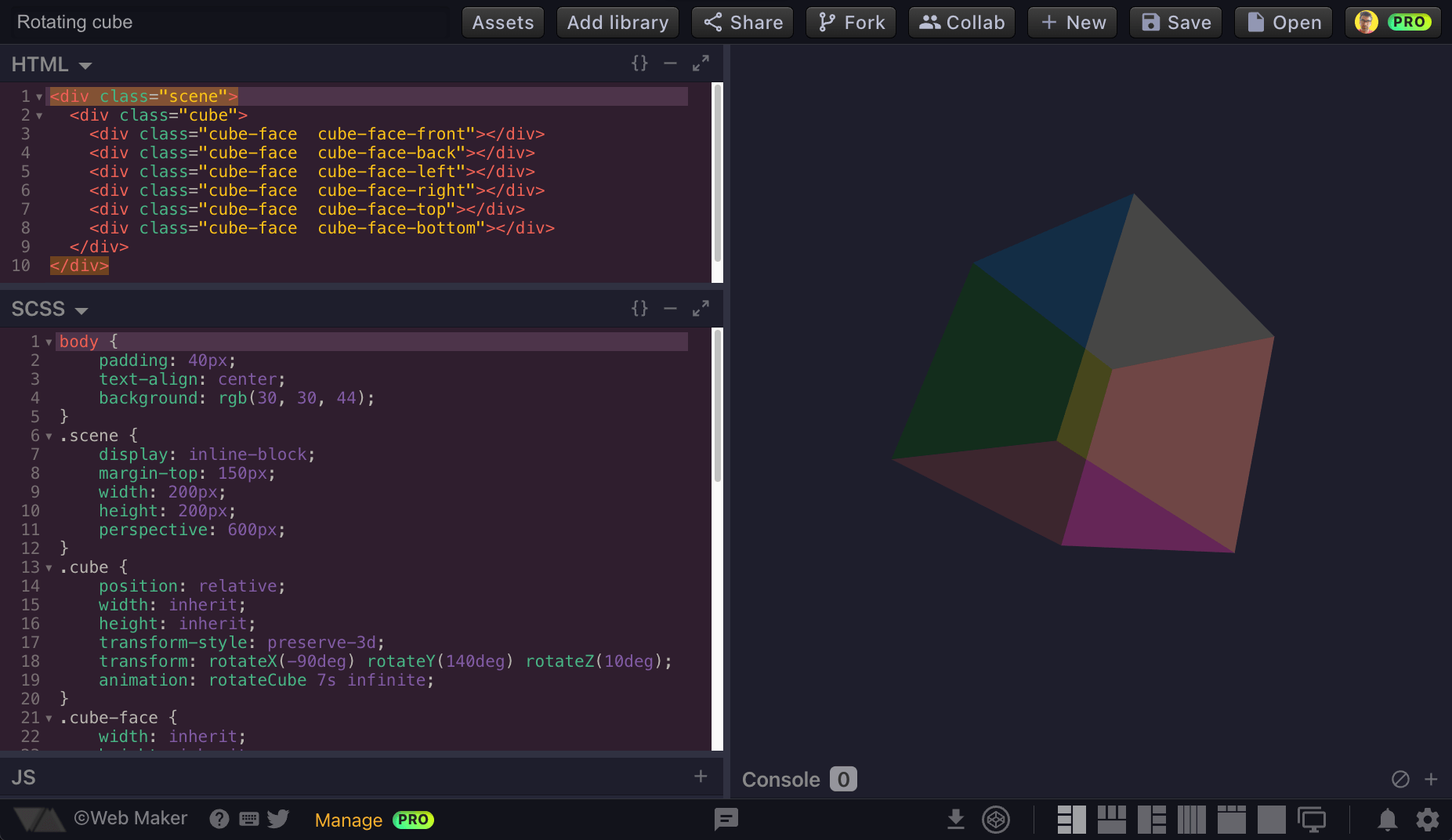 |
| og:title | Web Maker - Free Offline Code Editor |
| og:description | Build, experiment, and prototype HTML, CSS, and JavaScript instantly in your browser. Works offline. Supports SCSS, TypeScript, Pug, and more. Free Chrome extension. |
| twitter:card | summary_large_image |
| twitter:site | @webmakerApp |
| twitter:image | https://webmaker.app/images/ss1-new.png |
robots.txt (opens in a new tab)
2 rulesAll bots 1 allowed · 1 disallowed

 All bots

/
/create/
No matching rules.
Sitemaps
1 Registration details RDAP / WHOIS
| Registrar | CloudFlare, Inc. |
|---|---|
| Registered | 2018-05-08 |
| Expires | 2027-05-08 |
| Domain status | client transfer prohibited |
| Nameservers | anirban.ns.cloudflare.com、meera.ns.cloudflare.com |
| DNSSEC | unsigned |
 DNS records
| Type | Name | Value | TTL | Priority |
|---|---|---|---|---|
| A | webmaker.app | 75.2.60.5 | 60 | — |
| A | webmaker.app | 99.83.231.61 | 60 | — |
| MX | webmaker.app | route1.mx.cloudflare.net | 300 | 51 |
| MX | webmaker.app | route2.mx.cloudflare.net | 300 | 66 |
| MX | webmaker.app | route3.mx.cloudflare.net | 300 | 95 |
| NS | webmaker.app | anirban.ns.cloudflare.com | 86400 | — |
| NS | webmaker.app | meera.ns.cloudflare.com | 86400 | — |
| TXT | webmaker.app | google-site-verification=sxb2giqZFrc7gTuzfJfXh0ePuE-fWoFiyBe1J18Q3vA | 300 | — |
| TXT | webmaker.app | paddle-verification=e123dc0f | 300 | — |
| TXT | webmaker.app | v=spf1 include:_spf.mx.cloudflare.net ~all | 300 | — |
 TLS and certificates
| Assessment | Normal configuration |
|---|---|
| Supported protocols | TLSv1.2、TLSv1.3 |
| Negotiated protocol | TLSv1.3 |
| Certificate subject | webmaker.app |
| Issuer | Let's Encrypt |
| Valid until | 2026-11-12T21:43 · Remaining when checked: 39 days |
| Verification details | Certificate trust: Passed · Hostname match: Passed |
 HTTP response headers
| Header | Value |
|---|---|
| content-type | text/html; charset=UTF-8 |
| cache-control | public,max-age=0,must-revalidate |
| server | Netlify |
| strict-transport-security | max-age=31536000 |
 Identified technologies
User reviews (0)