Website profiles · Technology insights · Alternatives

larafast.com

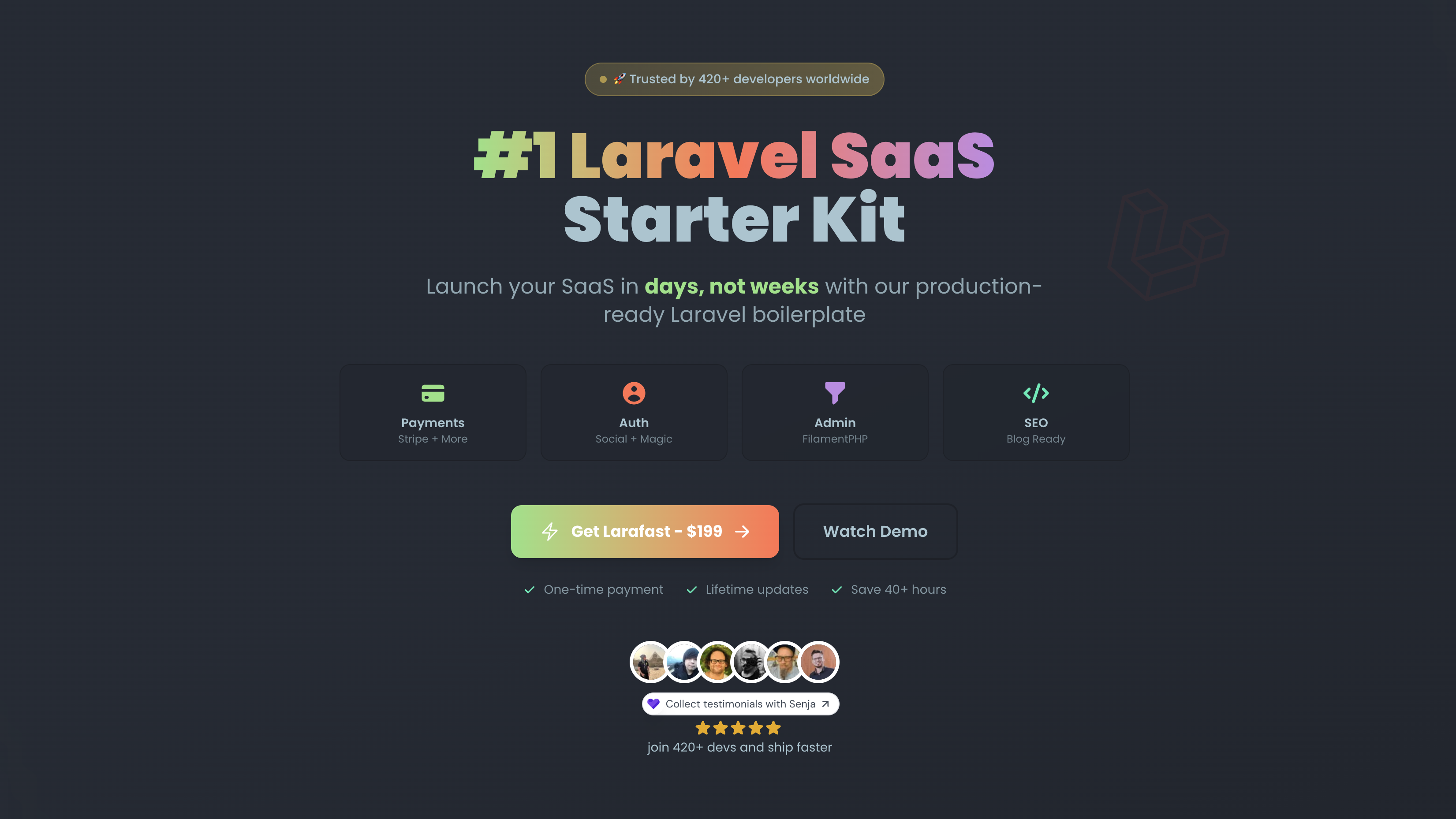
Larafast - Laravel SaaS Starter Kit with all the necessary features to transform your idea into reality in just a matter of hours.

Paid content
Visit website
Profile views 12 Outbound visits 12 Normal
Larafast Full homepage screenshot

At a glance

Category
Development
Language
English
Paid-content signal
Paid contentObserved
Registered
2024
Hosting
CloudflareInferred
HTTPS certificate trusted
PassedObserved
Last updated

Website review

This review may include AI-generated content and is not individually verified. Domain, certificate and other facts come from the observed data on this page.

What is Larafast?

Larafast is a Laravel SaaS starter kit: a pre-built codebase you buy once and adapt into your own subscription software, instead of wiring up the same foundations from scratch. Its stated purpose is to shorten the gap between idea and working product to "a matter of hours," which in practice means it targets the repetitive layer of SaaS work — accounts, billing plumbing, admin screens — so you can spend your time on the feature that makes your product different.

Who it fits

  • Solo developers and small teams already comfortable with Laravel and PHP.
  • Founders validating a paid product who want to charge real customers quickly.
  • Agencies that ship similar SaaS projects repeatedly and want a reusable base.

It fits less well if your stack is JavaScript-first, if you need unusual billing logic, or if you would rather learn by building the foundations yourself.

What to check before buying

  1. Confirm the Laravel and PHP versions it supports against the version you plan to deploy.
  2. List the features you actually need — authentication, teams, roles, subscription billing, admin panel, API layer — and tick off which are included versus which you would still build.
  3. Verify the billing integration. Payment handling is named as Lemon Squeezy, so if you intend to use another processor, budget time for that work.
  4. Read the license terms for the number of projects or seats allowed.
  5. Check how recent the last updates are; a starter kit's value decays if it lags behind framework releases.

Trade-off to weigh

A starter kit saves weeks of undifferentiated setup, but you inherit someone else's structure and conventions. If you dislike the chosen patterns, refactoring can cost more than starting clean. Skim the code organisation and documentation first — if the structure reads clearly to you, the shortcut is worth it.

For a concrete next step, open the official site and compare its feature list line by line against your own requirements, then estimate the hours each missing item would take. If that total is small, the kit pays for itself; if it is large, keep looking. Comparable boilerplates exist in the same space, such as Laravel's own first-party starter kits, which are worth pricing against it.

How does Larafast help me launch a Laravel SaaS faster?

Larafast is a Laravel SaaS starter kit: a pre-built codebase you install and extend, rather than an empty Laravel project where you wire up billing, authentication and admin screens yourself. Its value is skipping the repetitive "SaaS plumbing" so your first working version is a matter of configuration and customization rather than weeks of setup.

What it typically saves you from building

  • Authentication flows, including social login and password reset
  • Subscription billing and checkout, with Lemon Squeezy listed as the payment platform
  • User dashboards, admin panels and role/permission handling
  • Landing page and marketing sections that usually get rebuilt for every project
  • Transactional email, API scaffolding and other common SaaS infrastructure

Who it fits

  • Solo developers or small teams validating an idea who would rather spend time on the differentiator than on login screens
  • Agencies that ship similar Laravel SaaS products repeatedly and want a consistent base
  • Developers already comfortable with Laravel who don't want to learn a new framework

Who should look elsewhere

  • Teams on a different stack (Rails, Django, Node) — the kit won't transfer
  • Products with unusual billing models, multi-tenant complexity or compliance requirements that would mean rewriting large parts of the boilerplate anyway
  • Anyone who enjoys building infrastructure and wants full control from line one

A practical way to decide Install it, then try to reach a paying test user within a day: sign up, subscribe, hit a gated feature. If the kit gets you there with mostly configuration, it's earning its place. If you find yourself fighting its opinions on billing or user structure, that friction will only grow — compare against building on plain Laravel or another starter such as Laravel's own starter kits before committing.

What features are included in Larafast's Laravel SaaS starter kit?

Larafast is a Laravel SaaS starter kit aimed at developers who want to skip repetitive setup work and get a subscription product running faster. Its stated purpose is to provide "all the necessary features to transform your idea into reality in just a matter of hours," so the feature set is organized around the common building blocks of a SaaS application rather than a single niche.

What a kit like this typically covers

  • Authentication and user accounts — registration, login, password reset and session handling, which are prerequisites for any paid product.
  • Subscription billing — the page lists Lemon Squeezy among its payment platforms, so billing and checkout are intended to be part of the package rather than something you wire up yourself.
  • Admin and dashboard scaffolding — a starting point for the screens your customers and your team will use daily.
  • A Laravel codebase — since it is a Laravel starter kit, the output is a Laravel project you own and extend, not a hosted platform.

The exact list of included modules is not itemized in the supplied page information, so treat the above as the categories such a kit addresses rather than a confirmed inventory. Check the product's own feature page before buying if a specific integration is a dealbreaker.

Who it suits, and the trade-off

Larafast fits a small team or solo developer who is comfortable in Laravel, has a validated idea, and would rather spend the first weeks on the product than on auth, billing and account screens. The trade-off is the familiar one with boilerplates: you inherit someone else's structure and conventions, and you may end up removing or rewriting parts you don't need. If your product deviates sharply from a standard subscription model, the time saved upfront can be partly spent later on untangling assumptions.

Next step: write down your three must-have integrations — payment provider, email service, and any auth requirement such as social login — then compare them against Larafast's documented feature list. If all three are covered, the kit is likely worth the setup time; if two or more are missing, a plain Laravel install plus a few packages may be the faster route. For broader context on what these kits include, see Laravel.

How does Larafast compare to other Laravel starter kits or boilerplates?

Larafast is best understood as a Laravel SaaS starter kit: it targets founders and small teams who want to skip the repetitive groundwork of subscriptions, authentication and billing so they can ship a paying product faster. The supplied page evidence is thin, so treat the following as a framework for evaluating it against alternatives rather than a feature-by-feature verdict.

What "SaaS starter kit" usually means

Most kits in this category bundle a similar core:

  • Authentication and user management, often with social login and two-factor support
  • Subscription billing and plan management, frequently via Stripe or Paddle
  • An admin or user dashboard scaffold
  • Teams, roles and permissions
  • Email, notifications and queue setup
  • Theming or a front-end preset (Blade, Livewire, Inertia, Vue or React)

Larafast's stated pitch is turning an idea into a working product "in just a matter of hours," and its listed payment platform is Lemon Squeezy. That matters: if you specifically want Lemon Squeezy as your merchant of record, a kit built around it saves real integration time. If your business already runs on Stripe or Paddle, that alignment is less valuable.

How to compare kits concretely

Criterion Why it decides the choice
Billing provider Switching providers mid-build is painful; pick the kit that matches your processor
Front-end stack Blade/Livewire suits small teams; Inertia + Vue/React suits those with JS experience
Admin panel Some kits ship Filament or Nova; others leave admin to you
Teams and roles Essential for B2B SaaS, optional for single-user tools
Tests and code quality Determines how confidently you can modify the codebase
Update path Kits that ship updates keep you current; forks do not
Licence terms Check whether you can use it for client work or multiple products

Practical decision path

  1. Write down your must-haves: billing provider, front-end stack, team features, admin panel.
  2. Check each candidate against that list before looking at anything else.
  3. Download or preview the code structure if a demo or repository is available.
  4. Estimate the hours you would spend building the missing pieces yourself, then compare that cost against the kit price.

Where Larafast likely fits

Choose Larafast if you are building a subscription SaaS on Laravel, want Lemon Squeezy handling payments, and prefer to start from an opinionated scaffold rather than assembling packages yourself. Look at alternatives if you need a different billing provider, a specific front-end framework it does not use, or a larger ecosystem of plugins and community answers — established options such as Laravel's own starter kits and broader boilerplate marketplaces are worth checking for that reason.

A useful next step: list your three non-negotiable requirements, then verify each one directly against Larafast's current documentation before buying.

Can I customize Larafast for my own SaaS idea?

Yes — Larafast is built as a Laravel SaaS starter kit, so the intended workflow is to take the base and adapt it to your own product rather than use it as-is. The practical question is not whether you can customize it, but how much of your idea already fits its structure.

What customization usually involves

  • Branding and UI: swapping logos, colors, copy and landing-page sections to match your positioning.
  • Product logic: adding or replacing the core domain features (the part that makes your SaaS different).
  • Billing and plans: adjusting plan tiers, trial behavior and gating rules around whatever payment platform the kit integrates.
  • Auth and accounts: teams, roles, permissions, invitations or profile flows, depending on your target user.

Who gets the most value

Larafast suits a solo developer or small team who already knows Laravel and wants to skip repetitive groundwork — authentication, subscription plumbing, admin scaffolding — to reach a working prototype quickly. It is a weaker fit if your product needs a fundamentally different architecture, or if you don't work in PHP/Laravel, because you'd spend more time fighting the stack than building.

A practical way to decide

Before buying, list your must-have features and mark each one as already covered, adaptable, or needs custom work. If the third column is short, the kit saves you real time. If it's long, a plain Laravel install may be cheaper in effort.

As a next step, try building your single most important feature on top of the kit first. If that goes smoothly, the rest of the customization usually follows. For general Laravel guidance, the official documentation at Laravel is the reference point, and GitHub is useful for checking how comparable starter kits are structured before you commit.

What is the pricing and licensing for Larafast?

Larafast is a commercial Laravel SaaS starter kit, and its pricing is handled through Lemon Squeezy as the payment platform. Beyond that, the available page information doesn't list specific prices, tiers, or license terms, so I can't quote exact figures or confirm whether it's a one-time purchase or subscription.

What to expect from a Laravel SaaS starter kit license

Most kits in this category sell a one-time license that grants you the source code and the right to use it in your own projects. Common variations to check:

  • Single-project vs. unlimited projects — some licenses restrict you to one SaaS product.
  • Resale/redistribution rights — usually prohibited; you can build and sell your app, but not resell the kit itself.
  • Update access — often included for a period (e.g., a year) or tied to a major version.
  • Support — may be limited to a set window or offered via a private channel.

Next step

Visit the official site and open the pricing or checkout page (the Lemon Squeezy link) to see the current price, license tier, and refund policy. If the license terms are not clearly stated there, contact the seller before buying — the redistribution and multi-project clauses are the ones most likely to affect how you use it.

For comparison, other Laravel starter kits with published license terms include Laravel (the framework itself is free under the MIT license, though starter kits like Jetstream and Breeze have their own terms) and Spatie, whose paid packages clearly document per-project versus unlimited licensing.

As a practical scenario: if you're a solo developer shipping one product, a single-project license is usually enough; if you're an agency building for multiple clients, confirm the license explicitly permits that before paying.

Related questions

More questions →
Laravel Boilerplate vs Starter Kit: What You Get and How to Choose

A Laravel boilerplate is a pre-built Laravel codebase you clone or install to skip repetitive setup work. In practice, the term overlaps heavily with "Laravel starter kit" and "Laravel SaaS starter kit" — most products marketed under any of these names ship the same core pieces: authentication, billing hooks, team management, and an admin panel. The distinction that matters when choosing is not the label but what's actually included, how the code is licensed, and who maintains it. If you're building a SaaS product and want to reach a working prototype in hours rather than weeks, a SaaS-oriented kit like Larafast is the relevant category; if you just want a cleaner laravel new starting point, a lighter starter kit is enough.

What "Laravel Boilerplate" Actually Means

The word boilerplate comes from print publishing — text reused verbatim across many documents. In software, it means the same thing: code you'd otherwise rewrite for every project.

For Laravel specifically, boilerplate usually refers to the scaffolding around a fresh install:

  • Authentication — registration, login, password reset, email verification, often with social login
  • User and role management — the User model extended with roles, permissions, or subscription state
  • Billing integration — subscription plans, checkout, webhooks, and customer portal wiring
  • Team or multi-tenancy support — organizations, invitations, member roles, seat limits
  • Admin dashboard — user management, plan overview, impersonation, basic metrics
  • API scaffolding — token auth (Sanctum or Passport), rate limiting, versioned routes
  • Frontend stack — typically Inertia + Vue/React, or Blade + Livewire, plus a UI kit
  • DevOps basics — Docker or Sail config, CI workflow, environment templates

A boilerplate is not a framework feature. Laravel itself ships with almost none of the above beyond basic auth scaffolding, so everything else is either written by you or inherited from a package.

Boilerplate vs Starter Kit vs SaaS Starter Kit

These three terms are used loosely, but there's a useful working distinction:

Term Typical scope Best for
Laravel boilerplate Auth, base structure, maybe roles General Laravel apps, internal tools
Laravel starter kit Boilerplate + opinionated frontend/backend stack Teams standardizing on a stack
Laravel SaaS starter kit Starter kit + billing, teams, subscription logic, admin Products that charge recurring revenue

The boundaries blur. Laravel's own first-party starter kits (Breeze, Jetstream) sit in the first two rows — they handle auth and frontend scaffolding but leave billing and multi-tenancy to you. Commercial SaaS kits like Larafast occupy the third row: they assume you're selling subscriptions and pre-wire the parts that are tedious and error-prone to build, such as webhook handling and plan gating.

The practical test: does the kit include billing and team logic? If yes, it's a SaaS kit regardless of what the vendor calls it. If no, you'll be writing that layer yourself, which is usually the single largest chunk of pre-launch work.

How to Choose One

Work through these criteria in order — the first two eliminate most candidates.

1. Stack fit

Match the kit's frontend and auth approach to your team's skills. Inertia + Vue, Inertia + React, Livewire, and plain Blade are all common, and they are not interchangeable without a rewrite. If your team writes React daily, a Livewire kit will slow you down more than it saves.

2. License and usage terms

Check whether the license covers unlimited projects, a single project, or a team. Check whether you can modify and redistribute. Commercial kits typically sell a per-developer or per-project license through a payment platform — Larafast, for example, uses Lemon Squeezy for checkout. Read the actual license text rather than assuming; terms vary widely between vendors.

3. Maintenance and dependency freshness

A boilerplate is only valuable if it tracks Laravel's release cycle. Before buying or adopting:

  • Check the last commit date and the Laravel version supported
  • Look at how the vendor handles major Laravel upgrades (do they publish upgrade guides?)
  • Check whether dependencies like billing SDKs and UI kits are current

An abandoned kit costs more to modernize than starting fresh.

4. Included integrations

List what you'd otherwise build or buy, and confirm the kit covers it:

  • Payment provider (Stripe, Paddle, Lemon Squeezy)
  • Email provider and transactional templates
  • Social auth providers
  • Admin panel and role system
  • Testing setup (Pest or PHPUnit, factories, seeders)

Every integration the kit already wires up is a day you don't spend on plumbing.

5. Upgrade and lock-in risk

Ask how you'd leave. If the kit's abstractions are thin wrappers over Laravel and standard packages, migration is straightforward. If it introduces a proprietary layer you can't remove, you're renting your architecture. Prefer kits where billing, auth, and teams are built on well-known packages rather than custom replacements.

Common Pitfalls

  • Outdated dependencies. A kit pinned to an old Laravel or PHP version can take longer to upgrade than to replace.
  • Hidden upgrade costs. Some vendors charge separately for major version upgrades or new features. Confirm what the initial purchase includes.
  • Over-scaffolding. A kit with features you'll never use adds surface area to maintain and understand. Smaller is often better if it covers your core needs.
  • Assuming "free" or "no login." Pricing and access terms are set by each vendor and aren't implied by the category — verify on the vendor's own site.
  • Treating the kit as a finished product. A boilerplate gets you to a working starting point; product logic, UX, and domain rules are still yours to build.

A Quick Decision Path

  1. Building a subscription product? → SaaS starter kit.
  2. Building a non-commercial Laravel app? → first-party starter kit or a light boilerplate.
  3. Team already fluent in a specific frontend stack? → filter by that stack first.
  4. Need to ship in days, not weeks? → prioritize kits with billing and teams pre-wired.
  5. Evaluating a specific kit? → check license, last commit date, supported Laravel version, and what the price includes before committing.

The label on the box matters less than whether the included pieces match the work you're trying to avoid.

What Is a SaaS Starter Kit and How to Choose One

A SaaS starter kit is a pre-built codebase that bundles the parts every subscription software product needs — authentication, billing, team/account management, an admin panel — so you start from a working app instead of an empty repo. It fits best when you're building a standard subscription web product and want to skip weeks of plumbing; it fits poorly when your core differentiator is one of those plumbing layers (for example, a novel billing model or a custom identity system). Larafast is one example: a Laravel-specific kit that, per its own description, aims to turn an idea into a working product "in just a matter of hours."

What a typical SaaS starter kit includes

Most kits converge on the same feature set because subscription SaaS products share the same skeleton:

  • Authentication — sign-up, login, password reset, email verification, often social/OAuth login.
  • Billing and subscriptions — plan selection, checkout, webhooks for renewals and cancellations, and a customer portal.
  • Teams / multi-tenancy — organizations, member invites, roles and permissions, sometimes per-seat billing.
  • Admin panel — user management, impersonation, and internal metrics.
  • Supporting scaffolding — transactional email, background jobs, API tokens, and a settings/profile area.

The value isn't any single feature; it's that these are already wired together. Billing webhooks update user records, auth ties into teams, and the admin panel reads the same data model. Rebuilding those connections by hand is where early-stage projects lose time.

Framework-specific kits vs. generic boilerplates

The main split is between kits tied to one framework and generic boilerplates you assemble yourself.

Dimension Framework-specific kit (e.g., Larafast for Laravel) Generic boilerplate / DIY stack
Language & conventions Matches the framework's idioms; upgrades track the framework You choose and maintain every layer
Integration depth Auth, billing, teams shipped pre-wired You wire each service yourself
Learning curve Fast if you already know the framework Depends on how many tools you combine
Flexibility Constrained to the framework's patterns Maximum freedom, maximum setup cost
Maintenance Follows the kit's update cadence Entirely on you

If your team already works in Laravel, a Laravel SaaS starter kit removes the most friction. If you're framework-agnostic or your stack is unusual, a generic boilerplate may fit better — at the cost of doing the integration work yourself.

Criteria for evaluating a kit

Judge a kit on the things that are expensive to change later:

  1. Tech stack match — Does it use the language, framework, and database you'll actually ship on? A mismatch costs more than the kit saves.
  2. Included integrations — Which payment provider, auth method, and email service are baked in? Larafast, for instance, lists Lemon Squeezy among its payment platforms. If your business needs a different processor, check how hard swapping it is.
  3. Licensing — Is it a one-time purchase, per-project, or per-developer? What can you ship commercially? Read the license before you build on it.
  4. Update cadence — How often does it track upstream framework and dependency releases? A stale kit becomes a liability once security patches land.
  5. Code quality and test coverage — Can you read and extend it? Do you inherit someone else's shortcuts?
  6. Community and support — Docs, issues, and response times matter when you hit an edge case at 2 a.m.

Where a starter kit saves time — and where it doesn't

A kit compresses the undifferentiated work: auth flows, subscription state, team invites, admin screens. That's often the first several weeks of a new SaaS.

It does not build your product. Your domain logic, data model, unique UX, and integrations specific to your market remain custom work. A kit also doesn't decide your pricing, onboarding, or go-to-market — those are yours regardless.

A realistic split: the kit gets you to a deployable, billable shell quickly; the differentiated product on top is still your build.

Common pitfalls

  • Vendor lock-in — If billing, auth, and hosting are all tied to one provider the kit assumes, migrating later is painful. Check how coupled those layers are.
  • Mismatched payment or auth provider — A kit built around a processor or identity provider you can't use means rework, not savings.
  • Abandoned kits — An unmaintained kit leaves you owning framework upgrades and security patches alone.
  • Over-scoped kits — Features you'll never use still add code to read, secure, and maintain.
  • License surprises — Confirm commercial-use and redistribution terms before committing.

How to decide

Pick a framework-specific kit when you're already committed to that framework and its default integrations fit your product. Pick a generic boilerplate when your stack or your billing/identity requirements are non-standard. In both cases, verify the license, the update cadence, and how hard it is to swap the payment and auth providers — those three checks catch most of the regret later.

What Is SaaS? How Software-as-a-Service Works and When to Use It

SaaS (Software-as-a-Service) is a delivery model in which a vendor hosts an application and customers access it over the internet, typically paying a recurring subscription fee rather than buying a perpetual license. It fits most organizations that want faster deployment, lower upfront cost, and automatic updates — but it is a weaker fit when you need deep customization, strict data residency control, or the ability to run fully offline.

The core SaaS model

In a SaaS arrangement, three things move from the customer to the vendor:

  • Infrastructure — servers, storage, and networking are owned and operated by the provider.
  • Maintenance — patching, upgrades, and uptime are the provider's responsibility.
  • Access — users reach the software through a browser or thin client, usually with per-user or usage-based billing.

You consume the software as a service rather than owning a copy of it. That single shift is what drives most of the benefits and most of the trade-offs below.

SaaS vs. on-premise, self-hosted, IaaS, and PaaS

These models are often confused because they all involve "the cloud." The difference is how much the vendor manages.

Model Who manages the app? Who manages the infrastructure? Typical customer control
SaaS Vendor Vendor Configuration and data only
PaaS Customer (builds/deploys) Vendor App code, runtime settings
IaaS Customer Customer (on rented VMs) OS, middleware, app, data
On-premise Customer Customer (own hardware) Everything
Self-hosted Customer Customer (own or rented) Everything, but you install the vendor's software yourself

A quick way to place them: with IaaS you rent the raw building blocks; with PaaS you rent a ready workbench to build on; with SaaS you rent the finished product. On-premise and self-hosted mean you run and maintain the software on infrastructure you control.

Main benefits and trade-offs

Benefits

  • Lower upfront cost — no hardware purchase or large license fee; spend shifts to an operating expense.
  • Faster setup — provisioning is usually measured in hours or days, not procurement cycles.
  • Automatic updates — the vendor ships fixes and new features without a customer-side upgrade project.
  • Elastic scalability — capacity can often be adjusted up or down as demand changes.
  • Anywhere access — a browser and a connection are usually enough, which supports distributed teams.

Trade-offs

  • Less data control — your data lives in the vendor's environment, subject to their architecture and regions.
  • Limited customization — you generally configure within the vendor's boundaries rather than modifying the core.
  • Vendor lock-in — migrating away can be costly if data export and integration are not well supported.
  • Ongoing cost — subscriptions never "finish paying off" the way a perpetual license can.
  • Dependency on connectivity and uptime — if the service is down or unreachable, work may stop.

Typical use cases and examples

SaaS is the default choice for horizontal needs like email, CRM, project management, and HR. It is also increasingly common as vertical SaaS — software built for one industry's specific workflows and compliance requirements.

Regulated industries are a useful illustration. Trust, corporate, and fund services providers handle sensitive client data and face audit and reporting obligations, so they tend to weigh data control and compliance heavily. Quantios, for example, describes itself as an AI-native SaaS platform for global corporate, trust, and fund services providers, positioned to help them reduce risk, boost efficiency, and scale. That is the vertical-SaaS pattern: the delivery model is standard SaaS, but the feature set and compliance posture are tailored to one sector.

How to evaluate a SaaS option

Use the same criteria regardless of vendor, and get specifics rather than assurances:

  1. Security — encryption in transit and at rest, access controls, and how incidents are handled.
  2. Compliance — which standards and regulations the vendor supports, and whether they match your obligations.
  3. Integration — APIs, prebuilt connectors, and how easily it fits your existing stack.
  4. Pricing model — per user, per usage, tiered, or a mix; understand what triggers a cost increase.
  5. Data portability and exit — can you export your data in a usable format, and what happens to it at contract end?
  6. Service levels — uptime commitments, support channels, and response times.

When SaaS is the right fit — and when it isn't

Choose SaaS when you want speed, predictable operating costs, and low maintenance overhead, and your data can reasonably live in a vendor's environment.

Reconsider when you need deep customization, must keep data strictly on your own infrastructure, operate in low-connectivity settings, or face regulations that rule out third-party hosting. In those cases, self-hosted or on-premise may be the better fit — or a SaaS vendor with strong regional and compliance guarantees.

Larafast Review: What You Get in This Laravel SaaS Starter Kit and Who It's For

Larafast is a commercial Laravel SaaS starter kit that bundles the repetitive parts of a subscription product — authentication, billing, admin, and team management — so you can start from a working SaaS instead of an empty framework install. It fits best if you're building a subscription-based web app on Laravel and want to skip weeks of boilerplate. It fits poorly if you need a free, open-source starting point, or if your project doesn't involve recurring billing or multi-user accounts.

The catch: the source material available here confirms what Larafast is and that it sells through Lemon Squeezy, but it does not list specific features, prices, or supported Laravel/PHP versions. So treat the sections below as a framework for evaluating it, and verify the specifics on the product's own pages before you buy.

What a Laravel SaaS starter kit typically bundles

A starter kit in this category exists to remove the "undifferentiated heavy lifting" of a SaaS. The parts you'd otherwise build yourself usually include:

  • Authentication — registration, login, password reset, email verification, and often two-factor auth.
  • Billing and subscriptions — plan selection, checkout, webhooks from a payment provider, and gating features by plan.
  • Admin panel — user management, impersonation, and internal dashboards.
  • Teams / multi-tenancy — organizations, invitations, roles, and per-team data scoping.
  • Supporting scaffolding — settings pages, profile management, notifications, and API tokens.

Larafast's own description positions it as covering "all the necessary features to transform your idea into reality in just a matter of hours," which is the standard promise of this product class. The practical question is not whether those features exist in the abstract, but which ones Larafast actually ships and how opinionated its implementation is.

How to compare Larafast against Jetstream, Spark, and SaaSykit

These four are the names that come up most when choosing a Laravel SaaS starting point, and they differ mainly on two axes: what's included and how you pay.

Kit Typical positioning Billing included? Payment model
Larafast Full SaaS starter kit Yes (per its description) Commercial, via Lemon Squeezy
Jetstream Auth + teams scaffolding No — bring your own Free, open source
Spark Billing-focused starter Yes, first-party Commercial license
SaaSykit Full SaaS starter kit Yes Commercial license

Two things to hold onto when you compare:

  1. Jetstream is not a direct substitute. It gives you auth and team scaffolding but leaves billing to you, so the comparison is really "free foundation + your own billing work" versus "paid kit with billing included."
  2. Spark and SaaSykit are the closer comparisons. All three are paid kits that assume you want subscriptions handled. The decision then comes down to feature coverage, the payment provider each integrates with, and licensing terms — not to whether billing is included at all.

Because the available source material doesn't enumerate Larafast's feature list or price, don't fill that gap from memory. Check each kit's own feature and pricing pages on the same day, using the same criteria, before deciding.

Licensing and payment: what to confirm before buying

Larafast sells through Lemon Squeezy, which is the only payment detail confirmed in the source material. That tells you the checkout runs through a merchant-of-record platform, but it does not tell you:

  • Whether the license is one-time or subscription.
  • How many projects or domains a single license covers.
  • Whether updates are included, and for how long.
  • Whether there's a refund window.

These are the questions that most often cause buyer's remorse with commercial starter kits, so get answers in writing before checkout. A license that covers one project is a very different purchase from one that covers unlimited projects, even at the same price.

Setup requirements and time to a working SaaS

The realistic path with any kit in this class looks like this:

  1. Confirm version compatibility first. Check the kit's required Laravel and PHP versions against your target environment. This is the single most common blocker — a kit built for one Laravel major version may not run cleanly on another.
  2. Install and run the app locally. Expect a standard Laravel setup: clone or download, install dependencies, configure your .env, run migrations.
  3. Connect your own service credentials. Billing, mail, and any third-party integrations will need your own API keys and webhook endpoints — the kit provides the wiring, not the accounts.
  4. Verify the core flows end to end. Register a user, complete a test subscription, confirm the webhook updates the user's plan, and check that gated features unlock. This is where you find out whether the kit's billing logic matches your pricing model.
  5. Then start building your actual product.

The "hours" claim in the marketing copy refers to steps 1–4, not to building your product. Budget your time accordingly: the kit removes scaffolding work, not product work.

Common gaps to check before you buy

Starter kits are opinionated, and the friction shows up at the edges. Before committing, verify:

  • Supported Laravel and PHP versions — and whether the kit tracks new Laravel releases.
  • Payment provider lock-in — which gateway the billing is built around, and how hard it is to swap.
  • Frontend stack — whether it uses Livewire, Inertia, Vue, React, or plain Blade, and whether that matches your team's skills.
  • Multi-tenancy model — single database with scoping, or database-per-tenant. This is expensive to change later.
  • Test coverage and code quality — a kit you can't safely modify is a liability.
  • Update policy — whether you get future Laravel compatibility fixes.

Who Larafast is for

Choose Larafast if you're building a subscription SaaS on Laravel, you want billing and team management handled out of the box, and you'd rather pay for a head start than assemble free components yourself.

Look elsewhere if you want a free open-source foundation (Jetstream), if your app has no recurring billing or multi-user needs, or if you need to confirm exact pricing and version support before deciding — in which case, go straight to Larafast's own pricing and documentation pages, since those details aren't available in the source material summarized here.

Laravel Starter Kit vs Boilerplate: What You Get and How to Choose

A Laravel starter kit gives you a working application skeleton with opinionated features already wired up — typically authentication, billing, an admin panel, and UI scaffolding — while a boilerplate is closer to a bare project structure you extend yourself. Choose a starter kit when you want to ship a SaaS fast and accept its conventions; choose a boilerplate (or Laravel's own first-party scaffolds) when you need maximum control over architecture and dependencies. The trade-off is speed and included features versus flexibility and long-term ownership.

What "starter kit" actually means in Laravel

The term gets used loosely, so it helps to separate the layers:

  • Framework scaffold — what laravel new gives you: routing, config, Eloquent, migrations. No product features.
  • Boilerplate — a repo you clone that adds structure (folders, base models, maybe a layout) but leaves product logic to you.
  • Starter kit — a scaffold plus product-level features: auth flows, team/organization handling, subscription billing, admin dashboards, UI components, and often tests.

Laravel's first-party options sit in this space too: Breeze is a minimal auth scaffold (Blade or Inertia + Tailwind), Jetstream adds teams, profile management, and two-factor auth on top of a stack choice, and Spark targets subscription billing specifically. Third-party kits like Larafast bundle a broader set of SaaS features into one package.

Starter kit vs boilerplate: the practical differences

Dimension Boilerplate Starter kit
What you get Project structure, base config Structure + auth, billing, admin, UI
Time to first feature You build auth/billing first You build your product first
Flexibility High — nothing imposed Medium — you work within its conventions
Maintenance You own everything Depends on the maintainer's update cadence
Best for Custom architecture, unusual requirements Standard SaaS, internal tools, MVPs

The decision usually comes down to one question: is authentication and billing part of your product's value, or overhead? If it's overhead, a starter kit removes it. If your auth or billing model is unusual, a boilerplate plus targeted packages is often cleaner than fighting a kit's assumptions.

What to check in any Laravel starter kit

Before committing, verify these on the actual repo or product page:

  1. Auth and team model — Does it match how your users organize (single user, teams, orgs with roles)? Retrofitting multi-tenancy later is expensive.
  2. Billing integration — Which provider is wired in (Stripe, Paddle, Lemon Squeezy, etc.)? Confirm it supports your pricing model (one-time, subscription, usage-based) and your target regions.
  3. Admin and UI scaffolding — Is there a real admin panel, or just a layout? Check which frontend stack (Blade, Livewire, Inertia + Vue/React) it assumes.
  4. Tests and CI — A kit without tests means you inherit unverified code. Look for a test suite and a CI config.
  5. Licensing and update path — Is it a one-time purchase, a subscription, or open source? How do you receive updates, and can you merge them without conflicts?
  6. Maintenance signals — Recent commits, issue response, supported Laravel versions. An abandoned kit becomes a liability the moment a new Laravel major drops.

Red flags

  • No commits or releases in many months, with open issues unanswered.
  • No tests, or tests that don't run against a current Laravel version.
  • Unclear upgrade path — you can't tell how to pull in fixes.
  • Billing code tied to a single provider with no abstraction, making a switch a rewrite.
  • Licensing that restricts commercial use or redistribution in ways that conflict with your plans.

Matching the kit to your project

  • SaaS product — Prioritize billing, teams, and admin. A full starter kit pays off fastest here.
  • Internal tool — You may only need auth and a UI scaffold; Breeze or Jetstream is often enough, and a heavy billing kit adds unused surface area.
  • Simple app or API — A boilerplate or plain Laravel scaffold is usually the right call; a SaaS kit is overkill.

For a concrete example: if you're building a subscription app for a single region with Stripe and standard team seats, a kit that ships exactly that saves weeks. If you're building usage-based billing across multiple providers, you'll likely replace the kit's billing layer anyway — so weigh whether the rest of the kit still earns its place.

Where Larafast fits

Larafast is positioned as a Laravel SaaS starter kit that bundles the features needed to turn an idea into a working product quickly, and its listed payment platform is Lemon Squeezy. If Lemon Squeezy matches your billing needs and you want a SaaS-oriented feature set out of the box, it's a candidate worth evaluating against the checklist above. If you need Stripe specifically, or a different team model, confirm those details on the product page before deciding — the source material here doesn't specify pricing, licensing terms, or the full feature list, so treat those as things to verify directly.

How to decide

  1. List the features you'd otherwise build yourself (auth, billing, admin, teams).
  2. Estimate the time and risk of building each versus adopting a kit's version.
  3. Check the kit against the six criteria above, especially maintenance and licensing.
  4. If two or more core features don't fit your model, lean toward a boilerplate or first-party scaffold instead.

The kit is a starting point, not a commitment to its architecture forever — but the closer its assumptions match your product, the less you'll rewrite later.

Website Overview

Page metadata, canonical configuration and social previews work together to provide more consistent search and sharing presentation. An active inbound-mail setup with incomplete authentication may leave the domain more open to impersonation. Provider hosting alone does not close that gap.

Domain and Registration

Transfer-protection status is present, helping reduce the risk of unauthorized domain transfers. The domain has about 2 years of registration history; its current configuration provides more context than age alone. The registrar is GoDaddy.com, LLC, a widely used domain service provider. The domain uses the common .com extension, which is not an independent safety signal.

DNS and Email

The observed email authentication setup is incomplete: SPF is missing. Nameservers are provided by Cloudflare, indicating managed DNS hosting. MX records point to the Google Workspace email service. No CNAME was found; the observed records resolve directly to addresses. TXT records include verification markers for Google. Such markers may also remain after a service stops being used.

TLS and Certificates

The public key uses EC with 256 bits. The server supplied a complete certificate chain. No organization name is present in the certificate; the available fields are consistent with domain validation. The certificate was issued within the Google Trust Services cloud or CDN ecosystem. The certificate's total validity is about 90 days, consistent with a short renewal cycle.

HTTP and Browser Security

The response lacks these common security headers: HSTS, CSP, Referrer-Policy, Permissions-Policy. No X-Powered-By header was found, reducing one common source of backend fingerprinting information. The cf-ray response header indicates a CDN or caching proxy in the delivery path. No obvious internal addresses or debug information were found in the headers. The Server header identifies cloudflare without an exact version.

Technology Stack Analysis

The public page identifies Cloudflare without precise versions, leaving fewer clues for version-specific scanning.

Search and Social Sharing

Open Graph is partially configured; og:type is missing. Twitter Card metadata is configured. JSON-LD includes Product or Offer data, potentially supporting eligible product search features. The title has 46 characters, within a common display range. A meta description is present, with 130 characters.

Hosting and Email

DNSCloudflare
HostingCloudflare
EmailGoogle Workspace
Approximate IP geolocation (inferred; a CDN or proxy may differ from the origin server) Location unknown Inferred 104.21.26.91

Registration details

RDAP / WHOIS

RegistrarGoDaddy.com, LLC
Registered2024-02-16
Expires2027-02-16
Domain statusclient delete prohibited、client renew prohibited、client transfer prohibited、client update prohibited
Nameserverscora.ns.cloudflare.com、remy.ns.cloudflare.com
DNSSECunsigned

DNS records

DNS

TypeNameValueTTLPriority
Alarafast.com104.21.26.91300—
Alarafast.com172.67.135.209300—
AAAAlarafast.com2606:4700:3031::6815:1a5b300—
AAAAlarafast.com2606:4700:3031::ac43:87d1300—
MXlarafast.comaspmx.l.google.com18001
MXlarafast.comalt1.aspmx.l.google.com18005
MXlarafast.comalt2.aspmx.l.google.com18005
MXlarafast.comalt3.aspmx.l.google.com180010
MXlarafast.comalt4.aspmx.l.google.com180010
NSlarafast.comcora.ns.cloudflare.com86400—
NSlarafast.comremy.ns.cloudflare.com86400—
TXTlarafast.comgoogle-site-verification=iqCyYC4FZqnTqKHuPWiFtUkOo3kDsmW-Z50ffzLIAGM3600—
DMARC_dmarc.larafast.comv=DMARC13600—

TLS and certificates

TLS / SSL

AssessmentNormal configuration
Supported protocolsTLSv1.2、TLSv1.3
Negotiated protocolTLSv1.3
Certificate subjectlarafast.com
IssuerGoogle Trust Services
Valid until2026-12-25T15:15 · Remaining when checked: 86 days
Verification detailsCertificate trust: Passed · Hostname match: Passed

HTTP response headers

HTTP

HeaderValue
content-typetext/html; charset=UTF-8
cache-controlno-cache, private
servercloudflare
x-frame-optionsSAMEORIGIN
x-content-type-optionsnosniff
set-cookieRedacted

Identified technologies

Cloudflare

Pages, Search and Sharing

Meta descriptionLarafast - Laravel SaaS Starter Kit with all the necessary features to transform your idea into reality in just a matter of hours.
Canonical URLhttps://larafast.com
LanguageEnglish (default)
Twitter Cardsummary_large_image
All bots 0 allowed · 0 disallowed

User reviews (0)

  • No reviews yet.