
 简体中文
简体中文
nothumansearch.ai
Check if AI agents can find and use your site. Not Human Search scores any site 0–100 on 7 agentic signals — llms.txt, OpenAPI, MCP, Schema.org & more — and indexes 8,000+ agent-ready sites. Free instant score.
At a glance
- Category
- Artificial Intelligence
- Language
- English
- Paid-content signal
- No paid content foundObserved
- Registered
- 2026
- Hosting
- Fly.io, Inc.Inferred
- HTTPS certificate trusted
- PassedObserved
- Last updated
Related questions
More questions →How to Search for Agent-Ready Services on Not Human Search
Not Human Search is a search engine for services that AI agents can actually use. You search by category, protocol, or the job your agent needs to complete, then compare results by their machine-readable readiness score. It's free to search, and organic rank is based on readiness, never payment. Use it when you need to find an API, tool, or service that an autonomous agent can discover and call without human intervention.
What you can search for
The search bar accepts three kinds of queries:
- Category — e.g.
ecommerce,finance,developer,data,security,health,productivity,ai-tools,hosting,other - Protocol — e.g.
MCP,OpenAPI,llms.txt,ai-plugin,Schema.org - Task your agent needs to complete — e.g.
AI jobs,payment API,weather,auth,hosting
The site suggests these examples directly under the search field, so you can start from a task description rather than guessing a category name.
Step-by-step: finding a service
- Enter your query. Type the job, category, or protocol into the search box and submit. The result count updates — the index currently holds 5,379 sites.
- Scan the result cards. Each listing shows the service name, a short description, its domain, and a row of signal tags such as
llms.txt,ai-plugin,OpenAPI,API,AI bots,Schema.org, andMCP. - Read the score. Every site carries a 0–100 agent-readiness score. The average across indexed sites is 38. A score of 100 appears alongside point breakdowns like
+25 llms.txtand+20 ai-plugin, so you can see which signals earned the points. - Open the service if the score and signals match what your agent needs.
Expected result: a filtered list of services ranked by readiness, each with the evidence you need to decide whether an agent can consume it.
Browsing without a query
If you don't have a specific task in mind, use the category entry points instead of the search box:
- Top 100 — highest-scoring agent-ready sites
- Newest — recently indexed services
- MCP Servers — services exposing a Model Context Protocol interface
- AI Tools, Developer, Data, Finance, E-Commerce, Productivity, Security, Health
These let you survey the landscape before narrowing down.
Reading a result card
| Element | What it tells you |
|---|---|
| Score (0–100) | Overall agent-readiness |
Point breakdown (+25 llms.txt, +20 ai-plugin) |
Which signals contributed |
| Signal tags | Protocols and formats the site supports |
| Category label | Where it sits in the index |
| Description | What the service does |
A site tagged with llms.txt, OpenAPI, MCP, and Schema.org is discoverable and callable through several machine-readable paths. A site with only API gives your agent less to work with.
Common sticking points
- A high score doesn't mean the service fits your task. Readiness measures machine-consumability, not whether the API does what you need. Check the description and category.
- Protocol tags are not interchangeable. If your agent speaks MCP, filter for
MCPrather than assuming anOpenAPIlisting will work. - Ranking is readiness-based. A service can't buy a higher position, so treat the order as a signal-quality ranking rather than a popularity or quality ranking.
Related questions
- What are the 7 agentic signals Not Human Search scores?
- How Not Human Search ranks sites — and whether payment affects placement
- What is Not Human Search?
How to Improve Your Site's Agent-Readiness Score on Not Human Search
Not Human Search scores any site from 0 to 100 across 7 agentic signals and gives you a free instant score. To improve it, start by running your site through the "Score Your Site" entry to see which signals are missing, then add the machine-readable files and protocols you lack — most commonly llms.txt, an OpenAPI description, MCP support, and Schema.org markup — and re-check the score after each change. The highest-scoring indexed sites (100) carry the full set: llms.txt, ai-plugin, OpenAPI, API, AI bots, Schema.org, and MCP.
Step 1: Get your baseline score
Use the "Score Your Site" entry on Not Human Search and submit your domain. The result is an instant 0–100 score plus a per-signal breakdown, so you can see exactly which of the 7 agentic signals are present and which are missing. Treat this as your starting point — don't guess at what's absent when the tool tells you.
Step 2: Understand what each signal means
The 7 signals the site scores are:
| Signal | What it indicates |
|---|---|
| llms.txt | A machine-readable summary file for LLMs at your domain |
| ai-plugin | A plugin manifest describing your service to AI clients |
| OpenAPI | A machine-readable API specification |
| API | A usable programmatic interface |
| AI bots | Accessibility/allowance for AI crawlers and agents |
| Schema.org | Structured data describing your content and entities |
| MCP | Model Context Protocol support for agent tool use |
A site at 100 carries all seven. The listing pages show the exact combination, e.g. "llms.txt ai-plugin OpenAPI API AI bots Schema.org MCP" with a "+25 llms.txt" and "+20 ai-plugin" weighting hint, so the signals are not equally weighted — llms.txt and ai-plugin appear to contribute the largest shares.
Step 3: Add the missing signals
Work from the highest-weight gaps first.
Add llms.txt
Place an llms.txt file at your site root that summarizes what your service does and links to key resources, so agents can read a compact description instead of crawling everything. This is the single most common signal among top-ranked sites.
Add ai-plugin and OpenAPI
Publish an ai-plugin manifest and an OpenAPI specification describing your endpoints, parameters, and auth. Together these let an agent discover and call your service without human interpretation. Sites like CompliAPI advertise "one API key, one GET request," which is exactly the kind of clarity an OpenAPI spec encodes.
Add MCP support
Expose your service through the Model Context Protocol so agents can use it as a tool. Several indexed sites (e.g. Agent Guild) list REST, MCP, and A2A together, signaling broad agent compatibility.
Add Schema.org markup and allow AI bots
Add structured data to your pages and make sure AI crawlers aren't blocked. Both are baseline signals that appear on every 100-scoring listing.
Step 4: Re-check and iterate
After each change, re-run "Score Your Site." Because scoring is instant, you can verify whether a new file was detected before moving to the next signal. If a signal you added isn't registering, confirm the file is reachable at the expected path and correctly formatted — a present-but-unparseable file typically won't count.
What not to worry about
Ranking is based on readiness, never payment, per the site's own statement. So improving your score is purely a matter of adding the machine-readable signals — there's no paid placement to buy. You can also study the 5,379+ indexed sites, filterable by category, protocol, or job, to see which signal combinations the top scorers use and copy the pattern.
What is Not Human Search?
Not Human Search is a search and scoring platform that checks whether AI agents can find and use a website. It scores any site from 0 to 100 across seven "agentic signals" — including llms.txt, OpenAPI, MCP, and Schema.org — and indexes agent-ready services so they can be discovered by machine readers rather than only by humans. It is aimed at site owners and developers who want their services, APIs, or tools surfaced to AI agents, and at anyone looking for services an agent can actually call.
What problem it solves
Most websites are built for human eyes: rendered layouts, JavaScript, marketing copy. An AI agent trying to complete a task — book a service, call an API, fetch structured data — often can't parse that. Not Human Search treats machine-readability as a first-class ranking signal, so the sites that surface are the ones an agent can act on.
The site states its ranking rule directly: organic rank is based on readiness, never payment. That matters if you're evaluating whether a listing reflects genuine agent compatibility or ad spend.
How scoring works
Each site is scored 0–100 against seven agentic signals. The evidence page shows the signals it checks:
| Signal | What it indicates |
|---|---|
| llms.txt | A machine-readable summary file for LLMs |
| ai-plugin | A plugin manifest describing capabilities |
| OpenAPI | A formal API specification |
| API | A callable programmatic interface |
| AI bots | Bot access policy / crawlability |
| Schema.org | Structured data markup |
| MCP | Model Context Protocol support |
Listings display the score plus point contributions — for example, a site at 100 shows +25 llms.txt and +20 ai-plugin, indicating those signals carry weighted value. The exact weighting of all seven isn't fully shown in the available evidence, so treat individual point values as indicative rather than a published rubric.
Two ways to use it
Score your own site. Enter a URL and get an instant 0–100 readiness score. The site describes this as free and instant, with an "Improve a score" path for sites that fall short. This is the diagnostic use case: find out which signals you're missing before an agent gives up on you.
Search the agent-ready web. Browse or search indexed services by category, protocol, or the job your agent needs to complete. The index covers 5,379 sites at the time of the source data (the site markets "8,000+" as a target/claim), with categories including:
- MCP Servers, AI Tools, Developer
- Data, Finance, E-Commerce
- Productivity, Security, Health
Example listings show the pattern: a finance API scoring 100 with all seven signals present, or a crypto payment gateway with the same full-signal profile. The average score across indexed sites is 38 — a useful benchmark, since it suggests most sites are far from fully agent-ready.
Who it's for
- Site owners and developers who want AI agents to discover and use their service, API, or tool — and need a concrete checklist of what's missing.
- Agent builders looking for services with callable APIs, MCP support, or structured data, rather than sites that only render for humans.
- Anyone comparing services on machine-readiness as a proxy for how easily they can be integrated.
What to keep in mind
The score measures readiness signals, not service quality or reliability — a 100 means an agent can likely parse and call the site, not that the underlying service is good. The index and average score are moving figures. And since ranking is readiness-based rather than paid, a high placement reflects technical signals rather than commercial promotion, which is the platform's stated design.
What are the 7 agentic signals Not Human Search scores?
Not Human Search scores a site 0–100 across seven machine-readable "agentic signals" that determine whether AI agents can find, understand, and use it. The signals are llms.txt, ai-plugin, OpenAPI, API, AI bots, Schema.org, and MCP. Each contributes to the total, and a higher score means the site is more usable by autonomous agents. The site indexes 8,000+ agent-ready services and ranks them by readiness rather than payment.
The seven signals
Based on the site's own listing format, each indexed service shows the same set of readiness tags. The seven signals are:
| Signal | What it indicates |
|---|---|
| llms.txt | A machine-readable file that tells LLMs what the site offers and how to navigate it |
| ai-plugin | A plugin manifest that lets AI assistants call the service as a tool |
| OpenAPI | A formal API specification agents can parse to make structured calls |
| API | A callable programmatic interface, not just a human-facing page |
| AI bots | Explicit allowance for AI crawlers/agents to access the site |
| Schema.org | Structured data markup that describes content and entities |
| MCP | A Model Context Protocol server exposing capabilities to agents |
How the signals affect the 0–100 score
The scoring is additive and weighted by signal importance. In the observed listings, a fully ready site shows a base score of 100, with the two most heavily weighted signals broken out:
- +25 for llms.txt — the single largest contributor, reflecting that an LLM-readable index is the primary discovery mechanism.
- +20 for ai-plugin — the second-largest, since a plugin manifest makes the service directly callable.
The remaining signals (OpenAPI, API, AI bots, Schema.org, MCP) make up the rest of the total. A site missing llms.txt and ai-plugin would score substantially lower even if it has an API, because agents may never discover it in the first place.
Why these signals matter for AI agents
Each signal addresses a different stage of the agent workflow:
- Discovery — llms.txt and AI bots permissions let agents find the site and know they are allowed to use it.
- Understanding — Schema.org and OpenAPI describe what the service does and how to call it in a structured, unambiguous way.
- Execution — API, MCP, and ai-plugin let the agent actually perform a task (query data, make a payment, complete a job) rather than just read a page.
A site with only human-readable HTML may rank well for people but score near zero here, because an agent cannot reliably parse or invoke it.
What a high score means
A score closer to 100 indicates the site is fully legible and callable by autonomous agents across all seven dimensions. The site states that "organic rank is based on readiness, never payment," so position in its index reflects signal coverage, not advertising. If you want to know where a specific site stands, the score is presented as an instant, free check against these seven signals.
How Not Human Search Ranks Sites — and Whether Payment Affects Placement
Not Human Search ranks indexed sites by machine-readable readiness, not by payment. The site states directly that "Organic rank is based on readiness, never payment," and its scoring model is built from seven agentic signals (llms.txt, ai-plugin, OpenAPI, API, AI bots, Schema.org, MCP). If you want to know whether a listing's position reflects genuine agent-readiness or a paid boost, the answer from the source is: readiness only.
What "readiness" means in the ranking
Readiness is a composite of the seven agentic signals the site checks. Each indexed service shows which signals it has, and the score (0–100) is derived from those signals. In the listings shown on the homepage, top-scoring entries display the full signal set and a score of 100, with visible point contributions such as "+25 llms.txt" and "+20 ai-plugin."
This matters for credibility: a site can't buy its way to a higher position, because position is tied to the same signals anyone can inspect on the listing itself.
Public data points that support the claim
The homepage surfaces aggregate figures that let you sanity-check the index:
| Metric | Value shown |
|---|---|
| Sites indexed | 5,379 (also stated as "8,000+ agent-ready sites" in the site description) |
| Average score | 38 |
| Score range | 0–100 |
| Signals scored | 7 |
An average score of 38 across thousands of sites is consistent with a readiness-based ranking rather than a pay-to-rank model — if placement were sold, you'd expect the distribution to skew toward paying sites rather than reflecting a low average.
How to judge a listing's trustworthiness
Because ranking is readiness-based, you can evaluate any entry yourself:
- Check the signal badges. A listing showing llms.txt, ai-plugin, OpenAPI, API, AI bots, Schema.org, and MCP is maximally machine-readable.
- Compare score to signals. A high score should correspond to more signals present. If it doesn't, treat the listing with caution.
- Use the category and protocol filters. You can search by category, protocol, or the job your agent needs to complete, so results are organized by function rather than by sponsorship.
What this means for you
If you're deciding whether to trust the rankings: the stated policy is that organic rank reflects readiness alone, and the visible per-listing signal breakdown lets you verify that claim on any individual entry. If you're deciding whether to list your own site: improving your score means adding the machine-readable signals the index checks, not paying for placement. The site offers a free instant score and a "Score Your Site" path to see where you stand.
Website Overview
Limited stack disclosure and few obvious backend markers suggest a more restrained public footprint. That reduces easy fingerprinting clues but is not proof of overall security. Several search or sharing settings need attention. Together they may make snippets, preview images or preferred URLs less consistent across platforms.
Domain and Registration
The domain was registered less than a year ago and has limited historical evidence to assess. Transfer-protection status is present, helping reduce the risk of unauthorized domain transfers. The registrar is GoDaddy.com, LLC, a widely used domain service provider. Registration contact information is publicly available through RDAP. The domain uses the common .ai extension, which is not an independent safety signal.
DNS and Email
The observed email authentication setup is incomplete: SPF is missing. Nameservers are provided by GoDaddy, indicating managed DNS hosting. MX records point to the Amazon SES email service. No CNAME was found; the observed records resolve directly to addresses. DNSSEC signatures were not detected, so this additional DNS authenticity protection is not confirmed.
TLS and Certificates
The public key uses EC with 256 bits. The server supplied a complete certificate chain. No organization name is present in the certificate; the available fields are consistent with domain validation. The certificate was issued by Let's Encrypt, commonly associated with automated certificate services. The certificate's total validity is about 89 days, consistent with a short renewal cycle.
HTTP and Browser Security
The response lacks these common security headers: CSP. CORS permits any origin to read this response. This is common for public resources; sensitive responses need narrower handling. No X-Powered-By header was found, reducing one common source of backend fingerprinting information. The via response header indicates a CDN or caching proxy in the delivery path. No obvious internal addresses or debug information were found in the headers.
Technology Stack Analysis
No obvious technology stack is exposed. This may reflect restrained information disclosure, although the underlying technologies remain unknown.
Search and Social Sharing
The title has 84 characters and may be truncated in search results. The meta description has 210 characters and may be shortened in search results. Twitter Card metadata is configured. JSON-LD includes Organization data, helping describe the organization as an entity. The observed directives allow indexing and link following.
Hosting and Email
 GoDaddy
 Amazon SES
 Mississippi, United States
Inferred
66.241.124.16
Mississippi, United States
Inferred
66.241.124.16
Registration details
| Registrar | GoDaddy.com, LLC |
|---|---|
| Registered | 2026-04-13 |
| Expires | 2028-04-13 |
| Domain status | client delete prohibited、client renew prohibited、client transfer prohibited、client update prohibited |
| Nameservers | ns35.domaincontrol.com、ns36.domaincontrol.com |
| DNSSEC | unsigned |
DNS records
| Type | Name | Value | TTL | Priority |
|---|---|---|---|---|
| A | nothumansearch.ai | 66.241.124.16 | 3600 | — |
| AAAA | nothumansearch.ai | 2a09:8280:1::101:4be:0 | 600 | — |
| MX | nothumansearch.ai | inbound-smtp.us-east-1.amazonaws.com | 3600 | 0 |
| NS | nothumansearch.ai | ns35.domaincontrol.com | 3600 | — |
| NS | nothumansearch.ai | ns36.domaincontrol.com | 3600 | — |
| DMARC | _dmarc.nothumansearch.ai | v=DMARC1; p=quarantine; adkim=r; aspf=r; rua=mailto:[email protected]; | 3600 | — |
TLS and certificates
HTTP response headers
| Header | Value |
|---|---|
| content-type | text/html; charset=utf-8 |
| server | Fly/6d530f8f2 (2026-09-29) |
| strict-transport-security | max-age=31536000; includeSubDomains |
| x-frame-options | DENY |
| x-content-type-options | nosniff |
| referrer-policy | strict-origin-when-cross-origin |
| permissions-policy | geolocation=(), microphone=(), camera=() |
| access-control-allow-origin | * |
Identified technologies
Technology stack: Unknown
Pages, Search and Sharing
| Meta description | Check if AI agents can find and use your site. Not Human Search scores any site 0–100 on 7 agentic signals — llms.txt, OpenAPI, MCP, Schema.org & more — and indexes 8,000+ agent-ready sites. Free instant score. |
|---|---|
| Canonical URL | https://nothumansearch.ai/ |
| Language | English (default) |
| Twitter Card | summary_large_image |
Social Sharing Preview
13 fields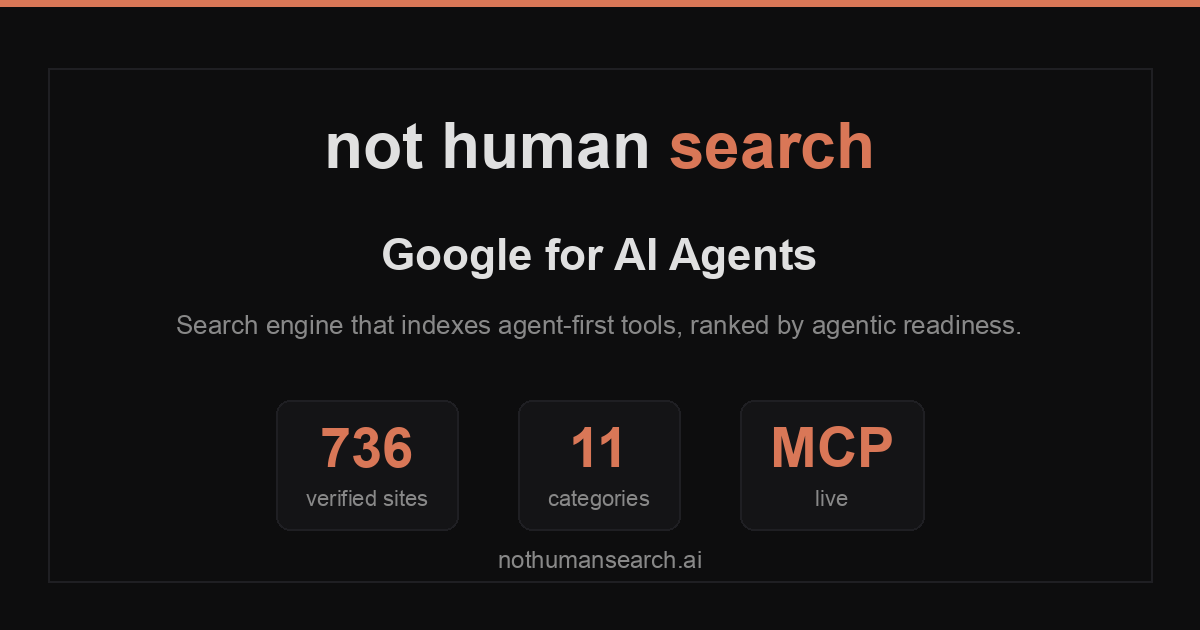

robots.txt (opens in a new tab)
21 rulesAll bots 1 allowed · 0 disallowed
- Allow
/
gptbot 1 allowed · 0 disallowed
- Allow
/
chatgpt-user 1 allowed · 0 disallowed
- Allow
/
oai-searchbot 1 allowed · 0 disallowed
- Allow
/
claudebot 1 allowed · 0 disallowed
- Allow
/
claude-web 1 allowed · 0 disallowed
- Allow
/
anthropic-ai 1 allowed · 0 disallowed
- Allow
/
perplexitybot 1 allowed · 0 disallowed
- Allow
/
google-extended 1 allowed · 0 disallowed
- Allow
/
applebot-extended 1 allowed · 0 disallowed
- Allow
/
meta-externalagent 1 allowed · 0 disallowed
- Allow
/
facebookbot 1 allowed · 0 disallowed
- Allow
/
ccbot 1 allowed · 0 disallowed
- Allow
/
bytespider 1 allowed · 0 disallowed
- Allow
/
amazonbot 1 allowed · 0 disallowed
- Allow
/
cohere-ai 1 allowed · 0 disallowed
- Allow
/
diffbot 1 allowed · 0 disallowed
- Allow
/
youbot 1 allowed · 0 disallowed
- Allow
/
duckassistbot 1 allowed · 0 disallowed
- Allow
/
petalbot 1 allowed · 0 disallowed
- Allow
/
firecrawlagent 1 allowed · 0 disallowed
- Allow
/
No matching rules.
Sitemaps
1Recent Updates
- Website images
- Screenshots
- Network details
- Website Technologies
- Pages and Search Information
- HTTP Response Information
- TLS and certificates
- DNS Information
- Domain Registration
- Website profile
- Website Description
- Website Name
- Website profile
- Website Description
- Website Name
User reviews (0)