Website profiles · Technology insights · Alternatives

onementalhub.com No paid content found Multilingual

Categories: Lifestyle

Take a quick, evidence-based mental health assessment and get clarity about your wellbeing — plus a report ready to bring to your GP.

Visit website

Updated: 2026-09-23 09:12 Language: English (default) Access: Normal

Profile views 1 Outbound visits 0
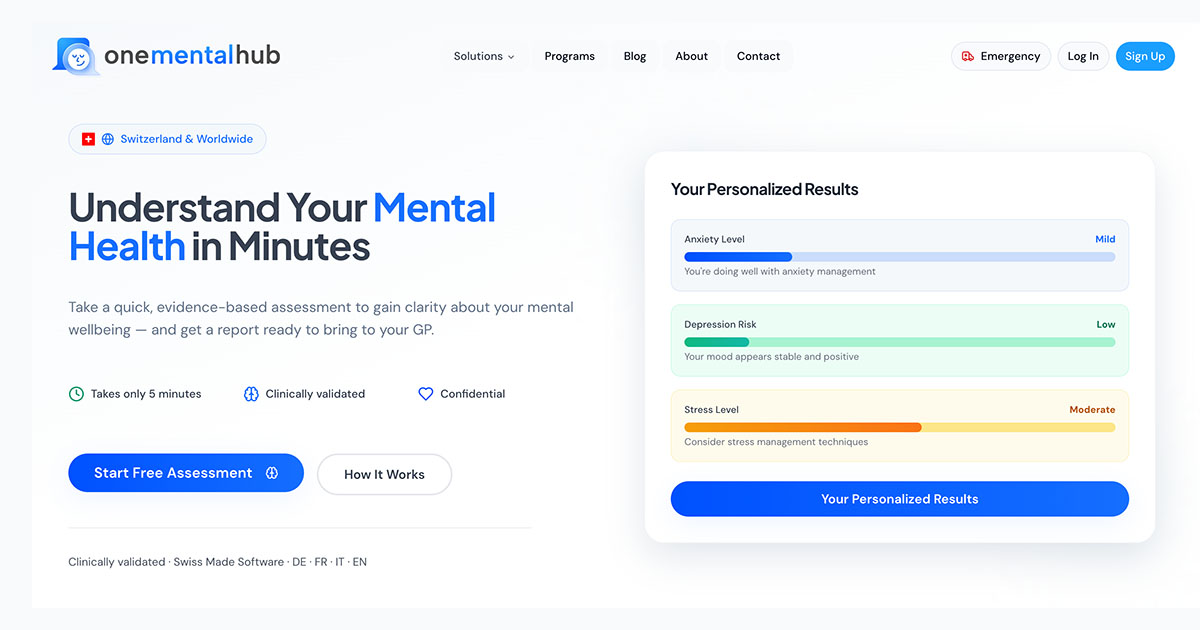
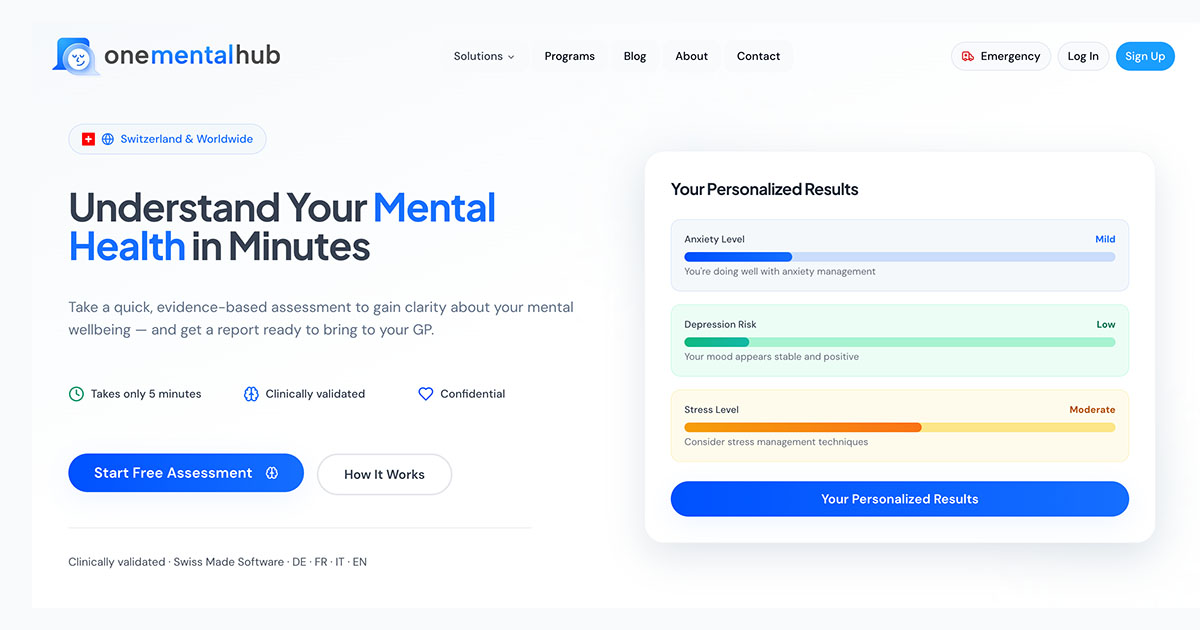
One Mental Hub Full homepage screenshot
Editorial Review

Website Review

What is One Mental Hub?

One Mental Hub is a mental health screening website built around a short, structured self-assessment. You answer evidence-based questionnaires, then see your results in plain language and can download a report formatted to bring to a GP.

Its screening library uses instruments familiar from clinical practice: PHQ-9 for depression, GAD-7 for anxiety, WSAS for how symptoms affect work and daily life, plus ACE, PCL-5, AUDIT and ISI for childhood adversity, trauma symptoms, drinking and sleep. Each is a screening tool, not a diagnosis, and the site says so directly.

How it fits into a real week

Suppose you have felt flat and sleepless for a month but cannot tell whether it is serious enough to book an appointment. You complete the PHQ-9 and ISI, get scores the same day, and bring the printed summary to your GP. That turns a vague "I have not been myself" into specific symptom counts and durations the doctor can act on — a real advantage in a short consultation.

The trade-off is that screening only captures what you report at one moment. It cannot distinguish, say, grief from depression, or a thyroid problem from low mood. Treat the scores as a conversation starter, not a verdict.

Practical decision criteria

  • Use it if you want a structured starting point, a record to track over time, or documentation to support a referral — the site mentions GP-ready reports for therapy referrals (Anordnung) in Switzerland.
  • Skip it if you are in crisis or having thoughts of harming yourself; contact emergency services or a crisis line instead.
  • Check first whether your GP accepts self-screening printouts, and confirm current account and report terms on the site itself.

For general context on what these questionnaires measure, the World Health Organization publishes guidance on common mental health conditions.

How do I get a GP-ready report for therapy referrals in Switzerland?

A GP-ready report for therapy referrals in Switzerland comes from completing a screening, creating an account, and then downloading the report the same day. On One Mental Hub, the process is: take the evidence-based assessment, get your scores in plain language, then download a report formatted for your GP — described as ready for therapy referrals (Anordnung) in Switzerland.

What the report is for

In Switzerland, a therapy referral (Anordnung) usually needs to come from a doctor, so a structured summary of your symptoms helps your GP act quickly. Instead of recalling weeks of mood, sleep and stress from memory in a short appointment, you hand over scored results.

How to get it

  1. Complete the assessment — the site says about 5 minutes.
  2. Create a free account to receive your scores immediately; no credit card is mentioned.
  3. Download the GP-ready report the same day.
  4. Bring it to your GP and ask whether it supports an Anordnung for psychotherapy.

What the screening covers

The platform uses instruments familiar in Swiss clinical practice, so your GP can read the scores without translation:

Instrument Screens for Score range Time
PHQ-9 Depression symptoms, past 2 weeks 0–27 ~5 min
GAD-7 Anxiety symptoms and severity 0–21 ~5 min
WSAS Work and social functioning 0–40 ~3 min
ACE Adverse experiences before age 18 0–10 ~3 min
PCL-5 Trauma symptoms, past month 0–80 ~8 min
AUDIT Hazardous drinking (WHO tool) 0–40 ~5 min
ISI Insomnia severity 0–28 ~5 min

A practical scenario

You have been sleeping badly, feeling tense, and struggling at work for a month. You complete PHQ-9, GAD-7, WSAS and ISI, download the report, and book a GP appointment. The GP sees validated scores plus functional impact, which is often exactly what is needed to justify a referral rather than a wait-and-see approach.

Decision criteria

  • Choose this route if you want a structured, GP-readable summary and are comfortable with a Swiss-hosted service (the site notes Swiss Made Software and DE/FR/IT/EN support).
  • Prefer a direct route if you are in crisis or need urgent care — screening tools are not a diagnosis and do not replace a medical assessment.
  • Check with your GP whether they want the Anordnung issued before or after the report, and whether your canton or insurer requires anything additional.

Next step: take the free assessment, then bring the downloaded report to your GP and ask directly whether it is sufficient for a therapy referral in your canton.

Which mental health screening tools like PHQ-9 or GAD-7 are included and how long do they take?

One Mental Hub includes seven validated screening instruments. Each is self-scored and takes between 3 and 8 minutes, so a full set is realistically a 30–35 minute sitting rather than the "5 minutes" the homepage leads with — that figure applies to a single short tool.

Tool What it screens Items Score range Stated time
PHQ-9 Depression symptoms over the past 2 weeks 9 0–27 ~5 min
GAD-7 Anxiety symptoms and severity 7 0–21 ~5 min
WSAS Functional impairment in work and social life 5 0–40 ~3 min
ACE Adverse experiences before age 18 10 0–10 ~3 min
PCL-5 Trauma symptoms over the past month (DSM-5) 20 0–80 ~8 min
AUDIT Hazardous drinking and alcohol-related harm (WHO) 10 0–40 ~5 min
ISI Insomnia severity, satisfaction and daytime impact 7 0–28 ~8 min

Choosing what to start with

If you have a specific concern, pick the matching tool first: low mood and loss of interest point to PHQ-9, persistent worry or tension to GAD-7, and disrupted sleep to ISI. The WSAS is different in kind — it measures how much symptoms interfere with work, chores and relationships, which is often the detail a GP cares about most. ACE and PCL-5 ask about difficult early experiences and trauma; they are worth doing when that history is relevant to you, and worth skipping or postponing if you would rather not revisit it without support.

Practical notes

  • Results are presented as plain-language bands (for example, mild anxiety, low depression risk) plus a 0–1000 wellness score tracked across screenings and daily check-ins.
  • The site describes the output as a GP-ready report, including for therapy referrals (Anordnung) in Switzerland, and says a free account is needed before scores are shown.
  • These are screening instruments, not diagnostic ones. A score indicates how likely a condition is and how severe symptoms appear; only a clinician can diagnose.

A sensible next step: complete PHQ-9 and GAD-7 first, then add WSAS if you plan to show the report to a doctor, since function is what often determines referral urgency. If any tool returns a high score or you have thoughts of harming yourself, contact a crisis line or emergency service rather than waiting on a report. For general background on these instruments, the developers publish free information at PHQ Screeners and WHO.

Is my screening data confidential and where is it stored?

One Mental Hub describes its screenings as confidential, and the results flow into your own dashboard rather than being posted anywhere public. The site also states that you create a free account before receiving scores, so the practical answer is: your data is tied to your account, and the service presents itself as privacy-conscious rather than anonymous.

What the site actually says

  • Screenings are described as "Quick, confidential assessments."
  • You complete the assessment, then "Create a free account, then receive your scores immediately."
  • A "GP-Ready Report" is downloadable and "formatted for your GP — ready for therapy referrals (Anordnung) in Switzerland."
  • The software is labeled "Certified Swiss Made Software," and the service lists "Switzerland & Worldwide" with DE, FR, IT and EN languages.

What that means in practice

Confidential means the results are not shared publicly or with your employer by default. It does not mean the assessment is anonymous: because you need an account, your scores are associated with your identity inside the platform. The GP-ready report is designed to be shared by you, with a clinician you choose — that is the point of the feature, and it is a deliberate disclosure rather than a leak.

The site does not spell out, in the material available, where servers are located, how long records are kept, whether data is encrypted at rest, or whether it is shared with third parties. Those are the details that determine real confidentiality, and they are usually covered in a privacy policy rather than a marketing page.

A concrete scenario

Suppose you take the PHQ-9 and GAD-7 in the evening, get a low depression risk and mild anxiety result, and download the GP report for a therapy referral. In that workflow, the sensitive step is the download and the handover to your doctor — not the screening itself. If you would rather your GP not see a particular module, such as the ACE questionnaire about childhood experiences, complete it separately or discuss it verbally instead of attaching it.

How to check before you start

  1. Open the site's privacy policy and look for: data storage location, retention period, encryption, and whether data is used for research or shared with third parties.
  2. Check whether you can delete your account and export or erase your results.
  3. Decide in advance which modules you are comfortable completing and which you would rather discuss in person.
  4. Treat the report as a document you control — review it before sending it to anyone.

If the privacy policy does not clearly answer the storage and retention questions, email the operator before entering sensitive information. For context on how such tools compare, you can also look at Patient for general screening explanations or Mind for guidance on discussing mental health records with a clinician.

How does the 0–1000 Mental Health Score work and what do daily check-ins track?

The 0–1000 Mental Health Score is One Mental Hub's own composite wellness indicator, not a clinical diagnosis. It rolls your screening results and daily check-ins into a single dashboard number, then updates as you complete more assessments or log more days. The page frames 900+ as the target range to track progress toward.

What feeds the score

  • Screenings — PHQ-9 (depression, 0–27), GAD-7 (anxiety, 0–21) and WSAS (work and social functioning, 0–40) results are named as score inputs.
  • Daily check-ins — mood, energy, stress and sleep.
  • Trend — movement over time toward the 900+ band.

What daily check-ins track

Check-in item What it captures
Mood Day-to-day emotional state
Energy Fatigue and drive
Stress Perceived pressure load
Sleep Rest quality, complementing the ISI insomnia screening

How to read it

A single number is useful for spotting direction, not for self-diagnosing. Because it blends validated instruments with subjective daily ratings, a bad week of sleep can drag the score down even when depression and anxiety scores are stable. Treat a sustained drop as a prompt to look at which component moved, not as a verdict on your mental health.

Practical next step

Log check-ins for two to three weeks before drawing conclusions, then compare the trend line against your individual PHQ-9 and GAD-7 scores. If the score falls while clinical screening scores rise, that combination is worth raising with a clinician — and the GP-ready report is built for exactly that conversation. For a second reference point on what these instruments measure, see Patient or WHO.

Can I use One Mental Hub in German, French, or Italian?

Yes. One Mental Hub lists DE, FR, IT and EN alongside its “Swiss Made Software” label, so German, French, Italian and English are the supported interface languages. The screening instruments themselves (PHQ-9, GAD-7, WSAS, AUDIT, ISI, ACE, PCL-5) are standard validated questionnaires, and the site presents results in plain language plus a GP-ready report — the language setting you choose should carry through to how scores and report text are displayed.

One Mental Hub

A practical scenario

If you live in Switzerland and want a therapy referral (Anordnung), you would typically complete the assessment and download the GP-ready report in the language your doctor works in — for example, German for a practice in Zurich or French for one in Lausanne. Switching interface language before you start avoids mixing terminology across the report.

What to check before relying on it

  • Language vs. locale: A language option is not the same as a regional version. Confirm your chosen language is selected when you create the account, since results and the downloadable report are generated after signup.
  • Clinical use: The site describes the score as a personal wellness indicator, not a diagnosis. Treat any report as a conversation starter with your GP, not a substitute for assessment.
  • Your GP's preference: Ask whether they want the report in the local language or in English, especially if the practice operates in more than one.

Decision criterion

Choose the language you can answer questions in most accurately — nuance in items about mood, sleep and alcohol use affects your scores more than interface convenience does. Then generate the report in the language your GP will read.

Related questions

More questions →
What Is Password Auditing and How Does It Differ from Password Recovery?

Password auditing is the proactive process of testing how well passwords in a system hold up against cracking attempts, while password recovery is the reactive process of regaining access to a specific account or file whose password has been lost. Both use similar technical methods — hash extraction and cracking — but they differ in goal, timing, and what you do with the results. LCPSoft publishes cross-platform applications for exactly these two tasks, so its toolset is a useful reference point for understanding where each fits.

Password auditing vs. password recovery at a glance

Dimension Password auditing Password recovery
Goal Measure overall password strength and find weak credentials Regain access to one account, file, or database
Timing Proactive, run on a schedule or before an incident Reactive, triggered by a lost or forgotten password
Scope Many accounts at once Usually a single target
Output A report of which passwords were cracked and how fast The recovered password itself
Success measure Percentage of weak passwords found Whether the target password was found
Typical owner Security team, sysadmin, compliance The account owner or an authorized admin

The practical difference: an audit that cracks 30% of passwords is a successful audit because it surfaced a problem. A recovery attempt that cracks 30% of passwords is a failed recovery for the other 70%.

What a password audit actually involves

A typical audit workflow has four stages:

  1. Extract password hashes. Pull the stored password representations from the system under test — a Linux /etc/shadow file, an Oracle Database user table, or an application's credential store. You need read access to the hash store, which normally means administrative rights on a system you own.
  2. Run cracking attempts. Feed the hashes to a cracking engine that tries candidate passwords — dictionary words, mangled variants, brute-force combinations — and compares the resulting hash to the stored one.
  3. Analyze results. Record which accounts were cracked, how long each took, and which password patterns dominated. This tells you whether your password policy is working.
  4. Remediate and re-test. Force resets on weak accounts, adjust policy, then re-run the audit later to confirm improvement.

The value is in step 3. A single cracked password is an anecdote; a pattern across hundreds of accounts is a policy finding.

Where recovery fits

Recovery uses the same cracking machinery but stops as soon as it finds the one password you need. Common scenarios:

  • A user forgets the password to an encrypted archive or document.
  • An administrator needs to regain access to a database account with no other recovery path.
  • A legacy system has credentials nobody recorded.

Recovery is legitimate when you own the data or are authorized to access it. It is not a way around someone else's security.

Legal and ethical boundaries

Both activities require authorization. The rule is simple: only audit or recover passwords on systems you own or have explicit written permission to test. Running cracking tools against accounts you don't control can violate computer-misuse laws in most jurisdictions, regardless of intent. In an audit context, get the scope in writing — which systems, which time window, who receives the results.

How LCPSoft's tools fit

LCPSoft describes itself as offering cross-platform applications for password auditing and recovery, with coverage that includes Linux and Oracle Database environments alongside general user and account targets. That combination — one toolset spanning audit and recovery across platforms — is the practical reason the two activities are often discussed together: the technical foundation is shared, so the same software can serve either purpose depending on how you configure and stop it.

If you are choosing a tool, ask two questions: does it support the hash formats and platforms you actually run, and does it let you stop at a single result for recovery versus run to completion for an audit? Those two capabilities cover both use cases from one install.

What Is a Depression Test and How Do You Interpret the Results?

A depression test is a structured questionnaire that screens for symptoms of depression over a defined period — it does not diagnose depression. The most widely used instrument is the PHQ-9 (Patient Health Questionnaire-9), a validated 9-item tool that asks about symptoms over the past 2 weeks and produces a score from 0 to 27. You can take one in about 5 minutes, and the result tells you how severe your symptoms appear and whether it's worth discussing them with a doctor or therapist. It is a starting point for a conversation, not a verdict.

What a Depression Test Is — and What It Isn't

A screening tool and a diagnosis are different things:

  • A depression test (screening) measures how many and how intense your symptoms are right now, using a fixed set of questions and a scoring rule. Anyone can take one.
  • A diagnosis is made by a qualified clinician who considers your history, other conditions, medication, life circumstances, and how long symptoms have lasted.

A high score on a depression test does not mean you have major depressive disorder, and a low score does not rule it out. The value of screening is that it turns vague feelings into a comparable number you can track over time and bring to an appointment.

How the PHQ-9 Works

The PHQ-9 is the instrument most clinical settings use for depression screening, and it's the one referenced on One Mental Hub's screening platform. Here's the mechanics:

  • 9 items. Each question maps to one of the nine core symptoms used to identify depression (low mood, loss of interest, sleep problems, fatigue, appetite changes, self-worth, concentration, movement/restlessness, and thoughts of self-harm).
  • 2-week timeframe. You're asked how often each symptom has bothered you over the past 2 weeks — this window matches how clinicians assess a depressive episode.
  • Frequency-based answers. Each item is scored on how often the symptom occurred, from "not at all" to "nearly every day."
  • Total score: 0–27. The nine items are added up. Higher scores indicate more frequent and more numerous symptoms.
  • Time to complete: about 5 minutes.

Because the questions are standardized, your score is comparable to scores from millions of other people and to your own score from a month ago.

How to Interpret Your PHQ-9 Score

Scores fall into bands that describe symptom severity. The commonly used ranges are:

Score range Severity band What it generally suggests
0–4 Minimal Little or no depressive symptoms
5–9 Mild Some symptoms present; monitor and re-check
10–14 Moderate Symptoms likely affecting daily life; worth discussing with a professional
15–19 Moderately severe Significant symptoms; professional assessment recommended
20–27 Severe Marked symptoms; prompt professional evaluation recommended

Two things matter beyond the total:

  1. Item 9 (thoughts of self-harm). Any endorsement of this item deserves attention regardless of your total score. If you're having thoughts of harming yourself, contact a crisis line or emergency service right away rather than waiting for a routine appointment.
  2. Functional impact. A score tells you about symptoms, not how much they disrupt your work, relationships, or daily tasks. Tools like the WSAS (Work and Social Adjustment Scale) measure that separately — which is why a screening platform may pair a PHQ-9 with a WSAS.

A single score is a snapshot. Repeating the test every few weeks shows whether you're improving, stable, or worsening — that trend is often more useful than any one number.

When to Seek Professional Help

Use your score as a prompt, not a gate. Consider talking to a GP, therapist, or other clinician if:

  • Your score lands in the moderate band or above (roughly 10+).
  • Your score is mild but has been persistent or worsening across repeated tests.
  • Symptoms are interfering with work, study, relationships, or self-care.
  • You have any thoughts of self-harm, at any score.
  • You're unsure — a clinician can sort out whether something else (thyroid issues, grief, burnout, medication side effects) is behind your symptoms.

In Switzerland, a report formatted for your GP can support a therapy referral (Anordnung). One Mental Hub generates a GP-ready report the same day, which you can bring to an appointment — useful if you find it hard to describe your symptoms from memory.

How to Prepare and What to Expect

Before the test:

  • Set aside about 5 minutes in a quiet place.
  • Answer based on the past 2 weeks, not how you feel today specifically.
  • Be honest — there's no advantage to under-reporting, and the tool is confidential.

During the test:

  • Answer each item by how often the symptom occurred, not how severe it felt.
  • Don't overthink individual questions; your first instinct is usually accurate.

After the test:

  • Read your score alongside its severity band, not in isolation.
  • Note your item-level results — a high score driven by sleep and fatigue points to a different conversation than one driven by low mood and self-worth.
  • If you plan to see a clinician, bring or download your report so the appointment starts from data rather than recollection.
  • Re-test on a regular schedule (for example, every 2–4 weeks) to see a trend.

A Note on Other Screenings

Depression rarely travels alone. Screening platforms often bundle related instruments so you get a fuller picture in one sitting:

  • GAD-7 — anxiety symptoms (score 0–21)
  • WSAS — how much symptoms impair daily functioning (score 0–40)
  • ISI — insomnia severity (score 0–28)
  • AUDIT — hazardous drinking (score 0–40)
  • PCL-5 — trauma symptoms (score 0–80)
  • ACE — adverse childhood experiences (score 0–10)

If your depression score is elevated, checking anxiety and sleep too can clarify what's driving what — and gives your clinician more to work with.

The bottom line: a depression test like the PHQ-9 gives you a fast, standardized read on your symptoms and a number you can track and share. Treat a moderate or higher score, or any thought of self-harm, as a signal to talk to a professional — not as a diagnosis you have to interpret alone.

What Is the GAD-7 and How Do You Interpret Your Score?

The GAD-7 (Generalized Anxiety Disorder-7) is a 7-item anxiety screening tool that measures how severe your anxiety symptoms have been over the past 2 weeks. Each item is scored 0–3, giving a total range of 0–21, and higher totals indicate more severe anxiety. It is a screening instrument, not a diagnosis — a high score signals that a professional evaluation is worth pursuing, not that you have a disorder. On One Mental Hub, the GAD-7 takes about 5 minutes and is one of several evidence-based screenings offered alongside the PHQ-9, WSAS, and others.

What the GAD-7 measures

The tool focuses on the core symptoms of generalized anxiety: feeling nervous or on edge, being unable to stop or control worrying, worrying too much, trouble relaxing, restlessness, irritability, and fear that something awful might happen. The 2-week recall window is deliberate — it captures recent, ongoing symptoms rather than a single bad day.

Because it targets worry and tension rather than panic attacks or specific phobias, a GAD-7 score reflects general anxiety load. It can still be elevated in other anxiety conditions, which is one reason it is used as a first-pass screen rather than a standalone diagnosis.

How scoring works

Each of the 7 items is answered on a 0–3 frequency scale, typically:

Response Score
Not at all 0
Several days 1
More than half the days 2
Nearly every day 3

Add the 7 item scores for a total between 0 and 21. There is no reverse-scoring and no weighting — every item counts equally.

Interpreting your total score

The commonly used severity bands are:

Total score Severity
0–4 Minimal
5–9 Mild
10–14 Moderate
15–21 Severe

A frequently cited cutoff for identifying probable generalized anxiety is 10 or above, which balances sensitivity and specificity reasonably well in general populations. That said, the bands describe symptom severity, not a diagnosis. A score of 12 means moderate anxiety symptoms over the past two weeks; it does not by itself confirm an anxiety disorder.

What a high score does — and doesn't — mean

A high GAD-7 score tells you your recent anxiety symptoms are significant enough to warrant attention. It does not tell you the cause, whether the anxiety is primary or secondary to another condition (such as depression, which commonly co-occurs), or what treatment is appropriate. Those judgments require a clinician who can take a history and rule out other explanations.

If your score is in the moderate or severe range, the reasonable next step is to bring it to a healthcare professional. On One Mental Hub, results can be downloaded as a GP-ready report formatted for therapy referrals (Anordnung) in Switzerland, which is designed to make that conversation easier. The platform also combines GAD-7 results with PHQ-9 and WSAS scores into a single wellness indicator — a personal tracking number, explicitly not a diagnosis.

When to seek professional evaluation

Consider professional assessment if:

  • Your total score is 10 or higher, or has risen over repeated screenings
  • Anxiety is interfering with work, relationships, sleep, or daily functioning (the WSAS can help quantify this)
  • You have thoughts of self-harm — seek help immediately rather than relying on a screening score
  • Symptoms have persisted for weeks despite self-management

Screening tools like the GAD-7 are most useful as a starting point and a way to track change over time. They give you language and numbers to bring into a clinical conversation, but the interpretation and any diagnosis belong with a qualified professional.

What Is an Anxiety Assessment and How Do You Interpret the Results?

An anxiety assessment is a short, structured questionnaire that measures how much anxiety you've experienced recently and how much it interferes with daily life. The most common tool is the GAD-7 (Generalized Anxiety Disorder-7): 7 items, a 2-week recall window, and a score range of 0–21. It tells you whether your symptoms fall in a minimal, mild, moderate, or severe band — but it is a screening result, not a diagnosis. If your score is moderate or higher, or you're struggling regardless of the number, the next step is a conversation with a GP or mental health professional.

What an anxiety assessment actually measures

Screening tools don't test for "anxiety" as a single thing. They count how often you've experienced specific symptoms over a defined period and how much those symptoms affect your functioning.

The GAD-7, for example, asks about 7 symptoms over the past 2 weeks. Each item is rated on how often it occurred, and the ratings are summed into a 0–21 score. That's it — the output is a severity indicator, not a label.

Anxiety often shows up alongside other conditions, which is why assessments are frequently bundled. On One Mental Hub, the GAD-7 sits next to tools that measure related areas:

Tool What it screens Items Score range Recall period
GAD-7 Anxiety symptoms and severity 7 0–21 Past 2 weeks
PHQ-9 Depression symptoms 9 0–27 Past 2 weeks
WSAS Functional impairment from symptoms 5 0–40 Current
ISI Insomnia severity 7 0–28 Recent
PCL-5 Trauma symptoms (DSM-5) 20 0–80 Past month
AUDIT Hazardous drinking (WHO) 10 0–40 —
ACE Adverse childhood experiences 10 0–10 Before age 18

The WSAS is worth noting: it measures how much your symptoms disrupt work, social life, and daily tasks. Two people can have the same GAD-7 score and very different WSAS scores — and the functional impact is often what matters most for deciding whether to seek help.

How GAD-7 scoring works

The GAD-7's 0–21 range is usually divided into four bands:

  • 0–4: Minimal — little to no anxiety symptoms reported
  • 5–9: Mild — some symptoms present
  • 10–14: Moderate — a level often used as a threshold for further evaluation
  • 15–21: Severe — high symptom burden

A commonly cited cutoff is 10: scores at or above this level are generally considered the point at which clinical follow-up is warranted. But bands are guides, not verdicts. A score of 8 with severe sleep disruption and missed work may deserve more attention than a score of 11 during an unusually stressful week.

Why screening is not a diagnosis

A screening tool flags probability, not certainty. It can't tell the difference between:

  • Generalized anxiety and panic disorder
  • Anxiety driven by a medical condition, medication, or substance use
  • Situational stress that resolves on its own
  • Anxiety occurring alongside depression

That distinction requires a clinician who can ask follow-up questions, take a history, and rule out other causes. The value of a screening score is that it gives you and your clinician a shared, quantified starting point — and something to compare against later.

What to do with your results

If your score is minimal or mild: no action is required. Re-screen if things change, or use periodic check-ins to track mood, energy, stress, and sleep over time.

If your score is moderate or higher: book an appointment with your GP or a mental health professional. Bring your results with you.

In any case, seek prompt help if you're having thoughts of harming yourself, can't function day to day, or feel unsafe. Screening tools are not designed for crisis situations.

Making the GP conversation useful

A raw score is more useful when it comes with context. Before your appointment, note:

  • Your score and when you took the assessment
  • Which symptoms bother you most (sleep, concentration, restlessness, worry)
  • How much your symptoms affect work, relationships, or daily tasks
  • How long this has been going on
  • Anything that changed recently — sleep, workload, health, major life events

On One Mental Hub, completing a screening produces a report formatted for a GP, which the site describes as ready for therapy referrals (Anordnung) in Switzerland. The platform also combines screening results with daily check-ins into a single 0–1000 wellness score on your dashboard — explicitly described as a personal wellness indicator, not a diagnosis. That framing is the right one: trends over time are informative, but they don't replace clinical judgment.

Quick answers

How long does it take? The GAD-7 takes about 5 minutes.

Do I need an account? On One Mental Hub, you create a free account to receive your scores, and the site states no credit card is required.

Can I self-diagnose from a score? No. Use it to decide whether to seek professional input, and to give that professional a clearer picture.

How often should I re-assess? There's no universal rule. Re-screening after a few weeks, or after a change in how you feel, gives you a more meaningful comparison than a single snapshot.

What Is Mental Health Screening and What Do the Scores Mean?

Mental health screening is a short, structured set of questions that flags whether you're likely experiencing symptoms of a condition such as depression, anxiety, or insomnia. It is not a diagnosis. Screening tools like PHQ-9 and GAD-7 produce a numeric score that maps to a severity band (for example, "mild" or "moderate"), which you can use to decide whether to seek professional help and to give a clinician a starting point. On One Mental Hub, screenings take roughly 3–8 minutes each, and results can be compiled into a report formatted for a GP visit.

Screening vs. diagnosis: what the difference actually means

A screening instrument is designed to be fast, standardized, and repeatable. It tells you how your symptoms compare to a known threshold — nothing more. A diagnosis, by contrast, requires a qualified clinician to assess your history, rule out other causes, and apply clinical criteria.

This distinction matters for two practical reasons:

  • A high score is a signal, not a verdict. It means your answers resemble those of people with the condition, which is a reason to get evaluated — not proof you have it.
  • A low score doesn't rule anything out. Screening tools are tuned to catch likely cases, and they can miss atypical presentations.

One Mental Hub states this directly: its 0–1000 Mental Health Score is "a personal wellness indicator — not a diagnosis."

The validated instruments and what each one measures

Each tool targets a specific symptom domain and has its own score range. The table below reflects the instruments and ranges listed on One Mental Hub.

Tool Full name What it measures Items Score range Time
PHQ-9 Patient Health Questionnaire-9 Depression symptoms over the past 2 weeks 9 0–27 ~5 min
GAD-7 Generalized Anxiety Disorder-7 Anxiety symptoms and severity 7 0–21 ~5 min
ACE Adverse Childhood Experiences Adverse experiences before age 18 10 0–10 ~3 min
PCL-5 PTSD Checklist for DSM-5 Trauma-related distress over the past month 20 0–80 ~8 min
WSAS Work and Social Adjustment Scale How symptoms impair daily functioning 5 0–40 ~3 min
AUDIT Alcohol Use Disorders Identification Test Hazardous drinking and alcohol-related harm 10 0–40 ~5 min
ISI Insomnia Severity Index Sleep difficulty, satisfaction, and daytime impact 7 0–28 ~5 min

Two things are worth noting about how these fit together. First, the timeframes differ — PHQ-9 asks about the last 2 weeks, while PCL-5 asks about the last month — so you're not measuring the same window across all tools. Second, WSAS is a functional measure rather than a symptom measure: it captures how much your symptoms interfere with work, home, and social life, which is often the part clinicians care most about when deciding on a referral.

What the scores mean in practice

Scores are only useful if you know how to read them. The general logic across these tools is that higher numbers indicate greater symptom burden, and each range is divided into severity bands.

For PHQ-9 and GAD-7 specifically, the widely used band structure is:

  • PHQ-9 (0–27): minimal, mild, moderate, moderately severe, severe
  • GAD-7 (0–21): minimal, mild, moderate, severe

So a GAD-7 score in the mild band suggests some anxiety symptoms that aren't yet dominating your life, while a score in the severe band suggests symptoms substantial enough that a clinical conversation is warranted. One Mental Hub presents results in plain language — for example, "Anxiety Level: Mild" or "Depression Risk: Low" — rather than raw numbers alone, which makes the bands easier to interpret at a glance.

A few cautions apply to every one of these tools:

  • Bands are guides, not cutoffs. Someone just below a threshold can still need help; someone just above it may not.
  • Context changes interpretation. A recent bereavement, a physical illness, or a medication change can all shift your scores without indicating a new condition.
  • Trends beat single readings. One Mental Hub updates your dashboard score as you complete screenings and daily check-ins (mood, energy, stress, sleep), which makes change over time more informative than any one result.

When a screening result should prompt you to see someone

There's no universal score at which you "must" seek care, but these situations are reasonable triggers to book an appointment:

  • Your score falls in a moderate or higher band on PHQ-9, GAD-7, or ISI.
  • Your WSAS results show that symptoms are interfering with work, relationships, or daily tasks.
  • Your PCL-5 or ACE results surface experiences you haven't discussed with a professional and that still affect you.
  • Your AUDIT score suggests drinking patterns that carry risk.
  • Any result — high or low — doesn't match how you actually feel.

If you're having thoughts of harming yourself, that's not a screening question at all. Contact emergency services or a crisis line immediately rather than waiting on a score.

Preparing a screening report for a GP or referral

The practical value of screening is often in the conversation it starts. One Mental Hub generates a GP-ready report the same day, formatted for therapy referrals (Anordnung) in Switzerland, and the site notes it is available in DE, FR, IT, and EN.

To get the most out of that appointment:

  1. Complete the relevant screenings first, so the report contains actual scores rather than impressions.
  2. Bring the report to your GP and say plainly what you want — an assessment, a referral, or both.
  3. Add your own context. Note when symptoms started, what makes them worse or better, and anything the questionnaires didn't ask about.
  4. Ask what the next step is — whether that's a referral, a wait-and-see period, or further evaluation.

Creating an account is required to receive scores, and the site states no credit card is needed for that step. Screening is confidential, and the software is described as Certified Swiss Made Software.

The bottom line: use screening to get a structured read on your symptoms and a concrete artifact to bring to a clinician — then let a professional handle the diagnosis.

Website Overview

Page metadata, canonical configuration and social previews work together to provide more consistent search and sharing presentation.

Domain and Registration

Transfer-protection status is present, helping reduce the risk of unauthorized domain transfers. The domain has about 1 years of registration history; its current configuration provides more context than age alone. The registrar is Cloudflare, Inc., a widely used domain service provider. The domain uses the common .com extension, which is not an independent safety signal.

DNS and Email

Nameservers are provided by Cloudflare, indicating managed DNS hosting. MX records point to the Google Workspace email service. DNSSEC is enabled, allowing validating resolvers to authenticate signed DNS data. No CNAME was found; the observed records resolve directly to addresses. SPF and DMARC are configured. DKIM status is unknown.

TLS and Certificates

The public key uses EC with 256 bits. The server supplied a complete certificate chain. No organization name is present in the certificate; the available fields are consistent with domain validation. The certificate was issued within the Google Trust Services cloud or CDN ecosystem. The certificate's total validity is about 90 days, consistent with a short renewal cycle.

HTTP and Browser Security

The response lacks these common security headers: HSTS, CSP. CORS permits any origin to read this response. This is common for public resources; sensitive responses need narrower handling. No X-Powered-By header was found, reducing one common source of backend fingerprinting information. The cf-ray response header indicates a CDN or caching proxy in the delivery path. No obvious internal addresses or debug information were found in the headers.

Technology Stack Analysis

The public page identifies Cloudflare without precise versions, leaving fewer clues for version-specific scanning.

Search and Social Sharing

Twitter Card metadata is configured. JSON-LD includes Organization data, helping describe the organization as an entity. The page declares 8 language or regional alternatives using hreflang. The title has 58 characters, within a common display range. A meta description is present, with 133 characters.

Hosting and Email

DNSCloudflare
HostingCloudflare
EmailGoogle Workspace
Location Location unknown 104.21.85.179

User reviews (0)

  • No reviews yet.

Pages, Search and Sharing

Meta descriptionTake a quick, evidence-based mental health assessment and get clarity about your wellbeing — plus a report ready to bring to your GP.
Canonical URLhttps://onementalhub.com/
LanguageEnglish (default) · Multilingual
Twitter Cardsummary_large_image
All bots 1 allowed · 6 disallowed
  • Allow/
  • Disallow/login
  • Disallow/dashboard
  • Disallow/pro
  • Disallow/settings
  • Disallow/doc
  • Disallow/auth

Registration details RDAP / WHOIS

RegistrarCloudflare, Inc.
Registered2025-03-14
Expires2027-03-14
Domain statusclient transfer prohibited
Nameserverseric.ns.cloudflare.com、isla.ns.cloudflare.com
DNSSECsigned

DNS records

TypeNameValueTTLPriority
Aonementalhub.com104.21.85.179300—
Aonementalhub.com172.67.208.223300—
AAAAonementalhub.com2606:4700:3030::ac43:d0df300—
AAAAonementalhub.com2606:4700:3037::6815:55b3300—
MXonementalhub.comaspmx.l.google.com36001
MXonementalhub.comalt1.aspmx.l.google.com36005
MXonementalhub.comalt2.aspmx.l.google.com36005
MXonementalhub.comalt3.aspmx.l.google.com360010
MXonementalhub.comalt4.aspmx.l.google.com360010
NSonementalhub.comeric.ns.cloudflare.com86400—
NSonementalhub.comisla.ns.cloudflare.com86400—
TXTonementalhub.comgoogle-site-verification=HD814hxuDBGecS71s36U0yBflv4cbg3FOv3S1mAdY1Y3600—
TXTonementalhub.comgoogle-site-verification=zZ4tCrCVzhsLk8ERa0OUZuQDv1BsQ38eeNg3zDhshJw3600—
TXTonementalhub.comv=spf1 include:_spf.google.com ~all3600—
DSonementalhub.com2371 13 2 e88c815b48acc211694aa7cced92231f98246f21ec784997c26848288c70cc1b86400—
DMARC_dmarc.onementalhub.comv=DMARC1; p=quarantine; pct=100; adkim=r; aspf=r300—

TLS and certificates

AssessmentNormal configuration
Supported protocolsTLSv1.2、TLSv1.3
Negotiated protocolTLSv1.3
Certificate subjectonementalhub.com
IssuerGoogle Trust Services
Valid until2026-11-05T12:53 · Remaining when checked: 43 days
Verification detailsCertificate trust: Passed · Hostname match: Passed

HTTP response headers

HeaderValue
content-typetext/html; charset=utf-8
cache-controlpublic, max-age=0, must-revalidate
servercloudflare
x-frame-optionsDENY
x-content-type-optionsnosniff
referrer-policystrict-origin-when-cross-origin
permissions-policycamera=(), microphone=(), geolocation=(), payment=()
access-control-allow-origin*

Identified technologies

Cloudflare