Website profiles · Technology insights · Alternatives

speakerranking.com

Passive, Powered and Portable Bluetooth speakers sorted by sound quality, affordability, bass, and more. Unbiased expert rankings and audio insights.

No paid content found
Visit website
Profile views 10 Outbound visits 3 Normal
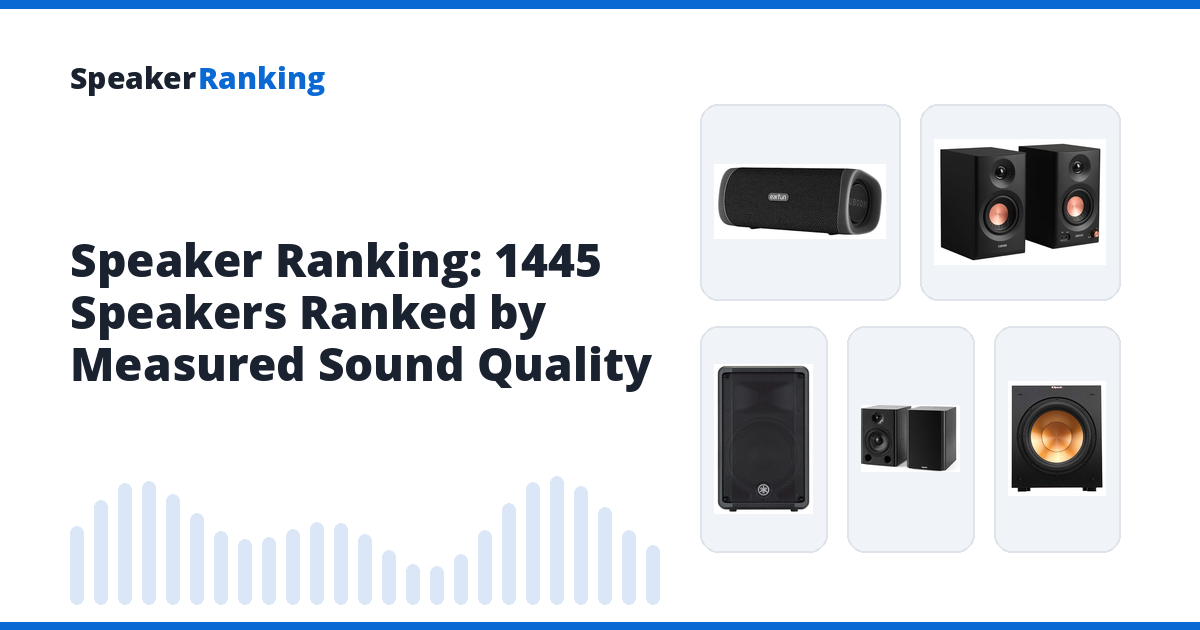
Speaker Ranking Full homepage screenshot

At a glance

Category
Technology & Electronics
Language
English
Paid-content signal
No paid content foundObserved
Registered
2022
Hosting
Oracle CorporationInferred
HTTPS certificate trusted
PassedObserved
Last updated

Website review

This review may include AI-generated content and is not individually verified. Domain, certificate and other facts come from the observed data on this page.

What is Speaker Ranking?

Speaker Ranking is a speaker-comparison site that ranks models by measured sound quality rather than by marketing claims or subjective listening alone. Its headline count is 1,445 speakers ranked, with 74 awaiting measurement, 27 ranked lists and 49 reviewers analyzed. It covers passive, powered and portable Bluetooth speakers, plus subwoofers and PA/live-sound gear.

The site organizes its rankings into five main families, each with its own size classes and buying filters:

Family Ranked models Size classes Typical use
Portable Bluetooth 438 6 Travel, camping, showers, parties
Powered home 205 7 Desks, studios, TVs, turntables
Passive home 316 4 Hi-fi systems with a separate amplifier
Subwoofers 303 3 Adding bass to a music or home-theater system
PA & live sound 183 7 Performances, events, DJ setups

Each family also has a buyer's guide and filters such as price bands, features (HDMI ARC, XLR, battery life, TWS pairing) and room or placement type. The rankings include named models with scores and prices, for example the Earfun Uboom L at 4.6, the Tribit Stormbox Lava at 4.6, the Edifier MR3 at 3.8, the Neumi BS5 at 3.8 and the SVS PB-3000 at 4.2.

If you are shopping, start with the family that matches how you will actually use the speaker, then use the price and feature filters to narrow the list. For example, a student wanting a desk speaker for a turntable would look at powered home speakers with a turntable or phono-friendly input, while someone needing music outdoors would start with portable Bluetooth and filter for battery life or weather resistance. Treat the measured rankings as one input, and check the individual review for the trade-offs that matter to you.

How does Speaker Ranking measure sound quality for its rankings?

Speaker Ranking ranks speakers by measured sound quality rather than by brand reputation or subjective listening alone. The site describes a process where reviewers' measurements and analysis are collected, then speakers are sorted into ranked lists by category (portable Bluetooth, powered home, passive home, subwoofers, PA/live sound) and by size class, so a small bookshelf model is not compared directly against a floorstanding tower. Scores appear on a 5-point scale, and the page notes that 1,445 speakers are ranked while 74 await measurement, indicating that measurement is the gate before a speaker enters the rankings.

The practical result is a database you can filter by use case—price band, size class, features such as HDMI ARC, XLR input, long battery life, or TWS pairing—and then compare scores within that group. For example, someone building a desktop setup might look at the powered medium-desktop class and see the Edifier MR3 at 3.8 or the JBL 308P MKII at 4.4, while a party-focused buyer might start with the portable party class and see the Sony ULT Tower 7 at 4.7. The score is a summary of measured performance, not a verdict on every preference: a speaker with a lower score may still suit a small room, a specific input need, or a tight budget.

A useful next step is to open the category and size class that matches your room and source equipment, then shortlist two or three models within your price band and read the linked full review for each. That way you are comparing like with like instead of chasing the single highest number on the site. If you want broader context on how speaker measurements are interpreted, the measurement-focused work at Audio Science Review and the testing explanations at RTINGS are useful complements, but Speaker Ranking's own value is the consolidated, category-specific ranking built from its collected measurements.

Which speakers offer the best bass performance according to Speaker Ranking?

For the strongest bass, start with the subwoofer rankings rather than the portable lists. Speaker Ranking sorts subwoofers into sealed and ported designs and by room size, which matters more for low-frequency output than a headline score. In the page evidence, the Speaker Ranking subwoofer section highlights the SVS PB-3000 as a top-ranked example and the Klipsch R-121SW as a budget option.

If you want bass from a single portable speaker, the site's portable boombox and party categories are the relevant ones. The Tribit Stormbox Blast appears as a boombox pick and the Sony ULT Tower 7 as a party pick; both are described as scoring well, but the site's own category structure suggests these are judged for their size class, not against dedicated subwoofers.

A practical way to decide:

  • Home theater or music depth: choose a subwoofer. Ported models generally trade some accuracy for more output; sealed models are often preferred for tighter, more controlled bass in smaller rooms.
  • Room size: the site separates small, medium and large subwoofers, so match the size class to your space before comparing scores.
  • Portable use: accept that a battery-powered speaker will not match a dedicated subwoofer, and prioritize models in the boombox or party classes if bass is your main goal.
  • Budget: the budget subwoofer entry (Klipsch R-121SW) is the low-cost starting point, while the SVS PB-3000 represents the higher-output end.

Next step: open the subwoofer rankings on Speaker Ranking, filter by your room size and budget, then read the linked full review for the model you shortlist. If you need portability instead, use the portable boombox ranking and compare within that class.

What are the top-rated portable Bluetooth speakers on Speaker Ranking?

The top-rated portable Bluetooth speakers on Speaker Ranking are led by the Earfun Uboom L, the Tribit Stormbox Lava, and the Tribit Stormbox Blast, with the Sony ULT Tower 7 topping the party category. Each tops its size class, which matters because "portable" spans pocket-sized units to wheeled boomboxes.

Size class Top pick Rating Rough price tier
Portable medium Earfun Uboom L 4.6 Budget (under $50)
Portable large Tribit Stormbox Lava 4.6 Around $100
Portable boombox Tribit Stormbox Blast 4.5 Around $180
Party Sony ULT Tower 7 4.7 Premium (several hundred)

Two things stand out. First, the highest scores sit in the cheaper tiers — the Uboom L's 4.6 at a budget price is a stronger value signal than the ULT Tower 7's 4.7 at many times the cost. Second, the ranking is built on measured sound quality rather than listening impressions alone, so a high score reflects objective performance, not just taste.

If you want a next step, decide by use case before score:

  • Commuting, travel, shower: portable medium — the Uboom L class.
  • Outdoor gatherings, camping: portable large or boombox, where bass output and battery life matter more than finesse.
  • Backyard parties: party class, accepting the size and price jump.

One caveat worth knowing: measured sound quality does not capture features like waterproofing, app support, or mic quality, so check those separately against your needs. Browsing the site's rankings by price, battery life, or feature filters narrows the field faster than scanning the full list.

How can I find the best budget speakers under $200 on Speaker Ranking?

Start with the site's price filters, then narrow by speaker type and size. On Speaker Ranking, every category (Portable Bluetooth, Powered Home, Passive Home, Subwoofers, PA & Live Sound) has its own "By price" menu, so the fastest route to budget options is to open the category you actually need and choose the "Under $200" or "Under $500" filter rather than browsing the full ranked list of 1445 speakers.

A practical path

  1. Decide the type first: Portable Bluetooth for travel and outdoor use, Powered Home for a desk, TV or turntable setup with no separate amplifier, Passive Home if you already own an amp or receiver.
  2. Apply the price filter inside that category.
  3. Sort or scan by the ranking score, then check the size class (Small, Medium, Large, Boombox, Party) so the speaker physically fits where you plan to put it.
  4. Open the review page for the two or three finalists and compare the specific feature tags that matter to you.

Feature tags are the real shortcut

The site tags speakers by practical attributes, which is often more useful than the score alone:

  • Long Battery Life, Power Bank, SD Card Slot, FM Radio, TWS Pairing — portable priorities
  • HDMI ARC, Optical Input, XLR, TRS, USB Digital Input — home and studio connections
  • Wheels, Party Mode Lights, Wireless Mic, Loudest — party and event use
  • Sealed vs Ported — subwoofer behaviour in small rooms

A comparison to frame the decision

Your situation Category to open What to prioritise
Beach, camping, commuting Portable Bluetooth Battery life, water resistance, size class
Desk or TV in one room Powered Home Inputs (HDMI ARC, optical), footprint
You own an amp or receiver Passive Home Impedance, sensitivity, bookshelf vs floorstanding
Filling out bass in a small room Subwoofers Sealed vs ported, size class
Small gigs or speeches PA & Live Sound Output, mic inputs, portability

One caution about a $200 ceiling

Under $200 you are mostly shopping in the Portable Bluetooth and budget Powered/Passive tiers. Deep bass and high output are the first things sacrificed at this price, so decide which compromise you can live with before comparing scores. A speaker that ranks slightly lower but matches your room size and inputs will serve you better than a higher-ranked one that does not fit.

Your next step: open the category that matches your use case, apply the under-$200 filter, and shortlist three models by size class before reading the full reviews.

What are the most reliable brands for powered studio monitors based on Speaker Ranking?

Speaker Ranking does not publish a brand-reliability score, so the closest thing to an answer is to look at which brands repeatedly appear at the top of its powered-monitor rankings and how many models each has measured. Brands that show up often with strong ratings across several sizes are the safer bets; a single highly rated model proves less.

How to read the rankings for reliability

  • Repeat presence: a brand with many ranked models in the powered category has more consistent measurement coverage than one with a single standout.
  • Consistency across sizes: look for good ratings in small desktop, medium desktop and bookshelf classes, not just one niche.
  • Reviewer spread: the site states it analyzed 49 reviewers, so a model that scores well across multiple sources is more trustworthy than one carried by a single review.
  • Measurement status: models still awaiting measurement should be treated as unverified, however familiar the brand.

Practical scenario

Suppose you are choosing between a well-known brand's cheapest desktop monitor and a lesser-known brand's mid-priced model. Rather than trusting the logo, open the powered rankings, filter to your size class and budget, and compare how each brand's other models in that same class scored. A brand whose entry-level and mid-range models both rank well is a more reliable choice than one with a strong flagship and weak budget line.

Next step

Use the site's own filters to narrow by size class and price, then shortlist two or three models per brand. Cross-check each shortlisted model against independent measurement sources such as Audio Science Review and Erin's Audio Corner, and treat brand reputation as a tiebreaker rather than the deciding factor.

Related questions

More questions →
How Many Speakers and Rankings Does Speaker Ranking Cover?

Speaker Ranking currently lists 1,445 speakers ranked by measured sound quality, with 74 speakers awaiting measurement, 27 ranked lists, and 49 reviewers analyzed. Those four numbers describe the site's coverage at a glance: most of the catalog is already ranked, a small remainder is pending, and the rankings are organized into 27 lists rather than one giant table.

What the coverage numbers mean

Metric Count What it tells you
Speakers ranked 1,445 Speakers that already have a measured ranking
Awaiting measurement 74 Speakers listed but not yet ranked
Ranked lists 27 Separate ranking lists you can browse
Reviewers analyzed 49 Sources the rankings draw on

The gap between 1,445 and 74 matters if you're searching for a specific model: a speaker can appear on the site without a ranking yet. If your model is in the pending group, you won't find a measured score for it.

How the 1,445 speakers are split across categories

The catalog is divided into five main product groups, each with its own ranked count and size classes:

  • Portable Bluetooth — 438 ranked, 6 size classes
  • Powered Home — 205 ranked, 7 size classes
  • Passive Home — 316 ranked, 4 size classes
  • Subwoofers — 303 ranked, 3 size classes
  • PA & Live Sound — 183 ranked, 7 size classes

Portable Bluetooth is the largest single group, which fits its position as the default entry point for most buyers. The other four groups are closer in size to each other, so no single home-audio category dominates the catalog.

What the 27 ranked lists cover

The 27 lists aren't just one ranking per category. They slice the same catalog along different axes so you can narrow by what actually matters to you:

  • By price — e.g. under $50, under $100, under $200, under $500
  • By size — small, medium, large, boombox, party, large party
  • By feature — long battery life, SD card slot, FM radio, wheels, loudest, wireless mic, power bank, aux input, removable battery, TWS pairing, bass, USB audio, Wi-Fi, built-in mic, mic input
  • By use case — outdoor, travel, camping, shower, kids, omnidirectional (360°), party mode, lights
  • By brand and by reviewer — best brands, and rankings drawn from top reviewers

Because the same speaker can appear in several lists, the 27 lists overlap. A single portable model might show up in a price list, a size list, and a feature list at the same time.

How to use the coverage to find your speaker

  1. Pick the product group that matches what you're buying (portable, powered, passive, subwoofer, or PA).
  2. Narrow with a price band or a feature filter rather than scrolling the full ranked count.
  3. Check whether the model you're considering is in the ranked group or the 74 awaiting measurement — if it's pending, there's no measured score yet.
  4. Cross-reference the reviewer-based lists if you want to see which sources the rankings draw from.

The practical takeaway: with 1,445 speakers ranked across 27 lists, the site is broad enough that most common models are already covered, but the 74 pending speakers are a real gap — confirm your specific model is ranked before relying on a score.

What to Consider When Choosing a Speaker, According to Speaker Ranking

Speaker Ranking organizes its buying guidance around one decision first: what kind of speaker you actually need. The site splits its 1,445 measured speakers into Portable Bluetooth, Powered Home, Passive Home, Subwoofers, and PA & Live Sound, then lets you filter within each category by price, size class, and features. If you start by picking the wrong category, no amount of score comparison will help — a passive bookshelf speaker and a portable boombox are not substitutes for each other. So the practical approach is: choose the category, set your budget and size limits, then compare scores and features inside that group.

Start with the category, not the score

Each category on Speaker Ranking has its own ranked lists and its own buyer's guide, which tells you the site treats them as separate purchase decisions:

Category Ranked speakers Size classes Example top pick shown
Portable Bluetooth 438 6 Earfun Uboom L, 4.6, $49.79 after coupon
Powered Home 205 7 JBL 308P MKII, 4.4, $298 per pair
Passive Home 316 4 AsciLab C6B, 4.7, $1,145 per pair
Subwoofers 303 3 SVS PB-3000, 4.2, $1,799
PA & Live Sound 183 7 Yamaha DBR10, 3.4

The scores are not comparable across categories in a meaningful way — a 4.6 portable and a 4.7 passive speaker are answering different questions. Compare within the group you've already decided you need.

Match the speaker to where it will actually sit

Size class is the second filter, and it maps directly to room or use case:

  • Portable breaks into small, medium, large, boombox, party, and large party. The site's own examples run from the Earfun Uboom L (medium portable) up to the Sony ULT Tower 7 (party, 4.7, $648).
  • Powered Home splits into desktop (small/medium/large) and bookshelf (small/medium/large) plus floorstanding. A small desktop speaker and a large bookshelf speaker are different products for different rooms.
  • Passive Home covers medium bookshelf, large bookshelf, large floorstanding, and in-wall/in-ceiling — the last one matters if you're building into a wall rather than placing a box.
  • Subwoofers are small, medium, or large, which is really a question about room volume and how low you need to go.

If you're unsure, the site's buyer's guides per category exist precisely for this step, and they're linked next to each ranked list.

Use features as hard requirements, not nice-to-haves

Speaker Ranking's feature filters are the fastest way to eliminate wrong options, because they encode real constraints:

  • Portable: long battery life, SD card slot, FM radio, wheels, loudest, wireless mic, power bank, aux input, removable battery, TWS pairing, bass, USB audio, Wi-Fi, built-in mic, mic input, outdoor, travel, camping, shower, kids, omnidirectional (360°), party mode, lights.
  • Powered Home: TV with HDMI ARC, XLR input, USB digital input, Bluetooth, optical input, Wi-Fi & streaming, computer, desk, studio monitors, turntable, headphone output, voice assistant, coaxial input, TRS input.
  • Passive Home: tube & low-power amps, DIY speaker kits.
  • Subwoofers: sealed, XLR input, music, ported, small rooms.

Two examples of how this changes the answer: if the speaker must connect to a TV, HDMI ARC is a filter that immediately removes most portables. If it has to survive a shower or a campsite, the outdoor/camping/shower tags matter more than a tenth of a point in score.

Set budget bands before you read reviews

The site organizes price filters per category rather than offering one global budget list:

  • Portable: under $50, under $100, under $200, under $500.
  • Powered: under $300, under $500, under $1,000.
  • Passive: under $500, under $1,000, under $2,000.
  • Subwoofers: under $500, under $1,000, under $2,000.

Note that powered and passive prices are often quoted per pair, while portables and subwoofers are quoted per unit — the Earfun Uboom L at $49.79 after coupon is one speaker, the JBL 308P MKII at $298 is a pair. Budget comparisons only work if you're comparing the same unit basis.

Where the rankings come from

The site states it has analyzed 49 reviewers and currently lists 74 speakers awaiting measurement, alongside 27 ranked lists. That "awaiting measurement" count is worth checking before you assume a specific model has been scored — a speaker can appear in the catalog without a final ranking yet. The rankings are described as based on measured sound quality rather than listening impressions alone, which is why the same score scale is applied across very different products.

A workable order of operations

  1. Decide the category from your actual use: portable, powered, passive, subwoofer, or PA.
  2. Apply the feature filters that are non-negotiable for you (TV input, battery, outdoor rating, mic input).
  3. Set a price band using that category's filter, and confirm whether prices are per unit or per pair.
  4. Pick a size class that fits the room or the carry scenario.
  5. Compare scores only among what's left, and check whether your candidate is ranked or still awaiting measurement.
  6. Read the category buyer's guide for context the score alone doesn't carry.
How Speaker Ranking Measures and Ranks Sound Quality

Speaker Ranking (speakerranking.com) ranks speakers by measured sound quality rather than by listening impressions alone. The site states that its rankings are built from measurements and from an analysis of 49 reviewers, and it presents the results as unbiased expert rankings. As of the site's own summary, it lists 1445 speakers ranked, with 74 awaiting measurement and 27 ranked lists. If you want a shortlist of speakers sorted by objective performance data, this is the intended use; if you want a single reviewer's subjective take on how a speaker "feels," the site is a different kind of tool.

What the rankings are based on

The core claim on the page is that speakers are "ranked by measured sound quality." That means the ordering is driven by test data, not by a reviewer's preference for a particular brand or sound signature.

The site also states that 49 reviewers were analyzed. In practice, this means the rankings aggregate published review results and combine them with measurements, rather than relying on one person's opinion. The page frames this as the reason to trust the rankings: many sources, plus measurement, instead of a single subjective verdict.

A key limitation to keep in mind: the site reports that 74 speakers are "awaiting measurement." Those models are not yet part of the measured ranking, so a speaker you're looking for may simply not be scored yet.

How the site is organized

The rankings are split into categories, and each category is further divided by size class and price. This matters because a portable Bluetooth speaker and a floorstanding passive speaker aren't judged on the same scale.

Category Ranked models Size classes Example top pick shown
Portable Bluetooth 438 ranked 6 Earfun Uboom L, 4.6, $49.79 after coupon
Powered Home 205 ranked 7 JBL 308P MKII, 4.4, $298 per pair
Passive Home 316 ranked 4 AsciLab C6B, 4.7, $1145 per pair
Subwoofers 303 ranked 3 SVS PB-3000, 4.2, $1,799.00
PA & Live Sound 183 ranked 7 Yamaha DBR10, 3.4

Within each category, the site offers several ways to narrow down:

  • By size — e.g. Portable splits into Small, Medium, Large, Boombox, Party, and Large Party; Powered Home splits into desktop and bookshelf sizes plus floorstanding.
  • By price — budget bands such as Under $50, Under $100, Under $200, Under $500.
  • By feature — long battery life, SD card slot, FM radio, wheels, loudest, wireless mic, power bank, aux input, removable battery, TWS pairing, bass, USB audio, Wi-Fi, and more.
  • By use case — outdoor, travel, camping, shower, kids, omnidirectional (360°), party mode, lights.

Each category also links to a buyer's guide for readers new to that segment.

Reading a score

Scores appear on a roughly 0–5 scale, shown to one decimal place. For example, the site lists the Earfun Uboom L at 4.6, the Tribit Stormbox Lava at 4.6, the Tribit Stormbox Blast at 4.5, and the Sony ULT Tower 7 at 4.7. In the powered category, the Edifier MR3 is listed at 3.8 and the JBL 308P MKII at 4.4. In passive, the Neumi BS5 is 3.8 and the AsciLab C6B is 4.7. Subwoofers show the Klipsch R-121SW at 3.6 and the SVS PB-3000 at 4.2.

Two things follow from this:

  1. A higher score means better measured sound quality within its category, not across every product type. A 4.6 portable and a 4.6 bookshelf aren't directly comparable.
  2. Prices are listed alongside scores, so you can weigh cost against measured performance. Note that some prices are marked "after coupon" or "per pair," which changes the effective cost.

How to use it to make a decision

  1. Pick your category first — Portable Bluetooth, Powered Home, Passive Home, Subwoofers, or PA & Live Sound. This is the single most important filter, because it determines what "good" means.
  2. Set a budget band using the price filters, so you're only comparing speakers you'd actually buy.
  3. Filter by the features you need — for example, TWS pairing and a power bank for travel, or HDMI ARC and optical input for a TV setup.
  4. Sort by score and check the review link for the top few models. The score gives you the ranking; the linked review gives you the context behind it.
  5. Check whether your candidate is in the "awaiting measurement" group. If it is, it won't have a measured score yet, and you'll need another source.

Common sticking points

  • "Unbiased" is the site's own description. The page presents its rankings as unbiased expert rankings, but you should treat that as the site's stated position rather than an independently verified fact.
  • Aggregated reviews can disagree. When 49 reviewers are analyzed, some will rate a speaker differently. The measured ranking is meant to cut through that, but a model with few reviews may be less stable than one with many.
  • Price and availability change. Prices shown (including coupon prices) are snapshots and may not reflect what you pay today.
  • Not every speaker is covered. With 1445 ranked and 74 awaiting measurement, popular models can still be missing, especially very new releases.

If your goal is to compare speakers using measured performance and a large pool of review data, start with the category and budget filters, then read the linked review for your top candidates before buying.

What Is Speaker Ranking and What Does It Offer?

Speaker Ranking (speakerranking.com) is an independent speaker review aggregator that ranks speakers by measured sound quality rather than marketing claims. It currently lists 1,445 ranked speakers across portable Bluetooth, powered, passive, subwoofer, and PA/live sound categories, with 74 more awaiting measurement. If you're choosing a speaker and want to compare options by objective performance, price, or features instead of brand reputation, this is the site's core purpose.

How the rankings are built

The site's stated approach is to sort speakers by sound quality derived from measurements, then layer in affordability, bass output, and other attributes. Its homepage reports that the rankings draw on analysis of 49 reviewers, which suggests the scores combine published measurement data and expert review sources rather than a single in-house test bench.

Each product entry shows a numeric score (for example, Earfun Uboom L at 4.6, Tribit Stormbox Blast at 4.5, AsciLab C6B at 4.7) alongside a price and a link to a full review. Prices appear as listed at the time of publication and can change.

What categories and lists it covers

The catalog is organized into five main product families, each with its own size classes and ranked lists:

Category Ranked speakers Size classes Example top pick
Portable Bluetooth 438 6 Earfun Uboom L (4.6, $49.79 after coupon)
Powered Home 205 7 JBL 308P MKII (4.4, $298/pair)
Passive Home 316 4 AsciLab C6B (4.7, $1,145/pair)
Subwoofers 303 3 SVS PB-3000 (4.2, $1,799)
PA & Live Sound 183 7 Yamaha DBR10 (3.4, listed price truncated in source)

Across these, the site maintains 27 ranked lists. Beyond the main categories, it also publishes curated lists by price band (under $50, $100, $200, $500, and higher), by size, and by feature.

Filtering by price, size, and features

The most practical part of the site is its filter system, which lets you narrow a category before you read any review:

  • By price — e.g., portable speakers under $50, $100, $200, or $500; powered speakers under $300, $500, or $1,000; passive speakers under $500, $1,000, or $2,000.
  • By size — portable speakers split into small, medium, large, boombox, party, and large party; powered into desktop and bookshelf/floorstanding sizes; passive into bookshelf, floorstanding, and in-wall/in-ceiling.
  • By feature — long battery life, SD card slot, FM radio, wheels, loudest output, wireless mic, power bank function, aux input, removable battery, TWS pairing, bass emphasis, USB audio, Wi-Fi, built-in mic, mic input, and use cases like outdoor, travel, camping, shower, and kids. Powered and passive categories add inputs such as HDMI ARC, XLR, optical, coaxial, and TRS, plus studio monitor and turntable use.

This matters because a high sound-quality score alone doesn't tell you whether a speaker has the input you need or fits your desk. Filtering first, then comparing scores, is the intended workflow.

Who it's useful for

  • Buyers comparing on a budget — the price-band lists put measured performance next to cost, so you can see what a given budget buys in each category.
  • People who care about bass or loudness — dedicated lists for bass and loudest output separate those traits from overall score.
  • Home audio planners — powered, passive, and subwoofer sections cover desk setups, bookshelf systems, floorstanders, and in-wall installations.
  • Event and venue users — the PA & live sound section (183 ranked) addresses portable PA needs separately from home listening.

Limitations to keep in mind

The site is a ranking and aggregation tool, not a retailer. It links to full reviews but doesn't sell products, and pricing shown (such as "$49.79 after coupon") reflects a specific moment and may not apply when you read it. Scores are comparative within the site's methodology; a 3.8 budget pick and a 4.7 premium pick aren't competing in the same price class. And 74 speakers are still awaiting measurement, so the catalog is incomplete by the site's own count.

If you want a starting point, pick your category, filter by the price and features you actually need, then read the linked review for the top-scoring match before buying.

How to Find the Right Speaker Ranking on Speaker Ranking

Speaker Ranking organizes 1,445 measured speakers into ranked lists you can filter by category, size, price, and features. To find the right ranking, start from the category that matches how you'll use the speaker (portable Bluetooth, powered home, passive home, subwoofer, or PA/live sound), then narrow by size class and budget. Each category has its own ranked list, a buyer's guide for newcomers, and filter links that jump straight to the relevant rankings.

Start With the Right Category

The site splits speakers into five main ranking groups. Pick the one that matches your setup:

Category Ranked speakers Size classes Best for
Portable Bluetooth 438 6 Battery-powered listening, travel, outdoor use
Powered Home 205 7 Desks, studios, TVs, turntables (built-in amplification)
Passive Home 316 4 Use with a separate amplifier or receiver
Subwoofers 303 3 Adding bass to an existing system
PA & Live Sound 183 7 Events, performances, larger spaces

If you're unsure, the portable buyer's guide is the entry point for battery-powered speakers, and each other category has its own guide linked from the category page.

Narrow by Size Class

Size classes let you match a speaker to your room or use case. Examples from the site:

  • Portable Bluetooth: Small (49), Medium (151), Large (93), Boombox (90), Party (43), Large Party (12)
  • Powered Home: Small Desktop (10), Medium Desktop (19), Large Desktop (7), Small Bookshelf (25), Medium Bookshelf (68), Large Bookshelf (68), Large Floorstanding (8)
  • Passive Home: Medium Bookshelf (90), Large Bookshelf (134), Large Floorstanding (74), In-Wall & In-Ceiling (18)
  • Subwoofers: Small (48), Medium (146), Large (109)

Choosing a size class first removes most irrelevant results — a Large Floorstanding passive speaker and a Small portable aren't competing for the same job.

Filter by Price

Each category offers price brackets so you can stay within budget:

  • Portable Bluetooth: Under $50, Under $100, Under $200, Under $500
  • Powered Home: Under $300, Under $500, Under $1,000
  • Passive Home: Under $500, Under $1,000, Under $2,000
  • Subwoofers: Under $500, Under $1,000, Under $2,000

Prices shown are per pair for some categories (for example, the Edifier MR3 at $109.99 per pair and the JBL 308P MKII at $298 per pair) and per unit for others, so check the listing before comparing.

Filter by Feature

Feature filters are the fastest way to match a speaker to a specific requirement:

  • Portable: Long Battery Life, SD Card Slot, FM Radio, Wheels, Loudest, Wireless Mic, Power Bank, Aux Input, Removable Battery, TWS Pairing, Bass, USB Audio, Wi-Fi, Built-in Mic, Mic Input, Omnidirectional (360°), Party Mode, Lights
  • Powered: TV With HDMI ARC, XLR Input, USB Digital Input, Bluetooth, Optical Input, Wi-Fi & Streaming, Computer Desk, Studio Monitors, Turntable, Headphone Output, Voice Assistant, Coaxial Input, TRS Input
  • Passive: Tube & Low-Power Amps, DIY Speaker Kits
  • Subwoofers: Sealed, Ported, XLR Input, Music, Small Rooms

Use-case tags also exist for portable speakers (Outdoor, Travel, Camping, Shower, Kids) and brand/reviewer filters (Best Brands, From Top Reviewers).

Read the Rankings and Reviews

Each ranked list shows a score, price, and a link to the full review. For example:

  • Portable Medium: Earfun Uboom L — 4.6, $49.79 after coupon
  • Portable Large: Tribit Stormbox Lava — 4.6, $100
  • Portable Boombox: Tribit Stormbox Blast — 4.5, $179.99
  • Party: Sony ULT Tower 7 — 4.7, $648.00
  • Budget Powered: Edifier MR3 — 3.8, $109.99 per pair
  • Powered: JBL 308P MKII — 4.4, $298 per pair
  • Budget Passive: Neumi BS5 — 3.8, $139.99 per pair
  • Passive: AsciLab C6B — 4.7, $1145 per pair
  • Budget Subwoofer: Klipsch R-121SW — 3.6, $249.00
  • Subwoofer: SVS PB-3000 — 4.2, $1,799.00

Scores reflect measured sound quality, so a lower-priced speaker can outrank a more expensive one within its size class.

A Practical Search Path

  1. Decide how the speaker will be used (portable, powered desk, passive with an amp, subwoofer, or PA).
  2. Open that category's ranked list.
  3. Apply the size class closest to your space.
  4. Set a price bracket.
  5. Add one or two must-have feature filters.
  6. Compare the top entries by score, price, and the linked full review.

Note that 74 speakers are still awaiting measurement, so a model you're looking for may not yet appear in the rankings.

Website Overview

Identifiable technologies and additional version or configuration signals make the service easier to fingerprint, which may help targeted scanners narrow their checks. Page metadata, canonical configuration and social previews work together to provide more consistent search and sharing presentation.

Domain and Registration

Transfer-protection status is present, helping reduce the risk of unauthorized domain transfers. The domain has about 3 years of registration history; its current configuration provides more context than age alone. The registrar is NameCheap, Inc., a widely used domain service provider. The domain uses the common .com extension, which is not an independent safety signal.

DNS and Email

The observed email authentication setup is incomplete: DMARC is missing. Nameservers are provided by Namecheap, indicating managed DNS hosting. MX records point to the registrar-servers.com email service. No CNAME was found; the observed records resolve directly to addresses. TXT records include verification markers for Google. Such markers may also remain after a service stops being used.

TLS and Certificates

The public key uses EC with 256 bits. The server supplied a complete certificate chain. No organization name is present in the certificate; the available fields are consistent with domain validation. The certificate was issued by Let's Encrypt, commonly associated with automated certificate services. The certificate's total validity is about 89 days, consistent with a short renewal cycle.

HTTP and Browser Security

The Server header exposes the software version: nginx/1.24.0 (Ubuntu). This makes version-targeted checks easier, but is not proof of an exploitable vulnerability. The response lacks these common security headers: Referrer-Policy, Permissions-Policy. No X-Powered-By header was found, reducing one common source of backend fingerprinting information. No obvious internal addresses or debug information were found in the headers. No explicit CDN or WAF marker was found in the response headers.

Technology Stack Analysis

The public page identifies Google Analytics, nginx 1.24.0, with exact versions exposed for 1 technologies. These details can narrow vulnerability checks, although exposure alone is not a vulnerability.

Search and Social Sharing

Twitter Card metadata is configured. JSON-LD includes Organization data, helping describe the organization as an entity. The title has 63 characters, within a common display range. A meta description is present, with 149 characters. No Generator meta tag is publicly exposed.

Hosting and Email

DNSNamecheap
HostingOracle Corporation
Emailregistrar-servers.com
Approximate IP geolocation (inferred; a CDN or proxy may differ from the origin server) United States flagPhoenix, Arizona, United States Inferred 129.146.129.121

Registration details

RDAP / WHOIS

RegistrarNameCheap, Inc.
Registered2022-12-20
Expires2026-12-20
Domain statusclient transfer prohibited
Nameserversdns1.registrar-servers.com、dns2.registrar-servers.com
DNSSECunsigned

DNS records

DNS

TypeNameValueTTLPriority
Awww.speakerranking.com129.146.129.1211799—
MXspeakerranking.comeforward1.registrar-servers.com180010
MXspeakerranking.comeforward2.registrar-servers.com180010
MXspeakerranking.comeforward3.registrar-servers.com180010
MXspeakerranking.comeforward4.registrar-servers.com180015
MXspeakerranking.comeforward5.registrar-servers.com180020
NSspeakerranking.comdns1.registrar-servers.com1800—
NSspeakerranking.comdns2.registrar-servers.com1800—
TXTspeakerranking.comgoogle-site-verification=YrnRckG5Z9BxYXBQFJBIjpdiVp_hhVM5AfMMU-tItkU1799—
TXTspeakerranking.comv=spf1 include:spf.efwd.registrar-servers.com ~all1799—

TLS and certificates

TLS / SSL

AssessmentNormal configuration
Supported protocolsTLSv1.2、TLSv1.3
Negotiated protocolTLSv1.3
Certificate subjectwww.speakerranking.com
IssuerLet's Encrypt
Valid until2026-11-03T10:32 · Remaining when checked: 30 days
Verification detailsCertificate trust: Passed · Hostname match: Passed

HTTP response headers

HTTP

HeaderValue
content-typetext/html
cache-controlno-cache
servernginx/1.24.0 (Ubuntu)
strict-transport-securitymax-age=31536000; includeSubDomains
content-security-policyframe-ancestors 'self' speakerranking.com *.speakerranking.com;
x-content-type-optionsnosniff

Identified technologies

Google Analyticsnginx 1.24.0

Pages, Search and Sharing

Meta descriptionPassive, Powered and Portable Bluetooth speakers sorted by sound quality, affordability, bass, and more. Unbiased expert rankings and audio insights.
Canonical URLhttps://www.speakerranking.com/
LanguageEnglish (default)
Twitter Cardsummary_large_image

No rules found

User reviews (0)

  • No reviews yet.