
 简体中文

statusgator.com
Cloud status monitoring and outage alerts in an all-in-one status page. Get real-time status updates for 12,100+ cloud services with StatusGator.
At a glance
- Category
- Development
- Language
- English
- Paid-content signal
- Paid contentObserved
- Registered
- 2015
- Hosting
- Amazon CloudFrontInferred
- HTTPS certificate trusted
- PassedObserved
- Last updated
Related questions
More questions →How does StatusGator provide early outage alerts before official status pages?
StatusGator gives early outage alerts by combining two signals: it continuously collects the official status of 12,100+ cloud services, and it adds Early Warning Signals when possible outages are detected through crowdsourced reports. That means your team can hear about a problem before the provider's own status page posts an official notice, then get confirmation when the official update arrives. This fits IT teams, support desks, and operations groups that depend on third-party SaaS and cloud tools and need to react before users start filing tickets.
Where the early warning comes from
StatusGator's own description draws a clear line between two layers of detection:
- Official status collection — StatusGator monitors the status pages of thousands of services across cloud infrastructure, hosted applications, and SaaS tools, and sends instant notifications when they go down.
- Early Warning Signals — in addition to official outage notices, StatusGator sends a signal when a possible outage is detected through crowdsourced reports.
The mechanism is straightforward: official status pages are authoritative but often lag behind real-world impact, because a provider may not post until it has confirmed and scoped the issue. Crowdsourced reports can surface the same symptoms earlier. StatusGator's value is putting both into one alert stream so you are not choosing between "fast but noisy" and "accurate but late."
A concrete example: your support team starts seeing login failures in a SaaS tool you use. If other users report the same symptom, StatusGator can raise an Early Warning Signal before the vendor's status page changes. You can begin checking your own integrations, draft a customer note, or route tickets — then the official notice confirms the scope.
What you get beyond the alert
Early warning only helps if it reaches the right place. StatusGator's page evidence lists:
| Capability | What it does |
|---|---|
| Unified status page | Publishes one page covering all your services for your team, stakeholders, or customers |
| Outage notifications | Instant alerts to your team when monitored services or websites go down |
| Website monitoring | Watches your own site and alerts on downtime or text changes |
| Incident communication | Publishes your own outages and maintenance notices to stakeholders |
| Integrations | Sends visibility into 20+ tools your team already uses |
| Helpdesk embeds | Embedding options and helpdesk integrations to reduce support tickets |
| Reliability tracking | 10+ years of history for hundreds of providers to track vendor reliability |
The reliability history is worth noting for vendor accountability: you can look back at how often a provider has had issues rather than judging it on the last incident alone.
How this differs from infrastructure monitoring
StatusGator positions itself against tools that monitor your internal systems (it names Pingdom, SolarWinds, and Datadog) or that rely solely on official status pages. The distinction matters when you are deciding what to buy:
- Internal system monitoring tells you whether your own servers and endpoints are healthy.
- Status page aggregation tells you whether the third-party services you depend on are healthy — including ones you cannot instrument yourself.
- StatusGator sits in the second category and adds the crowdsourced early layer on top.
If your gap is "we find out about vendor outages from customer complaints," aggregation with early signals addresses that gap. If your gap is "we don't know our own API is slow," you need infrastructure monitoring instead.
Trying it and checking fit
The site offers a free trial with no credit card required, plus a demo. Plan pages exist for Business, Enterprise, and Education, but the supplied material does not state prices, so confirm current pricing and limits on the plans pages before committing.
Before you start a trial, decide two things: which services and websites you want watched, and where alerts should land (chat tool, helpdesk, or a public status page). Those two choices determine whether the early signals actually reach the people who can act on them — which is the whole point of getting the alert before the official page updates.
What Is StatusGator and What Does It Do?
StatusGator is a cloud status monitoring and status page aggregator. It collects the published status of more than 12,100 cloud services, hosted applications, and SaaS tools, alerts your team when one of them goes down, and publishes a single unified status page for employees, stakeholders, or customers. It fits teams that depend on many external services and need to know about outages before users report them — especially IT and support teams that want one dashboard instead of checking dozens of vendor status pages.
How it works
StatusGator sits on top of the status pages that cloud providers already publish. Instead of you refreshing each vendor's page, it aggregates those sources into one view and pushes changes to the tools your team already uses.
Core capabilities
- Cloud service monitoring — tracks status across 12,100+ services, including cloud infrastructure, hosted applications, and SaaS tools.
- Outage notifications — sends instant alerts to your team when monitored services or websites go down.
- Early Warning Signals — in addition to official outage notices, flags possible outages detected through crowdsourced reports, so you may hear about a problem before the vendor confirms it.
- Unified status page — automatically communicates outages to your team, employees, stakeholders, or customers from one published page.
- Website monitoring — built-in checks on your own site, alerting when it goes down or when text on the page changes.
- Incident communication — publish outages and maintenance notices affecting your own infrastructure to stakeholders.
- Helpdesk embeds — embedding options and helpdesk integrations intended to reduce support tickets and speed up responses.
- Reliability tracking — 10+ years of history for hundreds of providers, so you can review vendor reliability over time.
- Integrations — connects with 20+ tools to bring outage visibility into existing workflows.
What makes it different
StatusGator is not a replacement for tools that monitor your internal systems, such as Pingdom, SolarWinds, or Datadog. Those watch infrastructure you control. StatusGator watches the external services you rely on but don't control — the vendors whose outages show up as "the app is broken" tickets even though nothing on your side changed.
When it's a good fit
| Your situation | StatusGator's role |
|---|---|
| You rely on many SaaS and cloud vendors | One aggregated view instead of checking each vendor's status page |
| Support gets tickets before you know an outage started | Early alerts and a public status page to deflect "is it down?" questions |
| You need to tell customers or staff about incidents | Branded, customizable status page with dark mode, custom domain, and layout options |
| You want vendor accountability | Historical reliability data for hundreds of providers |
| You mainly need to monitor your own servers | Look at internal monitoring tools first; StatusGator covers external dependencies and your website's availability |
Getting started
- Start a free trial from the StatusGator site — the page states no credit card is required.
- Add the cloud services and websites you depend on to your monitoring list.
- Connect the alerting tools your team already uses so notifications land where you work.
- Configure and brand your unified status page (custom domain, dark mode, layout, privacy options) and embed it where customers or staff will see it.
- Verify by checking that a monitored service's status change produces an alert and updates the status page.
A demo is available if you want to see the workflow before signing up. Plans are listed for Business, Enterprise, and Education (with discounts for K-12 and higher ed); check the plans page for current terms, since pricing details aren't specified here.
What Other Features Does StatusGator Offer Besides Cloud Service Monitoring?
StatusGator is more than a cloud service status aggregator. Beyond tracking 12,100+ services, it offers website monitoring, incident communication for your own infrastructure, helpdesk embeds and integrations, and vendor reliability tracking with 10+ years of history. These features are aimed at IT teams that need to both detect outages and communicate about them. Most are part of the broader platform; exact availability by plan should be confirmed on StatusGator's plans page.
Website Monitoring
StatusGator includes built-in website monitoring alongside its cloud service tracking. It watches your website and alerts you when the site goes down or when its text changes. That makes it useful for catching both availability problems and unexpected content changes on pages you care about, without adding a separate uptime tool.
Incident Communication for Your Own Infrastructure
Cloud service monitoring covers third-party outages. Incident communication covers yours. StatusGator lets you publish outages and maintenance notices about your own infrastructure to stakeholders, so customers and internal teams see a clear, consistent message during disruptions. This pairs naturally with the unified status page, which publishes a single view of service health.
Helpdesk Embeds and Integrations
StatusGator offers multiple embedding options and helpdesk integrations designed to reduce support tickets and speed up response. The platform also integrates with 20+ tools, so outage visibility can appear in the tools your team already uses rather than in a separate dashboard. For support teams, this means fewer "is it down?" tickets and faster answers when something breaks.
Reliability Tracking
StatusGator has 10+ years of history for hundreds of providers. That history lets you track the reliability of your vendors over time and hold them accountable with evidence rather than impressions. If you are evaluating a vendor or reviewing an existing one, historical uptime data gives you a concrete basis for the conversation.
How the Features Fit Together
| Feature | What it does | Who it helps |
|---|---|---|
| Cloud service monitoring | Tracks status of 12,100+ services | IT teams watching dependencies |
| Early Warning Signals | Crowdsourced alerts before official notices | Teams that need a head start |
| Website monitoring | Alerts on downtime or text changes | Teams monitoring their own sites |
| Incident communication | Publishes your own outages and maintenance | Stakeholders and customers |
| Unified status page | One branded page for all service health | External and internal audiences |
| Helpdesk embeds/integrations | Surfaces status where teams work | Support and operations |
| Reliability tracking | 10+ years of provider history | Vendor evaluation and accountability |
Who These Features Are For
These capabilities suit IT and operations teams that want outage detection and outage communication in one place, rather than stitching together a status aggregator, an uptime checker, and a separate status page. If your main need is only third-party service status, the core monitoring may be enough; the additional features matter most when you also need to inform stakeholders, reduce support load, or assess vendor reliability.
StatusGator offers a free trial with no credit card required, and separate plans for business, enterprise, and education. Check the plans page for which features are included at each tier.
What Is a Unified Status Page in StatusGator and How Does It Help Teams?
A unified status page in StatusGator is a single public or internal page that combines the live status of every cloud service and website your team depends on, so outages are communicated to your team, employees, stakeholders, or customers from one place instead of scattered across dozens of vendor status pages. It fits teams that rely on multiple SaaS tools and cloud providers and want one branded destination for outage visibility—StatusGator reports collecting status from 12,100+ services and offering customization such as your branding, a custom domain, dark mode, privacy options, and layout choices.
How the unified page works
StatusGator monitors the services you select and publishes their combined status on one page. The page draws on:
- Cloud service monitoring across 12,100+ services, including cloud infrastructure, hosted applications, and SaaS tools.
- Website monitoring built in, alerting when your site goes down or when text on it changes.
- Early Warning Signals, which flag possible outages detected through crowdsourced reports before official notices appear.
- Incident communication for your own infrastructure, letting you publish outages and maintenance notices to stakeholders on the same page.
The result is one view that answers "is anything we use down right now?" without checking each vendor separately.
How it helps teams
Fewer places to look and fewer tickets
When stakeholders can check one page, they stop asking support whether a tool is down. StatusGator positions helpdesk embeds and multiple embedding options as ways to reduce support tickets and speed up responses, and the unified page itself is the main channel for keeping everyone informed.
Communication that matches your audience
The same feature set serves different needs: an internal page for IT and employees, or a public page for customers. StatusGator's examples include status pages for an IT company, a school, a SaaS platform, and an e-commerce app.
A consistent, professional look
Customization options—your branding, custom domain, dark mode, privacy settings, and layout—let the page match your product rather than looking like a third-party tool. The page can also be embedded into your own webpage.
Vendor accountability
StatusGator reports 10+ years of history for hundreds of providers, which supports reliability tracking so you can review how often a vendor fails and hold them accountable.
Where it fits—and where it doesn't
StatusGator distinguishes itself from tools that monitor internal systems (it names Pingdom, SolarWinds, and Datadog as examples) or that rely solely on official status feeds. The unified page is about aggregating external service status and communicating it, not replacing infrastructure monitoring of your own servers.
| Need | Unified status page helps? |
|---|---|
| See if a SaaS vendor or cloud provider is down | Yes—aggregated status in one place |
| Tell customers or staff about an outage | Yes—publish incidents and maintenance notices |
| Reduce "is it down?" support tickets | Yes—embeds and a shared page |
| Monitor your own servers' CPU, memory, uptime internals | Not the focus—use infrastructure monitoring tools |
| Get alerts before a vendor confirms an outage | Yes—Early Warning Signals from crowdsourced reports |
Getting started
StatusGator offers a free trial with no credit card required, and a demo is available. Plan pages exist for Business, Enterprise, and Education (with discounts for K12 and higher ed); check the plans page for current pricing and limits rather than assuming any tier is free beyond the trial. A practical first step is to list the services your team relies on, add them to your monitor set, then publish a page with your branding and decide whether it should be internal, public, or embedded in your helpdesk.
Who Is StatusGator For and What to Consider Before Choosing a Plan
StatusGator fits IT and operations teams that depend on many external cloud services and need one place to see outages, get alerted early, and tell stakeholders what is happening. It is not a replacement for tools that monitor your own infrastructure. Before choosing a plan, check three things: how many services and websites you need to watch, whether you need a branded public status page, and which of the 20+ integrations your team already uses. A free trial is available with no credit card required, and plan tiers listed on the site are Business, Enterprise, and Education.
What StatusGator actually does
StatusGator is a cloud status monitoring and outage alerting service built around aggregating the status of other providers. According to the site, it collects the status of 12,100+ services, including cloud infrastructure, hosted applications, and SaaS tools.
Its core capabilities, as described on the site:
- Cloud service monitoring — tracks the status of thousands of third-party services in one view.
- Outage notifications — alerts your team when monitored services or websites go down.
- Early Warning Signals — in addition to official outage notices, it flags possible outages detected through crowdsourced reports.
- Unified status page — publishes one status page for your team, employees, stakeholders, or customers.
- Website monitoring — built-in monitoring of your own site, alerting when it goes down or when text changes.
- Incident communication — lets you publish outages and maintenance notices affecting your own infrastructure.
- Helpdesk embeds — embedding options and helpdesk integrations intended to reduce support tickets.
- Reliability tracking — 10+ years of history for hundreds of providers, so you can track vendor reliability.
The site explicitly positions this as different from tools that monitor internal systems (it names Pingdom, SolarWinds, and Datadog) or that rely solely on official status pages. The practical distinction: StatusGator watches the vendors you depend on, not just your own servers.
Who it is for
The site frames the product around IT teams that need "outage visibility" and a way to communicate incidents. Based on the features listed, it suits:
- IT and operations teams whose stack spans many SaaS and cloud providers and who need one consolidated view.
- Support and helpdesk teams that want to cut tickets by embedding live status where customers already look.
- Organizations that must communicate incidents to employees, stakeholders, or customers and want a branded status page rather than ad hoc emails.
- Teams evaluating vendor reliability who want historical uptime data to hold providers accountable.
It is less relevant if your main problem is monitoring your own servers and applications; that is the category the site contrasts itself against.
What to consider before choosing a plan
Number of services and websites
Pricing and service limits are not specified in the available material, so confirm the caps on monitored services and website monitors for each tier on the plans page before committing. If you plan to monitor many SaaS tools plus your own sites, this is the first number to check.
Branding and public status page needs
The site lists customization options for the unified status page: your branding, dark mode, privacy options, custom domain, layout options, and embedding into your webpage. If a customer-facing, branded page matters, verify which tier includes custom domain and branding controls.
Integrations
StatusGator says it integrates with 20+ tools to bring outage visibility into the tools you already use. List your alerting and ticketing tools first, then confirm each is supported at your intended tier.
Early Warning Signals
This is a distinguishing feature — crowdsourced detection of possible outages before official notices. If fast detection is the reason you are buying, make this a required capability in your evaluation rather than a nice-to-have.
Plan tier fit
The site lists three plan paths: Business ("for growing teams and organizations"), Enterprise ("for larger companies with unique needs"), and Education ("special plans and discounts for K12 and higher ed"). Match your organization type first, then compare features within that path. Education buyers should ask about the discount explicitly.
A practical evaluation sequence
- Start the free trial (no credit card required per the site) and add your highest-risk services and your own website.
- Trigger a test alert to confirm notifications reach your team in the tools you actually use.
- Build a draft unified status page and check branding, custom domain, and privacy options against what you need to show externally.
- Review reliability history for two or three of your key vendors to see whether the tracking data is useful for your reporting.
- Compare the Business and Enterprise tiers on service limits, branding, and integrations, and request a demo if your needs are unusual.
The main decision points are scope (how many services), exposure (public branded page or internal only), and workflow fit (integrations). Confirm current limits and pricing on the plans page, since the available material does not state them.
Website Overview
An established domain and managed infrastructure suggest continuity of operations and may support dependable delivery, although neither guarantees service quality.
Domain and Registration
Registered in 2015, this domain has about 11 years of history. That suggests continuity, although ownership and purpose may have changed. Transfer-protection status is present, helping reduce the risk of unauthorized domain transfers. The registrar is Cloudflare, Inc., a widely used domain service provider. The domain uses the common .com extension, which is not an independent safety signal.
DNS and Email
The lowest TTL is 1 seconds, supporting rapid record changes at the cost of more frequent lookups. Nameservers are provided by Cloudflare, indicating managed DNS hosting. MX records point to the Google Workspace email service. DNSSEC is enabled, allowing validating resolvers to authenticate signed DNS data. No CNAME was found; the observed records resolve directly to addresses.
TLS and Certificates
The certificate uses an RSA 2048-bit public key, offering broad client compatibility. The server supplied a complete certificate chain. No organization name is present in the certificate; the available fields are consistent with domain validation. The certificate was issued by Let's Encrypt, commonly associated with automated certificate services. The certificate's total validity is about 89 days, consistent with a short renewal cycle.
HTTP and Browser Security
The response lacks these common security headers: CSP, Permissions-Policy. No X-Powered-By header was found, reducing one common source of backend fingerprinting information. The x-cache, via response header indicates a CDN or caching proxy in the delivery path. No obvious internal addresses or debug information were found in the headers. The Server header contains the custom value Heroku.
Technology Stack Analysis
The public page identifies WordPress, Alpine.js, Google Tag Manager, Amazon CloudFront without precise versions, leaving fewer clues for version-specific scanning.
Search and Social Sharing
Open Graph is partially configured; og:type is missing. The title has 65 characters, within a common display range. A meta description is present, with 145 characters. The observed directives allow indexing and link following. No Generator meta tag is publicly exposed.
Hosting and Email
 Cloudflare
 Amazon CloudFront
 Google Workspace
 United States
Inferred
3.161.136.120
Registration details
| Registrar | Cloudflare, Inc. |
|---|---|
| Registered | 2015-08-09 |
| Expires | 2027-08-09 |
| Domain status | client transfer prohibited |
| Nameservers | anirban.ns.cloudflare.com、megan.ns.cloudflare.com |
| DNSSEC | signed |
DNS records
| Type | Name | Value | TTL | Priority |
|---|---|---|---|---|
| A | statusgator.com | 3.161.136.120 | 1 | — |
| A | statusgator.com | 3.161.136.30 | 1 | — |
| A | statusgator.com | 3.161.136.83 | 1 | — |
| A | statusgator.com | 3.161.136.93 | 1 | — |
| AAAA | statusgator.com | 2600:9000:26c7:0:17:8047:4180:93a1 | 60 | — |
| AAAA | statusgator.com | 2600:9000:26c7:2000:17:8047:4180:93a1 | 60 | — |
| AAAA | statusgator.com | 2600:9000:26c7:3a00:17:8047:4180:93a1 | 60 | — |
| AAAA | statusgator.com | 2600:9000:26c7:3c00:17:8047:4180:93a1 | 60 | — |
| AAAA | statusgator.com | 2600:9000:26c7:7200:17:8047:4180:93a1 | 60 | — |
| AAAA | statusgator.com | 2600:9000:26c7:8600:17:8047:4180:93a1 | 60 | — |
| AAAA | statusgator.com | 2600:9000:26c7:9800:17:8047:4180:93a1 | 60 | — |
| AAAA | statusgator.com | 2600:9000:26c7:9c00:17:8047:4180:93a1 | 60 | — |
| MX | statusgator.com | aspmx.l.google.com | 300 | 1 |
| MX | statusgator.com | alt1.aspmx.l.google.com | 300 | 5 |
| MX | statusgator.com | alt2.aspmx.l.google.com | 300 | 5 |
| MX | statusgator.com | alt3.aspmx.l.google.com | 300 | 10 |
| MX | statusgator.com | alt4.aspmx.l.google.com | 300 | 10 |
| NS | statusgator.com | anirban.ns.cloudflare.com | 86400 | — |
| NS | statusgator.com | megan.ns.cloudflare.com | 86400 | — |
| TXT | statusgator.com | ALIAS for statusgator.com.herokudns.com | 300 | — |
| TXT | statusgator.com | MS=ms14864026 | 300 | — |
| TXT | statusgator.com | google-site-verification=0nP4nFFnN0-WW77CHQ-hKSwMWw7_olTj_hllx-O5hYk | 300 | — |
| TXT | statusgator.com | google-site-verification=8gbZj8FCA_BrP5B2GxWcVlIPXXALfz0todZt1zy2n9I | 300 | — |
| TXT | statusgator.com | google-site-verification=cv_ue-5BciUuv8-8xM8BlNNA1zppjzG3TDFndGG8GPo | 300 | — |
| TXT | statusgator.com | k=rsa; p=MIGfMA0GCSqGSIb3DQEBAQUAA4GNADCBiQKBgQCS+jEo0xL3IZIOoYm5vfOqw+xy/lAsdI9CWW2+M86zMVHU1tJVUEXNmXE3233Lap93O86MUNxESU7SKfRBlIj1a/sJTsdR7M2zURK6+Lwe8SD7OeMWuLhjl2JsnaDGx90HKf3Y32yn0Qc+BGVaFIhW/ZQA3kMKbl9obPXKiK/JqQIDAQAB | 300 | — |
| TXT | statusgator.com | v=spf1 a include:_spf.google.com include:spf.mtasv.net ~all | 300 | — |
| DS | statusgator.com | 2371 13 2 383d3b11013358933d71376b9b5d80fb15ebd5eb3a7530bb1ebb1a0c7bd17983 | 86400 | — |
| DMARC | _dmarc.statusgator.com | v=DMARC1; p=none; sp=none; rua=mailto:[email protected],mailto:[email protected]; aspf=r; pct=100; | 300 | — |
TLS and certificates
HTTP response headers
| Header | Value |
|---|---|
| content-type | text/html; charset=utf-8 |
| cache-control | max-age=3600, public, s-maxage=3600, stale-while-revalidate=3600, stale-if-error=3600 |
| server | Heroku |
| strict-transport-security | max-age=63072000; includeSubDomains |
| x-frame-options | SAMEORIGIN |
| x-content-type-options | nosniff |
| referrer-policy | strict-origin-when-cross-origin |
Identified technologies
Pages, Search and Sharing
| Meta description | Cloud status monitoring and outage alerts in an all-in-one status page. Get real-time status updates for 12,100+ cloud services with StatusGator. |
|---|---|
| Canonical URL | https://statusgator.com/ |
| Language | English (default) |
| Twitter Card | Not detected |
Social Sharing Preview
3 fields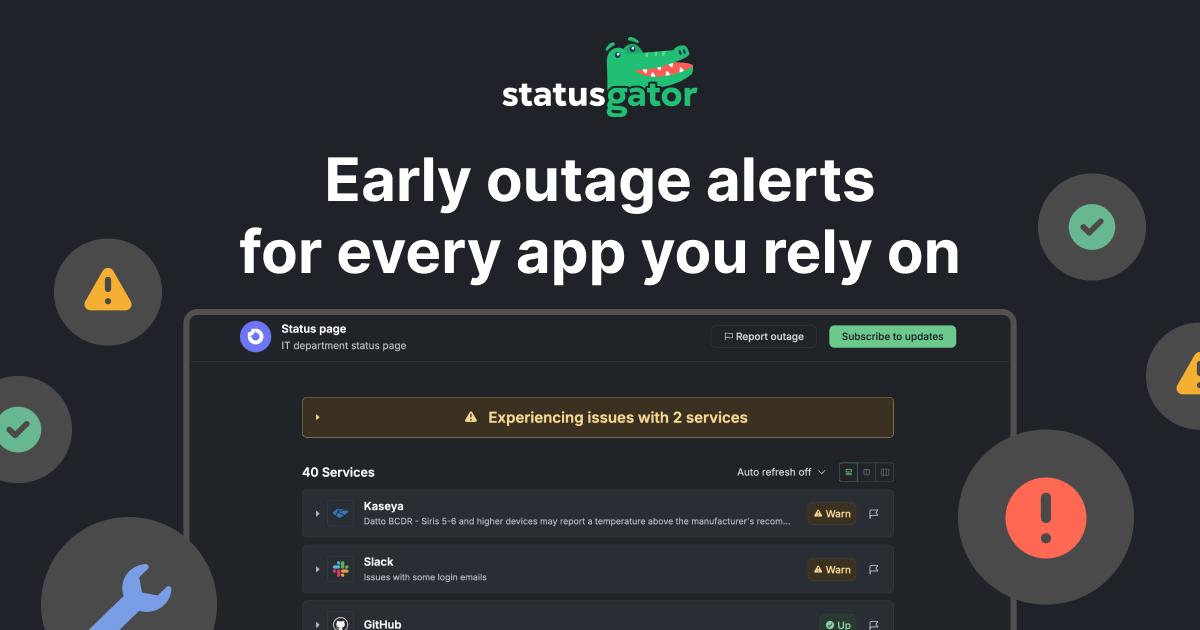
robots.txt (opens in a new tab)
1 rulesAll bots 0 allowed · 1 disallowed
- Disallow
/issue_reports/*
No matching rules.
Sitemaps
1Recent Updates
- Website images
- Screenshots
- Network details
- Website Technologies
- Pages and Search Information
- HTTP Response Information
- TLS and certificates
- DNS Information
- Domain Registration
- Website profile
- Website Description
- Website Name
- Website profile
- Website Description
- Website Name
User reviews (0)