
 简体中文
 English

Website review
This review may include AI-generated content and is not individually verified. Domain, certificate and other facts come from the observed data on this page.
What is voiceofindia.ai?
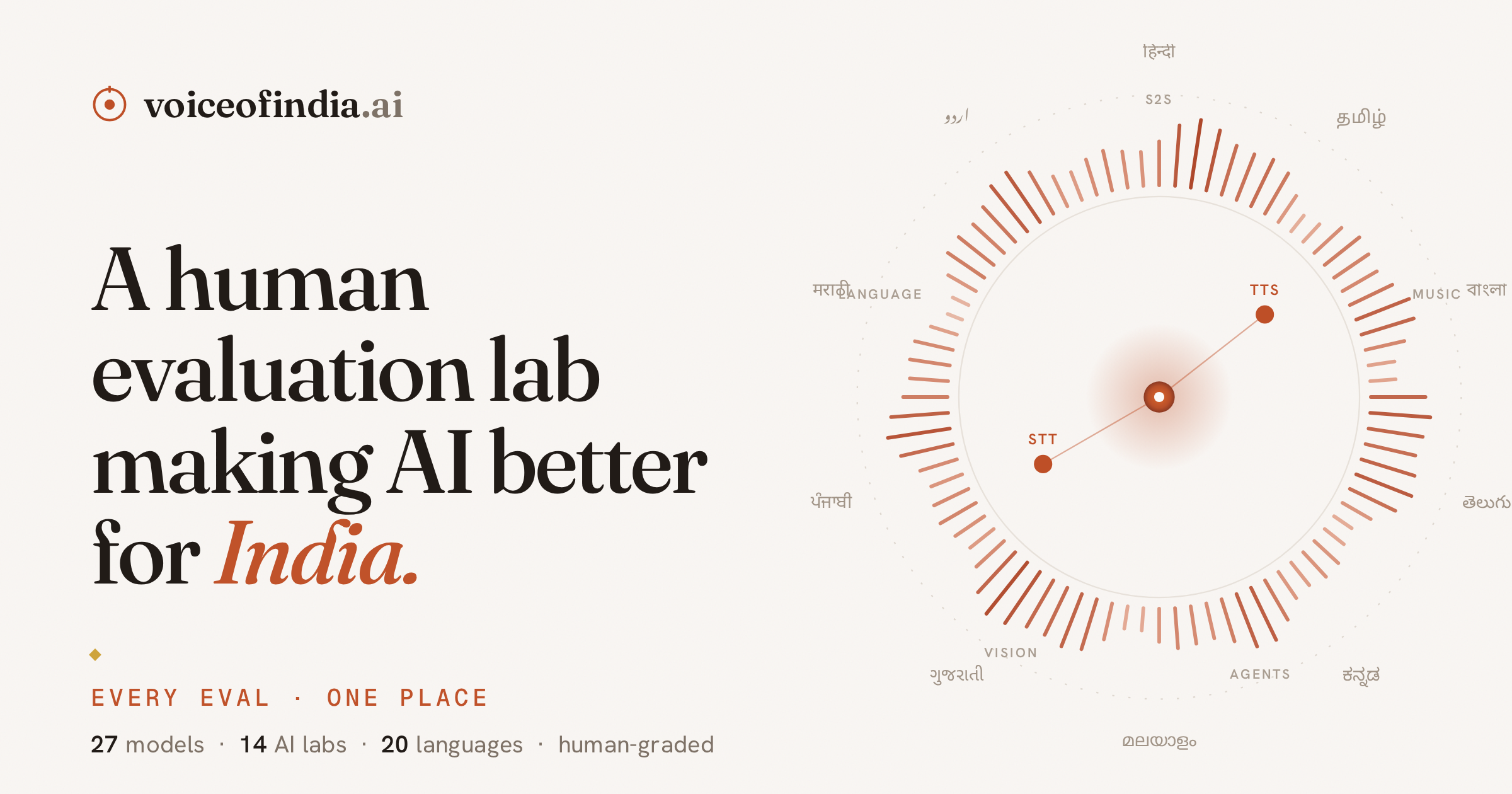
voiceofindia.ai presents itself as human evaluation infrastructure for AI in India: a single regulated benchmark spanning speech, language, vision and agents, aimed at the models Indians actually use. In practical terms, that means it is positioned less as a consumer app and more as a testing and accountability layer — a place where model performance is judged by human evaluators against Indian languages, accents and real usage conditions rather than only by automated scores.
Who it is for
- AI developers and model teams who need evidence that a model works for Indian users across languages and modalities, not just English benchmarks.
- Enterprises and public-sector buyers comparing vendors and wanting a common yardstick before procurement.
- Policy and standards bodies looking for a regulated, repeatable evaluation process rather than ad hoc studies.
- Researchers studying multilingual and speech performance in Indian contexts.
What a single cross-modal benchmark changes
Evaluating speech, text, vision and agent behaviour under one framework makes trade-offs visible. A model that leads on text may lag on speech recognition for code-switched speech; an agent that handles English commands well may fail on Hindi or Tamil instructions. A shared benchmark lets a reader see those gaps side by side instead of stitching together separate leaderboards.
| Approach | Strength | Limitation |
|---|---|---|
| Automated benchmarks only | Fast, cheap, reproducible | Misses accent, dialect and cultural context |
| Human evaluation, single modality | Rich qualitative signal | Hard to compare across tasks |
| One regulated benchmark across modalities (as described here) | Comparable results, human judgement built in | Requires sustained evaluator capacity and governance |
A concrete next step
If you are choosing a model for an Indian deployment, define your own priority languages and use cases first, then check whether the benchmark covers them — a broad cross-modal benchmark is most useful when its slices match your actual users. Pair it with your own small human pilot on real inputs, since no external benchmark fully substitutes for testing on your traffic. For complementary public evaluation efforts, see Google AI research on multilingual models and Hugging Face model cards, which often report language-specific results.
How does voiceofindia.ai evaluate AI models for Indian languages and accents?
voiceofindia.ai describes itself as human evaluation infrastructure for AI in India: one regulated benchmark spanning speech, language, vision and agents, aimed at the models India actually uses. The core idea is that Indian-language and accent performance is judged by human evaluators rather than inferred from English-centric automated scores.
What that means in practice
- Human raters as the measuring instrument. Outputs are assessed by people who can judge whether a response is correct, natural and culturally appropriate in the target language, rather than relying only on reference-text overlap or English-trained classifiers.
- Accent coverage in speech. For speech models, evaluation centres on how well systems handle the range of Indian accents and speaking styles, which automated word-error metrics on read speech tend to underrepresent.
- One benchmark across modalities. Speech, language, vision and agents are assessed under a single framework, so results are comparable across model types instead of being scattered across separate leaderboards.
- A "regulated" framing. The benchmark is positioned as governed and consistent, which matters to buyers who need defensible evidence for procurement or compliance decisions, not just a score.
A concrete scenario
A team deploying a voice assistant for a customer helpline in Maharashtra wants to know whether a speech model copes with Marathi-influenced English and code-switching. Instead of trusting a vendor's English benchmark number, they would look for human-rated results on accented and mixed-language speech, and check whether the rater pool reflects the actual caller population.
Decision criteria
| Question | Why it matters |
|---|---|
| Are raters native or fluent speakers of the target language? | Fluency determines whether subtle errors and unnatural phrasing are caught |
| Is accent coverage documented per region? | A single "Indian English" score hides large variation |
| Are agent and vision tasks included? | Multimodal deployments fail in ways text benchmarks miss |
| Is the methodology stable over time? | Only then can you compare model versions meaningfully |
As a next step, ask for the rater composition and the per-language, per-accent breakdown behind any headline score; a single aggregate number tells you little about performance for the users you actually serve.
Who can use voiceofindia.ai's benchmark results to make AI procurement or deployment decisions?
The benchmark results are intended for anyone in India who has to choose, approve or run AI systems and needs evidence about how those systems perform for Indian users. That includes government and public-sector procurement teams, enterprise technology and data leaders, AI developers, and researchers or policy groups assessing models in Indian languages and contexts.
Who gets the most practical value
- Public-sector buyers and programme owners. If you are specifying or evaluating models for citizen-facing services, a single regulated benchmark covering speech, language, vision and agents gives you a common yardstick across vendors rather than a patchwork of self-reported claims.
- Enterprise procurement and platform teams. Use results as a shortlisting filter before pilots: narrow the field, then test the surviving candidates on your own data and workflows.
- AI developers and model providers. Results show where a model underperforms on Indian languages, accents or tasks, which is more actionable than a single aggregate score.
- Researchers, auditors and policy analysts. A consistent benchmark makes comparisons between models and over time possible, and gives a shared reference point for public discussion.
How to use it in a decision
Treat benchmark results as one input, not the decision. A practical sequence: define the task and languages you actually need, use the benchmark to eliminate models that clearly fail, then run a small pilot with your own users and data. For example, a state helpline weighing two speech models should check the benchmark's speech results for the relevant languages and accents, then test call recordings from its own queue before committing.
The main trade-off is coverage versus fit: a cross-modality benchmark tells you how models compare under standard conditions, but not how they behave inside your specific system, latency budget or compliance constraints. Results are most useful to people who can pair them with their own acceptance testing—and least useful as a standalone score used to justify a purchase.
A sensible next step is to identify which benchmark categories map to your deployment (for instance, speech for a voice assistant, agents for tool-using workflows) and check whether the languages and use cases you depend on are represented before relying on the results.
How does voiceofindia.ai ensure its human evaluation is regulated and unbiased?
voiceofindia.ai presents itself as human evaluation infrastructure built around one regulated benchmark spanning speech, language, vision and agents, aimed at the models actually used in India. The available page evidence is limited to that positioning, so the specifics of how regulation and bias control are enforced are not documented here. What can be said is that a single shared benchmark is the mechanism the site leans on: one protocol applied across modalities is easier to audit and compare than a patchwork of separate tests.
For a team deciding whether to rely on it, treat "regulated" and "unbiased" as claims to verify rather than assume. Practical checks:
- Evaluator pool: who annotates, how they are recruited, and whether they reflect the languages and regions the model serves.
- Protocol and rubrics: whether scoring criteria are published and fixed before evaluation, not adjusted per model.
- Overlap and agreement: whether multiple evaluators rate the same items, with inter-annotator agreement reported.
- Governance: who sets the rules, who can change them, and how conflicts of interest with model providers are handled.
A concrete scenario: a team shipping a Hindi and Tamil voice assistant wants to know if its error rates are judged fairly against a competitor. The useful question is not whether the benchmark is called regulated, but whether the same raters, rubrics and sampling apply to both systems, and whether disagreement between raters is disclosed.
As general advice, independent oversight and published methodology are what make human evaluation credible; a single cross-modality benchmark helps only if those foundations are visible.
Can AI developers submit their models to voiceofindia.ai for independent benchmarking?
The site presents itself as human evaluation infrastructure for AI in India, but the supplied page information does not confirm a public model-submission process. There is no stated submission form, eligibility rule, review timeline or fee. Treat "can developers submit models?" as unconfirmed until you find a submission route on the site itself.
What to check on the site
- A "Submit a model", "For developers" or "Partners" page, with a named contact or form.
- Which modalities are in scope: the site describes one benchmark spanning speech, language, vision and agents, so a text-only model may not fit the same track as a speech model.
- Whether evaluation is open to any developer or run through a partnership arrangement.
- What you receive: scores, a public leaderboard entry, a private report, or certification language.
- Data handling: what evaluation data is used, whether it is Indian-language and dialect-specific, and whether results are published.
A practical next step
If you are a developer with, say, a Hindi–English speech model, prepare a short brief before contacting them: model type, languages and dialects covered, intended use, and the evaluation evidence you already have. Ask directly which benchmark track applies and whether submissions are open. That question is faster to resolve than reading a general benchmark description.
Decision criterion
If independent, India-specific human evaluation matters for your users or procurement, an open submission route is worth pursuing. If you need a fast, self-serve score, a public leaderboard with a submission portal is a better fit than an infrastructure partner that may evaluate on a project basis. For context on how other evaluation efforts describe their processes, see Google AI and arXiv for published evaluation methodology.
How does voiceofindia.ai cover speech, language, vision, and agent models in a single benchmark?
voiceofindia.ai presents itself as human evaluation infrastructure for AI in India, with one regulated benchmark spanning speech, language, vision and agents. The unifying idea is the evaluator: rather than testing each modality with a separate, disconnected leaderboard, the same human-evaluation framework is applied across model types, so results are meant to be comparable and governed by a shared set of rules.
What "single benchmark" implies in practice
- Shared evaluation standards. Speech, language, vision and agent models are assessed under one regulatory and methodological umbrella, rather than four unrelated test suites.
- Human raters as the common thread. The benchmark is built on human judgment, which lets it cover qualities that automated metrics handle poorly—naturalness of speech, cultural fit of language, relevance of visual outputs, and whether an agent completes a task sensibly.
- India-specific focus. The framing is about "the models India actually uses," suggesting evaluation is oriented toward local languages, accents, contexts and deployment conditions rather than generic global test sets.
Where the trade-offs sit
A single benchmark makes cross-model comparison easier and gives regulators and buyers one reference point. The cost is depth: a unified framework may not capture modality-specific edge cases as thoroughly as a dedicated speech or vision test suite would. For a team choosing a model, the practical question is whether the shared benchmark's criteria match your deployment—for example, a call-centre voice assistant needs speech and language coverage weighted heavily, while an agentic workflow needs task-completion evidence.
As a next step, map your use case to the modalities you actually depend on, then check whether the benchmark reports results at that granularity rather than only an aggregate score.
 GoDaddy
 Cloudflare
 Microsoft 365
 Frankfurt am Main, Hesse, Germany

User reviews (0)