
 youcompress.com
No paid content found
youcompress.com
No paid content found
 Multilingual
Categories: Resources & Utilities
Compress MP4, MOV, MP3, PDF, PNG, JPG, JPEG, GIF files online for free. Reduce file size of videos, PDF documents, MP3 audio files and images. Free online file compression tool lets you compress large files to make them smaller. No registration, no watermarks, free to use for anyone.
 Visit website
 Updated: 2026-09-27 02:16
Language: English (default)
Updated: 2026-09-27 02:16
Language: English (default)
 Access: Normal
 Profile views 0
 Outbound visits 0
Related questions
More questions →Image Editing: What It Is and How to Choose the Right Tool
Image editing is the process of changing an existing image—cropping, resizing, retouching, correcting color, removing a background, or converting its format—rather than creating a new design from scratch. It's the right approach when you already have a photo or graphic and need it to meet a specific requirement: a marketplace listing, a website, a print piece, or a social post. If you're building an original layout with type and vector shapes, that's graphic design; if you're repairing an old or damaged photo, that's restoration. Image editing sits in between and covers most day-to-day tasks.
What counts as image editing
The label covers a defined set of operations. Knowing which one you need determines which tool will work.
- Crop — remove unwanted edges or change the aspect ratio.
- Resize — change pixel dimensions or file size for a platform's limits.
- Retouch — remove blemishes, dust, or small unwanted objects.
- Color correction — fix white balance, exposure, contrast, or saturation.
- Background removal — isolate the subject, usually for product or profile images.
- Format conversion — move between JPEG, PNG, WebP, TIFF, and similar.
For example, an Amazon seller preparing a listing image may need background removal, a square crop, and a resize to the marketplace's minimum pixel requirement—three separate operations in one workflow.
Comparing editor types
The three main categories differ in where they run, what they cost in effort, and what they're good at. Use the same dimensions to compare any two tools.
| Type | Best for | Typical trade-off |
|---|---|---|
| Desktop software | Precise, repeatable, high-volume work; layered files | Install and learning curve |
| Web apps | Quick edits, no install, sharing a link | Depends on browser and upload speed |
| Mobile apps | On-the-go crops, filters, quick retouches | Smaller screens, fewer precision controls |
Some platforms bundle image editing into a wider toolset. IntelliFox, for instance, describes itself as a unified set of Amazon seller tools covering listing optimisation, PPC automation, sales and profit tracking, image editing, review requests, and fee change alerts—so image editing there is one function among several rather than a standalone editor. That matters if your editing needs are tied to marketplace listings rather than general photo work.
How to choose a tool
Match the tool to four things before you commit time to learning it:
- Platform — Do you work on desktop, in a browser, or on a phone? Pick the one you'll actually use daily.
- Budget — Check the vendor's pricing page rather than assuming a free tier. IntelliFox lists a pricing page at intellifox.com/pricing/, but the source material doesn't state what's free or paid, so verify before relying on it.
- Skill level — If you need layers and masks, a full editor is worth the learning curve. If you need a crop and a resize, a simpler tool is faster.
- Output needs — Resolution, file format, and transparency requirements rule out some tools immediately.
A basic editing workflow
The same sequence works in almost any editor:
- Import the original and keep a copy untouched.
- Crop to the target aspect ratio first, so later adjustments apply to the final framing.
- Correct color and exposure before retouching, since tonal changes can reveal or hide flaws.
- Retouch blemishes and unwanted objects.
- Remove or replace the background if the output needs transparency or a clean backdrop.
- Resize to the final pixel dimensions.
- Export in the required format and check the file size against the platform's limit.
Doing resize and export last avoids re-editing a file that's already been compressed.
Common problems and fixes
- Quality loss after resizing — You enlarged beyond the original resolution. Start from the largest source file you have, and downsize rather than upsize where possible.
- Wrong file format — Transparency needs PNG or WebP; JPEG doesn't support it. Convert after editing, not before.
- Unsupported file — Some editors won't open RAW, TIFF, or HEIC. Convert to a supported format first, or choose a tool that lists your camera's format.
- Colors look different after export — Check the color profile and whether the platform re-compresses uploads.
If your editing is part of a larger listing or storefront workflow, confirm the tool handles the export formats and dimensions that platform requires before you build a routine around it.
PDF Invoices in Legal Billing: What to Include and When to Use Them
A PDF invoice in legal billing is a fixed-format document that presents the fees and costs owed on a matter in a layout that looks the same on every device. It is the digital equivalent of a printed bill: readable, portable, and easy to attach to an email or upload to a client portal. Its main limitation is that it is not machine-readable in the way a LEDES file is, so a client's e-billing system cannot automatically ingest it. PDF works best for flat-fee matters, small or one-off engagements, and clients who do not run an automated billing platform.
What "PDF" means in a legal billing context
When a billing tool offers to send an invoice "in PDF," it is generating a rendered document rather than a structured data file. The distinction matters:
- PDF is a presentation format. A human reads it. Line items, totals, and matter details appear as text and tables on a page.
- LEDES (Legal Electronic Data Exchange Standard) is a structured, delimited text format. An e-billing system parses it, validates it against outside counsel guidelines, and routes it for review.
- Email delivery is a transport method, not a format. You can email a PDF, email a LEDES file, or email a link to an online invoice.
These three are often confused because a single invoice can combine them: a LEDES file delivered by email, or a PDF attached to an email. The format is what the client's systems can read; the delivery method is how it arrives.
When a PDF invoice is the right choice
PDF is usually appropriate when the client does not require electronic submission through a billing platform. Common scenarios:
- Flat-fee and fixed-price matters. When the invoice is one or two lines, a structured file adds no value.
- Small businesses and individuals. Clients without an accounts payable system can open a PDF and pay from it.
- Retainers and replenishment requests. A simple statement of the retainer balance is easy to read as a PDF.
- Pro bono or courtesy bills. Where no formal e-billing review applies.
- Backup documentation. Even when a LEDES file is submitted, a PDF is often attached for the reviewer's convenience.
If the client has outside counsel guidelines requiring LEDES submission, a PDF alone will typically be rejected or returned for manual entry. Check the client's billing requirements before choosing the format.
PDF versus LEDES versus emailed invoice: a quick comparison
| Factor | LEDES | Email (as delivery) | |
|---|---|---|---|
| Machine-readable | No | Yes | N/A |
| Accepted by e-billing platforms | Rarely | Yes | Depends on attachment |
| Setup effort | Low | Higher (mapping fields) | Low |
| Best for | Flat fees, small clients, backup | Corporate and insurer clients | Any format |
| Risk | Manual re-entry by client | Format rejection if fields are wrong | Lost or filtered messages |
Core elements of a compliant legal PDF invoice
A PDF invoice should stand on its own. If a client's AP department picks it up with no context, it should still answer who, what, when, and how much.
Firm and client identification
- Firm name, address, and contact details
- Tax or VAT identification number where applicable
- Client name and billing contact
- Invoice number and invoice date
- Client matter number or reference
Matter and timekeeper detail
- Matter name and description
- For each timekeeper: name, initials, and billing rate
- Time entries with date, narrative description, and time recorded in tenths of an hour
- Clear separation of fee earners if rates differ
Fees, expenses, and totals
- Fees subtotal
- Disbursements and expenses, itemized with dates
- Taxes applied
- Prior payments, credits, or trust retainer applied
- Total amount due and currency
Payment terms
- Due date and payment window
- Accepted payment methods
- Remittance details or a payment link
- Late-payment terms if the engagement letter specifies them
A useful test: hand the PDF to someone who has never seen the matter and ask them to confirm the amount due and the period covered. If they hesitate, the invoice is missing something.
Practical limitations to plan around
PDF invoices shift work to the recipient. Someone at the client has to read the document and key the data into their system, which introduces delay and transcription errors. PDFs also cannot be validated against billing guidelines automatically, so a reviewer may reject a line item that a LEDES rule would have caught before submission.
Two habits reduce the friction:
- Send a consistent template. Clients learn where to find the total, the matter number, and the payment terms.
- Keep a LEDES version in reserve. If a client later adopts an e-billing platform, you can convert rather than rebuild.
Choosing between PDF, LEDES, and email delivery
Work from the client's requirements backward:
- Does the client mandate LEDES submission? If yes, PDF is a supplement, not a substitute.
- Is the matter flat-fee or very small? PDF is usually sufficient.
- Does the client have no billing system? PDF delivered by email or portal is the simplest path.
- Is the invoice complex with many timekeepers and expenses? A structured format reduces disputes, even if the client accepts PDF.
When in doubt, ask the client's billing contact which format they prefer and whether a PDF attachment is acceptable alongside any required file. That one question prevents most rejected invoices.
Easy Legal Billing supports sending or scheduling invoices in LEDES, email, or PDF formats, which lets you match the format to each client's requirements rather than forcing one approach across every matter.
How Does AI Audio Transcription Work and What Affects Its Accuracy?
AI audio transcription converts speech into text by combining signal processing with machine learning models trained on huge amounts of paired audio and text. In practice, the pipeline runs through several stages: audio preprocessing, acoustic and language modeling, punctuation and formatting, and—if enabled—speaker diarization and summarization. Accuracy is not a single fixed number; it depends on recording quality, accents, background noise, overlapping speech, vocabulary, and how well the chosen language is supported. This article explains each stage and the practical factors that move accuracy up or down, so you can judge when automated transcription is enough and when human review still matters.
The core pipeline: from sound wave to readable text
1. Audio preprocessing
Before any speech recognition happens, the file is normalized and cleaned up. Typical steps include:
- Resampling to a consistent sample rate (commonly 16 kHz for speech models).
- Channel handling: mono conversion or selecting the dominant channel when stereo tracks differ.
- Noise reduction and gain normalization to bring quiet speakers up and steady loud peaks.
- Voice activity detection (VAD) to find where speech actually occurs and skip silence.
Good preprocessing improves everything downstream. A clean, consistent input gives the model less to compensate for.
2. Speech recognition (acoustic + language modeling)
Modern systems use neural networks—often transformer-based—that map short audio frames to probable words or subword units. Two components work together:
- The acoustic model estimates which sounds were spoken.
- The language model estimates which word sequences are plausible in the target language.
The decoder combines both to produce the most likely transcript. This is why context matters: a model that "knows" a phrase is common will favor it over a phonetically similar but unlikely alternative.
3. Punctuation, casing, and formatting
Raw recognition output is a stream of words. A separate step adds:
- Sentence boundaries and punctuation.
- Capitalization of proper nouns and sentence starts.
- Number, date, and currency formatting.
These are learned from text data, so they follow the conventions of the training material rather than any single style guide.
4. Speaker diarization
Diarization answers "who spoke when." The system extracts voice characteristics (embeddings) from each speech segment, clusters similar segments, and assigns labels like Speaker 1, Speaker 2. It works best when speakers sound distinct and don't talk over each other. Overlapping speech and similar voices are the main failure modes.
5. Summaries and derived outputs
Once a transcript exists, summarization models condense it into key points, action items, or topics. Because summaries are generated from the transcript, any transcription error can propagate into the summary. Speaker labels also let a summary attribute statements to the right person—if diarization was accurate.
What actually affects accuracy
Accuracy varies widely by conditions. The table below summarizes the main factors and their typical effect.
| Factor | Why it matters | Practical impact |
|---|---|---|
| Audio quality / bitrate | Low bitrate or clipping destroys phonetic detail | Major |
| Background noise | Music, traffic, chatter mask speech | Major |
| Microphone distance | Far-field audio is reverberant and quiet | Major |
| Accents and dialects | Training data may underrepresent them | Moderate to major |
| Overlapping speech | Models struggle to separate simultaneous voices | Major for diarization |
| Speaking rate | Very fast speech blurs word boundaries | Moderate |
| Domain vocabulary | Jargon, names, acronyms are rare in training data | Moderate to major |
| Language coverage | Less-resourced languages have weaker models | Major |
| Audio length / consistency | Mixed conditions within one file | Moderate |
Language coverage and multilingual models
A system advertising "54+ languages" does not mean equal quality in all of them. High-resource languages (English, Spanish, French, German) usually have more training data and better accuracy. Lower-resource languages may show more errors, especially with specialized terms. Multilingual models can handle code-switching—mixing languages in one conversation—but results depend on how much mixed-language data the model saw. If your content is in a less common language, test a sample before committing.
Domain-specific vocabulary
Names, product terms, medical or legal jargon, and acronyms are frequent error sources because they're rare in general training text. Many tools let you supply a custom vocabulary or keyword list to bias the decoder. This is one of the highest-leverage fixes you can apply.
Practical steps to improve your results
- Record well. Use a close microphone, a quiet room, and a consistent setup. This single step often matters more than any setting.
- Use one speaker per channel when possible; it makes diarization trivial and more reliable.
- Add a custom vocabulary for names, brands, and technical terms.
- Choose the correct language explicitly rather than relying on auto-detection, especially for short clips.
- Review the transcript against the audio for high-stakes content.
- Check speaker labels if attribution matters; correct them before generating summaries.
A simple quality-check template
For any important recording, run this quick pass:
- [ ] Does the transcript match the audio in the first two minutes?
- [ ] Are proper nouns and numbers correct?
- [ ] Are speaker labels consistent and correctly assigned?
- [ ] Do punctuation and paragraph breaks aid readability?
- [ ] Does the summary reflect the actual discussion, not just keywords?
When human review is still needed
Automated transcription is fast and increasingly accurate, but certain situations call for a human pass:
- Legal, medical, or financial records where a single word changes meaning.
- Heavily accented or overlapping speech in noisy environments.
- Highly technical content with dense jargon.
- Anything published under your name where errors carry reputational cost.
A common workflow is machine transcription first, then targeted human editing—this captures most of the speed benefit while controlling risk.
Choosing a tool: what to compare
When evaluating transcription software, compare on the dimensions that match your use case:
- Language support for your specific languages, not just the headline count.
- Speaker detection quality if you need attributed transcripts.
- Custom vocabulary support.
- Export formats (SRT, VTT, DOCX, JSON) for your downstream tools.
- Summarization if you want derived outputs.
- Pricing model—check the vendor's current pricing page, since plans and rates change.
Sonix, for example, positions itself around transcription in 54+ languages with AI summaries and speaker detection, and offers a free trial without a credit card. Verify current features and pricing directly on its site, as these details evolve.
Bottom line
AI transcription works by cleaning audio, recognizing speech with acoustic and language models, then adding punctuation, speaker labels, and summaries. Accuracy is driven less by the model alone and more by your recording conditions, language, vocabulary, and whether speakers overlap. Improve the input, supply domain terms, and reserve human review for high-stakes content—and you'll get reliable results from automated transcription in most everyday cases.
Website Overview
An established domain and managed infrastructure suggest continuity of operations and may support dependable delivery, although neither guarantees service quality. Several search or sharing settings need attention. Together they may make snippets, preview images or preferred URLs less consistent across platforms.
Domain and Registration
Registered in 2018, this domain has about 8 years of history. That suggests continuity, although ownership and purpose may have changed. Transfer-protection status is present, helping reduce the risk of unauthorized domain transfers. The domain uses the common .com extension, which is not an independent safety signal.
DNS and Email
Nameservers are provided by name.com, indicating managed DNS hosting. No CNAME was found; the observed records resolve directly to addresses. No MX record was found. A conventional explicit inbound-mail route is not configured. DNSSEC signatures were not detected, so this additional DNS authenticity protection is not confirmed. The lowest observed DNS TTL is 300 seconds.
TLS and Certificates
The public key uses EC with 256 bits. The server supplied a complete certificate chain. No organization name is present in the certificate; the available fields are consistent with domain validation. The certificate was issued by Let's Encrypt, commonly associated with automated certificate services. The certificate's total validity is about 89 days, consistent with a short renewal cycle.
HTTP and Browser Security
The response lacks these common security headers: CSP, Referrer-Policy, Permissions-Policy. No X-Powered-By header was found, reducing one common source of backend fingerprinting information. No obvious internal addresses or debug information were found in the headers. The Server header identifies nginx without an exact version. No explicit CDN or WAF marker was found in the response headers.
Technology Stack Analysis
The public page identifies nginx without precise versions, leaving fewer clues for version-specific scanning.
Search and Social Sharing
The meta description has 284 characters and may be shortened in search results. Open Graph is partially configured; og:type is missing. Twitter Card metadata is configured. The page declares 14 language or regional alternatives using hreflang. The title has 63 characters, within a common display range.
 Hosting and Email
 Hosting
 Hetzner Online GmbH
 Location
 Helsinki, Uusimaa, Finland
 Pages, Search and Sharing
| Meta description | Compress MP4, MOV, MP3, PDF, PNG, JPG, JPEG, GIF files online for free. Reduce file size of videos, PDF documents, MP3 audio files and images. Free online file compression tool lets you compress large files to make them smaller. No registration, no watermarks, free to use for anyone. |
|---|---|
| Canonical URL | https://www.youcompress.com/ |
| Language | English (default) · Multilingual |
| Twitter Card | summary_large_image |
Social Sharing Preview
8 fields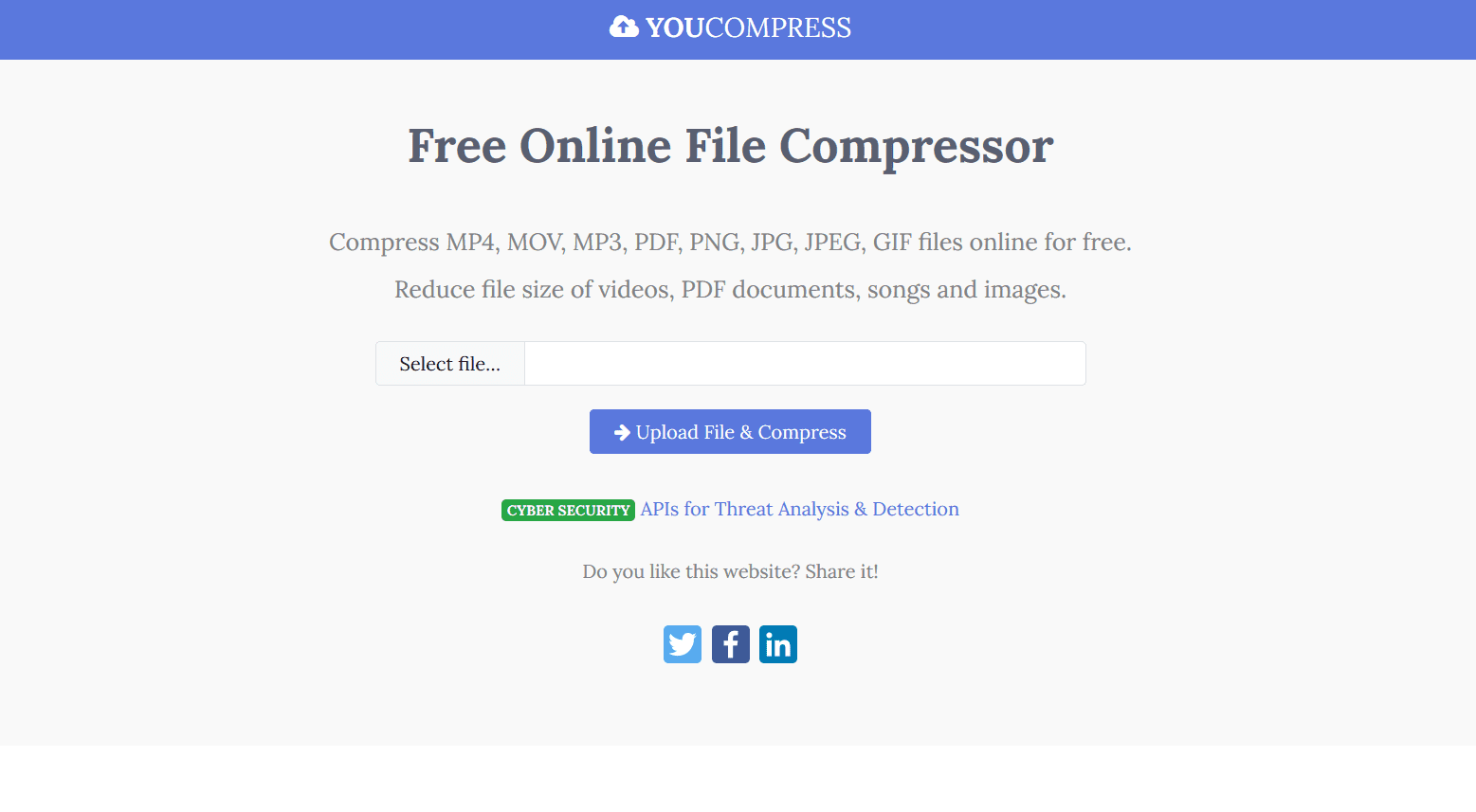

Sharing metadata
| og:image | https://www.youcompress.com/images/og-image.png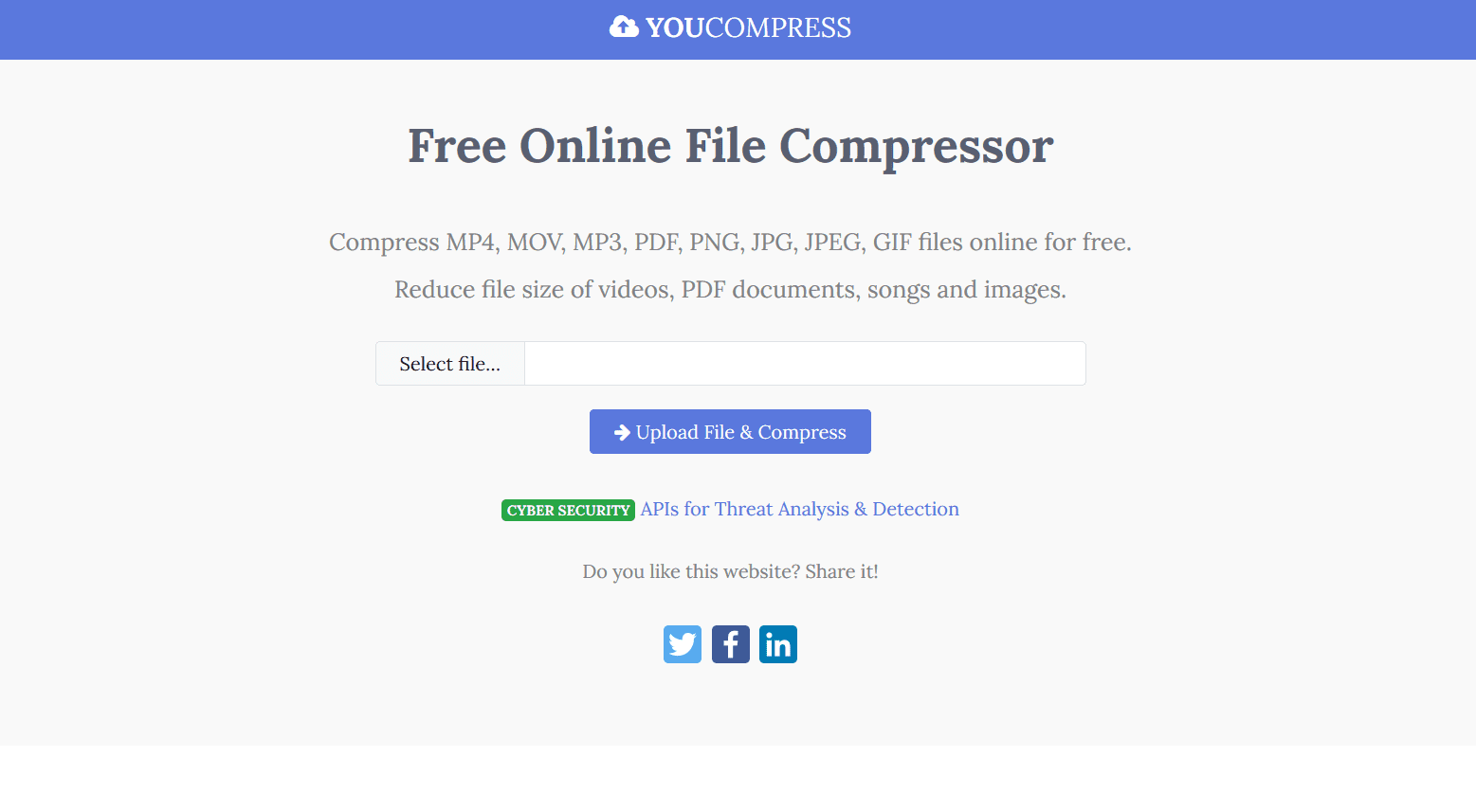 |
|---|---|
| og:title | Compress Video, Image, Audio and PDF Files Online | YouCompress |
| og:site_name | YouCompress.com |
| og:description | Compress MP4, MOV, MP3, PDF, PNG, JPG, JPEG, GIF files online for free. Reduce file size of videos, PDF documents, MP3 audio files and images. Free online file compression tool lets you compress large files to make them smaller. No registration, no watermarks, free to use for anyone. |
| twitter:card | summary_large_image |
| twitter:image | https://www.youcompress.com/images/og-image.png |
| twitter:title | Compress Video, Image, Audio and PDF Files Online | YouCompress |
| twitter:description | Compress MP4, MOV, MP3, PDF, PNG, JPG, JPEG, GIF files online for free. Reduce file size of videos, PDF documents, MP3 audio files and images. Free online file compression tool lets you compress large files to make them smaller. No registration, no watermarks, free to use for anyone. |
robots.txt (opens in a new tab)
7 rules
All bots 1 allowed · 0 disallowed

 All bots

/
cutestat 0 allowed · 1 disallowed

/
ahrefsbot 0 allowed · 1 disallowed
/
semrushbot 0 allowed · 1 disallowed
/
grapeshotcrawler 0 allowed · 1 disallowed
/
websiteoutlook 0 allowed · 1 disallowed
/
mj12bot 0 allowed · 1 disallowed
/
No matching rules.
Sitemaps
0No sitemaps found
 Registration details RDAP / WHOIS
| Registrar | Name.com, Inc. |
|---|---|
| Registered | 2018-06-05 |
| Expires | 2027-06-05 |
| Domain status | client transfer prohibited |
| Nameservers | ns1psw.name.com、ns2dqx.name.com、ns3dgj.name.com、ns4cjp.name.com |
| DNSSEC | unsigned |
 DNS records
 TLS and certificates
| Assessment | Normal configuration |
|---|---|
| Supported protocols | TLSv1.2、TLSv1.3 |
| Negotiated protocol | TLSv1.3 |
| Certificate subject | www.youcompress.com |
| Issuer | Let's Encrypt |
| Valid until | 2026-11-16T14:19 · Remaining when checked: 50 days |
| Verification details | Certificate trust: Passed · Hostname match: Passed |
 HTTP response headers
| Header | Value |
|---|---|
| content-type | text/html; charset=UTF-8 |
| server | nginx |
| strict-transport-security | max-age=31536000; includeSubDomains; preload |
| x-frame-options | SAMEORIGIN |
| x-content-type-options | nosniff |
 Identified technologies
User reviews (0)