Website profiles · Technology insights · Alternatives

acode.app No paid content found

Categories: Development

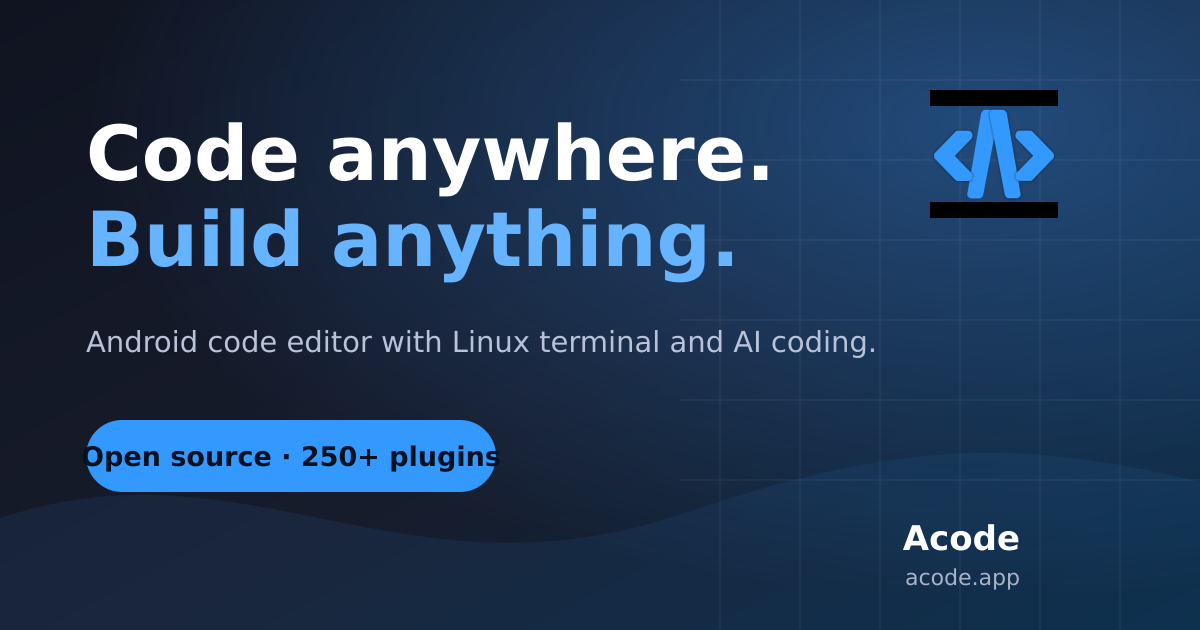
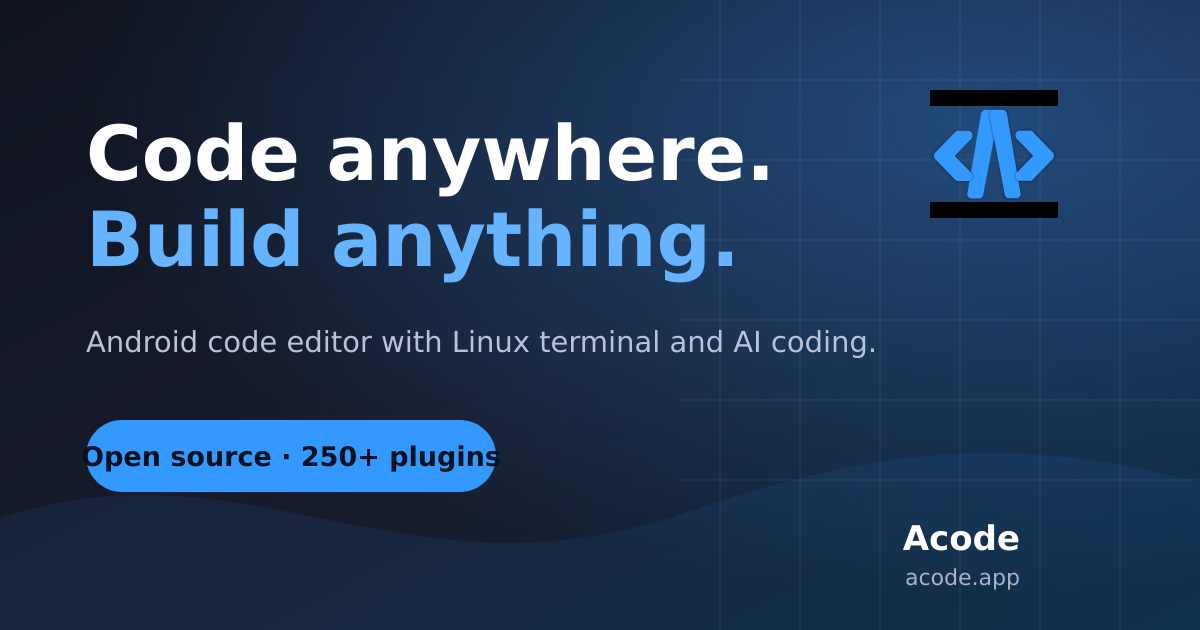
Acode is a code editor with a full Alpine Linux terminal. Run Claude Code, Codex, and OpenCode on your phone. Build with Node.js, React, Next.js, Python, Git, and 250+ plugins. Open source with 3.6M+ downloads.

Visit website

Updated: 2026-09-24 03:31 Language: English (default) Access: Normal

Profile views 3 Outbound visits 0
Acode Full homepage screenshot
Editorial Review

Website Review

What is Acode?

Acode is a mobile code editor for Android that pairs a familiar text-editing interface with a full Alpine Linux terminal, so you can write, run, and manage real projects on a phone or tablet rather than just tweaking snippets. It is open source, and its listing reports more than 3.6 million downloads. The editor supports JavaScript and Node.js workflows, React and Next.js front ends, Python, and Git, and it can be extended with a plugin ecosystem of 250+ add-ons. Because the terminal is a real Linux environment, it can also host command-line AI coding tools such as Claude Code, Codex, and OpenCode.

H3: Who it suits

  • Developers who want to push a quick fix, review a pull request, or run a script while away from a laptop.
  • Students and hobbyists on low-cost Android hardware who need a terminal and package manager without a PC.
  • Tinkerers who prefer an open-source, plugin-driven tool they can inspect and extend.

H3: Practical trade-offs

  • The phone form factor is the main constraint: a small screen and touch keyboard make long editing sessions slower than on a desktop, even with an external keyboard.
  • A full Linux terminal on mobile is powerful but can be resource-hungry, so heavier builds or large dependency installs may feel slow on older devices.
  • The plugin ecosystem adds flexibility, but plugin quality and maintenance vary, so test the ones your workflow depends on.

H3: How to decide

If your goal is to run a real development environment — Git, Node.js, Python, and a shell — from an Android device, Acode is aimed squarely at that use case. If you mainly want a lightweight notepad-style editor for reading and small edits, it may be more than you need.

A useful next step: install it, open the terminal, and try one small end-to-end task — clone a repository, install dependencies, and run the test suite. That single exercise will tell you quickly whether the mobile workflow fits how you actually work. You can also compare it with Termux if the terminal matters more than the editor, or Visual Studio Code if you are usually near a desktop.

Can I run Claude Code, Codex, or OpenCode on my phone with Acode?

Yes — Acode is built to run AI coding agents like Claude Code, Codex, and OpenCode on a phone. The key is that it bundles a terminal environment rather than being just a syntax-highlighting editor, so command-line tools can actually execute on the device.

What makes this possible

Acode ships with a full Alpine Linux terminal, according to its own description. That matters because Claude Code, Codex, and OpenCode are command-line programs: without a real shell and a Linux userland, there is nowhere for them to run. Acode also states support for Node.js, Python, Git, and 250+ plugins, which covers the runtimes these tools typically depend on.

Practical trade-offs

  • Convenience vs. comfort. You get agent-assisted coding anywhere, but a phone keyboard and small screen make reviewing long diffs or multi-file changes slower than on a laptop.
  • Terminal sessions vs. editor state. Running an agent in a terminal panel while editing in the same app reduces app-switching, but you will still be managing a shell session on a touch interface.
  • Setup effort. Expect to install and authenticate each agent inside the terminal yourself; Acode provides the environment, not a one-tap agent launcher.

A concrete scenario

You are commuting and want Codex to refactor a small utility in a Git repo you already cloned. Open Acode, start the terminal, launch the agent, let it edit files, then review the diff with Git before committing. This works well for small, well-scoped changes; it is frustrating for large architectural work.

How to decide

Pick Acode for this if your tasks are short and self-contained and you value not carrying a laptop. If your work involves heavy review, many files, or long agent sessions, use the phone version for quick fixes and keep a desktop for the rest.

Next step: clone a small test repository in Acode's terminal and run one agent on a trivial change first, so you learn the touch workflow before relying on it.

For the project itself, see Acode.

How do I use the Alpine Linux terminal in Acode?

The Alpine Linux terminal is Acode's standout feature: it gives you a real Linux shell on your phone, not a JavaScript-based emulator. That distinction matters because it means standard Linux tooling behaves the way you'd expect, rather than being reimplemented approximations.

What you can actually do with it

  • Run AI coding agents locally. According to Acode's own description, the terminal is intended to run Claude Code, Codex, and OpenCode directly on the device.
  • Use a normal toolchain. Node.js, React, Next.js, Python, and Git are all named as supported, so a phone-based workflow isn't limited to editing single files.
  • Extend the editor. Acode is open source and lists 250+ plugins, so the terminal sits alongside an editor you can customize rather than a locked-down app.

A realistic first session

  1. Install Acode and open a project folder.
  2. Open the terminal panel and confirm the shell starts.
  3. Run node --version or python3 --version to see what's already available.
  4. Clone a small repo with Git and try running it, so you learn the environment's limits before committing to a bigger project.
  5. If you plan to use an AI agent, start it in the project directory so it can read your files directly.

Trade-offs to weigh

Strength Cost
Genuine Alpine Linux shell, not a sandboxed imitation Terminal work on a touch keyboard is slower than on a laptop
Runs AI coding agents on-device Long builds and installs drain battery and can be slow on mobile hardware
Open source, large plugin ecosystem You'll spend time configuring packages that a desktop distro ships by default

Who this suits

It fits developers who want to review code, patch a bug, or drive an AI agent during a commute or while away from a desk. It suits tinkerers comfortable with a Linux prompt. It's a poor fit if your work depends on heavy compilation, large datasets, or a full IDE with rich debugging — those still belong on a desktop.

Practical next step

Before investing time, test the one thing you care about most. If it's AI-assisted coding, launch an agent in a throwaway repo and see whether the round trip feels usable on your screen size. If it's a specific stack, try installing its dependencies first — that's usually where mobile Linux environments show their constraints.

For background on the project and its plugin list, see Acode.

Which programming languages and frameworks does Acode support?

Acode's own listing positions it as a mobile code editor built around a full Alpine Linux terminal, and that terminal is the key to its language support: anything you can install and run inside Alpine Linux can generally be run from Acode. The product description names Node.js, React, Next.js, Python and Git, along with a plugin ecosystem of 250+ plugins. It also advertises running AI coding tools such as Claude Code, Codex and OpenCode on a phone.

What that means in practice

  • JavaScript/TypeScript stack: Node.js is named directly, which is what makes React and Next.js projects plausible on-device — you'd install dependencies and run dev servers or build scripts through the terminal.
  • Python: Named as a supported language, so scripts and small projects are the realistic target rather than heavy data-science workloads.
  • Git: Version control is listed as a first-class capability, useful for cloning a repo, editing, and committing from the same device.
  • Other languages: The 250+ plugins and the Alpine terminal suggest broader coverage (shell scripting, and any language whose toolchain installs in Alpine), but the page does not enumerate a definitive list, so treat specific languages as something to verify yourself.

How to check a language you care about

Open the terminal inside Acode and try installing the toolchain, for example apk add <package> or the language's own installer, then run a trivial "hello world." If it installs and runs, the editor can handle it. This is also the honest trade-off: a phone-class device limits compile times and memory, so Acode suits editing, scripting, small web projects and quick fixes rather than large builds. For desktop-scale work, a full IDE remains more practical; Acode's value is having a real Linux environment in your pocket.

For reference on the underlying environment, see Alpine Linux and, for the JavaScript runtime it names, Node.js.

Is Acode free and open source, and how do I install it?

Yes. Acode is free and open source, and it is distributed primarily as a mobile app for Android (and historically iOS), so installation is usually done through an app store rather than a desktop package manager.

Is it really free and open source?

  • Cost: The project is described as open source with no paid tier mentioned in the supplied information. There are no pricing links or payment platforms listed, which is consistent with a free download.
  • Source: Because it is open source, you can inspect, modify and redistribute the code under its project license. The exact license terms are not included in the supplied page evidence, so check the repository's license file if you need to reuse it commercially.
  • Caveat: "Free" applies to the editor itself. Running an Alpine Linux terminal inside it may pull in packages or network services that have their own terms.

How to install it

  1. On Android: Open Google Play, search for "Acode", and install the app published by the Acode project. This is the simplest route and gets you automatic updates.
  2. On iOS: Check the App Store for the same app name. Availability on iOS has varied over time, so verify the listing is current before relying on it.
  3. From source or APK: If you prefer to avoid the store, the project's official site and repository typically offer release builds. Treat any APK from a third-party mirror as untrusted.
  4. First launch: Grant storage permission so the editor can open project folders, then optionally install the terminal plugin if you want the Alpine Linux environment.

The official project page is Acode.

What to expect once installed

A practical scenario: you want to fix a small bug while commuting. You clone a repo into a local folder, edit files with syntax highlighting, run npm install and a test command in the built-in terminal, then commit with Git — all without a laptop. That is the core appeal, and it is where the trade-offs show up: a phone keyboard and small screen make long refactors slow, and heavy Node.js or Python builds can be memory- and battery-hungry.

If you mainly want a lightweight editor for reading and tweaking code on the go, install from the store and start there. If you need the full terminal workflow, install the terminal plugin and test it against one small project before committing to it as your main mobile setup.

How do Acode's 250+ plugins work and what can they add?

Acode’s plugin system is an extension layer for its mobile code editor: you install add-ons that hook into the editor’s commands, UI and language tooling, so the app gains features without the core editor carrying everything by default. In practice, that means the “250+ plugins” figure describes breadth of optional capability rather than 250 features switched on at once.

What plugins typically add

  • Language support: syntax highlighting, snippets, formatting or lint-style feedback for languages and file types beyond the built-in set.
  • Editor behaviour: themes, keybinding changes, autocomplete helpers, bracket or indentation tools, and UI tweaks.
  • Workflow integration: Git helpers, file navigation, preview or build-related commands, and shortcuts that fit a phone keyboard.
  • AI and terminal-adjacent tooling: commands that make it easier to launch or manage CLI-based coding agents inside the built-in Alpine Linux terminal.

How they work day to day

You browse or search a plugin list, install one, and it registers its contributions with the editor — menu entries, commands or language rules. Most plugins are small and single-purpose, so the practical approach is to install a few that match your stack rather than a large bundle.

A concrete scenario: a React developer on Android might add a JSX/TypeScript highlighting plugin, a Prettier-style formatter, a Git helper, and a theme, then run npm or next dev in the terminal. A Python user would swap the language and formatter plugins instead.

Trade-offs to weigh

  • More plugins, more overhead: each one adds startup work, memory use and possible conflicts on a phone.
  • Quality varies: popular plugins are usually maintained; niche ones may lag behind editor updates.
  • Terminal vs plugin overlap: some tasks are better done with CLI tools in the Alpine terminal than with a plugin.

Next step

Open Acode’s in-app plugin browser and search for your primary language first. Install one language plugin plus one formatter, test on a real project, then add Git or theme plugins only if you feel the gap. If you want to compare the editor itself before committing, see Acode.

Related questions

More questions →
What Are Open-Source UI Element Libraries and How Do They Differ From UI Frameworks?

An open-source UI element library is a collection of individual, ready-made interface pieces—buttons, cards, inputs, toggles, loaders—that you copy into your own project and adapt. A UI framework, by contrast, is a structured system of components, conventions, and often a theming layer that governs how your whole interface is built. The practical difference: an element library gives you a snippet; a framework gives you a way of working. If you need a polished button in ten minutes, reach for the element library. If you're building a 40-screen product with a team, you probably want the framework.

What "open-source UI element library" actually means

The term gets used loosely, so it helps to separate the parts:

  • Open-source: the code is publicly available, and the license tells you what you may do with it—copy, modify, redistribute, or use commercially.
  • UI element: a single, self-contained piece of interface, usually small enough to read in one sitting. A button with hover states, a pricing card, a search field.
  • Library: a browsable, searchable collection of those elements, typically contributed by many different people.

On a site like Uiverse, elements are shared by a community and written in plain CSS or Tailwind. You find one you like, copy the markup and styles, paste them into your project, and adjust colors, spacing, and text to fit. There's no package to install and no build step required—which is exactly the appeal, and also the source of most of the confusion.

Element library vs. UI framework: the core differences

Dimension Open-source UI element library UI framework / design system
Unit of reuse A single snippet you copy A component you import or call
Installation None; paste into your code Package install, config, sometimes a provider
Consistency Depends on you; each element may look different Enforced by shared tokens and APIs
Theming Manual edits per element Central theme/config file
Updates You own the copy; no upstream updates Version bumps bring fixes and changes
Accessibility Varies per contributor; must be checked Usually tested and documented
Best for Prototypes, landing pages, small sites, one-off needs Multi-page apps, teams, long-lived products
Learning curve Low—read the CSS Higher—learn the API and conventions

The table isn't a verdict. It's a map of trade-offs. Element libraries win on speed and freedom; frameworks win on consistency and maintenance.

Licensing and attribution: what to check before you paste

This is where people get into trouble, and it's worth slowing down for.

  1. Find the license. Every element or collection should state one. Common open-source licenses include MIT, Apache-2.0, and BSD. Some projects use copyleft licenses like GPL, which can impose obligations if you redistribute your code.
  2. Understand what the license permits. MIT and Apache-2.0 are permissive: you can typically use the code in commercial and closed-source projects. Copyleft licenses may require you to release derivative source under the same terms.
  3. Check attribution requirements. Permissive licenses usually require you to keep the copyright notice and license text somewhere in your project. That's a real obligation, not a formality.
  4. Look for per-element terms. On community sites, the site's overall terms and the individual contributor's stated wishes may differ. If a contributor asks for credit, honor it.
  5. When in doubt, ask or avoid. If a snippet has no license at all, you don't have clear permission to reuse it. Treat "no license" as "not open source," even if the code is publicly visible.

This article is general information, not legal advice. For commercial products with real exposure, have someone qualified review the licenses you're relying on.

How to use a community element in your project: a practical workflow

Here's a repeatable process that avoids most of the usual mess.

1. Start from a real need, not a browsing session

Decide what you need first—"a compact primary button with a loading state"—then search. Browsing aimlessly produces a pile of pretty snippets that don't fit together.

2. Copy the smallest version that works

Take the markup and the styles. Strip anything you don't need: demo wrappers, extra animations, decorative layers. Less code means fewer surprises.

3. Convert it to your conventions

If your project uses design tokens or CSS variables, replace hard-coded values:

/* Before: hard-coded */
.button { background: #4f46e5; border-radius: 8px; }

/* After: token-based */
.button { background: var(--color-primary); border-radius: var(--radius-md); }

This one step is what keeps a copied element from looking like a foreign object in your UI.

4. Check accessibility before you ship

Community elements vary widely here. Verify at minimum:

  • Keyboard focus is visible and the element is reachable by Tab.
  • Color contrast meets WCAG AA (4.5:1 for normal text).
  • Interactive elements use semantic HTML (<button>, not a clickable <div>).
  • Form inputs have associated labels.
  • Motion respects prefers-reduced-motion.

5. Test in context

Paste it into a real page with real content. Long labels, small screens, and dark mode break more copied elements than anything else.

6. Note where it came from

Keep a short comment or an internal credits file: source, license, date. Future you—and your legal reviewer—will be grateful.

Where element libraries genuinely shine

  • Prototypes and demos: you need something clickable today, not a design system.
  • Landing pages and marketing sites: a handful of distinctive elements, each custom.
  • Filling gaps: your framework lacks one specific component, and you don't want to build it from scratch.
  • Learning: reading well-made CSS is one of the fastest ways to improve.
  • Small projects: a personal site doesn't need a theming architecture.

Where they fall short

  • Consistency at scale: ten elements from ten contributors rarely look like one product.
  • Maintenance: you own every copy. When your design changes, you edit each one.
  • Accessibility debt: you inherit whatever the contributor did or didn't do.
  • No upstream fixes: a bug fixed in the original won't reach your copy.
  • Integration friction: different naming conventions, different units, different assumptions about resets.

When to choose which

Choose an element library when the scope is small, the timeline is short, or you need a few distinctive pieces rather than a whole system.

Choose a framework or design system when multiple people build multiple screens over months, when consistency is a product requirement, or when accessibility and theming need to be guaranteed rather than checked.

A hybrid works well for many teams: adopt a framework for the structural components—forms, navigation, layout—and borrow individual elements for the places where you want personality. Just route every borrowed element through the same token and accessibility checks, so it lands as part of your system rather than beside it.

The short version: open-source UI element libraries are a fast, flexible way to get good-looking interface pieces into a project. They are not a substitute for a design system, and the license and accessibility details are the part worth reading carefully.

What Does a Postal Code API Return? Fields, Formats, and Common Use Cases

A postal code API returns structured location data for a given ZIP Code or Canadian postal code. A typical response includes the code itself, city, state or province, county, latitude/longitude, and — where available — ZIP+4 detail. More complete services add time zone, area codes, boundary geometry, and demographic fields. You send a code (or an address), and the API sends back a machine-readable record you can store, validate, or display.

This article explains what those responses contain, how requests are usually shaped, and where postal code data fits into real applications.

First, clear up the word "code"

The keyword "code" is overloaded, and that causes real confusion for developers:

  • Postal code — the ZIP Code (U.S.) or postal code (Canada) that identifies a delivery area.
  • API key — the credential you use to authenticate your requests. It is not postal data.
  • Source code — the program you write to call the API.

When someone searches for "postal code API code," they usually want example request/response code for a postal code service. The rest of this article treats it that way.

What a postal code API actually returns

Response fields vary by provider and endpoint, but the core set is fairly consistent. A single-code lookup commonly returns:

Field Example Notes
Postal code 90210 The code you queried
City Beverly Hills May be one of several acceptable place names
State / Province CA Two-letter abbreviation
County Los Angeles Useful for tax, territory, and reporting logic
Latitude / Longitude 34.0901, -118.4065 Usually the centroid of the area
ZIP+4 90210-1234 Present only when a specific delivery segment is known
Time zone America/Los_Angeles Helps with scheduling and display
Area codes 310, 424 Regional phone context

Richer datasets add 90+ fields: boundaries, population, income, elevation, and more. You rarely need all of them — request only what your application uses.

A representative JSON response

{
  "postal_code": "90210",
  "city": "Beverly Hills",
  "state": "CA",
  "county": "Los Angeles",
  "latitude": 34.0901,
  "longitude": -118.4065,
  "timezone": "America/Los_Angeles",
  "area_codes": ["310", "424"]
}

XML responses carry the same information in tag form. Choose based on what your stack parses most easily; JSON is the common default.

Common request patterns

Most postal code APIs support four patterns. Knowing which one you need prevents wasted calls.

1. Lookup by code

You have a code and want its details. This is the simplest and fastest call.

GET /lookup?code=90210

2. Reverse lookup by address

You have a street address and want to confirm or complete the code. This is the pattern behind checkout address validation.

GET /validate?street=...&city=...&state=...

3. Radius search

You have a center point and want all codes within a distance. Useful for store locators and delivery zones.

GET /radius?code=90210&miles=10

4. Batch validation

You have a file of addresses and want them cleaned in bulk. Batch endpoints trade latency for throughput and usually have their own limits.

Handling missing and ambiguous matches

Real data is messy. Plan for these cases:

  • No match — the code doesn't exist or the address is malformed. Return a clear error rather than a silent empty object.
  • Multiple matches — a city name may map to several codes, or a code may span several acceptable city names. Decide whether to pick the primary or return a list.
  • Partial match — the street is valid but the ZIP+4 isn't. Fall back to the 5-digit code.
  • Stale data — codes are added, retired, and reassigned. Refresh your dataset on a regular schedule.

A practical rule: validate at the point of entry, store the normalized result, and never re-derive it later from raw user input.

Practical use cases

  • Checkout address validation — catch typos before shipping, reduce failed deliveries.
  • Shipping zone lookup — map a code to a zone, carrier route, or rate table.
  • Data enrichment — append county, coordinates, or demographics to existing records.
  • Store and service locators — radius search to find nearby branches or coverage areas.
  • Territory and tax logic — county and boundary data drive jurisdiction rules.

Licensing and data-source considerations

Postal code data originates with national authorities — USPS in the United States and Canada Post in Canada. Providers license and repackage it, which is why accuracy, update frequency, and field coverage differ between services. Before committing:

  • Confirm the data source and how often it refreshes.
  • Check whether ZIP+4 and boundary data are included or sold separately.
  • Review usage limits and whether batch processing is allowed.
  • Read the license terms for redistribution and storage.

Pricing and plan details change, so check the provider's current documentation rather than relying on secondhand figures.

Getting started

  1. Decide which request pattern you need (lookup, reverse, radius, or batch).
  2. Pick the fields you'll actually store.
  3. Write a small test call and inspect the raw response.
  4. Add error handling for no-match and ambiguous cases.
  5. Cache results where the same codes repeat.

A postal code API is ultimately a translation layer: you give it a code or an address, and it gives back structured location facts. Understand the fields, match them to your use case, and handle the messy edges — that's most of the work.

What Is AI Programming and How Are Developers Actually Using It?

AI programming is the practice of using machine-learning models to generate, complete, review, or test code inside a developer's existing workflow. It covers everything from a single-line autocomplete suggestion in an IDE to a chat assistant that explains an unfamiliar function to an autonomous agent that opens a pull request on its own. The practical dividing line is not the model but the level of human oversight: the more a tool acts without review, the narrower the tasks it should be trusted with.

The four things AI actually does in a codebase

Most day-to-day use falls into a few recognizable activities:

  • Completion — predicts the next line or block as you type, based on the file and surrounding context.
  • Generation — produces a function, class, config file, or migration script from a natural-language description.
  • Explanation and review — summarizes what a piece of code does, flags suspicious patterns, or suggests a refactor.
  • Testing and debugging — writes unit tests for existing code, proposes fixes for a failing test, or traces a stack trace back to a likely cause.

These are not separate products so much as separate modes. The same assistant that autocompletes a loop can also be asked to write the test for it.

Tool categories and where each fits

Category Typical form Best for Main trade-off
IDE copilot Inline suggestions in the editor Boilerplate, repetitive patterns, unfamiliar syntax Suggestions arrive without context about your architecture
Chat-based assistant Side panel or separate window Explaining code, drafting a design, debugging a stack trace You must paste or describe context manually
Autonomous agent Runs commands, edits files, opens PRs Multi-file changes, dependency upgrades, test scaffolding Highest blast radius; needs the tightest review

The categories overlap, and many tools now span more than one. The useful question is not which category is best but how much of the change you are willing to accept without reading it line by line.

What a realistic workflow looks like

A common pattern, for example when adding a new API endpoint:

  1. Describe the endpoint in a comment or chat prompt — method, path, expected input and output.
  2. Let the assistant draft the handler and the data model.
  3. Read the draft and correct the parts that assume an API or library version you don't use.
  4. Ask the assistant to generate tests for the happy path and at least one failure case.
  5. Run the tests, then review the diff as you would any teammate's pull request.

The assistant compresses the first draft; it does not remove steps 3 and 5. Teams that skip the review step are the ones that report the worst outcomes.

Where it breaks down

The limitations are consistent enough to plan around:

  • Hallucinated APIs. Models invent function names, parameters, and library methods that look plausible and compile-fail or, worse, silently do the wrong thing.
  • Insecure suggestions. Generated code may interpolate user input into queries, disable certificate checks, or hardcode credentials because the training data contained those patterns.
  • Licensing and provenance. Suggestions may closely resemble licensed source; teams need a policy on what is acceptable to commit.
  • Data privacy. Pasting proprietary code into a hosted assistant may send it to a third party. Check whether your tool runs locally, offers an enterprise tier with data controls, or is approved for your codebase.
  • Stale knowledge. Models have a training cutoff and will confidently describe an older version of a framework.

None of these make the tools unusable. They make verification mandatory.

How to verify AI-generated code

Treat every suggestion as an untrusted contribution:

  • Compile and run it. A suggestion that doesn't build is a cheap failure; catch it before review.
  • Check every external call. Confirm the function exists, the signature matches, and the version is the one you depend on.
  • Read for security. Look specifically at input handling, authentication, secrets, and anything touching the network or filesystem.
  • Test the edges. Ask for failure cases, not just the happy path, and add the ones the model missed.
  • Keep the diff small. A 20-line suggestion is reviewable; a 400-line agent-generated refactor is not, at least not in one pass.

How teams adopt it gradually

The lowest-risk entry point is tasks where a mistake is cheap and visible: writing tests for existing code, generating documentation comments, scaffolding a config file, or translating a snippet between languages. From there, teams typically move to in-editor completion for routine code, then to chat-based assistance for debugging and design questions. Autonomous agents that modify multiple files tend to come last, and usually behind a branch-and-review gate rather than direct commits.

The pattern that holds up: start where you would notice an error immediately, expand only after the review habit is established, and keep a human accountable for anything that reaches production.

Website Overview

Identifiable technologies and additional version or configuration signals make the service easier to fingerprint, which may help targeted scanners narrow their checks. An active inbound-mail setup with incomplete authentication may leave the domain more open to impersonation. Provider hosting alone does not close that gap.

Domain and Registration

Transfer-protection status is present, helping reduce the risk of unauthorized domain transfers. The domain has about 2 years of registration history; its current configuration provides more context than age alone. The domain uses the common .app extension, which is not an independent safety signal.

DNS and Email

The observed email authentication setup is incomplete: DMARC is missing. The lowest TTL is 30 seconds, supporting rapid record changes at the cost of more frequent lookups. Nameservers are provided by DigitalOcean, indicating managed DNS hosting. MX records point to the Zoho Mail email service. No CNAME was found; the observed records resolve directly to addresses.

TLS and Certificates

The public key uses EC with 256 bits. The server supplied a complete certificate chain. No organization name is present in the certificate; the available fields are consistent with domain validation. The certificate was issued by Let's Encrypt, commonly associated with automated certificate services. The certificate's total validity is about 89 days, consistent with a short renewal cycle.

HTTP and Browser Security

The Server header exposes the software version: nginx/1.24.0 (Ubuntu). This makes version-targeted checks easier, but is not proof of an exploitable vulnerability. X-Powered-By exposes backend information: Express. The response lacks these common security headers: CSP, Referrer-Policy, Permissions-Policy. No obvious internal addresses or debug information were found in the headers. No explicit CDN or WAF marker was found in the response headers.

Technology Stack Analysis

The public page identifies Google Analytics, nginx 1.24.0, Express, with exact versions exposed for 1 technologies. These details can narrow vulnerability checks, although exposure alone is not a vulnerability.

Search and Social Sharing

The meta description has 210 characters and may be shortened in search results. Twitter Card metadata is configured. JSON-LD includes Organization data, helping describe the organization as an entity. The title has 51 characters, within a common display range. The observed directives allow indexing and link following.

Hosting and Email

DNSDigitalOcean
HostingDigitalOcean, LLC
EmailZoho Mail
Location India flagBengaluru, Karnataka, India 139.59.28.174

User reviews (0)

  • No reviews yet.

Pages, Search and Sharing

Meta descriptionAcode is a code editor with a full Alpine Linux terminal. Run Claude Code, Codex, and OpenCode on your phone. Build with Node.js, React, Next.js, Python, Git, and 250+ plugins. Open source with 3.6M+ downloads.
Canonical URLhttps://acode.app/
LanguageEnglish (default)
Twitter Cardsummary_large_image
All bots 1 allowed · 15 disallowed
  • Allow/
  • Disallow/login
  • Disallow/register
  • Disallow/user
  • Disallow/profile
  • Disallow/change-password
  • Disallow/payments
  • Disallow/orders
  • Disallow/earnings
  • Disallow/publish
  • Disallow/add-payment-method
  • Disallow/oauth
  • Disallow/update-plugin-editor
  • Disallow/api
  • Disallow/admin
  • Disallow/become-sponsor

Registration details RDAP / WHOIS

RegistrarPDR Ltd. d/b/a PublicDomainRegistry.com
Registered2023-10-08
Expires2027-10-08
Domain statusclient transfer prohibited
Nameserversns1.digitalocean.com、ns2.digitalocean.com、ns3.digitalocean.com
DNSSECunsigned

DNS records

TypeNameValueTTLPriority
Aacode.app139.59.28.1741899—
MXacode.appmx.zoho.in3010
MXacode.appmx2.zoho.in3020
MXacode.appmx3.zoho.in3050
NSacode.appns1.digitalocean.com1800—
NSacode.appns2.digitalocean.com1800—
NSacode.appns3.digitalocean.com1800—
TXTacode.appfacebook-domain-verification=acvzs9mzyfbudif9t4lvkmfby7ldc130—
TXTacode.appgoogle-site-verification=863h-DVSR1_i0KWcYY1m48qj6JvVqHm-_hGvxZ1Aogs30—
TXTacode.appgoogle-site-verification=88Y9Im0fJgUEsqHVJ_IPt_Q_Om9wyg0sopMV8nXYDOY30—
TXTacode.appv=spf1 include:zohomail.in ~all30—

TLS and certificates

AssessmentNormal configuration
Supported protocolsTLSv1.2
Negotiated protocolTLSv1.2
Certificate subjectacode.app
IssuerLet's Encrypt
Valid until2026-11-23T22:05 · Remaining when checked: 60 days
Verification detailsCertificate trust: Passed · Hostname match: Passed

HTTP response headers

HeaderValue
content-typetext/html; charset=utf-8
servernginx/1.24.0 (Ubuntu)
strict-transport-securitymax-age=63072000; includeSubDomains; preload
x-frame-optionsDENY
x-content-type-optionsnosniff

Identified technologies

Google Analyticsnginx 1.24.0Express