Website profiles · Technology insights · Alternatives

aimentiontracker.ai

AIMentionTracker is the AI visibility platform brands use to get recommended by AI: what to fix in ChatGPT, Claude and Google AI, and whether it worked.

Paid content
Visit website
Profile views 1 Outbound visits 0 Normal
Get Recommended by ChatGPT, Claude and Google AI Full homepage screenshot

At a glance

Category
Artificial Intelligence
Language
English
Paid-content signal
Paid contentObserved
Registered
2026
Hosting
CloudflareInferred
HTTPS certificate trusted
PassedObserved
Last updated

Website review

This review may include AI-generated content and is not individually verified. Domain, certificate and other facts come from the observed data on this page.

What is AIMentionTracker?

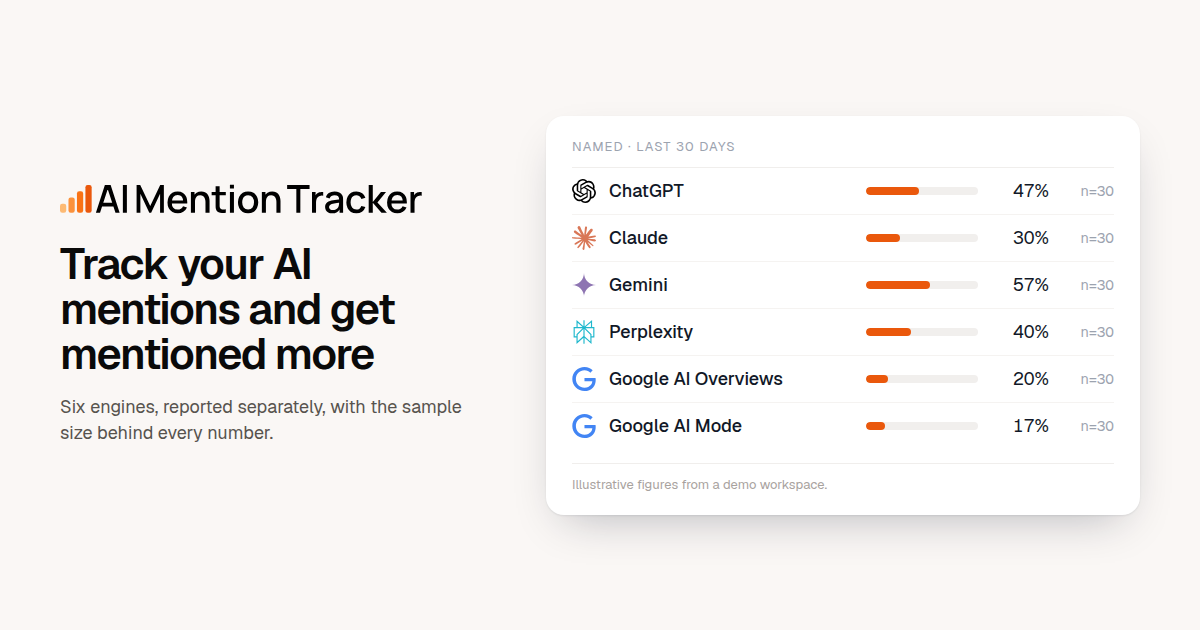
AIMentionTracker is an AI visibility platform: it tracks how often ChatGPT, Claude, Gemini, Perplexity, Google AI Overviews and Google AI Mode mention your brand when buyers ask category questions, then tells you what to change and whether the change moved the answers. Its pitch is that AI assistants now hand buyers a shortlist, and conventional rank tracking does not show whether you are on it.

What it actually does

  • Monitors the shortlist. It runs your buyers' questions across each engine and records which brands get named, how often you appear, and how the engine frames you when you do. Results are reported per engine rather than blended into one average score.
  • Produces a ranked action list. The top items are pages of your own that the engines already read while recommending a competitor — you can edit those immediately. Below that come third-party sources (review sites, comparison articles) that name rivals and never you.
  • Re-runs the same questions on a schedule. Because the question set stays fixed, a change in the answers is visible as a change, not noise.

Who it is for

Marketing and SEO teams at software and services brands whose buyers research by asking an assistant "what's the best X for Y." It is less useful if your category is rarely discussed in AI answers, or if you have no control over the pages and profiles that shape them.

How it differs from rank tracking

Traditional rank tracker AIMentionTracker
Unit of measurement Your position for a keyword Whether you are named in an AI answer
Competitor view Positions beside yours Which brands share the shortlist, per engine
Output Ranking report Ranked to-do list, then re-test

The trade-off is scope: it measures presence in AI answers, not search rankings or traffic, so it complements rather than replaces a conventional SEO stack. Pricing is described as based on prompts rather than seats, and a 7-day free trial is offered with a card required but nothing charged during the trial.

Next step: before committing, list the 10–20 questions your buyers actually ask an assistant, then check whether the tool's tracked prompt set matches them — that set is what every recommendation and progress measurement is built on. If you want background on how AI answers select sources, Google's guidance at Google Search Central and OpenAI is a reasonable starting point.

How does AIMentionTracker help my brand get recommended by AI assistants like ChatGPT and Google?

AIMentionTracker is an AI visibility platform. Its purpose is to show whether AI assistants name your brand when buyers ask category questions, and to give you a ranked, prioritized list of actions to change that. The page frames the core problem plainly: when someone asks ChatGPT, Claude, Gemini, Perplexity, Google AI Overviews, or Google AI Mode for the best tool in a category, the answer names a shortlist of brands. AIMentionTracker shows you whether you are on that shortlist, how often, and how each engine frames you when you appear. It also tracks competitors' inclusion rates alongside yours.

How it works in practice

The workflow described on the page has three moving parts:

  1. Baseline measurement. You paste your domain, and the platform runs a set of buyer-style questions across multiple engines. It reports how many answers named you versus how many named competitors. The example data shows a brand named in 55 of 105 answers over seven days, with the specific answers behind each number.
  2. A ranked action list. Every plan starts with a to-do list built from the answers the engines actually gave. The ordering reflects what you can influence fastest. Your own pages that the engines already read while recommending a competitor come first, because you control them. Next come third-party sites and articles the engines read that name rivals but never you — review platforms such as G2 and Capterra appear in the example.
  3. Verification. The same questions run on a schedule, so you can see whether the answers changed after you did the work. That closes the loop between effort and outcome.

What makes it different from rank tracking

Traditional rank trackers measure positions on a search results page. This tool measures inclusion in a generated shortlist, which is a different question. You can rank well in classic search and still be absent from an AI answer, and the page makes that distinction explicit. The engine-by-engine breakdown matters too: the page emphasizes that visibility is reported per engine and never averaged, because ChatGPT, Claude, Gemini, Perplexity, and Google's AI surfaces draw on different sources and cite different sites. A fix aimed at one engine may not move another.

Who gets the most from it

The clearest fit is a brand in a crowded category where buyers ask comparison questions — software, agencies, tools, services — and where competitors already appear in AI answers. Marketing and content teams benefit most, because the top of the action list is usually work they already own: clarifying pages, adding comparison content, and getting listed on the review sites engines cite. Teams without anyone who can edit web pages or pitch review sites will find the list harder to act on.

Two practical caveats. First, AI answers are probabilistic and shift over time, so a single run is a snapshot rather than a verdict; the scheduled re-runs are where the signal is. Second, the tool tells you what to change and whether it worked, but it does not do the writing, publishing, or outreach for you.

A useful next step

Pick five to ten questions a real buyer would ask an assistant about your category, run them yourself in ChatGPT, Claude, and Google's AI surfaces, and note which brands appear and which sources get cited. That manual check tells you whether you have a visibility gap worth tracking systematically. If the gap is real, a trial run of the platform gives you the ranked list and a baseline to measure against, and the page notes a seven-day free trial with a card required but nothing charged during that period.

Which AI platforms does AIMentionTracker monitor for brand mentions and recommendations?

AIMentionTracker monitors six AI answer surfaces: ChatGPT, Claude, Gemini, Perplexity, Google AI Overviews and Google AI Mode. The key detail is that it reports each engine separately rather than blending them into one score — the page's own framing is "your AI visibility on every engine, never averaged."

What the split means in practice

Each engine draws on different sources and phrases answers differently, so a brand can be the default pick in ChatGPT and absent from Perplexity for the same question. Keeping results per engine lets you see that gap instead of hiding it behind an average. The page's example data shows this directly: a review site was read in 14 answers naming four competitors, with Claude, Perplexity, Google AI Mode and Google AI Overviews cited as the engines involved — a different engine mix from the one attached to your own page.

How to use it

If you sell to buyers who research in more than one assistant, treat each engine as its own channel with its own fix list. The page's suggested order is to start with pages the engines already read while naming a competitor, since you control those, then pursue listings on third-party sites the engines read that mention rivals and never you. Running the same questions on a schedule is what turns a one-off snapshot into evidence that a change worked.

For a second view of the same problem, AIMentionTracker is the product itself; category-level trackers such as Semrush and Ahrefs cover AI visibility alongside traditional search data, which suits teams already working inside those suites.

How does AIMentionTracker track whether my AI visibility improvements are working?

AIMentionTracker tracks improvement by re-running the same buyer-style questions on a schedule and comparing whether the answers now name you. Its page describes a baseline of "named in 55 of 105 answers in the last 7 days," so progress is a change in that rate, not a one-off screenshot of a chat.

What it monitors and compares

  • Per-engine answers, not an average. ChatGPT, Claude, Gemini, Perplexity, Google AI Overviews and Google AI Mode are reported separately, so a gain in one assistant is not hidden by a loss in another.
  • The shortlist your buyers see. For each question, it records which brands the engine names and how often you appear beside competitors, with the underlying answers behind each number.
  • The sources the engines read. When a competitor is named and you are not, it flags the pages involved — including your own pages that were read while someone else was recommended, and third-party review sites or articles that cite rivals but never you.
  • A ranked action list. Every plan starts with a to-do list derived from actual engine answers: fix your own pages first, then pursue listings on the external sites the engines read.

How you read the result

The practical loop is: run a set of questions, work the list, then check the next run. A rising share of answers naming you across engines is the signal that something changed; a flat line after edits tells you the fix did not land. Because the same questions repeat, you are comparing like with like rather than guessing from a fresh prompt.

For a concrete case: a B2B tool sees it is named in some answers but loses to a competitor in "best alternatives for agencies" queries. The tool points to its own comparison page being read in those answers without being credited, so the team rewrites that page, then watches the next scheduled run to see whether the citation appears.

Decision criteria

Choose this approach if you need evidence that specific edits moved AI answers, and if you care about differences between ChatGPT, Claude and Google surfaces. It is less useful if you only want a single aggregate score, or if you cannot commit to acting on the source-level list — the value comes from the fix-and-recheck cycle, not from the dashboard alone.

Next step: pick five to ten questions your buyers actually ask, record your current naming rate per engine, then make one change from the top of the list and give the next run time to show a difference. The site offers a 7-day trial with a card required and nothing charged during that period; confirm current terms on AIMentionTracker before starting.

What does AIMentionTracker cost and how is pricing structured?

AIMentionTracker prices by prompts rather than by user seats, and offers a 7-day free trial with a card required but nothing charged during that window. The site's pricing page frames the model as "Priced on prompts, not on seats," so the bill scales with how many buyer questions you monitor across engines, not with how many teammates log in. For exact tiers and current rates, check AIMentionTracker.

What the structure implies

  • Prompt-based cost: You pay for the volume of questions tracked. Adding colleagues to view or act on results should not raise the bill the way seat-based tools do.
  • Trial terms: A card is required at signup, but the first 7 days are free.
  • Plan contents: Every plan starts with a ranked action list built from the answers the engines actually gave, so the entry tier is not just monitoring.

Who this fits

A small marketing or SEO team that wants many stakeholders reading the same data benefits from seat-free pricing. A solo consultant tracking a handful of prompts for each client may find prompt-based billing less predictable, since cost tracks scope rather than headcount.

Next step

Before committing, count the distinct buyer questions you need answered across ChatGPT, Claude, Gemini, Perplexity and Google AI surfaces. That number, not team size, is your pricing driver. Confirm the current prompt allowances on the pricing page, then use the free week to test whether the scheduled re-runs show real changes in how the engines name you.

Can I try AIMentionTracker before committing to a paid plan?

Yes. AIMentionTracker offers a 7-day free trial, and the page states that a card is required but nothing is charged during those seven days. That gives you a full week to run the tool against real buyer questions before any money changes hands.

What to actually test in those seven days

The trial is most useful if you treat it as a measurement exercise, not a browsing session. A practical sequence:

  1. Paste your domain first. The product builds its initial action list from answers the engines actually gave, so it needs your domain before it can show you anything meaningful.
  2. Pick five to ten real buyer questions — the ones a prospect would type into ChatGPT or Claude when choosing a vendor in your category. Generic queries produce generic output.
  3. Check the shortlist. For each question, note whether you appear at all, how often, and which competitors are named instead.
  4. Look at the "fix your own pages first" tier. These are pages the engines already read while recommending someone else — the fastest items to act on because they need nobody's permission.
  5. Re-run the same questions near the end of the week to see whether anything shifted.

The trade-off to weigh

Seven days is enough to see your baseline and identify the highest-value fixes, but probably not enough to complete them and observe a change in the answers. The page notes that questions run on a schedule so a change in answers is a change you can see — that feedback loop needs more than a week to close. So the realistic decision is: does the trial show you a clear enough list of concrete, actionable gaps to justify continuing?

If the answer list is vague, or the gaps are all "get listed on review sites" with no own-page fixes, that is useful information too. If it surfaces several of your own pages that engines already crawl while naming rivals, that is a strong signal the paid plan has work to do.

One pricing note

The pricing page indicates plans are priced on prompts rather than seats. Before the trial ends, count how many distinct questions you actually want tracked — that number, not team size, is what will drive your cost.

For comparison shopping, Semrush and Ahrefs cover traditional search visibility, though neither is built around AI assistant answers specifically.

Related questions

More questions →
What is AIMentionTracker.ai?

AIMentionTracker.ai is an AI visibility platform that shows whether AI assistants recommend your brand — and what to do when they recommend competitors instead. It tracks your presence across ChatGPT, Claude, Gemini, Perplexity, Google AI Overviews, and Google AI Mode, then turns the answers those engines actually gave into a ranked list of fixes. It's aimed at brands whose buyers ask AI tools for a shortlist of products in a category and need to know whether they made it.

What problem it solves

Ask ChatGPT, Claude, or Perplexity for the best tool in a category and the answer names a handful of brands. Everyone else is left out — and a traditional rank tracker won't tell you which side of that line you're on. AIMentionTracker reports the shortlist, how often you appear on it, and how each engine frames you when you do.

How it works

The workflow starts with your domain:

  1. Paste your domain. The platform proposes the rest.
  2. See the shortlist. It shows which brands each engine names for the questions your buyers ask, and how often.
  3. See where you stand. Your appearance rate sits beside every competitor's, with the underlying answers behind each number.
  4. Get a ranked action list. Every plan starts with a list of what to do next, built from the answers the engines actually gave.
  5. Verify it worked. The same questions run on a schedule, so a change in the answers is a change you can see.

The action list has a deliberate order

  • Fix your own pages first. These are pages the engines already read while naming a competitor — you can change them today without anyone's permission.
  • Then get listed. These are review sites and articles the engines read that name your competitors and never you.

The example shown on the site illustrates the pattern: a page credited in 2 of 9 answers where 7 answers cited it without naming the brand, alongside listings like g2.com read in 14 answers that named 4 competitors and never the brand.

What makes it different from a rank tracker

Dimension AIMentionTracker Typical rank tracker
What it measures Whether AI answers name your brand Search result positions
Engines covered ChatGPT, Claude, Gemini, Perplexity, Google AI Overviews, Google AI Mode Search engines
Reporting style Per-engine, never averaged Usually aggregated
Output Ranked list of fixes plus re-runs to confirm change Position tracking over time

The "never averaged" point matters: a strong showing on one engine can hide a total absence on another, and averaging would obscure exactly the gap you need to close.

Pricing and trial

Pricing is based on prompts, not on seats. A 7-day free trial is available — a card is required, but nothing is charged for 7 days. Check the pricing page for current tiers.

When it's a fit

Consider it if your buyers use AI assistants to build shortlists and you can't currently tell whether you're on them. It's less relevant if your category isn't something people ask AI tools about, or if you only need traditional search rankings.

Which AI Engines Does AIMentionTracker Cover, and Can You See Results Per Engine?

AIMentionTracker covers six AI surfaces: ChatGPT, Claude, Gemini, Perplexity, Google AI Overviews, and Google AI Mode. Results are reported per engine rather than as a single blended score — the platform's own framing is "your AI visibility on every engine, never averaged." So if you want to know whether Claude recommends you while ChatGPT doesn't, that distinction is the point of the product, not a limitation of it.

The engines covered

Engine Type
ChatGPT Standalone AI assistant
Claude Standalone AI assistant
Gemini Standalone AI assistant
Perplexity AI answer engine
Google AI Overviews AI summary inside Google search results
Google AI Mode Google's conversational AI search mode

The mix matters because these surfaces don't behave the same way. The three standalone assistants (ChatGPT, Claude, Gemini) and Perplexity answer a prompt directly, while Google AI Overviews and AI Mode sit inside the search experience your buyers already use. A brand can be named in one and absent from another for the same underlying question.

Why per-engine results matter more than an average

If you collapse six engines into one visibility number, you lose the only information you can act on. A blended score tells you that you're "somewhere in the middle" — it doesn't tell you which engine to fix or which source to pursue.

The platform's stated position is that AI gives buyers a shortlist, and the question is whether you're on it. Ask ChatGPT, Claude, or Perplexity for the best tool in a category and the answer names a handful of brands; the rest are left out. A traditional rank tracker won't tell you which side of that line you're on, because there is no ranked list of ten blue links to track.

Per-engine reporting answers three separate questions:

  • Which brands does each engine name for the questions your buyers actually ask, and how often.
  • Where do you stand — your mention rate shown beside every competitor's, with the underlying answers behind each number.
  • How does each engine frame you when you do appear.

What the per-engine view looks like in practice

The example data on the site shows the shape of it. A sample account is described as "Named in 55 of 105 answers in the last 7 days," followed by a ranked list of what to do next. Each item is tagged with the engines that produced it:

  • A page on your own domain, credited in 2 of 9 answers to a competitor-comparison query, with 7 answers citing it without naming you — attributed to Claude, Gemini, and Perplexity.
  • A review site read in 14 answers that named four competitors and never you — attributed to Claude, Perplexity, Google AI Mode, and Google AI Overview.
  • A second review site read in 11 answers that named five competitors and never you — attributed to ChatGPT, Claude, Gemini, and Perplexity.

That tagging is what makes the output actionable. You can see that a fix to your own page is likely to move Claude and Perplexity, while getting listed on a review site touches all four engines in that row.

How the per-engine tracking stays comparable over time

The same questions run on a schedule, so a change in the answers is a change you can see. Because each engine is tracked separately, you can attribute a movement to a specific engine rather than guessing whether a shift came from a model update, a new source being read, or your own edit.

What to check before relying on this

  • Confirm the engine list still matches your buyers. The six surfaces above are what the site states; AI search is a fast-moving category, so verify current coverage on the platform before you build a plan around it.
  • Decide whether you need all six. If your audience lives in Google search, AI Overviews and AI Mode may carry more weight than Perplexity. Per-engine reporting lets you weight them yourself instead of accepting someone else's average.
  • Note the pricing model. Pricing is described as based on prompts, not seats, and there is a 7-day free trial with a card required and nothing charged for 7 days. Check the pricing page for current terms, since prompt-based pricing means cost scales with how many questions you track — which is also what determines how granular your per-engine view can be.
How AIMentionTracker Helps You Get Recommended by ChatGPT, Claude and Google AI

AIMentionTracker is an AI visibility platform that shows which answers from ChatGPT, Claude, Gemini, Perplexity, Google AI Overviews and Google AI Mode name your competitors instead of you — then gives you a ranked list of what to change and tracks whether the answers actually changed. It fits brands that already have a site and some category presence but keep getting left off AI shortlists. Every plan starts with that action list, and the same questions are re-run on a schedule so a change in the answers is a change you can see.

What the platform actually measures

AI assistants don't return a ranked list of ten links. They name a handful of brands. AIMentionTracker's premise is that no traditional rank tracker tells you which side of that line you're on, so it measures three things instead:

  • The shortlist — which brands each engine names for the questions your buyers ask, and how often.
  • Where you stand — your mention rate beside every competitor's, with the underlying answers behind each number.
  • What to change — the specific sites and pages the engines read when they named someone else.

Visibility is reported per engine, never averaged. The product's own framing is "your AI visibility on every engine, never averaged," which matters because a brand can be cited constantly by Claude and ignored by Google AI Overviews.

The workflow, step by step

1. Paste your domain

You start by entering your domain; the platform proposes the rest — the questions to run and the competitors to compare against. There's no seat-based setup to configure first.

2. Work the ranked list, in order

The list is deliberately sequenced, and the order is the useful part:

  1. Fix your own pages first. These are pages the engines already read while naming a competitor. In the example data shown on the site, a page on your own domain was credited in 2 of 9 answers to "Best [competitor] alternatives for agencies (2026)," and 7 answers cited that page without naming you. Because it's your page, nobody's permission is needed to change it — which is why it comes first.
  2. Then get listed. These are third-party sites — review platforms and articles — that the engines read when they name your rivals and never you. The example data shows g2.com read in 14 answers naming 4 competitors and never the brand, and capterra.com read in 11 answers naming 5 competitors. Getting onto those pages requires an outreach or listing step rather than an edit.

3. Re-run and verify

The same questions run on a schedule. If your mention rate moves, that's a change you can see rather than infer — and if it doesn't move, you know the edit or listing didn't land with that engine.

A concrete example of the output

The site's sample dashboard shows a brand "Named in 55 of 105 answers in the last 7 days," followed by 13 places to get into. Each entry names the source, the engine(s) that read it, and the gap:

Priority Source What the engines did
1 Your own page (contoso.com) Read it in 9 answers, credited it in 2, recommended someone else in 7
2 g2.com Read in 14 answers naming 4 competitors, never you
3 capterra.com Read in 11 answers naming 5 competitors, never you

The engines listed against each row (Claude, Gemini, Perplexity, ChatGPT, Google AI Mode, Google AI Overview) tell you where the gap is concentrated, so you're not fixing a Perplexity problem with a Google AI Overview fix.

Trying it and what to check

The site offers a 7-day free trial with a card required and nothing charged for the 7 days, plus a demo video. Pricing is described as "priced on prompts, not on seats," so cost scales with how many questions you track rather than how many people log in — worth confirming against the current pricing page before you commit, since the specific tiers aren't stated in the material here.

Before paying, verify two things against your own category:

  • Does the proposed question set match how your buyers actually ask? The whole measurement is only as good as the prompts.
  • Are the competitors it surfaces the ones you actually lose to in AI answers? If not, the mention-rate comparison will mislead you.

If both hold, the fix-your-pages-first ordering gives you something you can act on the same day, and the scheduled re-runs give you a way to tell whether it worked.

How Is AIMentionTracker Priced and What Does the Free Trial Include?

AIMentionTracker is priced on prompts, not on seats, and it offers a 7-day free trial that requires a card but charges nothing for those 7 days. That means your cost scales with how many prompts you track across AI engines, not with how many people on your team log in. If you want the exact numbers for each tier, check the pricing page, since the site states the model but not the current figures.

What "priced on prompts, not on seats" means

Most SaaS tools bill per user, so adding teammates raises the bill. AIMentionTracker inverts that: the unit of pricing is the prompt.

  • Prompts are the billable unit. You pay based on how many questions you track across engines.
  • Seats are not the unit. The pricing page describes the model as "Priced on prompts, not on seats," so adding viewers or collaborators is not what drives cost.
  • Why it fits the product. The platform runs the same questions on a schedule and reports whether the answers changed. More prompts means more scheduled runs, more answers to compare, and more data to store, which is the real cost driver.

For a brand tracking a focused set of buyer questions, this usually means a smaller, more predictable bill than a per-seat tool. For a brand tracking hundreds of prompts, the prompt count is the number to watch.

What the 7-day free trial includes

The trial is described on the site as "Start 7-day free trial" with the note "Card required, nothing charged for 7 days."

  • Length: 7 days.
  • Card: Required to start.
  • Charge during trial: None for the 7 days.
  • What you get: Every plan starts with a ranked list of what to do next, built from the answers the engines actually gave.

That ranked list is the core of the trial experience. It is ordered so you can act immediately:

  1. Fix your own pages first. Pages the engines already read while naming a competitor. No one's permission is needed to change your own site.
  2. Then get listed. The review sites and articles the engines read that name your competitors and never you.
  3. See whether it worked. The same questions run on a schedule, so a change in the answers is a change you can see.

The example on the site shows this in practice: a domain named in 55 of 105 answers in the last 7 days, with 13 places to get into, including its own page credited in 2 of 9 answers while 7 answers cited it without naming the brand.

Which engines the trial covers

The platform reports AI visibility "on every engine, never averaged," and lists these assistants:

  • ChatGPT
  • Claude
  • Gemini
  • Perplexity
  • Google AI Overviews
  • Google AI Mode

Because results are not averaged, you can see which engine names you and which does not, rather than a single blended score.

How to decide whether the pricing model fits you

Your situation Prompt-based pricing tends to fit if… Watch out if…
Small team, many questions You track a defined set of buyer prompts and want the whole team to see results You expect to track a very large prompt set
Large team, few questions Many people need access without raising cost —
Comparing to rank trackers You care about AI answer shortlists, not search rankings You mainly need traditional SERP rank tracking

The site notes that no rank tracker will tell you which side of the AI shortlist line you are on, which is the gap this product targets.

Before you start the trial

  • Check the pricing page for current figures. The site confirms the model (prompts, not seats) but the exact tier prices are not stated in the material here, so verify them at the pricing link before committing.
  • Have your domain ready. The flow is "Paste your domain. We propose the rest."
  • Expect a card requirement. The trial is not card-free; the card is required even though nothing is charged for 7 days.
  • Plan to act on the list. The value in the trial comes from doing the ranked actions and then checking whether the next scheduled runs show changed answers.

If you want to see the shortlist, where you stand, and what to change before paying, the 7-day trial is the intended way to evaluate it. Confirm the current prompt-based pricing on the pricing page first.

What AI Visibility Means for Brands (and How It Differs From Rank Tracking)

AI visibility is the measure of whether AI assistants name your brand when buyers ask category questions — and how often they name competitors instead. It differs from rank tracking in one fundamental way: rank trackers tell you where your link appears in a list of links, while AI visibility tells you whether you appear at all in an answer that names only a handful of brands. If your buyers ask ChatGPT, Claude, or Perplexity for "the best tool in a category," the answer is a shortlist, not a page of results. You are either on it or you are not, and no rank tracker will tell you which side of that line you are on.

Why the shortlist changes the stakes

When someone searches Google, they see ten links and choose. When someone asks an AI assistant, they get a handful of brand names and often stop there. The rest of the market is left out of the consideration set before a single click happens.

AIMentionTracker frames this directly: "AI gives your buyers a shortlist. Are you on it?" The platform shows which brands each engine names for the questions your buyers ask, how often you make the list, and how each engine frames you when you do appear.

How AI visibility differs from rank tracking

Dimension Rank tracking AI visibility
What it measures Position of your URL in a list of links Whether your brand is named in an AI answer
Unit of output A rank number per keyword A shortlist of brands per question
Competitor view Who ranks above and below you Who gets named when you don't
Framing Title and snippet How the engine describes you
Failure mode Ranking lower Being absent entirely

The practical consequence: a strong rank-tracking dashboard can look healthy while AI engines consistently recommend your competitors and never mention you.

What AI visibility actually tracks

According to the platform's own description, AI visibility covers several distinct signals:

  • Which brands each engine names for the questions your buyers ask, and how often.
  • Your rate beside every competitor's, with the underlying answers behind each number.
  • How each engine frames you when you are named.
  • Per-engine results, never averaged — visibility on ChatGPT, Claude, Gemini, Perplexity, Google AI Overviews, and Google AI Mode is reported separately, because each engine reads and cites different sources.

That last point matters. An average across engines hides the fact that you might be well-represented on one assistant and invisible on another.

What you can act on

AI visibility is only useful if it produces a to-do list. AIMentionTracker's approach ranks fixes in a specific order:

  1. Fix your own pages first. These are pages the engines already read while naming a competitor — you can change them today without anyone's permission. In the platform's example data, a company's own page was cited in 7 answers that recommended someone else.
  2. Then get listed. These are third-party sites — review platforms, comparison articles — that the engines read when naming your competitors and never you. Examples in the sample data include g2.com (read in 14 answers naming 4 competitors) and capterra.com (read in 11 answers naming 5 competitors).
  3. Then verify it worked. The same questions run on a schedule, so a change in the answers is a change you can see rather than assume.

When this matters to you

AI visibility is relevant if your buyers research categories by asking AI assistants for recommendations — which is increasingly common for software, tools, and services. It matters less if your discovery happens through direct brand search, referrals, or channels where buyers already know your name.

The platform offers a 7-day free trial with a card required and nothing charged for 7 days, and pricing is structured on prompts rather than seats. If you want to see whether AI engines currently name you, the entry point is pasting your domain and reviewing the proposed list of actions.

Website Overview

Page metadata, canonical configuration and social previews work together to provide more consistent search and sharing presentation.

Domain and Registration

The domain was registered less than a year ago and has limited historical evidence to assess. Transfer-protection status is present, helping reduce the risk of unauthorized domain transfers. The registrar is GoDaddy.com, LLC, a widely used domain service provider. Registration contact information is publicly available through RDAP. The domain uses the common .ai extension, which is not an independent safety signal.

DNS and Email

Nameservers are provided by Cloudflare, indicating managed DNS hosting. MX records point to the Google Workspace email service. No CNAME was found; the observed records resolve directly to addresses. SPF and DMARC are configured. DKIM status is unknown. TXT records include verification markers for Google. Such markers may also remain after a service stops being used.

TLS and Certificates

The public key uses EC with 256 bits. The server supplied a complete certificate chain. No organization name is present in the certificate; the available fields are consistent with domain validation. The certificate was issued within the Google Trust Services cloud or CDN ecosystem. The certificate's total validity is about 90 days, consistent with a short renewal cycle.

HTTP and Browser Security

CORS permits any origin to read this response. This is common for public resources; sensitive responses need narrower handling. No X-Powered-By header was found, reducing one common source of backend fingerprinting information. All six checked browser-security headers are present. Their effectiveness still depends on the policy values and application behavior. The cf-ray response header indicates a CDN or caching proxy in the delivery path. No obvious internal addresses or debug information were found in the headers.

Technology Stack Analysis

The public page identifies Next.js, Cloudflare without precise versions, leaving fewer clues for version-specific scanning.

Search and Social Sharing

Twitter Card metadata is configured. JSON-LD includes Organization data, helping describe the organization as an entity. The title has 48 characters, within a common display range. A meta description is present, with 152 characters. The observed directives allow indexing and link following.

Hosting and Email

DNSCloudflare
HostingCloudflare
EmailGoogle Workspace
Approximate IP geolocation (inferred; a CDN or proxy may differ from the origin server) Location unknown Inferred 104.21.69.144

Registration details

RDAP / WHOIS

RegistrarGoDaddy.com, LLC
Registered2026-08-22
Expires2028-08-22
Domain statusclient delete prohibited、client renew prohibited、client transfer prohibited、client update prohibited
Nameservershazel.ns.cloudflare.com、quinton.ns.cloudflare.com
DNSSECunsigned

DNS records

DNS

TypeNameValueTTLPriority
Aaimentiontracker.ai104.21.69.144300—
Aaimentiontracker.ai172.67.209.32300—
AAAAaimentiontracker.ai2606:4700:3030::6815:4590300—
AAAAaimentiontracker.ai2606:4700:3037::ac43:d120300—
MXaimentiontracker.aismtp.google.com3001
NSaimentiontracker.aihazel.ns.cloudflare.com86400—
NSaimentiontracker.aiquinton.ns.cloudflare.com86400—
TXTaimentiontracker.aigoogle-site-verification=4rnw2pehAG3Ne84BJPrzi0j330ZoWRnBI38YRxI7xf8300—
TXTaimentiontracker.aiv=MCPv1; k=ed25519; p=54UaebZHp3+u0/9n3ThxF1jUlb9gOPcvovdRK5BmK84=300—
TXTaimentiontracker.aiv=spf1 include:_spf.google.com include:amazonses.com ~all300—
DMARC_dmarc.aimentiontracker.aiv=DMARC1; p=quarantine; adkim=r; aspf=r; rua=mailto:[email protected];300—

TLS and certificates

TLS / SSL

AssessmentNormal configuration
Supported protocolsTLSv1.2、TLSv1.3
Negotiated protocolTLSv1.3
Certificate subjectaimentiontracker.ai
IssuerGoogle Trust Services
Valid until2026-11-25T08:06 · Remaining when checked: 46 days
Verification detailsCertificate trust: Passed · Hostname match: Passed

HTTP response headers

HTTP

HeaderValue
content-typetext/html; charset=utf-8
cache-controlpublic, max-age=0, must-revalidate
servercloudflare
strict-transport-securitymax-age=31536000; includeSubDomains; preload
content-security-policyframe-ancestors 'none'
x-frame-optionsDENY
x-content-type-optionsnosniff
referrer-policystrict-origin-when-cross-origin
permissions-policygeolocation=(), microphone=(), camera=(), interest-cohort=()
access-control-allow-origin*

Identified technologies

Next.jsCloudflare

Pages, Search and Sharing

Meta descriptionAIMentionTracker is the AI visibility platform brands use to get recommended by AI: what to fix in ChatGPT, Claude and Google AI, and whether it worked.
Canonical URLhttps://aimentiontracker.ai
LanguageEnglish (default)
Twitter Cardsummary_large_image
All bots 1 allowed · 0 disallowed
  • Allow/
googlebot 1 allowed · 0 disallowed
  • Allow/
googlebot-image 1 allowed · 0 disallowed
  • Allow/
bingbot 1 allowed · 0 disallowed
  • Allow/
duckduckbot 1 allowed · 0 disallowed
  • Allow/
slurp 1 allowed · 0 disallowed
  • Allow/
yandexbot 1 allowed · 0 disallowed
  • Allow/
baiduspider 1 allowed · 0 disallowed
  • Allow/
gptbot 1 allowed · 0 disallowed
  • Allow/
oai-searchbot 1 allowed · 0 disallowed
  • Allow/
chatgpt-user 1 allowed · 0 disallowed
  • Allow/
claudebot 1 allowed · 0 disallowed
  • Allow/
claude-user 1 allowed · 0 disallowed
  • Allow/
claude-searchbot 1 allowed · 0 disallowed
  • Allow/
anthropic-ai 1 allowed · 0 disallowed
  • Allow/
perplexitybot 1 allowed · 0 disallowed
  • Allow/
perplexity-user 1 allowed · 0 disallowed
  • Allow/
google-extended 1 allowed · 0 disallowed
  • Allow/
applebot 1 allowed · 0 disallowed
  • Allow/
applebot-extended 1 allowed · 0 disallowed
  • Allow/
amazonbot 1 allowed · 0 disallowed
  • Allow/
meta-externalagent 1 allowed · 0 disallowed
  • Allow/
facebookbot 1 allowed · 0 disallowed
  • Allow/
bytespider 1 allowed · 0 disallowed
  • Allow/
ccbot 1 allowed · 0 disallowed
  • Allow/
cohere-ai 1 allowed · 0 disallowed
  • Allow/
duckassistbot 1 allowed · 0 disallowed
  • Allow/
mistralai-user 1 allowed · 0 disallowed
  • Allow/
youbot 1 allowed · 0 disallowed
  • Allow/
diffbot 1 allowed · 0 disallowed
  • Allow/
omgili 1 allowed · 0 disallowed
  • Allow/

User reviews (0)

  • No reviews yet.