

 Paid content
 Visit website
 Updated: 2026-09-27 18:39
 Language: English (default)
 Access: Normal
 Profile views 5
  Outbound visits 1
 Website Review
What is Arango Contextual Data Platform?
Arango Contextual Data Platform is a graph-native data foundation for AI agents, assistants and applications. Its purpose is to give every AI workload the same current, trusted view of a business, so answers stay consistent and decisions can be traced back to source data.
The platform sits between enterprise data sources and the AI layer. Fragmented data from multiple systems flows in, and Arango connects, understands, retrieves, governs and persists it as a unified contextual data layer. Instead of rebuilding context at runtime through pipelines, teams build context once and reuse it across agents, apps and workloads.
What it is made of
Arango describes itself as multimodel: graph, vector, document, key-value and search in one platform. The graph layer is the distinguishing part. It supplies relationships and lineage, which is what makes explainable answers and traceable decisions possible rather than just fast retrieval.
Who it is for
- AI and platform engineers building agents that need business context, not just a vector index.
- Data architects trying to replace a stack of separate graph, vector, document, key-value and search systems.
- Enterprises with governance, high availability, disaster recovery and access-control requirements that must be designed in from the start.
Trade-offs to weigh
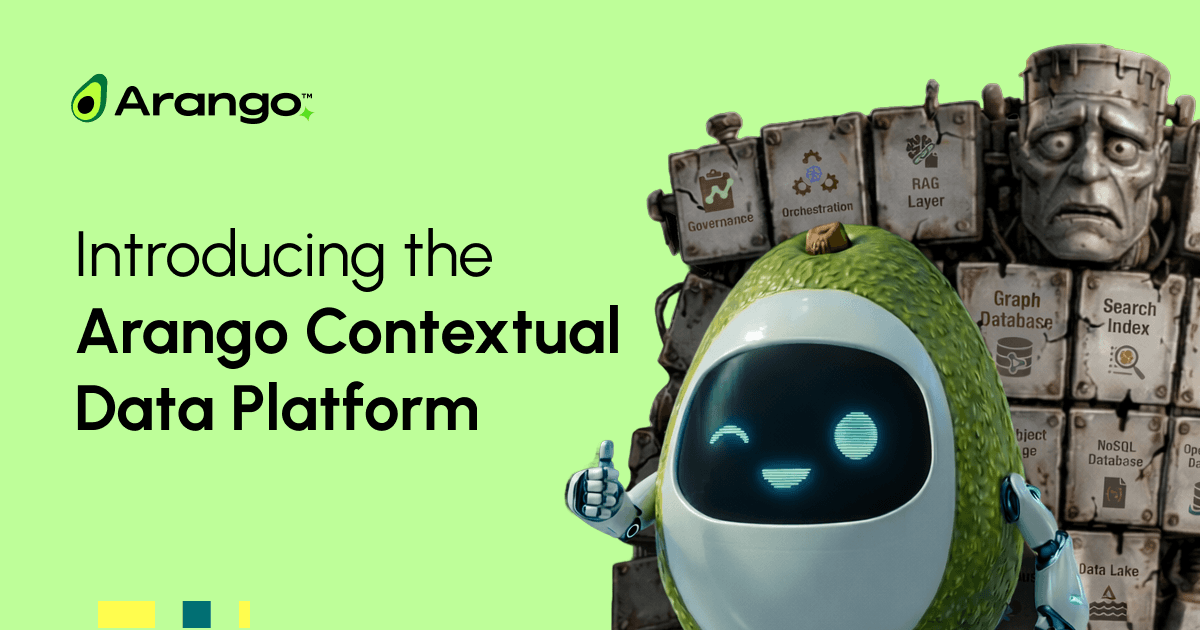
The main promise is consolidation: one governed platform instead of a "Frankenstack" of components the team has to glue together and maintain. The main cost is commitment to a single multimodel system and its query model. If your context needs are simple, a narrower tool may be enough. If your agents must reason over connected enterprise data with auditability, the unified layer is the more relevant choice.
Arango cites 200+ production environments, a 70% simpler stack and 2,000x faster workloads in its own material; treat those as vendor-reported figures rather than independently verified benchmarks.
Next step
If you are evaluating it, start with one high-value agent use case and check three things against your requirements: whether graph lineage covers your audit needs, whether the multimodel query model fits your team's skills, and whether deployment options match your infrastructure. Pricing and deployment details are listed at Arango. For a broader view of the category, the Forrester Wave on multimodel data platforms is referenced on the same page.
How does Arango differ from a Frankenstack of separate databases?
Arango's pitch is that one graph-native platform replaces a "Frankenstack" — the common pattern of stitching together a graph database, a vector store, a document store, a key-value store, and a search engine, then wiring them together with pipelines.
The core difference is where context is assembled. In a Frankenstack, each component holds a fragment of your business context, and your team has to rebuild the joined-up picture at query time: write cross-system queries, tune retrieval separately, and keep the pieces in sync as data changes. Arango positions its Contextual Data Layer between your data sources and your AI agents, apps, and LLMs, so fragmented data flows in once, gets connected and governed, and is then queried directly. The stated aim is that agents never reassemble context on the fly.
What that changes in practice
- Explainability and lineage. Because the layer is graph-native, Arango says decisions can be traced back to source data end to end. In a stitched stack, lineage usually stops at each component's boundary.
- Time to production. Arango cites AutoGraph, Auto Ingest and Retrieval, and pre-built MCP integrations as shortcuts for building a reliable AI data architecture, rather than assembling and tuning each store yourself.
- Operational surface. One platform to scale, secure, and maintain instead of several. Arango claims a 70% simpler stack and 2000x faster workloads from avoiding data movement between systems — vendor figures, so treat them as directional rather than benchmarked.
- Scale model. Horizontal scaling across graph, vector, document, key-value, and search without rebuilds.
When a Frankenstack can still make sense
If your team already runs best-in-class components, has deep expertise in tuning them, and your retrieval patterns are narrow, the switching cost may not pay off. Frankenstacks also let you swap one piece without touching the rest. The trade-off is the glue: integration code, duplicated governance, and context that drifts between systems.
A practical test: count how many systems a single AI answer currently has to touch, and how many of those joins your team maintains by hand. If that number is growing, a unified graph-native layer is worth evaluating; if it's one or two and stable, consolidation is harder to justify.
Next step: map one real agent query end to end and note every hop, transform, and sync it requires. That diagram is the honest comparison between the two approaches for your workload. You can review deployment and pricing options at Arango Contextual Data Platform.
Can I try Arango before paying, and what deployment options are available?
Yes. Arango is positioned as something you can evaluate before committing to a paid plan — the site lists a "Pricing & Deployment Options" page, which is where trial and deployment details live. The platform is also described as production-ready from day one and proven in 200+ production environments, so the intended path is: explore the platform, then choose a deployment that matches your environment.
Deployment options
Arango advertises deployment flexibility built into the platform rather than added later. The page does not enumerate every option, but the relevant categories to check on the pricing page are:
- Self-managed / on your own infrastructure — for teams that need data to stay inside their own network or cloud account.
- Managed cloud service — for teams that want to skip cluster operations and let the vendor handle scaling and upgrades.
- Hybrid or multi-environment setups — relevant if some data is regulated and some is not, since the platform includes RBAC and HA/DR as built-in features.
How to decide
| If your situation is... | Look for... |
|---|---|
| Evaluating for a prototype or proof of concept | A free trial or developer tier with enough storage and query capacity to load real sample data |
| Handling regulated or customer data | Self-managed or region-specific deployment, plus RBAC and audit/lineage features |
| Small team without a database ops function | Managed deployment, so scaling and failover are not your responsibility |
| Existing graph, vector, or search systems | Whether one platform can replace the stack, since Arango claims a 70% simpler stack |
A practical next step
Pick one real question your AI agent or app must answer — for example, "which customer accounts are affected by this supply-chain event?" — and try to answer it end to end on a trial deployment. That tests the two claims that matter most for a buying decision: that context can be built once and reused, and that graph-native lineage makes each answer traceable to source. If the trial cannot load your actual data shape, no pricing tier will fix that.
For official trial terms, regions, and support levels, check Arango Contextual Data Platform directly, since those details change and are not fully specified on the main page.
How do I build a graph-native context layer for my AI agents?
Build it as a persistent layer between your source systems and your agents, not as something each agent assembles at query time. The core move is: ingest fragmented enterprise data once, model the relationships that matter, and let agents query that same live graph for context.
Arango Contextual Data Platform describes exactly this pattern: a graph-native context layer that sits between enterprise data sources and AI agents, apps and LLMs, handling connect, understand, retrieve, govern and persist. Its stated production benefits are explainable answers, traceable decisions, faster time to production, and a simplified architecture replacing separate graph, vector, document, key-value and search systems.
H3. A practical build sequence
- Pick the entities and relationships that drive decisions. Customers, orders, products, policies, tickets — plus the edges between them. The graph is only as useful as the questions it can answer.
- Ingest from source systems into the graph. Aim for a repeatable pipeline rather than one-off imports, so context stays current.
- Attach retrieval to the graph. Agents should query the layer directly instead of rebuilding context at runtime.
- Add governance and lineage. If a decision can't be traced to source data, it isn't auditable.
- Expose it through a standard interface so multiple agents and apps reuse the same context rather than each maintaining its own copy.
H3. Why not a stack of separate stores
| Approach | What you get | Main trade-off |
|---|---|---|
| Graph + vector + document + search bolted together | Flexibility per component | Your team builds the graph, tunes retrieval, and writes cross-system queries; context drifts between stores |
| Single graph-native multimodel layer | One live view, shared by every agent | Requires committing to one platform and modelling discipline up front |
Arango frames the first option as a "Frankenstack" where the team does all the work, and positions itself as automating the hardest parts through AutoGraph, Auto Ingest and Retrieval, and pre-built MCP integrations. Treat those as the vendor's claims about its own product; the underlying principle — automate graph construction and retrieval rather than hand-building them — holds regardless of vendor.
H3. Decision criteria
- Do multiple agents need the same context? If yes, a shared layer beats per-agent retrieval.
- Does explainability matter? Regulated or high-stakes decisions favour graph lineage you can trace to source.
- How fragmented is your data? The more source systems, the more a unified layer pays off versus glue code.
- Can you accept one platform? Consolidation reduces maintenance but increases dependence on that vendor.
A useful next step: list the five questions your agents most often get wrong, and check whether each is answerable from relationships you could model as edges. If most are, a graph-native context layer is the right investment; if most are simple lookups, start smaller.
How does Arango handle security, high availability, and disaster recovery?
Arango treats security, high availability (HA) and disaster recovery (DR) as built-in platform concerns rather than add-ons. According to the platform description, these capabilities are "built into the platform, not bolted on afterward," which matters if you are running AI agents or apps that depend on continuous access to a live contextual data layer.
Security
- Role-based access control (RBAC) is listed as part of the enterprise-grade feature set.
- Because the platform unifies graph, vector, document, key-value and search data in one governed layer, access policies can be applied centrally instead of being replicated across separate systems.
- Graph-native lineage is presented as a way to trace decisions back to source data, which supports auditability end to end.
High availability and disaster recovery
- Enterprise-grade HA/DR is stated as a platform capability.
- Elastic scaling and deployment flexibility are also called out, so HA/DR can be aligned with how and where you deploy.
- Horizontal scale across all supported data models is described as requiring no rebuilds, which helps keep availability and recovery consistent as workloads grow.
How to evaluate the trade-off A unified platform can reduce the number of components you have to secure, replicate and fail over. The trade-off is that you are relying on one vendor's HA/DR design rather than composing best-of-breed tools. If your team already operates separate graph, vector and search systems, compare the operational effort of maintaining HA/DR across each of those against adopting one governed layer.
Next step Ask for the specific HA/DR topology options (for example, multi-zone versus multi-region), the RBAC granularity, and how failover and recovery are tested in production. If you want a broader view of the platform before that conversation, start with Arango Contextual Data Platform.
What real-world results have companies achieved with Arango in production?
Production stories on Arango's site center on replacing a "Frankenstack" of separate graph, vector, document, key-value and search systems with one graph-native multimodel platform, and on the operational gains that follow. The company reports deployment in 200+ production environments worldwide and cites a 70% simpler stack and workloads running up to 2,000x faster, which it attributes to eliminating data movement between systems Arango Contextual Data Platform.
Concrete outcomes it highlights:
- Explainable answers — agents grounded in a unified, live context layer return results that can be traced back to source data.
- Faster time to production — AutoGraph, Auto Ingest and Retrieval, and pre-built MCP integrations shorten the build-and-operate cycle for AI data architecture.
- Traceable decisions — graph-native lineage supports end-to-end auditability.
- Less to maintain — one governed platform instead of dozens of glued-together components, with HA/DR, RBAC and elastic scaling included rather than added later.
Named customer stories are referenced on the page but the specific companies and their numbers are not detailed in the available excerpt, so treat the headline figures as vendor-reported rather than independently verified benchmarks. For a like-for-like view, ask Arango for reference customers in your industry and compare their pre- and post-migration stack size, query latency and audit requirements against your own. If you want outside context on the multimodel category, the Forrester Wave: Multimodel Data Platforms, Q2 2026 is cited on the page.
 Hosting and Email
 Cloudflare
 Hosting
 Google Workspace
 Location
 Pages, Search and Sharing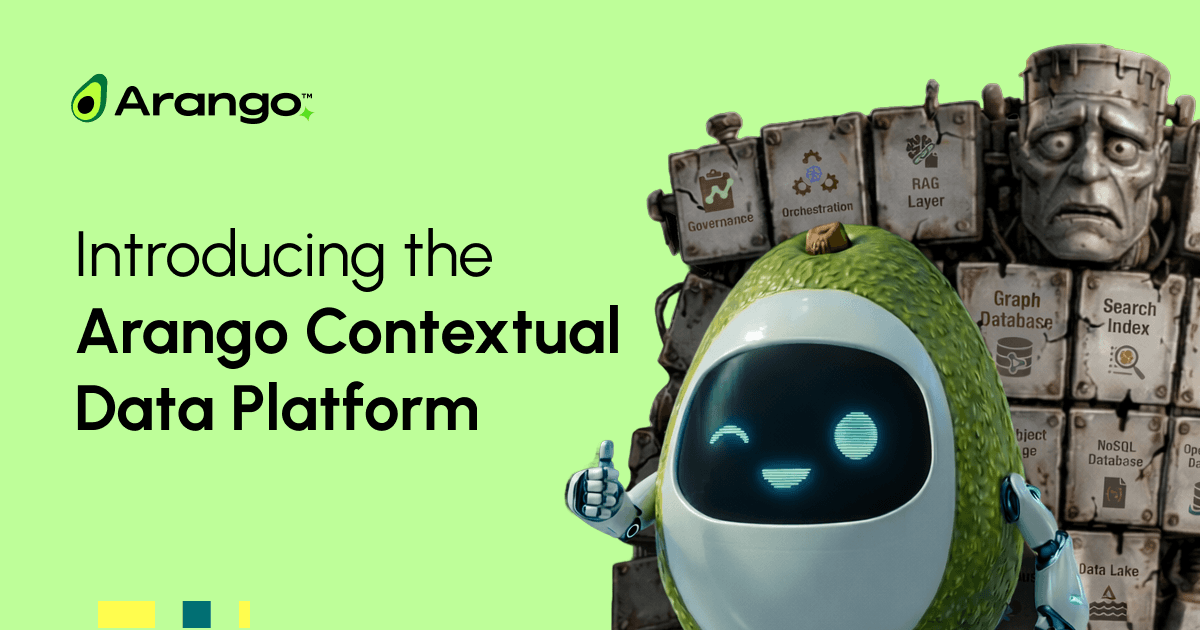



 All bots


 Registration details

 Identified technologies
User reviews (0)