Website profiles · Technology insights · Alternatives

artifactguesser.com

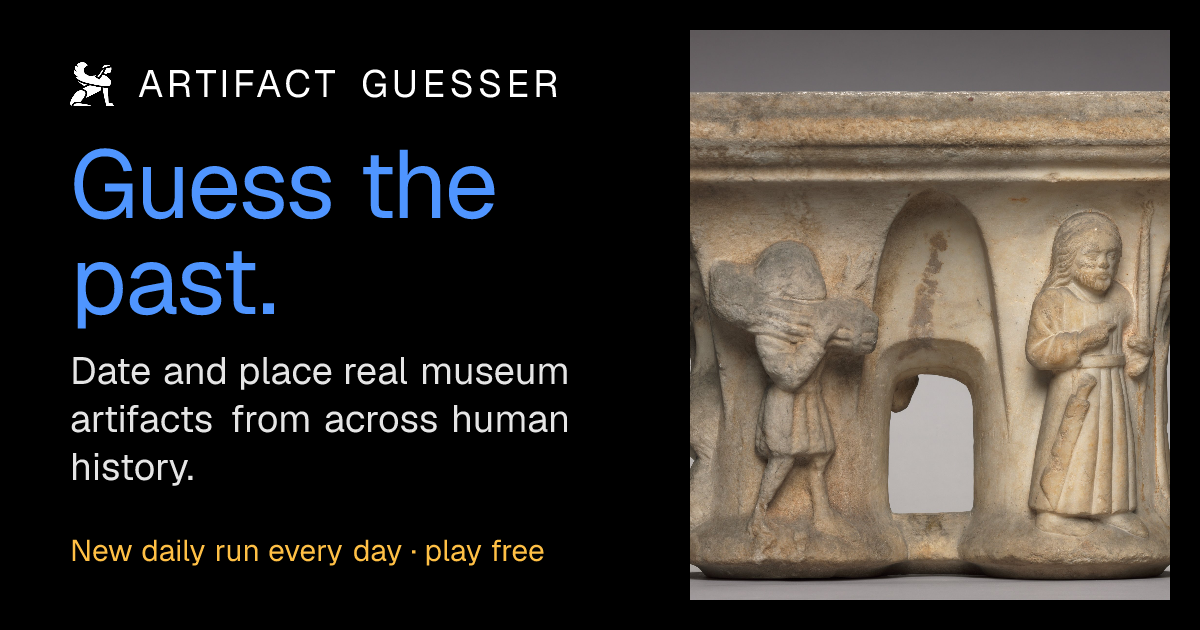
Guess the date and origin of real museum artifacts. Over 230,000 of them from 10 museums. New daily run, play free.

No paid content found
Visit website
Profile views 1 Outbound visits 0 Normal
Artifact Guesser Full homepage screenshot

At a glance

Category
Games & Board Games
Language
English
Paid-content signal
No paid content foundObserved
Registered
2024
Hosting
VercelInferred
HTTPS certificate trusted
PassedObserved
Last updated

Website review

This review may include AI-generated content and is not individually verified. Domain, certificate and other facts come from the observed data on this page.

What is Artifact Guesser?

Artifact Guesser is a free browser game built around real museum objects. You are shown an artifact and asked to guess its date and place of origin; the site draws on a large pool of objects from ten museums and offers a new daily run alongside free play.

Who it suits

  • Casual history fans who want a short daily puzzle rather than a long reading session.
  • Teachers and museum educators looking for a low-prep way to get people thinking about how archaeologists and curators date and place objects.
  • Quiz and guessing-game players who enjoy deduction more than trivia recall, since the answer is a range and a region rather than a name.

What the guessing actually tests

The appeal is that you cannot simply know the answer; you have to reason from materials, decoration, shape and wear. A reader trying it for the first time might look at a ceramic vessel and work through glazes, firing marks and silhouette to narrow a century and a continent. That reasoning loop is the core of the experience, and it is why the game works better as a warm-up or discussion prompt than as a formal learning tool.

Practical trade-offs

The daily format gives a shared puzzle to compare with friends, but it limits how much you can practise in one sitting. Free play with a very large object pool solves that, at the cost of less curation: expect wide swings in difficulty and subject matter. If you want structured context after guessing, pair the game with museum collections such as The British Museum or The Met, where object records explain dating and provenance in depth.

Next step: play one daily run, then note which clues you actually used. That short list of cues is a practical checklist for your next visit to a museum gallery.

How do I play a daily run in Artifact Guesser?

Open Artifact Guesser and start the daily run from the page's main play prompt. Each run asks you to guess the date and origin of a real museum artifact drawn from the site's collection of more than 230,000 objects from 10 museums. A daily run is a fixed set for that day, so it is the same challenge for everyone who plays it.

How a run works in practice

  • You are shown an artifact and estimate its date and where it comes from.
  • Submit your guess, then compare it with the actual date and origin.
  • Work through the day's artifacts; the site describes a new run each day, so returning players get a fresh set.

A reader scenario

Suppose you have five minutes over coffee. You open the site, start the daily run, and treat each artifact as a small deduction: the material and style narrow the period, the form and decoration narrow the region. After submitting, the reveal tells you how close you were, which is where most of the learning happens.

Decision criteria

  • Choose the daily run if you want a bounded, comparable challenge you can finish in one sitting.
  • Play casually if you mainly want to browse artifacts; the daily format rewards attention to detail more than speed.
  • If you enjoy the format, note that the collection is large, so the daily set is only a small sample of what the site draws from.

Next step: after your first run, look back at the artifacts you missed and note one visual clue (material, motif, or shape) that would have pointed you to the right period or region.

Which museums and artifact collections are included in Artifact Guesser?

The available page information does not list the individual museums or collections behind Artifact Guesser. It states only that the game draws on over 230,000 artifacts from 10 museums, without naming them. To see which institutions are represented, the most direct step is to open Artifact Guesser and check its about or collection pages, or look at the source credited on an individual artifact after a round.

For context, major museum collections that publish open artifact data—such as The Metropolitan Museum of Art or Smithsonian Institution—are the kind of source a guessing game of this scale would typically rely on, but that is general reasoning, not a confirmed feature of this product.

How is scoring or accuracy judged when I guess an artifact's date and origin?

The site doesn't publish its scoring rules in the information available here, so the exact formula for how your date and origin guesses are graded isn't something I can confirm. What the site does describe is the core loop: you guess the date and origin of real museum artifacts, drawn from a large collection spanning multiple museums, with a new daily run. That tells you what's being tested—your read on an object's period and place of origin—but not how close a guess must be to count as correct, or whether date accuracy is scored on a sliding scale versus a fixed target.

What to expect from this kind of guessing game

Date-and-origin quizzes usually grade in one of two ways, and the difference matters for how you play:

Grading style How it feels How you'd adjust
Exact or near-exact match Harsh; rewards deep knowledge of specific periods and regions Commit to a precise answer only when you're confident
Proximity-based (closer = more credit) Forgiving; rewards rough chronological and geographic instincts Aim for the right century and region rather than a pinpoint answer

If the site uses proximity scoring, a guess that's off by a century or a neighboring region may still earn partial credit; if it demands exact matches, hedging rarely helps. You can infer which system is in play within a few rounds by watching how your score responds to near-misses versus wild guesses.

A practical next step

Play one daily run and deliberately test the boundary: make one guess you know is close (say, the right region but a century off) and one that's clearly wrong. Compare the feedback. That single experiment tells you more about the scoring than any description, and it shapes whether you should guess boldly or conservatively in future runs. For background on the kinds of objects you'll encounter, museum collection sites such as The Metropolitan Museum of Art are useful for browsing artifacts by period and region before you play.

Is Artifact Guesser free to play, and do I need an account?

Yes—Artifact Guesser is free to play, and the site's description does not mention requiring an account. You can start a daily run without a signup step, based on the information provided.

What that means in practice

  • Cost: Free to play.
  • Account: No account requirement is stated. The described experience is a daily run of guessing artifact dates and origins.
  • Content: The pool is described as over 230,000 artifacts from 10 museums, with a new daily run.

A useful next step

Open Artifact Guesser and begin the daily run. If you later want to track streaks or compare results with friends, check whether the site offers any optional account or profile features—but nothing in the supplied description suggests one is needed to play.

Can teachers or group hosts use Artifact Guesser for a classroom or quiz activity?

Yes. Artifact Guesser suits a classroom or quiz activity because the core task—guessing the date and origin of real museum artifacts—works as a short, repeatable round that a group can play together. The site describes a pool of over 230,000 artifacts from 10 museums and a new daily run, which gives hosts plenty of material to build several rounds without repeating objects.

Practical ways to run it

  • Single-screen quiz: Project one artifact and have teams write down a date range and origin, then reveal and score. This keeps the whole class engaged with the same object.
  • Warm-up or bell-ringer: Use one artifact at the start of a history, art or archaeology lesson to prompt inference about materials, style and period.
  • Team competition: Assign points for closeness of the date guess and correctness of origin, which rewards reasoning rather than lucky guesses.
  • Discussion prompt: Ask students to justify their estimate from visual clues before the answer is shown.

Who it fits

It works best for middle school through university history, art history and social studies classes, plus museum education and trivia nights. Younger students may need scaffolding on chronology and geography, since guessing a date and origin assumes some background knowledge.

Trade-offs to plan for

The format is guessing-based, so it tests inference and recall rather than deep analysis on its own. Hosts should add a short explanation step—why the object looks Roman, medieval or modern—to turn each round into learning. Group scoring also needs a clear rule for how close a date must be to count.

A useful next step is to run one artifact as a trial round with your group, note how long discussion takes, and then decide how many artifacts fit your session length.

Related questions

More questions →
What the Daily Run and 230,000+ Artifact Collection Mean in Artifact Guesser

Artifact Guesser is a browser game where you guess the date and origin of real museum artifacts. The daily run gives you a fresh challenge each day, and the collection of over 230,000 artifacts from 10 museums is the pool that keeps that daily challenge varied over time. Together they mean you get a new puzzle on a regular cadence, drawn from a very large, real-world source rather than a small hand-written set of questions.

What the daily run means

The site describes a "new daily run" alongside free play. In practice, that signals two things:

  • A recurring reason to return. Each day brings a different set of artifacts to judge, so the game isn't a one-time quiz you exhaust in a sitting.
  • A shared challenge. Because everyone gets the same daily run, you can compare results with other players on the same artifacts.

The site does not specify how many artifacts a single daily run contains, whether runs are timed, or how scoring works. Treat those as details to confirm in-game rather than assumptions.

What 230,000+ artifacts from 10 museums means

The collection size is the more consequential number. It tells you:

Signal What it implies for you
230,000+ artifacts The pool is large enough that repeat play is unlikely to feel repetitive soon
10 museums Artifacts are real and sourced from multiple institutions, so variety spans different cultures and periods
Real museum objects You're practicing actual dating and provenance reasoning, not trivia recall

The 10-museum figure matters because a single collection would skew toward one region or era. Multiple museums broaden the range of dates and origins you'll encounter, which is the core skill the game tests.

How the two features work together

The daily run is the hook; the collection is the fuel. A small question bank would make a daily format stale within weeks. With 230,000+ artifacts, the daily run can keep drawing different objects, and free play can go on far longer than any single session. The site does not state how artifacts are selected for a given run or whether repeats are avoided, so don't assume a guaranteed no-repeat rule.

What to expect when you start

  1. Open artifactguesser.com in a browser.
  2. Choose the daily run for a fresh challenge, or free play to keep going.
  3. For each artifact, submit your guess for its date and origin.
  4. Compare your answer against the artifact's actual details.

The expected result is a short reasoning loop per artifact: look, estimate the period and place, commit, then learn the real answer. That feedback loop is where the value sits, especially with real museum objects behind each guess.

Common sticking points

  • Don't expect a fixed round count. The site doesn't publish how many artifacts a run includes.
  • Pricing isn't stated. The description says "play free," but no pricing page or payment details are provided, so confirm any limits in the game itself.
  • Guessing strategy matters more than memorization. With hundreds of thousands of objects, you can't memorize answers; you reason from style, material, and context.

If you want a repeatable daily reasoning exercise built on genuine museum collections, the daily run plus the 230,000+ artifact pool is the reason to try it. If you need published rules on rounds, timing, or scoring before committing, check those inside the game first.

Where Do the Artifacts in Artifact Guesser Come From?

The artifacts in Artifact Guesser are real museum objects, not invented or AI-generated items. The site describes its pool as over 230,000 artifacts drawn from 10 museums, and each round asks you to guess an object's date and origin. The exact museum list isn't published in the material available, so treat "10 museums" as the stated scope rather than a confirmed roster.

What "real museum artifacts" means in practice

Because the objects come from museum collections, you should expect the same kinds of things you'd see in an online collection database:

  • Everyday and ceremonial objects — pottery, tools, jewelry, textiles, sculpture, and similar holdings.
  • Catalog-style metadata — each object has an associated date range and place of origin, which is what the game turns into a question.
  • Uneven difficulty — famous object types are easier to place; plain or widely traded goods are harder, since similar forms appear across many cultures and centuries.

The game's premise only works if the answers are verifiable, so the date and origin you're guessing against are the museum's own attributions rather than the site's guesses.

A concrete example

Suppose a round shows a small painted ceramic vessel. A reasonable play is to reason from material and decoration: painted pottery with geometric bands narrows the region and period considerably, while an undecorated coarse-ware jar could plausibly come from many places. The correct answer is whatever the source museum recorded for that object — which is why the game rewards familiarity with collection types, not just general history.

How to check an artifact's source

The site's own description is the primary claim: 10 museums, 230,000+ objects, a new daily run, and free play. If you want to confirm a specific object, the practical route is to match its description against public museum collection databases, which publish the same date and origin fields. That lets you verify an answer independently instead of taking the game's word for it.

What isn't confirmed

  • The museum names — not listed in the available material, so don't assume a particular institution is included.
  • Whether every object links back to its catalog record — unverified.
  • Pricing beyond "play free" — the description says free play; no other pricing details are given.

Who this matters for

If you're playing to learn, the museum origin is the point: every guess is a small exercise in reading material, style, and chronology against real catalog data. If you're using the game with students, the 230,000-object pool and daily format make it a low-prep way to practice sourcing skills — with the caveat that you should confirm specific objects against museum databases before treating any answer as authoritative.

How Do You Play Artifact Guesser?

Artifact Guesser is a browser game in which you are shown a real museum artifact and have to guess two things about it: when it was made (its date) and where it came from (its origin). The site describes a pool of over 230,000 artifacts drawn from 10 museums, a new daily run, and free play. You don't need an account or any setup to start — open the site and begin a run.

What a Round Asks You to Do

Each round presents one artifact from a real museum collection. Your job is to read the object and commit to two guesses:

Guess What you're deciding What to look for
Date The period or year the artifact was made Material, technique, style, wear, and any visible markings
Origin The place or culture it came from Form, decoration, raw material, and craft tradition

The artifact is the only evidence you get, so the game rewards careful looking rather than prior knowledge of the specific object.

Step-by-Step: Playing a Run

  1. Open artifactguesser.com. The site loads directly into play; there is no described sign-up step.
  2. Start a run. You can join the daily run or play a free session, depending on which mode you pick on the page.
  3. Examine the artifact. Look at the image before guessing. Note the material (stone, metal, ceramic, textile), how it was made, and any surface detail.
  4. Enter your date guess. Decide the era or year range you think fits the object.
  5. Enter your origin guess. Decide the region or culture you associate with it.
  6. Submit and compare. The game reveals the actual date and origin so you can see how close you were.
  7. Continue through the run. Repeat for the remaining artifacts, then start a new run or return for the next daily one.

Expected result: after each submission you get a direct comparison between your guess and the artifact's real date and origin, which is the feedback loop the game is built on.

How to Make Better Guesses

  • Start with material. Stone, bronze, ceramic, and textile each point toward different production traditions and periods.
  • Use technique as a clock. Hand-built vs. wheel-thrown pottery, casting vs. hammering in metal, and similar distinctions narrow the date range.
  • Treat decoration as a map. Motifs, scripts, and patterns often cluster in specific regions.
  • Guess in ranges, not single years. A period-level guess is usually more defensible than an exact year when you're working from an image alone.
  • Learn from the reveal. The comparison after each guess is the main teaching tool; note which cues misled you and adjust.

Common Stumbling Points

  • Guessing origin from the museum, not the object. The artifact's origin is about where it was made, which isn't necessarily where it's now held.
  • Overweighting one detail. A single motif can appear across several cultures; combine several cues before committing.
  • Ignoring scale and wear. Condition and size often separate a modern reproduction-style look from an ancient original.
  • Rushing the daily run. Since the daily run is a single set, slow looking matters more than speed.

Modes and Access

The site lists two ways to play: a new daily run and free play. The available material does not describe pricing, accounts, or login requirements, so treat access details as something to confirm on the site itself rather than assume.

If you want a low-pressure way to build visual literacy about museum objects, start with free play to learn the feedback format, then use the daily run as a recurring short session.

What Is Artifact Guesser?

Artifact Guesser is a free browser game in which you guess the date and origin of real museum artifacts. Its pool draws on more than 230,000 objects from 10 museums, and it offers a new daily run. It suits anyone who wants a short, repeatable history or archaeology challenge built on genuine collection data rather than invented trivia.

How the Game Works

Each round presents an artifact and asks you to place it in time and geography. You commit to a date and an origin, then see how close you were. The appeal is the same as any estimation game: you reason from material, style, and shape before the answer is revealed.

A typical loop looks like this:

  1. An artifact appears with an image and whatever context the game provides.
  2. You enter your guess for its date and its origin.
  3. The game shows the actual date and origin, plus how far off you were.
  4. You move to the next artifact and try to improve.

Because the artifacts are real museum objects, the feedback teaches something concrete. A wrong guess about a vessel's date usually points to a specific misread cue — a decoration style, a production technique, a regional form.

What You Can Expect to Learn

  • Chronology sense: repeated guessing sharpens your feel for which materials and styles belong to which centuries.
  • Geographic patterns: you start recognizing regional traditions and trade influences.
  • Museum literacy: you encounter objects from collections you might never browse on your own.

The Daily Run and Replayability

The site advertises a new daily run, which gives the game a shared rhythm: one fresh set of artifacts per day. That structure works well for a five-minute habit and for comparing results with other players.

The larger catalog — over 230,000 artifacts across 10 museums — is what keeps the game from running dry. Even if the daily set is fixed, the underlying pool is large enough that repeated play keeps surfacing unfamiliar objects.

Who It Is For

If you are… Artifact Guesser offers…
A history or archaeology enthusiast A low-stakes way to test and sharpen existing knowledge
A teacher or student A concrete, image-based exercise in dating and provenance
A casual player A short daily challenge with immediate feedback
A museum fan Exposure to objects from 10 different collections

It is less suited to someone wanting deep catalog records or scholarly provenance data; the game frames artifacts as guessing prompts, not as research entries.

Practical Notes Before You Start

  • No account details are specified in the available information. The site describes the game as free to play, but nothing in the provided material confirms whether login, saves, or progress tracking exist.
  • Expect estimation, not exact recall. Guessing a precise year is unrealistic; the useful skill is narrowing a range and a region.
  • Play the daily run first. It gives you a bounded session and a natural stopping point.

If you want to try it, open artifactguesser.com and start a run; the first few artifacts will tell you quickly whether the guessing format fits how you like to learn.

Is Artifact Guesser Free to Play?

Artifact Guesser is described on its own site as free to play: the site says you can "play free" while guessing the date and origin of real museum artifacts. The available site information lists no prices, no payment platforms, and no pricing links, so there is no stated cost to play. The same information does not mention account creation or sign-up requirements, so registration should not be assumed either way.

What the site says about cost

The site's own description is the clearest signal:

  • It says you can "Guess the date and origin of real museum artifacts."
  • It says there is a "New daily run" and that you can "play free."
  • It cites over 230,000 artifacts from 10 museums.

That wording points to a free daily game rather than a paid product. Because no price list or checkout option appears in the available material, there is nothing to suggest a paid tier, subscription, or one-time purchase.

What is not confirmed

A few details are simply not covered by the site information, so treat them as open rather than settled:

Question What the available information shows
Does it cost money? Site says "play free"; no prices or payment methods listed
Is an account required? Not stated; no sign-up or login details provided
Are there ads or limits? Not stated
Is there a paid version? No pricing or payment signals found

If you want certainty on accounts or limits before playing, open the site and start a run — the first screen will show whether it asks you to sign up or pay.

How to check for yourself in under a minute

  1. Open artifactguesser.com in a browser.
  2. Look for a "Play" or "Start" button on the landing page.
  3. Start the daily run and see whether it asks for an email, login, or payment.
  4. If a prompt appears, read it before entering anything.

Expected result: if the game starts without a paywall or sign-up form, it is free to play as described. If a form appears, that is the site's actual requirement, which the summary above does not cover.

Common sticking points

  • Confusing "free" with "no account": the site says free to play, but free and registration-free are different claims. Only the first is supported here.
  • Assuming a mobile app: the description refers to the website; no app store listing or download requirement is mentioned.
  • Expecting unlimited play: the site highlights a "new daily run," which suggests a daily format. Whether you can play more than once a day is not stated.

For a quick answer: yes, Artifact Guesser is presented as free to play, and nothing in the available site information indicates a price or payment step. Whether you need an account is the one detail worth confirming on the site itself before you start.

Website Overview

Page metadata, canonical configuration and social previews work together to provide more consistent search and sharing presentation. An active inbound-mail setup with incomplete authentication may leave the domain more open to impersonation. Provider hosting alone does not close that gap.

Domain and Registration

Transfer-protection status is present, helping reduce the risk of unauthorized domain transfers. The domain has about 2 years of registration history; its current configuration provides more context than age alone. The registrar is NameCheap, Inc., a widely used domain service provider. The domain uses the common .com extension, which is not an independent safety signal.

DNS and Email

The observed email authentication setup is incomplete: DMARC is missing. Nameservers are provided by Namecheap, indicating managed DNS hosting. MX records point to the registrar-servers.com email service. No CNAME was found; the observed records resolve directly to addresses. TXT records include verification markers for Google. Such markers may also remain after a service stops being used.

TLS and Certificates

The certificate uses an RSA 2048-bit public key, offering broad client compatibility. The server supplied a complete certificate chain. No organization name is present in the certificate; the available fields are consistent with domain validation. The certificate was issued by Let's Encrypt, commonly associated with automated certificate services. The certificate's total validity is about 89 days, consistent with a short renewal cycle.

HTTP and Browser Security

X-Powered-By exposes backend information: Next.js. The response lacks these common security headers: CSP, X-Content-Type-Options, Referrer-Policy, Permissions-Policy, clickjacking protection. No obvious internal addresses or debug information were found in the headers. The Server header contains the custom value Vercel. No explicit CDN or WAF marker was found in the response headers.

Technology Stack Analysis

The public page identifies Next.js, Vercel without precise versions, leaving fewer clues for version-specific scanning.

Search and Social Sharing

Twitter Card metadata is configured. JSON-LD includes Product or Offer data, potentially supporting eligible product search features. The title has 16 characters, within a common display range. A meta description is present, with 115 characters. The observed directives allow indexing and link following.

Hosting and Email

DNSNamecheap
HostingVercel
Emailregistrar-servers.com
Approximate IP geolocation (inferred; a CDN or proxy may differ from the origin server) United States flagWalnut, California, United States Inferred 76.76.21.21

Registration details

RDAP / WHOIS

RegistrarNameCheap, Inc.
Registered2024-05-20
Expires2027-05-20
Domain statusclient transfer prohibited
Nameserversdns1.registrar-servers.com、dns2.registrar-servers.com
DNSSECunsigned

DNS records

DNS

TypeNameValueTTLPriority
Aartifactguesser.com76.76.21.211799—
MXartifactguesser.comeforward1.registrar-servers.com180010
MXartifactguesser.comeforward2.registrar-servers.com180010
MXartifactguesser.comeforward3.registrar-servers.com180010
MXartifactguesser.comeforward4.registrar-servers.com180015
MXartifactguesser.comeforward5.registrar-servers.com180020
NSartifactguesser.comdns1.registrar-servers.com1800—
NSartifactguesser.comdns2.registrar-servers.com1800—
TXTartifactguesser.comgoogle-site-verification=UvhCWlSE4Jw-ZckkNo78i_vzjgmo3sBRwS1yCbthmGU1799—
TXTartifactguesser.comv=spf1 include:spf.efwd.registrar-servers.com ~all1799—

TLS and certificates

TLS / SSL

AssessmentNormal configuration
Supported protocolsTLSv1.2、TLSv1.3
Negotiated protocolTLSv1.3
Certificate subjectartifactguesser.com
IssuerLet's Encrypt
Valid until2027-01-09T11:25 · Remaining when checked: 74 days
Verification detailsCertificate trust: Passed · Hostname match: Passed

HTTP response headers

HTTP

HeaderValue
content-typetext/html; charset=utf-8
cache-controlprivate, no-cache, no-store, max-age=0, must-revalidate
serverVercel
strict-transport-securitymax-age=63072000

Identified technologies

Next.jsVercel

Pages, Search and Sharing

Meta descriptionGuess the date and origin of real museum artifacts. Over 230,000 of them from 10 museums. New daily run, play free.
Canonical URLhttps://artifactguesser.com/
LanguageEnglish (default)
Twitter Cardsummary_large_image
All bots 1 allowed · 9 disallowed
  • Allow/
  • Disallow/api/
  • Disallow/dashboard
  • Disallow/dashboard/
  • Disallow/accounts/
  • Disallow/favorites
  • Disallow/games/
  • Disallow/confirm
  • Disallow/auth
  • Disallow/experiments

User reviews (0)

  • No reviews yet.