
 简体中文
简体中文 English
Website review
This review may include AI-generated content and is not individually verified. Domain, certificate and other facts come from the observed data on this page.
What is broadn?
broadn is an AI tool for manufacturing sales operations that turns inbound emails and contact-form requests into quotes and orders. It reads unstructured RFQs (requests for quote) and sales orders, then produces clean outputs: draft quotes sent to your CRM and structured orders sent to your ERP.
What it does
- Instant quoting: Builds draft quotes from live pricing and product logic.
- Rule-based discounts: Applies discount rules and approval steps automatically.
- Product configuration: Handles complex bundles and custom RFQs.
- Margin control: Shows margin visibility while quoting.
- Order entry to ERP: Parses POs, validates line items, and sends structured orders onward.
- Inbox-to-system sync: Connects email, CRM, and ERP so data does not need copy-pasting.
broadn's page also mentions Agent Herbie, an AI agent aimed at secure or air-gapped environments, meaning it can work offline.
Who it is for
U.S. manufacturers whose sales teams sell through email and contact forms, especially those handling BOMs, custom configurations, and high volumes of RFQs. It is less relevant if your quoting is already fully structured or you do not use a CRM/ERP.
How it fits alongside other tools
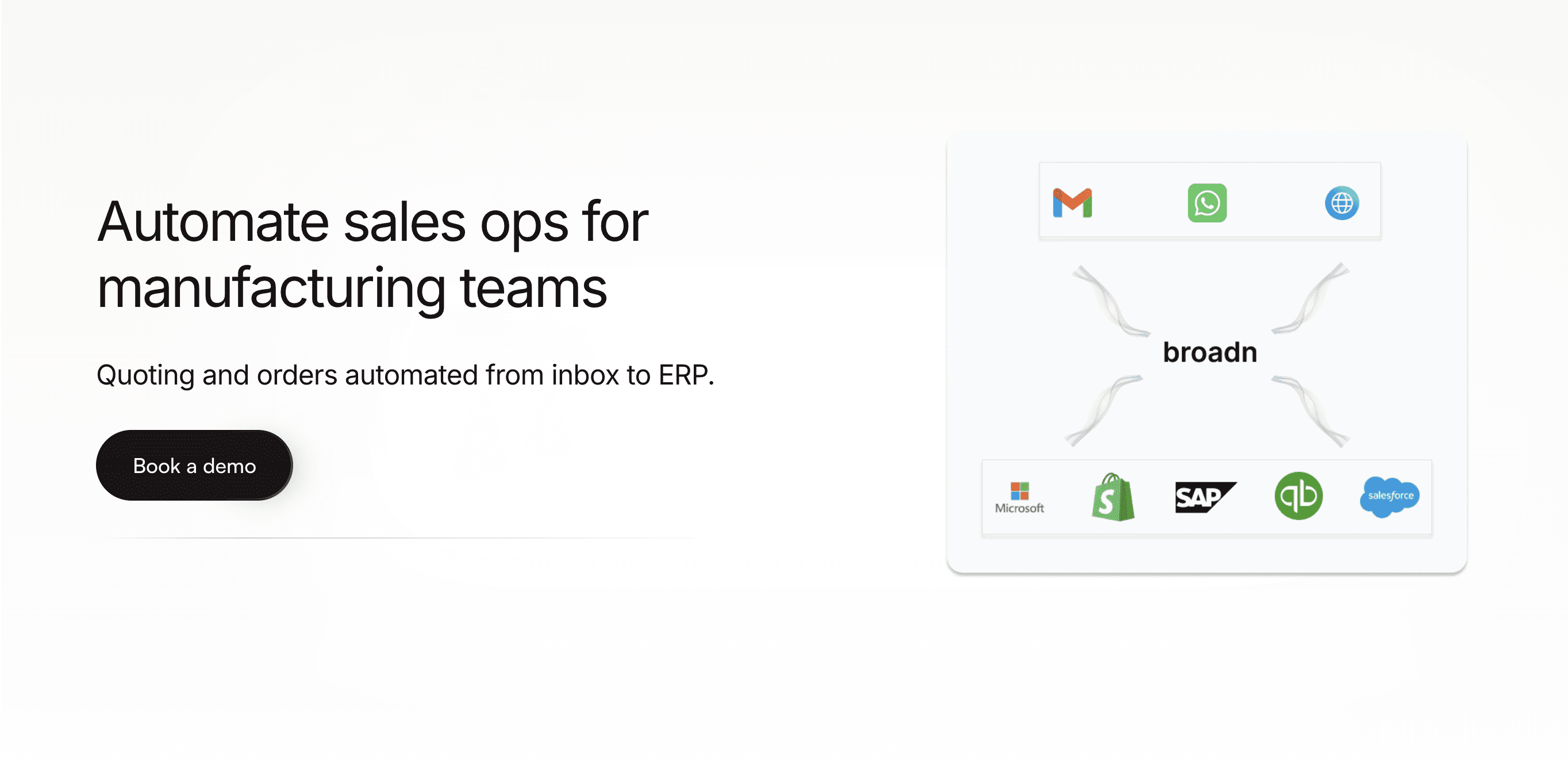
broadn connects with platforms such as Shopify, SAP, Microsoft, Quickbooks, and Salesforce. If you already run one of those systems, broadn sits between the inbox and the system of record rather than replacing it. For broader CRM context, see Salesforce or SAP.
A practical next step: pick one recurring RFQ type you handle manually, such as a configured bundle with a standard discount, and ask for a demo using that exact example. If broadn produces a correct draft quote and ERP-ready order for that case, you have a clear signal it fits your workflow.
How does broadn turn email RFQs into quotes and ERP orders?
Broadn is built for manufacturers that receive quote requests and purchase orders as free-form email rather than through a structured portal. It reads those messages, extracts the product, quantity and configuration details, and produces a quote or a structured order that flows into the systems you already run.
The email-to-quote path
The page describes an AI agent that reads inbound requests, builds quotes and replies to customers. Three pieces do the visible work:
- Request parsing. Unstructured RFQs and sales orders are turned into clean, structured data — product, quantity, options, customer.
- Instant quoting. Draft quotes are generated using live pricing and product logic, so the number reflects current data rather than a rep's memory.
- Product configuration. Complex bundles are handled, which matters when a customer asks for a configured assembly rather than a catalogue item.
Discounts are applied through rules and approvals rather than ad hoc negotiation, and margin visibility is exposed at the quoting stage. That combination is what separates this from a generic email summariser: the output is a priced document with commercial guardrails attached.
The quote-to-order path
Once a quote becomes a purchase order, the same parsing logic is applied to the PO. Line items are validated, and the structured order is sent to the ERP. Because the inbox, CRM and ERP are connected, the same data is not retyped at each step — the page's framing is "no copy-paste" and "no manual errors."
Broadn states it connects with existing platforms including Shopify, SAP, Microsoft, QuickBooks and Salesforce. If your stack is outside that list, integration effort is the first thing to test in a demo.
Where the human stays
The agent escalates when it hits an edge case; the page positions human involvement as the exception rather than the default. In practice, the useful question is not whether the agent can quote, but which requests it should refuse to quote. Non-standard terms, credit holds, expedited shipping and one-off engineering changes are the usual candidates for escalation, and you want those rules explicit before go-live.
A scenario worth testing
Take a week of real RFQ emails — including the messy ones with a signature block, a forwarded thread and a PDF attachment — and run them through. Measure two things: how many became accurate draft quotes without editing, and how many were routed to a person for the right reason. A tool that quotes the easy 60% and silently mis-quotes the rest is worse than no automation.
Deciding whether it fits
| Your situation | Likely fit |
|---|---|
| High volume of similar, catalogue-based RFQs | Strong — rules and live pricing do the heavy lifting |
| Configured products with option dependencies | Worth testing — product configuration is a stated capability |
| Orders arriving as PDFs and email threads | Core use case |
| Heavily negotiated, non-standard contracts | Expect escalation to dominate |
| ERP outside the listed connectors | Verify integration before committing |
For a next step, ask for a demo using your own redacted RFQ emails rather than a prepared dataset, and ask specifically how discount approval thresholds and escalation triggers are configured. Those two settings determine whether the agent behaves like a junior estimator or an unsupervised one.
For context on the wider category, SAP and Salesforce document how CPQ and order data are meant to move between CRM and ERP, which is useful for judging whether a connector is doing real work or just moving fields.
Which ERPs and CRMs does broadn integrate with?
Broadn's site names five systems it connects with: Shopify, SAP, Microsoft, QuickBooks and Salesforce. Of these, SAP, Microsoft (typically Dynamics) and QuickBooks are the ERP-side connections, while Salesforce is the CRM and Shopify covers ecommerce orders. The stated flow is that quotes are pushed to your CRM and structured orders are sent to your ERP, so the integration is what turns an email RFQ into a record in the systems your team already uses.
What that means in practice
- CRM side: a draft quote or reply lands against the right customer record in Salesforce, so sales sees the thread and the quote in one place instead of copying from an inbox.
- ERP side: parsed purchase orders and validated line items arrive as structured orders in SAP, Microsoft or QuickBooks, which is where the "no manual errors, no copy-paste" claim matters most.
- Ecommerce side: Shopify matters if some inbound demand arrives as online orders rather than email.
How to check fit before a demo
The list is short and skews toward large, well-known platforms. If you run a mid-market or niche ERP, treat compatibility as the first question to settle, not an afterthought. Ask three things:
- Which of these connectors is native versus built per customer?
- What does the ERP write-back cover — header only, or line items, pricing and discounts?
- Who owns the mapping when your product or pricing structure changes?
A useful comparison for a manufacturer deciding where to start:
| Your setup | Most relevant connection | Why |
|---|---|---|
| Email RFQs, Salesforce pipeline | CRM-first | Quotes appear where reps already work |
| SAP or Dynamics as system of record | ERP-first | Order accuracy is the main gain |
| Small finance-led stack | QuickBooks | Order entry without retyping |
| Mixed online and email demand | Shopify plus CRM | Both channels feed one quote flow |
For context on the platforms named, see SAP, Salesforce, QuickBooks and Shopify.
How does broadn handle complex product configurations and bundle pricing?
Broadn handles complex configurations by generating quotes for bundles rather than treating each line item as a standalone product. Its page describes "product configuration" as generating accurate quotes for complex bundles, with pricing drawn from live pricing and product logic rather than a static price list. Discounts are then layered on through rule-based logic, and margin visibility is shown on the quote so a rep can see whether a configured bundle still meets targets before sending it.
What that means in practice
- Configuration drives the price. The bundle structure and options determine the price, so a customer asking for a modified or non-standard combination gets a quote built from product logic instead of a manual spreadsheet.
- Discounts follow rules. Rule-based discounts and approvals are applied automatically, which matters most on configured deals where ad hoc discounting tends to erode margin.
- Margin is visible at quote time. Margin control is presented as part of quoting, not a post-deal report, so exceptions surface before the quote goes out.
- Escalation is built in. The agent handles routine requests and escalates edge cases to a person, which is where unusual configurations or approval thresholds should land.
Where it fits
This is aimed at U.S. manufacturers whose sales run through email and contact forms, including BOMs and custom RFQs. If your team sells standard catalog items, configuration logic adds little. If you sell engineered-to-order or bundled products, the value is in keeping configuration, discount rules and margin in one quoting step instead of three.
A practical next step: pick three recent RFQs that required manual rework — a custom bundle, a discount exception, and a margin question — and ask for a demo walking through those exact cases. The output should land in your CRM, with orders parsed into your ERP, since Broadn states it connects with platforms such as Shopify, SAP, Microsoft, QuickBooks and Salesforce.
What is Agent Herbie and when do you need an offline, air-gapped AI agent?
Agent Herbie is broadn's AI agent for mission-critical work that has to run in secure or air-gapped environments—meaning it operates without a live internet connection. It's aimed at teams that want the same kind of inbox-to-quote automation broadn provides, but where data can't leave a controlled network. You'd consider an offline agent like this when your RFQs, pricing logic, or order data are too sensitive for cloud tools, or when policy, contract, or facility rules prohibit sending them outside your environment.
When an air-gapped agent makes sense
- Defense, aerospace, or regulated manufacturing where inbound inquiries and BOMs can't touch external servers.
- Plants or sites with no reliable internet, or where connectivity is deliberately restricted.
- Contractual or compliance requirements that mandate data residency on-premises.
- High-value, low-volume quoting where a single misrouted RFQ or leaked price list is costly.
What to weigh
| Factor | Cloud agent | Air-gapped agent |
|---|---|---|
| Data exposure | Data leaves your network | Stays inside your environment |
| Updates & models | Continuous, vendor-managed | Manual or delayed updates |
| Setup effort | Fast, low IT burden | Heavier IT and infrastructure work |
| Best fit | Standard sales ops | Regulated or disconnected sites |
The trade-off is clear: air-gapped deployment buys you control and compliance at the cost of convenience and easier maintenance.
A practical next step
Map which inbound channels carry your most sensitive RFQs—email attachments, contact forms, EDI—and check whether those are already barred from third-party tools. If even one is, an offline agent is worth evaluating. For comparison, broadn's cloud automation is described at broadn, and general ERP and CRM integrations like SAP, Salesforce, and Microsoft appear in its platform list. If your stack is Microsoft-centric, Microsoft documents its own on-premises and compliance options; if you use Salesforce, Salesforce outlines its data-residency controls.
How does broadn apply discount rules, approvals, and margin controls automatically?
Broadn applies discount rules, approvals, and margin controls as part of turning an inbound RFQ into a draft quote, using live pricing and product logic rather than a rep rebuilding the quote by hand. The site describes three connected steps: rule-based discounts, product configuration for complex bundles, and margin control with full margin visibility. It also says the agent escalates when an edge case needs human input, so approval is not bypassed—it is triggered by the rule set.
What is automated, and what stays human
| Area | What Broadn automates | Where a person still matters |
|---|---|---|
| Discounts | Applies discount rules automatically | Sets the rules and thresholds in the first place |
| Approvals | Routes or applies approval logic automatically | Decides genuine exceptions and edge cases |
| Margins | Shows margin on the quote as it is built | Chooses the floor and target margin policy |
| Configuration | Builds quotes for complex bundles from product logic | Confirms unusual or non-standard configurations |
The practical benefit is consistency: every quote follows the same discount and margin policy, and the rep sees margin before the quote goes out instead of discovering a problem after the order lands. The trade-off is that automation is only as good as the rules behind it—if discount tiers or approval thresholds are vague, the agent will faithfully reproduce that vagueness.
A useful next step is to write down your current discount matrix and approval thresholds, then test them against a handful of real RFQs, including one messy bundle and one margin-sensitive deal, before relying on the agent for live quotes.
 Cloudflare
 Google Workspace
 Amsterdam, North Holland, The Netherlands

User reviews (0)