
 colorui.io
No paid content found
colorui.io
No paid content found
 Multilingual
Categories: Color Tools Design & Creativity
40+ free color tools: palette generator, color picker, paint schemes, contrast checkers, color blind simulators, gradients, and craft ideas.
 Visit website
 Updated: 2026-09-24 20:57
Language: English (default)
Updated: 2026-09-24 20:57
Language: English (default)
 Access: Normal
 Profile views 0
 Outbound visits 0
Related questions
More questions →What Is a Color Wheel and How Do You Use It to Pick Colors?
A color wheel is a circular diagram that arranges hues by their relationship to one another, so you can see at a glance which colors sit opposite, next to, or evenly spaced from a chosen base color. You use it by picking a starting hue, then following a fixed geometric pattern (opposite, adjacent, or triangular) to find partners that tend to look balanced together. This works for any design task where you need a palette that reads as intentional rather than random — a website, a poster, a brand mark, or a room. The method below assumes you can pick a base color and adjust its lightness and saturation; no special software is required, though a tool like Paletton (a color scheme designer built around the color wheel) automates the geometry.
The structure of the wheel
The standard wheel is built from three layers of hue:
- Primary colors — red, yellow, and blue. These sit roughly 120° apart and cannot be mixed from other hues.
- Secondary colors — green, orange, and purple. Each is made by mixing two primaries, so each sits halfway between its two parents.
- Tertiary colors — the six in-between hues such as yellow-green or blue-purple, made by mixing a primary with an adjacent secondary.
Positions matter more than names. Two colors are "related" when they sit close on the circle and "contrasting" when they sit far apart. That single fact drives every harmony below.
A note on the two common wheels
You will see both an RYB (red-yellow-blue) wheel, used in traditional art and design teaching, and an RGB/CMY wheel, used for screens and print. They place hues slightly differently. For picking palettes by eye, either works — just stay consistent within one project so your relationships don't shift.
The main harmony types
Each harmony is a geometric rule applied to the wheel. Pick your base color first, then apply the rule.
| Harmony | How to find it on the wheel | Character |
|---|---|---|
| Complementary | The color directly opposite (180°) | Maximum contrast, high energy; can feel harsh if used in equal amounts |
| Analogous | Two or three neighbors within about 30–60° | Calm, cohesive, low contrast |
| Triadic | Three colors evenly spaced (120° apart) | Vivid and balanced; needs one color to dominate |
| Split-complementary | A base plus the two colors adjacent to its opposite | Contrast with less tension than pure complementary |
| Tetradic (rectangle) | Two complementary pairs forming a rectangle | Rich but hard to balance; best with one dominant hue |
Choosing a base color and finding its partners
- Pick the base. Choose the hue that carries the message or matches existing brand/product color. This is your anchor; everything else is derived from it.
- Decide the role of contrast. If you need energy and focus (a call-to-action, a headline), lean complementary or split-complementary. If you need calm and unity (a background system, a body of text), lean analogous.
- Apply the geometry. Locate the base on the wheel and mark the partner positions for your chosen harmony. For a triadic scheme, for example, mark the two hues 120° to either side.
- Assign jobs, not equal weight. Give one color the dominant area (often the base), one a secondary supporting role, and one a small accent. Equal thirds rarely look good.
Turning a harmony into a usable palette
Raw hues are only the starting point. A palette becomes usable when you vary value (light/dark) and saturation (vivid/muted), and add tints (lighter, mixed with white) and shades (darker, mixed with black).
- Keep the harmony's hue relationships intact, but spread the colors across a light-to-dark range so you get background, surface, text, and accent tones from the same family.
- Mute the supporting colors slightly so the accent stands out. A fully saturated palette at every step competes with itself.
- Build a small set of steps per hue (for example, three tints and two shades) rather than many unrelated colors.
This is the step where a wheel-based tool saves time: Paletton lets you set a base color and switch harmony types while it generates the matching combinations, so you can compare options before committing.
Applying the palette and checking it works
Once you have candidate colors, test them against the actual job:
- Contrast: check text against its background. Low-contrast analogous palettes often fail for body text even when they look elegant as swatches.
- Balance: confirm one color clearly dominates. If all colors feel equal, the design reads as noisy.
- Context: view the palette on the real surface (screen, paper, wall) and at real size. Colors shift with surrounding light and with neighboring colors.
- Accessibility: if the design carries information (links, states, charts), don't rely on hue alone — pair color with shape, label, or position.
Common pitfalls
- Treating the wheel as a rulebook rather than a guide. Harmonies are starting points; the final palette is judged by how it performs in context.
- Using a complementary pair in equal amounts, which creates visual vibration. Let one dominate.
- Forgetting value and saturation. Two colors can be "harmonious" by hue and still be unusable if they're the same lightness.
- Mixing RYB and RGB logic mid-project, which shifts where "opposite" actually falls.
If you want to skip the manual geometry, Paletton's color wheel is built specifically for generating combinations that work together, and you can adjust the base and harmony until the palette fits your design.
Website Overview
Page metadata, canonical configuration and social previews work together to provide more consistent search and sharing presentation.
Domain and Registration
The domain was registered less than a year ago and has limited historical evidence to assess. Transfer-protection status is present, helping reduce the risk of unauthorized domain transfers. The domain uses the common .io extension, which is not an independent safety signal.
DNS and Email
Nameservers are provided by Cloudflare, indicating managed DNS hosting. MX records point to the Hostinger Email email service. No CNAME was found; the observed records resolve directly to addresses. SPF and DMARC are configured. DKIM status is unknown. DNSSEC signatures were not detected, so this additional DNS authenticity protection is not confirmed.
TLS and Certificates
The public key uses EC with 256 bits. The server supplied a complete certificate chain. No organization name is present in the certificate; the available fields are consistent with domain validation. The certificate was issued by Let's Encrypt, commonly associated with automated certificate services. The certificate's total validity is about 89 days, consistent with a short renewal cycle.
HTTP and Browser Security
No X-Powered-By header was found, reducing one common source of backend fingerprinting information. All six checked browser-security headers are present. Their effectiveness still depends on the policy values and application behavior. The cf-ray response header indicates a CDN or caching proxy in the delivery path. No obvious internal addresses or debug information were found in the headers. The Server header identifies cloudflare without an exact version.
Technology Stack Analysis
The public page identifies Next.js, Google Analytics, Cloudflare without precise versions, leaving fewer clues for version-specific scanning.
Search and Social Sharing
Open Graph is partially configured; og:type is missing. Twitter Card metadata is configured. JSON-LD includes Organization data, helping describe the organization as an entity. The page declares 8 language or regional alternatives using hreflang. The title has 61 characters, within a common display range.
 Hosting and Email
 Cloudflare
 Hosting
 Hostinger Email
 Location
 unknown
104.21.58.247
Location
Location unknown
104.21.58.247
 Pages, Search and Sharing
| Meta description | 40+ free color tools: palette generator, color picker, paint schemes, contrast checkers, color blind simulators, gradients, and craft ideas. |
|---|---|
| Canonical URL | https://colorui.io |
| Language | English (default) · Multilingual |
| Twitter Card | summary_large_image |
Social Sharing Preview
11 fields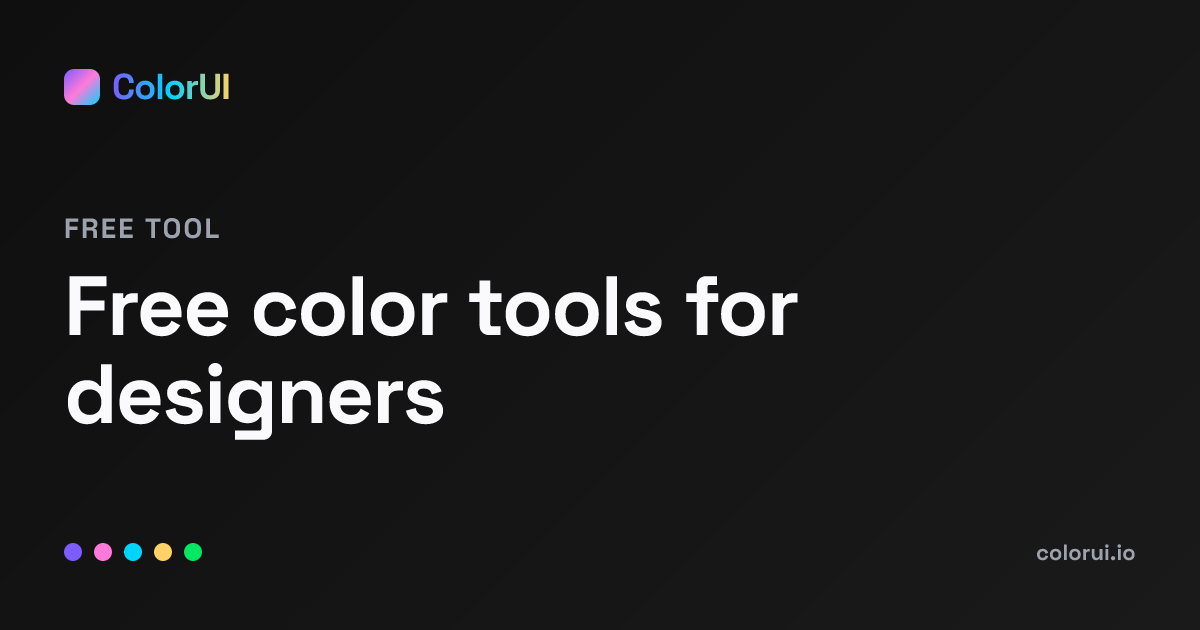

Sharing metadata
| og:url | https://colorui.io |
|---|---|
| og:image | https://colorui.io/api/og?type=tool&title=Free%20color%20tools%20for%20designers |
| og:title | ColorUI - Free Color Palette Generator & Paint Schemes Online |
| og:image:alt | ColorUI - Free color tools for designers |
| og:description | 40+ free color tools: palette generator, color picker, paint schemes, contrast checkers, color blind simulators, gradients, and craft ideas. |
| og:image:width | 1200 |
| og:image:height | 630 |
| twitter:card | summary_large_image |
| twitter:image | https://colorui.io/api/og?type=tool&title=Free%20color%20tools%20for%20designers |
| twitter:title | ColorUI - Free Color Palette Generator & Paint Schemes Online |
| twitter:description | 40+ free color tools: palette generator, color picker, paint schemes, contrast checkers, color blind simulators, gradients, and craft ideas. |
robots.txt (opens in a new tab)
28 rulesAll bots 3 allowed · 3 disallowed

 All bots

/api/og/api/v1//
/api//.well-known//*?
google-extended 2 allowed · 1 disallowed
//api/v1//.well-known/
claudebot 2 allowed · 1 disallowed
//api/v1//.well-known/
perplexitybot 2 allowed · 1 disallowed
//api/v1//.well-known/
gptbot 2 allowed · 1 disallowed
//api/v1//.well-known/
applebot-extended 2 allowed · 1 disallowed
//api/v1//.well-known/
bytespider 2 allowed · 2 disallowed
//api/v1//.well-known//
ccbot 0 allowed · 1 disallowed
/
diffbot 0 allowed · 1 disallowed
/
omgili 0 allowed · 1 disallowed
/
No matching rules.
Sitemaps
3 Registration details RDAP / WHOIS
| Registrar | HOSTINGER operations, UAB |
|---|---|
| Registered | 2026-04-28 |
| Expires | 2027-04-28 |
| Domain status | clientTransferProhibited https://icann.org/epp#clientTransferProhibited |
| Nameservers | burt.ns.cloudflare.com、june.ns.cloudflare.com |
| DNSSEC | unsigned |
 DNS records
| Type | Name | Value | TTL | Priority |
|---|---|---|---|---|
| A | colorui.io | 104.21.58.247 | 300 | — |
| A | colorui.io | 172.67.166.128 | 300 | — |
| AAAA | colorui.io | 2606:4700:3034::6815:3af7 | 300 | — |
| AAAA | colorui.io | 2606:4700:3035::ac43:a680 | 300 | — |
| MX | colorui.io | mx1.hostinger.com | 300 | 5 |
| MX | colorui.io | mx2.hostinger.com | 300 | 10 |
| NS | colorui.io | burt.ns.cloudflare.com | 86400 | — |
| NS | colorui.io | june.ns.cloudflare.com | 86400 | — |
| TXT | colorui.io | v=spf1 include:_spf.mail.hostinger.com ~all | 300 | — |
| DMARC | _dmarc.colorui.io | v=DMARC1; p=none; rua=mailto:[email protected] | 300 | — |
 TLS and certificates
| Assessment | Normal configuration |
|---|---|
| Supported protocols | TLSv1.2、TLSv1.3 |
| Negotiated protocol | TLSv1.3 |
| Certificate subject | colorui.io |
| Issuer | Let's Encrypt |
| Valid until | 2026-12-01T02:23 · Remaining when checked: 67 days |
| Verification details | Certificate trust: Passed · Hostname match: Passed |
 HTTP response headers
| Header | Value |
|---|---|
| content-type | text/html; charset=utf-8 |
| cache-control | private, no-cache, no-store, max-age=0, must-revalidate |
| server | cloudflare |
| strict-transport-security | max-age=63072000; includeSubDomains; preload |
| content-security-policy | default-src 'self'; script-src 'self' 'nonce-uwJ+3mOZtPna7I3kbAqQLw==' 'strict-dynamic' 'unsafe-inline' https://pagead2.googlesyndication.com https://*.googlesyndication.com https://www.googletagmanager.com https://*.googletagmanager.com https://www.google-analytics.com https://ssl.google-analytics.com https://*.analytics.google.com https://googleads.g.doubleclick.net https://cloud.umami.is https://www.clarity.ms https://mc.yandex.ru; style-src 'self' 'unsafe-inline' https://fonts.googleapis.com; img-src 'self' data: blob: https:; font-src 'self' data: https://fonts.gstatic.com; connect-src 'self' https://www.google-analytics.com https://*.google-analytics.com https://analytics.google.com https://*.analytics.google.com https://www.googletagmanager.com https://*.googletagmanager.com https://*.googlesyndication.com https://pagead2.googlesyndication.com https://googleads.g.doubleclick.net https://*.doubleclick.net https://*.adtrafficquality.google https://*.google.com https://*.googleapis.com https://*.gstatic.com https://api-gateway.umami.dev https://cloud.umami.is https://gateway.umami.is https://*.clarity.ms https://mc.yandex.ru wss://mc.yandex.ru https://mc.yandex.md wss://mc.yandex.md; frame-src 'self' blob: https://googleads.g.doubleclick.net https://*.googlesyndication.com https://*.doubleclick.net https://*.adtrafficquality.google https://*.google.com https://mc.yandex.ru https://mc.yandex.md; worker-src 'self' blob:; media-src 'self' data: blob:; object-src 'none'; base-uri 'self'; form-action 'self'; frame-ancestors 'none'; upgrade-insecure-requests |
| x-frame-options | DENY |
| x-content-type-options | nosniff |
| referrer-policy | strict-origin-when-cross-origin |
| permissions-policy | camera=(self), microphone=(), geolocation=(), interest-cohort=(), browsing-topics=() |
 Identified technologies
User reviews (0)