Website profiles · Technology insights · Alternatives

competera.ai

AI-driven retail price optimization software that helps enterprises predict demand, optimize prices, and increase margins with confidence.

Paid content
Visit website
Profile views 2 Outbound visits 1 Normal
AI-Driven retail price optimization software Full homepage screenshot

At a glance

Category
Artificial Intelligence
Language
English
Paid-content signal
Paid contentObserved
Registered
2023
Hosting
CloudflareInferred
HTTPS certificate trusted
PassedObserved
Last updated

Website review

This review may include AI-generated content and is not individually verified. Domain, certificate and other facts come from the observed data on this page.

What is Competera used for?

Competera is used to set and adjust retail prices at scale. It is an AI-driven price optimization platform for enterprise retailers: it predicts how shoppers will respond to price changes and recommends prices that aim to balance revenue, margin, and competitive position.

The core uses described on the site include:

  • Price optimization: generating optimal price recommendations rather than relying only on manual rules or simple competitor matching.
  • Demand and elasticity intelligence: understanding why customers buy, not just how sensitive they are to price.
  • Scenario planning: simulating pricing strategies and forecasting their business impact before rollout.
  • Competitive data and price intelligence: tracking market prices and using them to inform positioning.
  • Pricing analytics: measuring performance and supporting pricing decisions with data.
  • Omnichannel price management: coordinating prices across multiple channels and complex retail operations.

It is aimed mainly at enterprise retail pricing teams, pricing managers, and category or revenue leaders who need to manage many products and channels. The practical appeal is speed and consistency: pricing teams can move from spreadsheets and manual competitor checks to a repeatable workflow with human oversight. The trade-off is that this is enterprise software, so it suits organizations with enough SKU and market complexity to justify implementation and integration effort.

A useful next step is to compare Competera with adjacent pricing tools such as Pricefx or Revionics, then decide based on your data readiness, channel complexity, and whether you need demand-based optimization or mainly competitor price tracking.

How does Competera's AI price optimization software work?

Competera's price optimization software is built to answer a specific enterprise retail question: not just "what are competitors charging?" but "why do customers buy, and how will they react if we change the price?" It combines demand intelligence, competitive data and scenario simulation to recommend prices, with humans keeping strategic control.

The core loop

Based on the product page, the workflow runs through connected capabilities: automated pricing workflow, pricing optimisation, competitive data, pricing analytics, price intelligence and omnichannel price management. In practice that means the platform ingests internal sales and margin data plus external competitive prices, models true demand elasticity, then generates price recommendations across channels. Teams can simulate a pricing strategy and forecast its business impact before execution, rather than testing directly in the market.

Two design choices stand out. First, "human-in-the-loop" intelligence: the AI proposes, but pricing managers apply business rules and judgment. Second, enterprise-grade scalability, aimed at rapid deployment and integration across complex multi-channel operations. The page claims 95%+ accuracy in predicting business outcomes — treat that as a vendor benchmark tied to its own modelling, not a universal guarantee.

What it is and isn't

It is not rule-based repricing that simply undercuts a competitor. Competera positions itself against "traditional competitive or rule-based pricing," focusing instead on demand drivers and customer perceived value. That matters if your current tooling matches prices mechanically and erodes margin. It is also not a lightweight tool for small shops; the framing is enterprise retail, with 50+ retailers cited and references to pricing maturity and pricing managers as target roles.

Who gets the most from it

  • Pricing managers and analysts who need defensible recommendations at scale rather than manual spreadsheets.
  • Omnichannel retailers where the same product needs coherent pricing online and in stores.
  • Margin-focused teams that already have clean data and want to move from cost-plus or competitor-matching to elasticity-based pricing.

A useful next step is to check your data readiness: demand modelling depends on reliable transaction history, competitor feeds and margin data. If those are fragmented, the first win is consolidation, not automation. You can also review adjacent approaches at Competera and compare how other vendors frame elasticity and scenario planning, such as Revionics or Blue Yonder.

Can Competera integrate with my existing retail systems?

Yes — integration is a core part of Competera's pitch. The site describes the platform as "enterprise-grade scalability" with "rapid deployment and seamless integration across complex, multi-channel operations," and it positions the product for enterprises running multiple sales channels. That tells you integration is treated as a design requirement rather than an afterthought, though the page itself does not list specific connectors, ERP partners or data formats.

What this means in practice

Competera is a pricing layer, not a system of record. In a typical setup it needs three kinds of data flowing in:

  • Product and cost data from your PIM, ERP or merchandising system
  • Sales and demand history from your POS, e-commerce platform or data warehouse
  • Competitor prices gathered by its own price tracking and price intelligence functions

Recommendations then flow back out — to your e-commerce platform, pricing engine or manual review queues — with the "human-in-the-loop" controls the site highlights, so your team can apply business rules before prices go live.

Questions to settle before you commit

Question Why it matters
Which of my systems must be the source of truth? Determines whether you need a warehouse layer or direct connectors
How fresh must competitor data be? Daily vs. near-real-time changes the integration architecture
Who approves price changes? Defines the workflow and permissions you need configured
How many channels and currencies? Multi-channel operations are the stated target, but scope drives effort

Next step

Ask for a written integration scope during your demo: named systems, data direction, refresh frequency and who owns each connection. If you want a comparison point, look at how Revionics and Blue Yonder describe their retail pricing integrations, since both serve similar enterprise buyers and publish more detail on connectors.

What pricing strategies can I test with Competera's predictive scenario planning?

Competera's predictive scenario planning is designed to let you simulate a pricing strategy before you commit to it, using demand intelligence rather than rules of thumb. The page describes it as a way to "simulate any pricing strategy and forecast its precise business impact before execution," with a stated target of 95%+ accuracy in predicting business outcomes. So the honest answer is: the platform is positioned to test whatever pricing moves fit your business, and the value is in seeing the forecast before rollout.

Strategy types that fit this kind of simulation

  • Competitive repositioning. Test moving a category or SKU above, at, or below a key competitor's price and see the modeled effect on volume and margin. Competera lists competitive data and price intelligence as part of its scope.
  • Elasticity-based repricing. Because the platform claims "true demand elasticity" rather than simple price sensitivity, you can test how demand responds when you raise or lower price, including cases where the customer's reason for buying is not price alone.
  • Rule-based guardrail changes. If your team works with business rules, you can simulate what happens when those rules tighten or loosen — for example, a minimum margin floor or a maximum allowed gap to a competitor.
  • Promotional and markdown scenarios. Model a temporary discount or a markdown cadence and compare the forecast against holding price steady.
  • Omnichannel price consistency. Since omnichannel price management is listed, you can test the impact of aligning or differentiating prices across channels.

How to choose what to test first

Pick the decision you are least confident about and where a wrong move is expensive. A practical sequence for a pricing manager:

  1. Choose one category with enough sales history for demand modeling.
  2. Define two or three candidate strategies — for example, hold price, match the nearest competitor, or move to a value-based price.
  3. Simulate each and compare forecast revenue, margin, and units.
  4. Run the winner as a controlled pilot before scaling.

A concrete scenario

A fashion retailer with a large SKU count wants to raise prices on a subset of items without losing too much volume. Using scenario planning, the pricing team models a 3% increase across three subcategories, checks which ones show low modeled elasticity, and pilots only those. The rest stay unchanged. That is the trade-off: you accept slower, narrower rollout in exchange for less risk of a broad revenue hit.

For background on the methods behind this, the retailer's own pricing guides are a reasonable starting point at Competera. If you want to compare how other vendors frame scenario testing, Revionics and Blue Yonder are established names in retail price and markdown optimization.

How accurate is Competera in forecasting demand and price changes?

Competera claims 95%+ accuracy in predicting business outcomes, and its forecasting rests on demand elasticity modeling rather than simple price-sensitivity rules. The page states that the platform uncovers "true demand elasticity" — the drivers behind purchases — and offers predictive scenario planning so teams can simulate a pricing strategy and forecast its business impact before execution. Treat that 95%+ figure as a vendor claim tied to its own methodology and customer data, not a guarantee that transfers directly to your catalog.

What drives forecast quality in practice

Accuracy in retail price forecasting depends less on the algorithm than on the inputs and the assortment:

  • Data depth per SKU. Long, clean price and sales histories produce sharper elasticity estimates. New or slow-moving items have thin histories, so forecasts there will be wider.
  • Price variation in the past. If a product has rarely changed price, the model has little to learn from. Categories with frequent promotions and markdowns give the model more signal.
  • Competitive and cross-price effects. Competera positions itself beyond rule-based pricing and includes competitive data and price intelligence, which matters in categories where shoppers compare across retailers.
  • Human-in-the-loop rules. The platform pairs AI recommendations with team oversight and business rules, so final prices reflect margin floors, brand positioning, and strategy — not the model alone.

How to judge accuracy for your business

Ask for a backtest on your own data rather than accepting a headline number. A useful test: take 12–24 months of your transaction history, hold out a recent period, and compare predicted versus actual unit sales and margin at the SKU level. Measure error by category, since fashion, electronics, and grocery behave very differently. Then run a limited live pilot on one category with a control group, and check whether forecast error stays stable when competitors change prices.

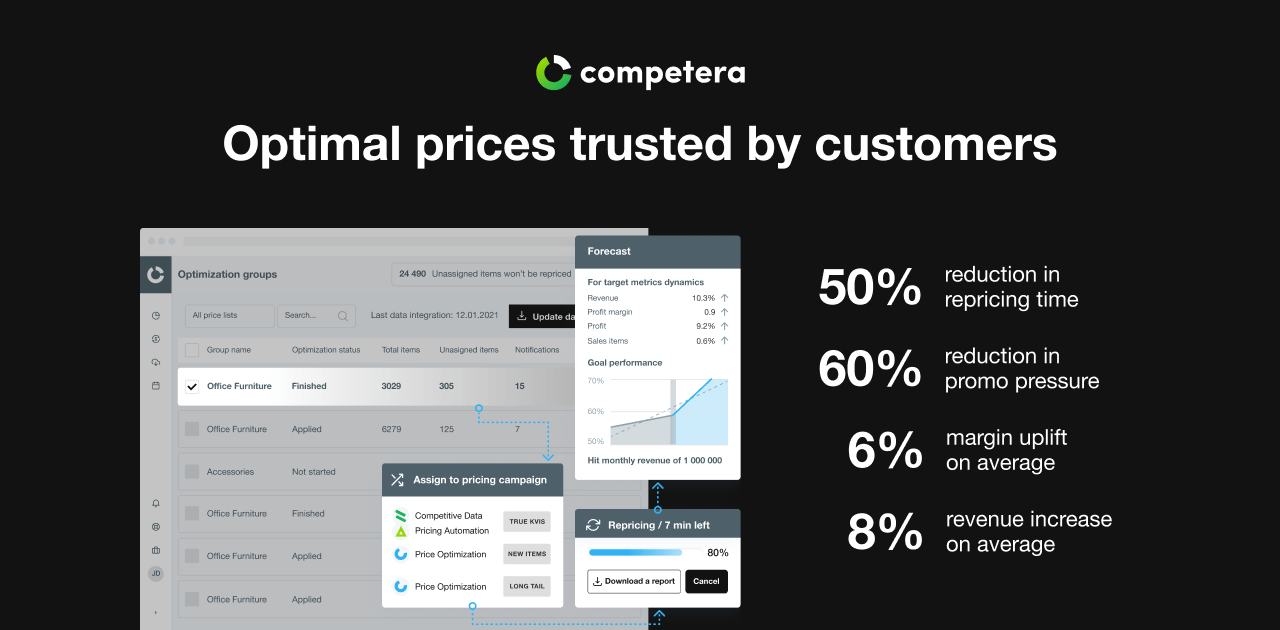
Competera's own case material points to margin gains and time savings rather than forecast precision alone — for example, Flaconi reportedly grew margin and cut pricing time by 50%. That is a business-outcome observation from the vendor's customer story, and it is worth reading alongside the accuracy claim: a retailer can benefit from faster, more consistent pricing decisions even where individual SKU forecasts carry meaningful error.

For context on the wider category, enterprise pricing and markdown tools from Revionics and Blue Yonder are commonly evaluated against Competera in retail RFPs, and ProfitWell publishes useful general material on pricing analytics if you want to sharpen your own evaluation criteria.

What results have retailers achieved after implementing Competera?

Retailers report two kinds of results after adopting Competera: measurable margin and time savings, and improved pricing accuracy. The clearest documented example on the site is Flaconi, a beauty retailer that grew margin and cut pricing time by 50%. A leading US fashion and apparel retailer saw a 40% increase in a reported metric (the page evidence is truncated, so the specific metric is worth confirming directly).

What the results point to

  • Faster pricing cycles. Cutting pricing time in half matters most for teams managing thousands of SKUs across channels, where manual repricing can't keep pace with competitor moves.
  • Margin growth without losing competitiveness. Margin gains are the headline, but they depend on getting elasticity right rather than simply raising prices.
  • Accuracy at scale. Competera claims 95%+ accuracy in predicting business outcomes, which is the foundation for trusting automated recommendations.

Whose observations these are

These figures come from Competera's own customer stories and site copy, so treat them as vendor-reported rather than independently verified. The Flaconi result and the 40% figure are concrete enough to ask about in a demo: which metric, over what period, and measured against what baseline.

A practical next step

If you're evaluating this for an enterprise retail team, ask for a reference call with a retailer in your category and size. The value of price optimization depends heavily on data quality, catalog complexity, and how much autonomy you give the system. A grocery chain with high price sensitivity will see different results than a fashion retailer with seasonal markdowns.

For broader context on retail pricing approaches, Competera publishes pricing guides and maturity assessments that can help you benchmark where your team stands before committing.

Related questions

More questions →
What pricing solutions and capabilities does Competera offer?

Competera offers an AI-driven retail price optimization platform for enterprise retailers, plus pricing consultancy and a set of pricing intelligence, analytics, and tracking solutions. It is built for organizations that need to set and manage prices across many products and channels, not for individuals or small single-store sellers. The platform's stated goal is to help retailers predict demand, optimize prices, and increase margins, with Competera claiming 95%+ accuracy in predicting business outcomes and citing use by 50+ retailers globally.

The two main offerings

Competera's site separates its commercial offer into a software platform and a service:

Offering What it is Who it suits
Pricing Platform AI-driven price optimization software that recommends optimal prices Retailers wanting to automate and scale pricing decisions
Pricing Consultancy Retail pricing expertise to enhance a pricing strategy Teams that need strategic guidance alongside or before tooling

The Pricing Platform is the core product. Pricing Consultancy is positioned as a way to strengthen pricing strategy with retail expertise — useful if your pricing process is immature or you want external input before committing to a platform.

Capabilities within the platform

The site lists these capability areas:

  • Automated pricing workflow — moves pricing from manual, rule-based steps toward an automated process.
  • Pricing optimisation — generates optimal price recommendations at scale.
  • Competitive data — incorporates competitor pricing into decisions.
  • Pricing analytics — analysis of pricing performance and outcomes.
  • Price intelligence — understanding the market and customer context behind prices.
  • Omnichannel price management — managing prices consistently across multiple channels.

These are presented as a connected set rather than standalone tools: competitive data and price intelligence feed the optimization engine, which produces recommendations that flow through the automated workflow and are managed across channels.

Solutions organized by need and by role

Beyond the platform itself, Competera groups its solutions in two ways:

By need:

  • Price intelligence
  • Price tracking
  • Pricing analytics
  • Pricing maturity

By title:

  • For Pricing Managers

The "pricing maturity" solution is worth noting if your organization is at an early stage — it frames adoption as a progression rather than a single switch. The "For Pricing Managers" entry signals that the day-to-day user is typically a pricing professional, not a generalist.

How it works and what it claims to deliver

Competera describes its approach as moving beyond traditional competitive or rule-based pricing. The stated mechanism is demand intelligence: uncovering why customers buy, not just how sensitive they are to price, and using that to generate price recommendations.

Four supporting capabilities are listed:

  • True demand elasticity — identifies real purchase drivers rather than only price sensitivity.
  • Predictive scenario planning — lets you simulate a pricing strategy and forecast its business impact before executing.
  • Human-in-the-loop intelligence — combines AI recommendations with your team's oversight and business rules.
  • Enterprise-grade scalability — designed for rapid deployment and integration across complex, multi-channel operations.

The human-in-the-loop point matters practically: recommendations are not presented as fully autonomous. Your pricing team retains strategic control and can apply business rules.

Outcomes retailers report

Competera cites specific results from named and unnamed retailers:

  • Flaconi — grew margin and cut pricing time by 50%.
  • A leading US-based fashion and apparel retailer — a 40% increase in a metric the excerpt cuts off (revenue-related, per context).

The platform also lists broader outcome categories: predictable revenue growth, enhanced brand perception, and higher customer lifetime value (CLTV). Treat the named case results as vendor-reported figures tied to specific contexts, not guaranteed outcomes.

Recognition and positioning

Competera lists several third-party recognitions: 2023 Best Breakthrough Technology Solution and 2024 Best Retail Insights (Vendors in Partnerships Awards), 2025 and 2026 honoree of the Inc. 5000 list, and Representative Vendor in the 2024 Market Guide for Retail Pricing & Markdown Optimization. These indicate enterprise-market positioning rather than a self-serve tool.

How to decide if it fits

Choose Competera's platform if you are an enterprise retailer with many SKUs and channels, you want AI-generated price recommendations with human oversight, and you need competitive data and analytics in the same system. Consider the consultancy track if your pricing strategy needs shaping before or alongside tooling. If you are a small retailer or an individual looking for a low-cost, self-serve pricing tool, the enterprise framing and demo-based access suggest this is not the intended fit.

To evaluate it concretely, the site offers a product tour and a personalized demo request — the practical next step, since pricing and access terms are not published on the pages reviewed here.

Who Competera Is Built For and What Retailers Actually Get From It

Competera is an AI-driven price optimization platform aimed at enterprise retailers, not small shops or single-store operators. Its stated purpose is to help pricing teams predict demand, set optimal prices at scale, and grow margins with confidence. If you are a pricing manager, revenue manager, or category lead at a multi-channel retailer evaluating whether this fits your operation, the short answer is: it fits teams that already have enough pricing volume and data complexity to justify AI-assisted decisions, and it delivers value through demand prediction, scenario simulation, and human-reviewed price recommendations rather than fully automated price setting.

Who the platform is designed for

Competera positions itself around enterprise retail, and the site's own framing points to a specific audience:

  • Enterprise retailers — the platform is described as "AI-driven retail price optimization software for enterprise retail," and the site notes it is trusted by 50+ retailers globally.
  • Pricing managers and pricing teams — there is a dedicated solution page "For Pricing Managers," which signals that the day-to-day user is a pricing professional, not a generalist marketer.
  • Multi-channel operations — "omnichannel price management" is listed as a core capability, so retailers selling across several channels are the intended fit.
  • Teams with existing competitive and analytics needs — the platform bundles competitive data, price intelligence, price tracking, and pricing analytics, which suggests it replaces or consolidates several tools a mature pricing function already uses.

If your pricing decisions are made by one person in a spreadsheet, this is likely more platform than you need. The design assumes a team, a workflow, and enough SKUs that manual pricing breaks down.

What retailers can expect to achieve

The outcomes Competera advertises are specific and worth checking against your own goals:

Stated outcome What it means in practice
Predictable revenue growth Pricing decisions tied to demand forecasts rather than rules of thumb
Enhanced brand perception Prices that reflect customer perceived value, not just competitor matching
Higher CLTV Pricing that accounts for why customers buy, not only price sensitivity
Margin improvement Cited in the Flaconi case, which reports margin growth and a 50% cut in pricing time
Accuracy The site claims 95%+ accuracy in predicting business outcomes

The Flaconi example is the most concrete outcome on the page: a beauty retailer that grew margin and halved the time spent on pricing. A US-based fashion and apparel retailer is cited with a 40% increase in revenue (the excerpt cuts off, so treat the full figure as unverified here). These are vendor-reported results, so use them as directional evidence of what the platform targets, not as a guarantee for your business.

How the platform works, in plain terms

Competera describes its approach as moving "beyond traditional competitive or rule-based pricing." Four mechanisms do the work:

  • True demand elasticity — instead of only measuring how sensitive customers are to price, it tries to uncover the real reasons behind purchases.
  • Predictive scenario planning — you simulate a pricing strategy and forecast its business impact before you execute it.
  • Human-in-the-loop intelligence — AI recommendations are combined with your team's oversight and business rules, so the system does not price unilaterally.
  • Enterprise-grade scalability — built for rapid deployment and integration across complex, multi-channel operations.

The practical workflow implied here is: feed in your data, let the model estimate demand and competitive position, generate price recommendations, review them against your rules, then execute. The "human-in-the-loop" framing matters if your organization is not ready to hand pricing over to a model.

What to verify before you commit

Because the site does not publish pricing, contract terms, or a public integration list, these are the questions to resolve in a demo rather than assume:

  • Integration fit — the page claims "seamless integration across complex, multi-channel operations," but does not name systems. Ask which of your commerce, ERP, and data platforms are supported and what the deployment timeline looks like.
  • Data requirements — demand elasticity and 95%+ accuracy claims depend on data volume and quality. Ask what minimum history and SKU count the model needs to perform as advertised.
  • Pricing and access — no pricing is listed and no payment details are published. Request a demo and get commercial terms in writing; do not assume any tier is free.
  • Your team's readiness — human-in-the-loop only helps if you have people to review recommendations. Confirm who on your side owns the workflow.
  • Reference checks — ask for retailers in your category and size, and ask those references what the first 90 days actually looked like.

Competera is a credible fit for enterprise retailers with a dedicated pricing function and multi-channel complexity. It is a poor fit for businesses without the data depth or team structure to use AI recommendations well. The deciding factor is usually not the software's capability but whether your operation can feed it and act on what it returns.

What is Competera and what does its AI-driven retail price optimization software do?

Competera is an AI-driven price optimization platform built for enterprise retail. It predicts how customers will respond to price changes and recommends optimal prices at scale, with the stated goal of helping retailers grow revenue and margins with more confidence. It is aimed at enterprise retailers and pricing teams rather than small merchants, and it positions itself as an alternative to purely competitive or rule-based pricing.

What Competera does

The platform's core job is to move pricing decisions from "match the competitor" or "follow a rule" to "follow the evidence of what drives demand." According to the site, it helps retailers understand why customers buy, predict how they will react to price changes, and set prices that reflect both competitive position and customer-perceived value.

The stated outcomes are predictable revenue growth, enhanced brand perception, and higher customer lifetime value (CLTV).

Core capabilities

Capability What it means in practice
True demand elasticity Identifies the real drivers behind purchases, not just price sensitivity
Predictive scenario planning Simulates a pricing strategy and forecasts its business impact before execution
Human-in-the-loop intelligence Combines AI recommendations with team oversight and business rules
Enterprise-grade scalability Built for rapid deployment and integration across complex, multi-channel operations
Accuracy claim 95%+ accuracy in predicting business outcomes (vendor-stated)

The platform also covers adjacent pricing workstreams listed on the site: automated pricing workflow, competitive data, pricing analytics, price intelligence, price tracking, and omnichannel price management.

How it works, conceptually

Competera's approach has three layers:

  1. Demand intelligence — model what actually drives buying behavior for each product and context.
  2. Recommendation — generate optimal price recommendations at scale rather than one product at a time.
  3. Oversight — let pricing teams apply strategy, constraints, and business rules on top of the AI output before prices go live.

The "human-in-the-loop" element matters for enterprise adoption: it means the system is designed to support pricing managers' judgment, not replace it outright.

Who it is for

  • Enterprise retailers operating across multiple channels
  • Pricing managers and pricing teams
  • Retailers that have outgrown manual or purely rule-based pricing

The site states it is trusted by 50+ retailers globally and cites recognition including a 2023 Best Breakthrough Technology Solution award, 2024 Best Retail Insights, Inc. 5000 honoree status for 2025 and 2026, and representative vendor status in a 2024 Market Guide for Retail Pricing & Markdown Optimization.

A concrete example

The site cites Flaconi, a retailer that grew margin and cut pricing time by 50% using Competera. It also references a leading US-based fashion and apparel retailer achieving a 40% increase in a metric (the excerpt is truncated). These are vendor-published case references, so treat the numbers as claims to verify in a demo rather than independent benchmarks.

What to check before deciding

  • Fit with your data: demand elasticity modeling depends on the quality and granularity of your sales, competitor, and customer data.
  • Integration scope: confirm how it connects to your existing pricing, ERP, and e-commerce systems.
  • Oversight model: clarify how business rules and approval workflows are configured for your team.
  • Pricing and contracting: the site offers a demo request rather than published pricing, so commercial terms need to come from a direct conversation.

If you are an enterprise retailer evaluating whether to move beyond rule-based pricing, Competera is worth a demo — specifically ask for a scenario-planning walkthrough on your own product categories, since that is where the predictive claims become testable.

How does AI price optimization software solve retail pricing challenges?

AI price optimization software solves retail pricing challenges by replacing rule-based or purely competitive pricing with demand intelligence: it identifies why customers buy, predicts how they will react to price changes, and generates optimal price recommendations at scale. It fits enterprise retailers with large, multi-channel assortments and enough transaction data to train demand models. It is not a plug-in replacement for judgment — Competera positions its system as human-in-the-loop, combining AI recommendations with your team's strategic oversight and business rules.

Why traditional competitive and rule-based pricing falls short

Competitive pricing and rule-based pricing both answer the wrong question. They tell you what competitors charge or what your policy says, not what a price change will do to your revenue.

  • Competitive pricing copies the market. It assumes your customers value your offer the same way they value a competitor's, which ignores differences in assortment, availability, brand perception, and service.
  • Rule-based pricing applies fixed logic (for example, "stay 5% below the market leader"). Rules cannot adapt when demand shifts, and they multiply across thousands of SKUs until no one can explain why a price was set.
  • Neither reveals demand drivers. Competera's stated position is that it "moves beyond traditional competitive or rule-based pricing" to uncover the true drivers of demand — the reasons behind purchasing decisions, not just price sensitivity.

The practical consequence: pricing teams spend their time defending and maintaining rules instead of making decisions, and margin opportunities stay invisible.

What AI price optimization actually does differently

Competera describes four capabilities that address the gaps above.

True demand elasticity

Instead of measuring only how much sales move when price moves, the system models the real reasons behind customer purchases. This matters because two products can show identical price sensitivity while responding to completely different levers — seasonality, competitor stockouts, or perceived value.

Predictive scenario planning

You can simulate any pricing strategy and forecast its business impact before execution. This turns pricing from a series of live experiments into a set of testable scenarios, so a strategy is evaluated on predicted outcomes rather than after the fact.

Human-in-the-loop intelligence

AI precision is combined with your team's strategic oversight and business rules. Price recommendations are inputs to a decision, not an autopilot — which is the condition under which most enterprise pricing teams will accept automated recommendations at all.

Enterprise-grade scalability and accuracy

The platform is built for rapid deployment and integration across complex, multi-channel operations, and Competera claims 95%+ accuracy in predicting business outcomes. Treat that figure as a vendor claim tied to their own modeling and customer data, not a guarantee for your assortment.

How the workflow fits together

Competera's platform is organized around six connected areas, which map to the sequence a pricing team actually works in:

Area What it covers
Competitive data Collecting and structuring competitor price information
Price intelligence Turning that data into insight on your competitive position
Pricing analytics Analyzing performance and demand
Pricing optimisation Generating optimal price recommendations
Automated pricing workflow Executing and managing price changes at scale
Omnichannel price management Keeping prices consistent across channels

The output Competera emphasizes is not a single price but a set of recommendations that "reflect your competitive position and customer perceived value" — the two inputs competitive-only and rule-only approaches each handle separately.

What retailers report achieving

Competera cites outcomes from named and anonymized customers:

  • Flaconi grew margin and cut pricing time by 50%.
  • A leading US-based fashion and apparel retailer saw a 40% increase in revenue (the excerpt is truncated at this point, so treat the full scope of that result as unverified).
  • The company states it is trusted by 50+ retailers globally.

These are vendor-published case results. They are useful as evidence that the approach has been deployed at enterprise scale, but they are not a forecast for your business — your data quality, assortment complexity, and pricing governance will drive most of the variance.

What to check before adopting

  • Data readiness. Demand intelligence depends on transaction history rich enough to separate price effects from seasonality, promotion, and availability. If your data cannot support that, the models will underperform regardless of the software.
  • Decision rights. Decide in advance which recommendations your team can accept automatically and which require review. The human-in-the-loop design only helps if you define the loop.
  • Channel complexity. If you sell across multiple channels, confirm how the platform handles conflicting price positions between them.
  • Accuracy claims. Ask how the 95%+ prediction accuracy figure is measured, on what time horizon, and against which baseline — then ask for a validation on your own data.

If your pricing today is driven by competitor matching or fixed rules and you have enterprise-scale transaction data, AI price optimization addresses a real gap. If your assortment is small or your data is thin, the return is unlikely to justify the deployment effort.

How does Competera's retail price optimization software work?

Competera is AI-driven retail price optimization software for enterprise retailers. It works by combining demand intelligence, predictive scenario planning, and human-in-the-loop controls to recommend prices at scale. It is designed for retailers with complex, multi-channel operations that need to move beyond rule-based or purely competitive pricing. If you are a smaller retailer looking for a simple repricing tool, this is likely more system than you need.

The core mechanism: demand intelligence before price setting

Traditional pricing tools often start from competitor prices or fixed rules. Competera starts from demand. According to the site, it uncovers the "why" behind customer buying behavior rather than just price sensitivity. This means the system attempts to identify the real drivers of demand, then uses those drivers to generate price recommendations.

The practical difference: instead of asking "what is the competitor charging?", the system asks "what price reflects our competitive position and customer perceived value?" That framing comes directly from Competera's positioning.

How the workflow runs

1. Data ingestion and competitive context

The platform pulls in competitive data and pricing analytics as inputs. Competera lists competitive data, price intelligence, and pricing analytics as distinct capabilities. These feed the demand model with market context.

2. Demand elasticity modeling

The system builds a true demand elasticity model. The site emphasizes "true demand elasticity" as distinct from simple price sensitivity — the goal is to understand the reasons behind purchases, not just how volume changes with price.

3. Predictive scenario planning

Before any price goes live, you can simulate a pricing strategy and forecast its business impact. Competera claims 95%+ accuracy in predicting business outcomes. This is the step where you test a markdown, a price increase, or a promotional strategy and see the projected result.

4. Human-in-the-loop review

Recommendations are not auto-executed blindly. Competera combines AI precision with team oversight and business rules. Pricing managers review and apply strategic judgment. The site lists a dedicated "For Pricing Managers" solution, which signals that the human role is a designed part of the workflow, not an afterthought.

5. Execution across channels

The platform supports omnichannel price management and an automated pricing workflow. Once approved, prices can be deployed across channels.

What capabilities are included

Capability What it does
Automated pricing workflow Moves prices from recommendation to execution
Pricing optimisation Generates optimal price recommendations
Competitive data Feeds market context into the model
Pricing analytics Measures and reports pricing performance
Price intelligence Tracks and interprets price movements
Omnichannel price management Manages prices across multiple channels

What results does it claim?

Competera reports being trusted by 50+ retailers globally. One named example: Flaconi grew margin and cut pricing time by 50%. A leading US-based fashion and apparel retailer saw a 40% increase in revenue (the excerpt cuts off there). The site also cites industry recognition, including a 2023 Best Breakthrough Technology Solution award and 2024 Best Retail Insights award.

These are vendor-reported outcomes. Treat them as directional evidence of what the platform is built to achieve, not as guaranteed results for your business.

Who this is for — and who it is not for

A reasonable fit if you:

  • Run an enterprise retail operation with multiple channels
  • Have a pricing team that wants AI recommendations but retains final control
  • Need to simulate pricing strategies before committing
  • Want demand-based pricing rather than pure competitor matching

Probably not a fit if you:

  • Are a small retailer wanting a plug-and-play repricer
  • Have no pricing team and want fully automated, no-review price changes
  • Only need basic competitor price tracking without demand modeling

How to evaluate it for your business

  1. Identify your current pricing bottleneck — is it speed, accuracy, or channel consistency?
  2. Request a demo and ask specifically how the demand model handles your category's data availability.
  3. Ask what integration work is required for your existing systems, since the site mentions "seamless integration" but does not detail specific connectors.
  4. Clarify pricing and contract terms directly — the site does not publish pricing, so do not assume any tier is free or self-serve.
  5. Run a scenario-planning test on a real category before committing to a full rollout.

The key question to bring to a demo: how does the system separate true demand elasticity from noise in your specific data environment? That is the mechanism the entire product depends on.

Website Overview

Page metadata, canonical configuration and social previews work together to provide more consistent search and sharing presentation.

Domain and Registration

Transfer-protection status is present, helping reduce the risk of unauthorized domain transfers. The domain has about 3 years of registration history; its current configuration provides more context than age alone. The registrar is GoDaddy.com, LLC, a widely used domain service provider. Registration contact information is publicly available through RDAP. The domain uses the common .ai extension, which is not an independent safety signal.

DNS and Email

Nameservers are provided by Cloudflare, indicating managed DNS hosting. MX records point to the Google Workspace email service. SPF, DKIM and DMARC records were found, with DMARC policy quarantine. Together they can help recipients reject impersonated messages. No CNAME was found; the observed records resolve directly to addresses. TXT records include verification markers for Google, Microsoft. Such markers may also remain after a service stops being used.

TLS and Certificates

The public key uses EC with 256 bits. The server supplied a complete certificate chain. No organization name is present in the certificate; the available fields are consistent with domain validation. The certificate was issued by Let's Encrypt, commonly associated with automated certificate services. The certificate's total validity is about 89 days, consistent with a short renewal cycle.

HTTP and Browser Security

The response lacks these common security headers: X-Content-Type-Options, Permissions-Policy, clickjacking protection. No X-Powered-By header was found, reducing one common source of backend fingerprinting information. The cf-ray response header indicates a CDN or caching proxy in the delivery path. No obvious internal addresses or debug information were found in the headers. The Server header identifies cloudflare without an exact version.

Technology Stack Analysis

The public page identifies HubSpot, Google Tag Manager, Cloudflare without precise versions, leaving fewer clues for version-specific scanning.

Search and Social Sharing

The Generator tag identifies HubSpot, making the publishing system easier to fingerprint. Open Graph is partially configured; og:type is missing. Twitter Card metadata is configured. JSON-LD includes Organization data, helping describe the organization as an entity. The title has 44 characters, within a common display range.

Hosting and Email

DNSCloudflare
HostingCloudflare
EmailGoogle Workspace
Approximate IP geolocation (inferred; a CDN or proxy may differ from the origin server) United States flagUnited States Inferred 199.60.103.185

Registration details

RDAP / WHOIS

RegistrarGoDaddy.com, LLC
Registered2023-06-05
Expires2027-06-05
Domain statusclient delete prohibited、client renew prohibited、client transfer prohibited、client update prohibited
Nameserversmatt.ns.cloudflare.com、venus.ns.cloudflare.com
DNSSECunsigned

DNS records

DNS

TypeNameValueTTLPriority
Acompetera.ai199.60.103.1853600—
Acompetera.ai199.60.103.853600—
MXcompetera.aiaspmx.l.google.com36001
MXcompetera.aialt1.aspmx.l.google.com36005
MXcompetera.aialt2.aspmx.l.google.com36005
MXcompetera.aialt3.aspmx.l.google.com360010
MXcompetera.aialt4.aspmx.l.google.com360010
NScompetera.aimatt.ns.cloudflare.com86400—
NScompetera.aivenus.ns.cloudflare.com86400—
TXTcompetera.aiMS=ms90919192300—
TXTcompetera.aianthropic-domain-verification-xe7r52=OlKrubt4GhOEB9iqvXN3YYUXL300—
TXTcompetera.aigoogle-site-verification=DDOB-_Hw6gzgcvYELwCJVGljFGUs__I4wvefpll-yhg300—
TXTcompetera.aigoogle-site-verification=KhJ8_UNsS7wLgV3ZQhqPAnf5_rkUs-vxD8kk9y4xDEo300—
TXTcompetera.aigoogle-site-verification=aFitoNQpaJwPsbIx92P8ydyvIWS3-QRWcFdPVMWqhOM300—
TXTcompetera.aigoogle-site-verification=uB7JpfcW0bNay7s4SBL5rUuME9acQEmWUUxVJShJqkY300—
TXTcompetera.aislack-domain-verification=HwSGF2ymohMtqwbA9M3oSTZkNFppd6iDucuaWmWm300—
TXTcompetera.aiv=DKIM1; k=rsa; p=MIIBIjANBgkqhkiG9w0BAQEFAAOCAQ8AMIIBCgKCAQEArwvbb0rgiJp1HfqEfbPaBAkdOurqEpCM/z5BbVzxO9PSTpVx+lnNFmu+AbqHUposJZI1ZBV7V5g5CCm27dKEx5u+uCDgIyv9qBh/jRLoUpaPLAMJs8qswV6WXs3iY4z5nTJIOltJh+pOhxg0srkNfZaHuIyAia25JIHxHDA9sPe2RoBIvbfaEEdj7+uS1811RQM16Cm6CLZnIOAuuUDUTfK/ZrkiotD4QWg7uP7BO6UDlsKAPL0CVPPWYR5mPTRHNLQ+jL7QL6Dhbi9ar97evqIh3iw/xuANeQ8flZy6IeDFTreNXr5p2nQHCPnm0OOEwCsu5oU44WQByB3x8QG7wQIDAQAB300—
TXTcompetera.aiv=spf1 include:_spf.google.com include:46731584.spf07.hubspotemail.net include:sendgrid.net ~all300—
DMARC_dmarc.competera.aiv=DMARC1; p=quarantine; aspf=r;3600—

TLS and certificates

TLS / SSL

AssessmentNormal configuration
Supported protocolsTLSv1.2、TLSv1.3
Negotiated protocolTLSv1.3
Certificate subjectd5ce67f3.sni.cloudflaressl.com
IssuerLet's Encrypt
Valid until2026-11-22T09:31 · Remaining when checked: 41 days
Verification detailsCertificate trust: Passed · Hostname match: Passed

HTTP response headers

HTTP

HeaderValue
content-typetext/html; charset=UTF-8
cache-controls-maxage=36000, max-age=5
servercloudflare
strict-transport-securitymax-age=31536000
content-security-policyupgrade-insecure-requests
referrer-policyno-referrer-when-downgrade
set-cookieRedacted

Identified technologies

HubSpotGoogle Tag ManagerCloudflare

Pages, Search and Sharing

Meta descriptionAI-driven retail price optimization software that helps enterprises predict demand, optimize prices, and increase margins with confidence.
Canonical URLhttps://competera.ai/
LanguageEnglish (default)
Twitter Cardsummary_large_image
All bots 0 allowed · 5 disallowed
  • Disallow/_hcms/preview/
  • Disallow/hs/manage-preferences/
  • Disallow/hs/preferences-center/
  • Disallow/*?*hs_preview=*
  • Disallow/*?*hsCacheBuster=*

User reviews (0)

  • No reviews yet.