
 简体中文
简体中文 English
Website review
This review may include AI-generated content and is not individually verified. Domain, certificate and other facts come from the observed data on this page.
What is CrowdSec?
CrowdSec is a cybersecurity platform that turns a community-contributed pool of attack data into curated, actionable blocklists. Rather than relying only on a vendor's own sensors, it aggregates signals from many participants and packages the result as threat intelligence you can feed into firewalls, proxies and other enforcement points. The site's central pitch is preemption: blocking malicious IPs before they reach you, with claims of being 7 to 60 days ahead of other blocklists and of holding data that most other threat-intelligence vendors do not.
What it actually does
- Collective detection: Behavior from many deployments is pooled to identify aggressive IPs and mass scanners.
- Curated blocklists: The output is a list you can act on — block, alert or enrich — not just a dashboard.
- Context: The page emphasizes detailed behavioral context around aggressive IPs, not just raw addresses.
- Automation: Customers describe lists being pushed automatically into firewalls, removing manual IP checking.
Who it suits
- SOC and CERT teams drowning in alert volume; one quoted customer says background noise dropped 40–50%, saving roughly two full-time-equivalents of incident-response work.
- Ops and platform engineers facing bot traffic; another quoted customer reports blocking about 95% of malicious bot traffic and reducing server load.
- Small teams without a large threat-intel budget, since crowd-sourced data substitutes for buying many feeds.
Trade-offs to weigh
- Community data cuts both ways. Broad contribution gives early visibility, but quality depends on curation; the site's "ultra-curated" framing is a claim to verify against your own false-positive tolerance.
- Blocklists are preventive, not diagnostic. They help with mass exploitation and known-bad IPs, but they do not replace patching, EDR or investigation of targeted attacks.
- Enforcement still needs integration work. Value depends on how cleanly it plugs into your existing firewall, WAF or SIEM.
Next step: Check whether the blocklist format and integrations match your stack, then run it in alert-only mode for a couple of weeks to measure false positives before switching to blocking. See CrowdSec for the product and data details.
How does CrowdSec's crowd-powered threat intelligence work?
CrowdSec builds threat intelligence by pooling attack observations from its community, then turning that collective data into curated blocklists you can feed into firewalls, servers or security tools. The core idea is that many independent sensors see the same attackers, so the crowd surfaces malicious IPs faster and with more context than a single organisation could gather alone.
What the page says
- The product is described as "AI-driven ultra-curated collective threat intelligence" with "actionable blocklists."
- CrowdSec claims it adds malicious IPs to its blocklists 7 to 60 days ahead of other market sources.
- It says 16% of proven aggressive IPs it preemptively blocks stay unknown to other vendors for at least 15 to 20 days.
- It says 50% of malicious IPs in its database are unknown to 89 of 92 threat intelligence vendors.
- It reports 36% exclusive data compared with other CTI sources, and says blocklists can cut alert volume by up to 80%.
- Named users describe automated list uploads to firewalls and blocking around 95% of malicious bot traffic.
How to think about it
The value is less about any single IP list and more about timing and coverage. If your team is drowning in mass-scanning noise, a crowd-fed blocklist can push known-bad addresses to your edge before they reach you. The trade-off is that crowd data reflects what contributors see; if your environment faces a niche or targeted attacker, the crowd may not have observed it yet.
A practical next step is to run the blocklists in monitor mode first, comparing what they would have blocked against your existing alerts. If they catch real attacks without disrupting legitimate traffic, move to enforcement.
For related context on community-driven security data, see abuse.ch and Spamhaus.
How does CrowdSec's preemptive blocking compare to other threat intelligence vendors?
CrowdSec's central claim is timing and exclusivity: its page states that it adds malicious IPs to its blocklists 7 to 60 days ahead of others on the market, that 16% of proven aggressive IPs it preemptively blocks stay unknown to other vendors for at least 15 to 20 days, and that 50% of the IPs in its database are unknown to 89 of 92 threat intelligence vendors. It also cites a customer observation that its high threat list carries "36% exclusive information compared to all other CTI sources." The practical comparison, then, is not list size but how early and how uniquely it flags addresses you would otherwise only see after an attack.
What that difference means in practice
| Dimension | CrowdSec's stated position | Typical trade-off to weigh |
|---|---|---|
| Lead time | 7–60 days ahead on blocklist additions | Earlier blocks may catch IPs later reassigned to legitimate users |
| Exclusivity | Large share of IPs unknown to most vendors | Exclusive data is harder to cross-validate with a second source |
| Coverage focus | Mass exploitation, scanners, zero-day exploiters | May under-serve targeted, low-volume intrusions |
| Operational effect | Claims up to 95% of mass exploitation blocked pre-emptively, up to 80% less alert volume | Aggressive blocking can create false positives that need tuning |
How to judge it against your current stack
The useful test is overlap, not marketing totals. Export a week of IPs your existing feeds flag, compare them against CrowdSec's lists, and measure two things: the addresses only CrowdSec catches, and the addresses it catches earlier. Then check how many of those exclusive IPs actually touched your logs. A feed with high exclusivity but no hits on your infrastructure is interesting but not urgent; one that appears days before your firewall sees the traffic is where the preemptive value shows up.
For a mid-size SOC, the realistic scenario is a scanner-heavy internet-facing estate where alert fatigue is the main cost. In that setting, earlier blocking of mass scanners is the biggest win, and the cited customer results — roughly 40–50% less background noise and about 95% of malicious bot traffic blocked — describe exactly that pattern. If your environment is dominated by targeted intrusions rather than mass scanning, weigh the exclusivity claims more carefully and validate with your own telemetry first.
As a next step, run a two-week side-by-side: keep your current feeds, add CrowdSec's lists in monitor-only mode, and log which source fires first on each confirmed incident. Compare that with alternatives such as AbuseIPDB or Spamhaus, and check pricing and integration details at CrowdSec before committing.
What types of cyber threats does CrowdSec protect against?
CrowdSec focuses on threats that reach you over the network from known-bad IP addresses, rather than on endpoint malware or phishing email. According to its page, the emphasis is on mass exploitation, zero-day exploit attempts and the background noise created by internet-wide scanners.
Threat categories it addresses
- Mass attacks and mass exploitation: Automated, high-volume attempts to exploit common exposures across many targets at once. CrowdSec says its blocklists can preemptively stop up to 95% of these attempts before they reach you.
- Zero-day exploits: Attacks targeting vulnerabilities before you have patched them. The page notes that zero-day exploiters will likely reach servers and apps before a patch is available, and positions early IP blocking as the mitigation.
- Malicious IPs you do not yet know about: The core pitch is identifying attacking IPs that other sources have not yet flagged, so you can block them before they appear in other feeds.
- Scanner noise and missed critical alerts: Mass scanners generate traffic that can hide genuine attacks. CrowdSec claims its data helps surface the real risks and can reduce alert volume by up to 80%.
What that means in practice
A small security team running internet-facing web servers is the clearest fit. Instead of manually chasing scanner traffic, they subscribe to curated IP lists and push them into a firewall or WAF. The page cites Le Monde's IT architecture lead, Laurent Sabri, saying the lists are automatically uploaded to their firewalls, removing manual IP checking. Kamil Czujowski of ScaleCommerce reports blocking roughly 95% of malicious bot traffic.
The trade-off is scope: this is network-level, IP-based protection. It complements, but does not replace, patching, endpoint detection or email security. Because the value depends on blocklist freshness, check how often lists update and how easily they integrate with your existing firewall or WAF before committing. CrowdSec publishes pricing and plan details at CrowdSec if you want to compare tiers.
How does CrowdSec reduce security alert volume and alert fatigue?
CrowdSec reduces alert volume mainly by blocking known-bad IPs before they reach your systems, so many routine mass-scanning and exploitation attempts never turn into alerts for your team to triage. The site presents this as preemptive blocking of up to 95% of mass exploitation attempts and a reduction in security alert volume of up to 80%, which directly targets alert fatigue: fewer low-value notifications competing for analyst attention.
Three mechanisms do the work:
- Preemptive blocklists. Rather than detecting each attack in your own logs, you subscribe to curated lists of aggressive IPs and block them at the edge (firewall, proxy, WAF). Traffic from those IPs is dropped before it generates an incident.
- Aggressive-IP context. The page says the data is ultra-curated with behavioral context, so you can distinguish mass scanners from actors targeting you specifically instead of treating every hit the same.
- Earlier coverage. CrowdSec claims it adds malicious IPs to its blocklists 7 to 60 days ahead of other sources, and that 50% of IPs in its database are unknown to 89 of 92 threat intelligence vendors. Earlier blocking means fewer repeat alerts from the same source.
A concrete scenario: a mid-size e-commerce team gets thousands of daily scanner alerts that bury the handful of real attempts. If most of those scanners are already on a blocklist enforced at the firewall, the SIEM only sees what got through, and the on-call analyst spends time on genuine incidents. The published customer observations point the same way — Guillaume Roussel of Crédit Mutuel reports eliminating 40–50% of background noise and saving roughly two FTEs of incident-response time, and Laurent Sabri of Le Monde notes that malicious IP lists are pushed automatically to firewalls, removing manual IP checking. Those are the customers' reported results, not guaranteed outcomes; your mileage depends on how much of your traffic comes from already-catalogued sources.
Trade-offs to weigh: blocklists only help against IPs someone else has already seen, so targeted or novel attackers still need detection. Aggressive blocking can also catch shared or misclassified addresses, so start in monitor mode, review false positives, and keep an allowlist before enforcing broadly.
Next step: export a week of your noisiest alerts, check what share come from IPs on a reputable blocklist, and pilot enforcement on one internet-facing service. If that share is high, the alert-volume case is strong; if most alerts come from authenticated or internal activity, blocklists will help less. For the vendor's own claims and list options, see CrowdSec.
How much does CrowdSec cost and what subscription plans are available?
CrowdSec does not publish its prices on the page you shared; the page only links to a pricing page and invites you to contact the company. That means the cost depends on which products you need, how much data you want, and whether you are protecting a single server or an entire organization.
What the page tells you
- There is a Pricing link in the site navigation, so a public price list may exist there.
- The page emphasizes blocklists, threat intelligence, and SOC efficiency, which suggests paid tiers are built around data access and volume rather than a single flat fee.
- A "Contact us" call to action appears next to the blocklist section, which is typical of quote-based or tiered enterprise pricing.
How to think about the cost If you only need basic protection for one or two servers, the free or low-cost end of the range is usually enough. If you want curated blocklists, exclusive threat data, or integration with firewalls and SIEMs, expect pricing to scale with the number of protected assets, the volume of IP data, and the support level. The page claims benefits such as blocking up to 95% of mass exploitation attempts and reducing alert volume by up to 80%, but those are product claims, not price information.
Next step Open CrowdSec and check the Pricing page directly, or request a quote if no public tiers are listed. Before you do, write down how many servers, firewalls, or endpoints you need to cover and whether you need the blocklists alone or the full threat-intelligence platform. That will let you compare a quote against alternatives such as AbuseIPDB or Spamhaus on a like-for-like basis.
 Vercel
 Google Workspace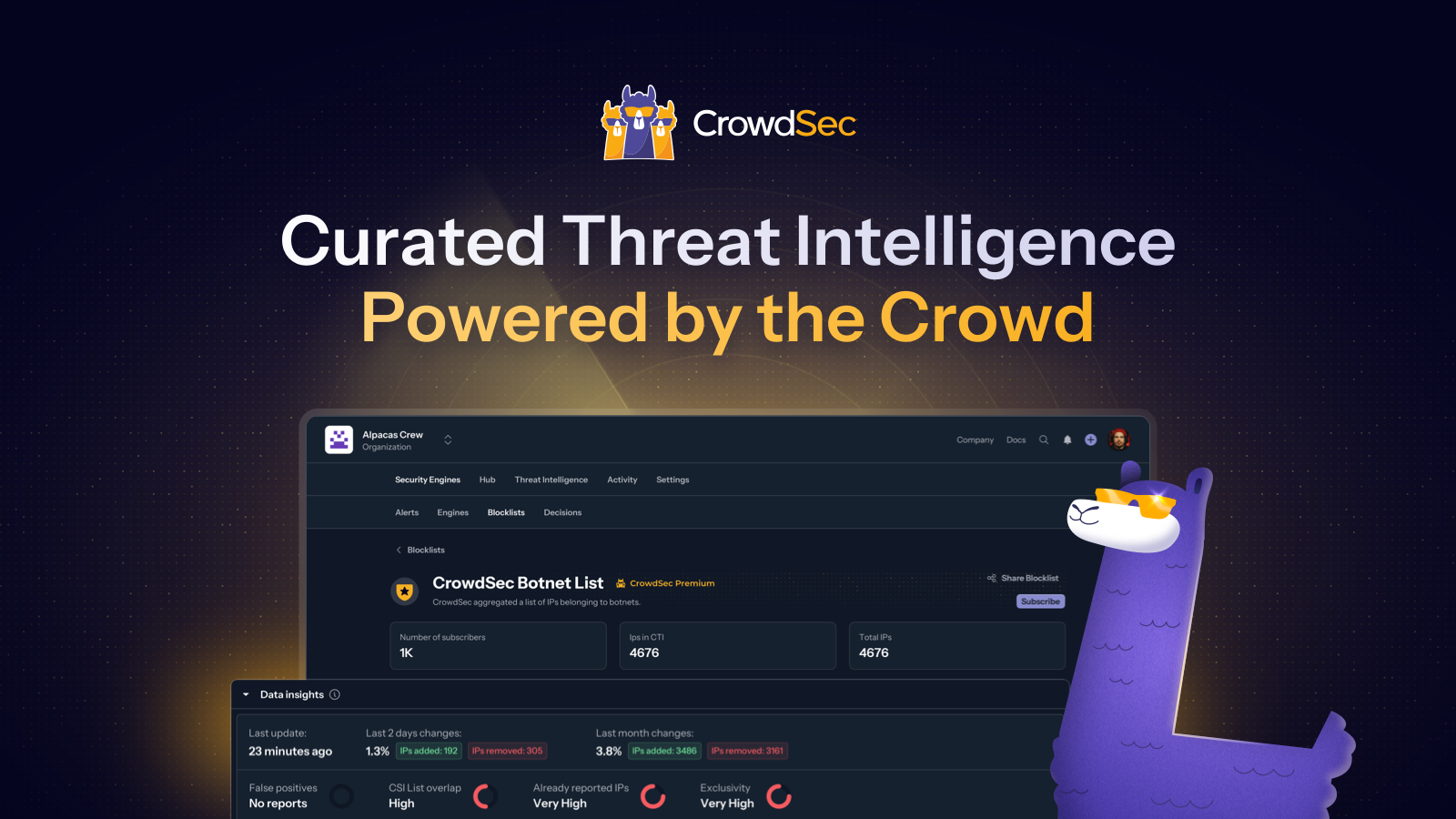

User reviews (0)