Website profiles · Technology insights · Alternatives

dancemusic.wtf

Quiz Game for Learning Electronic Dance Music Genres. How High Can You Score?

No paid content found
Visit website
Profile views 0 Outbound visits 0 Normal
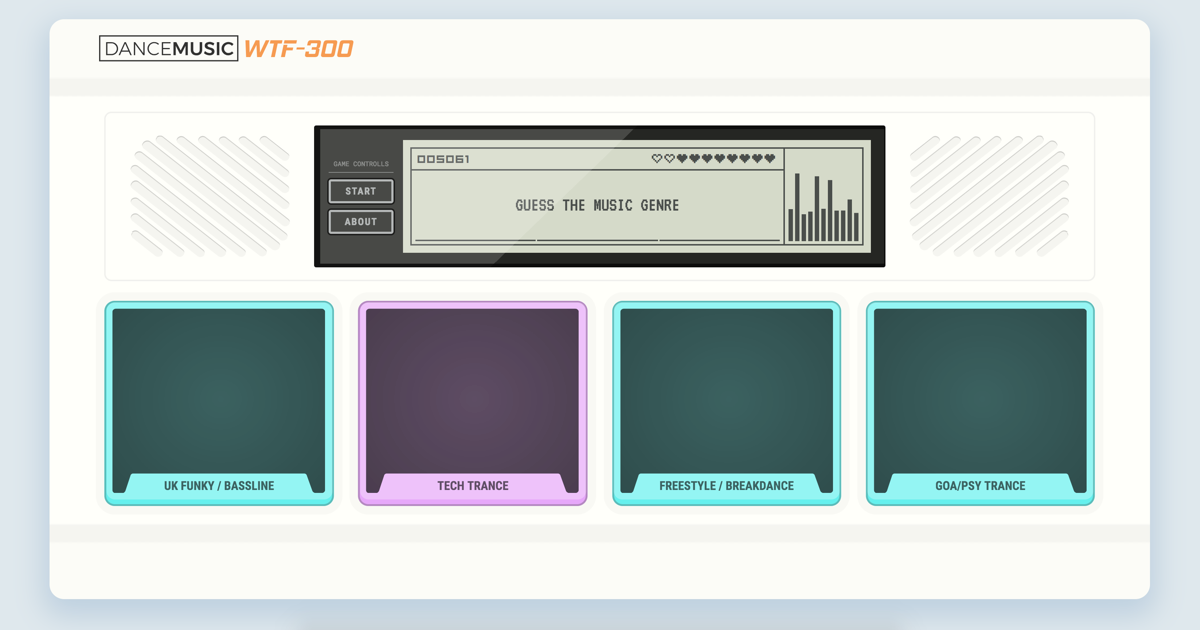
DANCEMUSIC WTF-300 Full homepage screenshot

At a glance

Category
Games & Board Games
Language
English
Paid-content signal
No paid content foundObserved
Registered
2017
Hosting
NetlifyInferred
HTTPS certificate trusted
PassedObserved
Last updated

Website review

This review may include AI-generated content and is not individually verified. Domain, certificate and other facts come from the observed data on this page.

What is DANCEMUSIC WTF-300?

DANCEMUSIC WTF-300 is a browser-based quiz game for learning electronic dance music genres. Its stated purpose is straightforward: you listen, identify the style, and see how high you can score. The page evidence is thin—just the title, a short description, and the beginnings of a game-controls and start section—so the exact question format, track selection and scoring rules aren't documented here. Treat the genre-recognition premise as the reliable part.

Who it suits

  • Curious listeners who enjoy house, techno, trance, drum & bass and similar styles but couldn't reliably name subgenres.
  • Students of dance music history who want a quick self-test rather than a reading list.
  • Groups looking for a low-stakes music quiz to play together on one screen.

How it compares with alternatives

Approach Strength Trade-off
DANCEMUSIC WTF-300 Fast, playful, score-driven Limited depth on scenes, artists and eras
Genre guides and wikis Context, lineage, key labels Passive reading, no feedback
Streaming-service radio Huge catalogue No labelling, so little learning pressure

A practical way to use it

Play one round cold to find your baseline, note the genres you missed, then spend ten minutes reading about two or three of them—where they emerged, what tempo and instrumentation define them—before replaying. The score gives you a reason to care; the reading is what makes it stick.

If you want a broader listening education alongside it, Discogs is useful for tracing labels and releases by genre, and Resident Advisor covers club culture and artist context.

How do I play the DANCEMUSIC WTF-300 quiz game?

Open DANCEMUSIC WTF-300 in your browser and start the quiz from the on-page controls; the page labels a "start" control, and the game is played directly in the browser with no account or download described.

What to expect

The game is a quiz for learning electronic dance music genres, framed around a score ("How High Can You Score?"). You are shown genre-related questions and answer them; correct answers build your score, and the page's counter display suggests progress and results are tracked on screen.

Practical way to play

  • Play in a quiet moment with sound available if the quiz uses audio clips, since genre recognition often depends on hearing the track.
  • Answer at a steady pace rather than overthinking; the score is the feedback loop, so wrong answers show you which genres need another listen.
  • Treat it as a study tool: after a round, note the genres you missed and go listen to a few representative tracks in each.

The main trade-off is depth versus speed. A scored quiz rewards quick recognition, so it suits casual learners, students revising genre histories, or anyone testing their ears before a club night or DJ set. If you want structured history and listening lists instead, pair it with a reference site such as Discogs for genre tags or Resident Advisor for scene context.

What electronic dance music genres can I learn from DANCEMUSIC WTF-300?

DANCEMUSIC WTF-300 is a quiz game for learning electronic dance music genres, so the genres you encounter depend on the question set rather than a fixed curriculum. The site presents itself as a genre-recognition game: you listen or read clues, choose an answer, and build a score. That format is best for training your ear and memory on distinctions that often get blurred in casual listening.

What you are actually practising

The useful skill here is separating adjacent styles, not memorising one definition per genre. Expect the game to test boundaries such as:

  • House versus techno, and where subgenres like deep house or minimal sit between them.
  • Trance versus progressive house, which share long builds and melodic leads.
  • Drum and bass versus jungle, and where breakbeat hardcore fits historically.
  • Dubstep versus grime and UK garage, three styles with shared London roots.
  • Hardstyle, hardcore and gabber, which differ mainly in tempo and kick design.
  • Ambient and downtempo versus the dancefloor genres they are often filed beside.

Because the page evidence shows only the game controls and a start prompt, there is no published list of included genres on the page itself. Treat any specific genre as likely rather than guaranteed.

How to use it well

Play a round, then note every genre you miss and look up two or three canonical tracks for each. A listener who can name a genre but not recognise it in a mix has learned vocabulary, not listening. Replaying after that research is where the score becomes meaningful.

If you want a broader reference alongside the game, Discogs lists genre and style tags on releases, and RateYourMusic organises electronic releases by genre descriptors. Both are catalogues rather than teaching tools, so use them to check a label or artist after the quiz flags a gap.

How is my score calculated in DANCEMUSIC WTF-300?

Scoring in DANCEMUSIC WTF-300 is not spelled out in the available page text, so the exact formula (points per correct answer, bonuses, penalties or timing multipliers) cannot be stated from the supplied information. What is clear from the site description is the intent: it is a quiz game for learning electronic dance music genres, framed around the question “How High Can You Score?” That framing suggests a straightforward correct-versus-incorrect tally rather than a complex ranking system, but treat that as a reasonable expectation, not a confirmed rule.

What you can reasonably assume

  • A score accumulates as you answer quiz questions, most likely one point per correct answer unless the game adds difficulty weighting.
  • Because the goal is genre learning, wrong answers probably cost you either nothing or a small deduction; the emphasis appears to be on recognition and improvement rather than punishing mistakes.
  • Any end-of-round total is likely compared against a maximum, giving you a simple self-assessment of how well you know the genres.

How to find the actual rule

Play one short round and watch the counter after a known correct answer and a known wrong one. If the number rises by one on a correct answer and stays flat on a wrong one, you have your baseline. If it jumps by more than one, look for a streak or speed factor. If it drops, note the size of the penalty. That single test tells you more than any description, because the display is the authoritative source.

For context on the genres the quiz draws from, the Wikipedia overview at Wikipedia covers electronic dance music subgenres, and Discogs genre and style tags show how the scene itself categorizes tracks — useful if you want to study before replaying for a higher score.

Can I play DANCEMUSIC WTF-300 for free without creating an account?

Yes. DANCEMUSIC WTF-300 is a browser-based quiz game, and the page evidence shows no account requirement — it opens straight into the game controls and a "start" action. You can begin playing without signing up or logging in.

What to expect

  • Format: A quiz game for learning electronic dance music genres.
  • Goal: Score as high as you can by identifying genres correctly.
  • Access: Runs in the browser, so nothing to install.

Who it suits

  • Curious listeners who want to put names to styles they already hear.
  • Beginner DJs and producers who need to tell house from techno, or garage from drum and bass, by ear.
  • Casual players who want a short, low-commitment session.

Trade-offs

Because it is free and account-free, there is no progress saving across devices or sessions — expect each visit to start fresh. It is also a quiz, not a course: it tests recognition rather than teaching production technique or genre history in depth.

Next step

Open DANCEMUSIC WTF-300, hit start, and play one round. If you score low on a particular genre, treat that as your listening assignment: find a few tracks in that style and compare them against the ones you already know. If you want structured background reading instead of testing, a reference site like Wikipedia is a better fit for genre history.

What strategies help achieve a high score in DANCEMUSIC WTF-300?

The main strategy in DANCEMUSIC WTF-300 is to recognize electronic dance music genres by their defining traits rather than by artist names or track titles. Because the game is a quiz about genre identification, a high score comes from pattern recognition: tempo range, drum pattern, bassline style, and the era a sound belongs to.

Build a genre checklist

Before playing, fix a mental checklist and run it in the same order every round:

  • Tempo: slow and heavy versus fast and driving narrows the field quickly.
  • Kick and rhythm: four-on-the-floor, breakbeat, half-time, or shuffled patterns point to different families.
  • Bass: sub-heavy, rolling, acidic, or reese-style.
  • Texture: clean and melodic versus distorted, lo-fi, or atmospheric.
  • Era cues: production polish, vocal treatment, and sample choices often separate older styles from modern ones.

Use elimination, not recall

If two options feel close, compare them on one axis at a time. Ask which one the tempo rules out, then which one the drum pattern rules out. This is faster and more reliable than trying to remember a specific track.

Learn from mistakes immediately

The excerpt shows a controls screen and a start prompt, so the loop is short: start, answer, repeat. After each wrong answer, name the single feature you misread. If you confuse two adjacent genres, write down the one trait that separates them and check for it first next time.

A practical next step: play a few rounds deliberately slowly, noting which genres you miss most, then study only those distinctions before trying to beat your score.

Related questions

More questions →
What Electronic Dance Music Genres Can You Learn with DANCEMUSIC WTF-300?

DANCEMUSIC WTF-300 is a quiz game built for learning electronic dance music genres, so the knowledge it targets is genre recognition rather than general music history. The specific genres covered are not listed in the available page evidence, so the honest answer is: it trains you to identify and distinguish EDM genres through quiz questions and scoring, but the exact genre list has to be confirmed on the site itself.

What the quiz actually teaches

The site describes itself as a "Quiz Game for Learning Electronic Dance Music Genres." That framing tells you what kind of learning to expect:

  • Genre identification — matching a track, description, or clue to the right genre name.
  • Genre distinction — telling apart styles that are easy to confuse.
  • Recall under scoring pressure — the quiz format tracks how high you can score, which pushes memorization and quick recognition.

It is not positioned as a history course, a production tutorial, or a listening guide. If your goal is to recognize genre labels by ear or by description, that is the skill being tested.

How the quiz format supports learning

The page evidence shows a game controls area and a scoring element ("How High Can You Score?"). That structure implies a loop of:

  1. You are shown a question or prompt tied to a genre.
  2. You choose an answer.
  3. Your score reflects whether you got it right.

Repeating that loop is what builds genre recognition — you see the same distinctions come up, get corrected, and improve. The score gives you a rough progress signal.

What is not confirmed

The available page evidence does not list which genres are included. It also does not show pricing, login requirements, or a full question bank. So:

  • Do not assume a specific genre list (house, techno, trance, drum and bass, etc.) until you check the site.
  • Do not assume it is free or requires no account — that is not stated in the evidence.

Who this is for

This suits you if you want a quick, game-like way to test and sharpen your ability to name and separate EDM genres. It is less useful if you want deep history, artist biographies, or production technique. For the exact genres and how the game is played, the site itself is the source to check.

What Is DANCEMUSIC WTF-300?

DANCEMUSIC WTF-300 is a browser-based quiz game for learning electronic dance music genres. You play by answering questions and trying to score as high as possible. Based on the site's own description, no account or download is mentioned as required to play — you open the page and start.

What the site is

The hostname is dancemusic.wtf, and the site presents itself under the name DANCEMUSIC WTF-300. Its stated purpose is a "Quiz Game for Learning Electronic Dance Music Genres," framed around a single challenge: "How High Can You Score?"

That framing tells you what kind of experience to expect:

  • Quiz format — you answer questions rather than browse reference articles.
  • Genre-focused — the subject matter is electronic dance music genres.
  • Score-driven — the point of playing is to reach a high score, which implies repeat attempts.

What you can do with it

Goal How the site supports it
Learn to tell EDM genres apart Quiz questions test genre knowledge
Test what you already know Scoring shows how many you get right
Compete with yourself "How High Can You Score?" invites repeated runs
Play without setup No account or download mentioned

How to start playing

  1. Open dancemusic.wtf in a browser.
  2. Look for the game controls — the page references "Game Controlls" as the starting point.
  3. Begin the quiz and answer the genre questions.
  4. Track your score and replay to beat it.

The exact control layout isn't documented in the available page text, so treat the on-page controls as your guide once the site loads.

Who it's for

This suits you if you want a quick, low-commitment way to test or sharpen your ear for electronic dance music genres. It is not positioned as a structured course, a music library, or a production tool — it is a quiz, and its value comes from playing it.

If you already know EDM genres well, the appeal is the score challenge. If you are newer to the space, the appeal is learning by being tested rather than by reading.

How to Play the DANCEMUSIC WTF-300 Quiz Game

DANCEMUSIC WTF-300 is a browser-based quiz game for learning electronic dance music genres, and you play it by starting the game and then answering questions to score as high as you can. The site itself describes it as a "Quiz Game for Learning Electronic Dance Music Genres" and asks "How High Can You Score?" The exact control scheme isn't fully spelled out in the available page text, so treat the steps below as the general flow and confirm the specific buttons on the live page.

What the game is

  • A quiz format focused on electronic dance music genres.
  • The stated goal is a high score — the page frames it as a challenge ("How High Can You Score?").
  • It runs in the browser; no download or account is mentioned in the available information.

How to start playing

  1. Open dancemusic.wtf in your browser.
  2. Find the start control. The page text references "Game Controlls" and a "start" action, so look for a start button or prompt near the top of the game area.
  3. Begin the quiz. Once started, you'll be presented with questions about EDM genres.
  4. Answer each question to the best of your knowledge. Your choices feed into your score.
  5. Keep going to build the highest score you can.

What to expect while playing

  • Genre recognition: Questions test whether you can identify or distinguish electronic dance music genres.
  • Scoring: The page emphasizes score as the main measure of success, so expect your result to be tracked as you play.
  • Controls: The available page text mentions "Game Controlls" but doesn't list every key or button. Check the on-screen instructions or the live page for the exact inputs (for example, whether you click answers, use number keys, or press specific keys).

Tips for a higher score

  • Brush up on EDM subgenres and their defining traits before you play — the game is built around genre knowledge.
  • Read each question carefully; genre questions often hinge on small distinctions.
  • Play more than once. Repeated runs help you learn the question style and the genres you're weakest on.

Common snags

  • Can't find the start control: The page references a start action but the exact placement isn't documented here — scan the game area for a button or prompt.
  • Unclear controls: If clicking doesn't work, look for keyboard hints; the page mentions controls but the available text doesn't specify them.
  • No score showing: Since scoring is the core of the game, if your score isn't updating, reload the page and start again.

For the precise controls and any current details, check the live page at dancemusic.wtf, since the available information only confirms the start action and the game's scoring focus.

How Scoring Works in the DANCEMUSIC WTF-300 Quiz

DANCEMUSIC WTF-300 is a quiz game for learning electronic dance music genres, and its own tagline asks "How High Can You Score?" — which tells you the score is meant as a progress measure, not just a number. What the available page evidence does not show is the exact scoring formula: there is no published breakdown of points per correct answer, streak bonuses, penalties, or a maximum possible score. So the honest answer is: scoring is central to the game's design, but the precise rules aren't documented on the page itself. You find out how it works by playing.

What the site actually tells you

The page evidence for dancemusic.wtf is thin. It shows the game controls and a start prompt ("Game Controlls start about DANCEMUSIC WTF-300"), plus the source description: "Quiz Game for Learning Electronic Dance Music Genres. How High Can You Score?"

From that, three things are supported:

  • The game is a quiz — you answer questions, presumably about EDM genres.
  • There is a score, and the framing invites you to push it higher.
  • The score functions as a learning signal: a higher score implies you're identifying genres more accurately.

Anything beyond this — whether wrong answers subtract points, whether there's a timer affecting score, whether difficulty ramps up — is not in the evidence and shouldn't be assumed.

How to find out your scoring rules

Since the rules aren't published, the practical approach is to play a round and observe:

  1. Start the game using the on-screen controls shown at the start prompt.
  2. Answer the first few questions and watch the score display after each one.
  3. Deliberately get one wrong (if you can tell which answer is wrong) and note whether the score drops, stays flat, or simply doesn't increase.
  4. Compare two runs — one where you answer quickly, one where you take your time — to see whether speed factors in.

Expected result: after one or two rounds you'll know whether scoring is purely cumulative (points only go up) or whether mistakes cost you. That distinction changes how you should play: cumulative scoring rewards finishing every question, while penalty scoring rewards caution.

Why the exact formula matters less than you'd think

For a genre-learning quiz, the score's job is to make progress visible. If you're using DANCEMUSIC WTF-300 to learn EDM genres, the useful comparison isn't your absolute score — it's your score across repeated attempts. A rising score on the same quiz means the genre distinctions are sticking.

If you want a concrete way to use it:

  • Play once and record your score as a baseline.
  • Note which genres or questions tripped you up.
  • Play again after reviewing those genres and compare.

The score becomes meaningful as a before-and-after measure, which works regardless of whether the underlying formula is simple or complex.

Common sticking points

  • Expecting a published rubric. There isn't one in the available material. Don't wait for it — the game teaches you its own rules through play.
  • Treating a low first score as failure. On a genre quiz, a low opening score usually just means the genre names are unfamiliar, not that you're bad at it.
  • Assuming the score is comparable to other players. Nothing in the evidence describes leaderboards or shared scoring, so treat your score as personal feedback unless the game itself shows otherwise.

If your goal is simply to learn to tell EDM genres apart, the scoring detail is secondary: play, note your score, review what you missed, and replay. The number is a checkpoint, not the point.

Website Overview

An established domain and managed infrastructure suggest continuity of operations and may support dependable delivery, although neither guarantees service quality. Several search or sharing settings need attention. Together they may make snippets, preview images or preferred URLs less consistent across platforms.

Domain and Registration

Registered in 2017, this domain has about 8 years of history. That suggests continuity, although ownership and purpose may have changed. Transfer-protection status is present, helping reduce the risk of unauthorized domain transfers. The domain uses the common .wtf extension, which is not an independent safety signal.

DNS and Email

Nameservers are provided by NS1, indicating managed DNS hosting. No MX record was found. A conventional explicit inbound-mail route is not configured. DNSSEC signatures were not detected, so this additional DNS authenticity protection is not confirmed. The lowest observed DNS TTL is 120 seconds. No CAA record was found; there is no additional DNS-based restriction on certificate issuers.

TLS and Certificates

The public key uses EC with 256 bits. The server supplied a complete certificate chain. No organization name is present in the certificate; the available fields are consistent with domain validation. The certificate was issued by Let's Encrypt, commonly associated with automated certificate services. The certificate's total validity is about 89 days, consistent with a short renewal cycle.

HTTP and Browser Security

The response lacks these common security headers: CSP, X-Content-Type-Options, Referrer-Policy, Permissions-Policy, clickjacking protection. No X-Powered-By header was found, reducing one common source of backend fingerprinting information. No obvious internal addresses or debug information were found in the headers. The Server header contains the custom value Netlify. No explicit CDN or WAF marker was found in the response headers.

Technology Stack Analysis

The public page identifies Netlify without precise versions, leaving fewer clues for version-specific scanning.

Search and Social Sharing

No homepage canonical URL was detected. If duplicate URLs exist, consolidation may be less explicit. Open Graph is partially configured; og:type is missing. The title has 18 characters, within a common display range. A meta description is present, with 77 characters. The observed directives allow indexing and link following.

Hosting and Email

DNSNS1
HostingNetlify
EmailUnknown
Approximate IP geolocation (inferred; a CDN or proxy may differ from the origin server) United States flagAshburn, Virginia, United States Inferred 18.208.88.157

Registration details

RDAP / WHOIS

Registrar1API GmbH
Registered2017-11-29
Expires2026-11-29
Domain statusclient transfer prohibited
Nameserversdns1.p08.nsone.net、dns2.p08.nsone.net、dns3.p08.nsone.net、dns4.p08.nsone.net
DNSSECunsigned

DNS records

DNS

TypeNameValueTTLPriority
Adancemusic-wtf.netlify.app18.208.88.157120—
Adancemusic-wtf.netlify.app98.84.224.111120—
AAAAdancemusic-wtf.netlify.app2600:1f18:16e:df01::258311—
AAAAdancemusic-wtf.netlify.app2600:1f18:16e:df01::259311—
NSdancemusic.wtfdns1.p08.nsone.net3600—
NSdancemusic.wtfdns2.p08.nsone.net3600—
NSdancemusic.wtfdns3.p08.nsone.net3600—
NSdancemusic.wtfdns4.p08.nsone.net3600—
CNAMEdancemusic.wtfdancemusic-wtf.netlify.app3600—

TLS and certificates

TLS / SSL

AssessmentNormal configuration
Supported protocolsTLSv1.2、TLSv1.3
Negotiated protocolTLSv1.3
Certificate subjectdancemusic.wtf
IssuerLet's Encrypt
Valid until2026-12-28T00:38 · Remaining when checked: 73 days
Verification detailsCertificate trust: Passed · Hostname match: Passed

HTTP response headers

HTTP

HeaderValue
content-typetext/html; charset=UTF-8
cache-controlpublic,max-age=0,must-revalidate
serverNetlify
strict-transport-securitymax-age=31536000

Identified technologies

Netlify

Pages, Search and Sharing

Meta descriptionQuiz Game for Learning Electronic Dance Music Genres. How High Can You Score?
Canonical URLNot detected
LanguageEnglish (default)
Twitter CardNot detected

No robots.txt found

No sitemaps found

User reviews (0)

  • No reviews yet.