
 简体中文
简体中文 English
Website review
This review may include AI-generated content and is not individually verified. Domain, certificate and other facts come from the observed data on this page.
What is ELSA Speak?
ELSA Speak is an AI-powered English speaking app focused on pronunciation, fluency, and confidence. Its core loop is simple: you speak, the app analyzes your speech, and it returns instant, personalized feedback on what to improve. It is aimed at individual learners as well as schools, companies, and other organizations that want to scale communication coaching.
What it actually does
- Speech Analyzer and Quick Evaluation: These features assess how you sound and give targeted pronunciation feedback rather than general comments.
- “How to Pronounce” guidance: Useful when a specific word or sound keeps tripping you up.
- Personalized learning paths: Lessons adapt to your level, goals, progress, preferred accent, and industry focus.
- AI role-play: You practice realistic conversations across scenarios and get feedback immediately afterward.
- Bilingual AI tutor: Beginners can start conversations in their native language, which lowers the intimidation factor before moving into English.
- Progress tracking: Visual dashboards show improvement over time across skill areas.
Who gets the most out of it
| Learner | Why it fits |
|---|---|
| Beginner intimidated by speaking | Bilingual tutor and low-pressure AI conversation |
| Intermediate learner with specific pronunciation problems | Speech Analyzer and word-level pronunciation help |
| Professional preparing for meetings or presentations | Role-play scenarios and industry-focused paths |
| School or employer rolling out training | B2B solutions, school integrations, and team or classroom dashboards |
The main trade-off is focus. ELSA is built around speaking and pronunciation practice, so it is less suited to someone who mainly wants reading, writing, or grammar drills. It also works best as a supplement to real conversation, not a replacement for it.
A practical next step: pick one recurring pronunciation problem or one real-world scenario you face, such as a job interview or client call, and run it through a few short sessions. Judge the app by whether the feedback changes how you speak in that specific situation, not by how many lessons you complete.
How does ELSA Speak's AI provide personalized feedback for pronunciation improvement?
ELSA Speak uses speech-recognition AI to analyze your spoken English and return feedback tuned to your own voice. The page describes this as "instant, personalized feedback" in every lesson, with a Speech Analyzer and Quick Evaluation among its core tools. The practical loop is: you speak, the AI scores what it hears, and you get direction on what to fix — rather than a generic pronunciation tip that ignores how you actually sounded.
Personalization goes beyond the sound of individual words. The site says ELSA builds a learning path shaped by your level, goals, progress, preferred accent, and industry focus. So two learners practicing the same lesson may get different follow-up material. For pronunciation specifically, that matters because a Spanish speaker's typical vowel errors differ from a Mandarin speaker's consonant clusters, and an accent preference (American vs. British) changes which pronunciations count as correct.
What the feedback covers
- Pronunciation accuracy on what you just said
- Fluency and overall speaking confidence
- Progress over time, shown in visual dashboards across skill areas
- Role-play conversations with AI, where feedback arrives inside a realistic scenario rather than a drill
Whose observation this is
The page's own claims are that the app is the "#1 AI English Speaking App for Fluency and Confidence," citing 92M+ downloads and a 4.9-star review figure. Those are the vendor's marketing statements, not independent testing. My practical read: download counts tell you the app is widely tried, not that it will fix your specific accent problem. Treat the feedback quality as the thing to test yourself.
A concrete way to judge it
Pick one sound you know you struggle with — the "th" in think, or the vowel in ship vs. sheep. Record yourself saying ten sentences containing it in ELSA, then repeat the same ten sentences a week later. If the feedback names the same underlying issue both times and your score moves, the personalization is doing real work for you. If the feedback stays vague or the score jumps around randomly, the AI is not tracking your actual pattern.
Where it fits and where it doesn't
ELSA suits learners who want frequent, low-pressure speaking reps with immediate correction, and beginners get a bilingual AI tutor that lets them start conversations in their native language. Organizations, schools, and teams get dashboards for tracking group progress. It is less suited to someone who mainly needs reading, writing, or exam-grammar prep, or who wants a human teacher's ear for nuance, humor, and cultural register.
For a second opinion on pronunciation fundamentals before you commit, see BBC Learning English. If you want to compare a human-tutor model instead, italki connects you with live teachers.
Next step: use the free practice option to run the ten-sentence test above before deciding whether a subscription is worth it for your goals.
Can ELSA Speak help me reduce my accent for professional communication?
Yes, ELSA Speak is built for exactly that use case. Its core tool is a speech analyzer that gives instant, personalized feedback on your pronunciation, and the app lets you set a preferred accent and an industry focus. That combination is what makes it relevant to professional communication rather than general English study: you can drill the specific sounds, stress patterns and phrasing that colleagues or clients notice in meetings, presentations and calls.
What the product actually offers
- Speech Analyzer — pronunciation feedback tuned to your voice, so you see which sounds are off rather than just that you "sound foreign"
- AI role-play — interactive conversations across scenarios with instant feedback, useful for rehearsing interviews, client calls or stand-ups
- Bilingual AI tutor — beginners can start conversations in their native language, lowering the intimidation barrier
- Progress tracking — dashboards showing movement across skill areas over time
- Organizational tiers — B2B solutions, school integrations and dashboards for tracking team or classroom progress
The honest trade-off
"Reducing an accent" is a misleading goal. What actually matters professionally is intelligibility and confidence: whether people understand you the first time, and whether you speak up at all. ELSA's feedback loop targets both — repeated pronunciation drills build muscle memory, and role-play lowers the anxiety of speaking. But accent reduction is slow, incremental work. Expect weeks of short daily sessions, not a quick fix, and expect your accent to remain audible even when your clarity improves. That is fine. Most international workplaces care about being understood, not about sounding American or British.
Who gets the most from it
| Your situation | Likely fit |
|---|---|
| Non-native speaker in an English-speaking workplace, understood but often asked to repeat | Strong — targeted pronunciation feedback is the point |
| Preparing for interviews, sales calls or presentations in English | Strong — role-play plus scenario practice |
| Beginner who freezes up in English conversation | Reasonable — the bilingual tutor softens the entry |
| L&D or school lead coaching a whole team | Worth evaluating — team dashboards and admin features exist |
| Already fluent, seeking advanced rhetoric or writing polish | Weak — this is a speaking tool, not a writing or debate coach |
A practical way to decide
Pick three real moments from your working week where your English cost you something — a misunderstood word in a stand-up, a client call where you lost the thread, a presentation you avoided. Run one week of short daily practice aimed at those exact scenarios. If the feedback feels specific enough to change what you do with your mouth and your pacing, it is working for you. If it only tells you that you scored well, it is not.
For a broader set of speaking partners and structured courses alongside app-based drilling, Cambly and italki connect you with human tutors, which complements AI feedback well — humans catch register, humor and cultural nuance that a speech analyzer cannot.
Is ELSA Speak suitable for beginners who are not confident speaking English?
Yes — beginner-friendly features are a core part of what ELSA Speak is designed to offer, so lack of confidence is not a reason to rule it out. The app is built around spoken practice with instant, personalized feedback, which means you can rehearse in private rather than in front of a class or conversation partner.
H3 What supports beginners specifically
- Bilingual AI Tutor: beginners can start conversations in their native language and transition gradually into English, which lowers the initial intimidation barrier.
- Personalized learning path: lessons and pacing are shaped by your level, goals, progress, preferred accent and industry focus, so a beginner is not dropped into advanced material.
- AI role-play: realistic scenarios let you practice everyday conversations with instant feedback, so mistakes stay between you and the app.
- Progress tracking: visual dashboards show improvement over time, which is useful when confidence lags behind actual ability.
- Quick Evaluation and Speech Analyzer: these features suggest a starting assessment and breakdown of your speech, useful for seeing where pronunciation stands before committing to a routine.
H3 Where the trade-offs are AI feedback is strongest on pronunciation, fluency and structured practice; it is not a substitute for human conversation, cultural nuance or spontaneous group discussion. A beginner who only drills alone may still feel nervous the first time they speak to a real person, so treat the app as a low-pressure rehearsal space, not the finish line. Also note that some of the deeper personalization and organizational features are aimed at schools and companies as well as individuals; if you are learning alone, check which features your plan includes.
H3 A practical way to start Use the Quick Evaluation first to get a baseline, then set a small daily target — for example, ten minutes of role-play plus one pronunciation drill. After two weeks, review the progress dashboard and pick the single weakest skill area to focus on next.
For a second opinion on pronunciation fundamentals, the British Council's learning resources are a reliable free complement: British Council. If you want structured listening and vocabulary alongside speaking practice, BBC Learning English is a long-standing option.
How can schools or companies use ELSA Speak for group training?
Schools and companies use ELSA Speak mainly as a scalable speaking-coach layer: learners practice on their own with AI feedback, while administrators track progress across a class or team. According to the product page, ELSA offers B2B solutions, school integrations, and dashboards for tracking team or classroom progress, positioning it as communication coaching for organizations rather than only individuals. See ELSA Speak.
Typical ways to deploy it
- Classroom supplement: Assign speaking practice as homework so in-person time goes to discussion and correction. The AI handles repetitive pronunciation drills; the teacher reviews dashboards to spot common errors.
- Workplace communication training: Teams that need English for meetings, calls, or presentations can use AI role-play scenarios to rehearse realistic conversations with instant feedback.
- Onboarding and leveled groups: Because the learning path adapts to level, goals, preferred accent, and industry focus, a mixed-ability cohort can each work at their own pace within one program.
- Beginner-heavy groups: The bilingual AI tutor option lets learners start conversations in their native language, which lowers the initial intimidation barrier.
What administrators should check before committing
| Consideration | Why it matters |
|---|---|
| Dashboard granularity | Confirm you can see per-learner and group-level progress, not just completion counts |
| Integration fit | "School integrations" is stated generally; verify it matches your LMS or SSO setup |
| Content relevance | Check whether industry-focused paths match your sector (e.g., healthcare, hospitality, tech) |
| Licenses vs. individual plans | Organizations are routed to separate pricing and a demo, so seat-based terms differ from consumer subscriptions |
A practical next step: run a small pilot with one class or team for 4–6 weeks. Pick a measurable goal (e.g., fewer pronunciation errors in a standard script, or confidence ratings before/after), assign role-play scenarios tied to real tasks, and review dashboards weekly. If the pilot group shows clear gains and admins find the tracking usable, expand; if not, the pilot cost stays contained.
The main trade-off: ELSA is strong for repeatable speaking practice and feedback at scale, but it does not replace a human instructor for nuanced cultural context, negotiation strategy, or live group dynamics. Treat it as the practice engine, with teachers or L&D staff owning the coaching and accountability layer.
What subscription plans does ELSA Speak offer and how do they compare?
ELSA Speak's public site does not list individual subscription tiers or prices in the material available here. What it does show is that paid access exists in two distinct tracks: individual subscriptions and organization-level plans.
- ELSA Subscriptions — the heading covering consumer plans. The site indicates a subscription model but does not surface tier names, monthly versus annual terms, or prices on the page evidence provided.
- Pricing for Organizations — a separate enterprise pricing page, with a "Book a Demo" contact form rather than self-serve checkout. This is typical of B2B licensing, where seats, dashboards and school or company integrations are quoted per organization.
So the meaningful comparison isn't between named consumer tiers — it's between buying for yourself and buying for a group.
| Individual subscription | Organization plan | |
|---|---|---|
| Who it's for | One learner | Companies, schools, teams |
| How you buy | In-app subscription | Demo request / quote |
| What's emphasized | Personal learning path, AI feedback, progress tracking | Team and classroom dashboards, integration, scaling coaching |
| Trade-off | Simple, self-directed; features fixed by tier | Flexible seats and admin oversight, but a sales conversation and likely longer commitment |
Next step: if you're an individual, open the app and check the subscription screen, since that's where current tiers and prices live. If you're evaluating for a team, use the enterprise pricing page and ask specifically about per-seat cost, minimum seats, contract length and admin dashboard access.
Decision criterion: choose individual if one person needs speaking practice; go the organization route only if you need consolidated progress reporting or bulk licensing. For general pronunciation practice alongside this, learners often compare dedicated tools such as ELSA Speak with broader course platforms — but check each one's own pricing page for current terms.
 Cloudflare
 Google Workspace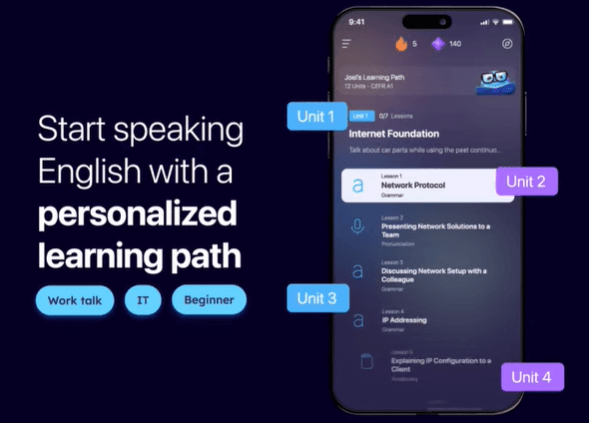

User reviews (0)