
 flightsim.to
No paid content found
flightsim.to
No paid content found
Categories: Other
✓ Discover Freeware Microsoft Flight Simulator 2020 & 2024 mods and add-ons - Explore a wide range of new Aircraft, Liveries, Airports, Tweaks, and more for both MSFS 2020 and 2024 at no cost.
 Visit website
 Updated: 2026-10-01 04:10
 Language: English (default)
 Access: Normal
 Profile views 0
 Outbound visits 0
Related questions
More questions →What Is an Aircraft? Types, Categories, and How to Get Involved in Aviation
An aircraft is any machine designed to fly through the air, supported by the air itself rather than by the ground. That covers airplanes, helicopters, gliders, balloons, and drones. If you're asking because you want to start flying or building, the practical next step is to connect with a local chapter of the Experimental Aircraft Association (EAA) — a group like EAA Chapter 62 in San Jose, California, which runs fly-outs, Young Eagles flights, and builder resources. This article explains the categories, the basic parts, how certification works, and how to take your first step.
What Counts as an Aircraft
The defining feature is that an aircraft generates lift from the air (aerodynamically or aerostatically) instead of riding on a road or rail. A car pushes against the ground; an aircraft pushes against air.
Common categories:
| Category | How it flies | Typical use |
|---|---|---|
| Airplane | Fixed wings generate lift; engine drives a propeller or jet | Travel, training, recreation |
| Helicopter | Rotating blades generate lift and thrust | Hovering, rescue, short hops |
| Glider / sailplane | No engine (or a retractable one); rides rising air | Soaring, training |
| Lighter-than-air | Balloon or airship floats on a lifting gas | Recreation, advertising |
| Light sport aircraft (LSA) | Small, simple, limited weight and speed | Affordable personal flying |
| Experimental / homebuilt | Built or assembled by an individual, often from a kit | Personal flying, learning by building |
"Experimental" here is a certification category, not a warning that the aircraft is dangerous. It's the route most homebuilders use.
The Basic Parts and What They Do
You don't need to memorize these to start, but knowing them makes every later conversation easier.
- Wings — create lift. Ailerons on the trailing edge roll the aircraft left and right.
- Fuselage — the body that holds people, cargo, and connects everything.
- Engine and propeller — provide thrust (or, on a jet, the engine provides thrust directly).
- Empennage (tail) — the elevator controls pitch (nose up/down); the rudder controls yaw (nose left/right).
- Landing gear — wheels, skids, or floats for ground or water operation.
The three primary controls — ailerons, elevator, rudder — are what a student pilot learns first, along with throttle and, on many aircraft, flaps.
How Aircraft Are Certified, and Why Homebuilts Exist
Factory-built aircraft are typically certified to a published standard, which is expensive and slow to change. That's why most new designs and affordable personal aircraft come through other paths:
- Standard airworthiness — factory aircraft built to full certification rules.
- Light sport — a simpler, lighter category with defined limits.
- Experimental / amateur-built — an individual builds or assembles the aircraft, usually from a kit, and it's registered in this category. This is the heart of the homebuilt movement.
The trade-off is real: experimental aircraft give builders flexibility and lower cost, but the owner takes on more responsibility for testing and maintenance decisions. That's exactly why builder communities exist.
How to Get Involved Through a Local EAA Chapter
EAA chapters are volunteer groups where builders, pilots, and curious beginners meet. A chapter site like EAA Chapter 62 (San Jose, California) shows the typical menu of activities:
- General meetings and board meetings — open gatherings, usually the easiest first contact.
- Fly-outs — group flights to nearby destinations.
- Young Eagles flights — free introductory flights for young people, run by volunteer pilots.
- Builder's logs and builder assist — shared experience from people actually building aircraft.
- Tech notes and flight planning / weather resources — practical references for pilots and builders.
- Scholarships and aviation careers — pathways for students, including an AirAcademy scholarship and aviation careers information.
- Show-N-Swap and photo galleries — events and community records.
If you're near San Jose, the chapter's site is a direct entry point. If you're elsewhere, search for your nearest EAA chapter and attend a general meeting — you don't need to be a member or own an aircraft to show up.
First Steps: Learning to Fly or Building
If you want to fly:
- Take an introductory flight (a Young Eagles flight if you're young, or a discovery flight at a local flight school).
- Visit a chapter meeting and ask pilots how they trained and what it cost in their area.
- Choose a training path — sport pilot or private pilot — based on your goals and budget.
- Start ground study and log flight hours with an instructor.
If you want to build:
- Attend a chapter meeting and look at builder's logs and builder-assist resources.
- Decide between a kit and plans-built; kits are faster, plans-built is more involved.
- Talk to people who have completed a build — the lessons they share save the most time.
- Understand the experimental/amateur-built registration and testing process before you buy anything.
Common Questions
Do I need a license to fly? Yes, for any aircraft you pilot — the specific certificate depends on the category.
Is "experimental" unsafe? No. It's a certification category. Safety depends on the build quality, testing, and maintenance.
Can I get involved without flying or building? Yes. Chapters need volunteers for events, Young Eagles registration, and newsletters.
Where do I start if I'm a student? Look for Young Eagles flights, scholarships, and aviation-careers resources through a local chapter.
The fastest way to move from curiosity to action is to attend one chapter meeting. Everything else — training, building, and the people who help you do it — tends to follow from there.
What Is MSFS and How Does It Connect to Virtual Airlines Like Delta Virtual Airlines?
MSFS stands for Microsoft Flight Simulator, and in the context of Delta Virtual Airlines it refers specifically to Microsoft Flight Simulator 2020 — the modern version the VA lists among its supported simulators. If you already fly MSFS and want a structured reason to keep flying, you can join Delta Virtual Airlines, file flight reports, and fly Delta and alliance routes without any connection to the real airline. The main condition is that you join the active pilot roster before you can submit reports or post in the forums.
MSFS vs. the older simulators Delta Virtual Airlines supports
Delta Virtual Airlines is a flight simulation community, not a software product. Its own description says its members fly Delta Air Lines and alliance partner routes using a range of simulators, and MSFS 2020 is one of them. The full supported list from the site:
| Simulator | Status on Delta Virtual Airlines |
|---|---|
| Microsoft Flight Simulator 2020 (MSFS) | Supported |
| Flight Simulator X (including Steam Edition) | Supported |
| Microsoft Flight Simulator 2004 | Supported |
| Lockheed-Martin Prepar3D v1–5 | Supported |
| Laminar Research X-Plane 10/11/12 | Supported |
So MSFS is not a separate program you need in order to fly for the VA — it is one of several simulators you can use. The practical difference is mostly visual and technical: MSFS 2020 is the newest of the Microsoft line, while FS2004 and FSX are much older platforms and Prepar3D is Lockheed-Martin's simulation-oriented branch. Delta Virtual Airlines supports all of them, which means your choice of simulator does not decide whether you can participate.
What a virtual airline actually is
A virtual airline (VA) is an organized group of flight simulation enthusiasts who replicate an airline's routes, schedules, and procedures in a simulator. Delta Virtual Airlines describes itself as "a group of flight simulation enthusiasts who fly Delta Air Lines and its alliance partners' routes." Two things follow from that:
- You are flying simulated routes, not real ones.
- The organization is independent. Delta Virtual Airlines states plainly that it is "in no way affiliated with Delta Air Lines."
The site also reports scale: since May 2003 it has received over 29,037,507 visits and 690,300,495 hits, and its servers have sent out over 23,598,529,145,233 bytes of data. Those numbers describe a long-running, active community rather than a small club.
How MSFS pilots log flights and submit reports
The site's own wording sets the gate: "Once you join the Delta Virtual Airlines active pilot roster, you may submit flight reports and contribute to our discussion forums and image library." In other words, flight reporting is a member function, not something open to visitors.
The site's navigation shows the tools involved in that workflow — a Flight Dispatch section with a Schedule, an ACARS system with a Live ACARS Map and Google Earth ACARS Flights, plus Logbooks and a Flight Planner (a Beta release of the Flight Planner was announced on the site). For an MSFS pilot, the practical sequence looks like this:
- Join and get onto the active pilot roster.
- Pick a route from the schedule or dispatch tools.
- Fly it in MSFS 2020.
- Submit a flight report so the flight is recorded in your logbook.
The site does not spell out every click path for filing a report, so treat the exact menu steps as something you confirm after logging in rather than something to assume in advance.
Joining Delta Virtual Airlines: what to expect
The homepage presents the VA as open to a wide range of experience: it says it is "designed for both the experienced pilot and the novice (and all of us that are in between!)" and invites interested visitors to join via a "Click Here to join Delta Virtual Airlines" link. The public roster activity gives a sense of what new members look like — recent additions include pilots listed with aircraft types such as the A320, B737-800, and A330-300.
A few things worth knowing before you commit:
- Membership is required for the core activities. Flight reports, the Water Cooler discussion forum, and the image library are all gated behind the active pilot roster.
- No pricing information is stated on the page. The site does not indicate whether joining involves any cost, so do not assume it is free or paid — check the join flow itself.
- MSFS is optional, not mandatory. You can fly the same routes in FSX, FS2004, Prepar3D, or X-Plane if that is what you have.
Is it worth joining if you fly MSFS?
If your goal is to give your MSFS flying a purpose — real Delta and alliance routes, a schedule to follow, a logbook that records your progress, and a community to compare notes with — Delta Virtual Airlines is built for exactly that, and MSFS 2020 is a supported platform. If you would rather fly freeform with no reporting or roster requirements, a VA structure will feel like overhead. The deciding factor is not which simulator you own, since all the major ones are supported, but whether you want the structure of an organized virtual airline at all.
What Is MSFS 2024 and How Do You Find Free Add-Ons for It?
MSFS 2024 is the 2024 edition of Microsoft Flight Simulator, and free add-ons for it are distributed mainly through community sites such as Flightsim.to, which lists freeware aircraft, liveries, airports, scenery, and tweaks for both MSFS 2020 and MSFS 2024. The practical catch is compatibility: because the two simulators are separate platforms, an add-on built for MSFS 2020 will not automatically work in MSFS 2024, so the version a file was made for is the first thing to check before downloading.
What MSFS 2024 Is
Microsoft Flight Simulator 2024 is a flight simulator platform that shares a name and a broad feature set with MSFS 2020 but is treated as its own product by the community that builds add-ons for it. Flightsim.to, one of the larger freeware libraries, maintains separate catalog entries for the two versions, which is the clearest signal that content is not universally interchangeable between them.
For a user, that means three things matter when browsing:
- The sim version a file targets — MSFS 2020, MSFS 2024, or both.
- The add-on category — aircraft, liveries, airports, scenery, or tweaks.
- The install method — most community content is dropped into a folder rather than installed through a store.
Where to Find Free MSFS 2024 Add-Ons
Flightsim.to is the reference point here: it describes itself as a source of freeware mods and add-ons for both MSFS 2020 and 2024, covering new aircraft, liveries, airports, tweaks, and more at no cost. Its own keyword set — MSFS, MSFS 2024, MSFS 2020, flight simulator, add-ons, mods, aircraft, scenery, airports, liveries — maps directly onto the categories you will see in its listings.
When you land on a listing page, the useful fields are:
| What to look at | Why it matters |
|---|---|
| Stated sim version | Tells you whether the file targets 2024, 2020, or both |
| Category | Aircraft, livery, airport, scenery, or tweak |
| File contents | Whether it is a folder to drop in or a package to install |
| Version/update notes | Whether the author has revised it since release |
If a listing does not state a sim version, treat that as missing information rather than assuming it works in 2024.
Checking Compatibility Before You Download
Compatibility is the single biggest source of wasted downloads. A livery or scenery pack made for one simulator version may load, partially load, or not appear at all in the other.
A workable check, in order:
- Read the listing's stated sim version. If it says MSFS 2020 only, do not expect it to work in 2024.
- Look for any note about 2024 support in the description or update history.
- Check whether the add-on depends on other content (another aircraft, a library pack) that you would also need.
- Prefer listings that explicitly name MSFS 2024 over ones that are silent on version.
Installing Community Add-Ons
Community add-ons are generally installed by placing files into the simulator's community folder rather than through an in-sim store. The exact folder path depends on your installation, so confirm it from your own sim setup rather than from a generic guide.
The general shape of the process:
- Download the add-on from the listing.
- Extract it if it arrives as an archive.
- Identify the package folder — the folder that contains the add-on's manifest, not the outer folder from the archive.
- Move that folder into the community folder for MSFS 2024.
- Restart the simulator and check whether the content appears.
Expected result: the aircraft, livery, airport, or scenery shows up in the relevant in-sim menu or location. If it does not, the version mismatch or folder placement is the first thing to re-check.
Common Problems and What They Usually Mean
The add-on does not appear at all. Most often the file targets MSFS 2020, or the wrong folder level was copied into the community folder.
The sim crashes on load. Frequently a version mismatch or a conflict with another add-on. Removing the most recently added content is the fastest way to isolate it.
The add-on appears but is broken or incomplete. Usually a dependency is missing, or the file was built for a different sim version and only partially loads.
It worked before an update. Simulator updates can change what older community content supports; re-check the listing for a revised version.
Making the Choice
If you are on MSFS 2024, filter for content that explicitly names 2024, and treat 2020-only listings as a separate library you can revisit only if the author adds 2024 support. Flightsim.to's split between MSFS 2020 and MSFS 2024 listings exists precisely because that distinction decides whether a download is worth your time.
What Is MSFS 2020 and How Do You Find Free Add-Ons for It?
MSFS 2020 is the common abbreviation for Microsoft Flight Simulator 2020, Microsoft's flight simulator that supports free add-ons for aircraft, liveries, airports, scenery, and tweaks. You can find these add-ons on community sites such as Flightsim.to, which lists freeware mods for both MSFS 2020 and MSFS 2024. To use them, download the add-on and place it in the simulator's Community folder, then check that it matches your simulator version.
What MSFS 2020 Is
MSFS 2020 stands for Microsoft Flight Simulator 2020. It is a flight simulator, and its add-on ecosystem is one of the main reasons players stay with it. Add-ons let you expand the base simulator without buying a new title.
The main free add-on categories are:
- Aircraft — new or modified planes you can fly
- Liveries — paint schemes and markings for existing aircraft
- Airports and scenery — detailed airports, landmarks, and terrain
- Tweaks — adjustments that change performance or visuals
Flightsim.to describes its catalog as covering "a wide range of new Aircraft, Liveries, Airports, Tweaks, and more for both MSFS 2020 and 2024 at no cost." That combination — multiple categories, both simulator versions, freeware — is what makes a community library useful when you are looking for something specific.
How to Find Free Add-Ons
- Go to a community library. Flightsim.to is one example; it hosts freeware mods and add-ons for MSFS 2020 and MSFS 2024.
- Filter by simulator version first. Because the site serves both MSFS 2020 and MSFS 2024, confirm the listing supports MSFS 2020 before downloading. A mod built for one version may not work correctly in the other.
- Filter by category. Narrow to aircraft, liveries, airports, scenery, or tweaks depending on what you want to change.
- Read the listing before downloading. Check the description, version notes, and any stated requirements. This is where compatibility problems usually show up.
How to Install an Add-On
The general pattern for MSFS 2020 add-ons is:
- Download the add-on file.
- Extract it if it is compressed.
- Move the add-on folder into your MSFS 2020 Community folder.
- Launch the simulator and confirm the add-on appears or loads.
Expected result: the aircraft, livery, airport, or tweak becomes available in the simulator after restart.
Common snags:
- The add-on was built for MSFS 2024, not MSFS 2020.
- The folder was nested one level too deep inside Community, so the simulator does not detect it.
- A required dependency or update is missing.
Choosing Add-Ons Safely
- Prefer listings that clearly state MSFS 2020 support.
- Check that the file type and contents match what the listing describes.
- Treat version compatibility as the first filter, not an afterthought — it prevents most failed installs.
If you only want to change how an existing plane looks, a livery is the lightest option. If you want new flying experiences, look at aircraft. If you want the world to look better on the ground, airports and scenery are the place to start.
Freeware: What It Is and How to Choose Safe Free Software
Freeware is software you can download and use at no cost, but the developer keeps the copyright — you don't get the source code or the right to modify and redistribute it. That single fact separates it from open-source software, and it's also why "free" tells you nothing about how the program is funded. Some freeware is genuinely free with no strings; some bundles adware, toolbars, or upsells. The practical skill is telling those apart before you install. XnView, a photo viewer and batch converter for Windows, macOS, and Linux, is a useful example of freeware done cleanly — its own site describes it as free for private (non-commercial) use, with no adware.
Freeware vs. the other "free" labels
These terms get used interchangeably, but they describe different licensing and business models. Knowing which one you're looking at tells you what to expect after install.
| Model | Cost | Source code | Typical catch |
|---|---|---|---|
| Freeware | Free | Closed | May be limited to personal use; may show donation prompts |
| Open source | Free | Public | None by license, but support may be community-only |
| Free trial | Free for a period | Closed | Stops working or limits output after the trial ends |
| Freemium | Free tier | Closed | Core features locked behind a paid upgrade |
| Shareware | Free to try | Closed | Expects payment to keep using it legitimately |
| Adware-supported | Free | Closed | Funded by ads or bundled installs |
The key distinction for freeware: the price is zero, but the license usually restricts how you can use it. XnView's own wording — "free for private (non-commercial) use" — is a common freeware pattern. If you plan to use a tool at work or in a product you sell, check the license terms rather than assuming "free" means "free for anything."
How freeware gets funded (and where the risk lives)
A zero price doesn't mean zero cost to produce, so the money comes from somewhere. The common sources:
- Donations — the developer asks, you decide. XnView's site includes a Donate link, which is a request, not a requirement.
- A paid tier or companion product — the free version drives interest in something paid.
- Ads or bundled software — the installer offers extra programs, toolbars, or changes your browser settings. This is the main safety concern with freeware.
- Commercial licensing — free for individuals, paid for business use.
The risk isn't freeware itself; it's where you download it from. Third-party download portals often wrap a legitimate installer in their own downloader that adds bundled offers. The developer's own site is the reliable source.
Verifying a download before you install
Run these checks in order. Each one is quick, and together they catch most problems.
- Start at the official site. Search for the product name and confirm the domain matches the developer. For XnView, that's xnview.com — not a mirror or aggregator.
- Read the license line. Look for wording like "free for private use" or "free for personal and non-commercial use." That tells you whether your intended use is covered.
- Check the version and platform. The official page lists current versions and which operating systems they support, so you can confirm you're getting a build that matches your machine.
- Watch the installer, not just the download. Decline any pre-checked boxes offering extra software. A clean freeware installer won't require them.
- Note the uninstall behavior. Before committing, know how you'd remove it — a normal entry in your system's app list is the baseline.
If a download page pushes a "download manager" instead of the file itself, or the file name doesn't match the product, stop and go back to the official source.
What XnView shows about a well-run freeware product
XnView is a concrete case of freeware that fits the clean pattern. According to its site, it's a free image viewer for Windows, macOS, and Linux that opens a wide range of formats — JPEG, TIFF, PNG, GIF, WEBP, JPEG-XL, AVIF, HEIC, PSD, JPEG2000, OpenEXR, camera RAW, PDF, DNG, and CR2 among them. Beyond viewing, it handles color adjustment, resizing, cropping, screen capture, and metadata editing (IPTC, XMP), plus batch rename, batch conversion, duplicate finding, and image comparison.
The product line is split by task, which is worth knowing before you pick one:
- XnView MP — the current cross-platform viewer and organizer (version 1.11.7 at the time of the source page).
- XnView Classic — the Windows-focused viewer (version 2.52.7).
- XnConvert — a batch image converter for Windows, macOS, and Linux (version 1.116.0), for converting, resizing, watermarking, adding text, and filtering in bulk.
- XnResize — a batch resizer.
- NConvert — a command-line tool for developers who need format support in their own applications.
The site describes these as "professional free applications" and states XnView and XnConvert are free for private (non-commercial) use. It also advertises "no adware." Note what the source does not say: it doesn't claim the software is open source, and it doesn't state pricing for commercial use. If you need it for business, treat the commercial terms as something to confirm with the developer rather than assume.
A practical checklist before installing any freeware
- [ ] Downloaded from the developer's official domain, not a portal
- [ ] License terms read, and your use (personal vs. commercial) is covered
- [ ] Version and platform match your system
- [ ] Installer's optional extras declined
- [ ] You know how to uninstall it
- [ ] For batch or automated work, you've confirmed the tool does what you need before relying on it
Freeware is a legitimate and often excellent way to get capable software at no cost — XnView's format support and batch tools are a good example. The deciding factor is rarely the price tag; it's whether the license fits your use and whether the download came from the source that controls it.
Website Overview
An established domain and managed infrastructure suggest continuity of operations and may support dependable delivery, although neither guarantees service quality. Several search or sharing settings need attention. Together they may make snippets, preview images or preferred URLs less consistent across platforms.
Domain and Registration
Registered in 2020, this domain has about 6 years of history. That suggests continuity, although ownership and purpose may have changed. The registrar is NAMECHEAP, a widely used domain service provider. The domain uses the common .to extension, which is not an independent safety signal.
DNS and Email
Nameservers are provided by Cloudflare, indicating managed DNS hosting. MX records point to the Namecheap Private Email email service. CAA records restrict which certificate authorities are authorized to issue certificates. No CNAME was found; the observed records resolve directly to addresses. SPF and DMARC are configured. DKIM status is unknown.
TLS and Certificates
The public key uses EC with 256 bits. The server supplied a complete certificate chain. No organization name is present in the certificate; the available fields are consistent with domain validation. The certificate was issued within the Google Trust Services cloud or CDN ecosystem. The certificate's total validity is about 90 days, consistent with a short renewal cycle.
HTTP and Browser Security
The response lacks these common security headers: HSTS, X-Content-Type-Options, Referrer-Policy, Permissions-Policy. No X-Powered-By header was found, reducing one common source of backend fingerprinting information. The cf-ray response header indicates a CDN or caching proxy in the delivery path. No obvious internal addresses or debug information were found in the headers. The Server header identifies cloudflare without an exact version.
Technology Stack Analysis
The public page identifies Google Analytics, Cloudflare without precise versions, leaving fewer clues for version-specific scanning.
Search and Social Sharing
The title has 66 characters and may be truncated in search results. The meta description has 192 characters and may be shortened in search results. Twitter Card metadata is configured. The observed directives allow indexing and link following. No Generator meta tag is publicly exposed.
 Hosting and Email
 Cloudflare
 Hosting
 Namecheap Private Email
 Location
 unknown
104.20.22.250
Location
Location unknown
104.20.22.250
 Pages, Search and Sharing
| Meta description | ✓ Discover Freeware Microsoft Flight Simulator 2020 & 2024 mods and add-ons - Explore a wide range of new Aircraft, Liveries, Airports, Tweaks, and more for both MSFS 2020 and 2024 at no cost. |
|---|---|
| Canonical URL | https://flightsim.to/ |
| Language | English (default) |
| Twitter Card | summary_large_image |
Social Sharing Preview
13 fields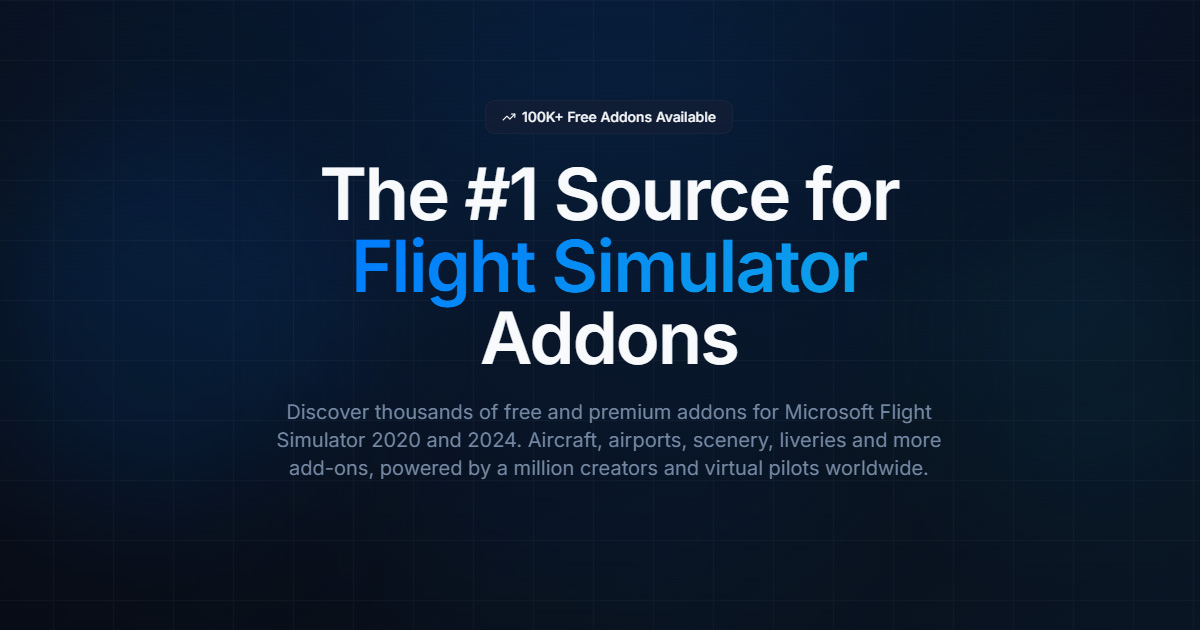

Sharing metadata
| og:url | https://flightsim.to/ |
|---|---|
| og:type | website |
| og:image | https://flightsim.to/images/og-image-v2.jpg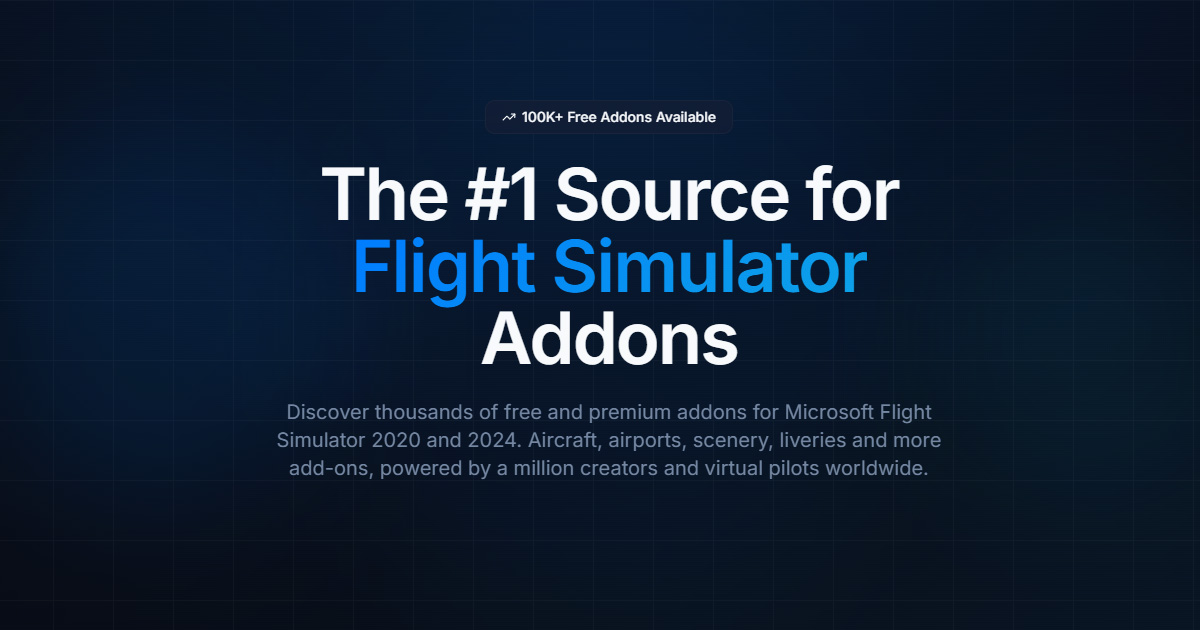 |
| og:title | Flightsim.to - Microsoft Flight Simulator Mods, Add-Ons & Liveries |
| og:locale | en_US |
| og:site_name | Flightsim.to |
| og:description | ✓ Discover Freeware Microsoft Flight Simulator 2020 & 2024 mods and add-ons - Explore a wide range of new Aircraft, Liveries, Airports, Tweaks, and more for both MSFS 2020 and 2024 at no cost. |
| og:image:width | 1200 |
| og:image:height | 630 |
| twitter:card | summary_large_image |
| twitter:image | https://flightsim.to/images/og-image-v2.jpg |
| twitter:title | Flightsim.to - Microsoft Flight Simulator Mods, Add-Ons & Liveries |
| twitter:description | ✓ Discover Freeware Microsoft Flight Simulator 2020 & 2024 mods and add-ons - Explore a wide range of new Aircraft, Liveries, Airports, Tweaks, and more for both MSFS 2020 and 2024 at no cost. |
robots.txt (opens in a new tab)
29 rulesgooglebot 1 allowed · 8 disallowed

 googlebot

/
/terms/privacy/legal/dmca/messages//ajax//auth//cronjobs/
bingbot 1 allowed · 8 disallowed
//terms/privacy/legal/dmca/messages//ajax//auth//cronjobs/
twitterbot 1 allowed · 0 disallowed
/
facebookexternalhit 1 allowed · 0 disallowed
/
All bots 1 allowed · 8 disallowed
//terms/privacy/legal/dmca/messages//ajax//auth//cronjobs/
No matching rules.
Sitemaps
1 Registration details RDAP / WHOIS
| Registrar | NAMECHEAP |
|---|---|
| Registered | 2020-08-27 |
| Expires | 2027-08-27 |
| Domain status | active |
| Nameservers | dora.ns.cloudflare.com、rick.ns.cloudflare.com |
| DNSSEC | unsigned |
 DNS records
| Type | Name | Value | TTL | Priority |
|---|---|---|---|---|
| A | flightsim.to | 104.20.22.250 | 300 | — |
| A | flightsim.to | 172.66.175.2 | 300 | — |
| AAAA | flightsim.to | 2606:4700:10::6814:16fa | 300 | — |
| AAAA | flightsim.to | 2606:4700:10::ac42:af02 | 300 | — |
| MX | flightsim.to | mx1.privateemail.com | 300 | 10 |
| MX | flightsim.to | mx2.privateemail.com | 300 | 10 |
| NS | flightsim.to | dora.ns.cloudflare.com | 86400 | — |
| NS | flightsim.to | rick.ns.cloudflare.com | 86400 | — |
| TXT | flightsim.to | ahrefs-site-verification_0d51768b2ecb26b88b7555ddfa01850bc4eeea79739d47d6bd5f9178d6cc807e | 300 | — |
| TXT | flightsim.to | brevo-code:5b9352b38c797ade26f72156af47c6ac | 300 | — |
| TXT | flightsim.to | google-site-verification=9m_teyzwCQPOPljI9wwHsTdqKnFwgvoea2eUf8bbios | 300 | — |
| TXT | flightsim.to | v=spf1 include:spf.privateemail.com ~all | 300 | — |
| CAA | flightsim.to | 0 issue "comodoca.com" | 3600 | — |
| CAA | flightsim.to | 0 issue "digicert.com; cansignhttpexchanges=yes" | 3600 | — |
| CAA | flightsim.to | 0 issue "letsencrypt.org" | 3600 | — |
| CAA | flightsim.to | 0 issue "pki.goog; cansignhttpexchanges=yes" | 3600 | — |
| CAA | flightsim.to | 0 issue "ssl.com" | 3600 | — |
| CAA | flightsim.to | 0 issuewild "comodoca.com" | 3600 | — |
| CAA | flightsim.to | 0 issuewild "digicert.com; cansignhttpexchanges=yes" | 3600 | — |
| CAA | flightsim.to | 0 issuewild "letsencrypt.org" | 3600 | — |
| CAA | flightsim.to | 0 issuewild "pki.goog; cansignhttpexchanges=yes" | 3600 | — |
| CAA | flightsim.to | 0 issuewild "ssl.com" | 3600 | — |
| DMARC | _dmarc.flightsim.to | v=DMARC1;p=none;pct=100;aspf=r;adkim=r; | 300 | — |
 TLS and certificates
| Assessment | Normal configuration |
|---|---|
| Supported protocols | TLSv1.2、TLSv1.3 |
| Negotiated protocol | TLSv1.3 |
| Certificate subject | flightsim.to |
| Issuer | Google Trust Services |
| Valid until | 2026-12-27T11:15 · Remaining when checked: 87 days |
| Verification details | Certificate trust: Passed · Hostname match: Passed |
 HTTP response headers
| Header | Value |
|---|---|
| content-type | text/html; charset=UTF-8 |
| cache-control | no-store, no-cache, must-revalidate |
| server | cloudflare |
| content-security-policy | frame-ancestors 'self' |
| x-frame-options | SAMEORIGIN |
| set-cookie | Redacted |
 Identified technologies
Recent Updates
- Website images
- Screenshots
- Network details
- Website Technologies
- Pages and Search Information
- HTTP Response Information
- TLS and certificates
- DNS Information
- Domain Registration
- Website profile
- Website Description
- Website Name
- Website profile
- Website Description
- Website Name
User reviews (0)