Website profiles · Technology insights · Alternatives

fluentwithstories.com

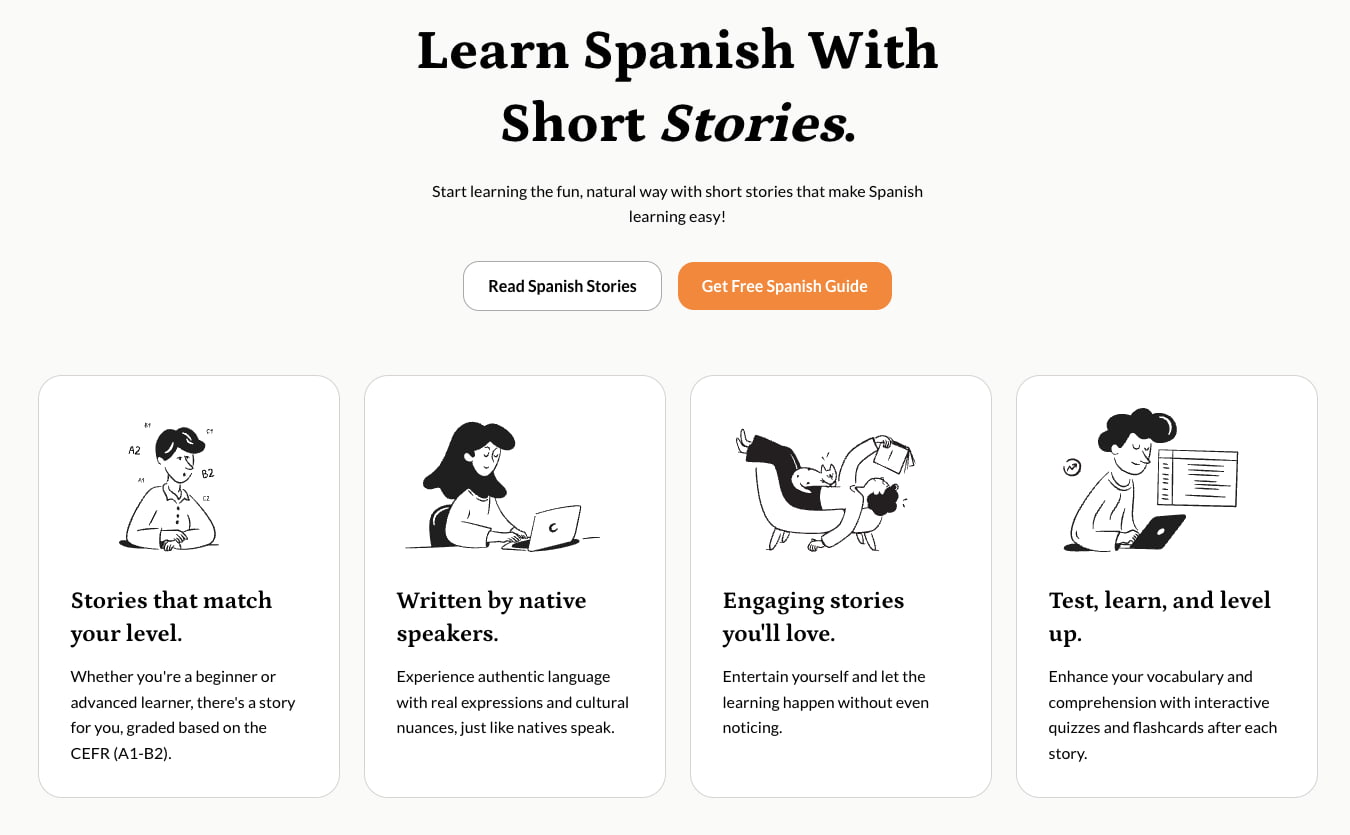
Discover the joy of learning Spanish with short stories. Follow along with native audio, English translations, and fun exercises to help you improve!

No paid content found
Visit website
Profile views 6 Outbound visits 14 Normal
Fluent With Stories Full homepage screenshot

At a glance

Category
Education & Learning
Language
English
Paid-content signal
No paid content foundObserved
Registered
2025
Hosting
CloudflareInferred
HTTPS certificate trusted
PassedObserved
Last updated

Website review

This review may include AI-generated content and is not individually verified. Domain, certificate and other facts come from the observed data on this page.

What is Fluent With Stories?

Fluent With Stories is a Spanish-learning website built around short stories rather than grammar drills. Its premise is simple: you read a story graded to your level, listen to native audio, and then reinforce what you read with quizzes and flashcards. The site also offers a free PDF ebook, "Learn 100 Must-Know Spanish Phrases Through Short Stories."

What you actually do on the site

  • Pick a story by CEFR level, from A1 (beginner) to B2 (upper intermediate).
  • Read the Spanish text, with English translations available for support.
  • Follow along with audio recorded by a native speaker.
  • After each story, work through interactive quizzes and flashcards to test vocabulary and comprehension.

Who it suits

The graded levels make it workable for a genuine beginner who wants real sentences instead of isolated word lists, while the B2 stories give intermediate learners something more substantial than textbook dialogues. The story catalogue leans toward everyday and emotional situations — a new neighborhood in Madrid, a first gym session, a summer romance, an immigrant's fresh start, a mystery-solving writer — so it rewards learners who stay motivated by narrative rather than by exercises alone.

What it is not

It is not a structured course with a fixed syllabus, and it will not teach you grammar systematically. If you need explicit explanations of verb tenses or pronoun placement, this works better as a supplement alongside a course or tutor than as your only resource. The trade-off is the usual one for story-based learning: you get authentic phrasing and cultural nuance, but you have to be comfortable learning some things by exposure rather than by rule.

A practical next step

Start with one A1 story even if you think you are past that level. Read it once without the translation, then again with it, then listen to the audio. If you understand roughly 80 percent on the first pass, move up a level; if you are lost, stay put and use the flashcards before trying again.

For comparison, LingQ takes a similar reading-and-listening approach across many languages, while Duolingo offers structured beginner lessons in Spanish if you want grammar practice alongside your reading.

How do the CEFR levels A1 to B2 help me choose the right Spanish story for my current skill?

The CEFR labels on Fluent With Stories are a difficulty filter: each story is graded A1, A2, B1 or B2, so you pick the level where you can follow the plot without translating every line. The site describes the range as covering beginner through advanced learners, so the label is your main signal for whether a story will feel comfortable, challenging or overwhelming.

What each level usually means in practice

Level Typical reader What a story at this level asks of you
A1 First weeks or months of Spanish Short sentences, present tense, everyday vocabulary; you can guess unknown words from context
A2 You can handle simple past narration Longer sentences, more past tense, small surprises in the plot; some new words per paragraph
B1 You can read a short story without pausing constantly Connected narration, dialogue with idiomatic phrasing, subplots
B2 You read for pleasure and want authentic texture Complex sentences, nuance, cultural references, less scaffolding

The page shows this in action: the A1 stories are simple slice-of-life setups (a new neighbourhood, a first gym session), the A2 stories add emotional turns (a lost job, an anniversary that goes wrong), and the B1 and B2 stories carry longer arcs, including a recurring mystery character at B2.

How to choose without guessing

  1. Read the first two paragraphs of a story one level below your instinct. If you understand roughly 80–90% without a dictionary, that is your comfortable level.
  2. Move up a level when you finish a story and the quizzes feel easy rather than revealing.
  3. Drop a level when you keep stopping to look up words; comprehension, not difficulty, drives progress.
  4. Use the same level across several stories before jumping, so the vocabulary repeats and sticks.

The site also pairs each story with native audio, an English translation and post-story quizzes and flashcards, which means a slightly harder story is still workable: you can listen first, then read, then test yourself. A learner preparing for a trip to Madrid, for example, might work through the A1 and A2 Madrid-set stories for everyday vocabulary, then try B1 for dialogue that sounds more like real conversation.

A useful next step: open one A1 and one B1 story, read the opening paragraph of each, and let your comprehension decide which one you finish today. For broader level descriptions, the Council of Europe publishes the official CEFR scales, and Instituto Cervantes offers Spanish-specific level guidance.

What interactive exercises and quizzes come with each story to practice vocabulary and comprehension?

Each story on Fluent With Stories pairs with two interactive practice formats: quizzes and flashcards. The site's own description states that after each story you can "enhance your vocabulary and comprehension with interactive quizzes and flashcards," so the exercises are positioned as a post-reading check rather than a separate course.

How the two formats divide the work

Format Likely focus Best used for
Interactive quizzes Comprehension of the story you just read Checking whether you followed plot, characters and details
Flashcards Vocabulary from the story Memorising words and phrases until they stick

What this looks like in practice

A learner working through an A2 story such as "El Billete de La Felicidad" would read the Spanish text, then take the quiz to confirm they understood why Marcos buys his ticket, and finally run the flashcards to lock in the words they had to guess. The A1 stories, like "Mi Nuevo Barrio," suit the same loop at an easier level, while B1 and B2 texts such as "Cartas de Aquel Verano" or "Mateo y El Misterio de Los Muebles" give more room for vocabulary gain per story.

Trade-offs to weigh

  • The exercises are tied to specific stories, so vocabulary is learned in context rather than from a themed word list — good for retention, less systematic for exam-style coverage.
  • Quizzes test the story in front of you; they are not a general placement or progress test.
  • Flashcards built from a story you enjoyed tend to be more memorable than a generic deck, but you get less control over which words appear.

Next step: pick one story at your CEFR level, read it once without stopping, then take the quiz before touching the flashcards — that order shows you which words you genuinely missed rather than which ones you merely recognise. If you want a broader graded library to compare against, Fluent With Stories lists its stories by level, and you can sanity-check the CEFR bands against a reference such as Instituto Cervantes.

Is the audio narration recorded by a native Spanish speaker, and does it include English translations?

Yes. Fluent With Stories says its short stories come with native audio and English translations, and the page adds that the stories are written by a native speaker using authentic expressions and cultural nuances.

What that means for you

  • Audio: You get narration to listen to alongside the text, which supports pronunciation, rhythm and listening comprehension rather than reading alone.
  • Translations: English translations let you check meaning without leaving the story, which is most useful at A1–A2 when a single unknown word can derail a whole paragraph.
  • Level fit: Stories are graded A1–B2, so you can pick material where you understand roughly most of the text and use the translation for the rest.

A practical way to use it

Try a three-pass routine on one story: read the Spanish once without help, read again with the translation to resolve gaps, then listen to the audio without looking at either. If the audio-only pass feels comfortable, move up a level; if you catch only scattered words, stay put and repeat the same story a day later.

What to confirm yourself

The page describes native audio and translations generally rather than detailing how the audio is delivered or whether translations are line-by-line or full-text. If that distinction matters to you, open a sample story and check before committing time. For a second opinion on story-based Spanish learning generally, Fluent With Stories is the product itself; broader learner communities such as Reddit can tell you how others combine audio, translation and flashcards in practice.

How can I get the free PDF ebook of 100 must-know Spanish phrases through short stories?

Sign up for the site's email list on Fluent With Stories. The free ebook, Learn 100 Must-Know Spanish Phrases Through Short Stories, is delivered by email after you submit the subscription form.

What to expect

  • Enter your email address in the signup form near the free PDF offer.
  • Confirm your subscription if a confirmation email arrives.
  • Check your inbox for the ebook; the page's own confirmation message says it has been sent to your email inbox.
  • If it does not appear, check spam, promotions, or updates folders and search for "Fluent With Stories" or "Spanish phrases."

Practical notes

  • The signup states you agree to receive emails and can unsubscribe at any time, so treat this as joining a mailing list rather than a one-off download.
  • The ebook is described as a story-based guide to phrases in context, readable on the go or offline. That makes it most useful if you want phrase practice during commutes or short breaks, not a full grammar course.
  • If you prefer not to subscribe, the site also offers graded short stories at A1–B2 with native audio, translations, quizzes, and flashcards; those can serve as an alternative way to learn phrases in context.

A sensible next step: subscribe, then read one story at your CEFR level and note five phrases from the ebook that appear in it. That turns the PDF from a phrase list into active vocabulary you can reuse.

Can these short stories help me learn real-life Spanish expressions and cultural nuances instead of textbook language?

Yes. The site is built around exactly that goal: the stories are described as written by a native speaker and designed to expose you to "real expressions and cultural nuances, just like natives speak," rather than drill-style textbook sentences. The story list reinforces this — the A1–B2 titles are everyday situations (moving to a new neighborhood in Madrid, a first gym session, an anniversary dinner, a summer romance, emigrating from Venezuela to Spain), which is the kind of context where idiomatic phrasing and cultural assumptions actually show up.

What that means in practice:

  • Expressions in context. You meet a phrase inside a scene with a speaker, a mood and a consequence, so you can infer tone (ironic, polite, annoyed) instead of just translating it.
  • Cultural texture. Settings like Plaza Mayor or a Madrid restaurant carry social details — how people greet, tease, complain or flirt — that a vocabulary list strips out.
  • Level control. Because stories are graded A1–B2, you can get authentic language without being drowned by it. Textbook language is often "safe but fake"; graded authentic language is the middle path.

A realistic reader scenario: you're at A2 and keep freezing in casual conversation because you only know formal classroom forms. You read an A2 story about an anniversary dinner going wrong, note two or three phrases you'd never have produced yourself, then replay the native audio and copy the rhythm. That's a far better bridge to real speech than memorizing a dialogue about ordering a train ticket.

Trade-off to be honest about: stories alone won't fix your speaking. They build recognition and intuition; production still needs you to reuse the phrases out loud. The site's post-story quizzes and flashcards help lock in vocabulary and comprehension, which supports that, but treat them as reinforcement, not as conversation practice.

Next step: pick one story at or just above your level, read it once without translating, then read again and highlight only the expressions you couldn't have written yourself. Say each one aloud in a sentence about your own life. If you want a second source of authentic input to compare phrasing, RTVE offers native Spanish audio and video, and Real Academia Española is useful when you want to check how a colloquial expression is actually regarded.

Related questions

More questions →
What Learning Tools and Exercises Does Fluent With Stories Offer?

Fluent With Stories is a Spanish learning site built around graded short stories. Each story comes with native-speaker audio, English translations, and follow-up exercises — interactive quizzes and flashcards — so you can read, listen, and then test yourself on what you just absorbed. It suits beginner through upper-intermediate learners (CEFR A1–B2) who want to learn through reading rather than drills. There is also a free PDF ebook, Learn 100 Must-Know Spanish Phrases Through Short Stories, available by email signup.

The core learning loop

The site's own framing is "Test, learn, and level up" — the idea being that vocabulary and comprehension are reinforced after each story through interactive quizzes and flashcards, not before. In practice, that suggests a four-step routine:

  1. Read the story at your level, using the English translation only when you get stuck.
  2. Listen to the native audio — ideally a second pass, reading along or just listening.
  3. Take the quiz to check comprehension.
  4. Run the flashcards to move new words into longer-term memory.

The order matters less than the repetition: the same vocabulary shows up in the story, the quiz, and the flashcards, which is what makes the loop work.

Stories graded to your level

Stories are graded on the CEFR scale from A1 to B2, and the site states there is a story for you whether you are a beginner or advanced learner. The catalog visible on the homepage shows the spread:

Level Example story Premise
A1 Mi Nuevo Barrio Ana moves to Madrid and explores her new neighborhood around Plaza Mayor
A1 La Lección Dolorosa Luis ignores his friend's gym advice — and regrets it
A2 El Billete de La Felicidad Marcos buys a ticket to the most distant destination after losing his wife and job
A2 Una Noche Casi Perfecta A Madrid anniversary dinner that stops going perfectly
B1 Cartas de Aquel Verano A summer love between two teenagers
B1 La Voz de Venezuela Bianca leaves Venezuela for Spain with no money and no help
B2 Mateo y El Misterio de Los Muebles A blocked writer solves a mystery about furniture that moves on its own
B2 Mateo y La Novia Sospechosa Mateo investigates a fiancé suspected of cheating days before a wedding

A useful way to pick: choose the level where you can follow the plot but still meet several unfamiliar words per paragraph. If you understand nearly everything, move up; if you are translating every sentence, move down.

Native audio and English translations

The site describes the stories as "written by a native speaker," with authentic expressions and cultural nuances "just like natives speak." The audio is likewise native. Two practical ways to combine the audio and translation:

  • Translation as a safety net, not a crutch. Read the Spanish first, then check the English only for passages that stay opaque. Reading the translation first turns the story into a comprehension exercise in English rather than Spanish.
  • Audio for rhythm and listening skill. After you understand a story, replay the audio without the text. Because you already know what happens, you can focus on sounds, contractions, and sentence rhythm instead of meaning.

Quizzes and flashcards

After each story, interactive quizzes and flashcards target vocabulary and comprehension. Treat them as a diagnostic rather than a grade:

  • Quiz items you miss point to specific sentences worth re-reading.
  • Flashcard words you keep failing are the ones to look for in the next story at your level.

If a word keeps appearing across stories and you still miss it, that is a signal to study it deliberately rather than rely on exposure alone.

The free PDF ebook

Learn 100 Must-Know Spanish Phrases Through Short Stories is a free story-based ebook that teaches phrases "the way natives actually speak," in context, and is designed to be read on the go or offline. It is delivered by email after you subscribe (the site notes you can unsubscribe at any time). This is a good starting point if you want a sample of the site's story-based approach before committing to the graded story catalog.

How to decide if this fits you

Choose Fluent With Stories if you want reading and listening practice bundled with built-in self-testing, and you like the idea of level-graded fiction carrying your vocabulary growth. It is a weaker fit if you are looking for structured grammar instruction, live speaking practice, or teacher feedback — the site's materials center on stories, audio, translations, and post-story exercises.

What is Fluent With Stories?

Fluent With Stories is a Spanish-learning website built around graded short stories. It is aimed at learners from beginner to upper-intermediate level (CEFR A1–B2) who want to improve vocabulary and comprehension through reading and listening rather than through grammar drills. Each story is written by a native speaker, and the site pairs stories with interactive quizzes and flashcards. If you already read some Spanish and want more natural, context-based practice, this format fits; if you are looking for structured grammar lessons or live tutoring, it is not that kind of resource.

What the site actually offers

The core content is a library of Spanish short stories, each labeled with a CEFR level so you can pick something close to your current ability. Based on the site's own listing, the library spans A1 through B2, for example:

Level Example story Premise
A1 Mi Nuevo Barrio Ana moves to Madrid and explores her new neighborhood around Plaza Mayor
A1 La Lección Dolorosa Luis ignores his friend's gym advice and faces the consequences
A2 El Billete de La Felicidad Marcos buys a ticket to a distant destination after loss
A2 Una Noche Casi Perfecta A couple's anniversary dinner in Madrid goes off track
B1 Cartas de Aquel Verano A teenage summer romance and whether it lasts
B1 La Voz de Venezuela Bianca leaves Venezuela for Spain with nothing
B2 Mateo y El Misterio de Los Muebles A writer solves a mystery about furniture that moves on its own
B2 Mateo y La Novia Sospechosa Mateo investigates a bride's suspicion before her wedding

Around each story, the site describes three supporting features:

  • Native audio — you follow along with audio recorded by a native speaker.
  • English translations — translations are provided to help you through passages you don't fully understand.
  • Interactive exercises — quizzes and flashcards after each story to reinforce vocabulary and comprehension.

There is also a free PDF offer: Learn 100 Must-Know Spanish Phrases Through Short Stories, described as a story-based ebook delivered by email after subscribing. The site states you can unsubscribe at any time.

Who it suits

The level labels make the fit fairly easy to judge:

  • A1–A2 learners get short, simple narratives with everyday situations (moving to a new city, a first gym visit, a dinner date) and translation support to avoid getting stuck.
  • B1–B2 learners get longer, more emotionally complex stories (immigration, loss, a mystery series with a recurring character) where the goal shifts toward comprehension speed and picking up real expressions.

The site emphasizes "real expressions and cultural nuances" and learning "the fun, natural way," so it is best treated as extensive reading and listening practice — input that builds vocabulary and comprehension over time — rather than a course that explains grammar rules in order.

How it differs from other approaches

Most Spanish apps lead with drills, spaced-repetition vocabulary, or grammar trees. Fluent With Stories leads with narrative: you read a story at your level, listen to it, then check yourself with quizzes and flashcards. That means:

  • Strength: context. Words and phrases appear inside a plot, which tends to make them stick better than isolated word lists.
  • Strength: leveling. The A1–B2 grading lets you start where you can actually finish a story.
  • Trade-off: less explicit grammar instruction. If you want rules explained, you will need another resource alongside it.
  • Trade-off: progress depends on your own consistency, since the model is self-study reading rather than a scheduled class.

Practical notes before you start

  • Pick a story one level below what feels challenging at first — finishing a whole story matters more than struggling through a hard one.
  • Read once without translation, then again with the English translation and audio to catch what you missed.
  • Use the quizzes and flashcards as a check, not as the main event; the reading itself is the practice.
  • The free PDF is a low-commitment way to sample the story-based method before working through the full library.

If your goal is to read and listen to more Spanish at a level you can handle, with native audio and built-in comprehension checks, this site is designed for exactly that. If your goal is exam preparation or grammar mastery, treat it as one component rather than the whole plan.

How to Get the Free Spanish Guide from Fluent With Stories

Fluent With Stories offers a free PDF ebook, Learn 100 Must-Know Spanish Phrases Through Short Stories, which teaches common phrases in context through story-based reading. You get it by subscribing to the site's email list. The ebook is designed to be read on the go or offline, so once it arrives in your inbox you can download it and keep it on your device.

What the Free Guide Contains

According to the site, the free ebook teaches 100 must-know Spanish phrases "through short stories," with the goal of showing how natives actually speak by putting real-life phrases in context. It is positioned as a story-based resource rather than a phrase list, so the phrases appear inside narrative rather than as isolated vocabulary.

The site describes it as readable "on the go or offline," which means the PDF format is intended for download and later use without an internet connection.

How to Request It

  1. Go to fluentwithstories.com and find the free guide section, which appears under the heading Learn 100 Must-Know Spanish Phrases Through Short Stories!
  2. Enter your email address in the signup field.
  3. Submit the form. The site states that by subscribing you agree to its emails and privacy policy, and that you can unsubscribe at any time.
  4. Check your inbox for the ebook. The site's confirmation message reads "The ebook has been sent to your email inbox!"

The only stated requirement is an email address. No price, account creation, or login is mentioned for the guide itself.

What Happens After You Subscribe

  • You receive the PDF by email, per the site's confirmation message.
  • You are added to the site's email list. The site notes you can unsubscribe at any time.
  • If the form fails, the site shows "Oops! Something went wrong while submitting the form." In that case, re-submit the form or try again later, since the failure message does not specify a cause.

Where the Guide Fits in the Site

The free guide is one part of a broader Spanish-learning site built around short stories. The main content is a library of Spanish short stories graded by CEFR level from A1 to B2, each written by a native speaker and paired with native audio, English translations, and post-story exercises such as interactive quizzes and flashcards.

If your goal is to sample the site's approach before committing to the story library, the free guide is the lowest-friction entry point: it requires only an email and delivers a self-contained PDF. If you want structured level-based reading with audio and quizzes, the graded story library is the main product to explore after you have the guide.

How Are the Spanish Stories on Fluent With Stories Graded by Level?

Fluent With Stories grades its Spanish short stories against the CEFR scale, using the labels A1, A2, B1, and B2. That means the site's own catalog is organized so you can pick a story that matches your current reading level rather than guessing. The grading covers the range from beginner (A1) through upper-intermediate (B2), so it does not extend into C1 or C2 territory.

What the CEFR labels mean here

CEFR (Common European Framework of Reference for Languages) is the standard European scale for describing language ability. On Fluent With Stories, each story carries one of four labels:

Label Rough level What it signals on the site
A1 Beginner Shortest, simplest stories; everyday topics
A2 Elementary Slightly longer narratives, still concrete situations
B1 Intermediate More developed plots and character situations
B2 Upper-intermediate Complex stories, including multi-part series

The site states plainly that stories are "graded based on the CEFR (A1-B2)," so the label on each story is the primary signal for whether it fits you.

Examples of stories at each level

The catalog shows what each grade actually looks like in practice:

  • A1 — Mi Nuevo Barrio: Ana moves to Madrid and explores Plaza Mayor. La Lección Dolorosa: Luis goes to the gym for the first time and ignores his friend's advice. Both are short, concrete, everyday scenarios.
  • A2 — El Billete de La Felicidad: Marcos buys a ticket to a distant destination after losing his wife and job. Una Noche Casi Perfecta: a couple's anniversary dinner in Madrid goes wrong. These introduce more emotional and narrative complexity while staying grounded in familiar situations.
  • B1 — Cartas de Aquel Verano: a summer romance between two teenagers. La Voz de Venezuela: Bianca leaves Venezuela for Spain with no money or support. These carry fuller plots and social themes.
  • B2 — Mateo y El Misterio de Los Muebles and Mateo y La Novia Sospechosa: a two-story series about a writer solving mysteries. The B2 level includes recurring characters and more intricate storylines.

How the grading helps you choose

The level label lets you match reading material to your ability in a few practical ways:

  • Start where you can read without constant lookup. If A1 stories feel too easy, move to A2; if B1 feels like a slog, drop back. The labels give you a concrete way to calibrate.
  • Use the level as a filter, not a rule. A story's topic may interest you even if the label is one step above your comfort zone — the grading tells you what to expect, not what you're allowed to read.
  • Track progress across levels. Because the scale runs A1 through B2, you can watch yourself move up the same ladder the site uses to organize its catalog.

What the grading does not cover

The site's stated range is A1 to B2. There is no indication of C1 or C2 content, so advanced learners beyond upper-intermediate will not find material graded at their level here. The grading also applies to the stories themselves; the site separately mentions native audio, English translations, and post-story quizzes and flashcards, but those features are not what the CEFR labels describe.

If you are unsure where you fall, the simplest test is to open an A1 story and a B1 story and compare how much you understand on a first read. The level that feels challenging but manageable is your starting point.

Are the Spanish Stories on Fluent With Stories Written by a Native Speaker?

Yes. Fluent With Stories states that its Spanish short stories are "written by a native speaker," and the site describes the content as offering "authentic language with real expressions and cultural nuances, just like natives speak." That means the stories are intended to expose you to Spanish as it is actually used, not simplified textbook phrasing. This matters most if your goal is to understand natural dialogue, everyday expressions, and cultural context rather than only grammar rules.

What the site says about authorship and authenticity

Fluent With Stories presents two related claims on its homepage:

  • Native authorship: The site says the stories are written by a native speaker.
  • Authentic language: It describes the stories as containing "real expressions and cultural nuances, just like natives speak."

These two points work together. A story can be grammatically correct but still sound unnatural if it is written by a non-native speaker or generated from textbook patterns. The site's positioning is that its stories avoid that problem by using language a native speaker would actually produce.

Why native-written stories can help your Spanish

When you read stories written by a native speaker, you encounter:

  • Real expressions — phrases and collocations that appear in everyday speech, which may not match literal translations.
  • Cultural nuances — the way people address each other, joke, complain, or describe daily life in Spanish-speaking contexts.
  • Natural rhythm — sentence structures and dialogue that reflect how the language flows, rather than artificially simplified patterns.

For learners, this can make the difference between understanding a textbook sentence and understanding a real conversation.

Evidence of cultural range in the stories

The story list on the site suggests settings and themes that go beyond a single country or generic scenario. Examples include:

Level Story Setting or theme
A1 Mi Nuevo Barrio A move to Madrid and exploring Plaza Mayor
A1 La Lección Dolorosa A first visit to the gym and ignoring advice
A2 El Billete de La Felicidad Loss, escape, and a distant destination
A2 Una Noche Casi Perfecta An anniversary dinner in Madrid
B1 Cartas de Aquel Verano Teenage summer love
B1 La Voz de Venezuela Leaving Venezuela for Spain to survive
B2 Mateo y El Misterio de Los Muebles A writer solving a mystery about moving furniture
B2 Mateo y La Novia Sospechosa A bride suspecting her fiancé before the wedding

This range — from Madrid neighborhoods to Venezuelan migration — suggests the stories are not all set in one place or culture. For a learner, that variety can be useful because it exposes you to different vocabulary and social contexts within Spanish.

What this means for your learning decision

If your priority is authentic input — language that sounds like what native speakers actually say — the site's native-speaker authorship claim is directly relevant. The stories are graded from A1 to B2 on the CEFR scale, so you can choose a level that matches your current reading ability while still getting natural language.

If your priority is structured grammar drills or exam preparation, native-written stories alone may not be enough. The site does mention interactive quizzes and flashcards after each story, which can support vocabulary and comprehension, but the core offering is story-based reading and listening.

A practical way to test the claim

You do not have to take the native-speaker claim on faith. A simple check:

  1. Pick a story at your level.
  2. Read a paragraph and note any phrase that feels unfamiliar or different from what you would expect from a textbook.
  3. Compare it with how you have heard that idea expressed in real Spanish media or conversation.
  4. If the phrasing matches natural usage, the story is doing what the site claims.

This is also a useful habit for any Spanish learning resource: read for meaning first, then notice the expressions that sound genuinely native.

Website Overview

Page metadata, canonical configuration and social previews work together to provide more consistent search and sharing presentation.

Domain and Registration

Transfer-protection status is present, helping reduce the risk of unauthorized domain transfers. The domain has about 1 years of registration history; its current configuration provides more context than age alone. The registrar is NameCheap, Inc., a widely used domain service provider. The domain uses the common .com extension, which is not an independent safety signal.

DNS and Email

Nameservers are provided by Namecheap, indicating managed DNS hosting. MX records point to the Zoho Mail email service. SPF and DMARC are configured. DKIM status is unknown. DNSSEC signatures were not detected, so this additional DNS authenticity protection is not confirmed. The lowest observed DNS TTL is 300 seconds.

TLS and Certificates

The public key uses EC with 256 bits. The server supplied a complete certificate chain. No organization name is present in the certificate; the available fields are consistent with domain validation. The certificate was issued within the Google Trust Services cloud or CDN ecosystem. The certificate's total validity is about 90 days, consistent with a short renewal cycle.

HTTP and Browser Security

The response lacks these common security headers: CSP, X-Content-Type-Options, Referrer-Policy, Permissions-Policy, clickjacking protection. No X-Powered-By header was found, reducing one common source of backend fingerprinting information. The cf-ray response header indicates a CDN or caching proxy in the delivery path. No obvious internal addresses or debug information were found in the headers. The Server header identifies cloudflare without an exact version.

Technology Stack Analysis

The public page identifies Webflow, Google Tag Manager, Cloudflare without precise versions, leaving fewer clues for version-specific scanning.

Search and Social Sharing

Twitter Card metadata is configured. The title has 54 characters, within a common display range. A meta description is present, with 149 characters. The observed directives allow indexing and link following. No Generator meta tag is publicly exposed.

Hosting and Email

DNSNamecheap
HostingCloudflare
EmailZoho Mail
Approximate IP geolocation (inferred; a CDN or proxy may differ from the origin server) United States flagUnited States Inferred 198.202.211.1

Registration details

RDAP / WHOIS

RegistrarNameCheap, Inc.
Registered2025-01-26
Expires2028-01-26
Domain statusclient transfer prohibited
Nameserversdns1.registrar-servers.com、dns2.registrar-servers.com
DNSSECunsigned

DNS records

DNS

TypeNameValueTTLPriority
Acdn.webflow.com198.202.211.1300—
AAAAcdn.webflow.com2620:cb:2000::1300—
MXfluentwithstories.commx.zoho.eu179910
MXfluentwithstories.commx2.zoho.eu179920
MXfluentwithstories.commx3.zoho.eu179950
NSfluentwithstories.comdns1.registrar-servers.com1800—
NSfluentwithstories.comdns2.registrar-servers.com1800—
TXTfluentwithstories.commailerlite-domain-verification=b39b15457f096c9b6d8c27f226c9729560fecff21799—
TXTfluentwithstories.comv=spf1 mx include:zohomail.eu include:sendgrid.net include:_spf.mlsend.com ~all1799—
TXTfluentwithstories.comzoho-verification=zb25054441.zmverify.zoho.eu1799—
CNAMEwww.fluentwithstories.comcdn.webflow.com300—
DMARC_dmarc.fluentwithstories.comv=DMARC1; p=none;1799—

TLS and certificates

TLS / SSL

AssessmentNormal configuration
Supported protocolsTLSv1.2、TLSv1.3
Negotiated protocolTLSv1.3
Certificate subjectwww.fluentwithstories.com
IssuerGoogle Trust Services
Valid until2026-11-17T21:32 · Remaining when checked: 47 days
Verification detailsCertificate trust: Passed · Hostname match: Passed

HTTP response headers

HTTP

HeaderValue
content-typetext/html; charset=utf-8
servercloudflare
strict-transport-securitymax-age=31536000

Identified technologies

WebflowGoogle Tag ManagerCloudflare

Pages, Search and Sharing

Meta descriptionDiscover the joy of learning Spanish with short stories. Follow along with native audio, English translations, and fun exercises to help you improve!
Canonical URLhttps://www.fluentwithstories.com
LanguageEnglish (default)
Twitter Cardsummary_large_image
* allow: / 0 allowed · 0 disallowed

User reviews (0)

  • No reviews yet.