
 freeshow.app
No paid content found
freeshow.app
No paid content found
Categories: Other
FreeShow is a free and open-source presenter software for anyone to use with ease.
 Visit website
 Updated: 2026-09-26 20:21
 Language: English (default)
 Access: Normal
 Profile views 0
 Outbound visits 0
Related questions
More questions →What Is Lorem Ipsum and How Do You Generate Placeholder Text?
Lorem Ipsum is dummy text used to fill a layout before real content exists. It looks like readable Latin, so reviewers focus on typography, spacing, and visual balance instead of getting distracted by the words. You use it when you need to test a design, mockup, or template and the final copy is not ready yet. The text itself carries no meaning, so it should never ship as real content.
Where Lorem Ipsum Comes From
The standard passage is derived from Cicero's De Finibus Bonorum et Malorum, a philosophical work written in 45 BC. The familiar opening line, "Lorem ipsum dolor sit amet…", is a scrambled, altered excerpt rather than a faithful quotation. Words were changed, added, and removed over time, which is why the result reads like Latin but does not translate into coherent sentences.
The version most people recognize today was popularized in the 1960s, when Letraset sheets used it for type specimens, and it spread further with desktop publishing software that shipped it as default placeholder text.
Why Designers and Publishers Use It
- It has realistic texture. Letter and word distribution resembles natural language, so line lengths and paragraph shapes look plausible.
- It stays neutral. Readers do not start interpreting or editing the copy, which keeps feedback on the layout.
- It is widely recognized. Clients and collaborators understand it signals "content goes here."
A common mistake is treating Lorem Ipsum as a finished draft. If placeholder text reaches a live page, it signals unfinished work and can hurt credibility or search visibility.
How to Generate Placeholder Text
A Lipsum generator produces random Lorem Ipsum on demand. The general workflow:
- Choose the unit you need — words, sentences, or paragraphs.
- Set the quantity, such as five paragraphs or 50 words.
- Generate the text and copy it into your layout.
- Check that the amount fills the space realistically, then replace it with real content before publishing.
Common Variations
| Variation | Typical use |
|---|---|
| Words | Button labels, short headings, tight UI elements |
| Sentences | Captions, single-line descriptions |
| Paragraphs | Body copy blocks, article layouts, multi-column pages |
Some generators also offer lists, byte counts, or HTML output. Pick the format that matches where the text will be pasted, since pasting paragraph text into a single-line field creates messy wrapping.
What to Watch For
- Length is not meaning. A generator can produce any amount of text, but it will not tell you whether your real copy fits the design.
- Do not publish it. Search for "Lorem ipsum" before launch to catch leftovers.
- Match the language of your audience. If your product is not English, placeholder text in Latin can hide line-length problems that appear once real translated copy is inserted.
For quick layout work, a generator is the fastest path. For anything user-facing, treat the result as a temporary stand-in and swap it out before the work goes live.
What Does "Church" Mean in Asian Mission Work?
In Asian mission work, "church" usually means more than a building or a weekly service. It refers to a community of believers that is planted, led, and multiplied locally—often among an unreached people group. Asia Harvest describes its purpose as serving and equipping Asian church leaders "to see effective churches planted among unreached people groups." So when a mission organization talks about "church" in Asia, it is typically talking about a local body of believers that can sustain itself, reach its own community, and plant further churches.
The biblical and missiological meaning
In mission usage, "church" carries two layers:
- Theological: the gathered community of followers of Jesus, not a structure or denomination.
- Missiological: a reproducible local expression—small enough to multiply, rooted enough to survive pressure, and led by people from the same culture and language.
This distinction matters in Asia because many unreached groups have no existing church tradition. A "church" there may begin as a handful of believers meeting in a home, not a registered congregation with a building.
How churches are planted among unreached people groups
Church planting in this context generally follows a progression rather than a single event:
- Entry and presence — workers or local believers build relationships within a community.
- Evangelism and discipleship — new believers are taught and gathered.
- Local leadership — leadership is transferred to people from that culture as early as possible.
- Multiplication — the new church is encouraged to reach neighboring families or villages.
The goal is not to import a foreign model but to see a church that fits its own context and can reproduce without outside dependency.
Equipping local Asian church leaders
Asia Harvest's stated focus is equipping Asian church leaders rather than running churches from outside. In practice, this kind of equipping can include:
- Training in Bible teaching and discipleship
- Resources in local languages
- Support for evangelists and church planters
- Bible printing and distribution so new believers have Scripture
The underlying principle is that local leaders are best positioned to reach their own people—they already know the language, culture, and social barriers.
The role of churches in reaching unreached groups
A planted church does several things a mission team alone cannot:
| Function | Why it matters |
|---|---|
| Local witness | Believers reach family, neighbors, and coworkers |
| Cultural fit | The church expresses faith in a way the community understands |
| Sustainability | The church continues after outside workers leave |
| Multiplication | Mature believers plant further churches |
This is why "church" and "unreached people groups" are linked so closely in mission language: the church is the intended outcome, not just the method.
How readers can engage
If you want to support or take part in church-focused mission work, common entry points include:
- Prayer — many ministries list specific unreached groups and church-planting needs.
- Giving — supporting Bible printing, training, or evangelists.
- Newsletter updates — Asia Harvest, for example, offers an e-newsletter sign-up on its site for ongoing updates.
- Learning — understanding a specific people group before committing to support.
Before giving or volunteering, check what a ministry actually does with funds and whether its approach matches your own convictions about local leadership and church multiplication.
Cascadeur Free vs Paid Plans: What You Get and When to Upgrade
Cascadeur's site offers a free way to try the software and links to paid plans, but the public page does not spell out exactly what the free tier includes or where its limits sit. What it does confirm is the feature set — AI-assisted keyframe animation, AutoPosing, AutoPhysics, Ragdoll, Inbetweening, AI motion generation, rigging, retargeting, and UE Live Link — plus file compatibility with .FBX, .DAE, .GLB/.GLTF, and .USD. If you need a definitive free-vs-paid breakdown, treat the Plans page and the trial start as the two places to check, because the homepage itself doesn't publish export limits, watermark rules, or commercial-use terms.
What the public page actually tells you
The homepage positions Cascadeur as "the easiest way to animate" and invites you to "Try for free" or "Watch demo." It lists these capabilities without marking any as paid-only:
- Inbetweening — AI interpolation that generates motion between keyframes
- Ragdoll — procedural reactions to impacts, falls, and collisions
- AutoPosing — get natural poses by moving fewer control points
- Quadrupeds — rigging, AutoPosing, and one-click retargeting for four-legged animals
- AI Motion Generation — running, jumping, combat, acrobatics, idles, and more
- AutoPhysics — a character double showing a physically accurate result, for tuning secondary motion and inertia
- Rigging — drag-and-drop joints to auto-generate a rig for humanoids and quadrupeds
- Retargeting — copy/paste animation between characters regardless of skeleton or proportions
- UE Live Link — stream animation to Unreal Engine with real-time updates
It also names the solution areas: mocap cleanup, previz, animation editing, AI, video games, prototyping, and markerless mocap. Mocap cleanup is described as fixing foot sliding, knee pops, geometry penetration, poses via AutoPosing, weight via AutoPhysics, and edits via Animation Layers.
None of this is labeled "free" or "paid" on the page, so don't assume the list equals the free tier.
The two "free" paths are different things
The page shows two separate entry points, and mixing them up is the most common source of confusion:
| Entry point | What it is | What to expect |
|---|---|---|
| "Try for free" | A trial-style access route | Time-limited or feature-limited evaluation; check the Plans page for terms |
| A long-term free tier | A persistent no-cost version | Not described on the homepage; verify on the Plans page |
The trial link points to cascadeur.com/plans#trial, which means trial terms live on the pricing page, not the homepage. If your decision depends on whether you can keep using it indefinitely at no cost, that answer has to come from the Plans page — the homepage doesn't provide it.
When the free route is likely enough
Based on the feature list alone, a free or trial route is worth starting with if you are:
- Learning the workflow — testing AutoPosing and Inbetweening on a simple humanoid before committing
- Evaluating mocap cleanup — checking whether the foot-sliding and knee-pop fixes fit your pipeline
- Prototyping — blocking previz or game animation without a production deadline
- Testing file compatibility — confirming your .FBX, .DAE, .GLB/.GLTF, or .USD assets import cleanly
When upgrading becomes the real question
Upgrade pressure usually comes from constraints the homepage doesn't state, so verify each against the Plans page before paying:
- Export restrictions — if the free tier limits resolution, format, or adds a watermark, that alone can force an upgrade for client work.
- Commercial use — confirm whether free-tier output can be used in shipped products. The page doesn't say.
- Team or pipeline needs — UE Live Link and retargeting matter more in production; check whether they're gated.
- Volume of work — a single test animation and a full game's combat set have very different tolerance for limits.
A concrete example: if you're cleaning up a markerless mocap take for a game prototype and the free route lets you fix foot sliding and apply AutoPhysics, you may never need to pay. If you're delivering that animation into a commercial build and the free tier restricts export or licensing, the upgrade decision is made for you by the terms, not the feature list.
How to decide without guessing
- Open the Plans page and read the actual tier comparison — this is the only authoritative source in the material provided.
- Start the trial and test the specific features your project needs: AutoPosing, AutoPhysics, Ragdoll, Inbetweening, retargeting, and UE Live Link.
- Test an export end-to-end with your real file format (.FBX, .DAE, .GLB/.GLTF, or .USD) and inspect the output for watermarks or quality loss.
- Check the commercial-use terms in writing before shipping anything.
- Only then compare cost against the limits you actually hit.
The homepage is useful for understanding what Cascadeur does — AI-assisted keyframe animation for character work, mocap cleanup, and game pipelines. It is not a pricing document. For the free-vs-paid question specifically, the Plans page is the answer, and the trial is how you verify it against your own project.
What Are Open-Source UI Element Libraries and How Do They Differ From UI Frameworks?
An open-source UI element library is a collection of individual, ready-made interface pieces—buttons, cards, inputs, toggles, loaders—that you copy into your own project and adapt. A UI framework, by contrast, is a structured system of components, conventions, and often a theming layer that governs how your whole interface is built. The practical difference: an element library gives you a snippet; a framework gives you a way of working. If you need a polished button in ten minutes, reach for the element library. If you're building a 40-screen product with a team, you probably want the framework.
What "open-source UI element library" actually means
The term gets used loosely, so it helps to separate the parts:
- Open-source: the code is publicly available, and the license tells you what you may do with it—copy, modify, redistribute, or use commercially.
- UI element: a single, self-contained piece of interface, usually small enough to read in one sitting. A button with hover states, a pricing card, a search field.
- Library: a browsable, searchable collection of those elements, typically contributed by many different people.
On a site like Uiverse, elements are shared by a community and written in plain CSS or Tailwind. You find one you like, copy the markup and styles, paste them into your project, and adjust colors, spacing, and text to fit. There's no package to install and no build step required—which is exactly the appeal, and also the source of most of the confusion.
Element library vs. UI framework: the core differences
| Dimension | Open-source UI element library | UI framework / design system |
|---|---|---|
| Unit of reuse | A single snippet you copy | A component you import or call |
| Installation | None; paste into your code | Package install, config, sometimes a provider |
| Consistency | Depends on you; each element may look different | Enforced by shared tokens and APIs |
| Theming | Manual edits per element | Central theme/config file |
| Updates | You own the copy; no upstream updates | Version bumps bring fixes and changes |
| Accessibility | Varies per contributor; must be checked | Usually tested and documented |
| Best for | Prototypes, landing pages, small sites, one-off needs | Multi-page apps, teams, long-lived products |
| Learning curve | Low—read the CSS | Higher—learn the API and conventions |
The table isn't a verdict. It's a map of trade-offs. Element libraries win on speed and freedom; frameworks win on consistency and maintenance.
Licensing and attribution: what to check before you paste
This is where people get into trouble, and it's worth slowing down for.
- Find the license. Every element or collection should state one. Common open-source licenses include MIT, Apache-2.0, and BSD. Some projects use copyleft licenses like GPL, which can impose obligations if you redistribute your code.
- Understand what the license permits. MIT and Apache-2.0 are permissive: you can typically use the code in commercial and closed-source projects. Copyleft licenses may require you to release derivative source under the same terms.
- Check attribution requirements. Permissive licenses usually require you to keep the copyright notice and license text somewhere in your project. That's a real obligation, not a formality.
- Look for per-element terms. On community sites, the site's overall terms and the individual contributor's stated wishes may differ. If a contributor asks for credit, honor it.
- When in doubt, ask or avoid. If a snippet has no license at all, you don't have clear permission to reuse it. Treat "no license" as "not open source," even if the code is publicly visible.
This article is general information, not legal advice. For commercial products with real exposure, have someone qualified review the licenses you're relying on.
How to use a community element in your project: a practical workflow
Here's a repeatable process that avoids most of the usual mess.
1. Start from a real need, not a browsing session
Decide what you need first—"a compact primary button with a loading state"—then search. Browsing aimlessly produces a pile of pretty snippets that don't fit together.
2. Copy the smallest version that works
Take the markup and the styles. Strip anything you don't need: demo wrappers, extra animations, decorative layers. Less code means fewer surprises.
3. Convert it to your conventions
If your project uses design tokens or CSS variables, replace hard-coded values:
/* Before: hard-coded */
.button { background: #4f46e5; border-radius: 8px; }

/* After: token-based */
.button { background: var(--color-primary); border-radius: var(--radius-md); }
This one step is what keeps a copied element from looking like a foreign object in your UI.
4. Check accessibility before you ship
Community elements vary widely here. Verify at minimum:
- Keyboard focus is visible and the element is reachable by Tab.
- Color contrast meets WCAG AA (4.5:1 for normal text).
- Interactive elements use semantic HTML (
<button>, not a clickable<div>). - Form inputs have associated labels.
- Motion respects
prefers-reduced-motion.
5. Test in context
Paste it into a real page with real content. Long labels, small screens, and dark mode break more copied elements than anything else.
6. Note where it came from
Keep a short comment or an internal credits file: source, license, date. Future you—and your legal reviewer—will be grateful.
Where element libraries genuinely shine
- Prototypes and demos: you need something clickable today, not a design system.
- Landing pages and marketing sites: a handful of distinctive elements, each custom.
- Filling gaps: your framework lacks one specific component, and you don't want to build it from scratch.
- Learning: reading well-made CSS is one of the fastest ways to improve.
- Small projects: a personal site doesn't need a theming architecture.
Where they fall short
- Consistency at scale: ten elements from ten contributors rarely look like one product.
- Maintenance: you own every copy. When your design changes, you edit each one.
- Accessibility debt: you inherit whatever the contributor did or didn't do.
- No upstream fixes: a bug fixed in the original won't reach your copy.
- Integration friction: different naming conventions, different units, different assumptions about resets.
When to choose which
Choose an element library when the scope is small, the timeline is short, or you need a few distinctive pieces rather than a whole system.
Choose a framework or design system when multiple people build multiple screens over months, when consistency is a product requirement, or when accessibility and theming need to be guaranteed rather than checked.
A hybrid works well for many teams: adopt a framework for the structural components—forms, navigation, layout—and borrow individual elements for the places where you want personality. Just route every borrowed element through the same token and accessibility checks, so it lands as part of your system rather than beside it.
The short version: open-source UI element libraries are a fast, flexible way to get good-looking interface pieces into a project. They are not a substitute for a design system, and the license and accessibility details are the part worth reading carefully.
What Is AZLyrics and How Do You Find Song Lyrics on It?
AZLyrics is a lyrics website that organizes songs by artist and title, with an A–Z index, a search box, and daily-updated lists of hot songs and albums. Use it when you want to look up lyrics by a specific artist or song title, browse alphabetically, or see what's currently popular. The site describes its collection as "large, legal, every day growing," covering artists across genres and eras.
How to search for lyrics on AZLyrics
The fastest way to find a song is the search box on the homepage.
- Go to the AZLyrics homepage.
- Find the field labeled "Enter artist name or song title."
- Type the artist's name or the song title.
- Submit the search and pick the matching result from the list.
The expected result is a lyrics page for that song. If you get no match, try the other identifier — searching the artist instead of the title, or vice versa — since the site indexes both.
How to browse lyrics A–Z
If you don't have a specific song in mind, use the alphabetical index at the top of the homepage.
- The index runs A B C D E F G H I J K L M N O P Q R S T U V W X Y Z #.
- The # entry covers artists or titles that begin with a number or symbol.
- Selecting a letter opens the listings that start with that letter, letting you drill down to an artist and then a song.
This is the better route when you know the artist but not the exact title, or when you want to explore everything filed under a letter.
Finding popular songs and albums
The homepage surfaces two rotating lists so you can see what's trending without searching:
| Section | What it shows | Example entries from the page |
|---|---|---|
| HOT SONGS | Currently popular tracks | LISA – "SaWaDiKa"; Maluma & Shakira – "AGUA"; JISOO – "CLICK" |
| HOT ALBUMS | Recently notable albums | Miley Cyrus "Bass Persuades"; beabadoobee "Pylon"; Beck "Ride Lonesome" |
These lists change over time, so treat them as a discovery aid rather than a fixed chart.
Soundtracks and submitting lyrics
Two additional entry points appear on the homepage:
- Soundtracks — a dedicated section for soundtrack lyrics, useful when a song isn't tied to a single artist's main catalog.
- Submit Lyrics — a form for contributing lyrics the site doesn't yet have. If you can't find a song, this is the route to add it.
Site policies worth knowing
The footer links to Privacy Policy, Cookie Policy, DMCA Policy, Contact Us, and Advertise Here. The DMCA link matters if you're a rights holder; the privacy and cookie policies matter if you want to know how the site handles data. AZLyrics also states its lyrics collection is legal, which is relevant if you're deciding whether to rely on it as a source.
Quick answers
Is AZLyrics free to use? The page presents search, browsing, and lyrics access as open functions with no stated paywall or login requirement. No pricing or account terms are mentioned in the available page content.
Can I find lyrics by album? Yes — the HOT ALBUMS list links albums, and artist pages typically group songs by release.
What if a song is missing? Use Submit Lyrics, or check the Soundtracks section first.
Website Overview
The available information shows a mix of normal operation and configuration gaps. Depending on how the website is used, these gaps may affect secure access or the consistency of its public presentation.
Domain and Registration
Transfer-protection status is present, helping reduce the risk of unauthorized domain transfers. The domain has about 4 years of registration history; its current configuration provides more context than age alone. The domain uses the common .app extension, which is not an independent safety signal.
DNS and Email
Nameservers are provided by NS1, indicating managed DNS hosting. MX records point to the domeneshop.no email service. No CNAME was found; the observed records resolve directly to addresses. SPF and DMARC are configured. DKIM status is unknown. TXT records include verification markers for Google. Such markers may also remain after a service stops being used.
TLS and Certificates
The public key uses EC with 256 bits. The server supplied a complete certificate chain. No organization name is present in the certificate; the available fields are consistent with domain validation. The certificate was issued by Let's Encrypt, commonly associated with automated certificate services. The certificate's total validity is about 89 days, consistent with a short renewal cycle.
HTTP and Browser Security
The response lacks these common security headers: CSP, X-Content-Type-Options, Referrer-Policy, Permissions-Policy. No X-Powered-By header was found, reducing one common source of backend fingerprinting information. No obvious internal addresses or debug information were found in the headers. The Server header contains the custom value Netlify. No explicit CDN or WAF marker was found in the response headers.
Technology Stack Analysis
The public page identifies SvelteKit, Google Analytics, Netlify without precise versions, leaving fewer clues for version-specific scanning.
Search and Social Sharing
No homepage canonical URL was detected. If duplicate URLs exist, consolidation may be less explicit. The title has 43 characters, within a common display range. A meta description is present, with 82 characters. The observed directives allow indexing and link following. No Generator meta tag is publicly exposed.
 Hosting and Email
 NS1
NS1 Hosting
 Netlify
 Location
 Ashburn, Virginia, United States
 Pages, Search and Sharing
| Meta description | FreeShow is a free and open-source presenter software for anyone to use with ease. |
|---|---|
| Canonical URL | Not detected |
| Language | English (default) |
| Twitter Card | Not detected |
Social Sharing Preview
5 fields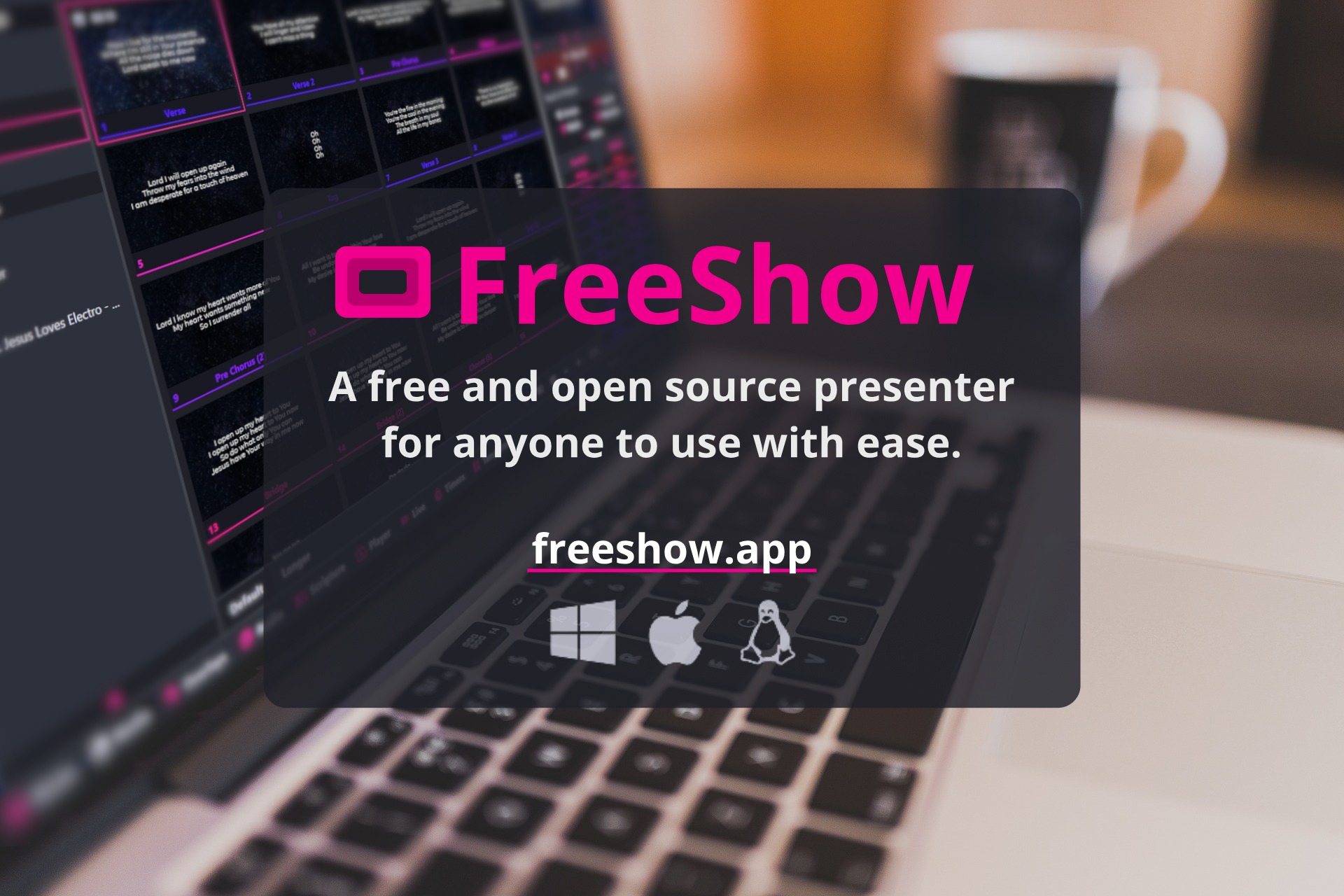
Sharing metadata
| og:url | https://freeshow.app |
|---|---|
| og:type | website |
| og:image | https://freeshow.app/freeshow.jpg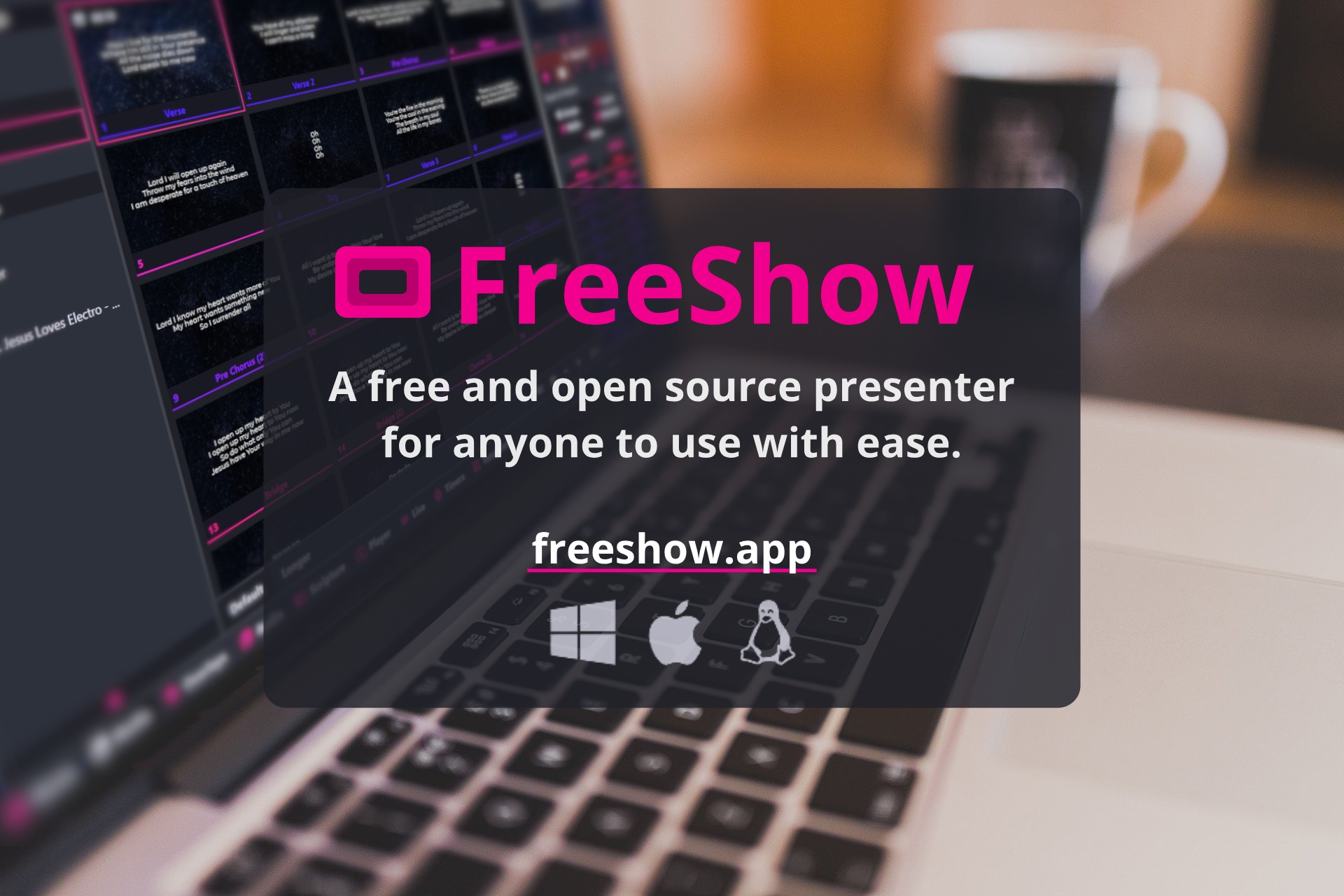 |
| og:title | FreeShow — A free and open-source presenter |
| og:description | FreeShow is a free and open-source presenter software for anyone to use with ease. |
robots.txt (opens in a new tab)
HTTP 404No robots.txt found
Sitemaps
0No sitemaps found
 Registration details RDAP / WHOIS
| Registrar | Domeneshop AS dba domainnameshop.com |
|---|---|
| Registered | 2022-03-01 |
| Expires | 2027-03-01 |
| Domain status | client transfer prohibited |
| Nameservers | dns1.p06.nsone.net、dns2.p06.nsone.net、dns3.p06.nsone.net、dns4.p06.nsone.net |
| DNSSEC | unsigned |
 DNS records
| Type | Name | Value | TTL | Priority |
|---|---|---|---|---|
| A | freeshow.app | 18.208.88.157 | 120 | — |
| A | freeshow.app | 98.84.224.111 | 120 | — |
| MX | freeshow.app | mx.domeneshop.no | 3600 | 10 |
| NS | freeshow.app | dns1.p06.nsone.net | 3600 | — |
| NS | freeshow.app | dns2.p06.nsone.net | 3600 | — |
| NS | freeshow.app | dns3.p06.nsone.net | 3600 | — |
| NS | freeshow.app | dns4.p06.nsone.net | 3600 | — |
| TXT | freeshow.app | google-site-verification=3kNmcICa5k65F1hUWW_omIT3rH55csbhsXtvVZElm5o | 3600 | — |
| TXT | freeshow.app | v=spf1 include:_spf.domeneshop.no ~all | 3600 | — |
| DMARC | _dmarc.freeshow.app | v=DMARC1; p=quarantine; pct=100; rua=mailto:[email protected] | 3600 | — |
 TLS and certificates
| Assessment | Normal configuration |
|---|---|
| Supported protocols | TLSv1.2、TLSv1.3 |
| Negotiated protocol | TLSv1.3 |
| Certificate subject | freeshow.app |
| Issuer | Let's Encrypt |
| Valid until | 2026-11-08T02:52 · Remaining when checked: 42 days |
| Verification details | Certificate trust: Passed · Hostname match: Passed |
 HTTP response headers
| Header | Value |
|---|---|
| content-type | text/html; charset=UTF-8 |
| cache-control | public,max-age=0,must-revalidate |
| server | Netlify |
| strict-transport-security | max-age=31536000 |
| x-frame-options | SAMEORIGIN |
 Identified technologies
User reviews (0)