Website profiles · Technology insights · Alternatives

gekri.com

Write every day in your encrypted private journal. Track your mood to follow your level of happiness.

No paid content found
Visit website
Profile views 6 Outbound visits 1 Normal
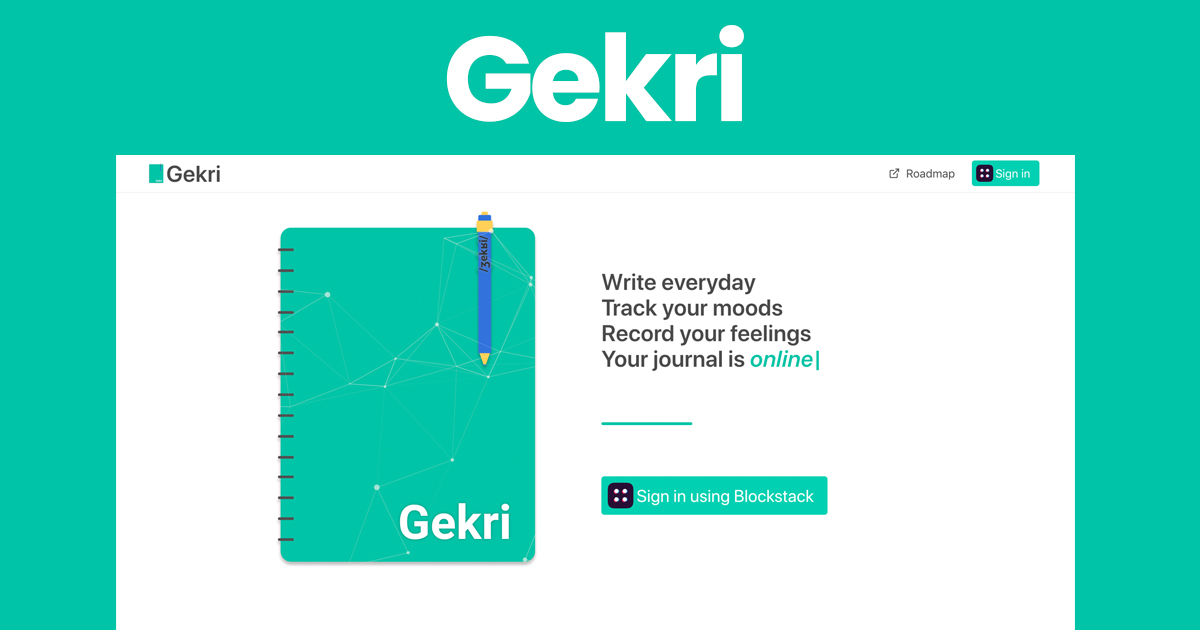
Gekri, your privacy-focused online journal Full homepage screenshot

At a glance

Category
News
Language
English
Paid-content signal
No paid content foundObserved
Registered
2019
Hosting
NetlifyInferred
HTTPS certificate trusted
PassedObserved
Last updated

Website review

This review may include AI-generated content and is not individually verified. Domain, certificate and other facts come from the observed data on this page.

What is Gekri?

Gekri is a privacy-focused online journal: a place to write daily entries in an encrypted private journal and track your mood over time to see how your level of happiness changes. It is aimed at people who want the habit and reflection benefits of journaling without handing their personal writing to an ad-driven platform.

What it is for

  • Daily writing. A simple routine of short or long entries, kept in one private place.
  • Mood tracking. Logging how you feel alongside your writing, so patterns become visible rather than staying vague.
  • Privacy as the default. Encryption is the central idea, not an optional extra.

Who it suits

  • Someone who has tried paper journals and wants searchable, backed-up entries.
  • A person who wants to notice mood patterns but does not need a clinical or therapy-grade tool.
  • Anyone uncomfortable with a general-purpose notes app that scans or monetises content.

Trade-offs to weigh

  • Convenience vs. control. Strong privacy usually means fewer integrations, no social features and less automatic syncing with other services.
  • Routine vs. insight. Mood tracking only helps if you log consistently; the value comes from the pattern, not a single day.
  • Encryption vs. recovery. If you lose your credentials, recovery may be limited by design. Check how the service handles this before committing years of entries.

A practical next step

If you are deciding whether to start, try a two-week test: write one short entry each evening and rate your mood on the same simple scale. At the end, look for one repeated trigger. If that single observation feels useful, the habit is worth keeping — and a privacy-first tool like Gekri is a reasonable home for it.

How does Gekri keep my journal entries private and encrypted?

Gekri is built around the idea that a personal journal should stay personal, so privacy is handled at the level of the entry itself rather than bolted on as a setting. The site presents Gekri as an encrypted private journal, which means the content you write is stored in encrypted form, and access is tied to your account rather than to a public profile or social feed. In practice, that matters most in the ordinary moments: writing a difficult entry after a bad day, noting health symptoms, or recording relationship thoughts you would not want indexed by a search engine or visible to someone glancing at a shared device.

What "private and encrypted" means in daily use

  • No public audience by default. A journal entry is not a post. There is no expectation that anyone else reads it, so you can write plainly instead of performing for readers.
  • Encryption protects stored content. If someone obtained the stored data without your credentials, the entries would not be readable as plain text. This is the main practical benefit over a plain notes app or a document in cloud storage.
  • Your account is the key. Privacy depends on keeping your login secure. A strong, unique password and two-factor authentication, where offered, matter more than any single feature.
  • Mood tracking stays attached to private entries. Gekri also tracks mood so you can follow your level of happiness over time. That data is sensitive precisely because it is a record of how you felt, so it should be covered by the same private, encrypted approach as the writing itself.

A concrete scenario

Suppose you journal every evening about work stress and sleep. Over a month, the mood tracking shows a pattern you had not noticed. The value comes from being honest in the entries, and honesty depends on trusting that no one else is reading them. That is the trade-off: an encrypted private journal gives you candor, but it also means you cannot casually share an entry with a therapist or friend unless the app provides an explicit export or share option.

What to check before committing

  1. Encryption scope. Confirm whether entries are encrypted at rest, in transit, or both, and whether mood data receives the same treatment.
  2. Key handling. Ask whether the provider can read your entries. If it can, the privacy guarantee is weaker than the word "encrypted" suggests.
  3. Recovery. Understand what happens if you forget your password. Strong encryption often means no one can reset it for you.
  4. Export. Make sure you can get your writing out in a readable format, so your journal is not locked to one service.

For comparison, a general-purpose notes app such as Evernote is convenient but not designed as a private diary, while a dedicated encrypted option is a better fit when confidentiality is the priority. If you already use a password manager, store your Gekri credentials there and enable any available second factor before you write your first entry.

Can I use Gekri to track my mood over time?

Yes. Gekri is built around a daily encrypted journal, and mood tracking is one of its stated purposes: you write an entry and record how you feel, then look back at those entries to see how your mood has moved over weeks or months. The journal is private and encrypted, which matters if you want to be honest about low days without worrying who might read them.

What this looks like in practice

A realistic routine: each evening you open Gekri, pick a mood, and add a few lines about what happened. After a month you have a timeline rather than a vague sense that "it's been a rough stretch." That distinction is the whole point of tracking — memory is unreliable and tends to skew toward whatever you felt most recently.

Who gets the most out of it

  • People in therapy or coaching who want concrete material to bring to sessions instead of reconstructing the week from memory.
  • Anyone testing a change — sleep schedule, medication, exercise, a new job — who wants to see whether mood actually shifted or just felt like it did.
  • People who journal already and would otherwise keep mood notes in a separate app or spreadsheet.

If you only want a one-tap mood logger with charts and no writing, a dedicated mood tracker will feel lighter. Gekri's value is that the mood data sits alongside the context explaining it, which is what makes patterns interpretable.

Trade-offs worth knowing before you commit

Consistency is the real cost. A mood log with gaps is much less useful, and daily logging is easy to start and easy to abandon. Encrypted, privacy-first tools also tend to trade away some convenience — syncing, sharing and export usually work differently than in mainstream cloud apps, so check that your entries are retrievable in a format you can keep before you build months of history.

A useful next step

Run a two-week trial: log daily, then read straight through from day one. If the pattern tells you something you didn't already know, the habit is worth keeping; if not, a simpler tracker will do. For general background on mood monitoring and when it's clinically useful, National Institute of Mental Health is a reliable starting point.

Is Gekri free to use, or does it require a paid subscription?

Gekri does not publicly state a price on the page you referenced — the page evidence shows only a loading state with no headings, pricing links or payment platforms. So the honest answer is: it is unclear from the available information whether Gekri is free or requires a paid subscription. The site describes itself as a privacy-focused encrypted journal with mood tracking, but no pricing details are visible.

How to decide for yourself

  • Open the site and look for a pricing or plans link, usually in the top navigation or footer.
  • Check whether you can create an account and write an entry without entering payment details. If you can, there is likely a free tier.
  • Look for words like "free," "trial," "premium," or "upgrade" on the signup screen, since privacy journals often offer a limited free version with paid extras.
  • If a paywall appears only after signup, treat the free option as a trial rather than a permanent free plan.

Practical scenario

Suppose you want a private journal for daily mood tracking but have a tight budget. You could sign up, write a few entries, and watch for any prompt asking for a card. If none appears after a week of normal use, the free tier is probably usable long-term. If a card is required upfront, compare that cost against other encrypted journaling options before committing.

For official details, the only reliable source is the site itself: Gekri.

How do I start writing my first entry in Gekri?

Start by creating your journal, then write in the entry field the app presents; Gekri is built around a simple loop of writing and saving an encrypted private entry. Because Gekri is described as an encrypted private journal, treat your first entry as a short, low-pressure note rather than a polished piece.

A practical first-entry routine

  1. Open Gekri and set up or unlock your journal so the writing view is available.
  2. Write one honest paragraph about today: what happened, what you felt, and one thing you want to remember.
  3. Add a mood check if the mood-tracking option is offered, since Gekri's stated purpose includes tracking mood to follow your level of happiness.
  4. Save the entry and confirm it appears in your journal list before closing.

What to write when you feel stuck

  • A single sentence: "Today was mainly about ___."
  • Three bullets: one event, one feeling, one intention for tomorrow.
  • A mood label first, then two lines explaining why you chose it.

Decide based on your goal

If your goal is... Write this first Why
Building a daily habit Two or three sentences Keeps the barrier low enough to repeat tomorrow
Tracking happiness over time A mood rating plus one reason Gives future you something comparable
Processing a hard day A free-form paragraph, no structure Lets you vent without judging the writing

If you are comparing tools, privacy-focused journaling options include Gekri, Day One and Penzu. For a first entry, the deciding factor is usually whether the writing screen feels calm enough to open daily, not the feature list.

Does Gekri work on mobile devices as well as desktop?

Yes. Gekri is a browser-based journal, so it works on phones and tablets as well as desktop computers without a separate app install. You sign in through the browser, and the journal is encrypted, which matters most on mobile: a lost or borrowed phone is exactly the situation where an unencrypted journal is risky.

What mobile use looks like in practice

  • Short daily entries. A phone is convenient for a two-minute mood check-in or a few lines before bed; desktop suits longer reflective writing.
  • Mood tracking on the go. Logging a mood takes seconds and is easy to do at the moment it changes, rather than reconstructing the day later.
  • Switching devices. Because entries live with your account rather than on one machine, you can start on a phone and continue on a laptop.

Trade-offs to weigh

Mobile browser Desktop browser
Best for Quick entries, mood logs Long writing sessions
Typing comfort Lower Higher
Availability Wherever you are At your desk
Main risk Small screen, interruptions Less frequent check-ins

A practical test

Open Gekri on your phone, write one short entry, then open it on your computer and confirm the entry appears. That single check tells you whether the cross-device workflow fits how you actually write. If you prefer a native app with offline sync, compare it with a dedicated mobile journal before committing; Gekri's strength is privacy through encryption rather than app-store polish.

For a fuller picture of its features, see Gekri.

Related questions

More questions →
How Gekri's Mood Tracking Works and What You Can Learn From It

Gekri is a privacy-focused online journal whose stated purpose is to let you "write every day in your encrypted private journal" and "track your mood to follow your level of happiness." Based on that description, mood tracking is a built-in companion to daily writing rather than a separate wellness app: you log how you feel alongside your entries, and over time the accumulated mood data gives you a view of your happiness trend. The value depends on two things — how consistently you record, and whether the mood signal stays connected to the written context that explains it.

What the mood tracking is designed to do

The site's own summary sets the scope clearly: write daily, and track mood to follow your level of happiness. That framing tells you what to expect and what not to expect.

  • It is a personal trend tool, not a diagnosis. The output is your own pattern over time, not a clinical assessment.
  • It is tied to journaling. Mood is captured in the same place as your writing, so a low or high day can be read next to what you actually wrote about it.
  • It is positioned as private. Gekri describes the journal as encrypted and private, and mood data recorded inside that journal falls under the same framing.

How the daily loop typically works

Gekri's public description does not spell out the exact interface, so treat the following as the general shape of a mood-tracking journal rather than a click-by-click guide:

  1. Write your entry. You record the day's thoughts in the journal.
  2. Log your mood. You attach a mood rating or state to that day.
  3. Repeat daily. The description emphasizes writing "every day," which is what makes a trend visible.
  4. Review over time. You look back at mood across days or weeks to see direction, not just single points.

The expected result of this loop is a dated record where each mood value has written context behind it. That context is the part a standalone mood app usually lacks.

What you can actually learn from it

The useful signal comes from pairing the number with the note.

What you observe What it can tell you
Mood trending up or down over weeks Direction of your overall happiness level, which single days can't show
Repeated low moods on similar days A possible pattern worth examining in your entries
Mood that doesn't match what you wrote A gap between how you rated the day and how you described it
Gaps in logging Where your record is too thin to support conclusions

A concrete example: if you rate most workdays low and most weekends high, the trend line alone just shows a dip. Reading the entries behind those days is what tells you whether it's workload, sleep, or something else — and that's the difference between a mood chart and a mood journal.

Privacy considerations for mood data

Because Gekri presents itself as a privacy-focused, encrypted journal, mood entries recorded inside it should be understood as covered by the same privacy framing as the written entries. Two practical points follow:

  • If your mood data lives in the same encrypted journal as your text, you are not maintaining a separate, less-protected mood profile elsewhere.
  • The site description does not detail the encryption method or data handling on the page provided, so if encryption specifics matter to your decision, verify them directly on the site before relying on them.

When this approach fits and when it doesn't

It fits if you already want to journal daily and want a lightweight happiness trend without a second app — the mood record comes free with the writing habit.

It fits less well if you want structured clinical mood instruments, exportable analytics, or mood tracking without journaling. Gekri's stated design centers on the journal, so the mood feature is strongest as a companion to consistent writing, not as a standalone measurement tool.

The honest bottom line: the tracking itself is simple, and its value is proportional to how regularly you write and how often you actually look back at the trend alongside your entries.

Who Is Gekri Best Suited For, and What to Consider Before Using It

Gekri is best suited to people who want to write in a private journal every day and care more about keeping entries encrypted than about social features or elaborate formatting. It fits a daily writing habit, and its mood tracking only becomes useful if you keep that habit going. Before committing, understand two things: how you access an encrypted journal, and what happens if you lose that access. Gekri's own description positions it as a "privacy-focused online journal" where you "write every day in your encrypted private journal" and "track your mood to follow your level of happiness."

Who gets the most out of it

  • Daily writers. The product is built around writing every day. If you already journal most days, or want a tool that nudges you toward that, the format matches the intent.
  • Privacy-first users. Encryption is the core selling point, not an add-on. If you would otherwise avoid an online journal because you don't want your entries readable by the service, this is the audience it targets.
  • People who want light mood tracking. Tracking mood alongside entries is meant to show a trend in your "level of happiness." That only works with consistent entries over time.
  • Anyone who prefers a simple, text-focused journal. The description emphasizes writing and mood, not templates, media, or publishing.

Who should look elsewhere

  • People who want a social or shared journal. Nothing in the description suggests sharing, comments, or community.
  • Occasional writers. If you write a few times a year, mood tracking won't produce a meaningful signal, and the daily-writing framing won't fit.
  • Anyone who needs guaranteed account recovery. Encrypted journals typically tie access to your credentials or keys. If you can't tolerate the risk of losing access, weigh that carefully (see below).

What to consider before you start

Access and recovery limits

The main trade-off of an encrypted journal is that privacy and recoverability pull in opposite directions. Strong encryption usually means the service can't read your entries — and often can't restore them for you either. Before you rely on Gekri for anything you'd hate to lose:

  • Find out what happens if you forget your password or lose your device.
  • Check whether there's any export or backup option, and use it if it exists.
  • Decide in advance whether you're comfortable with entries that only you can unlock.

The source material here doesn't specify Gekri's exact recovery or export mechanics, so verify these in the app itself rather than assuming.

The habit requirement

Mood tracking is only as good as the data behind it. A single entry tells you little; a month of entries can show a pattern. If you want the "level of happiness" view to mean anything, plan to write consistently — daily if you can.

How it compares to other journaling options

Option Privacy Effort Mood tracking Best for
Gekri (encrypted online journal) High — entries encrypted Daily writing habit Built in Private daily writers who want mood trends
Plain notes app Depends on device/sync Low None Quick, casual notes
Paper journal Physical only Low Manual People who want zero digital footprint
Public/blog journal Low Medium None Writers who want an audience

Choose Gekri if privacy and daily mood tracking matter most. Choose a notes app or paper if you want zero setup or don't need trends. Choose a blog if being read is the point.

A practical way to decide

  1. Ask whether you'll actually write most days. If yes, Gekri's design works in your favor.
  2. Confirm how access and recovery work in the app before you put sensitive material in it.
  3. Start with a short trial period — a week or two — and see whether the mood view gives you anything useful.
  4. If it does, keep going; if not, the encryption alone may still justify it for private writing.

The short version: Gekri suits private, habitual journalers who want mood tracking and accept the access trade-offs of encryption. It's a poor fit for occasional writers, people who want to share their journal, or anyone who needs guaranteed recovery they haven't verified.

What Is Gekri and What Makes It a Privacy-Focused Online Journal?

Gekri is an online journal built around daily writing, encrypted privacy, and mood tracking. It suits people who want a long-term personal record of their thoughts and emotional state, and who care that the journal content stays readable only to them. The core difference from a typical notes app or blogging tool is the combination: private encrypted entries plus a mood signal that turns daily writing into a trackable happiness record.

What Gekri does

Based on the site's own description, Gekri positions itself as "your privacy-focused online journal" with three stated functions:

  • Daily writing — the primary use is writing every day in a private journal.
  • Encryption — entries are described as encrypted, which is the basis for the privacy claim.
  • Mood tracking — you track your mood to follow your level of happiness over time.

The intended loop is simple: write an entry, log how you feel, and let the accumulated mood data show a trend rather than a single day's impression.

What makes it "privacy-focused"

The privacy angle rests on encryption of the journal content. The site's framing is that this is a private journal, not a public or social writing space — the value is in the entries being protected rather than shared.

That distinction matters when comparing options:

Dimension Gekri (as described) Typical notes app Public blog
Primary purpose Private daily journal General note-taking Publishing to an audience
Privacy model Encrypted entries Depends on device/account Public by default
Mood tracking Built in Not typical Not typical
Audience Just you Just you Others

If your goal is publishing or collaboration, Gekri is the wrong shape of tool. If your goal is a private record you return to over months, the encryption and mood features are the relevant ones.

Who it fits

Gekri is a reasonable fit if you:

  • Want to write regularly and keep the writing private.
  • Are interested in tracking mood or happiness as a trend, not a one-off check-in.
  • Prefer a dedicated journal over repurposing a notes or docs app.

It is a weaker fit if you need sharing, multi-user collaboration, or a public writing platform — none of those are part of the described product.

Practical notes before you commit

The available site information describes the product's purpose and features but does not state pricing, account requirements, or platform details. Before relying on it for sensitive long-term writing, check on the site itself:

  1. How encryption works — whether entries are encrypted such that only you can read them, and what happens if you lose access.
  2. Export and backup — whether you can get your entries out, since a journal is a long-term commitment.
  3. Cost and account terms — confirm current pricing and login requirements directly, as these are not specified in the available description.

The short version: Gekri is an encrypted daily journal with mood tracking, aimed at private long-term self-recording. Its differentiator is the pairing of privacy with an emotional trend line — not publishing, not collaboration.

How Does Gekri Keep My Journal Entries Private and Encrypted?

Gekri is a privacy-focused online journal whose stated purpose is to let you "write every day in your encrypted private journal" and track your mood over time. Based on the site's own description, encryption is presented as a core property of the product rather than an add-on. What the public page evidence does not spell out is the exact cryptographic design — the specific algorithms, where keys are generated, or whether the operator can technically read entries. So the honest answer is: Gekri markets itself as an encrypted private journal, but you should verify the technical details before treating it as a zero-knowledge service.

What the site itself claims

From the available page evidence, Gekri describes two things:

  • Encrypted private journal — entries are written into a journal that is described as encrypted.
  • Mood tracking — you can track your mood to follow your level of happiness, which implies entries carry structured metadata (like a mood value) alongside free text.

That is the full extent of what the source material supports. There is no published detail in the evidence about key management, server-side access, or export formats.

The questions that actually determine your privacy

Encryption claims are only meaningful when you know who holds the key. These are the four things to check on any encrypted journal, including Gekri:

Question Why it matters
Where are entries encrypted — in your browser or on the server? Browser-side (client-side) encryption means plaintext never leaves your device. Server-side encryption means the operator handles plaintext at some point.
Who holds the decryption key? If the service holds it, the operator can in principle read your entries. If only you hold it, they cannot.
Is the key derived from your password, or stored separately? Password-derived keys tie access to something only you know; stored keys may be recoverable by the operator.
What happens if you forget your password? A true zero-knowledge design usually means no recovery — the data is unrecoverable. Recovery options often imply the operator can access data.

What you are responsible for

If Gekri works like most privacy-first journals, the security burden shifts to you:

  • Your password becomes the key. A weak or reused password undermines the encryption regardless of the algorithm.
  • Loss may be permanent. In zero-knowledge systems, forgotten passwords typically mean lost entries, because no one else can decrypt them.
  • Your device matters. Malware, a compromised browser, or someone with access to your unlocked device can read what you type before encryption ever happens.

How this affects daily writing

Strong encryption usually trades a little convenience for privacy:

  • You may need to unlock the journal each session rather than staying logged in indefinitely.
  • Password reset flows tend to be limited or absent.
  • Syncing across devices depends on your key being available on each device, which can mean re-entering credentials.

For a daily mood-and-journal habit, these are small costs — but they are real, and worth knowing before you commit years of entries.

How to verify before trusting it

  1. Look for a security or privacy page on gekri.com that names the encryption method and key handling.
  2. Check whether the site states that the operator cannot read your entries (a zero-knowledge claim) or only that data is encrypted in transit and at rest.
  3. Test with a throwaway entry: write something, then check whether any export or account feature reveals it in plaintext outside your unlocked session.
  4. Confirm what happens on password reset — if you can recover entries without your original password, the operator likely can too.

If the site does not answer these questions, treat the encryption as unverified and avoid storing anything you would not want exposed.

Website Overview

An established domain and managed infrastructure suggest continuity of operations and may support dependable delivery, although neither guarantees service quality.

Domain and Registration

Registered in 2019, this domain has about 7 years of history. That suggests continuity, although ownership and purpose may have changed. Transfer-protection status is present, helping reduce the risk of unauthorized domain transfers. The registrar is Porkbun LLC, a widely used domain service provider. The domain uses the common .com extension, which is not an independent safety signal.

DNS and Email

Nameservers are provided by NS1, indicating managed DNS hosting. No CNAME was found; the observed records resolve directly to addresses. No MX record was found. A conventional explicit inbound-mail route is not configured. DNSSEC signatures were not detected, so this additional DNS authenticity protection is not confirmed. The lowest observed DNS TTL is 120 seconds.

TLS and Certificates

The public key uses EC with 256 bits. The server supplied a complete certificate chain. No organization name is present in the certificate; the available fields are consistent with domain validation. The certificate was issued by Let's Encrypt, commonly associated with automated certificate services. The certificate's total validity is about 89 days, consistent with a short renewal cycle.

HTTP and Browser Security

The response lacks these common security headers: CSP, X-Content-Type-Options, Referrer-Policy, Permissions-Policy, clickjacking protection. No X-Powered-By header was found, reducing one common source of backend fingerprinting information. No obvious internal addresses or debug information were found in the headers. The Server header contains the custom value Netlify. No explicit CDN or WAF marker was found in the response headers.

Technology Stack Analysis

The public page identifies Nuxt, Netlify without precise versions, leaving fewer clues for version-specific scanning.

Search and Social Sharing

No homepage canonical URL was detected. If duplicate URLs exist, consolidation may be less explicit. Twitter Card metadata is configured. The title has 42 characters, within a common display range. A meta description is present, with 101 characters. The observed directives allow indexing and link following.

Hosting and Email

DNSNS1
HostingNetlify
EmailUnknown
Approximate IP geolocation (inferred; a CDN or proxy may differ from the origin server) United States flagAshburn, Virginia, United States Inferred 18.208.88.157

Registration details

RDAP / WHOIS

RegistrarPorkbun LLC
Registered2019-06-03
Expires2027-06-03
Domain statusclient delete prohibited、client transfer prohibited
Nameserversdns1.p07.nsone.net、dns2.p07.nsone.net、dns3.p07.nsone.net、dns4.p07.nsone.net
DNSSECunsigned

DNS records

DNS

TypeNameValueTTLPriority
Agekri.com18.208.88.157120—
Agekri.com98.84.224.111120—
NSgekri.comdns1.p07.nsone.net3600—
NSgekri.comdns2.p07.nsone.net3600—
NSgekri.comdns3.p07.nsone.net3600—
NSgekri.comdns4.p07.nsone.net3600—

TLS and certificates

TLS / SSL

AssessmentNormal configuration
Supported protocolsTLSv1.2、TLSv1.3
Negotiated protocolTLSv1.3
Certificate subjectgekri.com
IssuerLet's Encrypt
Valid until2026-11-08T07:33 · Remaining when checked: 32 days
Verification detailsCertificate trust: Passed · Hostname match: Passed

HTTP response headers

HTTP

HeaderValue
content-typetext/html; charset=UTF-8
cache-controlpublic,max-age=0,must-revalidate
serverNetlify
strict-transport-securitymax-age=31536000

Identified technologies

NuxtNetlify

Pages, Search and Sharing

Meta descriptionWrite every day in your encrypted private journal. Track your mood to follow your level of happiness.
Canonical URLNot detected
LanguageEnglish (default)
Twitter Cardsummary_large_image
All bots 0 allowed · 1 disallowed
  • Disallow/app/

No sitemaps found

User reviews (0)

  • No reviews yet.