Website profiles · Technology insights · Alternatives

getreditus.com

Grow the MRR for your B2B SaaS by leveraging the audience of someone else. Setup, manage & recruit B2B SaaS affiliates via Reditus. 14-day free trial.

Paid content
Visit website
Profile views 5 Outbound visits 0 Normal
B2B SaaS Affiliate Network | Reditus Full homepage screenshot

At a glance

Category
Marketing
Language
English
Paid-content signal
Paid contentObserved
Registered
2019
Hosting
CloudflareInferred
HTTPS certificate trusted
PassedObserved
Last updated

Website review

This review may include AI-generated content and is not individually verified. Domain, certificate and other facts come from the observed data on this page.

What is Reditus?

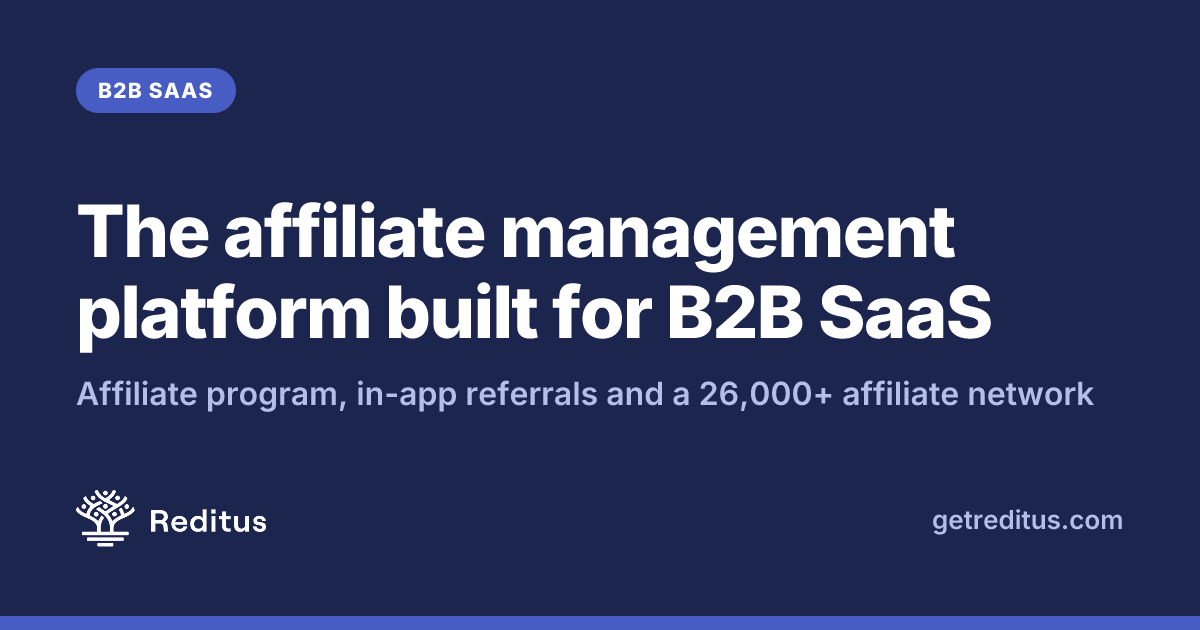
Reditus is an affiliate and referral management platform built specifically for B2B SaaS companies. Its pitch is that most affiliate tools only handle tracking, while Reditus also helps you find and recruit relevant SaaS affiliates from a network the site describes as 26,000+ B2B SaaS affiliates. It combines affiliate program management with an in-app referral program in one place, aimed at teams that want to grow recurring revenue through partners rather than buying more ads.

What it does

  • Affiliate management: Track partners, automate payouts, and manage hundreds of affiliates without adding headcount.
  • In-app referral program: Turn existing happy customers into a tracked word-of-mouth channel inside your product.
  • Affiliate discovery and recruitment: Tap a network of B2B SaaS affiliates instead of manually recruiting on generic platforms.
  • Migration support: The page offers a path for teams moving from another platform.

Who it is for

The site says it is trusted by 200+ B2B SaaS teams and positions itself best for companies already running an affiliate program, as well as those starting one. A typical fit is a lean B2B SaaS marketing or growth team with rising customer acquisition costs that wants a lower, performance-based CAC: you pay a percentage of revenue you have already received, so cost scales with results rather than upfront spend.

How it differs from generic networks

Generic affiliate networks tend to attract e-commerce coupon and deal sites, which rarely suit B2B software buying cycles. Reditus leans on the argument that in B2B, trust beats targeting, so relevant SaaS affiliates and existing customers are more valuable than broad reach. That is the main trade-off to weigh: a SaaS-specific network may give you better-matched partners, but it is a narrower pool than general affiliate marketplaces.

Getting started

There is a 14-day free trial with no credit card required, and the site says you can launch in minutes. If you want to compare costs first, check the pricing page at Reditus and consider booking a demo if you are migrating an existing program.

How does Reditus help reduce customer acquisition cost for B2B SaaS companies?

Reditus reduces customer acquisition cost (CAC) by shifting spend from paid impressions toward performance-based partner payouts. Instead of paying upfront for ads, you pay a percentage of revenue you have already collected, so the cost only materializes when a referral converts into a paying customer. That makes CAC more predictable and typically lower than traditional demand generation, because you are not paying for clicks or leads that never close.

The platform addresses the two leaks that usually make affiliate and referral programs underperform in B2B:

  • Untracked word-of-mouth. Happy customers already refer people informally. Reditus runs an in-app referral program so those introductions are tracked and rewarded rather than left ad hoc.
  • Mismatched partners. Generic affiliate networks skew toward coupon and e-commerce audiences. Reditus is positioned specifically for B2B SaaS, with a network of affiliates who already promote comparable software, plus AI-assisted affiliate discovery to shorten manual recruiting.

Where the savings actually come from

Lever How it lowers CAC Trade-off to weigh
Pay-for-performance commissions Cost is tied to payments received, not impressions Lower volume early; depends on partner quality
In-app referral loop Converts existing customers into a repeatable channel Requires product experience good enough to refer
B2B-focused affiliate network Less time wasted on irrelevant partners Network fit still varies by category and price point
Automated tracking and payouts Lean teams can manage many partners without added headcount Setup and program design still need owner attention

Practical decision criteria

If your CAC payback is stretching and you have a healthy base of satisfied customers, a referral-plus-affiliate motion is worth testing before increasing ad budgets. If your product has weak retention or a very narrow buyer, partner-sourced volume will likely stay small regardless of tooling.

A concrete next step: pick one cohort of loyal customers, launch an in-app referral offer, and measure partner-sourced CAC against your paid-channel CAC over one quarter. Reditus offers a free trial with no credit card required, and its pricing page is at Reditus. For broader context on affiliate program economics, PartnerStack and impact.com cover comparable B2B partnership models.

How do I recruit affiliates through Reditus's network of 26,000+ B2B SaaS affiliates?

Reditus approaches affiliate recruitment as a managed pipeline rather than a directory you browse manually. Its stated model is an affiliate management platform built for B2B SaaS, combining affiliate management, an in-app referral program, and an affiliate network with AI-powered discovery in one place. The recruitment angle rests on that network: 26,000+ B2B SaaS affiliates who already promote software products, positioned as an alternative to generic networks that skew toward e-commerce coupon traffic.

How the recruitment flow is presented

  • Discovery is AI-assisted. The page leads with "AI-powered Affiliate Discovery," so the intended workflow is that the platform surfaces relevant affiliates for you rather than you filtering a raw list yourself.
  • Relevance is the filter, not volume. The stated differentiator is B2B SaaS specificity — the pitch is fewer mismatched partners instead of a large pool of low-intent promoters.
  • Recruitment sits alongside program operations. Tracking, attribution, and payouts are handled in the same system, so onboarding a new affiliate doesn't require separate tooling.
  • Two partner types are in scope. External affiliates (people promoting you to their audience) and your own customers via an in-app referral program, which is where untracked word-of-mouth becomes measurable.

What to decide before you start recruiting

Recruitment only pays off if the program terms attract the right partners. Settle three things first:

  1. Commission basis. Reditus frames payouts as a percentage of payment already received, which suits recurring SaaS revenue. Decide whether you pay on first payment, on recurring MRR, or a hybrid.
  2. Attribution window and cookie/link durability. B2B sales cycles run long, so a short window will lose credit to late conversions and frustrate partners.
  3. Partner fit criteria. Define what a qualified B2B SaaS affiliate looks like for your category — audience, content type, overlap with your buyer — so AI suggestions can be judged against something concrete.

A realistic scenario

A seed-to-Series-A SaaS with a small marketing team has rising CAC and happy customers who never refer formally. They enable the in-app referral program for existing customers, then use affiliate discovery to find a handful of newsletter writers and consultants in their niche. The lean-team claim — automating tracking and payouts so a small team can manage hundreds of partners — is the relevant promise here; whether it holds depends on how much manual review the AI suggestions still need.

Trade-offs to weigh

An affiliate network is a demand-generation channel, not a demand-creation one. If your product has no clear buyer or your pricing is low-touch, affiliate commissions rarely motivate serious B2B partners. And a curated B2B network is smaller than a general one by design — you trade reach for relevance. Reditus offers a 14-day free trial with no credit card required, and a demo path for teams already running a program or migrating from another platform. Use the trial to test one thing: whether the affiliates surfaced are ones you would have chosen yourself.

For comparison, affiliate and referral infrastructure for SaaS is also offered by PartnerStack and Rewardful, while SaaStr is a useful read for benchmarking SaaS growth channel economics.

Can Reditus manage both an affiliate program and an in-app referral program in one place?

Yes. Reditus is positioned as a single platform for running both an affiliate program and an in-app referral program. Its page explicitly says you can "run your affiliate and in-app referral program in one place," and the feature breakdown lists an in-app referral program, affiliate management, and affiliate network/AI recruitment as parts of the same platform.

What that means in practice

  • Affiliate program: Reditus handles tracking, affiliate management, and payouts, and offers recruitment from a network of B2B SaaS affiliates. The page also notes migration support if you are coming from another platform.
  • In-app referral program: The page describes creating a viral loop inside your product, so existing customers can refer others. This is separate from external affiliates and is meant to capture word-of-mouth that would otherwise go untracked.
  • One dashboard, one system of record: The pitch is that you do not need one tool for affiliates and another for customer referrals. That matters for attribution and payout consistency, because both programs touch the same revenue events.

Who this fits

This suits B2B SaaS teams with an existing affiliate program, or those ready to formalize referrals. The page says it is "best if you're already running an affiliate program," and it mentions a 14-day free trial with no credit card required. If you are starting from zero, the in-app referral side may be the easier entry point.

A practical next step

Decide which program you want to launch first. If your priority is lowering CAC through existing customers, start with the in-app referral program and use the free trial to test tracking and payout flow. If you already have affiliates, use the migration path and the affiliate network to consolidate. Then check the pricing page for plan limits on affiliates, referrals, and payouts before committing.

For comparison, affiliate-focused tools like PartnerStack and impact.com also support partner and referral programs, but Reditus is narrower and explicitly aimed at B2B SaaS rather than e-commerce or broad partnership ecosystems.

What does Reditus cost, and how does the 14-day free trial work?

Reditus does not publish its full pricing on the page referenced here, so there is no reliable monthly or percentage figure to quote. What is confirmed: the site lists a Pricing page and promotes a 14-day free trial with no credit card required, positioned as something you can launch "in minutes." The trial is framed around the platform itself — affiliate management, an in-app referral program, and access to the affiliate network with AI-powered discovery — rather than a one-off demo.

What the trial realistically lets you test

  • Whether you can connect your billing or payment flow, since Reditus says it only pays affiliates a percentage of payments you have already received.
  • How tracking behaves across signup, trial-to-paid conversion and renewals, which is where B2B affiliate programs usually break.
  • Whether the affiliate network surfaces partners relevant to your category rather than coupon or e-commerce traffic.
  • How much setup work falls on you versus the platform, given the "launch in minutes" claim.

What to check on the pricing page

Because Reditus charges on a share of revenue you collect, the real cost depends on your deal sizes and commission rates. Before starting the trial, ask:

  1. Is pricing a flat platform fee, a percentage of affiliate-driven revenue, or a mix?
  2. Are network recruitment features included, or priced separately from affiliate management?
  3. What happens to tracked links and partner data if you do not convert after 14 days?
  4. Is there a minimum contract or onboarding fee not shown on the pricing page?

The trial is most useful if you already have an affiliate or referral program running or a clear list of potential partners — the page itself notes the full platform is "best if you're already running an affiliate program." If you are starting from zero, spend the trial on recruitment and tracking setup rather than configuration polish.

For comparison, affiliate platforms such as PartnerStack and Impact also target B2B and SaaS partnerships, and their public pricing pages can help you judge whether a revenue-share model suits your margins.

How does Reditus compare to migrating from another affiliate platform?

Reditus positions itself as an affiliate management platform designed specifically for B2B SaaS, rather than a general affiliate network. Its page evidence emphasizes three things that matter when you are already running a program elsewhere: a network of 26,000+ B2B SaaS affiliates for recruitment, AI-powered affiliate discovery, and in-app referral plus affiliate management in one place. It also advertises migration support with a "Migrating from another platform? Talk to us" prompt, and a 14-day free trial with no credit card required.

What changes when you migrate

The practical comparison is not "old platform vs. new platform" in the abstract. It is what you gain and what you have to rebuild.

  • Affiliate sourcing. Generic networks often attract coupon and e-commerce affiliates. Reditus claims a B2B SaaS-specific affiliate pool, which matters if your product needs partners who can explain software to a business audience.
  • Recruitment effort. If you currently recruit manually, AI-powered discovery is meant to shorten that work. If your existing program already has strong partners, the value is more about adding relevant affiliates than replacing them.
  • Program scope. Reditus combines affiliate management with an in-app referral program. Teams running those separately may consolidate; teams with a complex custom setup may need to check how much of their logic transfers.
  • Tracking and payouts. Reditus says it automates tracking and payouts so lean teams can manage hundreds of partners. This is the part most likely to break during a migration, so test link tracking, attribution windows and payout rules before switching fully.

A decision criterion

Migrate if your main bottleneck is finding relevant B2B SaaS affiliates or managing referrals and affiliates in one system. Stay and optimize if your current platform already delivers qualified partners and your pain is only reporting or commission logic that Reditus does not clearly address.

A concrete next step: run both programs in parallel for one cohort of new affiliates. Give them Reditus links, keep your existing links live for current partners, and compare activation, tracked signups and CAC payback over a full sales cycle. That tells you whether the switch improves revenue rather than just changing dashboards.

Related questions

More questions →
What Is SaaS? How Software-as-a-Service Works and When to Use It

SaaS (Software-as-a-Service) is a delivery model in which a vendor hosts an application and customers access it over the internet, typically paying a recurring subscription fee rather than buying a perpetual license. It fits most organizations that want faster deployment, lower upfront cost, and automatic updates — but it is a weaker fit when you need deep customization, strict data residency control, or the ability to run fully offline.

The core SaaS model

In a SaaS arrangement, three things move from the customer to the vendor:

  • Infrastructure — servers, storage, and networking are owned and operated by the provider.
  • Maintenance — patching, upgrades, and uptime are the provider's responsibility.
  • Access — users reach the software through a browser or thin client, usually with per-user or usage-based billing.

You consume the software as a service rather than owning a copy of it. That single shift is what drives most of the benefits and most of the trade-offs below.

SaaS vs. on-premise, self-hosted, IaaS, and PaaS

These models are often confused because they all involve "the cloud." The difference is how much the vendor manages.

Model Who manages the app? Who manages the infrastructure? Typical customer control
SaaS Vendor Vendor Configuration and data only
PaaS Customer (builds/deploys) Vendor App code, runtime settings
IaaS Customer Customer (on rented VMs) OS, middleware, app, data
On-premise Customer Customer (own hardware) Everything
Self-hosted Customer Customer (own or rented) Everything, but you install the vendor's software yourself

A quick way to place them: with IaaS you rent the raw building blocks; with PaaS you rent a ready workbench to build on; with SaaS you rent the finished product. On-premise and self-hosted mean you run and maintain the software on infrastructure you control.

Main benefits and trade-offs

Benefits

  • Lower upfront cost — no hardware purchase or large license fee; spend shifts to an operating expense.
  • Faster setup — provisioning is usually measured in hours or days, not procurement cycles.
  • Automatic updates — the vendor ships fixes and new features without a customer-side upgrade project.
  • Elastic scalability — capacity can often be adjusted up or down as demand changes.
  • Anywhere access — a browser and a connection are usually enough, which supports distributed teams.

Trade-offs

  • Less data control — your data lives in the vendor's environment, subject to their architecture and regions.
  • Limited customization — you generally configure within the vendor's boundaries rather than modifying the core.
  • Vendor lock-in — migrating away can be costly if data export and integration are not well supported.
  • Ongoing cost — subscriptions never "finish paying off" the way a perpetual license can.
  • Dependency on connectivity and uptime — if the service is down or unreachable, work may stop.

Typical use cases and examples

SaaS is the default choice for horizontal needs like email, CRM, project management, and HR. It is also increasingly common as vertical SaaS — software built for one industry's specific workflows and compliance requirements.

Regulated industries are a useful illustration. Trust, corporate, and fund services providers handle sensitive client data and face audit and reporting obligations, so they tend to weigh data control and compliance heavily. Quantios, for example, describes itself as an AI-native SaaS platform for global corporate, trust, and fund services providers, positioned to help them reduce risk, boost efficiency, and scale. That is the vertical-SaaS pattern: the delivery model is standard SaaS, but the feature set and compliance posture are tailored to one sector.

How to evaluate a SaaS option

Use the same criteria regardless of vendor, and get specifics rather than assurances:

  1. Security — encryption in transit and at rest, access controls, and how incidents are handled.
  2. Compliance — which standards and regulations the vendor supports, and whether they match your obligations.
  3. Integration — APIs, prebuilt connectors, and how easily it fits your existing stack.
  4. Pricing model — per user, per usage, tiered, or a mix; understand what triggers a cost increase.
  5. Data portability and exit — can you export your data in a usable format, and what happens to it at contract end?
  6. Service levels — uptime commitments, support channels, and response times.

When SaaS is the right fit — and when it isn't

Choose SaaS when you want speed, predictable operating costs, and low maintenance overhead, and your data can reasonably live in a vendor's environment.

Reconsider when you need deep customization, must keep data strictly on your own infrastructure, operate in low-connectivity settings, or face regulations that rule out third-party hosting. In those cases, self-hosted or on-premise may be the better fit — or a SaaS vendor with strong regional and compliance guarantees.

How Reditus Helps B2B SaaS Teams Lower CAC and Grow Revenue

Reditus is an affiliate and referral management platform built specifically for B2B SaaS. It helps lower customer acquisition cost (CAC) and grow revenue by turning trusted partners and existing customers into a tracked acquisition channel: you pay a percentage of payments you've already received, automate tracking and payouts, and recruit from a network of 26,000+ B2B SaaS affiliates. It's best suited to teams already running (or ready to run) an affiliate or in-app referral program, and it offers a 14-day free trial with no credit card required.

The problem Reditus targets

The platform frames its value around three gaps in traditional growth:

  • Rising CAC. Traditional marketing channels get more expensive and less effective over time — you pay more for each lead.
  • Untracked word-of-mouth. Happy customers can drive growth, but without a referral system that word-of-mouth stays ad-hoc and unmeasured.
  • Generic affiliate networks fall flat. Most affiliate networks are filled with e-commerce coupon hunters rather than the B2B partners a SaaS company actually needs.

Reditus's answer is to activate trusted partners instead of buying more impressions.

How Reditus lowers CAC

Pay on revenue you've already collected

Reditus uses a performance model: you only pay a percentage of the payment you already received. That makes acquisition cost predictable and structurally lower from the start, because spend is tied to revenue rather than to impressions or leads.

Recruit relevant affiliates instead of manual outreach

Rather than spending weeks manually recruiting on generic platforms, Reditus gives you access to a network of 26,000+ B2B SaaS affiliates who already promote products like yours, plus AI-powered affiliate discovery. The pitch is relevance: B2B buyers respond to trust and peer recommendation more than to targeting alone.

Scale without adding headcount

Tracking and payouts are automated, so even a lean team can manage hundreds of partners. This removes the operational ceiling that usually forces companies to hire affiliate managers as a program grows.

How Reditus grows revenue

Reditus combines two channels in one place:

Channel What it does Where it operates
In-app referral program Creates a viral loop inside your product by rewarding existing users for referring others Inside your app
Affiliate program Creates word-of-mouth and partner-driven acquisition Outside your app

Running both from one platform means referral and affiliate activity feed the same revenue engine rather than living in separate tools.

What the platform includes

Based on the site, Reditus covers:

  • Affiliate management — run and manage your affiliate program.
  • In-app referral program — reward users for referrals inside the product.
  • Affiliate Network & AI Recruitment — tap into 26,000+ B2B SaaS affiliates and use AI-powered discovery to find relevant ones.
  • Automated tracking and payouts — reduce manual admin work.
  • Migration support — the site notes you can talk to the team if you're migrating from another platform.

The site states Reditus is trusted by 200+ B2B SaaS teams.

Who should consider it

Reditus is most relevant if:

  • You run a B2B SaaS business (it's built specifically for software, not e-commerce).
  • You already have an affiliate program, or you're ready to launch one — the site notes it's "best if you're already running an affiliate program."
  • Your CAC is climbing and you want a channel tied to revenue rather than upfront spend.
  • You want to activate existing customers through an in-app referral loop.
  • You're a lean team that needs automation to manage partners at scale.

If you're on the other side — someone who wants to earn as an affiliate — Reditus also offers a way to join its network.

Getting started

  1. Start the free trial. The site offers a 14-day free trial with no credit card required, and says you can launch in minutes.
  2. Or book a demo if you want a guided walkthrough first.
  3. If you're migrating from another affiliate platform, contact the team to discuss the move.

For current plan details and pricing, check the pricing page directly, since the site's pricing specifics aren't detailed in the available page content.

Why B2B SaaS Teams Switch to Reditus Instead of Generic Affiliate Platforms

B2B SaaS teams switch to Reditus when their affiliate program is producing traffic but not revenue. The core reason is audience mismatch: generic affiliate networks are built around e-commerce coupon hunters, while Reditus is built around a network of 26,000+ B2B SaaS affiliates who already promote software products. If you are running an affiliate or in-app referral program and want partners who can influence a buying committee rather than a consumer checkout, Reditus is designed for that job. If your product sells to consumers or your growth depends on coupon and cashback traffic, a generic network is likely the better fit.

The mismatch that pushes teams to switch

The Reditus site frames the problem directly: traditional marketing channels are expensive and less effective, word-of-mouth goes untracked without a referral system, and generic affiliate networks are "filled with e-commerce coupon hunters, not the B2B partners you need."

That last point is the switching trigger. In B2B, a referral only converts if the referrer has credibility with the buyer. A coupon site has none. So teams end up paying for clicks that never enter a sales conversation.

Reditus states its own positioning as "In B2B, Trust beats Targeting" — the argument being that a trusted partner's recommendation outperforms better ad targeting.

What Reditus does differently

Dimension Generic affiliate platforms Reditus
Affiliate pool Broad, e-commerce-heavy 26,000+ B2B SaaS affiliates
Recruitment Manual, weeks of outreach AI-powered affiliate discovery
Program types Affiliate tracking Affiliate management + in-app referral program in one place
Cost model Varies Pay a percentage of payment already received
Migration — Support for migrating from another platform

The cost model matters for the CAC argument. Reditus describes it as "only pay a percentage of the payment you already received," which makes cost predictable and tied to collected revenue rather than upfront spend.

The three capabilities teams actually switch for

1. Relevant affiliates, found faster

Manual recruiting on generic platforms takes weeks and often yields partners outside your category. Reditus offers AI-powered affiliate discovery against its B2B SaaS network, so the shortlist starts relevant.

2. One place for affiliate + in-app referral

Running two systems creates tracking gaps. Reditus puts affiliate management and an in-app referral program in the same platform, which is what enables the "viral loop within your app" the site describes.

3. Scale without headcount

Tracking and payouts are automated, so lean teams can manage hundreds of partners. This is the operational reason teams cite for not staying on a generic tool plus spreadsheets.

Who should switch — and who shouldn't

Switch if:

  • You sell B2B SaaS and your buyers are companies, not consumers.
  • You already run an affiliate program but the partners are irrelevant.
  • You want referrals and affiliates managed together.
  • You are migrating from another platform and want help doing it.

Don't switch if:

  • Your growth model depends on coupon, cashback, or mass consumer traffic.
  • You have no existing program and no budget to pay partners a percentage of revenue.

Reditus notes it is "best if you're already running an affiliate program," which is a useful filter before you commit.

Getting started

The site offers a 14-day free trial with no credit card required and says you can launch in minutes. There is also a demo booking option and a migration path for teams coming from another platform. If you want to evaluate it against your current setup, the practical test is whether the affiliate pool it surfaces looks like your buyers' trusted peers — that is the whole basis of the switch.

What Is Reditus and What Does It Do for B2B SaaS Companies?

Reditus is an affiliate management platform built specifically for B2B SaaS. It lets a SaaS company run both an affiliate program and an in-app referral program from one place, and recruit partners from a network of 26,000+ B2B SaaS affiliates. It's aimed at teams whose customer acquisition cost (CAC) is rising and who want to turn word-of-mouth and partner audiences into a trackable revenue channel. It's best suited to companies already running an affiliate program, or ready to start one, rather than to affiliates looking to earn commissions.

The problem Reditus targets

The platform frames its pitch around three gaps that B2B SaaS teams hit with traditional growth channels:

  • Rising CAC. Paid channels get more expensive per lead over time, so paying for more impressions has diminishing returns.
  • Untracked word-of-mouth. Happy customers refer people informally, but without a referral system those referrals are ad-hoc and invisible.
  • Generic affiliate networks don't fit. Large affiliate networks skew toward e-commerce coupon and deal sites, not the B2B partners a SaaS company actually needs.

Reditus's answer is to activate trusted partners instead of buying more impressions, on the logic that in B2B, trust beats targeting.

What it actually does

Reditus combines three functions that are often separate tools:

Affiliate management

Track partners, attribute referrals, and automate payouts. The stated goal is that even a lean team can manage hundreds of partners without adding headcount.

In-app referral program

Create a referral loop inside your own product, so existing customers can refer others and the referrals are tracked rather than informal.

Affiliate network and AI recruitment

Recruit from a network of 26,000+ B2B SaaS affiliates who already promote products in the category, instead of manually prospecting on generic platforms for weeks.

The company also offers AI-powered Affiliate Discovery as part of the recruitment side.

How the model is meant to pay off

Reditus describes the economics as paying only a percentage of revenue you've already received. That makes the cost variable and tied to results rather than a fixed upfront spend. The claimed outcomes are:

Goal Mechanism
Lower CAC, higher ROI Pay a share of payment already collected
Scale without headcount Automated tracking and payouts
New revenue stream In-app referral loop plus external affiliate program
Better partners, faster Access to a relevant B2B SaaS affiliate network

The site poses the framing question of what it would mean if 20% of new ARR came from referrals and affiliates — that's a prompt, not a guarantee.

Who it's for

Reditus states it is best if you're already running an affiliate program, which suggests it's positioned as an upgrade or consolidation move rather than a first experiment. It also notes that if you want to earn as an affiliate rather than run a program, you should join the network instead.

The site says it's trusted by 200+ B2B SaaS teams, and mentions migration support ("Migrating from another platform? Talk to us") for teams switching tools.

Getting started

  • Free trial: 14-day free trial, no credit card required, described as launching in minutes.
  • Demo: A "Book a demo" option is available for teams that want a walkthrough.
  • Pricing: A pricing page exists at getreditus.com/pricing; specific plan costs aren't stated in the material reviewed here, so check that page for current numbers.

If your CAC is climbing and you have customers or partners willing to refer, Reditus is worth evaluating as a way to make that channel measurable. If you're pre-product or have no existing referral activity, the "already running a program" positioning suggests it may be more platform than you need yet.

Who Is Reditus Designed For?

Reditus is built for B2B SaaS teams that want affiliate and referral revenue without running recruitment and payouts by hand. It fits best if you already have an affiliate program that needs scaling, or you're starting one and want access to a network of affiliates who already promote software like yours. It is not built for e-commerce coupon or deal-site affiliate models.

The core audience: B2B SaaS teams

The platform describes itself as "the affiliate management platform built for B2B SaaS." That framing matters because it shapes who gets value from it.

You're in the target group if:

  • You sell software on a subscription or recurring-revenue model, and affiliate payouts are tied to payments you actually collect.
  • You want to run an affiliate program and an in-app referral program in one place, rather than stitching two tools together.
  • You need to recruit affiliates, not just track them. Reditus offers AI-powered affiliate discovery and a network of 26,000+ B2B SaaS affiliates.
  • You want to scale without adding headcount — the site positions automated tracking and payouts as the way lean teams manage hundreds of partners.

The site states it is trusted by 200+ B2B SaaS teams, which is the clearest signal of the segment it serves.

Two entry points: already running a program, or starting fresh

Reditus splits its audience by where you are today.

If you already run an affiliate program

The site labels this the "best" fit. The pitch is migration and scale: keep your existing program, move management onto Reditus, and tap the affiliate network to add partners. There's a dedicated path for teams "migrating from another platform."

If you're starting from zero

The pitch is the untracked word-of-mouth problem: happy customers refer people, but without a system it's ad-hoc and invisible. Reditus offers an in-app referral program to capture that loop inside your product, plus an affiliate program to create word-of-mouth outside it.

Who it is not for

The site is explicit about the mismatch: "Generic affiliate networks are filled with e-commerce coupon hunters, not the B2B partners you need."

So Reditus is a poor fit if:

  • Your product is e-commerce or physical goods and your affiliates are coupon or deal sites.
  • You want a generic, high-volume affiliate network rather than a curated B2B SaaS one.
  • You only need basic link tracking with no recruitment or network component — the site's own contrast is "most tools handle tracking," while Reditus adds discovery and scaling.

A second audience: affiliates who want to earn

Reditus also serves the other side of the marketplace. If you want to earn as an affiliate rather than run a program, there's a separate "Join the network" path. This is a distinct user type from the B2B SaaS team, and the two should not be confused when evaluating the product.

How to decide

Your situation Reditus fit
B2B SaaS, already running an affiliate program, want to scale Strong — this is the stated best fit
B2B SaaS, no program yet, want referrals + affiliates Strong — in-app referral plus affiliate program
B2B SaaS migrating from another affiliate platform Supported — dedicated migration path
E-commerce or coupon-driven affiliate model Poor — explicitly not the target
Want to earn as an affiliate partner Supported — join the network as an affiliate
Only need link tracking, no recruitment Weak — tracking alone isn't the differentiator

Practical next step

The site offers a 14-day free trial with no credit card required, and states you can launch in minutes. For teams that want to see the workflow before committing, there's also a demo booking option and an interactive demo on the page. If you're weighing a switch from another platform, the migration conversation is the fastest way to test whether your existing program transfers cleanly.

Website Overview

An established domain and managed infrastructure suggest continuity of operations and may support dependable delivery, although neither guarantees service quality. Page metadata, canonical configuration and social previews work together to provide more consistent search and sharing presentation.

Domain and Registration

Registered in 2019, this domain has about 6 years of history. That suggests continuity, although ownership and purpose may have changed. Transfer-protection status is present, helping reduce the risk of unauthorized domain transfers. The registrar is Cloudflare, Inc., a widely used domain service provider. The domain uses the common .com extension, which is not an independent safety signal.

DNS and Email

Nameservers are provided by Cloudflare, indicating managed DNS hosting. MX records point to the Google Workspace email service. CAA records restrict which certificate authorities are authorized to issue certificates. No CNAME was found; the observed records resolve directly to addresses. SPF and DMARC are configured. DKIM status is unknown.

TLS and Certificates

The public key uses EC with 256 bits. The server supplied a complete certificate chain. No organization name is present in the certificate; the available fields are consistent with domain validation. The certificate was issued within the Google Trust Services cloud or CDN ecosystem. The certificate's total validity is about 90 days, consistent with a short renewal cycle.

HTTP and Browser Security

X-Powered-By exposes backend information: Next.js. The response lacks these common security headers: CSP. The cf-ray response header indicates a CDN or caching proxy in the delivery path. No obvious internal addresses or debug information were found in the headers. The Server header identifies cloudflare without an exact version.

Technology Stack Analysis

The public page identifies Next.js, Google Analytics, Cloudflare without precise versions, leaving fewer clues for version-specific scanning.

Search and Social Sharing

Twitter Card metadata is configured. JSON-LD includes Organization data, helping describe the organization as an entity. The title has 36 characters, within a common display range. A meta description is present, with 150 characters. The observed directives allow indexing and link following.

Hosting and Email

DNSCloudflare
HostingCloudflare
EmailGoogle Workspace
Approximate IP geolocation (inferred; a CDN or proxy may differ from the origin server) Location unknown Inferred 104.26.0.40

Registration details

RDAP / WHOIS

RegistrarCloudflare, Inc.
Registered2019-11-13
Expires2026-11-13
Domain statusclient transfer prohibited
Nameserverssima.ns.cloudflare.com、will.ns.cloudflare.com
DNSSECunsigned

DNS records

DNS

TypeNameValueTTLPriority
Agetreditus.com104.26.0.40300—
Agetreditus.com104.26.1.40300—
Agetreditus.com172.67.68.208300—
AAAAgetreditus.com2606:4700:20::681a:128300—
AAAAgetreditus.com2606:4700:20::681a:28300—
AAAAgetreditus.com2606:4700:20::ac43:44d0300—
MXgetreditus.comaspmx.l.google.com3001
MXgetreditus.comalt1.aspmx.l.google.com3005
MXgetreditus.comalt2.aspmx.l.google.com3005
MXgetreditus.comalt3.aspmx.l.google.com30010
MXgetreditus.comalt4.aspmx.l.google.com30010
MXgetreditus.comsjpjhw4tmybina7ulyqc5tmzfcptkopgk3n26cjrnz43d2fxipiq.mx-verification.google.com30015
NSgetreditus.comsima.ns.cloudflare.com86400—
NSgetreditus.comwill.ns.cloudflare.com86400—
TXTgetreditus.comfacebook-domain-verification=8186schpmq2j3ixkedy5io1wvf3a4z300—
TXTgetreditus.comgoogle-site-verification=JMxW_xjxx4Hhty8KxNLXl3JFYzcUfmMQk3vLF_4weRk300—
TXTgetreditus.comgoogle-site-verification=NkZyYMmG13V15wv5RcXJyi0eNT4i4AzgqTERtDO7w-4300—
TXTgetreditus.comgoogle-site-verification=Sm-l4UyUghMeRJbot5aBP6o4CRsH5a1_p2-lBS2z1QA300—
TXTgetreditus.comgoogle-site-verification=hM0qB7rPFVeu6x5aLrMt62OE1nv7Q1a-A6q14ECImqQ300—
TXTgetreditus.comv=spf1 ip4:109.71.54.24 include:_spf.google.com include:spf.mandrillapp.com include:143804338.spf06.hubspotemail.net ~all300—
CAAgetreditus.com0 issue "amazon.com"300—
CAAgetreditus.com0 issue "comodoca.com"300—
CAAgetreditus.com0 issue "digicert.com; cansignhttpexchanges=yes"300—
CAAgetreditus.com0 issue "letsencrypt.org"300—
CAAgetreditus.com0 issue "pki.goog; cansignhttpexchanges=yes"300—
CAAgetreditus.com0 issue "ssl.com"300—
CAAgetreditus.com0 issuewild "comodoca.com"300—
CAAgetreditus.com0 issuewild "digicert.com; cansignhttpexchanges=yes"300—
CAAgetreditus.com0 issuewild "letsencrypt.org"300—
CAAgetreditus.com0 issuewild "pki.goog; cansignhttpexchanges=yes"300—
CAAgetreditus.com0 issuewild "ssl.com"300—
DMARC_dmarc.getreditus.comv=DMARC1; p=quarantine; rua=mailto:[email protected]; ruf=mailto:[email protected]; adkim=r; aspf=r; fo=0; pct=100; sp=none; rf=afrf; ri=86400;300—

TLS and certificates

TLS / SSL

AssessmentNormal configuration
Supported protocolsTLSv1.2、TLSv1.3
Negotiated protocolTLSv1.3
Certificate subjectgetreditus.com
IssuerGoogle Trust Services
Valid until2026-11-28T18:26 · Remaining when checked: 52 days
Verification detailsCertificate trust: Passed · Hostname match: Passed

HTTP response headers

HTTP

HeaderValue
content-typetext/html; charset=utf-8
cache-controlprivate, no-cache, no-store, max-age=0, must-revalidate
servercloudflare
strict-transport-securitymax-age=31536000
x-frame-optionsSAMEORIGIN
x-content-type-optionsnosniff
referrer-policystrict-origin-when-cross-origin
permissions-policycamera=(), microphone=(), geolocation=()
set-cookieRedacted

Identified technologies

Next.jsGoogle AnalyticsCloudflare

Pages, Search and Sharing

Meta descriptionGrow the MRR for your B2B SaaS by leveraging the audience of someone else. Setup, manage & recruit B2B SaaS affiliates via Reditus. 14-day free trial.
Canonical URLhttps://getreditus.com
LanguageEnglish (default)
Twitter Cardsummary_large_image
All bots 1 allowed · 0 disallowed
  • Allow/

User reviews (0)

  • No reviews yet.