
 hackertyper.com
No paid content found
hackertyper.com
No paid content found
 Multilingual
Categories: Development
Troll your friends and coworkers with Hacker Typer's Hacker Prank Simulator. We make it look like you're coding like a real hacker. Just start typing, we'll do the rest ;)
 Visit website
 Updated: 2026-09-26 23:36
Language: English (default)
Updated: 2026-09-26 23:36
Language: English (default)
 Access: Normal
 Profile views 6
 Outbound visits 1
Related questions
More questions →How to Use Ahrefs for Your First SEO Audit: A Step-by-Step Tutorial
If you're new to Ahrefs and want to run your first SEO audit, the fastest path is: open Site Explorer, enter your target URL, review the Overview for a health snapshot, then dig into Organic Keywords, Top Pages, and Site Audit to find specific problems. From there, build a short prioritized to-do list instead of trying to fix everything at once.
This tutorial walks through that workflow using a realistic starting scenario, explains what the numbers mean, and shows how to turn findings into actions.
Before You Start: Pick a Narrow Scope
A common beginner mistake is auditing an entire large website on day one. The reports become overwhelming, and you can't tell which issues matter.
Instead, choose one of these starting points:
- A single important page (your homepage or a key product/service page)
- A small site (under ~50 pages, e.g., a personal blog or small business site)
- One section of a bigger site (e.g.,
/blog/)
For this tutorial, assume you're auditing a small business site with about 30 pages. The same steps scale up later.
You'll need an Ahrefs account to follow along. Ahrefs offers paid plans, and pricing and feature limits change over time, so check the current Pricing page for what's included in each tier before committing.
Step 1: Enter Your Target in Site Explorer
Site Explorer is Ahrefs' core tool for analyzing any website or URL.
- Open Site Explorer from the top navigation.
- In the search box, paste your domain (e.g.,
example.com). - Choose the Exact URL or Domain mode depending on scope. For a full-site view, use Domain or Prefix; for a single page, use Exact URL.
- Press Enter.
You'll land on the Overview report. Don't try to absorb everything — focus on four numbers first.
Reading the Overview Snapshot
| Metric | What it tells you | How to use it |
|---|---|---|
| Ahrefs Rank (AR) | Relative strength of the site's backlink profile vs. others in the database | Useful for comparing against competitors, not as a standalone goal |
| Organic traffic | Estimated monthly visits from search | A rough trend indicator, not exact analytics |
| Organic keywords | Estimated number of keywords the site ranks for | Shows breadth of visibility |
| Backlinks / Referring domains | Total links and unique sites linking to you | Referring domains matter more than raw backlink count |
Important caveat: Ahrefs' traffic and keyword numbers are estimates based on its own data. They won't match Google Search Console or your analytics exactly. Treat them as directional, not absolute.
Step 2: See What You Already Rank For
Go to Organic Keywords in the left sidebar. This shows queries where your site appears in search results.
Sort by Traffic (descending) to see which pages bring the most estimated visitors. Then look for:
- Keywords ranking in positions 4–15 — these are often the easiest wins. A small content or on-page improvement can push them onto page one.
- Keywords with high volume but low position — potential opportunities if the topic is relevant.
- Irrelevant keywords — if you rank for something off-topic, it may signal thin or mismatched content.
Write down 5–10 of the position 4–15 keywords. These become your first optimization targets.
Step 3: Find Your Best and Weakest Pages
Open Top Pages. This ranks your URLs by estimated organic traffic.
Look for two things:
- Your top performers — understand what topics and formats work. Can you create more content like this?
- Pages with traffic but poor rankings — these may need on-page fixes (title, headings, internal links).
If a page gets zero traffic and targets a topic you care about, it's a candidate for a rewrite or consolidation.
Step 4: Run a Technical Site Audit
Now move to Site Audit. This crawls your site and flags technical and on-page issues.
- Click Site Audit → New project.
- Enter your domain and set crawl settings (default is usually fine for a small site).
- Start the crawl and wait for it to finish.
Once complete, you'll see a Health Score and a list of issues grouped by category.
Which Issues to Fix First
Not all issues are equal. Prioritize in this order:
| Priority | Issue type | Why it matters |
|---|---|---|
| 1 | Broken links (404s) | Bad for users and crawl efficiency |
| 2 | Pages blocked from indexing | They can't rank at all |
| 3 | Missing or duplicate title tags | Directly affects click-through and relevance |
| 4 | Slow-loading pages | Affects experience and rankings |
| 5 | Thin content | Low value to users and search engines |
Ignore low-impact warnings (like minor meta description length) until the big items are handled.
Step 5: Turn Findings Into a To-Do List
You now have raw data. Convert it into a short, actionable list. Example:
- Fix 3 broken links found in Site Audit.
- Rewrite title tags on 5 pages with duplicate titles.
- Improve 4 pages ranking in positions 6–12 by adding missing subtopics and internal links.
- Remove or update 2 thin pages with no traffic.
Keep the list to 5–10 items max for your first audit. Finishing a short list beats starting a long one.
Common Beginner Mistakes
- Chasing every red flag. Site Audit flags many minor issues. Fix what affects rankings and users first.
- Trusting estimates as exact numbers. Ahrefs data is modeled, not measured from your analytics.
- Auditing a huge site too early. Start small to learn the interface.
- Ignoring search intent. A page can be technically perfect but still fail if it doesn't match what searchers want.
- Forgetting to re-crawl. After fixes, run Site Audit again to confirm improvements.
Where to Go Next
Once your first audit is done:
- Compare with competitors using Site Explorer's Competing Domains and Content Gap reports.
- Track keyword rankings over time with Rank Tracker.
- Explore backlink opportunities in the Backlinks and Link Intersect reports.
- Set up recurring Site Audit crawls so new issues surface automatically.
Your first audit isn't about perfection — it's about building a repeatable habit: enter a target, read the key reports, pick the highest-impact fixes, and act. Do that once a month and your site's health compounds.
What Is raylib and How Do You Start Making Games With It?
raylib is a simple, easy-to-use programming library for making videogames, written for C and usable from C++. It is code-first: there is no fancy interface, no visual helpers, no GUI tools or editors — you build games by writing code. That makes it a good fit if you already know some C or C++ and want direct control without an engine's editor layer, or if you want a small library you can learn from a cheatsheet and a pile of examples. If you want a drag-and-drop scene editor, raylib is deliberately not that.
What raylib actually is
raylib is a library, not a game engine. You write a program, call raylib functions for windows, input, graphics, audio, and math, and compile it like any other C program. The project describes itself as "a programming library to enjoy videogames programming; no fancy interface, no visual helpers, no gui tools or editors... just coding in pure spartan-programmers way."
Two consequences follow from that design:
- You learn by reading code. The project states it does not provide the typical API documentation or a big set of tutorials. Instead, it is meant to be learned from a cheatsheet covering the required functionality plus a large collection of examples.
- You bring your own structure. There is no editor to organize scenes, assets, or build settings, so project layout and build steps are yours to set up.
How it differs from Unity or Godot
The practical difference is where the work happens.
| Dimension | raylib | Typical editor-based engine |
|---|---|---|
| Primary workflow | Write C/C++ code | Build scenes in a visual editor, attach scripts |
| Built-in editor | None | Yes |
| Learning material style | Cheatsheet + examples | Docs, tutorials, editor guides |
| Language | C, with C++ support; 60+ bindings for other languages | Usually a fixed set of supported languages |
| Structure provided | Minimal — a template is offered as a starting point | Project/scene structure built in |
Neither column is "better" in the abstract. Choose raylib when you want to write the game as a program and keep the toolchain small. Choose an editor-based engine when you want visual scene assembly, asset pipelines, and a guided project structure.
The recommended learning path
The project points to a specific route rather than a tutorial series:
- Start with the cheatsheet. It lists the functionality you need, so you can see the available calls without reading full API docs.
- Read the examples. The project's stated position is that the best way to learn to code is reading code, and the examples show how each piece of functionality is used.
- Use the raylib game template if the options overwhelm you. It provides some structure and a Makefile that are quick to pick up, which is useful when you want a working layout instead of assembling one yourself.
- Join the Discord community. The project recommends it for staying up to date on raylib news and asking for help. Community-made tutorials also exist outside the official materials.
A concrete first task looks like this: install raylib, open one example that draws something and responds to input, compile and run it unchanged, then modify one value and recompile to confirm your build loop works. That verifies your setup before you write anything original.
Platforms and language bindings
raylib has been tested on multiple target platforms. The project notes that technically any platform supporting the C language and OpenGL graphics (or similar) can run raylib, or can be ported to it fairly easily.
You are not limited to C and C++. There are more than 60 language bindings, so you can use raylib from many other programming languages. If your preferred language is not C, check whether a binding exists before assuming you need to switch languages.
Extending it and what it powers
raylib can be combined with extra libraries for additional functionality. Some of those libraries are already used internally by raylib, while others are provided for you to integrate; most are single-file, header-only, and have no external dependencies — which keeps them easy to drop into a project.
raylib is also the base technology behind the raylib technologies tools: several multiplatform tools have been built with raylib and raygui. That is a useful signal if you want to see what the library looks like at application scale rather than in minimal examples.
Getting started checklist
- Confirm you are comfortable writing and compiling C or C++ (or pick one of the 60+ bindings for a language you already know).
- Accept that there is no editor: your project structure and build configuration are your responsibility.
- Learn from the cheatsheet and the examples rather than expecting full API documentation.
- Use the raylib game template if you want a ready-made structure and Makefile.
- Join the Discord community for news and help.
- Check the extra libraries before writing utility code that may already exist as a single-file dependency.
If that workflow sounds appealing — code, compile, read examples, iterate — raylib is designed exactly for it. If you want a visual editor and a guided project structure, an editor-based engine will get you to a running game with less setup work.
Website Overview
An established domain and managed infrastructure suggest continuity of operations and may support dependable delivery, although neither guarantees service quality. Several search or sharing settings need attention. Together they may make snippets, preview images or preferred URLs less consistent across platforms.
Domain and Registration
Registered in 2011, this domain has about 15 years of history. That suggests continuity, although ownership and purpose may have changed. Transfer-protection status is present, helping reduce the risk of unauthorized domain transfers. The registrar is Porkbun LLC, a widely used domain service provider. The domain uses the common .com extension, which is not an independent safety signal.
DNS and Email
Nameservers are provided by Cloudflare, indicating managed DNS hosting. MX records point to the Google Workspace email service. No CNAME was found; the observed records resolve directly to addresses. SPF and DMARC are configured. DKIM status is unknown. TXT records include verification markers for Google. Such markers may also remain after a service stops being used.
TLS and Certificates
The public key uses EC with 256 bits. The server supplied a complete certificate chain. No organization name is present in the certificate; the available fields are consistent with domain validation. The certificate was issued within the Google Trust Services cloud or CDN ecosystem. The certificate's total validity is about 90 days, consistent with a short renewal cycle.
HTTP and Browser Security
The response lacks these common security headers: HSTS, CSP, Permissions-Policy, clickjacking protection. CORS permits any origin to read this response. This is common for public resources; sensitive responses need narrower handling. No X-Powered-By header was found, reducing one common source of backend fingerprinting information. The cf-ray response header indicates a CDN or caching proxy in the delivery path. No obvious internal addresses or debug information were found in the headers.
Technology Stack Analysis
The public page identifies Google Tag Manager, Cloudflare without precise versions, leaving fewer clues for version-specific scanning.
Search and Social Sharing
The title has 75 characters and may be truncated in search results. The meta description has 171 characters and may be shortened in search results. Twitter Card metadata is configured. The page declares 11 language or regional alternatives using hreflang. The observed directives allow indexing and link following.
 Hosting and Email
 Cloudflare
 Hosting
 Google Workspace
 Location
 unknown
104.21.6.253
Location
Location unknown
104.21.6.253
 Pages, Search and Sharing
| Meta description | Troll your friends and coworkers with Hacker Typer's Hacker Prank Simulator. We make it look like you're coding like a real hacker. Just start typing, we'll do the rest ;) |
|---|---|
| Canonical URL | https://hackertyper.com |
| Language | English (default) · Multilingual |
| Twitter Card | summary_large_image |
Social Sharing Preview
13 fields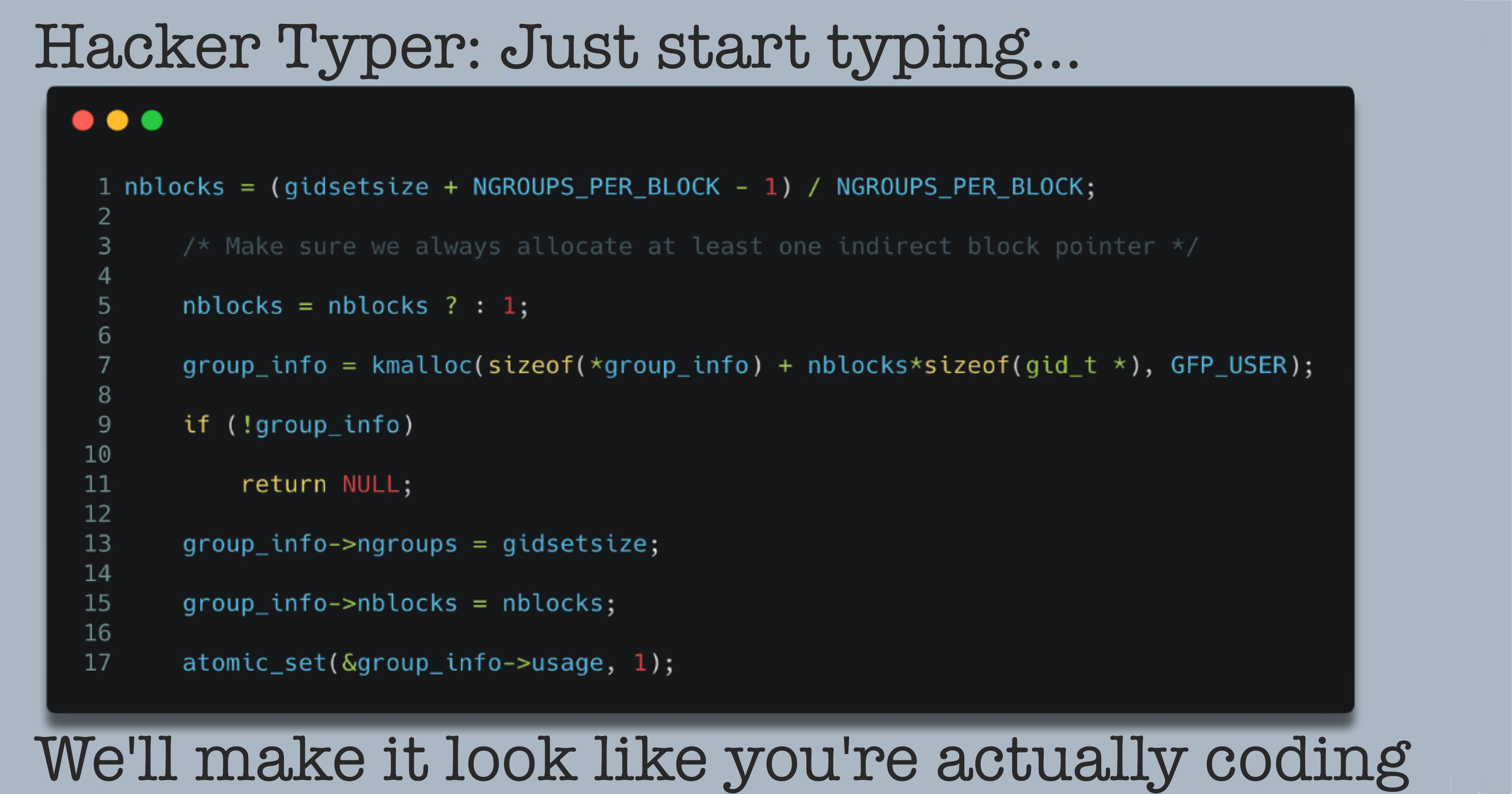

Sharing metadata
| og:url | https://hackertyper.com/ |
|---|---|
| og:type | website |
| og:image | https://hackertyper.com/hackertyper.jpg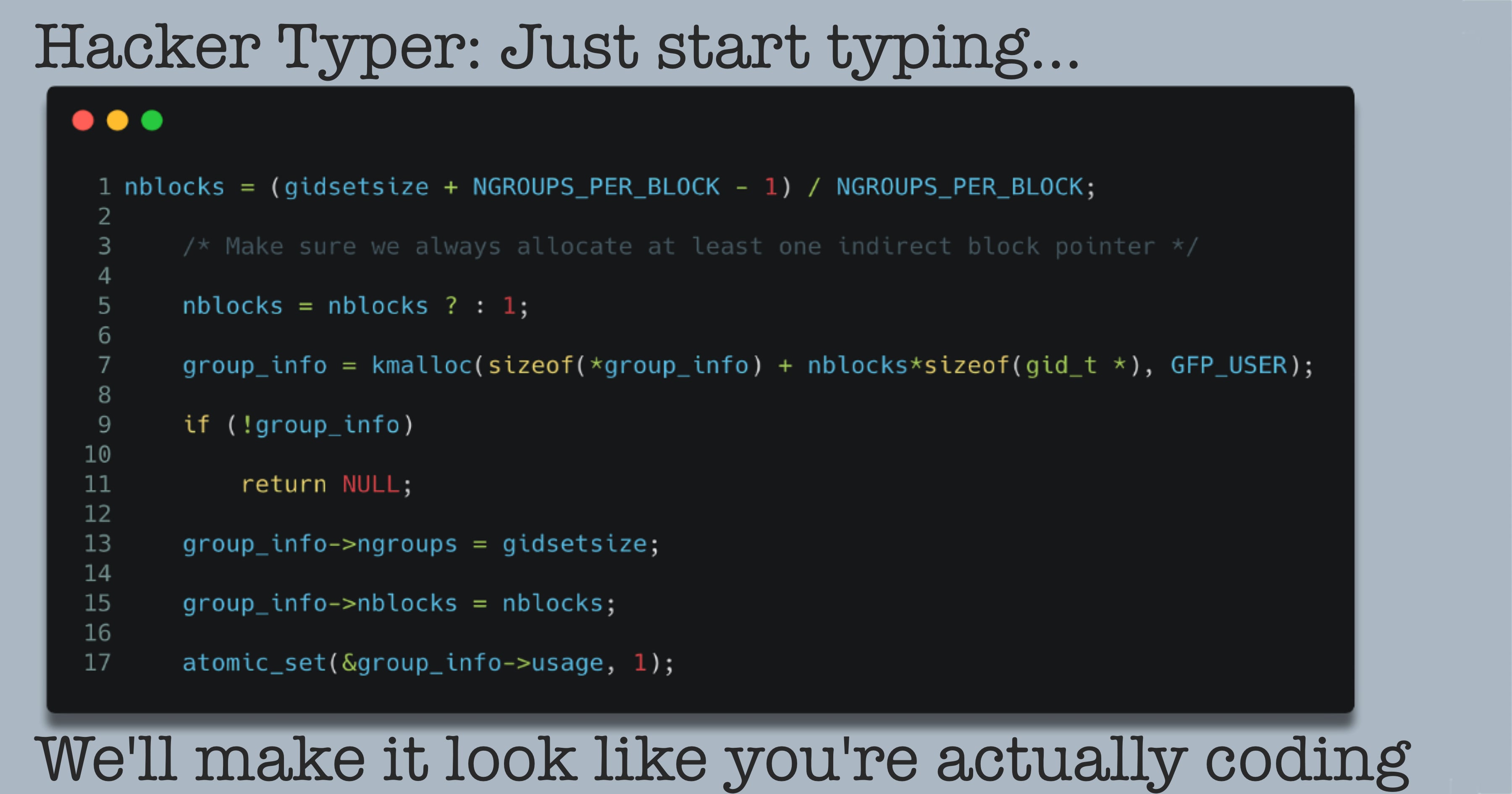 |
| og:title | HackerTyper: Use This Site To Prank Your Friends With Your Coding Skills :) |
| og:image:alt | A web browser with C++ code sample. Above it are the words 'Hacker Typer: Just start typing...' beneath it are the words 'We'll make it look like you're actually coding' |
| og:image:type | image/jpeg |
| og:description | This simulator makes it look like you're actually coding like a real pro. Just start typing, we'll take care of the rest ;) |
| og:image:width | 1200 |
| og:image:height | 628 |
| twitter:card | summary_large_image |
| twitter:image | https://hackertyper.com/hackertyper.jpg |
| twitter:title | Hacker Typer: Coding Simulator |
| twitter:description | The Hacker Typer simulator makes it look like you're actually coding like a real hacker. Just start typing, we'll take care of the rest ;) |
robots.txt (opens in a new tab)
1 rulesAll bots 1 allowed · 0 disallowed

 All bots

/
No matching rules.
Sitemaps
0No sitemaps found
 Registration details RDAP / WHOIS
| Registrar | Porkbun LLC |
|---|---|
| Registered | 2011-04-26 |
| Expires | 2027-04-26 |
| Domain status | client delete prohibited、client transfer prohibited |
| Nameservers | dan.ns.cloudflare.com、mona.ns.cloudflare.com |
| DNSSEC | unsigned |
 DNS records
| Type | Name | Value | TTL | Priority |
|---|---|---|---|---|
| A | hackertyper.com | 104.21.6.253 | 300 | — |
| A | hackertyper.com | 172.67.135.136 | 300 | — |
| AAAA | hackertyper.com | 2606:4700:3033::ac43:8788 | 300 | — |
| AAAA | hackertyper.com | 2606:4700:3037::6815:6fd | 300 | — |
| MX | hackertyper.com | aspmx.l.google.com | 3600 | 1 |
| MX | hackertyper.com | alt1.aspmx.l.google.com | 3600 | 5 |
| MX | hackertyper.com | alt2.aspmx.l.google.com | 3600 | 5 |
| MX | hackertyper.com | alt3.aspmx.l.google.com | 3600 | 10 |
| MX | hackertyper.com | alt4.aspmx.l.google.com | 3600 | 10 |
| NS | hackertyper.com | dan.ns.cloudflare.com | 86400 | — |
| NS | hackertyper.com | mona.ns.cloudflare.com | 86400 | — |
| TXT | hackertyper.com | google-site-verification=KVtmT2u9xHdRcF491tq_Ehwdi8uL9faEjvM19KKzg7c | 300 | — |
| TXT | hackertyper.com | google-site-verification=kqw-ypSGLbG0dqbIQd5FZ4bJoTfOykaw4-Ib4EERKpg | 300 | — |
| TXT | hackertyper.com | v=spf1 include:_spf.google.com -all | 300 | — |
| DMARC | _dmarc.hackertyper.com | v=DMARC1; p=none; | 300 | — |
 TLS and certificates
| Assessment | Normal configuration |
|---|---|
| Supported protocols | TLSv1.2、TLSv1.3 |
| Negotiated protocol | TLSv1.3 |
| Certificate subject | hackertyper.com |
| Issuer | Google Trust Services |
| Valid until | 2026-12-09T05:33 · Remaining when checked: 73 days |
| Verification details | Certificate trust: Passed · Hostname match: Passed |
 HTTP response headers
| Header | Value |
|---|---|
| content-type | text/html; charset=utf-8 |
| cache-control | public, max-age=0, must-revalidate |
| server | cloudflare |
| x-content-type-options | nosniff |
| referrer-policy | strict-origin-when-cross-origin |
| access-control-allow-origin | * |
 Identified technologies
User reviews (0)