
 简体中文
 English

Website review
This review may include AI-generated content and is not individually verified. Domain, certificate and other facts come from the observed data on this page.
What is Humanitas University?
Humanitas University (Hunimed) is an international medical school near Milan, Italy, built alongside the Humanitas Research Hospital. It trains students for careers in clinical health professions and in research, and describes itself as preparing graduates to work in Italy and abroad. Its stated focus areas are internationality, innovation, interactivity, research, and integration with the hospitals of the Humanitas Group.
What it offers
- Two English-taught single-cycle degree programmes: Medicine and Surgery, and MEDTEC School.
- Five Italian-taught three-year programmes in health professions: Nursing, Physiotherapy, Osteopathy, Biomedical Laboratory Techniques, and Medical Imaging and Radiotherapy Techniques.
- Teaching style: active learning through case studies, simulations, and 3D anatomy tools, in small tutor-led groups, with attention to AI in medicine.
- Research links: a research centre with close to 600 researchers in more than 38 groups, working with around 700 hospital physicians.
The university cites first place among medical universities in Italy (CENSIS) and, for its hospital, first place in Italy (AGENAS). It reports over 3,000 students from more than 30 countries, and offers postgraduate options including specialty schools, Masters and PhDs.
Is it the right fit?
The main decision point is language and programme type. If you want an English-taught medical degree with strong hospital integration, the two medical programmes are the relevant route; if you are aiming at nursing or allied health professions and are comfortable studying in Italian, the three-year programmes fit. The clinical setting next to a major research hospital suits students who want research exposure alongside clinical training. Prospective applicants can explore the official site at Hunimed or compare programme structures with other Italian medical schools such as University of Milan before applying.
How do I apply to the English-taught Medicine and Surgery program at Humanitas University?
Apply through Humanitas University's own admissions process for the English-taught single-cycle Medicine and Surgery programme, then sit its entrance test; the university's site is the authoritative place to confirm the current call for applications, deadlines and test format before you do anything else. Start at Hunimed and look for the Medicine and Surgery course page and its admissions section.
What to prepare first
- Check the entry route for your qualification. Italian medical admissions are test-based rather than a US-style holistic application, so your secondary-school results matter mainly for eligibility, while the entrance test largely decides selection.
- Confirm English and science requirements. The programme is taught in English, so verify the language certificate the university accepts and the biology, chemistry and physics background expected.
- Register on the university portal and pay the application fee when the call opens; late or incomplete registrations are the most common avoidable loss.
- Sit the entrance test and check whether the university uses its own exam or an international test such as IMAT, since this changes your preparation timeline.
- Prepare for ranking, not just passing. Places are limited and offers go by score, so treat the test as competitive.
A realistic scenario
A student finishing secondary school in spring should map the admissions calendar in autumn of the final year, book test preparation around biology and chemistry, and keep documents such as transcripts and ID ready for upload. If the score falls short, ask admissions about later rounds or related routes such as the MEDTEC School or health-profession degrees.
Next step
Download the current admissions call from the official site and note the registration window, test date and document checklist in one calendar entry. For comparison, Università degli Studi di Milano and University of Bologna also run English-taught medicine routes with their own test rules, which helps you judge how much the Humanitas hospital-integrated model matters to you.
What are the tuition fees and available scholarships for international students at Humanitas University?
Humanitas University's public pages do not list tuition amounts or scholarship terms, so treat any figure you see elsewhere as unverified until it appears in the official admissions pages for your specific programme and entry year. What the site does establish is the structure that determines cost: two English-taught single-cycle degrees (Medicine and Surgery, and MEDTEC School) and five Italian-taught three-year health professions degrees (Nursing, Physiotherapy, Osteopathy, Biomedical Laboratory Techniques, and Medical Imaging and Radiotherapy Techniques). Fees and scholarship eligibility are typically set per programme and per year, so a figure quoted for one course will not transfer to another.
What to confirm before applying
- Programme language and level: English-taught medicine versus Italian-taught health professions follow different admission tracks and fee rules.
- Fee bands by family income: Italian universities commonly scale tuition to household income via an ISEE-type declaration; ask admissions whether this applies and what documents international applicants must submit.
- Scholarship types: distinguish merit awards, need-based reductions and any external or regional funding. Ask which are automatic on admission and which require a separate application and deadline.
- Non-tuition costs: Milan living costs, accommodation and any lab or materials charges are separate from tuition and often the larger part of the budget.
A practical next step
Write to the admissions office with a short, specific message: your nationality, the exact programme, the entry year, and two questions — the tuition range for that programme and the list of scholarships international students may apply for, with deadlines. Ask for the response in writing so you can compare it against the official call for applications when it is published.
For orientation on the institution itself, the official site is Hunimed. To compare funding options across Italian universities generally, the national student portal Universitaly and the regional scholarship agency for Lombardy are the bodies to check, since need-based support in Italy is often administered regionally rather than by the university alone.
How does the MEDTEC School program differ from the standard Medicine and Surgery degree at Humanitas University?
The MEDTEC School is Humanitas University's second English-taught single-cycle medical programme, run alongside the standard Medicine and Surgery degree; the university presents it as a distinct option rather than a variant of the same course. The essential difference is emphasis: Medicine and Surgery is the conventional route into clinical practice, while MEDTEC is positioned at the intersection of medicine and engineering/technology, aimed at students who want to work with medical devices, digital tools and technology-driven care as well as with patients.
What the site makes clear, and what it leaves open
From the page evidence, both programmes are single-cycle degrees taught in English, both sit within the Medical Schools area, and both draw on the same campus, hospital integration and teaching approach: active learning through case studies, simulations and 3D anatomy in small tutor-led groups, with attention to AI in medicine and international careers. The site also states that all degree programmes use these methods, so innovative teaching is not what separates the two.
The page does not publish a side-by-side curriculum comparison, admission requirements or the specific engineering content of MEDTEC. Treat any detailed claims about module structure, credit weighting or eligibility as things to verify directly with the university rather than infer from the overview.
How to choose
| Your priority | More likely fit |
|---|---|
| Straightforward clinical training and a career as a physician | Medicine and Surgery |
| Combining clinical work with devices, diagnostics technology or health-tech development | MEDTEC School |
| Studying medicine in English in Milan, with hospital proximity | Either; compare curricula |
| Keeping options open for postgraduate specialisation | Either; check how each is recognised |
A concrete scenario
A student who wants to become a clinician but is also drawn to surgical robotics or medical imaging innovation should compare the actual course plans rather than the labels: look at how much mathematics, physics and engineering appears in each, whether there are projects with engineers or industry, and where graduates have gone. A student who is certain about ward-based clinical practice may find the standard degree the more direct path.
Next step
Request the full study plans for both programmes and ask admissions how each degree is recognised for postgraduate specialty training, then speak with Student Ambassadors from each course — the university invites prospective students to chat with them. The official site is Hunimed.
What clinical training and hospital exposure do students get through the Humanitas Research Hospital and Group hospitals?
Humanitas University's clinical training is built around its placement alongside Humanitas Research Hospital near Milan, with the university describing integration with the hospitals of the Humanitas Group as one of its defining features. Students are trained in clinical and research fields, and the university states that roughly 700 hospital physicians work closely with its research staff, which is the pool from which much bedside teaching is drawn.
What the university says about clinical exposure
- Hospital-integrated campus: The university presents its state-of-the-art campus as built next to the research hospital, so clinical and teaching environments sit in the same place.
- Group-wide clinical setting: The page refers to integration with the hospitals of the Humanitas Group, not a single site, so students may encounter more than one hospital environment during their studies.
- Active-learning methods: All degree programmes use case studies, simulations and 3D anatomy tools in small tutor-led groups, with attention to AI in medicine. These methods prepare students for clinical work but are not the same as patient contact.
- English-taught medical degrees: Medicine and Surgery and the MEDTEC School are taught in English, while the five Health Professions degrees (Nursing, Physiotherapy, Osteopathy, Biomedical Laboratory Techniques, and Medical Imaging and Radiotherapy Techniques) are taught in Italian.
What the page does not specify
The website material does not give year-by-year clinical rotation schedules, the number of bedside hours per programme, which Group hospitals host students, or how placements are allocated. Students choosing between programmes should ask admissions directly for the clinical curriculum of the specific degree, since a nursing or radiotherapy student's hospital exposure will differ substantially from a medicine student's.
A practical next step
Prospective students can use the university's Student Ambassadors, promoted on the page, to ask current students what ward time and simulation work actually look like in their programme. For broader context on Italian medical education and English-taught options, University Italy and Study in Italy are useful starting points.
What is campus life like for international students at the Humanitas University campus near Milan?
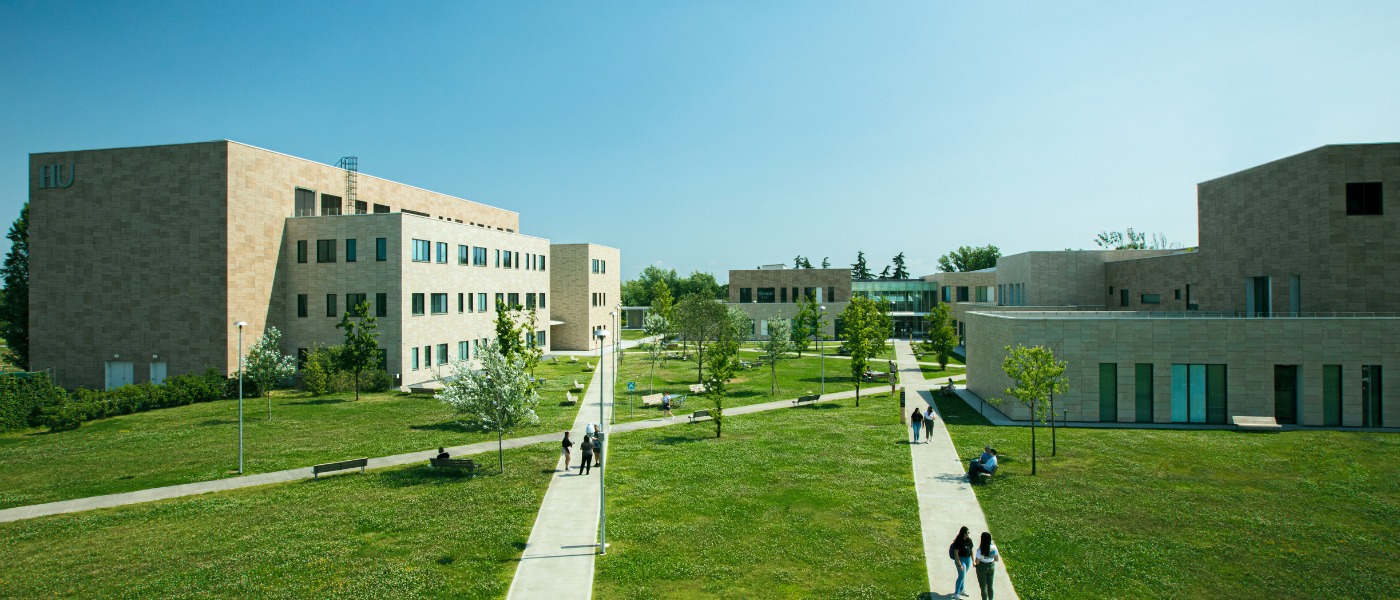
Campus life at Humanitas University is built around a modern campus next to the Humanitas Research Hospital, with an international student body of more than 3,000 people from over 30 countries. The university presents this setting as part of its educational model: students study and train close to a working hospital and research centre, rather than on a separate, purely academic site.
What shapes day-to-day life
- International mix: English-taught Medicine and Surgery and MEDTEC programmes sit alongside Italian-taught health professions degrees, so the campus combines international and local students.
- Small-group, active learning: The university says its programmes use case studies, simulations, 3D anatomy tools and tutor-led small groups, which tends to mean a more structured timetable than lecture-only degrees.
- Hospital proximity: With the research hospital and roughly 600 researchers nearby, clinical exposure and research contact are part of the appeal for students aiming at clinical or research careers.
- Milan access: The campus is described as near Milan, giving students a major city for transport, culture and placements without being in the historic centre.
A realistic student scenario
An international student arriving for an English-taught medical degree would likely find the academic side internationally oriented, but everyday life requires some Italian for the city and for interaction with Italian-taught peers and staff. The university's own student ambassadors are the most direct way to test this: asking them about language, housing, commuting and how students mix across programmes gives a clearer picture than prospectuses.
How to decide
Use campus visits or virtual tours to check the things that matter most to you: commute time to Milan, accommodation options, how much teaching is classroom-based versus hospital-based, and whether the international community extends beyond your own programme. The official site, Hunimed, lists campus tours and student ambassador contact as starting points.
 Proofpoint
User reviews (0)