Website profiles · Technology insights · Alternatives

keygenmusic.tk No paid content found

Categories: Music & Audio

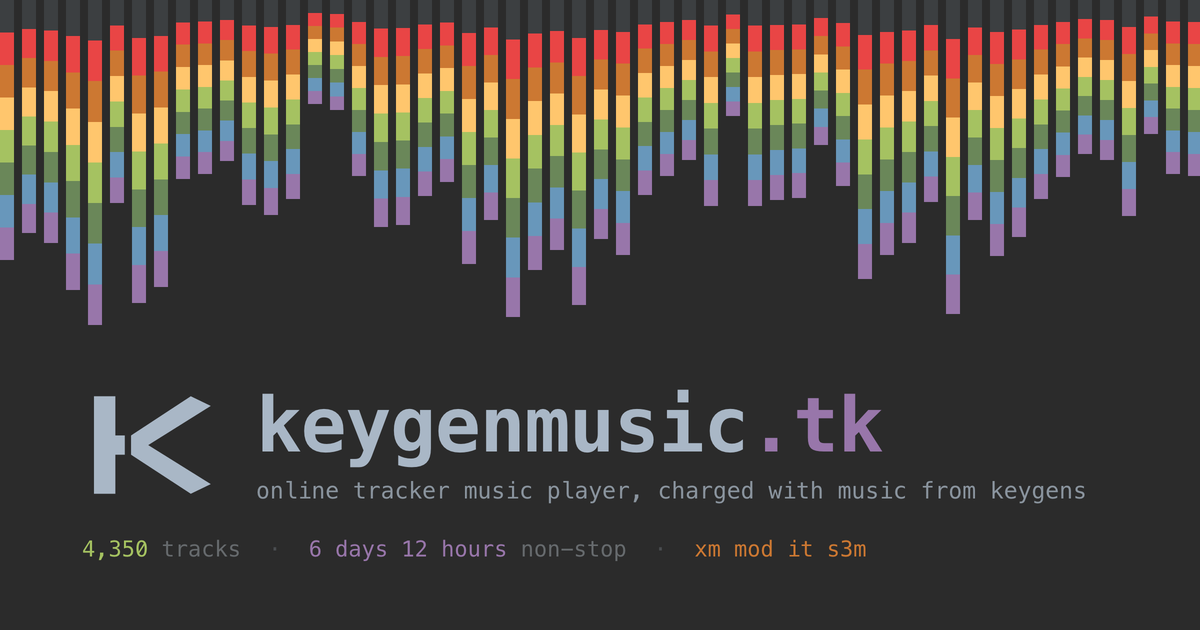
Online chiptune music player. Charged with music from keygens. Streams directly in your browser

Visit website

Updated: 2026-10-02 00:27 Language: English (default) Access: Normal

Profile views 2 Outbound visits 0
keygenmusic.tk Full homepage screenshot
Editorial Review

Website Review

What is keygenmusic.tk?

keygenmusic.tk is a browser-based music player devoted to keygen music — the chiptune-style tracks that historically accompanied software key generators. The site's own framing is explicit: "No keygens here. Just the music." It streams tracker modules directly in the browser, so nothing needs to be downloaded or installed to listen.

The library is built around classic tracker formats: .mod, .xm, .s3m and .it. The interface is a labelled β-version, with browsing aids rather than a polished commercial feel — a full library list, search by module title, shuffle, volume control, favorites, and global Top 100 charts by all time, month and week, plus a "most favorited" view. Playback controls work through media keys, and mobile support was added in later revisions. The site states there are no accounts and no tracking cookies, only anonymous statistics.

Who it suits

  • Tracker and demoscene listeners who want authentic module playback rather than remixes or re-uploads.
  • People with a nostalgic interest in keygen-era software culture who want the soundtrack without the cracking tools.
  • Casual listeners who just want background chiptunes in a tab — the shuffle and charts make it easy to start without knowing any track names.

The trade-off is depth versus convenience. This is a niche archive in beta, not a curated streaming service: expect raw module files, a utilitarian player, and a catalogue shaped by historical music packs rather than editorial playlists. If you want polished discovery, mood tagging or offline sync, it will feel thin. If you want the actual .MOD/.XM/.IT files played as intended, that narrowness is the point.

Next step: open the player and try the "Top 100 (All Time)" chart first — it gives you a quick sense of the catalogue's character before you commit to browsing the full library. If a track grabs you, favorite it and use the song link to return later. For broader chiptune listening beyond keygen material, keygenmusic.net is the long-running source the site's music packs are drawn from.

How do I play a .mod, .xm, .s3m, or .it file in my browser on keygenmusic.tk?

Open keygenmusic.tk and pick a track from the library or a chart list — the player handles .mod, .xm, .s3m and .it files itself, so you don't need a plugin, an account or a separate tracker program. The site describes itself as a browser-based tracker music player that streams keygen chiptunes directly, and its own note says there are no keygens here, just the music.

What to expect in the interface

  • A library plus My Favorites, and Top 100 lists for all time, month and week (the Most Favorited track is also surfaced).
  • Shuffle toggle, volume control, and a now-playing display.
  • Search, including search by module title.
  • Media-key support for play/pause/next/previous, so keyboard controls work without touching the page.
  • A download button, if you'd rather keep a file locally.
  • A spectrum display while a track plays.

Steps

  1. Open the site in Firefox if possible. Its own fallback message recommends Firefox when the browser lacks AudioContext support, and a changelog entry mentions Firefox-specific fixes.
  2. Browse the library or a Top 100 list, or search for a module title you already know.
  3. Press play on a track. Shuffle stays off until you switch it on, so playback order is predictable.
  4. Star tracks you like to build a favorites list, then use the link to a song to return to it later.
  5. Use the volume slider and media keys to control playback while you work elsewhere.

Practical notes

Playback begins only when you press play — a changelog entry notes autoplay was removed, which is normal for browser audio and avoids surprise sound. Mobile support arrived in a later build, so phones and tablets should work, though a desktop browser is the more comfortable way to browse long lists.

If you want to play these formats outside the site — for example your own .xm or .it files — you need a player that supports tracker modules rather than a standard MP3 player. That's a general point about the format family, not a feature of this site.

A realistic scenario: you remember a module from an old installer, search its title, find it in the library, and leave it looping in a background tab with shuffle on. Favoriting it saves you the search next time.

Next step: if a track won't start, try Firefox first, then check that your volume isn't muted at the system level before assuming the file is broken.

Can I download tracks from keygenmusic.tk to listen offline?

Yes — the site includes a download button, added in the β19 update listed in its changelog. Since it streams tracker modules (.mod, .xm, .s3m, .it) rather than ordinary audio files, what you save is most likely the module file itself, not an MP3.

What offline listening actually looks like

A downloaded tracker module is a set of note patterns plus instrument samples, not a finished recording. To hear it, you need a player that understands those formats:

  • Desktop: OpenMPT, VLC, XMPlay, or Schism Tracker handle .mod/.xm/.s3m/.it natively.
  • Mobile: options are thinner; Android has a few module players, iOS is awkward.
  • Browser: the site itself plays them via a WebAssembly-based engine, so a saved file won't just open in a normal browser tab.

If you want something that behaves like a normal music file, you'd have to render each module to WAV or MP3 in a tracker or converter first — an extra step per track.

Practical scenario

Say you want a handful of favourites for a flight with no Wi-Fi. Download the modules on your laptop, open them in OpenMPT or VLC to confirm they play, then either keep them there or export audio versions to copy to your phone. Doing this for a whole collection is tedious; for a dozen tracks it's fine.

Decision criteria

  • Choose download if you want offline playback, archiving, or remixing in a tracker.
  • Skip it if you just want background listening on a phone — the in-browser player is easier, and the site states there are no accounts and no tracking cookies, so nothing is lost by streaming.
  • Check the format first if you need phone playback; module support on mobile is the main friction point.

For broader chiptune listening without downloading, keygenmusic.tk itself is the starting point; the changelog notes Firefox is recommended if your browser lacks AudioContext support.

What are the Top 100 charts on keygenmusic.tk and how are they calculated?

The Top 100 charts on keygenmusic.tk are built-in popularity lists for the site's tracker-music library. The page advertises three chart views: Top 100 (All Time), Top 100 (Month) and Top 100 (Week). A separate Most Favorited list ranks tracks by how many users have added them to favorites, and a Global Top Charts playlist feature was added in the β18 update.

How they are calculated is not spelled out on the page. The site says it uses only anonymous statistics and no accounts or tracking cookies, so the plausible inputs are aggregate play counts and favorite counts rather than personal profiles. Treat the weekly and monthly charts as recent-activity rankings and the all-time chart as a cumulative ranking; their exact weighting is not documented.

Practical uses

  • Use Week or Month to find what is currently circulating in the chiptune/keygen scene.
  • Use All Time as a starting point if you want the widely recognized tracks.
  • Use Most Favorited when you care about tracks people deliberately saved, not just played once.
  • Use the search and shuffle controls alongside the charts if you already know a module title.

What to expect

The library plays .mod, .xm, .s3m and .it tracker formats directly in the browser, with no keygens included. Volume control, media-key playback and mobile support are present, but charts rely on anonymous aggregate data, so smaller or newer tracks can be underrepresented.

If you want to check the current rankings yourself, open the site's Top 100 pages and compare the Week, Month and All Time lists for the same track. A track that appears high on Week but not All Time is a recent favorite; one high on All Time but absent from Week is a classic that is no longer heavily played. For related chiptune listening, keygenmusic.net is the pack source referenced in the site's changelog.

Is keygenmusic.tk safe and private to use without an account?

Yes, for normal browser listening it is safe and private in the narrow sense: the site describes itself as account-free, with no tracking cookies and only anonymous stats. It streams tracker modules (.mod, .xm, .s3m, .it) in the browser, and the page explicitly says "No keygens here. Just the music." That last point matters: the name refers to music once bundled with keygen software, not to the site distributing keygens.

What "private" means here

  • No sign-up or login is required to play tracks, so there is no account profile to leak.
  • The stated privacy position is no tracking cookies, only anonymous statistics.
  • It still needs a connection to the site and to whatever hosts the module files; your IP and browser details are visible to those servers as with any streaming site.
  • It is a small beta project (the page labels itself β19-version), so treat the privacy claim as the operator's stated policy rather than an audited guarantee.

Practical safety scenario

You want background chiptunes while working and would rather not create another account. Open the player, use search or the Top 100 charts, and leave it running. Nothing asks for an email or password, so there is little to expose. If you want to keep listening habits off your main browser profile, use a separate browser profile or private window and avoid favoriting tracks under an identity you care about.

Trade-offs and decision criteria

Question Practical answer
Do I need an account? No, playback works without one.
Are there tracking cookies? The site says none; only anonymous stats.
Is the content legal/legit? It is music from keygen scenes, not keygens or cracks.
Should I download files? Only if you accept that module files come from a small beta site.
Best use case Casual listening to MOD/XM/S3M/IT chiptunes in-browser.

For a more established tracker-music alternative, you can also listen on The Mod Archive. If you specifically want the keygen-era catalog, keygenmusic.tk is the direct fit; just keep expectations modest given its beta status and use a separate browser profile if privacy is your priority.

How do I use media keys or keyboard controls to play, pause, and skip tracks on keygenmusic.tk?

Use your keyboard's media keys directly, or the player's own on-screen controls, and make sure the page has focus first.

Media keys (play/pause/next/prev) The site added media-key support in its β13 update, so the standard hardware buttons on a keyboard or headset—Play/Pause, Next Track, Previous Track—can drive the player. This works because the browser registers the page as an active media session. Practical points:

  • Click once anywhere on the page (or press Play in the player) so the browser treats keygenmusic.tk as the current media source; otherwise the keys may control another tab, a music app, or nothing at all.
  • If the keys do nothing, check that another tab or app isn't holding the media session. Close or pause competing media, then reload the page.
  • The site explicitly notes it disabled autoplay (β15), so the first track needs a manual start before keys take over.

On-screen controls instead of keys If your keyboard lacks media keys, the player interface itself covers the same ground: a play/pause control, next/previous, a SHUF (shuffle) toggle, and a volume control set to 100% by default. Favorites and a link to the current song let you save or share a specific track.

Formats and playback The player streams tracker modules in .mod, .xm, .s3m and .it formats using in-browser audio (chiptune2.js and libopenmpt via emscripten). If you see "Your browser does not support AudioContext," switch to a current Firefox or another modern browser—the site itself recommends Firefox.

A concrete scenario You're working with a browser tab open and want background chiptunes without touching the mouse. Start one track, then use the media keys on your keyboard or headset to pause when a call comes in and skip when a track isn't to your taste. Volume stays under the player's own slider, so adjust it there rather than with system volume if you want finer control.

Next step Open the player, press Play once, then test each media key. If Play/Pause works but Next/Previous doesn't, that's usually a browser or OS media-session limitation rather than the site—fall back to the on-screen next/previous buttons.

For more tracker-style listening options, keygenmusic.net is the long-running archive the site's music packs historically came from, and The Mod Archive hosts a large browsable collection of .mod, .xm, .s3m and .it files if you want to download modules rather than stream them.

Related questions

More questions →
What Is Chiptune Music and How Do You Make It Online for Free?

Chiptune is instrumental music built from the simple waveforms of early game consoles and computers — most recognizably the square wave, plus triangle, sawtooth, and noise channels. You can make it for free in a browser with a pattern-based sequencer like JummBox (jummb.us), which runs entirely online: you place notes on a grid, the tool plays them back immediately, and your whole song is stored in the page URL so you can save and share it by copying a link. This guide covers what defines the style and the concrete steps to write a track in JummBox.

What makes chiptune sound like chiptune

The genre's character comes from hardware constraints, not from a genre rulebook. Early sound chips had a small number of channels, each limited to a basic waveform, so composers worked with:

  • Square waves for leads and melodic lines — the classic "beep" timbre.
  • Triangle waves for bass, since they're softer and sit lower.
  • Noise channels for percussion and sound effects.
  • Few simultaneous voices, which forces you to write clear, interlocking parts instead of dense layered pads.

That limitation is the aesthetic. When you write in a tracker or pattern sequencer, you're recreating the same trade-offs: a handful of channels, each doing one job.

How pattern-based sequencers work

Instead of one long timeline, chiptune tools usually split a song into patterns — short, reusable blocks of notes. You edit one pattern at a time, then arrange patterns into a song structure.

In JummBox specifically:

  • Notes go into patterns, and you edit one pattern at a time.
  • The numbered boxes at the bottom of the editor are your patterns. Click a box to jump to that part of the song.
  • Click the arrows on the currently selected box to swap which pattern plays during that part — this is how you reuse a pattern in multiple places.
  • JummBox can play several rows of patterns simultaneously, and each row has its own set of patterns. Most rows handle melodies or harmonies; the bottom row is for drums.

This is the core mental model: rows are your channels/instruments, patterns are your building blocks, and the arrangement is which pattern sits in which slot.

Making your first track in JummBox

Add notes and hear them

Click on the gray rows at the top to add or remove notes. JummBox plays the notes out loud automatically as you work, so you can audition ideas without a separate playback step.

Edit note length, chords, and volume

  • Duration: click and drag horizontally on a note to adjust how long it lasts.
  • Chords: click above or below an existing note to add notes that play simultaneously.
  • Bulk moves: long-press in the pattern editor to select a time range, then drag to move multiple notes at once.
  • Pitch bend (advanced): drag vertically from an existing note to bend its pitch.
  • Volume (advanced): drag vertically from above or below a note to adjust its volume. Hold Control while doing this for fine adjustment.

Copy and paste sections

Click and drag on the pattern grid to make a selection, then press C to copy and V to paste — useful for mass-duplicating parts of your song.

Save and share via the URL

All song data is contained in the URL at the top of your browser. As you make changes, the URL updates to reflect them. When you're happy with the song, copy and paste the URL to save and share it. There's no separate export step described — the link is the file.

Keyboard shortcuts worth learning

JummBox has focus-dependent shortcuts (click on its interface first). The ones that speed up editing most:

Shortcut Action
Spacebar Play or pause
Shift + Spacebar Play from mouse location
Z Undo
Y or Shift + Z Redo
C / V Copy / paste pattern from selection
0–9 Assign pattern number to selection
Arrows Move selection
Ctrl + Arrows Rearrange channels
[ ] Move playhead backward or forward
F / H Move to First or Highlighted pattern
Shift + Drag Select part of a pattern

The edit menu holds more shortcuts beyond these.

Practical notes and common sticking points

  • The URL is your save file. If you close the tab without copying the link, you lose the song. Copy the URL as soon as a track is worth keeping.
  • Drums live on the bottom row. If percussion isn't behaving like your melodic rows, check that you're editing the drum row.
  • Patterns are reused, not duplicated by default. Swapping a pattern into a slot changes what plays there — that's the point, but it also means editing a shared pattern changes every place it appears.
  • Some features are hard to find. JummBox notes that certain options are buried; clicking the label next to each option shows a description of what it does, and modulator channels have their own Ctrl/Shift behaviors.

When this approach fits

Use a browser pattern sequencer like JummBox if you want to sketch chiptune quickly, share a playable link instead of a file, and work within the constraint of a few channels. If you need sample-based instruments, mixing, or plugin effects, a DAW will serve you better — but for the square-wave, pattern-driven sound that defines chiptune, the constraint is the instrument.

How to Set Up Your Game Server to Stream to PBBans Hub

PBBans Hub lets a PunkBuster-enabled game server stream its ban data to PBBans and other anti-cheat sites at the same time, with live banning, live banlist updates, and live ban removals. Setup is done through your PBBans account: apply for streaming, run the Automated Hub Setup, then confirm the server appears in the Check Streaming Server tool. PBBans states the process usually takes 15 minutes or less from application to a streaming server.

What streaming to PBBans Hub actually does

Once your server is connected, PBBans describes the Hub as a multi-stream and live-banning system. In practice that means:

  • Multi-streaming — your server sends its data to PBBans and other anti-cheat sites at the same time, rather than to one destination only.
  • Live banning — bans are applied while the server is running.
  • Live banlist updates — the ban list your server uses is refreshed without a restart.
  • Live ban removals — bans that are lifted stop applying to your server.

PBBans frames the wider benefit as collective: the more servers that stream, the harder it is for cheaters to find servers they can join.

Before you start

You need:

  • A PunkBuster-enabled game server that you administer.
  • A PBBans account — streaming is applied for from inside account management, so you must be able to log in.
  • Your server's IP address and port, since the verification tool checks a specific address such as 69.168.58.45:17567.

Step 1: Apply for streaming

Log in to your PBBans account and go to the Streaming Application area. This is where a server is submitted for streaming. Complete the application for the server you want to connect.

Step 2: Run the Automated Hub Setup

PBBans provides an Automated Hub Setup for configuring the server side. Follow it for the server you applied with. This is the step that prepares the server to stream to the Hub, including the multi-streaming behavior described above.

PBBans points new admins to its Beginners Guide as the starting walkthrough; the Automated Hub Setup is the configuration path it offers alongside that guide.

Step 3: Verify the server is streaming

Use the Check Streaming Server tool on the PBBans site. Enter your server's IP and port in the format shown in the example, for example 69.168.58.45:17567.

Expected result: the tool reports the server as streaming. If it does not, the server is not yet connected and you should revisit Step 2.

You can also check a player's GUID separately with the Check GUID tool, which accepts 8 or 32 characters.

Step 4: Confirm bans are flowing

After streaming is live, the site's public data gives you a way to sanity-check that the pipeline is working:

  • The Latest 25 Bans list shows recent bans with the game and detection type (for example BF4 | PBSS or BF4 | EB 81697).
  • The Master Ban Index (MBI) holds the shared ban records.
  • Hub Live statistics show current activity, including streaming servers and players.

PBBans notes its statistics update every 5 minutes, so a short delay before your server's activity appears is expected.

Reference: PBBans Hub figures

These are the site's published statistics at the time of the source page:

Metric Value
MBi Entries 410,140
Unofficial MBi Entries 58,756
Cached Global Bans 105,906
Streaming Servers 27
Players (Hub Live) 74
MLi Entries 1,439
Teams 16,039
Members Online 1

Common setup failures

  • Server does not appear in Check Streaming Server. The most likely cause is that the Automated Hub Setup was not completed or was applied to the wrong server. Re-run it for the exact server you applied with.
  • Wrong address checked. The verification tool needs the server's IP and port, not just the IP. Use the IP:port format.
  • Checking too soon. Statistics refresh every 5 minutes, so allow a short window before concluding the stream failed.
  • Not logged in. Streaming application and account management require an active PBBans login.

Related tools on the same site

Beyond streaming setup, PBBans exposes several indexes and tools from its menu: Master Ban Index, Master Config Index, Master League Index, Master Player Index, and Master Stream Index, plus Downloads, Cheat Submission, and a ban appeal route for players who are globally banned.

What Are Chiptunes and How Can You Listen to Them in Your Browser?

Chiptunes are songs built from the same kinds of synthetic sound generators found in early game consoles and home computers, and you can listen to them in a browser without downloading files or installing plugins. keygenmusic.tk is one example: it streams tracker music directly in the browser and supports the four common tracker formats — .mod, .xm, .s3m, and .it. The catch is that browser playback depends on the Web Audio API, so an older browser may refuse to play anything.

What makes a chiptune a chiptune

A chiptune is music written for, or emulating, the limited sound chips of 1980s and 1990s hardware. Instead of recorded instruments, the composer works with a small number of channels, each producing simple waveforms — square, triangle, pulse, noise — plus tight constraints on polyphony and sample memory. That constraint is the sound: thin, buzzy leads, fast arpeggios standing in for chords, and percussion made from noise bursts.

The style survived because the tools did. Trackers — software that arranges notes in a vertical pattern grid rather than on a staff — let anyone compose chip-style music on a normal computer, and the resulting files stayed tiny.

The tracker formats you will actually encounter

Most chiptune and keygen music circulating online comes in four tracker formats. They are not audio recordings; they are instructions plus small instrument samples, which is why a full song can be a few dozen kilobytes.

Format Typical origin What it means in practice
.mod Amiga / ProTracker era The oldest common format; 4 channels by default, simple and widely supported
.xm PC trackers (FastTracker II lineage) Adds more channels and instrument features; common for richer chip-style tracks
.s3m Scream Tracker 3 Popular on PC demoscene and DOS-era music
.it Impulse Tracker Later format with more advanced instrument and effect handling

For a listener, the practical difference is small: all four play back through the same kind of software engine. For a player to work, it needs a decoder for each format it claims to support.

Listening in the browser

keygenmusic.tk describes itself as an online chiptune music player charged with music from keygens, streaming directly in the browser. Its stated format support is .mod, .xm, .s3m, and .it. The site is explicit on one point: "No keygens here. Just the music."

A typical session works like this:

  1. Open the player in a current browser. The site notes that an unsupported browser will report "Your browser does not support AudioContext" and suggests Firefox.
  2. Pick a track from the library, or use the built-in lists — My Favorites, Top 100 (All Time), Top 100 (Month), Top 100 (Week), and Most Favorited.
  3. Use the controls: shuffle on/off, volume, play/pause, and next/previous. Media keys on a keyboard can also control playback.
  4. Search by track title if you are looking for something specific.
  5. Favorite tracks to build a personal list, and use the download button if you want the file itself.

Expected result: audio starts streaming in the page, with the current track shown in the playlist and a spectrum display. If nothing plays, the browser is the first thing to check, not the track.

Features worth knowing about

  • Charts and playlists — global top charts by all time, month, and week, plus a most-favorited list.
  • Search — by module title.
  • Favorites — saved per user in the browser.
  • Shuffle — a toggle rather than a mode you have to re-enable.
  • Download — added in the β19 build.
  • Mobile support — added in β16, so phone playback is a supported case rather than an afterthought.

Privacy and account expectations

The site states there are no accounts and no tracking cookies, only anonymous stats. That matches the absence of any pricing or login signals on the page — nothing indicates a paid tier, and nothing indicates a required sign-in either. Treat it as a no-account player unless the site itself says otherwise.

Why keygen music is a chiptune category

Keygens — small programs that generated registration keys — often shipped with a short looping track, and those tracks were typically tracker modules. Over time the music outlived the software it accompanied, and archives of keygen tunes became one of the largest casual entry points into chiptune listening. That is the niche keygenmusic.tk occupies: the music from that scene, separated from the tools.

Common snags

  • Nothing plays at all. Check the browser first; the site calls out AudioContext support and recommends Firefox.
  • Autoplay does not start. The changelog records that autoplay was deliberately removed in the β15 build, so expect to press play.
  • A file will not load. Confirm it is one of the four supported formats. Other tracker or audio formats are outside the stated support list.
  • Volume seems wrong. The player exposes a volume control; check it before assuming a broken track.

If you want a zero-install way to hear chip-style music, a browser tracker player covers the basics: open it, search or browse a chart, press play. If you need offline files or a specific format outside .mod/.xm/.s3m/.it, download the tracks you like and use a dedicated tracker or module player instead.

How to Listen to Free Music, Radio, and Podcasts on iHeart

iHeart is a free streaming platform that combines live radio stations, customizable artist stations, playlists, and podcasts in one place. You can start listening without paying by opening iheart.com in a browser or using the iHeart app, then searching for a station, artist, song, or podcast. A subscription is only relevant for certain premium features; the core listening experience described on iHeart's site is available for free.

What you can listen to on iHeart

iHeart organizes its content into a few main types, and knowing the difference helps you find what you want faster.

Content type What it is Best for
Live radio stations Thousands of real-time broadcast stations Hearing a scheduled show, local station, or live event
Artist stations Stations built around a specific artist Continuous music in the style of an artist you like
Playlists Curated or self-made collections of songs A defined set of tracks for a mood or activity
Podcasts On-demand episodic shows Talk, news, storytelling, and interviews
Music and trending news Updates on artists, songs, and bands Discovering what's new

The key distinction is live versus on-demand. Live radio plays whatever is broadcasting right now, so you can't skip tracks. Artist stations and playlists behave more like on-demand listening, where you control the starting point.

How to start listening for free

You can begin on either the web or the app. The steps are similar.

  1. Open the platform. Go to iheart.com in a browser, or install the iHeart app on your phone or tablet.
  2. Search or browse. Use the search function to enter a station name, artist, song, or podcast. Alternatively, browse categories to see what's available.
  3. Select what you want to hear. Choosing a live station starts playback immediately. Choosing an artist creates or opens a station built around that artist.
  4. Press play and adjust. Use the player controls to pause, change volume, or move between stations. On live radio, expect no track skipping; on artist stations, you have more control over what plays next.
  5. Save what you like. Favoriting a station or artist makes it easier to return to later without searching again.

Expected result: audio begins playing shortly after you select content, and your favorites appear in your account for quick access next time.

Creating your own stations and playlists

  • Artist stations: Start from an artist you like, and the station plays music in that style. This is the fastest way to get continuous music without building a list yourself.
  • Playlists: Add individual songs to a playlist when you want a specific set of tracks rather than a continuous stream. This suits workouts, commutes, or a fixed party set.
  • Tip: Use artist stations for discovery and playlists for control. If a station drifts away from what you want, switch to a playlist instead of fighting the stream.

What's free versus what needs a subscription

iHeart's own description states that its music, podcasts, and radio stations are available for free, and that you can listen to thousands of live stations or create your own artist stations and playlists. The site also references a subscription, which indicates that some features sit behind a paid tier.

Because the exact free-versus-paid split isn't fully detailed in the available information, treat it this way:

  • Assume free: live radio stations, artist stations, playlists, podcasts, and general music/news browsing, based on iHeart's stated offering.
  • Check before assuming: any feature labeled as premium, ad-free, or subscription-only. If a paywall appears, that specific feature requires payment.
  • Don't assume: that a subscription is required to listen at all, or that everything is free. Verify at the point where you're asked to sign up or pay.

Common snags and how to handle them

  • A station won't play. Live stations can be unavailable due to regional restrictions or temporary outages. Try another station to confirm whether the issue is the station or your connection.
  • You can't skip a track. That's expected on live radio. Switch to an artist station or playlist if you want control.
  • Search returns too many results. Add the type of content to your search, such as the artist name plus "station," or search podcasts separately from music.
  • You lose your favorites. Sign in to an account so saved stations and playlists persist across sessions and devices.

Quick decision guide

  • Want background music with no effort? Open an artist station.
  • Want a specific set of songs? Build a playlist.
  • Want a live show or local broadcast? Pick a live radio station.
  • Want talk or storytelling? Go to podcasts.
  • Want to avoid paying? Stick to the free listening options above and check any prompt before entering payment details.
What Is Keygen Music and How Can You Listen to It Online?

Keygen music is the background music that played inside software keygens — the small programs that generated serial numbers for pirated software in the 1990s and 2000s. The music itself is tracker music, usually in MOD, XM, S3M, or IT format, which is why it sounds like chiptune. You can listen to it online without touching a keygen: keygenmusic.tk is a browser-based player that streams these tracks directly, with no accounts and no tracking cookies (only anonymous stats, per the site).

Why keygen music sounds like chiptune

The overlap isn't a coincidence — it's a format issue. Keygen authors needed tiny audio files that could loop forever and play on weak hardware, so they used tracker modules instead of MP3s. A tracker module stores note patterns and instrument samples rather than a rendered waveform, which keeps file sizes small and lets the same short loop repeat indefinitely while someone types a name or clicks "Generate."

That constraint produced the sound people now call chiptune: simple waveforms, arpeggios, and tight percussion. The keygenmusic.tk player explicitly supports the four classic tracker formats:

Format Typical origin
.mod Amiga / early trackers
.xm FastTracker II era
.s3m Scream Tracker 3
.it Impulse Tracker

If you've heard chiptune elsewhere and wondered why keygen tracks fit the same playlist, this is the reason — same file formats, same era, same hardware limits.

How to listen on keygenmusic.tk

The site is labeled β19-version and describes itself as an "Online Tracker Music Player" that "streams directly in your browser." A few things worth knowing before you start:

  • No keygens are hosted. The site states plainly: "No keygens here. Just the music." You're only getting audio.
  • No account needed. Privacy note says no accounts and no tracking cookies.
  • Playback controls exist. The interface includes shuffle on/off, a volume control (added in β17), and media-key support for play/pause/next/prev (β13).

Finding tracks

The player organizes music through several entry points visible on the page:

  1. Keygen Music Lib — the main library.
  2. My Favorites — saved tracks (favorites were added back in β5).
  3. Top 100 (All Time), Top 100 (Month), Top 100 (Week) — global charts, added in β18.
  4. Most Favorited — sorted by how often tracks were favorited.
  5. Search — search by module title (search by mod titles dates to β10).

A practical workflow: start with a Top 100 list to hear representative tracks, favorite the ones you like, then use search to find specific modules by title. Shuffle is useful once your favorites list is long enough.

Playing and controlling

Select a track and it streams in the browser — no download step required to listen. The download button was added in β19, so if you want a local copy, that option now exists. Volume, shuffle, and media keys cover the basic controls; "now playing in playlist" display was added in β8.

If playback fails

The page includes a specific error message: "Your browser does not support AudioContext. Use FireFox." AudioContext is the Web Audio API that the player relies on to decode and stream tracker modules. If you see this, the fix is to switch to a browser with AudioContext support — the site points to Firefox.

Other things to check if audio doesn't start:

  • Autoplay is off by design. A changelog entry (β15) notes "no autoplay," so you need to press play yourself.
  • Mobile support exists but arrived late. Mobile device support was added in β16, so older mobile browsers may behave poorly.
  • Firefox-specific fixes were applied in β15, suggesting other browsers may have had quirks historically.

The player is built on chiptune2.js, libopenmpt, and emscripten — libopenmpt is the decoding library, which is why only tracker formats (.mod/.xm/.s3m/.it) play and not arbitrary audio files.

What you're actually getting

This is a niche archive, not a general music service. Its value is that it preserves tracker modules from keygen scenes in a playable, searchable form with charts and favorites, without distributing the keygens themselves. If you want chiptune-adjacent music from that specific era and format, this is a direct route. If you want modern produced music or mainstream streaming, it isn't the right tool.

Website Overview

The available information shows a mix of normal operation and configuration gaps. Depending on how the website is used, these gaps may affect secure access or the consistency of its public presentation.

Domain and Registration

Unknown

DNS and Email

Nameservers are provided by Cloudflare, indicating managed DNS hosting. No CNAME was found; the observed records resolve directly to addresses. No MX record was found. A conventional explicit inbound-mail route is not configured. The lowest observed DNS TTL is 300 seconds. No CAA record was found; there is no additional DNS-based restriction on certificate issuers.

TLS and Certificates

The public key uses EC with 256 bits. The server supplied a complete certificate chain. No organization name is present in the certificate; the available fields are consistent with domain validation. The certificate was issued within the Google Trust Services cloud or CDN ecosystem. The certificate's total validity is about 90 days, consistent with a short renewal cycle.

HTTP and Browser Security

The response lacks these common security headers: HSTS, CSP, Permissions-Policy, clickjacking protection. CORS permits any origin to read this response. This is common for public resources; sensitive responses need narrower handling. No X-Powered-By header was found, reducing one common source of backend fingerprinting information. The cf-ray response header indicates a CDN or caching proxy in the delivery path. No obvious internal addresses or debug information were found in the headers.

Technology Stack Analysis

The public page identifies jQuery, Cloudflare without precise versions, leaving fewer clues for version-specific scanning.

Search and Social Sharing

No homepage canonical URL was detected. If duplicate URLs exist, consolidation may be less explicit. Twitter Card metadata is configured. The title has 37 characters, within a common display range. A meta description is present, with 95 characters. The observed directives allow indexing and link following.

Hosting and Email

DNSCloudflare
HostingCloudflare
EmailUnknown
Location Location unknown 104.21.23.180

User reviews (0)

  • No reviews yet.

Pages, Search and Sharing

Meta descriptionOnline chiptune music player. Charged with music from keygens. Streams directly in your browser
Canonical URLNot detected
LanguageEnglish (default)
Twitter Cardsummary_large_image

Unknown

No sitemaps found

Registration details RDAP / WHOIS

Unknown

DNS records

TypeNameValueTTLPriority
Akeygenmusic.tk104.21.23.180300—
Akeygenmusic.tk172.67.212.119300—
AAAAkeygenmusic.tk2606:4700:3031::ac43:d477300—
AAAAkeygenmusic.tk2606:4700:3034::6815:17b4300—
NSkeygenmusic.tkhal.ns.cloudflare.com86400—
NSkeygenmusic.tkheather.ns.cloudflare.com86400—

TLS and certificates

AssessmentNormal configuration
Supported protocolsTLSv1.2、TLSv1.3
Negotiated protocolTLSv1.3
Certificate subjectkeygenmusic.tk
IssuerGoogle Trust Services
Valid until2026-11-13T12:05 · Remaining when checked: 42 days
Verification detailsCertificate trust: Passed · Hostname match: Passed

HTTP response headers

HeaderValue
content-typetext/html; charset=utf-8
cache-controlpublic, max-age=0, must-revalidate
servercloudflare
x-content-type-optionsnosniff
referrer-policystrict-origin-when-cross-origin
access-control-allow-origin*

Identified technologies

jQueryCloudflare