Website profiles · Technology insights · Alternatives

lettered.io

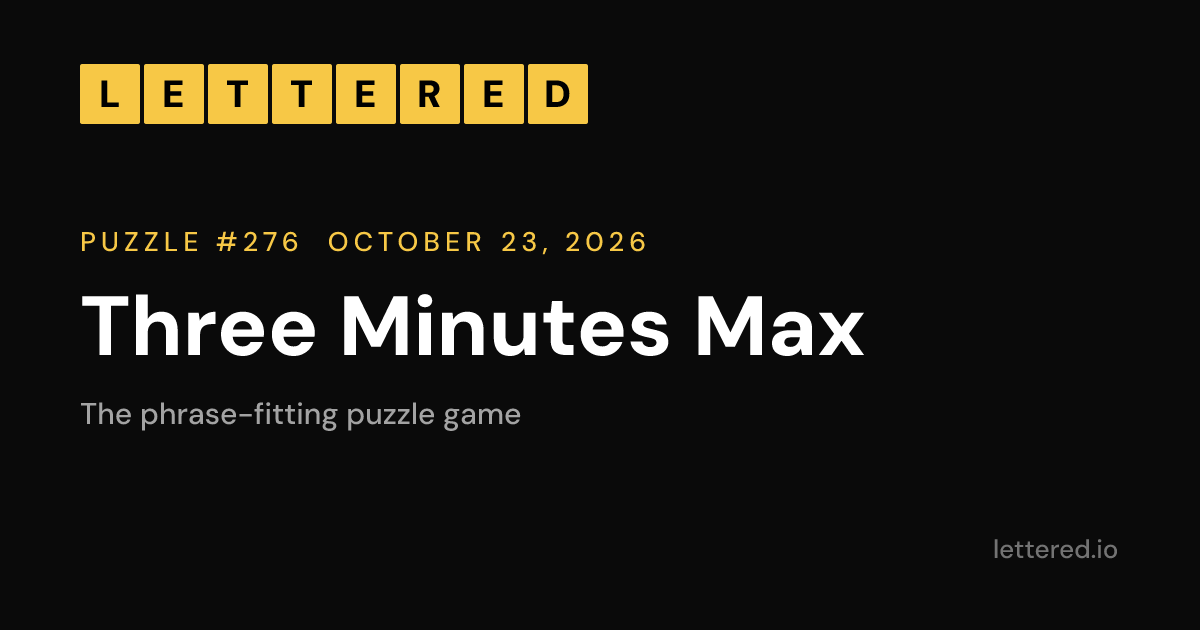
Fit letter tiles into place to reveal the hidden phrase. New puzzles daily and free to play.

No paid content found
Visit website
Profile views 1 Outbound visits 10 Normal
Lettered Full homepage screenshot

At a glance

Category
Games & Board Games
Language
English
Paid-content signal
No paid content foundObserved
Registered
Unknown
Hosting
VercelInferred
HTTPS certificate trusted
PassedObserved
Last updated

Website review

This review may include AI-generated content and is not individually verified. Domain, certificate and other facts come from the observed data on this page.

What is Lettered?

Lettered is a free daily word puzzle at Lettered. You fit letter tiles into place to reveal a hidden phrase. A new puzzle appears each day, so it works as a short, repeatable brain warm-up rather than a long story-driven game.

Who it suits

  • Word-game regulars who want a quick phrase puzzle in the spirit of daily word challenges.
  • Casual players looking for something short and free to play, not a large download or a long session.
  • Routine builders who like a fresh puzzle each morning and can compare results with friends.

What to expect

The core loop is deduction: place letter tiles, use the feedback to narrow down the phrase, and keep adjusting until the hidden words appear. Because the challenge is a phrase rather than a single word, you need to think about word boundaries and common phrasing, not just letter frequency.

If you enjoy it, a sensible next step is to make it a daily habit and try a related daily word game for variety. The New York Times publishes Wordle and Connections, both useful comparisons for pacing and difficulty.

How do you play Lettered's daily phrase puzzle?

Lettered is played by fitting letter tiles into place until a hidden phrase is revealed: you place the available letters into the puzzle's slots, and the correct arrangement uncovers the phrase. Lettered offers a new puzzle each day, so the loop is a short daily session rather than a long campaign.

What a session looks like

  1. Open the day's puzzle.
  2. Look at the letter tiles you've been given and the slots they need to fill.
  3. Place tiles into positions, using the phrase's likely word shapes and letter patterns to guide you.
  4. Adjust placements as the phrase becomes clearer, until every tile sits in its correct spot and the phrase is revealed.

How to approach it well

  • Start with the slots you're most confident about: short words, common letter pairings, and any position where only one or two letters plausibly fit.
  • Treat wrong placements as information. A tile that doesn't resolve the phrase tells you something about the surrounding letters.
  • Say the phrase aloud as it takes shape; phrase puzzles reward recognizing a familiar expression faster than pure letter-by-letter deduction.

Who it suits

It's a good fit for people who like short, self-contained word challenges — a few minutes a day rather than an open-ended game. If you prefer untimed logic puzzles or long vocabulary-building games, a daily phrase puzzle will feel lighter and more repetitive by design. If you like the ritual of a fresh puzzle each morning, the daily format is the main appeal.

A practical next step: play today's puzzle once without rushing, and note whether you finish by phrase recognition or by elimination. That tells you whether to treat it as a quick warm-up or as a puzzle worth slowing down for.

Is Lettered free to play, and do I need an account?

Lettered is described as free to play, and nothing on the site indicates that an account is required. You can open the daily puzzle and start fitting letter tiles to reveal the hidden phrase without a signup step.

What that means in practice

  • Cost: The site presents the game as free, with no pricing information listed. Treat any future paid tiers or extras as unconfirmed until they appear on the site itself.
  • Account: No login or registration is mentioned, so expect to play as a guest. A practical consequence is that progress and streaks may live only in your browser—clearing cookies or switching devices could reset them.
  • Daily format: New puzzles arrive daily, which suits a short routine: one phrase per day rather than an endless session.

A quick way to decide

If you want a low-commitment brain break, start with today's puzzle at Lettered and see whether the phrase-fitting mechanic clicks for you. If you care about keeping a streak across devices, check the site for any save or profile option before relying on it.

How is Lettered different from Wordle and other daily word games?

Lettered differs from Wordle mainly in what you're solving: Wordle asks you to guess a five-letter word through color-coded feedback, while Lettered asks you to fit letter tiles into place to reveal a hidden phrase. The shift from a single word to a phrase changes the reasoning—you're working with word boundaries, spacing and sentence structure rather than just letter frequency.

Where the difference shows up

  • Unit of the puzzle. Wordle is one word per day; Lettered is a phrase, so clues come from how words fit together, not just which letters are present.
  • Feedback style. Wordle gives per-letter correct/ misplaced/ absent signals. Lettered's core loop is placement of tiles into a grid to expose the phrase, which rewards pattern and context thinking over elimination.
  • Daily rhythm. Both are daily and free to play according to the site, so the habit is similar; the mental task is not.

Who each suits

If you like quick deduction and a clean win/lose result, Wordle-style games fit. If you prefer crossword-adjacent reasoning—using grammar and common phrasing to narrow options—Lettered's phrase format is the closer match. A reader who enjoys The New York Times word puzzles may find Lettered a lighter daily complement rather than a replacement.

Next step

Try one Lettered puzzle alongside your usual daily word game and notice which part of your thinking gets used: letter elimination or phrase prediction. That tells you which format to keep in your routine.

Does Lettered offer puzzles beyond the daily one?

Lettered is described as offering a new puzzle daily, and the available page information does not confirm any additional puzzle modes, archives or practice puzzles beyond that daily challenge. So the safe answer is: the daily puzzle is the confirmed offering, and anything more is unverified.

What this means in practice

If you want a predictable five-minute word challenge, the daily format fits well: one puzzle to solve each day, with no indication of extra modes to choose from. If you prefer to play several puzzles in a sitting, or want to revisit earlier days, treat that as an open question rather than an expected feature.

A useful next step

Check the site directly for an archive, "previous puzzles" section or mode selector before relying on it for repeat play. As a comparison point for daily-word formats with visible archives, you could look at The New York Times games section or Wordle, though their structures differ from Lettered's.

What strategies help when the letter tiles won't fit the phrase?

When letter tiles won't fit, stop trying to force whole words and switch to eliminating possibilities. In a phrase-fitting puzzle, the fastest progress usually comes from constraints, not inspiration: find the letters or slots that can only accept one option, lock those in, and let the rest of the phrase narrow itself.

Practical tactics

  • Start with the most constrained slot. If one position has only one or two plausible letters, fill it first. Every fixed tile removes options elsewhere.
  • Use repeated letters as anchors. A letter appearing several times in the phrase tells you how many copies must be placed; if you have fewer tiles than the phrase needs, a word containing that letter is probably wrong.
  • Test short function words early. Articles, prepositions and conjunctions ("the", "of", "to", "and") are common in phrases and use familiar letter patterns, so they are quick to confirm or rule out.
  • Work from both ends. Filling the first and last words often reveals the phrase's grammatical shape (a question, a title, a saying) and constrains the middle.
  • Say the phrase aloud. Phrase puzzles reward rhythm and idiom; a grammatically valid but unnatural combination is usually a dead end.
  • Backtrack deliberately. If a placement forces an impossible letter later, undo the earliest assumption rather than patching the last one.

A quick comparison of approaches

Approach Best when Trade-off
Constraint-first (fixed slots, rare letters) Many tiles, few obvious words Slower start, fewer wrong turns
Pattern-first (common short words) Phrase looks idiomatic Can lock in a plausible but wrong word
Sound-it-out You suspect a familiar saying or title Weak for unusual names or technical phrases

For a concrete case: a player stuck on a five-word phrase might notice only one tile fits the second slot, place it, then see that the remaining letters can form "of the" — which immediately suggests the phrase's structure. That is faster than guessing the opening word.

Lettered is a daily phrase-fitting puzzle where you place letter tiles to reveal a hidden phrase, with new puzzles each day and free play, per Lettered. If you want to practise the constraint-first habit, treat each daily puzzle as an exercise: before placing anything, note which slot has the fewest candidates and start there.

Related questions

More questions →
What Is a Daily Game and How Do You Play One Like Minigolfle?

A daily game is a small web or app game that gives you a fixed set of content once per day—usually one puzzle or a few levels—and then waits until the next day to refresh. Minigolfle fits this format: according to the site, you complete 3 unique procedurally generated mini golf levels every day and can share your score with friends. You play it in a browser with no install described, and the goal is simply to finish the day's three holes and see how your score compares.

How the daily format works

The defining mechanic is a shared, time-locked reset. Everyone playing on the same day gets the same content, and the content changes on a daily schedule rather than on demand.

Feature Daily game (e.g., Minigolfle) Ordinary web game
Content refresh Once per day, fixed set Continuous or on replay
Replay of old content Usually not offered Usually available
Comparison Score sharing with friends Often none
Session length Short, one sitting Open-ended

This is the same rhythm popularized by Wordle-style games: a small commitment, a common topic of conversation, and a reason to come back tomorrow.

What you actually do in Minigolfle

Minigolfle is a physics-based mini golf puzzle. Each day's three levels are procedurally generated, so the layout is not hand-designed for that date—you have to read the course and figure out the shot. The stated objective is to complete all three levels and then share your score.

Expect the loop to look like this:

  1. Open the Minigolfle site in your browser.
  2. Play the day's three generated holes, adjusting aim and power for each shot.
  3. Finish all three levels to complete the daily set.
  4. Share your score with friends if you want to compare.

Because the levels are generated rather than fixed, the skill is in adapting to unfamiliar layouts rather than memorizing a known course.

How to start and what to check if something goes wrong

There is no account or download described on the site, so the entry point is simply loading the page. If the game does not behave as expected, work through these checks in order:

  • Browser compatibility: try a current version of a major browser; physics-based web games depend on smooth rendering.
  • Refresh the page: a partial load can leave the course unplayable.
  • Confirm the day's status: if you have already completed today's three levels, there may be nothing left to play until the next reset—this is normal for daily games, not a bug.
  • Score not showing: finish all three levels before expecting a shareable result, since the score is tied to completing the set.

Who this format suits

Daily games like Minigolfle are a good fit if you want a short, repeatable break with a light competitive element—comparing scores with friends—and you don't mind that yesterday's levels are gone. If you prefer to replay content freely, practice a course repeatedly, or play for long sessions, a standard mini golf web game will serve you better than a daily one.

What Is Mahjong Solitaire and How Do You Play This Puzzle Game?

Mahjong Solitaire is a single-player tile-matching puzzle game. You clear a board by pairing identical tiles, but only tiles that are "free" can be selected: not covered by another tile, and open on at least one side (left or right). The goal is to remove every tile. It is not the four-player gambling game also called mahjong — the tiles look similar, but the rules and objective are completely different. This guide covers the core rules, a typical layout, and practical starting advice.

The Core Rules

Every move follows the same logic:

  1. Pick a tile that is free. A tile is free when no tile sits on top of it and its left or right side is unblocked. Tiles buried in the middle of a stack or boxed in on both sides cannot be chosen.
  2. Find its exact match. Tiles match only if they show the same face. Most sets pair identical symbols, though some tile sets treat certain groups (like the four seasons or four flowers) as matching within their group rather than by identical image.
  3. Remove the pair. Both tiles disappear, opening up new tiles that were previously blocked.
  4. Repeat until the board is empty. If no valid pairs remain and tiles are left, the board is unsolvable in its current state.

The order you remove pairs matters. A pair that looks harmless can seal off the only route to a tile underneath it.

Reading the Board: A Typical Layout

Most versions open with a stacked, roughly pyramid- or turtle-shaped arrangement — often called the turtle layout. Tiles sit in layers: a wide base, narrower layers above, and a single tile or small cluster on top.

Position Why it matters
Top layer Usually free early; clearing it exposes the layer below
Outer edges Often free on one side; good candidates for early moves
Center of a stack Blocked until the tiles above and beside it are removed
Long horizontal rows The ends are free; the middle is not

Because the top and edges are the most accessible, they are also where beginners tend to burn pairs too quickly — sometimes removing a tile that was the only match for a deeply buried one.

How to Start Without Getting Stuck

  • Clear the top layers first. They block the most tiles, so removing them unlocks the widest area.
  • Work from the edges inward. Edge tiles are free by default; using them early keeps the board open.
  • Before removing a pair, check what it exposes. If a pair sits on top of a single buried tile with no visible match, consider whether another pair could free that tile's partner first.
  • Keep matched pairs in reserve when you can. If two identical tiles are both free, you do not have to remove them immediately — sometimes leaving one as a future key is safer.
  • Watch for tiles that are free on only one side. They can become trapped if the open side gets filled by a new tile dropping into place.

When You Get Stuck

If no legal pairs remain but tiles are still on the board, the layout has reached a dead end. Common options in most versions:

  • Undo — reverse your last move or several moves.
  • Hint — highlight an available pair.
  • Shuffle — reshuffle the remaining tiles to create new matches.
  • Restart — begin the same layout again.

Some versions also track your best time, which gives a reason to replay a layout rather than just finish it.

What You Need to Play

Mahjong Solitaire runs in a browser with no download required in the version described here. The site lists 84 board layouts, 13 tile sets, a 3D mode, 14 themes, and 37 languages, so you can change the visual style or difficulty without learning new rules. If you are new, start with a standard turtle layout and a familiar tile set — the symbols are easier to scan when you are still learning which tiles are free.

What Is a Word Game and How Do You Play One?

A word game is any game where the main challenge involves letters, words, or vocabulary. You play by forming, guessing, finding, or arranging words under a set of rules, and you win or lose based on how many valid words you produce or how quickly you solve the puzzle. Common formats include guessing a hidden word, searching a letter grid, filling a crossword, and placing letter tiles. If you enjoy vocabulary and light problem-solving, a word game is a good fit; if you prefer pure logic with no language element, a number or pattern puzzle may suit you better.

What Counts as a Word Game

The defining feature is that language is the core mechanic, not just a theme. A game about building a city that happens to use words in the menu is not a word game; a game where you must spell words to score points is.

Typical building blocks:

  • Letters — single characters you arrange or select
  • Words — the valid answers or moves, usually checked against a dictionary
  • A grid or board — where letters sit or get placed
  • A goal — guess the word, clear the board, reach a target score, or beat a timer

Common Types and How Each Is Played

Type Example format Your goal How a turn works
Guess-the-word Hidden word with limited tries Reveal the word before attempts run out Enter a word, get feedback on which letters are right
Word search Letters scattered in a grid Find all listed words Scan rows, columns, and diagonals, then select
Crossword Interlocking blank squares with clues Fill every square with valid words Read a clue, type an answer that fits the crossing letters
Letter tiles / blocks Tiles you place on a board Score points by forming words Place tiles, submit the word, keep or lose tiles based on validity
Word-building A set of given letters Make as many words as possible Rearrange the letters into valid words within the time or move limit

Blockle, for instance, describes itself as "a unique blend of a word and puzzle game with a new challenge every day," which places it in the daily-challenge branch of word puzzles: one fresh board per day rather than endless levels.

How a Basic Round Works

Most word games follow the same loop, even when the surface looks different:

  1. Start the puzzle. You get a board, a set of letters, or a hidden target.
  2. Make a move. Type a word, tap letters, or drag tiles into place.
  3. Get feedback. The game tells you whether the word is valid and how close you are — correct letters, correct positions, or points scored.
  4. Adjust. Use that feedback to narrow down your next move.
  5. Finish. You win by solving the puzzle or reaching the target; you lose when attempts, time, or moves run out.

Example: In a guess-the-word game, you type "CRANE." The game marks C as correct but in the wrong spot, R and A as not present, and N and E as correct and in the right place. Your next guess must keep N and E in those positions and avoid R and A.

How Word Games Differ from Puzzle and Brain Games

The categories overlap, so the useful question is what the game actually tests:

  • Word game — vocabulary and spelling are central. Remove the words and there is no game.
  • Puzzle game — the core is logic, spatial reasoning, or pattern-matching; words may be absent entirely.
  • Brain game — a broad label for anything marketed as mental exercise, which can include word, number, and memory tasks.

A crossword is both a word game and a puzzle game. A sliding-tile puzzle is a puzzle game but not a word game. Many word games are also brain games, but "brain game" alone tells you nothing about whether language is involved.

Why People Play Them

  • Vocabulary practice — you meet and recall words you would not otherwise use.
  • Short sessions — most rounds take a few minutes, which suits a daily habit.
  • Low setup — no equipment beyond a phone, browser, or pen and paper.
  • Clear feedback — you know immediately whether an answer is right.

Getting Started

Pick a format that matches how much time and frustration you want. Daily single-puzzle games like Blockle suit a fixed few-minute routine; word searches suit relaxed, untimed play; crossword-style games suit longer sessions and reward general knowledge. Start with an easy difficulty or a small grid, learn the feedback system, and only then move to timed or larger versions. The main skill you build is not memorizing word lists but reading feedback efficiently and narrowing your options with each move.

What Is a Brain Game and How Do You Play One?

A brain game is a puzzle or challenge built around a specific mental skill—memory, logic, vocabulary, pattern-spotting, or focus—rather than reflexes or luck. You play one by picking a game that targets the skill you want to exercise, learning its single core rule, and playing in short, regular sessions. Lettered, a daily phrase-fitting puzzle, is one example: you place letter tiles to reveal a hidden phrase. Brain games are best treated as engaging practice, not as proven cognitive training, so choose one you actually enjoy and can return to daily.

What makes a game a "brain game"

The label covers a wide range, but most brain games share three traits:

  • A narrow core skill. Each round asks for one kind of thinking—recalling words, deducing a number, remembering a sequence, or holding several constraints in mind at once.
  • Simple rules, variable difficulty. You can learn the rule in a sentence, but the puzzles get harder as you go.
  • Self-contained rounds. Most finish in a few minutes, which makes daily play practical.

This separates them from entertainment games where the challenge is reaction speed, story, or exploration. A racing game tests reflexes; a phrase puzzle tests vocabulary and pattern recognition.

Common types and what they ask of you

Type Example format Skill exercised
Word and phrase puzzles Fit letter tiles to reveal a hidden phrase (as in Lettered) Vocabulary, pattern recognition, deduction
Number and logic puzzles Grid or sequence puzzles with fixed rules Logical reasoning, working memory
Memory matching Pair or sequence recall Short-term memory, attention
Daily challenge games One new puzzle per day, shared by all players Consistency, focus

Daily-format games add a useful habit layer: because everyone gets the same puzzle, you can compare approaches with other players without a leaderboard.

What brain games actually train

Be careful with claims here. Brain games give you real practice at the specific task in front of you—you get faster and more accurate at that kind of puzzle. Whether that improvement carries over to unrelated mental tasks is debated, and the evidence for broad "brain training" benefits is mixed. What is well supported is more modest:

  • Practice effects are real. Repeated play improves performance on similar puzzles.
  • Habit and focus matter. A short daily puzzle builds a routine of concentrated attention.
  • Enjoyment drives consistency. The game you keep playing is the one that helps you most, because you actually play it.

So treat a brain game as a pleasant, low-stakes way to exercise a skill—not a substitute for sleep, exercise, or learning something new.

How to choose one and start playing

  1. Name the skill you want to work on. Vocabulary and word-finding point to phrase or letter puzzles; logic points to number grids; memory points to matching games.
  2. Check the session length. If you have five minutes a day, a daily single-puzzle format fits better than an open-ended game.
  3. Confirm the rules are learnable in one round. A good first session should end with you understanding the mechanic, even if you don't solve it.
  4. Play one round before committing. Most daily puzzle sites, including Lettered, present a new puzzle each day; try it once to see whether the difficulty suits you.
  5. Set a small routine. One puzzle at the same time each day beats a long weekend session for building the habit.

A worked example: playing a phrase-fitting puzzle

Take a puzzle where you must place letter tiles to reveal a hidden phrase:

  • Input: a set of letter tiles and a phrase structure with blanks.
  • Action: place tiles into positions, using word patterns and common letter combinations to test guesses.
  • Expected result: the completed phrase appears when every tile is correctly placed.

The skill being exercised is deduction from partial information—you narrow possibilities using what fits, not by guessing randomly.

Common frustrations and how to adjust

  • Stuck on the first move. Start with the most constrained part of the puzzle—the shortest word or the position with the fewest possible letters.
  • Difficulty feels wrong. If a puzzle is too easy, look for a harder variant or a game with escalating levels; if too hard, switch to a type with clearer rules before returning.
  • Losing the habit. Keep sessions short and tie them to an existing routine, such as a morning coffee.
  • Comparing yourself to others. Shared daily puzzles invite comparison, but the useful benchmark is your own past attempts.

The goal is steady, enjoyable practice. Pick one game that matches a skill you care about, learn its single rule, and let a short daily round do the rest.

What Is a Phrase Puzzle and How Do You Play One?

A phrase puzzle is a word game where you fit letter tiles into a grid of slots to reveal a hidden phrase. Each slot belongs to a word, and the letters you place must form a real phrase when every slot is filled. Lettered (lettered.io) is one example: it describes itself as a phrase-fitting puzzle game with new puzzles daily and free to play. You can start with no account and no download — just open the site and begin a puzzle.

How the Core Mechanic Works

The board is a set of empty slots arranged as words. You have a pool of letter tiles, and your job is to place each tile into the slot where it belongs. The phrase is hidden until the slots are filled correctly.

Three things drive the solving:

  • Slot count per word. A three-slot word needs a three-letter word; a five-slot word needs five letters. The slot count is your first filter.
  • Letter inventory. The tiles you're given are exactly the letters of the phrase. If you see only one "E" tile, the phrase contains only one E.
  • Cross-word constraints. Letters are shared across the phrase's structure, so a letter that fits one word often locks in or rules out options in a neighboring word.

A useful example: if the board shows a 2-slot word followed by a 4-slot word and your tiles include a single "A," then only one of those words can contain an A. That single observation can eliminate a large set of candidate phrases before you place anything.

How a Daily Phrase Puzzle Works

Lettered's model is one new puzzle per day. That means:

  • The puzzle changes on a daily schedule, so there's a fresh phrase to solve each day.
  • The site states the game is free to play; no pricing or login requirements are listed on the page, so treat account or payment details as unconfirmed until you see them in the game itself.
  • Because it's a daily format, you get a natural stopping point — solve today's phrase, then come back tomorrow.

Daily formats suit short sessions. If you want a longer sit-down, play through several days' puzzles rather than expecting an endless stream in one session.

Step-by-Step Approach to Solving

  1. Count the slots. Write down the length of every word in the phrase. This tells you the shape of the answer before you know any letters.
  2. Sort your tiles by frequency. Note duplicates and rare letters (Q, Z, X, J). Rare letters are strong anchors — there are few words they can appear in.
  3. Place the most constrained tiles first. Put rare letters and duplicate letters into slots where they're most likely, rather than starting with common vowels.
  4. Build short words first. Two- and three-slot words have the smallest candidate sets. Filling them narrows the letters available to longer words.
  5. Check the phrase as a whole. A phrase puzzle isn't a set of independent words — the words must read as a coherent phrase. If your filled words are individually valid but don't form a sensible phrase, something is misplaced.
  6. Verify before you commit. Read the completed phrase aloud. If it sounds like natural language, you've likely solved it.

Common Mistakes and How to Recover

Forcing a letter into a slot because it "feels right." This is the most common trap. If a letter placement makes a neighboring word impossible, back it out immediately rather than trying to make the rest fit around it.

Ignoring duplicate letters. If you have two "T" tiles, the phrase contains two T's. Placing both in the same word when the word only has one open slot is a sign you've misread the board.

Treating words as independent. Solving each word in isolation can produce a grammatically odd result. When you get stuck, step back and ask what phrase could plausibly contain the letters you've already locked in.

Recovery method: clear the least-confident placements first, keep the anchors (rare letters, short words) in place, and re-derive from there. Most stuck states come from one wrong early placement, not from a lack of vocabulary.

Is a Phrase Puzzle Right for You?

Choose a phrase puzzle if you like deduction with a language payoff — the satisfaction comes from the phrase clicking into place, not from speed. It's a good fit for a short daily habit. If you prefer timed arcade-style word games or open-ended anagram play, a daily phrase-fitting format may feel too constrained. Either way, the fastest way to judge it is to open today's puzzle and try the first three steps above.

Website Overview

Page metadata, canonical configuration and social previews work together to provide more consistent search and sharing presentation. An active inbound-mail setup with incomplete authentication may leave the domain more open to impersonation. Provider hosting alone does not close that gap.

Domain and Registration

Unknown

DNS and Email

The observed email authentication setup is incomplete: DMARC is missing. Nameservers are provided by Cloudflare, indicating managed DNS hosting. MX records point to the Cloudflare Email Routing email service. No CNAME was found; the observed records resolve directly to addresses. TXT records include verification markers for Google. Such markers may also remain after a service stops being used.

TLS and Certificates

The certificate uses an RSA 2048-bit public key, offering broad client compatibility. The server supplied a complete certificate chain. No organization name is present in the certificate; the available fields are consistent with domain validation. The certificate was issued by Let's Encrypt, commonly associated with automated certificate services. The certificate's total validity is about 89 days, consistent with a short renewal cycle.

HTTP and Browser Security

X-Powered-By exposes backend information: Next.js. The response lacks these common security headers: CSP, X-Content-Type-Options, Referrer-Policy, Permissions-Policy, clickjacking protection. No obvious internal addresses or debug information were found in the headers. The Server header contains the custom value Vercel. No explicit CDN or WAF marker was found in the response headers.

Technology Stack Analysis

The public page identifies Next.js, Vercel without precise versions, leaving fewer clues for version-specific scanning.

Search and Social Sharing

Twitter Card metadata is configured. The title has 41 characters, within a common display range. A meta description is present, with 92 characters. The observed directives allow indexing and link following. No Generator meta tag is publicly exposed.

Hosting and Email

DNSCloudflare
HostingVercel
EmailCloudflare Email Routing
Approximate IP geolocation (inferred; a CDN or proxy may differ from the origin server) United States flagUnited States Inferred 216.150.1.1

Registration details

RDAP / WHOIS

Unknown

DNS records

DNS

TypeNameValueTTLPriority
Alettered.io216.150.1.1600—
MXlettered.ioroute1.mx.cloudflare.net30019
MXlettered.ioroute3.mx.cloudflare.net30042
MXlettered.ioroute2.mx.cloudflare.net30051
NSlettered.ioelisabeth.ns.cloudflare.com86400—
NSlettered.iorohin.ns.cloudflare.com86400—
TXTlettered.iogoogle-site-verification=c7vosXKeB2v-0FYLkgNvgiCZjotd80qWcDM6nLDNwr8300—
TXTlettered.iov=spf1 include:_spf.mx.cloudflare.net ~all300—

TLS and certificates

TLS / SSL

AssessmentNormal configuration
Supported protocolsTLSv1.2、TLSv1.3
Negotiated protocolTLSv1.3
Certificate subjectlettered.io
IssuerLet's Encrypt
Valid until2026-12-22T14:31 · Remaining when checked: 60 days
Verification detailsCertificate trust: Passed · Hostname match: Passed

HTTP response headers

HTTP

HeaderValue
content-typetext/html; charset=utf-8
cache-controlpublic, max-age=0, must-revalidate
serverVercel
strict-transport-securitymax-age=63072000

Identified technologies

Next.jsVercel

Pages, Search and Sharing

Meta descriptionFit letter tiles into place to reveal the hidden phrase. New puzzles daily and free to play.
Canonical URLhttps://lettered.io
LanguageEnglish (default)
Twitter Cardsummary_large_image
All bots 1 allowed · 12 disallowed
  • Allow/
  • Disallow/api/
  • Disallow/admin/
  • Disallow/settings/
  • Disallow/feedback/
  • Disallow/auth/callback
  • Disallow/auth/confirm
  • Disallow/auth/error
  • Disallow/auth/forgot-password
  • Disallow/auth/update-password
  • Disallow/auth/sign-up-success
  • Disallow/signin
  • Disallow/signup

User reviews (0)

  • No reviews yet.