Website profiles · Technology insights · Alternatives

medimobile.com No paid content found

Categories: Development

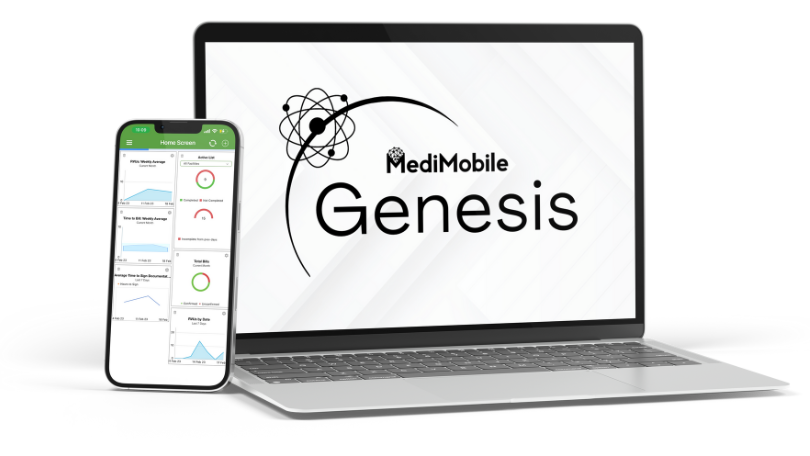
MediMobile's leading automated medical coding solution Genesis transforms healthcare RCM by automating charge capture & CPT and ICD-10 code selection.

Visit website

Updated: 2026-10-01 08:13 Language: English (default) Access: Normal

Profile views 4 Outbound visits 0
MediMobile Full homepage screenshot
Editorial Review

Website Review

What is MediMobile?

MediMobile is a healthcare revenue-cycle platform whose main product, Genesis, automates charge capture and medical coding. Providers keep documenting visits in their existing EHR; MediMobile's software reads that documentation and turns it into coded, bill-ready charges by selecting CPT and ICD-10 codes, so clinicians and coding teams spend less time on manual search and review.

It is aimed at three broad groups:

  • Providers and clinicians: mobile tools for managing patients and capturing charges with minimal extra steps.
  • Coding and billing teams: AI-assisted coding plus charge review, intended to reduce manual lookups and rework.
  • Revenue-cycle leaders: visibility into missed charges, coding progress, and the path from encounter to claim.

Alongside coding, the platform covers MIPS quality-measure tracking inside the workflow, integrations with EHR, billing, and data systems, and reporting and analytics.

A practical next step: if your organization loses charges between the visit and the claim, ask for a demo using your own de-identified documentation. Test how often Genesis's suggested codes match your coders' final codes, how much review each charge still needs, and how cleanly it writes back to your EHR and billing system. Those three answers tell you more than a feature list.

How does MediMobile's Genesis automate CPT and ICD-10 code selection from provider documentation?

MediMobile's Genesis is an automated charge capture and coding layer that sits after the visit: providers document in their EMR as usual, and Genesis turns that documentation into coded, bill-ready charges — including CPT and ICD-10 selection — rather than requiring coders to search code sets manually. The stated aim is to capture encounters before revenue slips away, with AI-assisted coding and charge review feeding into billing workflows. It also supports MIPS quality-measure tracking inside the same workflow and connects to EHR, billing, and data systems.

MediMobile

H3 What that means in practice

  • Providers: no separate coding workflow; they document in the EMR and the coding step is handled downstream.
  • Coding teams: review AI-suggested codes and exceptions instead of building charges from scratch.
  • RCM leaders: visibility into missed charges, coding progress, and the path from encounter to claim.

H3 Where to look closer before committing Automation shifts the human role rather than removing it. Ask how code suggestions are validated, how specialty-specific and payer-specific rules are handled, what the coder review queue looks like, and how corrections feed back into accuracy. Those details decide whether Genesis reduces rework or just moves it.

Next step: request a demo using your own de-identified documentation sample for one or two high-volume encounter types, and compare the suggested codes against your coders' output before deciding.

How does MediMobile integrate with existing EHR and billing systems?

MediMobile positions integration as part of its Genesis charge-capture platform: it connects EHR, billing and data workflows so coded, bill-ready charges move toward billing without re-keying. The core model is that providers document in their existing EMR, and MediMobile handles the coding and charge capture from that documentation.

Who this matters for

  • Providers: they keep documenting in the EMR they already use; the mobile tools are for capturing encounters and charges rather than replacing clinical documentation.
  • Coding teams: coded charges arrive from documentation with AI-assisted CPT and ICD-10 selection and a charge-review step, so coders review rather than build charges from scratch.
  • RCM and billing leaders: integration is the mechanism for visibility into missed charges and coding progress rather than a separate reporting silo.

What to verify in a demo

Integration claims are the easiest thing to over-read, so pin down specifics:

  1. Which EHR and billing/PM systems are supported out of the box, and which need custom work.
  2. Direction of data flow — does documentation come in, do charges and codes go out, or both?
  3. Whether the connection is real-time or batched, since that affects how fast charges reach billing.
  4. How charge review and corrections sync back, and who owns the record of truth.
  5. Implementation effort: interface build, testing, and what your team must supply.

Practical next step

Bring your actual EHR and billing system names to a demo and ask for that exact pairing, not a general integration list. If you want to compare approaches, MediMobile covers its own workflow; broader RCM integration patterns are documented by HIMSS and the American Medical Association.

Decision criterion

Choose an integrated charge-capture tool when your bottleneck is missed or delayed charges between documentation and billing. If your coders mainly need a standalone coding aid and your billing workflow is already clean, the integration overhead may not pay off.

How does MediMobile help healthcare organizations reduce missed charges and improve revenue cycle performance?

MediMobile targets the gap between a completed patient visit and a billable claim. Its Genesis platform automates charge capture and selects CPT and ICD-10 codes from provider documentation, so encounters are less likely to be lost between the EMR and the billing system. The stated aim is to "capture every charge" and reduce missed revenue rather than simply speed up existing manual steps.

Where it fits in the revenue cycle

  • Capture: Mobile tools let providers record charges and manage patients without leaving their normal workflow, which matters most where charges are entered after the fact and easily forgotten.
  • Code: AI-assisted coding turns documentation into coded, bill-ready charges, reducing manual code searches for coding teams.
  • Review: Charge review gives coders a structured queue rather than ad hoc follow-up.
  • Report: Dashboards surface missed charges, coding progress, and workflow status for revenue cycle leaders.
  • Report quality measures: MIPS tracking sits inside the same workflow instead of a separate reporting exercise.

Who gets what

Role Practical benefit
Providers Fewer extra steps to capture a charge; less end-of-day catch-up
Coders AI-assisted code suggestions and a defined review queue
Billers Charges arrive coded and bill-ready sooner
RCM leaders Visibility into what was missed and where work is stuck

A realistic scenario

A multi-site specialty group sees claims lag because providers document in the EMR but charges are entered later from memory. Genesis-style automation helps if the underlying documentation is complete and structured; it will not create billable codes from notes that lack the necessary detail. The practical test is whether your providers document thoroughly enough for code selection to be trusted, and whether coders can audit AI output efficiently rather than re-checking everything.

Next step

Ask for a demo using your own de-identified encounters and compare the codes Genesis produces against your current coder output, including denial-prone cases. If you want broader context on revenue cycle automation, the official sites of AAPC and AHIMA cover coding accuracy and compliance expectations; CMS publishes MIPS and documentation requirements.

How does MediMobile support MIPS reporting within clinical workflows?

MediMobile supports MIPS reporting by embedding quality-measure tracking inside the same charge-capture workflow providers already use, rather than treating it as a separate reporting task. The platform's stated approach is to let providers document visits in their EMR while MediMobile handles charge capture and code selection, with MIPS support listed as a core capability alongside AI coding and integrations.

In practice, that means MIPS data capture is tied to the encounter: as a visit is captured and coded, the quality measures associated with that encounter can be tracked within the workflow. For a provider, the appeal is not having to reconstruct measure data later from claims or a separate registry. For an RCM or quality lead, the appeal is visibility into whether measures are being met while there is still time to act, rather than after the reporting period closes.

H3. Who benefits most

  • Providers: less duplicate documentation and fewer reminders to log quality data separately.
  • Coding and billing teams: coded charges and quality data originate from the same encounter record.
  • RCM and quality leaders: earlier sight of gaps, since MIPS tracking sits alongside charge review and revenue workflows.

H3. Trade-offs to weigh

  • MIPS tracking depends on encounters being captured promptly; if documentation or charge entry lags, measure data lags too.
  • Measure logic changes with program rules, so the integration between EHR, coding and reporting needs to be maintained.
  • Practices with heavy specialist or procedure-based MIPS reporting should confirm that the relevant measures are supported before assuming a fit.

H3. Practical next step Ask for a walkthrough of one real encounter type your practice reports on: where the measure is triggered, how a gap is surfaced, and what a provider sees at the point of care. That single demo answers more than a feature list. You can request this through MediMobile.

What pricing and service level options does MediMobile offer for different healthcare teams?

MediMobile's site does not publish specific pricing or tiered service-level details. What it does show is a "Service Levels & Pricing" section in its navigation, which suggests the company discusses these terms directly with prospective customers rather than listing them publicly. The practical takeaway: expect a quote-based or demo-driven conversation instead of a self-serve price list.

What the page indicates about service levels

The site frames MediMobile as a platform that adapts to different roles and team types rather than offering fixed packages:

  • Providers get mobile tools for managing patients and capturing charges with less friction.
  • Coding teams get AI-assisted coding and charge review.
  • RCM leaders get visibility into missed charges, coding progress, and revenue workflows.
  • A "Choose the workflow that fits your team" message suggests configuration around existing workflows, not a one-size-fits-all plan.

Who each option suits

Team type Likely fit Trade-off to weigh
Small practices Mobile capture plus AI coding in one workflow May not need the full reporting layer
Specialty groups Coding accuracy and MIPS tracking Setup effort to match specialty codes
Health systems Integrations across EHR, billing, and data More coordination across departments
Billing teams Charge review and faster billing handoff Depends on how clean your EMR documentation is

Next step

Since pricing isn't public, the fastest path is to request a demo and ask three specific questions: what's included at each service level, how implementation and support are priced, and whether MIPS reporting and EHR integrations carry separate fees. If you want to compare against other vendors' published pricing first, you could look at general RCM software directories, though MediMobile itself only offers MediMobile as the direct source.

Related questions

More questions →
What Is AI Medical Billing and How Does It Fit into the Revenue Cycle?

AI medical billing is the use of artificial intelligence to automate parts of the revenue cycle that sit between a documented patient encounter and a paid claim — most commonly charge capture and CPT/ICD-10 code selection. It fits into the revenue cycle as an upstream layer: providers document visits in their existing EMR, and the AI turns that documentation into coded, bill-ready charges before they move to billing. It is most useful for provider groups, health systems, specialty practices, and billing teams that lose revenue to missed encounters and slow manual coding. It does not replace human coders or compliance review.

AI medical billing vs. AI medical coding vs. charge capture

These terms are often used interchangeably, but they describe different stages of the same pipeline.

Term What it covers Where it sits in the cycle
AI medical billing The broader use of AI across billing-related tasks, including charge capture and coding support Spans from encounter to claim
AI medical coding Assigning CPT and ICD-10 codes from clinical documentation After documentation, before billing
Charge capture Capturing encounters and the charges they generate so nothing is missed Starts at the point of care

MediMobile's Genesis is described as an automated medical coding solution that automates charge capture and CPT and ICD-10 code selection — which means it operates across the coding and charge capture stages rather than only at claim submission.

The end-to-end workflow

  1. Encounter documentation — Providers document visits in their EMR. This is the input the AI works from.
  2. Code selection — The system turns documentation into CPT and ICD-10 codes, producing coded, bill-ready charges.
  3. Charge capture — Encounters are captured before revenue slips away, so billable work does not fall through the cracks.
  4. Charge review — Coding teams review charges with AI assistance and fewer manual searches.
  5. Claim submission and reimbursement — Cleaner, faster charges move toward billing, reducing late charges and errors that delay reimbursement.

Failure points AI is meant to address

MediMobile frames the problem as manual charge capture making revenue "too easy to miss." Three specific failure points:

  • Encounters get missed — Billable work falls through the cracks when providers are busy and systems are disconnected.
  • Coding takes time — Manual searches and reviews slow coding teams down.
  • Claims get delayed — Late charges and errors impact reimbursement.

AI addresses these by capturing encounters at the point of care, generating codes from documentation automatically, and giving RCM leaders visibility into missed charges and coding progress.

How it integrates with existing systems

AI billing is not a standalone replacement for your EMR or billing platform. MediMobile describes integrations that connect EHR, billing, and data workflows, and positions the platform as bringing providers, coders, billers, and revenue cycle leaders into one workflow. It also supports MIPS reporting by tracking quality measures inside the workflow.

The practical implication: the AI layer reads from your EMR and feeds coded charges into your billing process, rather than requiring teams to abandon the systems they already use.

What AI does not replace

  • Human coders — MediMobile describes AI-assisted coding and cleaner charge review, not the elimination of coding teams. Coders still review charges.
  • Compliance review — Code selection is automated, but the platform is presented as a coding and charge capture tool, not a compliance authority.
  • Clinical documentation — Providers still document visits in their EMR; the AI works from that documentation.

Who this fits

MediMobile lists providers, health systems, specialty groups, and billing teams as its audience, with distinct workflows for providers (mobile charge capture), coding teams (AI-assisted coding and charge review), and RCM leaders (visibility into missed charges and revenue workflows). If your bottleneck is missed encounters and slow manual coding rather than claim denials alone, this layer of the revenue cycle is where AI billing applies.

What Is AI Charge Capture and How Does It Turn Documentation into Billable Codes?

AI charge capture is software that reads clinical documentation and produces coded, bill-ready charges automatically. Instead of a provider or coder manually translating a visit note into CPT and ICD-10 codes, the system extracts the relevant details from the note and selects codes for review or submission. It fits teams that already document visits in an EHR or EMR and want to reduce missed charges, manual coding searches, and claim delays — MediMobile's Genesis is one example of this category, positioned as an automated medical coding and charge capture solution.

How AI charge capture differs from manual charge entry

Manual charge capture depends on a person remembering to log the encounter, then finding the right codes by hand. That creates three predictable failure points:

  1. Encounters get missed — billable work falls through the cracks when a busy provider moves to the next patient.
  2. Coding takes time — manual searches and reviews slow coders down.
  3. Claims get delayed — late or incorrect charges affect reimbursement.

AI charge capture targets all three by making code selection part of the documentation workflow rather than a separate step after it.

The workflow: from EMR documentation to bill-ready charges

The mechanism MediMobile describes is deliberately narrow: providers document their visits in their EMR, and the system handles the rest. In practice that means:

  • Input: the clinical note the provider already writes during or after the visit.
  • Action: AI coding reads that documentation and generates CPT and ICD-10 code selections.
  • Output: coded charges that are ready for billing, with a charge review step available for coding teams.

The stated result is that documentation turns into CPT and ICD-10 codes "instantly," so encounters are captured before revenue slips away. The provider's job ends at documentation; the coding and charge creation happen downstream.

How the AI selects CPT and ICD-10 codes

The platform describes AI-assisted coding that produces "coded, bill-ready charges from documentation," paired with cleaner charge review and fewer manual searches for coding teams. Two things are worth separating here:

  • Code generation — the system proposes CPT and ICD-10 codes based on what the note contains.
  • Charge review — a human-facing step where coding teams check and clean up those charges before they move toward billing.

That review layer matters because it keeps a person in the loop on code selection rather than treating AI output as final. The source does not specify the model, accuracy rates, or whether any codes bypass review, so treat "autonomous" coding as a spectrum and confirm the review policy with any vendor.

Who each part of the platform serves

MediMobile frames the product around three roles, which is a useful way to check whether a tool fits your team:

Role What the platform provides
Providers Mobile tools to manage patients and capture charges without extra friction
Coding teams AI-assisted coding and charge review with fewer manual searches
RCM leaders Visibility into missed charges, coding progress, and revenue workflows

If your bottleneck is providers forgetting to log encounters, the provider-side capture matters most. If it's coder throughput, the AI coding and review layer is the relevant piece.

Where charge capture connects to the rest of the revenue cycle

Charge capture is one link in a longer chain, and the platform's other features show where it plugs in:

  • MIPS reporting — quality measures are tracked inside the same workflow, so reporting doesn't require a separate data pull.
  • Integrations — connections to EHR, billing, and data workflows, which is what allows charges to move toward billing without re-entry.
  • Reporting and analytics — visibility into missed charges and coding progress for revenue cycle leaders.

The practical takeaway: evaluate AI charge capture by how well it hands off to coding review and billing, not just by whether it generates codes.

Common failure points to check before adopting

The problems MediMobile names — missed encounters, slow manual coding, delayed claims — are the same things to test against in a demo. Ask specifically:

  • Does the system capture encounters from the EMR automatically, or does someone still trigger each one?
  • How are generated CPT and ICD-10 codes reviewed, and who signs off?
  • What happens to a charge the AI can't confidently code?
  • How do charges flow into billing, and what integration work is required?

MediMobile lists "Service Levels & Pricing" and a demo request as the next steps, but the source does not publish prices or plan details, so cost and contract terms have to come from the vendor directly.

How Do Enterprise Teams Adopt Specialist AI Agents Without Disrupting Existing Workflows?

Enterprise teams can adopt specialist AI agents without disruption by starting with one narrow, high-volume workflow, running it as a bounded pilot with human review, measuring against a baseline, and only then expanding. The key is to treat agents as new team members with defined scopes rather than as a replacement for existing tools or a sweeping platform migration. This article explains what specialist agents are, where they fit across common team functions, and a phased approach you can follow.

What Makes an Agent "Specialist" Rather Than General-Purpose

A general-purpose assistant responds to open-ended prompts across many topics. A specialist agent is scoped to one job: it has a defined goal, a limited set of tools and data sources, and a clear definition of "done."

That scoping matters for enterprise teams for three practical reasons:

  • Predictability. A narrow agent produces more consistent outputs, which makes it easier to review and trust.
  • Permission control. You can grant access only to the systems that specific task needs, rather than broad data access.
  • Measurable value. When an agent owns one workflow, you can compare its output against a manual baseline.

A useful rule of thumb: if you cannot describe the agent's job in one sentence with a clear input and output, it is still too broad to deploy safely.

Mapping Team Functions to Agent Use Cases

Most enterprise teams have a handful of repetitive, rules-plus-judgment tasks that are good first candidates. The table below shows typical starting points.

Team Candidate agent task Why it fits
Sales Research and enrich inbound leads before handoff High volume, structured output, easy to verify
Customer success Draft responses to common account questions Repetitive, benefits from consistency
Marketing Repurpose long-form content into channel variants Clear brief, reviewable drafts
HR Screen and summarize applications against criteria High volume, needs audit trail
Operations Triage and route incoming requests Rule-based with clear routing logic

Notice that none of these replace a person's judgment. They compress the repetitive portion so the human spends time on exceptions and decisions.

A Phased Adoption Approach: Pilot, Measure, Expand

Phase 1: Pick one workflow and define success

Choose a task that is high-volume, low-risk, and currently a bottleneck. Write down:

  • The current process, step by step
  • The baseline metric (time per task, volume per week, error rate)
  • What "good output" looks like, with two or three examples
  • Who reviews the agent's work

Phase 2: Run a bounded pilot

Keep the agent inside the existing workflow rather than beside it. For example, the agent drafts; the human sends. Set a review gate so nothing leaves the team unreviewed. Run for a fixed period, such as four to six weeks, with a small group.

Phase 3: Measure against the baseline

Compare the same metrics you recorded in Phase 1. Look for time saved, consistency gained, and — importantly — where the agent failed. Failures tell you whether the scope was right.

Phase 4: Expand deliberately

Only widen scope after the pilot shows a clear, repeatable gain. Expand in one of two directions: more volume of the same task, or an adjacent task with the same data and review pattern. Avoid expanding into a new function and a new data source at the same time.

Handling Workflow Integration Concerns

Data access

Give each agent the minimum access its task requires. Prefer read access plus a single write action over broad permissions. Document which systems it touches so security and IT can review.

Handoffs

Define exactly where the agent stops and a human begins. A simple handoff rule works well: the agent completes the task and flags anything outside its defined scope for a person. Ambiguous handoffs are the most common source of friction.

Human oversight

Decide the review level up front:

  • Full review for anything customer-facing or high-stakes
  • Spot check for internal, low-risk outputs
  • Exception-only review once the agent has a track record

Start stricter than you think you need, then relax as evidence accumulates.

How Roles and Responsibilities Shift

Adopting agents rarely removes roles; it redistributes effort. Expect these shifts:

  • Reviewers become editors. People spend less time producing first drafts and more time improving and approving them.
  • Process owners become agent owners. Someone needs to maintain the agent's instructions, examples, and scope as the business changes.
  • New quality checks appear. Teams need a lightweight way to catch drift — for example, a weekly sample review.

Be explicit about who owns the agent after launch. An unowned agent degrades quietly.

Practical Criteria for Choosing Where to Start

Score candidate workflows against these questions:

  1. Volume: Does it happen often enough to matter?
  2. Risk: What is the cost of a wrong output, and can a human catch it?
  3. Structure: Is the input and output reasonably consistent?
  4. Baseline: Can you measure the current state today?
  5. Ownership: Is there a person who will own the agent after launch?

A workflow that scores well on all five is a strong first pilot. A high-volume task with no clear owner is a poor start, no matter how repetitive it is.

A Simple Pilot Template

You can copy this structure to scope your first agent:

  • Task: [one sentence]
  • Current baseline: [time/volume/error rate]
  • Agent scope: [what it does, what it does not do]
  • Data access: [systems, read/write]
  • Handoff rule: [when it escalates to a human]
  • Review level: [full / spot / exception]
  • Owner: [name]
  • Pilot length: [weeks]
  • Success metric: [target]

Bottom Line

Disruption comes from adopting too much at once, not from agents themselves. Start with one scoped task, keep humans in the loop, measure against a real baseline, and expand only when the evidence supports it. Platforms built around specialist agents — such as Relevance AI, which offers agents for sales, customer success, marketing, and HR — are designed for exactly this kind of task-by-task rollout, so you can add capability without rebuilding your team's existing processes.

What Does a Postal Code API Return? Fields, Formats, and Common Use Cases

A postal code API returns structured location data for a given ZIP Code or Canadian postal code. A typical response includes the code itself, city, state or province, county, latitude/longitude, and — where available — ZIP+4 detail. More complete services add time zone, area codes, boundary geometry, and demographic fields. You send a code (or an address), and the API sends back a machine-readable record you can store, validate, or display.

This article explains what those responses contain, how requests are usually shaped, and where postal code data fits into real applications.

First, clear up the word "code"

The keyword "code" is overloaded, and that causes real confusion for developers:

  • Postal code — the ZIP Code (U.S.) or postal code (Canada) that identifies a delivery area.
  • API key — the credential you use to authenticate your requests. It is not postal data.
  • Source code — the program you write to call the API.

When someone searches for "postal code API code," they usually want example request/response code for a postal code service. The rest of this article treats it that way.

What a postal code API actually returns

Response fields vary by provider and endpoint, but the core set is fairly consistent. A single-code lookup commonly returns:

Field Example Notes
Postal code 90210 The code you queried
City Beverly Hills May be one of several acceptable place names
State / Province CA Two-letter abbreviation
County Los Angeles Useful for tax, territory, and reporting logic
Latitude / Longitude 34.0901, -118.4065 Usually the centroid of the area
ZIP+4 90210-1234 Present only when a specific delivery segment is known
Time zone America/Los_Angeles Helps with scheduling and display
Area codes 310, 424 Regional phone context

Richer datasets add 90+ fields: boundaries, population, income, elevation, and more. You rarely need all of them — request only what your application uses.

A representative JSON response

{
  "postal_code": "90210",
  "city": "Beverly Hills",
  "state": "CA",
  "county": "Los Angeles",
  "latitude": 34.0901,
  "longitude": -118.4065,
  "timezone": "America/Los_Angeles",
  "area_codes": ["310", "424"]
}

XML responses carry the same information in tag form. Choose based on what your stack parses most easily; JSON is the common default.

Common request patterns

Most postal code APIs support four patterns. Knowing which one you need prevents wasted calls.

1. Lookup by code

You have a code and want its details. This is the simplest and fastest call.

GET /lookup?code=90210

2. Reverse lookup by address

You have a street address and want to confirm or complete the code. This is the pattern behind checkout address validation.

GET /validate?street=...&city=...&state=...

3. Radius search

You have a center point and want all codes within a distance. Useful for store locators and delivery zones.

GET /radius?code=90210&miles=10

4. Batch validation

You have a file of addresses and want them cleaned in bulk. Batch endpoints trade latency for throughput and usually have their own limits.

Handling missing and ambiguous matches

Real data is messy. Plan for these cases:

  • No match — the code doesn't exist or the address is malformed. Return a clear error rather than a silent empty object.
  • Multiple matches — a city name may map to several codes, or a code may span several acceptable city names. Decide whether to pick the primary or return a list.
  • Partial match — the street is valid but the ZIP+4 isn't. Fall back to the 5-digit code.
  • Stale data — codes are added, retired, and reassigned. Refresh your dataset on a regular schedule.

A practical rule: validate at the point of entry, store the normalized result, and never re-derive it later from raw user input.

Practical use cases

  • Checkout address validation — catch typos before shipping, reduce failed deliveries.
  • Shipping zone lookup — map a code to a zone, carrier route, or rate table.
  • Data enrichment — append county, coordinates, or demographics to existing records.
  • Store and service locators — radius search to find nearby branches or coverage areas.
  • Territory and tax logic — county and boundary data drive jurisdiction rules.

Licensing and data-source considerations

Postal code data originates with national authorities — USPS in the United States and Canada Post in Canada. Providers license and repackage it, which is why accuracy, update frequency, and field coverage differ between services. Before committing:

  • Confirm the data source and how often it refreshes.
  • Check whether ZIP+4 and boundary data are included or sold separately.
  • Review usage limits and whether batch processing is allowed.
  • Read the license terms for redistribution and storage.

Pricing and plan details change, so check the provider's current documentation rather than relying on secondhand figures.

Getting started

  1. Decide which request pattern you need (lookup, reverse, radius, or batch).
  2. Pick the fields you'll actually store.
  3. Write a small test call and inspect the raw response.
  4. Add error handling for no-match and ambiguous cases.
  5. Cache results where the same codes repeat.

A postal code API is ultimately a translation layer: you give it a code or an address, and it gives back structured location facts. Understand the fields, match them to your use case, and handle the messy edges — that's most of the work.

What Is Automated Medical Coding and How Does AI Charge Capture Work?

Automated medical coding uses software to turn clinical documentation into billable CPT and ICD-10 codes with minimal manual lookup. MediMobile's Genesis is one example: providers document visits in their existing EMR, and the platform handles charge capture and code selection from that documentation. It fits teams that already document in an EHR and want charges to move toward billing faster without coders manually searching for every code.

How the workflow runs

The process follows the path from a completed visit to a bill-ready charge:

  1. Encounter capture — the visit is captured as a chargeable encounter, either through mobile tools or from documentation already in the EMR.
  2. AI coding — the system reads the documentation and produces coded, bill-ready charges, selecting CPT and ICD-10 codes.
  3. Charge review — coding teams review AI-assisted output, which MediMobile describes as requiring fewer manual searches.
  4. Handoff to billing — reviewed charges move toward billing, with integrations connecting EHR, billing, and data workflows.

MediMobile frames the input as documentation the provider already creates: "Providers document their visits in their EMR and we handle the rest."

What it is not

Automated medical coding is narrower than "medical billing." Coding assigns the codes; billing covers claim submission, payer follow-up, and payment posting. MediMobile's stated scope is charge capture and code selection, plus MIPS reporting support and reporting/analytics — not the full billing cycle. Treat any vendor's coding tool as one component of revenue cycle management, not a replacement for the whole function.

Where manual charge capture breaks down

MediMobile names three failure points that automation targets:

Failure point What happens What automation changes
Missed encounters Billable work falls through the cracks Capture encounters before revenue slips away
Slow coding Manual searches and reviews delay teams AI-assisted coding with fewer manual searches
Delayed claims Late charges and errors affect reimbursement Charges move toward billing faster

These are vendor-stated problems, so treat the size of the improvement as something to verify against your own missed-charge and days-to-bill data.

Who uses it, and for what

MediMobile describes three audiences with different needs:

  • Providers — mobile tools to manage patients and capture charges with less friction.
  • Coding teams — AI-assisted coding and charge review with fewer manual searches.
  • RCM leaders — visibility into missed charges, coding progress, and revenue workflows.

If your team has none of these pain points — for example, low encounter volume with a stable coding backlog — the case for automation is weaker.

Evaluation criteria

When comparing automated coding options, ask for evidence on each of these:

  • EHR integration — does it read documentation from your EMR without duplicate entry, and which systems are supported?
  • Code output — does it produce both CPT and ICD-10 codes, and how are AI-suggested codes reviewed before they reach a claim?
  • Charge visibility — can RCM leaders see missed charges and coding progress in one place?
  • MIPS reporting — is quality-measure tracking inside the workflow, as MediMobile claims for Genesis?
  • Workflow fit — MediMobile lets teams "choose the workflow that fits your team," so confirm which capture paths (mobile, EMR-based, or both) match how your providers actually work.

Pricing is not published on the page reviewed here; MediMobile lists "Service Levels & Pricing" as a separate section, so request a quote rather than assuming a cost model.

Website Overview

An established domain and managed infrastructure suggest continuity of operations and may support dependable delivery, although neither guarantees service quality. Page metadata, canonical configuration and social previews work together to provide more consistent search and sharing presentation.

Domain and Registration

Registered in 2004, this domain has about 22 years of history. That suggests continuity, although ownership and purpose may have changed. Transfer-protection status is present, helping reduce the risk of unauthorized domain transfers. The registrar is GoDaddy.com, LLC, a widely used domain service provider. The domain uses the common .com extension, which is not an independent safety signal.

DNS and Email

Nameservers are provided by dnsmadeeasy.com, indicating managed DNS hosting. MX records point to the Microsoft 365 email service. SPF and DMARC are configured. DKIM status is unknown. TXT records include verification markers for Google, Microsoft. Such markers may also remain after a service stops being used. DNSSEC signatures were not detected, so this additional DNS authenticity protection is not confirmed.

TLS and Certificates

The public key uses EC with 256 bits. The server supplied a complete certificate chain. No organization name is present in the certificate; the available fields are consistent with domain validation. The certificate was issued by Let's Encrypt, commonly associated with automated certificate services. The certificate's total validity is about 89 days, consistent with a short renewal cycle.

HTTP and Browser Security

The response lacks these common security headers: X-Content-Type-Options, Permissions-Policy, clickjacking protection. No X-Powered-By header was found, reducing one common source of backend fingerprinting information. The cf-ray response header indicates a CDN or caching proxy in the delivery path. No obvious internal addresses or debug information were found in the headers. The Server header identifies cloudflare without an exact version.

Technology Stack Analysis

The public page identifies HubSpot, Google Analytics, Cloudflare without precise versions, leaving fewer clues for version-specific scanning.

Search and Social Sharing

The Generator tag identifies HubSpot, making the publishing system easier to fingerprint. Open Graph is partially configured; og:type is missing. Twitter Card metadata is configured. The title has 56 characters, within a common display range. A meta description is present, with 150 characters.

Hosting and Email

DNSdnsmadeeasy.com
HostingCloudflare
EmailMicrosoft 365
Location United States flagUnited States 199.60.103.225

User reviews (0)

  • No reviews yet.

Pages, Search and Sharing

Meta descriptionMediMobile's leading automated medical coding solution Genesis transforms healthcare RCM by automating charge capture & CPT and ICD-10 code selection.
Canonical URLhttps://www.medimobile.com
LanguageEnglish (default)
Twitter Cardsummary_large_image
All bots 0 allowed · 5 disallowed
  • Disallow/_hcms/preview/
  • Disallow/hs/manage-preferences/
  • Disallow/hs/preferences-center/
  • Disallow/*?*hs_preview=*
  • Disallow/*?*hsCacheBuster=*

Registration details RDAP / WHOIS

RegistrarGoDaddy.com, LLC
Registered2004-08-14
Expires2030-08-14
Domain statusclient delete prohibited、client renew prohibited、client transfer prohibited、client update prohibited
Nameserversns0.dnsmadeeasy.com、ns1.dnsmadeeasy.com、ns2.dnsmadeeasy.com、ns3.dnsmadeeasy.com、ns4.dnsmadeeasy.com
DNSSECunsigned

DNS records

TypeNameValueTTLPriority
Agroup15.sites.hscoscdn10.net199.60.103.225300—
Agroup15.sites.hscoscdn10.net199.60.103.31300—
AAAAgroup15.sites.hscoscdn10.net2606:2c40::c73c:671f300—
AAAAgroup15.sites.hscoscdn10.net2606:2c40::c73c:67e1300—
MXmedimobile.commedimobile-com.mail.protection.outlook.com360010
NSmedimobile.comns0.dnsmadeeasy.com86400—
NSmedimobile.comns1.dnsmadeeasy.com86400—
NSmedimobile.comns2.dnsmadeeasy.com86400—
NSmedimobile.comns3.dnsmadeeasy.com86400—
NSmedimobile.comns4.dnsmadeeasy.com86400—
TXTmedimobile.comMS=ms773290751800—
TXTmedimobile.comgoogle-site-verification=raI5YAJGs8YU_bIaXIil-3mNik58VgponhSmenzDt0g1800—
TXTmedimobile.comv=spf1 mx a ip4:208.180.122.230/28 ip4:207.200.38.130/25 ip4:77.104.138.170 ip4:77.104.138.121 ip4:173.219.38.218 ip4:8.28.3.0/24 ip4:40.107.236.87 a:delivery.mailspamprotection.com include:servers.mcsv.net include:spf.protection.outlook.com include:2850815.spf03.hubspotemail.net ~all1800—
CNAMEwww.medimobile.com2850815.group15.sites.hubspot.net300—
DMARC_dmarc.medimobile.comv=DMARC1; p=quarantine; fo=1; rua=mailto:[email protected]; ruf=mailto:[email protected]; rf=afrf; pct=100;120—

TLS and certificates

AssessmentNormal configuration
Supported protocolsTLSv1.2、TLSv1.3
Negotiated protocolTLSv1.3
Certificate subject0652011a.sni.cloudflaressl.com
IssuerLet's Encrypt
Valid until2026-11-27T18:09 · Remaining when checked: 57 days
Verification detailsCertificate trust: Passed · Hostname match: Passed

HTTP response headers

HeaderValue
content-typetext/html; charset=UTF-8
cache-controls-maxage=36000, max-age=5
servercloudflare
strict-transport-securitymax-age=31536000
content-security-policyupgrade-insecure-requests
referrer-policyno-referrer-when-downgrade

Identified technologies

HubSpotGoogle AnalyticsCloudflare