
 简体中文
简体中文 English
Website review
This review may include AI-generated content and is not individually verified. Domain, certificate and other facts come from the observed data on this page.
What is Microns.io?
Microns.io is a marketplace for buying and selling small online businesses — "micro startups" — such as micro-SaaS tools, mobile apps, and niche e-commerce sites. Its own framing emphasizes verified metrics and validated ideas, so the pitch is less about browsing any random listing and more about acquiring a small, already-operating business with confidence.
What you'll find there
- Listings with revenue and asking price shown side by side. From the page evidence, examples include a Roblox game-making AI tool at $1,665 annual revenue / $15,000 asking price, an Etsy market research tool at $9,364 / $8,500, and a chat API platform at $78,400 / $200,000.
- Category filters by type, such as Micro-SaaS, mobile apps, e-commerce, and AI tools.
- Price bands, with browse pages for businesses under $5k, $10k, $30k, $50k, $100k, $300k, and $500k.
- Buyer and seller sides, plus sections for recently sold startups and success stories.
Who it suits
| If you are… | Microns.io is useful because… |
|---|---|
| A first-time acquirer with a small budget | Low price bands let you buy a real operating asset rather than start from zero |
| A solo operator or side-project buyer | Micro startups are typically small enough to run without a team |
| A seller of a small SaaS or app | The marketplace is aimed at exactly this size of business |
| Someone wanting a large, established company | The inventory skews small; larger deals sit outside its focus |
How to approach it
Treat the revenue figure as a starting point, not a conclusion. On a small business, a single traffic source or one client can account for most of the revenue, so ask what happens if that disappears. The gap between annual revenue and asking price varies widely across the listings above — some are priced near one year of revenue, others at several multiples — which usually reflects growth trend, how hands-off the business is, and how durable the income looks.
A practical next step: pick a price band you can fund without borrowing, shortlist three listings in it, and compare each on revenue concentration, how much of the work is automated, and whether you could personally run or improve it.
How does Microns.io ensure the legitimacy of startup listings?
Microns.io addresses legitimacy mainly through two mechanisms it highlights on its marketplace page: verified metrics and validated ideas, so buyers can "acquire profitable online businesses with confidence."
In practice, that means listings are presented with business data such as annual revenue and asking price, and the platform frames itself as a curated marketplace of micro startups rather than an open classifieds board. The page also separates Latest Startups For Sale from Recently Sold Startups and includes a Wall of Love and Success Stories, which give prospective buyers social proof that transactions do occur.
What this does and does not guarantee
| Signal on Microns.io | What it helps with | What it does not replace |
|---|---|---|
| Verified metrics | Confidence that reported figures were checked | Your own review of bank statements, analytics and contracts |
| Validated ideas | Evidence the product has real users or revenue | Proof that revenue is stable or transferable |
| Sold listings and success stories | Evidence the marketplace completes deals | A guarantee that your purchase will perform similarly |
| Categorised listings (Micro-SaaS, mobile apps, e-commerce) | Comparing similar businesses by type and price band | Due diligence on code quality, traffic sources or churn |
A practical next step
If you are evaluating a specific listing, treat the platform's verification as a starting filter, not a substitute for diligence. Ask the seller for read-only access to Stripe or payment processor data, Google Analytics or equivalent traffic data, and the top customer acquisition channels. For a micro-SaaS listing, also check whether revenue depends on one founder's ongoing work, since that is the most common reason small acquisitions underperform after handover.
You can browse by budget to narrow the field, for example Microns.io listings under $10k, then apply the same diligence checklist to each candidate.
What are the fees for buying or selling on Microns.io?
Microns.io advertises zero commission on its marketplace. That means the platform does not take a percentage cut of the sale price from either the buyer or the seller when a deal closes.
What that covers, and what it doesn't
- No commission: The site's own description says there are no hidden fees and no commission on transactions, so a listed asking price is not automatically padded by a platform percentage.
- Escrow and payment processing: Any third-party escrow service, payment processor or transfer agent used to move funds will normally charge its own fee. Those costs are separate from the marketplace and are typically split or negotiated between the two parties.
- Buyer premium: Some marketplaces charge buyers a percentage on top of the purchase price. Microns.io's messaging is aimed at avoiding that model, but confirm the final figure with the seller or the platform before you commit.
- Listing and subscription: The site has a Pricing page and a Premium option for buyers, which suggests some features or visibility may sit behind a paid tier. Treat any subscription as an optional add-on rather than a transaction fee.
Practical next step
If you are buying, ask the seller directly: "Is the asking price the total I pay, and who covers escrow?" If you are selling, confirm whether a premium listing changes your exposure or cost. Then read the official Microns.io pricing page to see what, if anything, is charged for enhanced placement or buyer tools.
Can I find micro startups for sale under $10,000 on Microns.io?
Yes. Microns.io lists micro startups across several price bands, including a dedicated page for online businesses under $10k. The marketplace currently shows listings in that range, such as an Etsy market research tool with $9,364 in annual revenue at an $8,500 asking price, and an AI resume checker at $10,000.
What you can expect at this price point:
- Smaller revenue bases. Sub-$10k listings often show annual revenue in the hundreds or low thousands, though the Etsy tool above is a clear outlier.
- Common categories. Micro-SaaS tools, mobile apps, and niche content or data products appear most often.
- Mixed maturity. Some are side projects with minimal revenue; others have paying users and a repeatable niche.
If your budget is flexible, the site also segments listings under $5k, $30k, $50k, and higher, so you can compare what each step up buys. A practical next step: shortlist two or three sub-$10k listings, then check whether the asking price is justified by revenue, how much of the work is automated, and whether the seller will transfer accounts, code, and customer relationships. At this price level, treat the acquisition as buying a small project or a head start rather than a stable income stream.
What types of micro startups are available on Microns.io?
Microns.io lists small, mostly software-based online businesses across several recurring categories. The page's own examples include Micro-SaaS, mobile apps, AI tools and e-commerce stores, so the inventory is best understood as "small digital products with existing revenue" rather than physical businesses or local services.
Typical categories in the listings
- Micro-SaaS — subscription or tool-based software, such as an Etsy market research tool, a chat API and SDKs, an AI resume checker, or an AI virtual data room.
- AI tools — products built around a specific AI use case, such as generating Roblox games from prompts, summarising and chatting with books, or an AI writing assistant for startups and business owners.
- Mobile apps — iOS and Android apps, including Muslim prayer and fasting apps and a screen-time blocking app.
- E-commerce and marketplaces — for example, a multi-vendor store selling XenForo themes and add-ons.
What ties them together
These are generally small, niche products with an existing user base and reported annual revenue, which is why asking prices vary so widely in the examples shown. Some are content- or data-driven (an interview questions database), some are community-linked (an AI trading dashboard with a Discord community), and some are utility apps with narrow, well-defined jobs.
How to choose a type
Match the category to skills you already have. A Micro-SaaS tool usually needs ongoing development and support; a mobile app needs store compliance and update cycles; a content or marketplace business may depend more on SEO, curation and supplier relationships. If you want a lower-maintenance acquisition, look for products with simple tech stacks and clear, recurring revenue rather than those needing constant feature work.
As a next step, filter the marketplace by price band and category, then compare the revenue-to-asking-price ratio and the work required to keep each product running. The site also groups listings by budget, from under $5k to under $500k, which is a practical way to narrow the field before reading individual listings.
How does Microns.io support buyers after acquiring a startup?
Microns.io does not present itself as an post-acquisition support service. Its buyer-facing offer is the transaction itself: verified metrics and validated ideas, so you can acquire a profitable online business "with confidence." The page also points buyers to a premium tier, which suggests some buyer features sit behind a subscription rather than being bundled with every purchase.
In practice, that means you should treat post-acquisition help as something to arrange yourself, not something to expect from the marketplace.
H3 What the page does and does not promise
- Does: lists businesses for sale with revenue and asking price, marks them as having verified metrics, and provides price-band browsing (under $5k up to under $500k).
- Does not: describe onboarding, migration, mentoring, or a handover period after you buy.
H3 Practical next steps for a buyer
- Ask the seller directly what handover looks like: documentation, account transfers, supplier or ad-account access, and how many hours of support they will give in the first 30 days.
- Budget for the tools and freelancers you will need. A micro-SaaS with AI features often needs ongoing API and hosting spend, and a mobile app needs store-account ownership transferred cleanly.
- If you are new to acquisitions, compare how different marketplaces handle escrow and buyer protection before committing. Established options include Flippa and Acquire.com; the U.S. Federal Trade Commission's guidance for buying a business at FTC is a useful neutral starting point on due diligence.
H3 Whose observation is this?
The page evidence is Microns.io's own marketing copy, so the "verified metrics" and "validated ideas" claims are the platform's framing, not an independent review. My practical read: verification reduces the risk of obviously false revenue numbers, but it does not replace your own checks on traffic sources, churn, and whether the product depends on one person's skills. A concrete scenario—buying the $8,500 Etsy research tool at roughly $9,364 annual revenue—means your first job after purchase is confirming that revenue is recurring and not tied to a single seasonal spike.
Decision criterion: if you need hand-holding after purchase, negotiate it in writing before you pay; if you are comfortable running a small product yourself, Microns.io's listing and price filters are the main value.
 Cloudflare
 Google Workspace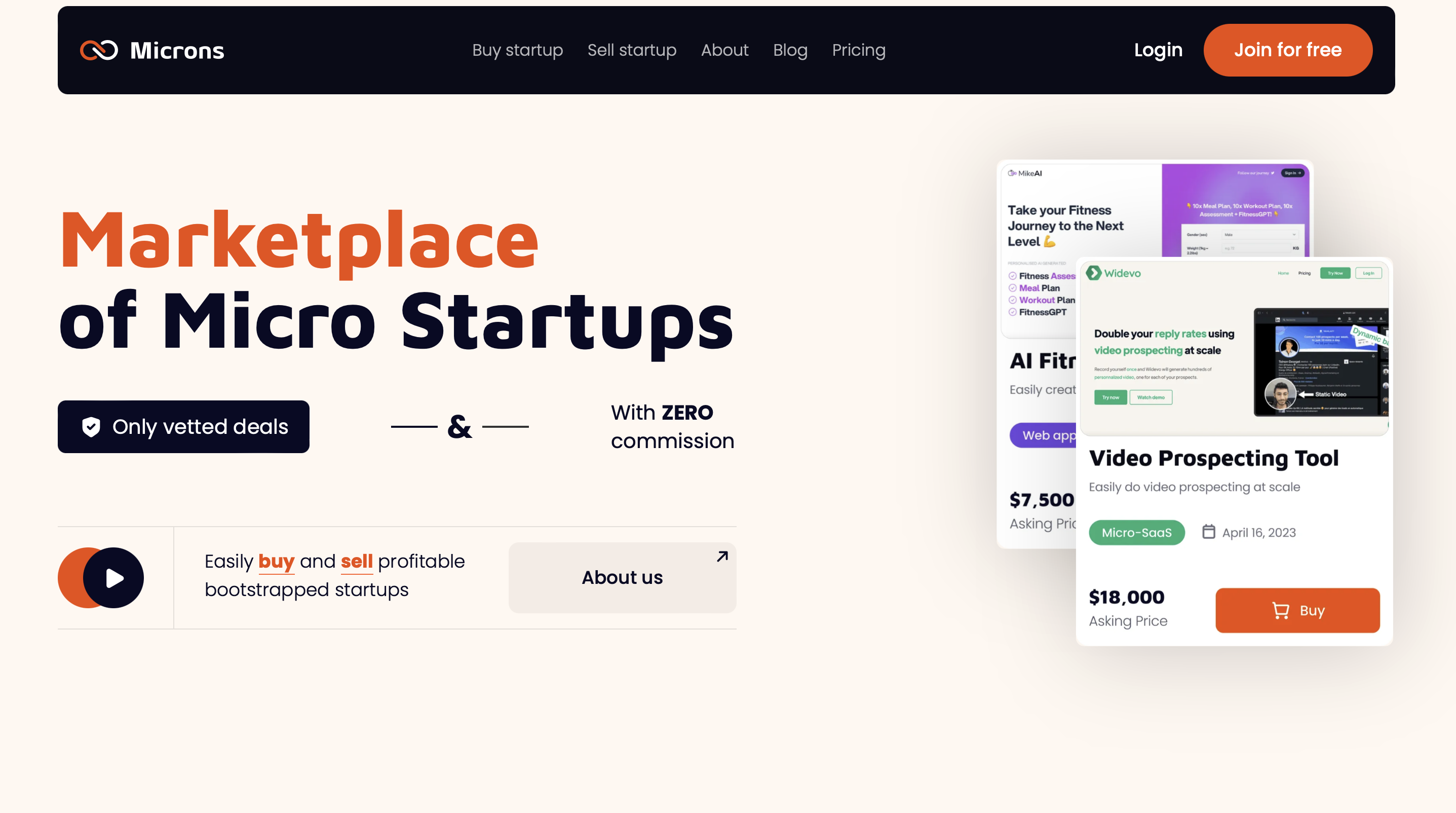

User reviews (0)