
 简体中文
简体中文muted.io
A collection of interactive online music theory tools and piano references for notes, keys, chords and scales. A fun way to learn and retain music concepts.
At a glance
- Category
- Music & Audio
- Language
- English
- Paid-content signal
- No paid content foundObserved
- Registered
- 2016
- Hosting
- NetlifyInferred
- HTTPS certificate trusted
- PassedObserved
- Last updated
Related questions
More questions →What Is Desktop Software and When Should You Use It Instead of a Browser Extension?
Desktop software is a program you install and run directly on your computer's operating system (Windows, macOS, or Linux), rather than inside a browser tab. You should choose it over a browser extension or web app when your task needs deeper system access, steadier performance, or offline capability — for example, real-time meeting transcription that captures audio from multiple apps. Browser extensions are lighter and install in seconds, but they live inside one browser and inherit its limits.
What "desktop software" actually means
A desktop app is installed on the machine and runs as its own process. It can:
- Read and write local files without a download/upload round trip
- Access system-level resources like the microphone, speakers, camera, and other running apps
- Keep working when the browser is closed or the network drops (depending on the app)
- Persist settings and data locally
This is different from a web app, which runs in a browser tab and depends on a live connection and browser permissions, and from a browser extension, which is a small add-on that modifies or extends one browser's behavior.
Desktop app vs. browser extension vs. web app
| Dimension | Desktop software | Browser extension | Web app |
|---|---|---|---|
| Where it runs | Installed on the OS | Inside one browser | In a browser tab |
| Offline access | Often partial or full | Rarely | Usually none |
| System permissions | Broad (mic, files, other apps) | Limited to browser APIs | Limited to browser APIs |
| Performance | Uses full local resources | Constrained by browser | Constrained by browser + network |
| Updates | App-managed or manual | Auto via browser store | Automatic on reload |
| Cross-app capture | Yes (e.g., system audio) | Usually no | Usually no |
The practical takeaway: extensions and web apps are convenient and low-commitment; desktop apps trade a heavier install for capability and stability.
When a desktop app is the better choice
Pick desktop software when the task depends on one or more of these:
- Capturing audio from multiple sources at once — a meeting where you're on a call and taking notes. A desktop notetaker can tap system audio and the mic; a browser extension generally can't reach outside its tab.
- Real-time transcription and live summaries — Otter's Meeting Agent is described as supporting real-time transcription, live chat, automated summaries, insights, and action items. That kind of continuous processing benefits from a local process rather than a single browser tab.
- Long or resource-heavy sessions — recording and transcribing for an hour is more stable outside a tab you might accidentally close.
- Working across apps — if your workflow spans a video call app, a document, and a notes tool, a desktop app can sit across all of them.
Choose a browser extension instead when you only need to enhance one website (for example, adding a button to a specific web tool), want zero install friction, and don't need system-level access.
How to choose and install a desktop app safely
- Confirm the task fits a desktop app. If you only need to tweak one website, an extension is lighter. If you need system audio, local files, or offline use, go desktop.
- Check system requirements. Match the OS (Windows/macOS/Linux) and version. Download only from the vendor's official site — for Otter, that's otter.ai.
- Review permissions before granting. A meeting/transcription app will ask for microphone (and possibly screen or system audio) access. Grant only what the task needs.
- Install and sign in. Follow the vendor's installer. If the app requires an account, expect a login step.
- Verify it works. Run a short test — record 30 seconds and confirm transcription or capture appears as expected.
- Check update and pricing terms. Otter lists a pricing page at otter.ai/pricing; check it for current plan limits rather than assuming a free tier.
Troubleshooting common desktop software problems
- Install fails — confirm OS version meets requirements, free up disk space, and re-download from the official source (a corrupted installer is a common cause).
- App crashes on launch — update to the latest version, restart the machine, and check whether a security tool is blocking it.
- No audio captured — re-check microphone/system-audio permissions in OS settings, not just in the app.
- Sync or login issues — verify your network and credentials; if the app stores data locally, confirm it isn't blocked by a firewall.
- Extension works but desktop doesn't (or vice versa) — they use different permission models; a feature available in one may not exist in the other.
If your goal is AI meeting transcription with live summaries and action items, a desktop app is usually the more capable choice; if you just need a small tweak inside one website, a browser extension is the faster path.
Website Overview
An established domain and managed infrastructure suggest continuity of operations and may support dependable delivery, although neither guarantees service quality. Page metadata, canonical configuration and social previews work together to provide more consistent search and sharing presentation.
Domain and Registration
Registered in 2016, this domain has about 10 years of history. That suggests continuity, although ownership and purpose may have changed. Transfer-protection status is present, helping reduce the risk of unauthorized domain transfers. The registrar is GoDaddy.com, LLC, a widely used domain service provider. The domain uses the common .io extension, which is not an independent safety signal.
DNS and Email
Nameservers are provided by NS1, indicating managed DNS hosting. No CNAME was found; the observed records resolve directly to addresses. No MX record was found. A conventional explicit inbound-mail route is not configured. TXT records include verification markers for Google. Such markers may also remain after a service stops being used. DNSSEC signatures were not detected, so this additional DNS authenticity protection is not confirmed.
TLS and Certificates
The public key uses EC with 256 bits. The server supplied a complete certificate chain. No organization name is present in the certificate; the available fields are consistent with domain validation. The certificate was issued by Let's Encrypt, commonly associated with automated certificate services. The certificate's total validity is about 89 days, consistent with a short renewal cycle.
HTTP and Browser Security
The response lacks these common security headers: CSP, X-Content-Type-Options, Referrer-Policy, Permissions-Policy, clickjacking protection. No X-Powered-By header was found, reducing one common source of backend fingerprinting information. No obvious internal addresses or debug information were found in the headers. The Server header contains the custom value Netlify. No explicit CDN or WAF marker was found in the response headers.
Technology Stack Analysis
The public page identifies Tailwind CSS, Netlify without precise versions, leaving fewer clues for version-specific scanning.
Search and Social Sharing
Twitter Card metadata is configured. The title has 57 characters, within a common display range. A meta description is present, with 156 characters. The observed directives allow indexing and link following. No Generator meta tag is publicly exposed.
Hosting and Email
 NS1
NS1 Netlify
 Ashburn, Virginia, United States
Inferred
18.208.88.157
Ashburn, Virginia, United States
Inferred
18.208.88.157
Registration details
| Registrar | GoDaddy.com, LLC |
|---|---|
| Registered | 2016-08-18 |
| Expires | 2027-08-18 |
| Domain status | autoRenewPeriod https://icann.org/epp#autoRenewPeriod、clientDeleteProhibited https://icann.org/epp#clientDeleteProhibited、clientRenewProhibited https://icann.org/epp#clientRenewProhibited、clientTransferProhibited https://icann.org/epp#clientTransferProhibited、clientUpdateProhibited https://icann.org/epp#clientUpdateProhibited |
| Nameservers | dns1.p02.nsone.net、dns2.p02.nsone.net、dns3.p02.nsone.net、dns4.p02.nsone.net |
| DNSSEC | unsigned |
DNS records
| Type | Name | Value | TTL | Priority |
|---|---|---|---|---|
| A | muted.io | 18.208.88.157 | 120 | — |
| A | muted.io | 98.84.224.111 | 120 | — |
| NS | muted.io | dns1.p02.nsone.net | 3600 | — |
| NS | muted.io | dns2.p02.nsone.net | 3600 | — |
| NS | muted.io | dns3.p02.nsone.net | 3600 | — |
| NS | muted.io | dns4.p02.nsone.net | 3600 | — |
| TXT | muted.io | ahrefs-site-verification_85edd55c2853a4744e7dda5562c35790a6410415e07cc4079547752e9a9514da | 3600 | — |
| TXT | muted.io | google-site-verification=EHcak9BFM9oZyfGu7fMd1GdsPjgVGMXPaFcGRB3wrXY | 3600 | — |
TLS and certificates
HTTP response headers
| Header | Value |
|---|---|
| content-type | text/html; charset=UTF-8 |
| cache-control | public,max-age=0,must-revalidate |
| server | Netlify |
| strict-transport-security | max-age=31536000 |
Identified technologies
Pages, Search and Sharing
| Meta description | A collection of interactive online music theory tools and piano references for notes, keys, chords and scales. A fun way to learn and retain music concepts. |
|---|---|
| Canonical URL | https://muted.io/ |
| Language | English (default) |
| Twitter Card | summary_large_image |
Social Sharing Preview
11 fields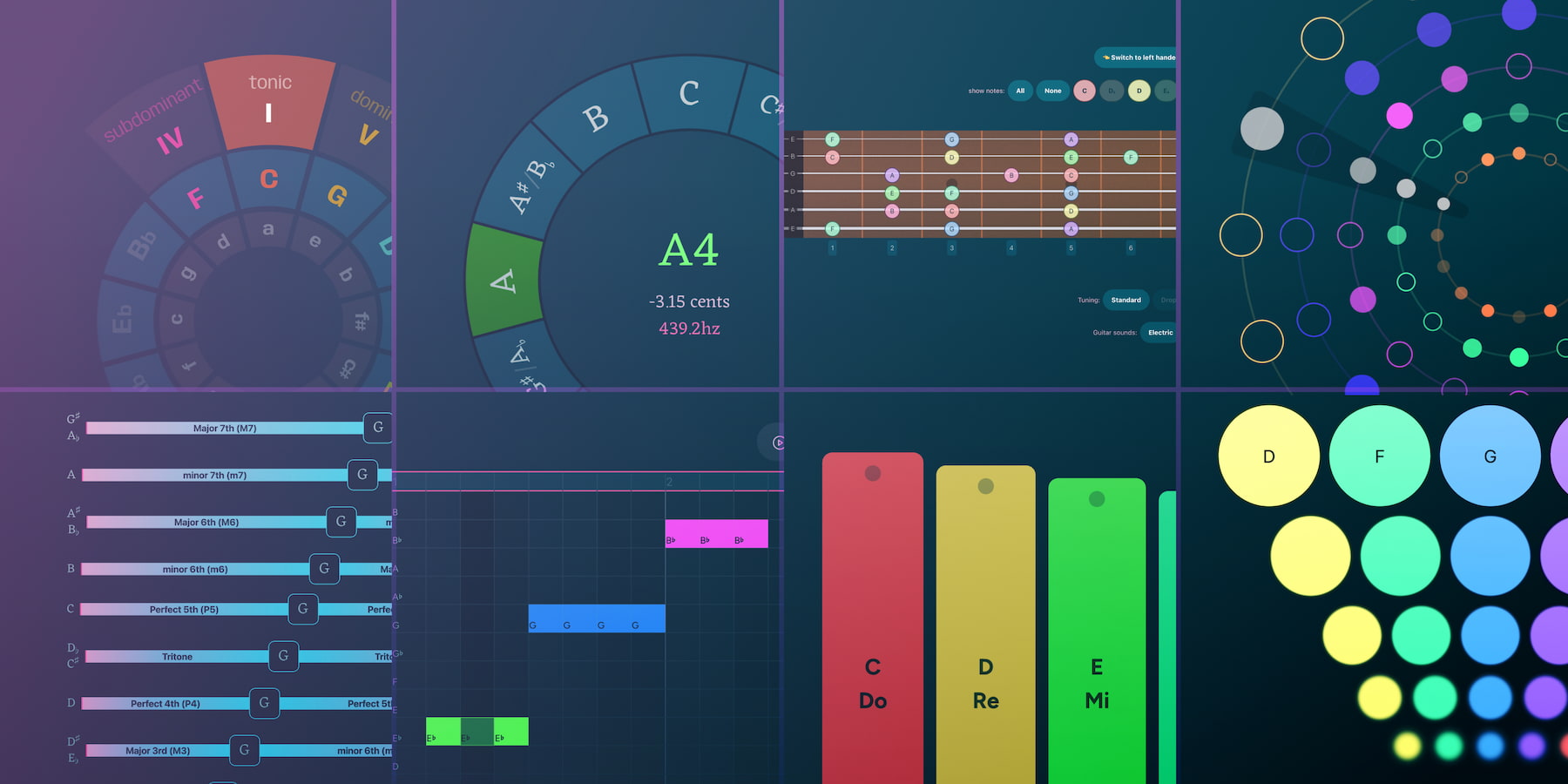
robots.txt (opens in a new tab)
0 rulesAll bots 0 allowed · 0 disallowed
No matching rules.
Sitemaps
1Recent Updates
- Website images
- Screenshots
User reviews (0)