
 podsnapper.com
No paid content found
podsnapper.com
No paid content found
Categories: Artificial Intelligence
Turn hours of audio into a few minutes. AI-powered text + audio podcast summaries in 30+ languages. Works with YouTube, Twitch, Spotify, Apple Podcasts, and RSS.
 Visit website
 Updated: 2026-09-23 09:14
 Language: English (default)
 Access: Normal
 Profile views 1
 Outbound visits 0
Related questions
More questions →How Does AI Audio Transcription Work and What Affects Its Accuracy?
AI audio transcription converts speech into text by combining signal processing with machine learning models trained on huge amounts of paired audio and text. In practice, the pipeline runs through several stages: audio preprocessing, acoustic and language modeling, punctuation and formatting, and—if enabled—speaker diarization and summarization. Accuracy is not a single fixed number; it depends on recording quality, accents, background noise, overlapping speech, vocabulary, and how well the chosen language is supported. This article explains each stage and the practical factors that move accuracy up or down, so you can judge when automated transcription is enough and when human review still matters.
The core pipeline: from sound wave to readable text
1. Audio preprocessing
Before any speech recognition happens, the file is normalized and cleaned up. Typical steps include:
- Resampling to a consistent sample rate (commonly 16 kHz for speech models).
- Channel handling: mono conversion or selecting the dominant channel when stereo tracks differ.
- Noise reduction and gain normalization to bring quiet speakers up and steady loud peaks.
- Voice activity detection (VAD) to find where speech actually occurs and skip silence.
Good preprocessing improves everything downstream. A clean, consistent input gives the model less to compensate for.
2. Speech recognition (acoustic + language modeling)
Modern systems use neural networks—often transformer-based—that map short audio frames to probable words or subword units. Two components work together:
- The acoustic model estimates which sounds were spoken.
- The language model estimates which word sequences are plausible in the target language.
The decoder combines both to produce the most likely transcript. This is why context matters: a model that "knows" a phrase is common will favor it over a phonetically similar but unlikely alternative.
3. Punctuation, casing, and formatting
Raw recognition output is a stream of words. A separate step adds:
- Sentence boundaries and punctuation.
- Capitalization of proper nouns and sentence starts.
- Number, date, and currency formatting.
These are learned from text data, so they follow the conventions of the training material rather than any single style guide.
4. Speaker diarization
Diarization answers "who spoke when." The system extracts voice characteristics (embeddings) from each speech segment, clusters similar segments, and assigns labels like Speaker 1, Speaker 2. It works best when speakers sound distinct and don't talk over each other. Overlapping speech and similar voices are the main failure modes.
5. Summaries and derived outputs
Once a transcript exists, summarization models condense it into key points, action items, or topics. Because summaries are generated from the transcript, any transcription error can propagate into the summary. Speaker labels also let a summary attribute statements to the right person—if diarization was accurate.
What actually affects accuracy
Accuracy varies widely by conditions. The table below summarizes the main factors and their typical effect.
| Factor | Why it matters | Practical impact |
|---|---|---|
| Audio quality / bitrate | Low bitrate or clipping destroys phonetic detail | Major |
| Background noise | Music, traffic, chatter mask speech | Major |
| Microphone distance | Far-field audio is reverberant and quiet | Major |
| Accents and dialects | Training data may underrepresent them | Moderate to major |
| Overlapping speech | Models struggle to separate simultaneous voices | Major for diarization |
| Speaking rate | Very fast speech blurs word boundaries | Moderate |
| Domain vocabulary | Jargon, names, acronyms are rare in training data | Moderate to major |
| Language coverage | Less-resourced languages have weaker models | Major |
| Audio length / consistency | Mixed conditions within one file | Moderate |
Language coverage and multilingual models
A system advertising "54+ languages" does not mean equal quality in all of them. High-resource languages (English, Spanish, French, German) usually have more training data and better accuracy. Lower-resource languages may show more errors, especially with specialized terms. Multilingual models can handle code-switching—mixing languages in one conversation—but results depend on how much mixed-language data the model saw. If your content is in a less common language, test a sample before committing.
Domain-specific vocabulary
Names, product terms, medical or legal jargon, and acronyms are frequent error sources because they're rare in general training text. Many tools let you supply a custom vocabulary or keyword list to bias the decoder. This is one of the highest-leverage fixes you can apply.
Practical steps to improve your results
- Record well. Use a close microphone, a quiet room, and a consistent setup. This single step often matters more than any setting.
- Use one speaker per channel when possible; it makes diarization trivial and more reliable.
- Add a custom vocabulary for names, brands, and technical terms.
- Choose the correct language explicitly rather than relying on auto-detection, especially for short clips.
- Review the transcript against the audio for high-stakes content.
- Check speaker labels if attribution matters; correct them before generating summaries.
A simple quality-check template
For any important recording, run this quick pass:
- [ ] Does the transcript match the audio in the first two minutes?
- [ ] Are proper nouns and numbers correct?
- [ ] Are speaker labels consistent and correctly assigned?
- [ ] Do punctuation and paragraph breaks aid readability?
- [ ] Does the summary reflect the actual discussion, not just keywords?
When human review is still needed
Automated transcription is fast and increasingly accurate, but certain situations call for a human pass:
- Legal, medical, or financial records where a single word changes meaning.
- Heavily accented or overlapping speech in noisy environments.
- Highly technical content with dense jargon.
- Anything published under your name where errors carry reputational cost.
A common workflow is machine transcription first, then targeted human editing—this captures most of the speed benefit while controlling risk.
Choosing a tool: what to compare
When evaluating transcription software, compare on the dimensions that match your use case:
- Language support for your specific languages, not just the headline count.
- Speaker detection quality if you need attributed transcripts.
- Custom vocabulary support.
- Export formats (SRT, VTT, DOCX, JSON) for your downstream tools.
- Summarization if you want derived outputs.
- Pricing model—check the vendor's current pricing page, since plans and rates change.
Sonix, for example, positions itself around transcription in 54+ languages with AI summaries and speaker detection, and offers a free trial without a credit card. Verify current features and pricing directly on its site, as these details evolve.
Bottom line
AI transcription works by cleaning audio, recognizing speech with acoustic and language models, then adding punctuation, speaker labels, and summaries. Accuracy is driven less by the model alone and more by your recording conditions, language, vocabulary, and whether speakers overlap. Improve the input, supply domain terms, and reserve human review for high-stakes content—and you'll get reliable results from automated transcription in most everyday cases.
Website Overview
Several search or sharing settings need attention. Together they may make snippets, preview images or preferred URLs less consistent across platforms. An active inbound-mail setup with incomplete authentication may leave the domain more open to impersonation. Provider hosting alone does not close that gap.
Domain and Registration
The domain was registered less than a year ago and has limited historical evidence to assess. Transfer-protection status is present, helping reduce the risk of unauthorized domain transfers. The domain uses the common .com extension, which is not an independent safety signal.
DNS and Email
The observed email authentication setup is incomplete: DMARC is missing. Nameservers are provided by Cloudflare, indicating managed DNS hosting. MX records point to the Cloudflare Email Routing email service. No CNAME was found; the observed records resolve directly to addresses. DNSSEC signatures were not detected, so this additional DNS authenticity protection is not confirmed.
TLS and Certificates
The public key uses EC with 256 bits. The server supplied a complete certificate chain. No organization name is present in the certificate; the available fields are consistent with domain validation. The certificate was issued by Let's Encrypt, commonly associated with automated certificate services. The certificate's total validity is about 89 days, consistent with a short renewal cycle.
HTTP and Browser Security
The response lacks these common security headers: CSP, X-Content-Type-Options, Referrer-Policy, Permissions-Policy, clickjacking protection. CORS permits any origin to read this response. This is common for public resources; sensitive responses need narrower handling. No X-Powered-By header was found, reducing one common source of backend fingerprinting information. The cf-ray response header indicates a CDN or caching proxy in the delivery path. No obvious internal addresses or debug information were found in the headers.
Technology Stack Analysis
The public page identifies Next.js, Cloudflare, Vercel without precise versions, leaving fewer clues for version-specific scanning.
Search and Social Sharing
The meta description has 161 characters and may be shortened in search results. No homepage canonical URL was detected. If duplicate URLs exist, consolidation may be less explicit. Twitter Card metadata is configured. The title has 31 characters, within a common display range. The observed directives allow indexing and link following.
 Hosting and Email
 Cloudflare
 Hosting
 Vercel
 Location
 unknown
104.21.29.170
Location
Location unknown
104.21.29.170
 Pages, Search and Sharing
| Meta description | Turn hours of audio into a few minutes. AI-powered text + audio podcast summaries in 30+ languages. Works with YouTube, Twitch, Spotify, Apple Podcasts, and RSS. |
|---|---|
| Canonical URL | Not detected |
| Language | English (default) |
| Twitter Card | summary_large_image |
Social Sharing Preview
13 fields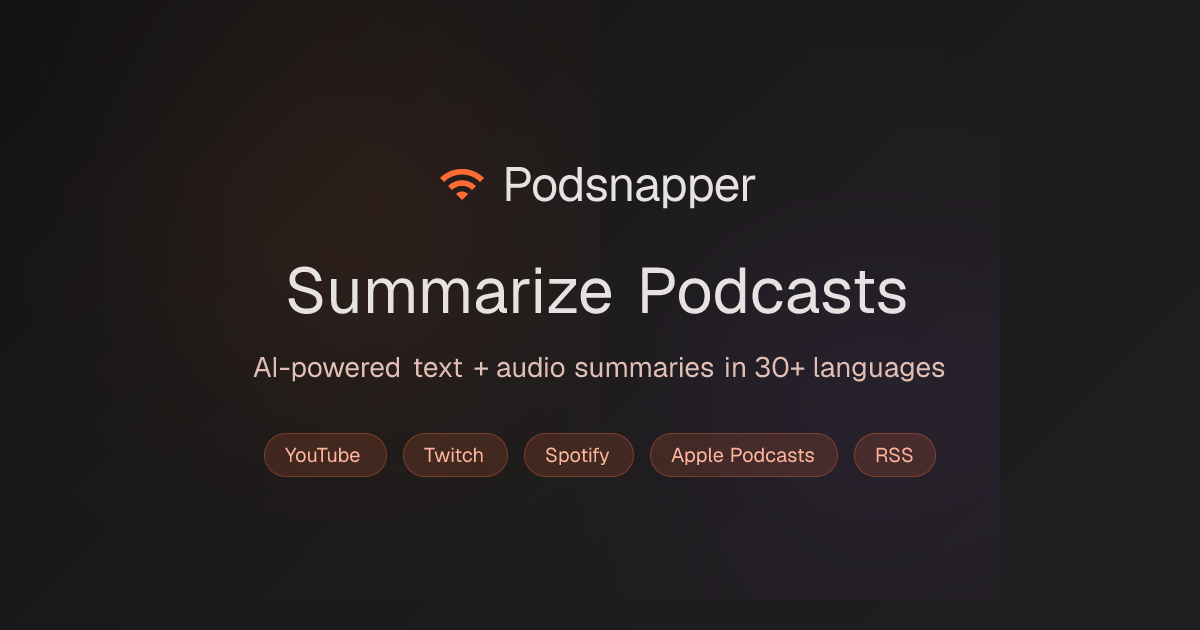

Sharing metadata
| og:url | https://podsnapper.com |
|---|---|
| og:type | website |
| og:image | https://podsnapper.com/api/og |
| og:title | Podsnapper — Summarize Podcasts |
| og:image:alt | Podsnapper — Summarize Podcasts |
| og:site_name | Podsnapper |
| og:description | AI-powered text + audio podcast summaries in 30+ languages. |
| og:image:width | 1200 |
| og:image:height | 630 |
| twitter:card | summary_large_image |
| twitter:image | https://podsnapper.com/api/og |
| twitter:title | Podsnapper — Summarize Podcasts |
| twitter:description | AI-powered text + audio podcast summaries in 30+ languages. |
robots.txt (opens in a new tab)
1 rulesAll bots 1 allowed · 0 disallowed

 All bots

/
No matching rules.
Sitemaps
1 Registration details RDAP / WHOIS
| Registrar | Hosting Concepts B.V. d/b/a Registrar.eu |
|---|---|
| Registered | 2026-03-22 |
| Expires | 2027-03-22 |
| Domain status | client transfer prohibited |
| Nameservers | hunts.ns.cloudflare.com、rosemary.ns.cloudflare.com |
| DNSSEC | unsigned |
 DNS records
| Type | Name | Value | TTL | Priority |
|---|---|---|---|---|
| A | podsnapper.com | 104.21.29.170 | 300 | — |
| A | podsnapper.com | 172.67.149.138 | 300 | — |
| AAAA | podsnapper.com | 2606:4700:3032::6815:1daa | 300 | — |
| AAAA | podsnapper.com | 2606:4700:3036::ac43:958a | 300 | — |
| MX | podsnapper.com | route3.mx.cloudflare.net | 300 | 11 |
| MX | podsnapper.com | route2.mx.cloudflare.net | 300 | 75 |
| MX | podsnapper.com | route1.mx.cloudflare.net | 300 | 97 |
| NS | podsnapper.com | hunts.ns.cloudflare.com | 86400 | — |
| NS | podsnapper.com | rosemary.ns.cloudflare.com | 86400 | — |
| TXT | podsnapper.com | v=spf1 include:_spf.mx.cloudflare.net ~all | 300 | — |
 TLS and certificates
| Assessment | Normal configuration |
|---|---|
| Supported protocols | TLSv1.2、TLSv1.3 |
| Negotiated protocol | TLSv1.3 |
| Certificate subject | podsnapper.com |
| Issuer | Let's Encrypt |
| Valid until | 2026-12-16T17:35 · Remaining when checked: 84 days |
| Verification details | Certificate trust: Passed · Hostname match: Passed |
 HTTP response headers
| Header | Value |
|---|---|
| content-type | text/html; charset=utf-8 |
| cache-control | public, max-age=0, must-revalidate |
| server | cloudflare |
| strict-transport-security | max-age=63072000 |
| access-control-allow-origin | * |
 Identified technologies
User reviews (0)