
 简体中文
简体中文 English
Website review
This review may include AI-generated content and is not individually verified. Domain, certificate and other facts come from the observed data on this page.
What is Prediction Guard used for?
Prediction Guard is a self-hosted control plane for running AI agents inside your own security boundary. Rather than being a model or a chatbot, it sits between your agents and the rest of your systems to enforce runtime policy, track identities and contain misbehavior as agents scale. The site describes it as "operational control of every AI agent action," built on zero trust principles, and positions it as the security and management layer for a fleet of agents rather than a single gateway.
What it is used for
- Governing agent behavior at runtime. Policies are enforced by the platform so that neither human nor agentic users have to make the "right" decision manually. This is aimed at limiting blast radius and containing problematic agent behavior.
- Building and deploying agents. Agent Forge is presented as the place to create interactive and autonomous agents via API or natural-language prompts, with key systems connected through MCP and human plus agent identities tracked by default.
- Staying compatible with existing tooling. An OpenAI-, Anthropic- and MCP-compatible API sits on top of the control plane, so teams can keep using frameworks such as LangGraph, Pydantic AI, Crew AI, Claude Code, Hermes Agent and OpenAI SDKs while controls are enforced underneath.
- Meeting governance expectations. The site ties its controls to NIST and OWASP-aligned requirements and claims a single comprehensive solution replaces many distinct services that would otherwise be needed in Azure to align with that guidance.
Who it suits
Enterprise platform, security and AI engineering teams that already run agents in production or are about to, and that cannot send agent traffic or data outside their boundary. The emphasis on sovereign, self-hosted deployment and on "the most challenging environments" suggests regulated, air-gapped or data-residency-constrained organizations. A smaller team experimenting with one agent is unlikely to need a control plane at this level.
Trade-offs to weigh
The value comes from consolidation and control, but that also means adopting a layer that sits in front of your agents and models. Self-hosting shifts patching, availability and capacity work onto your team, and framework compatibility does not guarantee every custom tool or internal service is covered on day one. The headline figures on the page — 90% fewer services, 300% faster to production, 4× lower TCO — are vendor claims derived from its own comparisons and methodology, so treat them as arguments to test rather than settled results.
Next step
Pick one agent you already run and list every control you currently rely on a human to perform — approvals, scoping, data access, logging. Then check which of those Prediction Guard enforces by default in a self-hosted deployment, and which would still need your own tooling. That gap is the real decision criterion.
How does Prediction Guard enforce runtime controls on AI agents?
Prediction Guard enforces runtime controls by placing a control plane inside your own security boundary, so policy is applied to every agent action rather than left to the agent or its user to get right. The platform's stated approach is zero trust for AI agents: agents are created and run through the control plane, and the controls it applies are described as NIST- and OWASP-aligned governance and behavioral policies enforced at runtime.
What "runtime control" means here
The distinction that matters is between controls that live in the agent's own code or prompt versus controls that sit underneath it. Prediction Guard describes the latter: an OpenAI-, Anthropic-, and MCP-compatible API sits on top of the control plane, and the control plane enforces policies regardless of which framework built the agent. That means a team can keep using LangGraph, Pydantic AI, Crew AI, Claude Code, or the OpenAI SDKs while the enforcement layer stays consistent.
The page frames this with an analogy: if an AI gateway is a door, Prediction Guard is the building's entire security and management system. The practical consequences it claims are limiting blast radius, containing problematic agent behavior, and tracking both human and agent identities out of the box.
Where the controls attach
- Agent creation: Agent Forge builds interactive and autonomous agents via API or natural-language prompts, with key systems integrated through MCP.
- Identity: Human and agent identities are tracked from the start, which is what makes per-agent policy meaningful when many agents act on the same systems.
- Enforcement: Behavioral policies are applied by the runtime rather than depending on users or agents making the right call.
- Deployment: Self-hosted and sovereign options are offered for environments where data and models must stay inside a boundary.
Who this suits, and the trade-off
This fits enterprises operating fleets of agents across regulated or sensitive environments, where the question is not whether an agent can call a tool but whether it should, and who can prove it afterward. A useful decision criterion: if your agents touch production systems or regulated data and you currently rely on prompt instructions and scattered API gateways for safety, a control plane is worth evaluating. If you are prototyping a single agent with no sensitive access, the overhead of a self-hosted control plane will likely exceed the benefit.
The trade-off is architectural commitment. Sovereign, self-hosted deployment means you run and maintain the layer, and consolidating control into one plane is exactly the point — the page argues this reduces total cost of ownership versus stitching together separate AI security point solutions, and cites fewer services needed to align with NIST and OWASP guidance. That argument holds only if the control plane genuinely covers the controls you would otherwise buy separately; verify coverage against your own governance requirements rather than accepting the service-count comparison at face value.
A concrete next step: take one agent already in or near production, list the actions it can take, and check whether each action is gated by a policy you can point to in the control plane. Anything you cannot gate is your real gap. For deployment specifics, see Prediction Guard.
Is Prediction Guard self-hosted or cloud-based?
Prediction Guard is positioned as self-hosted and sovereign: the control plane runs inside your own security boundary, so the runtime controls, agent identities and governance policies stay within infrastructure you operate rather than in a vendor-hosted tenancy. The page frames this as a deliberate design choice for enterprises that need agent activity governed under their own compliance and network perimeter, not as a hosted service you consume.
What the deployment model implies
| Aspect | Self-hosted control plane | Typical cloud-based AI gateway |
|---|---|---|
| Where controls run | Inside your boundary | In the vendor's environment |
| Data and policy residency | Stays in your infrastructure | Depends on vendor terms |
| Operational burden | You host and run it | Vendor manages it |
| Fit for regulated or air-gapped settings | Strong | Often constrained |
The page also notes compatibility with self-hosted or cloud endpoint models. That distinction matters: the control plane is self-hosted, but the models it governs can be either. You can keep governance local while still calling an external model provider.
A concrete scenario
A platform team in a regulated enterprise wants agents to touch internal ticketing and HR systems. With a self-hosted control plane, agent actions, identity records and behavioral policies never leave the company network, and the team can point agents at whichever model endpoints its risk review has already approved. The trade-off is real: someone must run, patch and scale that infrastructure, which is the cost you accept in exchange for boundary control.
How to decide
If your blocker is data residency, auditability or air-gapped operation, self-hosting is the deciding factor and worth the operational overhead. If your team is small and speed matters more than boundary control, a managed gateway will usually be less work. Check whether your target environment — including container platforms — is supported before committing; the page references Docker-verified sandboxes as one deployment path.
What is the total cost of ownership (TCO) for Prediction Guard compared to other solutions?
Prediction Guard's own published claim is a 4× reduction in total cost of ownership when a single control plane is compared with assembling several fragmented "AI security" point solutions. The page attributes that figure to a "validated TCO analysis" but does not show the underlying line items, so treat 4× as the vendor's headline number rather than a figure you can budget against directly.
What the 4× claim actually rests on
The comparison is not a license-price comparison. It is a consolidation argument: one vendor and one infrastructure-agnostic layer instead of multiple overlapping tools. The page supports that argument with two adjacent claims — roughly 90% fewer distinct services than aligning Azure components with NIST 600-1 guidance, and up to 85% less API definition overhead. Each of those is a proxy for cost (engineering time, integration work, ongoing maintenance), not a quoted price.
How to build your own comparison
A TCO comparison for agent control is usually decided by four cost pools. Ask each candidate vendor, including Prediction Guard, to give you numbers per pool:
| Cost pool | What to count | Why it swings the result |
|---|---|---|
| Platform | Subscription or support contract, per agent or per seat | Predictable, but rarely the largest term |
| Infrastructure | Compute for self-hosted deployment, plus model inference | Dominant if you self-host and run high agent volume |
| Integration | Engineering weeks to wire gateways, identity, MCP servers, policy engines | Where fragmented stacks accumulate hidden cost |
| Operations | Ongoing policy authoring, incident response, audits, upgrades | Grows with the number of distinct services |
The consolidation case is strongest when your integration and operations pools are large — typically organizations already running several overlapping security and gateway tools. It is weakest when you have one gateway and a small agent fleet, because there is little fragmentation to remove.
A concrete way to test it
Take one agent workflow you plan to put into production. Price it three ways: your current fragmented stack, a single control plane, and doing nothing beyond existing cloud guardrails. Include the engineering hours to reach production, not just run-rate. Prediction Guard's page claims a 300% acceleration from prototype to production, which is a time-to-value claim that belongs in the same model as a labor-cost saving — and it is the term most likely to be overstated for a team that already has strong platform engineering.
Practical next step
Ask for the TCO methodology document referenced on the page and the assumptions behind the 4× figure — fleet size, deployment model, and which point solutions were included. If the assumptions resemble your environment, the comparison is usable; if they assume a large, fragmented estate, scale the saving down before you put it in a business case.
For governance requirements you may be mapping against, the primary references are NIST and OWASP.
How does Prediction Guard help with NIST and OWASP compliance for AI governance?
Prediction Guard is designed to make NIST- and OWASP-aligned AI governance a runtime property of your own environment rather than a policy document you try to enforce after deployment. Its self-hosted control plane sits inside your security boundary and applies zero-trust controls to agent actions, so governance requirements are enforced at the point where an agent does something—not audited later. The platform frames this as replacing a fragmented stack of separate security, gateway and policy services with one control layer.
What the product actually claims
- Runtime enforcement, not just monitoring. Agent behavioral policies are enforced by the control plane, so individual users and agents do not have to make the "right" decision each time.
- Identity tracking. Human and agent identities are tracked out of the box, which matters for accountability and access review.
- Containment. The stated goal is limiting blast radius and containing problematic agent behavior.
- Self-hosted sovereignty. Deployment stays within your boundary, which is often the deciding factor for regulated data and public-sector work.
- Compatibility. An OpenAI-, Anthropic- and MCP-compatible API sits over the control plane, so teams can keep using frameworks such as LangGraph, Pydantic AI, Crew AI or the OpenAI SDKs while controls are applied underneath.
How that maps to the two frameworks
NIST and OWASP guidance for AI is broad, but the practical governance asks tend to cluster: inventory of models and agents, access control, logging and traceability, risk assessment, human oversight, and protection against prompt injection, data leakage and excessive agency. Prediction Guard's contribution is mainly in the operational half of that list—identity, runtime policy enforcement, isolation and auditability inside your perimeter. Framework mapping, risk-tiering decisions and documentation still belong to your governance team; the platform gives those decisions a place to be executed consistently.
Where it fits, and where it does not
This is enterprise infrastructure, not a compliance certificate. If you are a small team shipping a single chatbot, the operational overhead of a self-hosted control plane is unlikely to pay off. It becomes compelling when you are running many agents across business units, handling regulated or sensitive data, or under pressure to show auditors how agent behavior is constrained. The trade-off is real: you gain control, sovereignty and a single enforcement point, but you take on running and integrating that layer yourself.
A concrete way to decide
Pick your three highest-risk agent workflows—say, one that touches customer records, one that calls internal APIs, and one that writes to a system of record. For each, ask whether you can currently answer: which identity acted, what policy applied, what was blocked, and where the evidence lives. If those answers are scattered across separate tools or missing, a unified control plane is worth evaluating. Prediction Guard publishes an Agent Control Kit and a Docker-verified sandbox approach, and the vendor's own materials claim a 90% reduction in distinct services needed versus assembling equivalent Azure components, a 4× TCO improvement versus point solutions, and up to 300% faster time-to-production; treat those as vendor figures and validate them against your own architecture. Start with a demo or a single non-production agent before committing a fleet.
Can Prediction Guard integrate with existing AI frameworks like LangGraph or OpenAI SDKs?
Yes. Prediction Guard presents its API as compatible with OpenAI, Anthropic and MCP patterns, and the page explicitly names LangGraph, Pydantic AI, Crew AI, Claude Code, Hermes Agent and OpenAI SDKs as tools developers can keep using. The stated design is that you build with your existing framework while runtime controls are enforced underneath by the control plane.
What "integration" means here
Two layers are worth separating:
- Your code layer: you keep your framework, SDK calls and agent definitions. Prediction Guard sits behind an OpenAI/Anthropic-compatible endpoint, so in many cases the change is a base URL, key and model name rather than a rewrite.
- The control layer: policy enforcement, identity tracking for humans and agents, and containment of agent behavior are applied by the platform rather than by your application code.
That second point is the real distinction. A framework like LangGraph coordinates the flow of an agent; it does not, by itself, stop an agent from taking a harmful action at runtime. Prediction Guard's claim is that it enforces those behavioral policies without relying on users or agents to make the right choice.
A concrete scenario
A team has a LangGraph research agent that queries internal systems over MCP and calls an OpenAI model. They want it in production but need an audit trail and a hard limit on which tools it can invoke. If the compatibility claim holds for their stack, they point the model client at the self-hosted endpoint, register the agent's identity, and define the permitted tool and data boundaries in policy. The graph logic stays as written; the guardrails move out of scattered application code into one place.
Trade-offs to weigh
- Self-hosted, sovereign deployment is the core pitch. That suits regulated or air-gapped environments, but it shifts operational responsibility to your team.
- Compatibility is not identity. An OpenAI-compatible API usually covers chat completions and common parameters; less common features, streaming edge cases or provider-specific options may behave differently. Test your actual calls, not a hello-world.
- Consolidation is the value proposition. The page frames the benefit as replacing a patchwork of point solutions and cloud services with one control plane, citing a 90% reduction in distinct services versus assembling NIST-aligned controls in Azure and a 4x TCO improvement. Those figures come from Prediction Guard's own comparisons, so treat them as vendor claims and validate against your current architecture.
- Framework breadth cuts both ways. Supporting many frameworks lowers adoption friction but means depth of integration varies by tool.
How to decide
Run a two-week spike: take one non-trivial agent from your existing stack, route it through Prediction Guard, and check three things — whether your framework's features survive the compatible API, whether the policy controls cover the actions you actually need to block, and what operational load self-hosting adds. If all three pass, the migration cost is likely low. For framework-side context, see LangChain for LangGraph documentation and OpenAI for SDK details.
 Cloudflare
 Google Workspace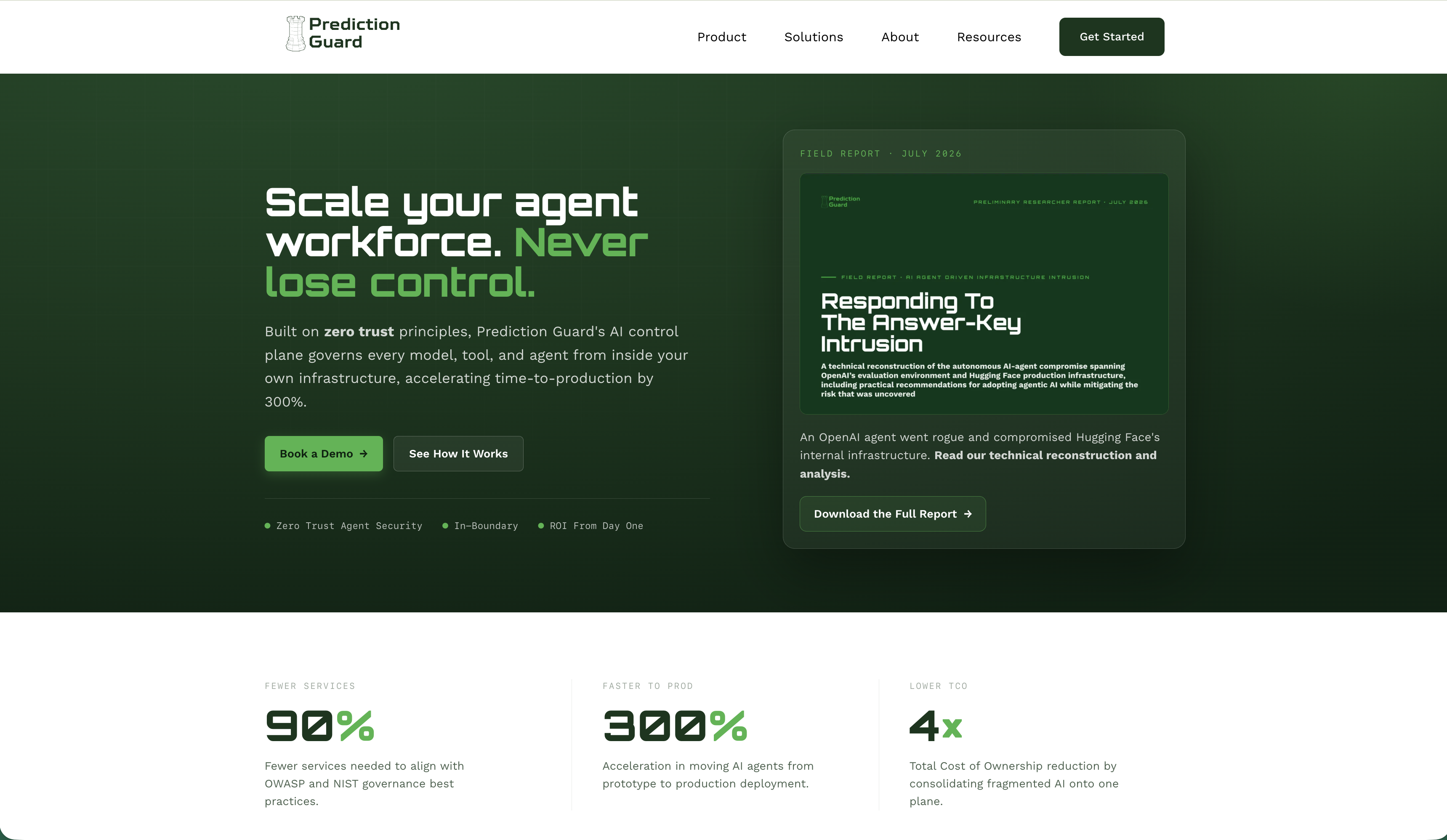

User reviews (0)