Website profiles · Technology insights · Alternatives

publishing.co.uk

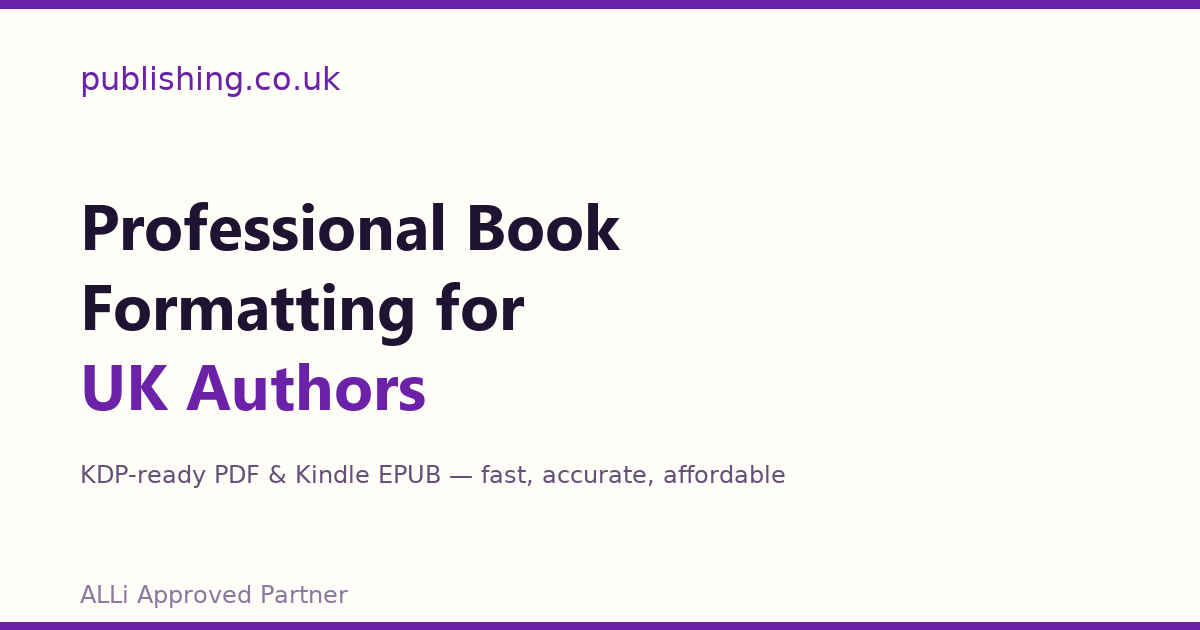
You wrote the book — we make it sell. UK formatting, covers, Amazon pages and full launches. KDP-ready files back in 24 hours, from £69.

No paid content found
Visit website
Profile views 5 Outbound visits 1 Normal
publishing.co.uk Full homepage screenshot

At a glance

Category
Artificial Intelligence
Language
English
Paid-content signal
No paid content foundObserved
Registered
1995
Hosting
Hostinger International LimitedInferred
HTTPS certificate trusted
PassedObserved
Last updated

Website review

This review may include AI-generated content and is not individually verified. Domain, certificate and other facts come from the observed data on this page.

What is publishing.co.uk?

publishing.co.uk is a UK-based service that formats self-published books and helps them launch on Amazon. Its stated focus is the practical production side of indie publishing: taking a finished manuscript and returning KDP-ready files — a print-ready interior and a Kindle ebook file — typically within 24 hours. It also covers Amazon book pages, author websites and full launches.

Who it is for

The site positions itself for first-time authors, non-fiction writers and memoirists, and says it has operated from the UK since 2018. If you have written a book but do not want to wrestle with file conversion, trim sizes, margins and ebook reflow yourself, that is the problem it addresses.

What it actually offers

  • Formatting of manuscripts into files Amazon's Kindle Direct Publishing accepts, alongside ebook files.
  • Amazon pages and author websites, plus full book launches for authors who want the whole package handled.
  • Free checks — short assessments covering the manuscript, cover, advertising and book discovery, so you can see where your book stands before paying.
  • Self-paced courses, including one on selling more books and one on AI discoverability, both personalised to your own book.
  • Book Score, which reads your Amazon listing and asks AI assistants such as ChatGPT, Claude and Gemini whether they would recommend your book.

The research angle

What distinguishes the service from a plain formatting shop is its stated research. It publishes a weekly "AI Shelf" tracking which books AI assistants name across 16 genres, and cites a citation study covering 981 books. The practical claim is that advice on getting discovered is based on observing what these tools actually surface, rather than on general marketing theory.

A realistic scenario

Say you have finished a 70,000-word non-fiction manuscript and want it on Amazon in both paperback and Kindle. Formatting is the immediate blocker; discovery is the longer-term one. A service like this handles the first in about a day and gives you tools for the second. The trade-off is cost and dependence: you pay from a stated starting point and hand over production work you could learn to do yourself, though the learning curve for KDP file preparation is genuinely steep for a first book.

Next step: if formatting is your bottleneck, use the free manuscript or cover check first — it tells you what needs fixing before you commit money. If your book is already published and simply invisible, the Book Score route is the more relevant entry point.

How much does it cost to have my manuscript formatted for KDP?

Formatting a manuscript for KDP through publishing.co.uk starts at £69. That is the entry price for their hand-formatting service, which turns your manuscript into the two files KDP expects: a print-ready interior file and a Kindle ebook file, returned within 24 hours. The starting figure applies to straightforward formatting work; longer books, complex layouts, tables, images or custom design will typically sit above it, so treat £69 as a floor rather than a fixed quote.

What affects the price

  • Length and complexity — a 60,000-word novel with plain chapter headings is simpler than a non-fiction book with tables, diagrams or footnotes.
  • Interior design — standard genre-appropriate styling costs less than a bespoke layout.
  • Cover work — the £69 signal covers formatting; covers, Amazon pages and launches are separate services on the same site.
  • Turnaround — the advertised 24-hour return is part of the standard offer, not a premium tier.

How that compares

Route Typical cost signal Trade-off
Do it yourself in Word or Google Docs Free, plus your time Cheapest, but KDP rejects files for margin, bleed and font-embedding errors
Template or dedicated formatting software One-off or subscription Good control, learning curve, you still check every page
Freelancer on a marketplace Varies widely by quote Flexible, quality varies, you manage the brief
Done-for-you service like this one From £69 Fast and predictable, less control over fine design choices

A practical next step

Before spending anything, run the free 60-second checks on the site — manuscript, cover, advertising and discovery — to see which problem is actually costing you sales. If your file already passes KDP's previewer and looks clean, formatting may not be your bottleneck; if it fails or looks amateurish next to competing titles, £69 is a modest outlay against a book that reads as professional. For a UK-based first-time author or memoirist who wants files back quickly without learning typesetting, the entry price is reasonable; if you have a heavily illustrated book, ask for a quote against your actual manuscript rather than assuming the starting figure applies.

What exactly is included in the 24-hour turnaround service?

The 24-hour turnaround covers the core production step: hand-formatting your manuscript into the two files KDP accepts — a print-ready file and a Kindle ebook file — and returning them to you within a day. The page presents this as the fast, done-for-you route for authors who already have a finished manuscript and want it to look professional without learning formatting software.

It is worth separating what is fast from what is packaged around it. The site describes a wider set of services — cover work, Amazon pages, author websites and full launches — and those are not promised on the same 24-hour clock. The page also offers five free 60-second checks (manuscript, cover, advertising, discovery, and editorial from 2027), which are diagnostic rather than part of the formatting job.

Who this suits

  • First-time authors who have written the book but dread the file-preparation stage.
  • Non-fiction writers and memoirists who want a clean, store-ready interior without hiring a designer.
  • Anyone on a deadline who would rather pay for speed than spend a weekend fighting styles and margins.

Practical scenario

You finish your memoir on a Sunday, send the Word file over, and expect the KDP-ready pair back on Monday. That works if your manuscript is clean and your expectations are limited to formatting. If you also need a cover, a sales page or a launch plan, treat those as separate projects with their own timelines.

Decision criterion

Use the 24-hour service when the manuscript is final and only the files are missing. If the book still needs structural editing, a cover, or a launch, start with the free checks and the stage-based roadmap on the page, then decide what to buy first. For general context on self-publishing routes, the Kindle Direct Publishing help pages and the Alliance of Independent Authors are useful references — the latter is relevant here because the site states it is an approved partner.

How can I check if AI tools like ChatGPT recommend my book?

Start by testing the assistants directly, then look at whether your book's Amazon page gives them anything to quote. AI recommendations are drawn from what models have read and can retrieve about your book, so a thin or inconsistent listing gives them little to work with.

Run a realistic reader test yourself

Ask ChatGPT, Claude and Gemini the questions a real reader would type, not your title. "What should I read after [well-known book in your genre]?" or "Best memoirs about growing up in a working-class family?" Then note whether your book appears, and in what company.

Repeat this a few times and vary the phrasing, because answers shift between sessions. A single mention is weak evidence; consistency across tools and phrasings is what matters.

Check the inputs, not just the output

Assistants can only name what they can find and quote. Look at:

  • Your Amazon listing — description, categories, keywords and editorial reviews. Vague copy gives an AI nothing distinctive to repeat.
  • Consistency — the same title, subtitle, author name and description everywhere, so the model isn't matching fragments.
  • Third-party coverage — reviews, interviews, listicles and genre round-ups. Citations tend to follow pages that already discuss the book in context.

publishing.co.uk offers a free Book Score check that reads your Amazon page and puts it to ChatGPT, Claude and others, as part of its wider AI Shelf research tracking which books assistants name across 16 genres. That is a useful starting point if you want a structured read rather than ad-hoc prompting. For a manual alternative, ChatGPT and Claude both let you paste a listing and ask what the page communicates about the book — a quick way to see how clearly your own copy reads.

What to do with the result

If your book never appears, the usual cause is not the AI but the listing: no clear category signal, no quotable description, no outside pages discussing it. Fix those before assuming the tool is against you. If it appears inconsistently, that is normal — treat it as a visibility signal to improve rather than a verdict.

A practical next step: run the same three questions across all three assistants today, save the answers, then repeat in a month after updating your listing and seeking a review or two. The change, or lack of it, tells you more than any single check.

What are the free 60-second checks and what do they cover?

The free 60-second checks are quick diagnostics that show where a book stands before you pay for any service. On publishing.co.uk they are described as five checks covering the manuscript, the cover, advertising, book discovery, and editorial (the last listed as coming in 2027). Each is pitched as a 60-second pass, so the point is a fast read on obvious problems rather than a full critique.

What each check looks at, based on the site's framing:

Check What it appears to cover Who it suits
Manuscript Whether the text is ready for KDP-style formatting First-time authors unsure if their file is clean
Cover Whether the cover meets the basic bar for a selling book Anyone about to upload a cover they made themselves
Advertising Whether an ad setup is likely to waste spend Authors who have tried Amazon ads without results
Book discovery Whether readers and AI assistants can find the book Non-fiction and memoir authors relying on search
Editorial (from 2027) Manuscript-level editorial quality Authors still deciding whether to pay for editing

A practical next step: run the checks in the order your book is furthest along. If the manuscript is finished but unsold, start with cover and discovery; if it sells but slowly, start with advertising. Treat the results as a triage list — fix the cheapest, most visible problem first, then decide whether paid formatting or launch help is worth it.

The limits are worth naming. A 60-second check cannot judge whether a memoir's structure works or whether a non-fiction argument holds; those need a reader, not a scan. The editorial check is also not yet available, so anyone needing developmental feedback should look elsewhere for now. For a broader independent view of self-publishing standards, the Alliance of Independent Authors publishes guidance, and Amazon's own help pages for Kindle Direct Publishing explain the file requirements the manuscript check is measuring against.

Should I take the Sell More Books course or the AI Discoverability course for my book?

Choose AI Discoverability if your book is already published and your problem is being found; choose Sell More Books if your problem is the whole commercial picture — positioning, Amazon page, pricing, launch, ongoing sales. If you are pre-launch or newly launched with a thin sales record, Sell More Books is the more likely starting point, because discoverability work has little to work with until the listing and positioning are sound.

The practical difference

Your situation Better fit Why
Published, ranking poorly, few impressions or clicks AI Discoverability It targets how assistants like ChatGPT, Claude and Gemini describe and cite books — a discovery channel rather than a full sales system
Manuscript nearly ready, no clear audience or hook Sell More Books Longer, broader course covering the selling side end to end
Listing gets traffic but doesn't convert Sell More Books Conversion is a positioning, page and pricing problem, not a discovery one
Strong sales, want a second discovery channel AI Discoverability Adds reach without rebuilding what already works
Budget only stretches to one Sell More Books first It covers more of the chain from publish to repeat sales

What each course is

Sell More Books is the larger commitment: 18 modules, described as self-paced and personalised to your book, with exercises built around the parts authors find hardest. Treat it as the general-purpose option — the course to take when you need a working method for selling, not a single tactic.

AI Discoverability is the narrower, shorter course: 39 lessons, aimed at how AI assistants surface and cite books. It sits alongside the site's ongoing AI Shelf research, which tracks which books assistants name across genres, and its citation study of sources assistants quote. That research background is the reason to take this course rather than improvise — the methods are tied to observed assistant behaviour rather than general SEO advice.

The honest trade-off: AI Discoverability is a bet on a channel that is still shifting, and its value depends on your book already being findable and well-presented in ordinary search and on Amazon. Sell More Books is slower and broader, but its lessons stay useful regardless of how assistant behaviour changes.

A concrete way to decide

Paste your Amazon link into the site's free Book Score check first. If the score is weak because the page itself is unclear — vague description, wrong categories, no obvious reader — fix that with Sell More Books. If the page reads well and sells to the people who find it, but too few people find it, AI Discoverability is the better use of your money.

If you want both, sequence them: Sell More Books first to get the listing and positioning right, then AI Discoverability to widen the top of the funnel. Taking them in the other order tends to produce visibility for a book that still isn't converting. The site's own stage-finder and free 60-second checks — manuscript, cover, advertising, discovery — are the quickest way to confirm which stage you are actually at before paying for either course.

Related questions

More questions →
What services does publishing.co.uk offer at different stages of publishing a book?

publishing.co.uk is a UK book-formatting and Amazon launch service for self-publishing authors, aimed mainly at first-time authors, non-fiction writers and memoirists. It organises its work around where you are in the book process rather than around a single fixed package, so you can start at the stage that is currently blocking you — whether that is the manuscript file, the Amazon listing, or getting the book discovered after launch. Formatting work is returned as KDP-ready files within 24 hours, with book formatting starting from £69.

The stages it covers

The site frames the author journey in three acts and offers six ways in, described as "pick the one that fits where you are." Across the service, the work spans:

  • Formatting — hand-formatting a manuscript into the files Amazon's Kindle Direct Publishing (KDP) accepts: a print-ready book file and a Kindle ebook file.
  • Amazon pages — building the book's Amazon listing.
  • Author websites — sites for the author.
  • Full book launches — done-for-you launch support.

The stated goal is that the book "looks professional and actually gets found," so the later stages are oriented around discovery rather than just production.

Free checks before you spend anything

Before paying, there are five free 60-second checks covering:

  1. Manuscript
  2. Cover
  3. Advertising
  4. Book discovery
  5. Editorial (listed as coming from 2027)

These are positioned as a way to see where your book stands before committing money. If you are unsure which stage you are at, the site offers a "find your stage" route rather than requiring you to choose a service blind.

Courses for doing it yourself

If you would rather handle sales and discovery yourself, there are two self-paced, interactive courses, both personalised to your book with exercises:

Course Scope Price
Sell More Books 18 modules £347
AI Discoverability 39 lessons from £149

Discovery and AI-focused tools

A distinctive part of the offer is research into how AI assistants recommend books. The site runs a weekly "AI Shelf" that asks ChatGPT, Claude and Gemini the same reader questions across 16 genres and charts the books named — 2,304 real AI answers in the first two weeks. An earlier citation study logged 141,282 citations across 981 books. There is also a Book Score tool: you paste your Amazon link, and it reads your page and asks the AI assistants whether they recommend your book.

How to choose

  • Manuscript not yet in KDP-ready shape → start with formatting (from £69, files back in 24 hours).
  • File ready but listing weak → Amazon pages.
  • Book live but not being found → Book Score, then AI Discoverability or a launch.
  • Want to learn it yourself → the two courses.
  • Not sure → use the free checks or the "find your stage" route first.

The service describes itself as UK-based since 2018, an Approved Partner of the Alliance of Independent Authors, part of the LoveReading family, and founded by Robert Prime.

How to Get Started with publishing.co.uk (and What It Costs)

Start with a free check, not a purchase. publishing.co.uk offers five free 60-second checks (manuscript, cover, advertising, book discovery, and editorial from 2027) plus a free Book Score tool, so you can see where your book stands before spending anything. When you're ready to pay, the entry point is book formatting from £69, with courses at £347 (Sell More Books) and from £149 (AI Discoverability). If you're unsure which service fits, the site's own advice is to tell the team where you are in your book and let them point you to the right stage.

What publishing.co.uk actually does

It's a UK book-formatting and Amazon launch service aimed at first-time authors, non-fiction writers and memoirists. The core promise: they hand-format your manuscript into the exact files Amazon's Kindle Direct Publishing (KDP) platform will accept — a print-ready book file and a Kindle ebook file — returned within 24 hours.

Beyond formatting, the service covers Amazon pages, author websites and full book launches. The company describes itself as UK-based since 2018, an Approved Partner of the Alliance of Independent Authors, and part of the LoveReading family, founded by Robert Prime.

The free starting points (spend nothing first)

Two tools let you assess your book before committing money:

  • Five 60-second checks — manuscript, cover, advertising, book discovery, and editorial (the last arriving in 2027). These show where your book stands.
  • Book Score — paste your Amazon link and the tool reads your page, then asks ChatGPT, Claude and Gemini whether they recommend your book. This is aimed at the growing share of readers who ask AI assistants what to read next.

There's also an "AI Shelf" research feature: every week the team asks ChatGPT, Claude and Gemini the same reader questions across 16 genres and charts the books named. Their citation study logged sources quoted across 981 books, with 141,282 citations in a July 2026 study and 2,304 real AI answers in the first two weeks. The point of citing this is that their discovery advice is grounded in tracked data rather than guesswork — useful context if AI discoverability is your main concern.

Paid services and prices

Service Price What it is
Book formatting from £69 Hand-formatting into KDP-ready print and Kindle files, back within 24 hours
Sell More Books course £347 18 modules, self-paced, personalised to your book
AI Discoverability course from £149 39 lessons, self-paced, personalised to your book

Both courses are described as self-paced and interactive, with exercises designed to work through the hard parts alongside you.

How to decide where to start

The site frames this as "start wherever it hurts most" and organises help into six ways in (eight in total, in order). A practical sequence:

  1. If you don't know what's wrong yet — run the free checks and Book Score first. They cost nothing and tell you whether the problem is the manuscript, the cover, the Amazon page or discoverability.
  2. If your manuscript is finished but not sale-ready — formatting from £69 is the entry point, and it's the service with the clearest deliverable (KDP-ready files in 24 hours).
  3. If you want to do it yourself — the courses. Sell More Books (£347) if selling is the gap; AI Discoverability (from £149) if being found by AI assistants is the gap.
  4. If you're still unsure — use the "tell us where you're up to" route and let the team match you to a stage rather than guessing.

What to check before paying

The site's pricing signals mention subscription and premium terms, but no pricing links or payment platforms are listed in the available material — so confirm billing model, what's included at each tier, and turnaround terms directly with the service before committing. The £69 formatting figure is a "from" price, which means your actual quote may differ depending on your manuscript.

One thing the free tools genuinely solve: they answer "do I need this at all?" before you spend. Run them first, then pay only for the stage that's actually holding your book back.

How does publishing.co.uk format a manuscript for KDP?

publishing.co.uk hand-formats your manuscript into the two files Kindle Direct Publishing (KDP) accepts — a print-ready book file and a Kindle ebook file — and returns them to you within 24 hours, with formatting starting from £69. It is a UK-based service aimed at first-time authors, non-fiction writers and memoirists, and the key word is "hand": this is done for you rather than through a template you fill in yourself.

What you actually get back

The deliverable is a pair of KDP-ready files:

File Purpose
Print-ready book file For the paperback (or hardback) edition you upload to KDP
Kindle ebook file For the digital edition sold through Amazon's Kindle store

Both are the formats Amazon's self-publishing platform will accept, so the point of the service is to remove the trial-and-error of rejected uploads and badly reflowed text.

The process, step by step

  1. You send your manuscript. You provide the text in whatever state it is in — the service is positioned around where you are in the book, not around a fixed intake format.
  2. They hand-format it. Rather than pushing your text through an automated template, the formatting is done manually, which is what allows unusual layouts, non-fiction structures and memoir-style content to survive the conversion intact.
  3. You get the files back within 24 hours. The stated turnaround is inside one day.
  4. You upload to KDP yourself. The files are prepared for KDP; the publishing account and the actual upload remain yours.

If you are unsure whether formatting is the right starting point, the site offers a free route to check first: five 60-second checks covering manuscript, cover, advertising, book discovery and (from 2027) editorial, plus a free "check your book" tool. These exist so you can see where your book stands before spending anything.

Why hand-formatting matters for KDP

KDP is unforgiving about interior files: margins, bleed, font embedding and reflow all have to be right, and a file that looks fine in a word processor can fail or produce a poor reading experience once converted. Automated template exports tend to break on anything that is not a straightforward novel — chapter epigraphs, tables, images, footnotes, block quotes. Hand-formatting is the service's answer to that, and it is the main reason to consider paying rather than doing it yourself.

What it costs and what else is available

  • Formatting: from £69.
  • Courses, if you would rather learn to do the selling yourself: Sell More Books (18 modules, £347) and AI Discoverability (39 lessons, from £149), both self-paced and personalised to your book.
  • Wider services beyond formatting: Amazon pages, author websites and full book launches.

The site also runs ongoing research into how AI assistants recommend books — charting 16 genres weekly and citing a July 2026 citation study covering 981 books — which feeds into its advice on discoverability. That is context for the launch and Amazon-page side of the business rather than the formatting itself.

When this is the right choice

Choose publishing.co.uk's formatting service if you have a finished manuscript, you want KDP-accepted files without learning interior design, and a 24-hour turnaround at a from-£69 price suits you. If your book is a plain-text novel and you are comfortable with templates, the DIY route may be enough — but for non-fiction, memoir or anything with non-standard layout, hand-formatting is the safer path to a file Amazon will accept first time.

What is publishing.co.uk and what does it do?

publishing.co.uk is a UK-based book formatting and Amazon launch service for self-publishing authors. It hand-formats manuscripts into the files Amazon's Kindle Direct Publishing (KDP) platform accepts — a print-ready book file and a Kindle ebook file — and returns them within 24 hours, with formatting starting from £69. It also offers Amazon pages, author websites, full book launches, self-paced courses and a free Book Score check. It is aimed at first-time authors, non-fiction writers and memoirists, and has been UK-based since 2018.

Who it's for

The service is positioned around three groups:

  • First-time authors who need production work done for them rather than doing it themselves
  • Non-fiction writers whose books depend on discoverability and a professional Amazon presence
  • Memoirists working on personal narrative projects

If you have a finished or near-finished manuscript and want KDP-ready files without learning formatting software, this is the stage the service addresses. If you are still drafting, the site's "Where are you in your book?" section points you to the stage that fits.

What it actually does

The core deliverable is described plainly: your manuscript is hand-formatted into the exact files KDP will accept, and you get them back inside 24 hours. That covers two outputs:

Output Purpose
Print-ready book file For paperback (and hardback) production through KDP
Kindle ebook file For the Kindle store edition

Beyond formatting, the service covers Amazon pages, author websites and full book launches — described as "done for you, so your book looks professional and actually gets found." The site frames these as separate crafts rather than one bundle, so you can start wherever the gap is largest.

The free checks

Before paying anything, the site offers five free 60-second checks covering:

  1. Manuscript
  2. Cover
  3. Advertising
  4. Book discovery
  5. Editorial (listed as coming from 2027)

There is also a Book Score tool: you paste your Amazon link, and it reads your page and asks ChatGPT, Claude and Gemini whether they recommend your book. This is the entry point to the site's wider research interest in AI-driven book discovery.

Courses

Two self-paced, interactive courses are offered, both personalised to your book with exercises:

  • Sell More Books — 18 modules, £347
  • AI Discoverability — 39 lessons, from £149

These suit authors who want to run their own marketing rather than hand it to the service.

The AI discovery angle

A distinctive part of the site is its research into how AI assistants recommend books. It publishes an "AI Shelf" charting what ChatGPT, Claude and Gemini name when asked the same reader questions across 16 genres, updated weekly. It reports 2,304 real AI answers in the first two weeks and a July 2026 citation study logging 141,282 citations across 981 books. The site uses this to argue that its advice on getting a book found is based on observed data rather than guesswork.

Credentials and pricing signals

  • Approved Partner of the Alliance of Independent Authors
  • Part of the LoveReading family
  • Founded by Robert Prime
  • Formatting from £69; courses at £347 and from £149

The site's metadata references "subscription" and "premium" as pricing-related terms, but no subscription price, tier structure or payment platform is stated on the page, so treat those as unconfirmed until you ask directly.

How to decide

  • You want KDP-ready files fast, without learning formatting tools → the formatting service (from £69, 24-hour turnaround) is the direct fit.
  • You want to handle your own marketing → the two courses are the relevant option.
  • You're unsure what's wrong with your book → start with the five free checks or the Book Score tool before spending.
  • You need a full launch, website and Amazon page built for you → that's the broader launch service, not just formatting.

The practical first step is the free check that matches your biggest gap, then a quote for the specific service you need.

How publishing.co.uk Helps Authors Get Discovered by AI Tools Like ChatGPT, Claude and Gemini

publishing.co.uk approaches AI discoverability as a research problem rather than a guess. The UK book-formatting and Amazon launch service runs a weekly study that asks ChatGPT, Claude and Gemini the same reader questions across 16 genres, and it has logged the sources those assistants quoted across 981 books. Authors can use the findings directly, or paste an Amazon link into the free Book Score tool to see whether AI assistants recommend their book. The research and tools are most useful if you already have a published Amazon page; if your book isn't live yet, the formatting and launch services come first.

What the AI Shelf research actually measures

The core idea is that readers increasingly ask AI assistants what to read next, so the books those assistants name become a new kind of visibility. To track this, publishing.co.uk asks ChatGPT, Claude and Gemini the same reader questions every week across 16 genres and charts which books get named. The page reports 2,304 real AI answers in the first two weeks of the study.

A separate citation study looked at what the assistants quote when they answer. That study logged 141,282 citations across 981 books in July 2026. The distinction matters:

  • Being named means an assistant mentions your book in an answer.
  • Being cited means an assistant treats a source as evidence and quotes or links it.

The site frames the pipeline as "ink → tokens → citations" — the path by which a book becomes an answer. Both layers are tracked, so the advice covers getting mentioned and getting used as a source.

The Book Score tool

Book Score is the free, self-serve way to check where your book stands. You paste your Amazon link, and the tool reads your book's page and asks ChatGPT, Claude and Gemini about the book. The result tells you whether AI assistants recommend it.

This is a diagnostic, not a fix. It shows you the gap between how your book is presented on Amazon and how AI tools describe or overlook it. If the assistants don't name your book, the research findings are what you'd act on next.

Where the advice comes from

The site is explicit that its recommendations on getting found are based on this research rather than guesswork. That's the practical difference from generic "AI SEO for authors" advice: the guidance is tied to observed patterns in what the assistants actually answer and quote, refreshed weekly.

For authors who want to go further, there are two self-paced courses:

Course Scope Price
Sell More Books 18 modules £347
AI Discoverability 39 lessons from £149

Both are described as personalised to your book, with exercises. If you only want the free signal, Book Score and the AI Shelf are the entry points.

How this fits the rest of the service

AI discoverability sits at the end of a longer pipeline. publishing.co.uk hand-formats manuscripts into the files KDP accepts — a print-ready book file and a Kindle ebook file — with files returned inside 24 hours, from £69. It also handles Amazon pages, author websites and full book launches. The site describes itself as UK-based since 2018, an Approved Partner of the Alliance of Independent Authors, and part of the LoveReading family.

The logic of the order: formatting and a proper Amazon page give the AI tools something coherent to read and cite. Discovery work on top of a weak or missing page has little to work with.

Choosing what to do first

  • Your book isn't published yet — start with formatting and the Amazon page, then run Book Score once it's live.
  • Your book is live but AI tools don't mention it — run Book Score to confirm, then use the AI Shelf findings to see which genres and question types surface books like yours.
  • You want a structured process — the AI Discoverability course covers the same ground as guided lessons.
  • You're not sure where you are — the site offers five free 60-second checks (manuscript, cover, advertising, book discovery, and editorial from 2027) and a "find your stage" path.

One caveat worth stating plainly: the page does not say the Book Score tool or the checks require payment, but it also doesn't state they're free of login or limits — treat the free framing as the site's own description and confirm at the point of use.

Website Overview

Identifiable technologies and additional version or configuration signals make the service easier to fingerprint, which may help targeted scanners narrow their checks. An established domain and managed infrastructure suggest continuity of operations and may support dependable delivery, although neither guarantees service quality.

Domain and Registration

Registered in 1995, this domain has about 31 years of history. That suggests continuity, although ownership and purpose may have changed. Transfer-protection status is present, helping reduce the risk of unauthorized domain transfers. The registrar is GoDaddy.com, LLC., a widely used domain service provider. Registration contact information is publicly available through RDAP. The domain uses the common .uk extension, which is not an independent safety signal.

DNS and Email

Nameservers are provided by GoDaddy, indicating managed DNS hosting. MX records point to the Zoho Mail email service. No CNAME was found; the observed records resolve directly to addresses. SPF and DMARC are configured. DKIM status is unknown. TXT records include verification markers for Google. Such markers may also remain after a service stops being used.

TLS and Certificates

The public key uses EC with 256 bits. The server supplied a complete certificate chain. No organization name is present in the certificate; the available fields are consistent with domain validation. The certificate was issued by Let's Encrypt, commonly associated with automated certificate services. The certificate's total validity is about 89 days, consistent with a short renewal cycle.

HTTP and Browser Security

The Server header exposes the software version: nginx/1.24.0 (Ubuntu). This makes version-targeted checks easier, but is not proof of an exploitable vulnerability. The response lacks these common security headers: CSP. No X-Powered-By header was found, reducing one common source of backend fingerprinting information. No obvious internal addresses or debug information were found in the headers. No explicit CDN or WAF marker was found in the response headers.

Technology Stack Analysis

The public page identifies nginx 1.24.0, with exact versions exposed for 1 technologies. These details can narrow vulnerability checks, although exposure alone is not a vulnerability.

Search and Social Sharing

The Generator tag identifies Hugo 0.158.0, making the publishing system easier to fingerprint. Twitter Card metadata is configured. JSON-LD includes Organization data, helping describe the organization as an entity. The title has 51 characters, within a common display range. A meta description is present, with 136 characters.

Hosting and Email

DNSGoDaddy
HostingHostinger International Limited
EmailZoho Mail
Approximate IP geolocation (inferred; a CDN or proxy may differ from the origin server) United Kingdom flagManchester, United Kingdom Inferred 147.93.84.13

Registration details

RDAP / WHOIS

RegistrarGoDaddy.com, LLC.
Registered1995-09-27
Expires2027-09-27
Domain statusclient transfer prohibited、client update prohibited、client renew prohibited、client delete prohibited
Nameserversns43.domaincontrol.com、ns44.domaincontrol.com
DNSSECunsigned

DNS records

DNS

TypeNameValueTTLPriority
Apublishing.co.uk147.93.84.133600—
MXpublishing.co.ukmx.zoho.eu360010
MXpublishing.co.ukmx2.zoho.eu360020
MXpublishing.co.ukmx3.zoho.eu360050
NSpublishing.co.ukns43.domaincontrol.com3600—
NSpublishing.co.ukns44.domaincontrol.com3600—
TXTpublishing.co.ukgoogle-site-verification=7xlvVgnzfiTbDQ8Fk4DV9PPFhhDrmKkdLFHW66e6w1A600—
TXTpublishing.co.ukv=spf1 include:zoho.eu ~all600—
TXTpublishing.co.ukzoho-verification=zb04303733.zmverify.zoho.eu600—
DMARC_dmarc.publishing.co.ukv=DMARC1; p=none; rua=mailto:[email protected]3600—

TLS and certificates

TLS / SSL

AssessmentNormal configuration
Supported protocolsTLSv1.2、TLSv1.3
Negotiated protocolTLSv1.3
Certificate subjectpublishing.co.uk
IssuerLet's Encrypt
Valid until2026-12-11T01:58 · Remaining when checked: 57 days
Verification detailsCertificate trust: Passed · Hostname match: Passed

HTTP response headers

HTTP

HeaderValue
content-typetext/html; charset=utf-8
servernginx/1.24.0 (Ubuntu)
strict-transport-securitymax-age=31536000
x-frame-optionsSAMEORIGIN
x-content-type-optionsnosniff
referrer-policystrict-origin-when-cross-origin
permissions-policygeolocation=(), microphone=(), camera=()

Identified technologies

nginx 1.24.0

Pages, Search and Sharing

Meta descriptionYou wrote the book — we make it sell. UK formatting, covers, Amazon pages and full launches. KDP-ready files back in 24 hours, from £69.
Canonical URLhttps://publishing.co.uk/
LanguageEnglish (default)
Twitter Cardsummary_large_image
All bots 1 allowed · 5 disallowed
  • Allow/
  • Disallow/blog_backup*/
  • Disallow/blog_backup/
  • Disallow/api/
  • Disallow/admin/
  • Disallow/auth/
gptbot 1 allowed · 0 disallowed
  • Allow/
oai-searchbot 1 allowed · 0 disallowed
  • Allow/
chatgpt-user 1 allowed · 0 disallowed
  • Allow/
claudebot 1 allowed · 0 disallowed
  • Allow/
anthropic-ai 1 allowed · 0 disallowed
  • Allow/
perplexitybot 1 allowed · 0 disallowed
  • Allow/
perplexity-user 1 allowed · 0 disallowed
  • Allow/
google-extended 1 allowed · 0 disallowed
  • Allow/
applebot-extended 1 allowed · 0 disallowed
  • Allow/
amazonbot 1 allowed · 0 disallowed
  • Allow/
ccbot 1 allowed · 0 disallowed
  • Allow/

Recent Updates

  • Website images
  • Screenshots
  • Network details
  • Website Technologies
  • Pages and Search Information
  • TLS and certificates
  • DNS Information
  • Domain Registration

User reviews (0)

  • No reviews yet.