Website profiles · Technology insights · Alternatives

rankone.global

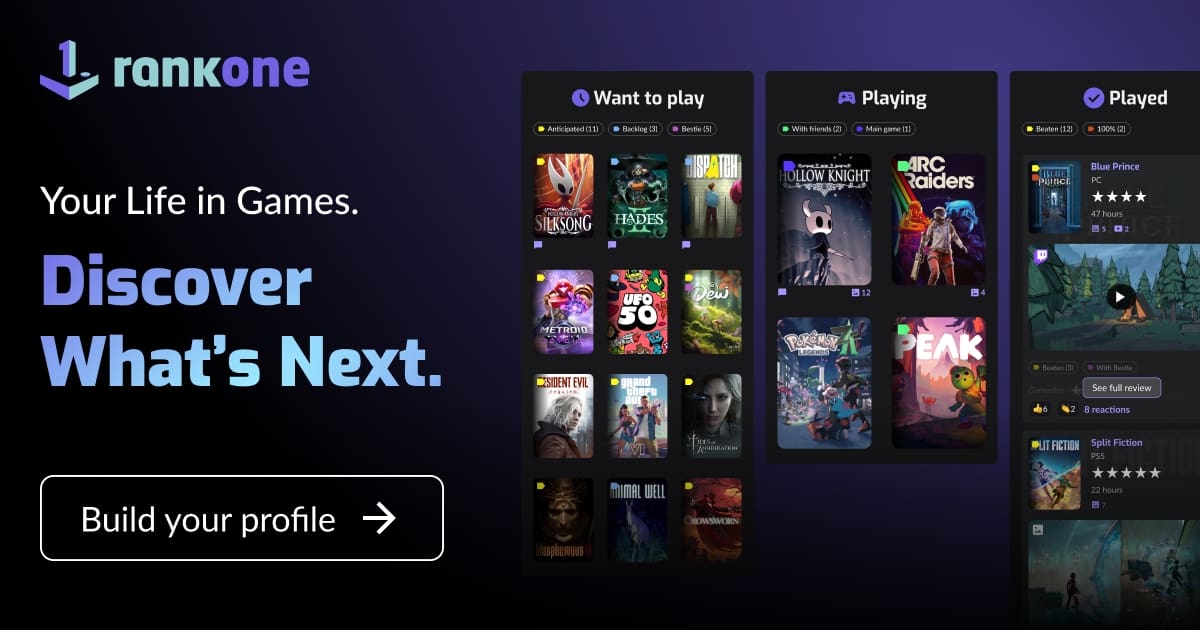
Join 100,000+ game enthusiasts. Build your profile on Rankone, organize your library and discover what to play next.

No paid content found
Visit website
Profile views 10 Outbound visits 8 Normal
Rankone Full homepage screenshot

At a glance

Category
Games & Board Games
Language
English
Paid-content signal
No paid content foundObserved
Registered
2018
Hosting
NetlifyInferred
HTTPS certificate trusted
PassedObserved
Last updated

Website review

This review may include AI-generated content and is not individually verified. Domain, certificate and other facts come from the observed data on this page.

What is Rankone?

Rankone is a game-tracking site where you build a profile, organize the games you own or play, and get suggestions for what to play next. It's aimed at people who play across multiple platforms and want one place to keep their library and activity instead of scattered notes or store wishlists.

What you'd actually use it for

  • Keeping a single catalog of your games, so you can see what you have before buying something twice.
  • Tracking what you're playing or have finished, which doubles as a personal history.
  • Getting discovery suggestions based on what's already in your library — useful when you're staring at a backlog and can't decide.
  • Having a profile you can share with friends, so recommendations come from people rather than store algorithms.

Who it suits

If you are… Rankone is…
Someone with games spread across several platforms and storefronts A reasonable fit — the point is consolidation
A backlog owner who wants a nudge on what to play next Useful, provided you keep the library current
A casual player with a handful of games Probably more upkeep than value
Someone wanting to buy or launch games Not that — it's a tracking and discovery layer, not a store

The trade-off is the usual one for tracking tools: the value comes entirely from your own data entry. A half-empty library produces weak suggestions and no useful overview, so it only pays off if logging games feels light enough that you'll actually do it.

Next step: before committing, add five games you're currently playing and see whether the "what next" suggestions feel relevant to your taste. If they do, expand the library; if not, the tracking alone may still be worth it, but don't expect the discovery side to carry it.

For a broader picture of your habits, Backloggd and HowLongToBeat cover similar ground with different emphases — worth a look if you want to compare before settling on one.

How do I build a game profile on Rankone?

Rankone is a game library and profile site: you build a profile by adding the games you own or play, then using that library to show what you're into and find what to play next. The page's own pitch is "organize your library and discover what to play next," aimed at game enthusiasts who want a shareable record of their playing rather than a storefront.

What building a profile involves

  • Create an account. A profile is tied to you, so sign-up comes first. The site claims 100,000+ members, which suggests a social layer — expect your profile to be visible to others.
  • Add games to your library. This is the core action. You search for titles and add them, which is what turns an empty profile into a useful one.
  • Shape how it reads. Ratings, statuses (owned, playing, finished) and any notes are what make a library informative rather than a bare list.
  • Fill in the profile itself. Display name, avatar and a short bio help other members recognise you and decide whether your taste overlaps with theirs.

A realistic first session

Pick 15–20 games you've actually finished or spent real time with, rather than dumping your entire backlog. A short, honest list is more useful for matching with other players than a 400-title catalogue nobody will read. Then add a line or two about what you're currently playing, so anyone landing on your profile has an obvious conversation starter.

Where the trade-offs sit

If you want… Rankone-style library profile A storefront profile (e.g. Steam)
A cross-platform record of what you play Fits, since you add titles yourself Tied mainly to purchases on that store
Automatic tracking Manual entry, so it needs upkeep Largely automatic
Discovery from other people's taste The main point Secondary to buying

If your games live across several consoles and stores, manual entry is the price of a single unified list. If you only play on one platform, its built-in profile may already do enough.

Next step

Decide what the profile is for before you start adding: a personal record, a way to find people to play with, or a discovery feed. That choice tells you how much detail to enter. If you want a second reference point for how library profiles and discovery work elsewhere, Backloggd is a comparable cataloguing site, and HowLongToBeat is useful for the time estimates that often shape what people pick next.

Can I organize my existing game library with Rankone?

Yes. Rankone is built around organizing a game library you already own, not just discovering new titles. Its stated focus is letting you "organize your library and discover what to play next," so the natural workflow is to add the games you already have, then use that collection to decide what to play.

What organizing looks like in practice

  • Build a profile around your collection. Your library lives on your profile, so it doubles as a shareable record of what you play.
  • Sort by what you actually care about. Typical uses are separating what you're currently playing from a backlog, or grouping by platform, genre or mood.
  • Use it as a decision tool. The point of a tidy library is a shorter path from "I have nothing to play" to picking something.

A concrete scenario

Say you own 80 games across a console and a PC storefront, and roughly 30 are unfinished. Add them all, tag the unfinished ones, and Rankone becomes a shortlist rather than a vague memory. Next time you have two free hours, you scan the backlog instead of scrolling a store.

Trade-off to weigh

Manual entry is the usual cost of a personal library tool. If your collection is large, expect an initial setup session; after that, maintenance is incremental. If you mainly want automatic syncing from one storefront, check whether that fits your setup before committing.

Next step

Start with one platform or one category rather than everything at once. Add your ten most-played games, then your five most-wanted-to-finish, and see whether the resulting view actually helps you choose. Rankone is at Rankone.

How does Rankone recommend what to play next?

Rankone presents recommendations as part of a personal game-tracking profile: you build a library, and the site suggests what to play next from there. The available page information confirms the library-and-discovery purpose but does not detail the recommendation method, so any specific algorithm claim would be guesswork.

What that means in practice: a library-based recommender usually works from signals such as what you've added, what you've finished or dropped, and how your taste overlaps with similar players. The trade-off is consistency versus surprise — tracking-based suggestions stay relevant but can narrow over time, while popularity-driven ones surface well-known titles you may already know.

For a reader deciding whether to invest time in it: add a realistic sample of your library first, including a few games you abandoned, since negative signals are often more informative than positive ones. Then judge the suggestions after a week rather than on day one.

A useful comparison of what different approaches tend to give you:

Recommendation basis Strength Weakness
Your tracked library Fits your actual history Needs enough entries to work
Similar players' libraries Finds titles outside your habits Can skew toward popular games
Editorial or curated lists Good for browsing and context Less personal

If you want a second opinion alongside it, Backloggd and How Long to Beat serve related needs — logging and time estimates — and can complement a library-based picker.

Is Rankone free to use?

Rankone presents itself as a free-to-join platform for tracking your game library and building a profile, so there is no cost implied for the core experience.

What "free" likely covers

Based on how the site describes itself, the free tier centers on:

  • Creating a profile and joining a community of game enthusiasts
  • Organizing and tracking your game library
  • Discovering what to play next

What to check before committing

Because the site doesn't spell out pricing details, confirm these on the platform itself:

  • Whether any premium tier, ads, or paid features exist
  • What data you share when building a profile
  • Whether library imports or third-party account connections are supported

A practical next step

If you mainly want a free way to log games and get recommendations, sign up and test the library tools first. You can explore Rankone directly to verify current features and any limits before investing time in building out your profile.

How does Rankone compare to other game tracking platforms?

Rankone is a game library tracker built around a profile and a "what to play next" recommendation flow, and it claims a community of 100,000+ enthusiasts. That places it in the same broad category as long-established trackers, but the emphasis differs: Rankone leads with discovery and profile-building, while the older platforms lead with exhaustive logging and data depth.

Because the site's page content loads dynamically, the details below stick to what its own description states; anything about specific features, pricing or integrations is general category advice rather than a confirmed Rankone capability.

How the main options differ

Platform Core strength Best for
Rankone Rankone Profile, library organisation, "play next" discovery Players who want a social profile and suggestions, not just a log
Backloggd Backloggd Clean diary-style logging, lists, reviews People who enjoy writing about and curating games
HowLongToBeat HowLongToBeat Completion-time data per playstyle Deciding whether a game fits your available time
Letterboxd Letterboxd Film, not games — (listed only to avoid confusion; it is not a game tracker)

Steam's own library Steam is the default for PC players because it tracks playtime automatically, but it only covers games you own there and gives you little room to rate, rank or discuss them.

What actually matters when choosing

  • Effort per entry. Automatic import from a store account suits large libraries; manual logging suits people who want ratings and notes on every title.
  • What you do with the data. If you want a shareable profile and recommendations, prioritise social and discovery features. If you want stats, completion history and lists, prioritise logging depth.
  • Platform coverage. Check that your consoles and stores are supported before committing, since retro and console-only titles are the usual gap.
  • Community size. A bigger user base means more reviews and lists to browse, but a smaller one can feel more focused.

A practical next step

Pick the two games you are most likely to play next, then try adding them to Rankone and to one alternative. If Rankone's discovery flow surfaces something useful in that five-minute test, it is worth building out your library there; if you find yourself wanting detailed playtime stats or long-form reviews instead, a logging-first tracker will serve you better. Many people run two: one store-linked tracker for automatic playtime, and one profile-based site like Rankone for discovery and discussion.

Related questions

More questions →
Is Rankone the right game library tracker for you?

Rankone is a game library tracker aimed at game enthusiasts who want one place to build a profile, organize their library, and figure out what to play next. It fits you if you already track games in scattered notes or storefront wishlists and want a single profile that also surfaces discovery. It is a weaker fit if you only need a private backlog list with no interest in a public-facing profile or in discovery features.

What Rankone is built to do

Based on the site's own description, Rankone positions itself around three connected jobs:

  • Build a profile — a personal page representing you as a game enthusiast, not just a list of titles.
  • Organize your library — keep your games in one structured place instead of spread across platforms.
  • Discover what to play next — use the library and profile as the basis for finding the next game.

The site also states that over 100,000 game enthusiasts have joined. Treat that as the site's own claim rather than an independently verified figure.

How it compares to tracking games manually

Dimension Rankone Manual tracking (notes, spreadsheets, storefront wishlists)
Where your games live One profile and library on Rankone Split across apps, each with its own purpose
Profile / identity Built in as a core feature None — a list is just a list
Discovery Part of the product's stated purpose You bring your own sources
Control over format Follows Rankone's structure Fully yours, any format you want
Setup effort Requires creating an account and entering your library Starts immediately, no signup

The trade-off is structure versus control. Rankone gives you a shared format and a discovery layer; manual tracking gives you total flexibility but no built-in way to surface what to play next.

How to tell whether it fits your habits

Work through these conditions rather than a general "is it good" judgment:

  • You want a profile, not just a list. If the idea of a public or shareable game identity appeals to you, Rankone's profile feature is the point. If it doesn't, that feature is dead weight.
  • You have games spread across multiple platforms. The more fragmented your library, the more a single organizing place is worth. If everything already lives in one storefront, the gain is smaller.
  • You struggle to pick the next game. Discovery is one of Rankone's stated purposes. If you never have trouble deciding, this matters less.
  • You're willing to invest setup time. Any library tracker only works once your games are in it. If you won't do that entry work, no tracker helps.

What the available information does not cover

The site description does not state pricing, account limits, import options from other services, or which platforms are supported. Those details affect the decision but are not established here, so check them directly on the site before committing. Do not assume the service is free or that it works without an account — neither is confirmed by the available material.

A practical way to decide

  1. List where your games are currently recorded (notes, spreadsheets, storefront libraries, memory).
  2. Ask whether a profile layer adds anything you actually want.
  3. If both answers point to "I want one organized place plus discovery," Rankone matches the stated purpose.
  4. If you mainly want a private, format-free backlog, manual tracking or a simpler list may serve you better.

The honest summary: Rankone is designed for enthusiasts who want their library and their gaming identity in the same place, with discovery attached. If that describes you, it's worth trying; if you only need a checklist, it's more structure than you asked for.

How to Build a Game Profile and Organize Your Library on Rankone

Rankone is a platform for game enthusiasts to build a profile, organize a personal game library, and discover what to play next. Based on the site's own description, you can join a community of 100,000+ game enthusiasts, create a profile, and manage your library in one place. The exact steps below reflect what the platform publicly states it offers; specific menu names and button locations may differ, so treat the flow as a general guide rather than a click-by-click map.

What Rankone Is Built For

Rankone positions itself around three connected activities:

  • Building a profile — a personal page that represents you as a player.
  • Organizing your library — a collection of the games you own, play, or want to play.
  • Discovering what to play next — using that library and profile to surface new options.

The site's tagline, "Your Life in Games | Track your library," makes the tracking function the core of the experience. Everything else — profile, discovery, community — builds on top of a well-maintained library.

Creating Your Profile

A profile is the anchor for everything else you do on Rankone. According to the site, you build a profile as part of joining the platform.

General flow

  1. Create an account on rankone.global. The site describes joining as the entry point for the 100,000+ member community.
  2. Set up your profile — this is your identity on the platform. Since the site frames the profile as something you "build," expect to add details that describe your gaming interests.
  3. Connect your library to the profile — the profile and library work together; the library is what gives the profile substance.

What to decide before you start

  • How public you want to be. The site describes profiles as part of a community experience, so assume some visibility to other players. Decide what you're comfortable sharing.
  • What "your games" means to you. Owned? Currently playing? Backlog? Wishlist? Deciding this upfront makes organizing much faster.

Adding and Organizing Games in Your Library

The library is the functional heart of Rankone. The site's description centers on organizing your library and tracking it over time.

A practical approach to organizing

Step Action Why it helps
1 Add games you own or play Creates the raw material for your library
2 Group them by status (playing, completed, backlog, wishlist) Turns a flat list into something actionable
3 Revisit and update statuses Keeps the library accurate as your habits change
4 Use the library to spot gaps or patterns Feeds directly into discovery

Common sticking points

  • Starting too big. Adding hundreds of games at once is discouraging. Start with what you're actively playing or thinking about.
  • Treating it as a one-time task. A library is only useful if it stays current. A quick update after finishing a game keeps it reliable.
  • Ignoring the "why." If you don't decide what the library is for (tracking? discovery? showing off?), organizing becomes aimless.

How Your Profile and Library Appear to Others

Rankone describes itself as a community of 100,000+ game enthusiasts, which implies that profiles and libraries are visible to other members in some form. The site does not detail exact privacy controls, so the safe assumption is that your profile represents you publicly within the platform.

This matters for two reasons:

  • Your library becomes a conversation starter. Other players can see what you play, which supports community interaction.
  • Your profile signals your taste. A well-organized library communicates more than a list of titles — it shows what you value, finish, and recommend.

If visibility is a concern, check the platform's settings directly rather than assuming a default.

How Organizing Your Library Helps You Discover New Games

This is where the pieces connect. The site explicitly frames the library as the basis for discovering "what to play next."

A maintained library gives the platform (and you) useful signals:

  • Patterns in what you finish point toward genres or styles worth exploring.
  • A backlog that never shrinks is a signal to either play it or let it go.
  • A wishlist becomes a shopping and discovery shortlist rather than a vague mental note.

In other words, the value of organizing isn't tidiness for its own sake — it's that a structured library makes recommendations and decisions easier.

Quick Checklist

  • [ ] Create an account on rankone.global
  • [ ] Build your profile with details that reflect your gaming interests
  • [ ] Add a starter set of games (active + backlog + wishlist)
  • [ ] Assign each game a status
  • [ ] Review and update the library regularly
  • [ ] Use the library to decide what to play next

What the Site Does Not Specify

Rankone's public description does not state pricing, account limits, or detailed privacy controls. It also does not list specific menu names or exact click paths. If any of these matter to your decision — for example, whether the service is free or how visible your profile is by default — verify them directly on the site before committing time to building out a large library.

How does Rankone help you discover what to play next?

Rankone approaches game discovery through your own library rather than a generic popularity chart. Based on the site's stated purpose — "organize your library and discover what to play next" — the platform is built so that the games you already track become the input for what it surfaces next. That makes it most useful if you're willing to build and maintain a profile; if you just want a quick top-10 list without logging anything, the discovery value depends entirely on what you put in.

What Rankone actually is

Rankone describes itself as a place to build a profile, organize a game library, and find out what to play next, aimed at game enthusiasts (the site cites a community of 100,000+). Two functions sit at the center:

  • Library tracking — recording the games you own, play, or care about.
  • Discovery — using that record to point you toward something new.

The two are linked by design: the library is the signal, and discovery is the output.

How the library feeds discovery

The mechanism is straightforward personalization. Instead of recommending from the whole catalog of games, Rankone works from the set you've already organized. The more complete and honest your library is, the more the "what to play next" suggestions reflect your actual taste rather than a broad average.

A practical example: if your library is heavy on long single-player RPGs and you've marked several as finished, the useful next suggestion is another narrative-driven title — not a competitive multiplayer shooter that happens to be trending. That kind of relevance only exists because you logged the RPGs in the first place.

Why this matters for decision fatigue

The stated goal — reducing the "what do I play next" problem — comes from narrowing options. A library-based system can cut a huge catalog down to a shortlist that fits what you've already shown you like, which is faster than scrolling storefronts or review sites.

What you need to do to get value from it

Step Action Expected result
1 Create a profile A place for your library and activity to live
2 Add games you own or play A starting signal for recommendations
3 Keep the library current (mark finished/playing) Suggestions stay aligned with your current taste
4 Use the discovery output A shortlist to choose from instead of a blank slate

The key dependency: discovery quality tracks library quality. A sparse or stale library produces weaker suggestions.

When Rankone fits — and when it doesn't

Good fit if:

  • You enjoy tracking what you play and want that record to do something useful.
  • You're a game enthusiast who wants personalized suggestions rather than generic charts.
  • You're willing to spend a little time building a profile.

Weaker fit if:

  • You don't want to log games and just want a one-off recommendation.
  • You expect discovery to work with zero input.

Common sticking points

  • Empty library, weak results. Discovery is downstream of tracking, so start by adding games.
  • Stale library, off-target suggestions. Update statuses as your habits change.
  • Expecting a storefront. Rankone is positioned around profile and library organization, not as a shop.

The site's own framing — build a profile, organize your library, discover what to play next — is the clearest statement of how the pieces connect. Treat the library as the input and discovery as the payoff.

What Is Rankone and What Can You Do on It?

Rankone is a game library tracking and profile platform for gamers. According to its own site description, it invites you to "build your profile on Rankone, organize your library and discover what to play next," and states that over 100,000 game enthusiasts have joined. If you want one place to record what you own or play, show it off through a profile, and get help deciding your next game, that is the problem Rankone is positioned to solve.

What Rankone Is

Rankone describes itself as a place to track your library and manage "your life in games." The core idea is a personal gaming profile tied to a collection of games you record. Rather than a storefront or a review site, it is framed around your own library and activity.

The site's stated scope covers three things:

  • Profile building — a personal presence for your gaming identity
  • Library organization — keeping your games in one tracked place
  • Discovery — figuring out what to play next

What You Can Do on Rankone

Based on the site's own description, the main actions are:

Build your profile

You create a profile that represents you as a gamer. This is the anchor of the platform — your library and activity sit around it.

Organize your library

You add and arrange the games you want to track. The point is to have your collection organized in one place instead of scattered across storefronts, notes, or memory.

Discover what to play next

Rankone explicitly frames itself as helping you "discover what to play next." This is the discovery side of the platform, aimed at the common problem of owning plenty of games but not knowing which to start.

Join a gamer community

The site cites a community of 100,000+ game enthusiasts. Being part of that group is part of the pitch — your profile and library exist alongside other players rather than in isolation.

Who It's For

Rankone fits you if:

  • You play across multiple platforms or stores and want one place to track everything
  • You like the idea of a public or shareable gaming profile
  • You often stall on choosing your next game and want discovery help
  • You want to be part of a gaming community rather than track games alone

It is less relevant if you only want a store to buy games, or if you have no interest in maintaining a profile or library.

What to Check Before Signing Up

The available site information does not specify pricing, account limits, or which platforms and stores can be connected. Before committing, confirm on the site itself:

  • Whether creating an account is free or paid
  • Which platforms, stores, or services your library can pull from or link to
  • What your profile shows publicly versus privately
  • Whether library import is manual or automatic

The Short Version

Rankone is a game tracking and profile platform: you build a gamer profile, organize your game library, and use it to decide what to play next, alongside a community of 100,000+ enthusiasts. It is worth trying if you want your games organized in one place and help choosing the next one — just verify pricing, platform support, and privacy settings on the site first.

Website Overview

An established domain and managed infrastructure suggest continuity of operations and may support dependable delivery, although neither guarantees service quality. Several search or sharing settings need attention. Together they may make snippets, preview images or preferred URLs less consistent across platforms.

Domain and Registration

Registered in 2018, this domain has about 8 years of history. That suggests continuity, although ownership and purpose may have changed. Transfer-protection status is present, helping reduce the risk of unauthorized domain transfers. The domain uses the common .global extension, which is not an independent safety signal.

DNS and Email

Nameservers are provided by NS1, indicating managed DNS hosting. MX records point to the Google Workspace email service. No CNAME was found; the observed records resolve directly to addresses. SPF and DMARC are configured. DKIM status is unknown. TXT records include verification markers for Google. Such markers may also remain after a service stops being used.

TLS and Certificates

The public key uses EC with 256 bits. The server supplied a complete certificate chain. No organization name is present in the certificate; the available fields are consistent with domain validation. The certificate was issued by Let's Encrypt, commonly associated with automated certificate services. The certificate's total validity is about 89 days, consistent with a short renewal cycle.

HTTP and Browser Security

The response lacks these common security headers: CSP, X-Content-Type-Options, Referrer-Policy, Permissions-Policy, clickjacking protection. No X-Powered-By header was found, reducing one common source of backend fingerprinting information. No obvious internal addresses or debug information were found in the headers. The Server header contains the custom value Netlify. No explicit CDN or WAF marker was found in the response headers.

Technology Stack Analysis

The public page identifies Netlify without precise versions, leaving fewer clues for version-specific scanning.

Search and Social Sharing

No homepage meta description was detected, leaving snippet selection more dependent on page text. No homepage canonical URL was detected. If duplicate URLs exist, consolidation may be less explicit. Twitter Card metadata is configured. The title has 49 characters, within a common display range. The observed directives allow indexing and link following.

Hosting and Email

DNSNS1
HostingNetlify
EmailGoogle Workspace
Approximate IP geolocation (inferred; a CDN or proxy may differ from the origin server) United States flagAshburn, Virginia, United States Inferred 18.208.88.157

Registration details

RDAP / WHOIS

RegistrarName SRS AB
Registered2018-07-23
Expires2027-07-23
Domain statusclient transfer prohibited
Nameserversdns1.p02.nsone.net、dns2.p02.nsone.net、dns3.p02.nsone.net、dns4.p02.nsone.net
DNSSECunsigned

DNS records

DNS

TypeNameValueTTLPriority
Awww.rankone.global18.208.88.157120—
Awww.rankone.global98.84.224.111120—
MXrankone.globalaspmx.l.google.com18001
MXrankone.globalalt1.aspmx.l.google.com18005
MXrankone.globalalt2.aspmx.l.google.com18005
MXrankone.globalalt3.aspmx.l.google.com180010
MXrankone.globalalt4.aspmx.l.google.com180010
NSrankone.globaldns1.p02.nsone.net3600—
NSrankone.globaldns2.p02.nsone.net3600—
NSrankone.globaldns3.p02.nsone.net3600—
NSrankone.globaldns4.p02.nsone.net3600—
TXTrankone.globalgoogle-site-verification=HPWYXyYHVmD8UdymukBQALk2pUKnBTqzm6z8EgKMWYM300—
TXTrankone.globalgoogle-site-verification=uQpbusoG3DGM4gKfcCzWVRsOTaQeaZpOtJZZOfJ2UsY300—
TXTrankone.globalv=spf1 include:servers.mcsv.net include:_spf.createsend.com ~all300—
DMARC_dmarc.rankone.globalv=DMARC1; p=none;3600—

TLS and certificates

TLS / SSL

AssessmentNormal configuration
Supported protocolsTLSv1.2、TLSv1.3
Negotiated protocolTLSv1.3
Certificate subject*.rankone.global
IssuerLet's Encrypt
Valid until2026-11-24T16:56 · Remaining when checked: 50 days
Verification detailsCertificate trust: Passed · Hostname match: Passed

HTTP response headers

HTTP

HeaderValue
content-typetext/html; charset=UTF-8
cache-controlpublic,max-age=0,must-revalidate
serverNetlify
strict-transport-securitymax-age=31536000

Identified technologies

Netlify

Pages, Search and Sharing

Meta descriptionNot detected
Canonical URLNot detected
LanguageEnglish (default)
Twitter Cardsummary_large_image

No rules found

User reviews (0)

  • No reviews yet.