
 简体中文
 English
Website review
This review may include AI-generated content and is not individually verified. Domain, certificate and other facts come from the observed data on this page.
What is The Satyrs’ Forest?
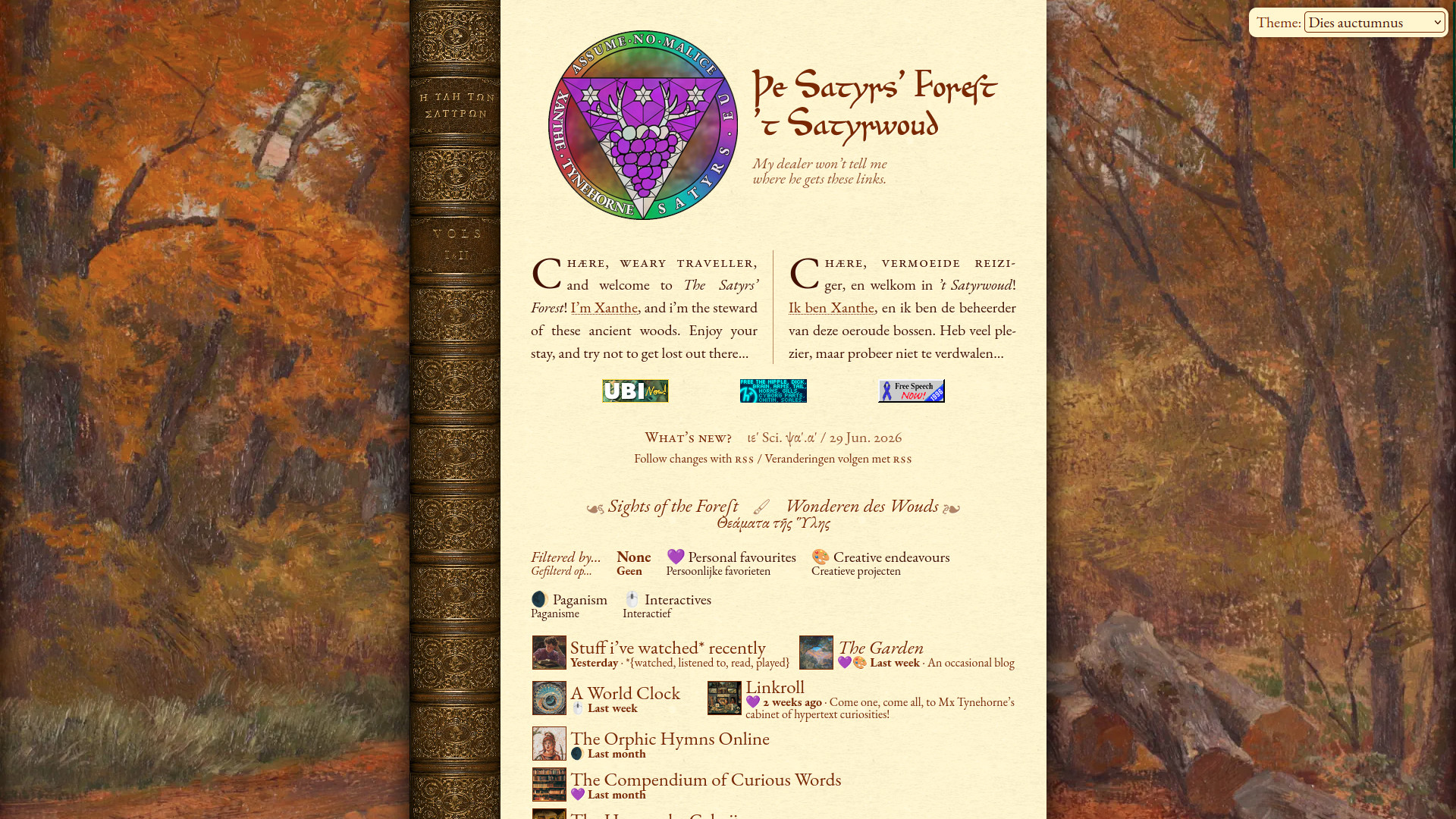
The Satyrs’ Forest is a long-running personal website, not a commercial product. Its steward signs herself Xanthe and greets visitors as “weary traveller” in a forest metaphor that runs through the whole site; the heading appears in English, Dutch (“’t Satyrwoud”) and Greek, and that trilingual habit recurs in section labels. Content is a mix of essays, creative projects, interactive toys, link collections and personal logs — favourites, quotes, music lists, a constructed language, a coat of arms, annual awards and a Saturnalia tradition. Sections named in the page evidence include “Sights of the Forest”, “Typesetting”, “Copyrightn’t” and “Afterword”.
Who it suits
- Readers who enjoy hand-built, opinionated personal sites rather than feeds or platforms.
- People interested in typography and typesetting, paganism, conlangs, web interactives and hypertext curiosities.
- Anyone who wants a browsable archive: dated entries, an RSS feed for changes, and category filters such as personal favourites, creative endeavours, paganism and interactives.
What to expect
The tone is playful and antiquarian, with in-jokes, multilingual headings and a strong authorial voice. There is no pricing model in evidence, and the site’s own “Copyrightn’t” section and public domain declaration indicate a deliberately permissive stance rather than a shop or subscription. Navigation rewards wandering: a “Linkroll” and long chronological index sit alongside themed pages, so the easiest entry point is the “What’s new” list or the category filters rather than a search box.
A practical first visit
Start with the newest entries to gauge whether the voice appeals, then jump to one themed area that matches your interests — typesetting if you care about text craft, the interactive pages if you want something to play with. If you like it, follow the RSS feed instead of checking back manually, since updates are irregular and dated. For comparison, other independent personal web projects include Neocities, and a long-standing example of the same spirit is tilde.club.
What personal projects and creative works are showcased on The Satyrs’ Forest?
The Satyrs’ Forest is a personal site where Xanthe presents an unusually wide range of creative and intellectual projects, mostly as writing, lists, interactive pieces and collections rather than as a conventional portfolio. Its centre of gravity is personal taste: favourites, enthusiasms, rituals and long-running records.
What is actually showcased
- Personal favourites and curated collections — sections such as “My favourite films”, “My favourite works of art”, “My music collection” and “The Panpipes” gather works Xanthe returns to, with commentary rather than neutral listings.
- Creative projects — “The Otter’s Holt”, “The Garden”, “The Crew of the Ardhanarishvara” and “My coat of arms” sit under creative endeavours, suggesting fiction, worldbuilding, drawing or related making.
- Interactive pieces — “A World Clock”, “The Matrix of Power” and “The Cartothèque” are presented as things to use or explore, not just read.
- Pagan and religious material — “The Orphic Hymns Online”, “The Cult of Phanes” and a calendrical table fall under paganism, mixing devotion, calendar work and classical reception.
- Language and wordplay — “Są̂qʌk” is a constructed language, while “The Compendium of Curious Words” and “One loan word per language” show a sustained interest in vocabulary and translation.
- Annual rituals and records — “Lords of Misrule” is described as an annual Saturnalia tradition, alongside yearly favourites, predictions, dream logs and award-style round-ups.
- Essays and opinion — “In my opinion”, “Looking at the Big Sky”, “How i rate films” and “The Hoorn Manual of Style” are argumentative or explanatory writing rather than project logs.
- Site culture and meta-writing — “About comments on this site”, “About the author”, “Copypastables” and a public domain declaration show that the site itself, its etiquette and its copyright stance are treated as creative material.
Who it is for
The likely reader is someone who enjoys browsing a densely linked personal webstead: a fan of hypertext, obscure words, paganism, furry creative work, film and music lists, and handmade interactive toys. It rewards curiosity and wandering more than targeted research. A reader looking for a single polished product, a professional portfolio or a straightforward blog will find the range scattered; someone who likes indexes, marginalia and recurring annual traditions will find plenty to follow.
A practical next step
Start with the “What’s new” list and follow whichever entry matches your interest, then use the filters for personal favourites and creative projects to see the site’s own sense of its best work. If you want a single representative example, “The Otter’s Holt” and “The Garden” are flagged as both personal favourites and creative endeavours, making them a fair introduction to what Xanthe actually makes.
How can I follow updates and new content on The Satyrs’ Forest?
The site publishes an RSS feed, so a feed reader is the most reliable way to catch every new page, post and list update. Add the feed address shown on the homepage (it appears next to the “Follow changes with RSS / Veranderingen volgen met RSS” line) to a reader such as Feedly or a desktop client, and new entries will arrive without you revisiting the homepage.
For occasional browsing rather than completionism, the homepage does the work for you: the “What’s new?” block is a reverse-chronological list with dates, and each item carries tags such as 💜️ Personal favourites, 🎨️ Creative endeavours, 🌒️ Paganism and 🖱️ Interactives. Those tags are also filter buttons, so you can narrow the list to one interest instead of reading everything.
Choosing between the two
| Approach | Best for | Trade-off |
|---|---|---|
| RSS feed | Never missing an update; reading in one place with other sites | Needs a reader; no tag filtering unless your reader supports it |
| Homepage “What’s new?” list | Seeing the site as its steward arranged it, with tags and dates | You must remember to check back; the list grows long over time |
A practical next step: if you only care about one thread of the site, start by clicking the relevant tag on the homepage — for instance 🌒️ Paganism for the Orphic Hymns and calendrical material, or 🎨️ Creative endeavours for constructed languages and art pages — then subscribe to the feed for everything else. If you want to follow a single long-running item, note that individual pages such as the dream log or annual awards are updated in place, so a feed reader that flags updated entries serves you better than one that only shows brand-new ones.
What resources does The Satyrs’ Forest offer for constructed languages and word curiosities?
The Satyrs’ Forest hosts a small, personal collection of conlang and word-interest pages rather than a systematic reference library. The relevant entries are scattered through the site's log of updates, so treat it as a browsable cabinet of curiosities: you follow a link because the description intrigues you, not because you are searching a catalogue.
What is actually there
- Są̂qʌk — described as a constructed language. This is the site's main conlang project, presumably with its own grammar, vocabulary or script notes on its page.
- The Compendium of Curious Words — a collection of odd or notable words, the closest thing here to a word-curiosity resource.
- One loan word per language — a recurring or list-style piece on loanwords across languages.
- The Hoorn Manual of Style — a style guide, useful if you care about the site's own editorial conventions rather than language learning.
- The Cult of Phanes and The Orphic Hymns Online — filed under paganism, but relevant if your interest in old languages runs toward Greek and Orphic material.
The site is trilingual in presentation (English, Dutch and Greek appear side by side), and it publishes a public domain declaration, so material can be reused freely.
How to use it
If you are building a conlang, Są̂qʌk is the page to read first for a worked example of someone else's design choices. If you want lexical oddities for naming, worldbuilding or a writing project, the Compendium of Curious Words and the loanword piece are the quicker payoffs.
For serious conlang work, this site is a starting point, not a substitute for dedicated communities and reference works. Compare it with the Language Creation Society at Language Creation Society for community and conference material, the Conlang Wiki at Conlang Wiki for shared grammar and vocabulary documentation, and Omniglot at Omniglot for scripts and writing systems. Wiktionary at Wiktionary is the practical companion for checking etymologies and loanword claims.
A reasonable next step: open Są̂qʌk and the Compendium together, and note which of the two you actually finish reading. That tells you whether your interest is in constructing a language or in collecting words — they lead to quite different resources.
What is the copyright and public domain policy for content on The Satyrs’ Forest?
The Satyrs’ Forest takes an explicitly anti-copyright stance. The site’s own section heading is “Copyrightn’t 🧠︎ Auteursrechtn’t Πνευματικὴ ἀνιδιοκτησία” — a playful trilingual negation of copyright — and its index lists a “Public domain declaration” dated February with the line “No rights reserved.”
What that means in practice
- No rights reserved: The steward, Xanthe, signals that content is released for reuse rather than held under an all-rights-reserved default.
- Public domain declaration: A dedicated declaration page exists, so that document is the authoritative statement rather than the site-wide tone.
- Scope is not spelled out in the index: Whether the declaration covers all writing, artwork, music, code and third-party quotations is not clear from the listing alone.
The trade-off to watch
A blanket public domain gesture is generous and frictionless for reusers — you can quote, remix or republish without asking. The risk runs the other way: third-party material (quoted lyrics, guest posts, linked artworks) may still carry its own terms, and a personal declaration cannot release someone else’s rights. If you plan to reuse something beyond a short quotation, check the declaration page and, for anything credited to a guest or external source, treat that item separately.
Your next step: open the “Public domain declaration” entry on the site and read its exact wording before reusing anything. If you only need to cite or link, no permission question arises at all.
What pagan and mythological content can I explore on The Satyrs’ Forest?
The Satyrs’ Forest collects pagan and mythological material as part of a wider personal site, so you can read it as a small curated library rather than a formal reference work. Its pagan-flagged items sit alongside creative projects, interactive toys and blog posts, which means you often get a personal voice and modern commentary rather than neutral encyclopaedia entries.
What is there to explore
- The Orphic Hymns Online — a pagan-tagged resource devoted to the Orphic hymn tradition, useful if you already know the corpus and want an online reading space for it.
- The Cult of Phanes — a pagan and creative piece centred on Phanes, the Orphic primordial deity, so expect a personal devotional or artistic treatment rather than a dry summary.
- A calendrical table — a pagan-tagged table, handy as a practical reference if you follow seasonal or festival dates.
- Lords of Misrule — described as an annual Saturnalia tradition, which places it in the Roman midwinter festival orbit and shows how the site’s pagan interests are lived rather than only written about.
- The Compendium of Curious Words — not pagan itself, but useful for the archaic and specialist vocabulary that turns up in hymn translations and myth retellings.
The site’s trilingual habit (English, Dutch and Greek) is worth knowing before you start: headings and some text appear in all three, which suits readers comfortable with Greek terms but can slow down anyone who only reads English. The “What’s new” list also shows that pagan entries are updated sporadically, mixed in with film lists, music and furry creative work, so browsing by the pagan filter is more efficient than reading chronologically.
If your interest is specifically Hellenic or Orphic, begin with the Orphic Hymns and Phanes pages and treat the calendrical table as your practical companion. If your interest is broader modern paganism, the Saturnalia material gives you a concrete example of how one practitioner marks a festival. For a wider classical reference shelf to read alongside it, Theoi Greek Mythology covers gods, hymns and source texts in more systematic depth.
 Gateshead, United Kingdom
User reviews (0)