Website profiles · Technology insights · Alternatives

snowpixel.app

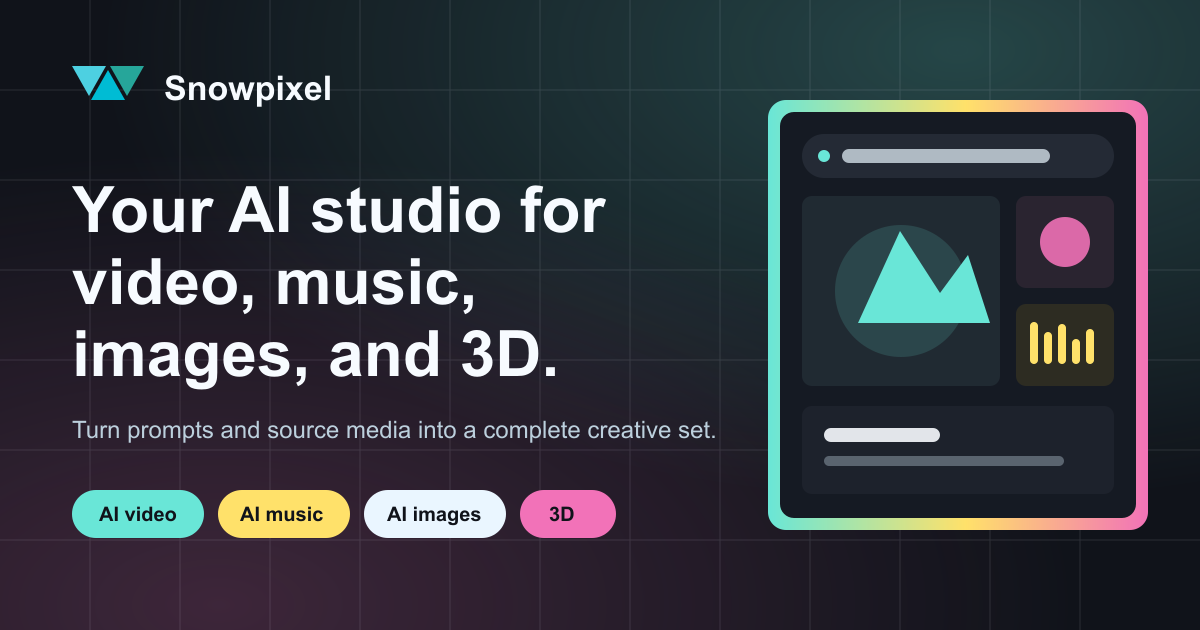
Generate AI videos, music, sound effects, images, and 3D objects in one creative studio. Turn prompts and source media into creative concepts with Snowpixel.

No paid content found
Visit website
Profile views 2 Outbound visits 0 Normal
Snowpixel Full homepage screenshot

At a glance

Category
Music & Audio
Language
English
Paid-content signal
No paid content foundObserved
Registered
2021
Hosting
CloudflareInferred
HTTPS certificate trusted
PassedObserved
Last updated

Website review

This review may include AI-generated content and is not individually verified. Domain, certificate and other facts come from the observed data on this page.

What is Snowpixel?

Snowpixel is a browser-based AI creative studio that generates several kinds of media from one prompt or source image. Rather than jumping between separate tools for video, audio, stills, and objects, you work in a single workspace where the outputs stay connected to the same creative context. The site describes it as covering text-to-video, image-to-video, AI music and sound effects, AI images, and text-to-3D objects.

What you can make

  • Video: Animated shots from text prompts or a source image, aimed at shorts, social cuts, concept trailers, and campaign sequences.
  • Music and sound effects: Loops, textures, and effects matched to the pacing and mood of a scene.
  • Images: Art direction, character frames, product scenes, and campaign stills, useful before committing to motion.
  • 3D objects: Object references and turntable previews for prototypes, game assets, pitch decks, and visual planning.

How the workflow runs

The site frames it as four steps: write the scene (a prompt, source image, or rough idea), generate a set of video, image, audio, and 3D directions from that shared context, compare versions while refining mood and detail, then export what fits the brief. The pitch is continuity — the still, soundtrack, and object reference stay tied to the same idea instead of drifting apart across tools.

Who it suits, and the trade-off

A solo creator or small team producing a campaign concept, a prototype, or a social post set is the clearest fit: you can hold one visual mood and pull a clip, a still, an audio bed, and a 3D reference from it. The trade-off is depth. A studio that already relies on a dedicated video editor or 3D pipeline may find a single multi-format generator convenient for exploration but less precise for final production work.

Access runs on credits rather than a subscription, so you can start small for a quick test or buy a larger pack when a project needs more iteration.

Next step

Pick one idea you already have a reference image for and run it through video, a still, and an audio bed to see whether the outputs feel like one coherent set. If they do, that continuity is the reason to use Snowpixel; if you only need one format, a specialist tool will usually go deeper. For broader comparisons, Runway and OpenAI cover adjacent ground.

How do the credit packs work instead of a subscription?

Snowpixel uses a pay-as-you-go model: you buy a pack of credits when you want to generate, and spend those credits on the media you create. There is no recurring subscription, so cost follows your actual use rather than a monthly billing cycle. The page frames this as "start with credits, not a subscription," with two named tiers — Starter and Creator — described as differing mainly in how much generation room they give you.

What the credit model changes in practice

  • No idle cost. If you go a month without a project, you are not paying for access you did not use.
  • Budgeting is per-project, not per-month. A one-off social post and a multi-asset campaign are funded from the same wallet, so you decide pack size based on the job in front of you.
  • Iteration has a visible price. Every video run, image variant, audio bed and 3D study draws down credits, which makes "four variants" style exploration a deliberate spend rather than an unlimited default.

How the two packs are positioned

Pack Stated purpose Fits
Starter Explore a concept, test prompt directions, produce a first asset set A single experiment or a small deliverable
Creator Build a fuller launch set with room for multiple media runs, comparisons and refinements Campaigns where you expect several rounds of revision

The page lists Starter at $10 and Creator at $50, and describes Creator as the most useful option. Treat those as the vendor's own published positioning rather than a guarantee about how far each pack stretches — the number of outputs you get per credit is not stated on the page.

A concrete way to decide

Suppose you are a solo designer pitching a product concept. You want one hero video, a few stills, a matching audio loop and a 3D reference for the deck. That is four media types in one pass, plus likely a second round after feedback. If your first attempt is close, a Starter pack may cover the experiment; if you expect to compare multiple video directions and re-render audio to match pacing, Creator is the more realistic starting point.

Next step

Run your smallest useful test first: generate one video, one still and one audio bed from the same prompt context, and note how many credits that consumed. That ratio — not the headline pack price — tells you which pack matches your normal working rhythm. If your usage turns out to be steady and heavy, the trade-off of prepaid packs is that you keep topping up; if it is spiky, the model favours you.

Can I generate multiple types of media from a single prompt?

Yes. Snowpixel is built around exactly that workflow: one prompt or source image can produce video, images, music or sound effects, and 3D references inside the same workspace, rather than making you move the idea between separate tools.

What "one prompt, several outputs" looks like

The page's own example starts with a portrait prompt and ends with a media set: a short video loop, still direction with multiple variants, an audio bed generated from the visual mood, and a 3D reference. So the single prompt acts as a shared creative brief, and each output type interprets it differently.

Output type Typical use What you supply
Video Shorts, social cuts, concept trailers Text prompt or a source image
Image Art direction, character frames, product scenes Text prompt
Music and sound effects Loops and textures matching a scene's pacing Prompt describing mood or pacing
3D object Prototypes, game assets, pitch decks Prompt, with turntable-style previews

Where this helps and where it doesn't

The real advantage is consistency. Keeping the shot, still, soundtrack, and object reference tied to one context makes it easier to develop a campaign or prototype without losing the thread between them. The trade-off is that a single prompt rarely gives you a finished asset in every medium at once — expect to compare versions and refine mood, pacing, and detail before exporting.

If you want to test this cheaply, start with a narrow brief: one subject, one mood, one intended use. Generate the image set first, since it is the fastest way to judge whether the prompt is landing, then reuse that same wording for video and audio. Snowpixel's page frames entry as credit packs rather than a subscription, so a small pack suits a first experiment and a larger one suits a multi-media launch set.

What can I create with the AI video generator?

You can generate short animated clips from either a text prompt or a source image, and pair them with stills, audio and 3D references produced in the same workspace.

What the video side covers

Snowpixel describes its video generator as turning text or a source image into animated shots. The examples on the page point to practical formats rather than feature films: shorts, social cuts, concept trailers and campaign sequences. A "portrait motion study" is shown as a 16-second loop, which is a useful signal for the kind of output to expect — motion studies and short loops, not long-form edits.

Where it fits in a wider workflow

The reason to use it here rather than a dedicated video tool is continuity. The same creative context can produce:

  • Video — animated shots from a prompt or an existing image
  • Images — art direction, character frames, product scenes and campaign stills
  • Music and sound effects — loops, textures and effects matched to the pacing and mood of the scene
  • 3D — object references and turntable previews for prototypes, game assets and pitch decks

For a reader scenario: if you are pitching a product launch, you could generate a short motion clip, a set of campaign stills, an audio bed keyed to the visual mood, and a 3D object reference for the product, then compare versions side by side before exporting.

Decision criteria

Choose this approach when your project needs several media types that must feel like they belong together. Choose a single-purpose video tool when you need precise timeline editing, long runtime, or shot-level control — the page describes four steps (write the scene, generate the set, compare versions, ship the asset), with access starting from credit packs rather than a subscription, so a small experiment is the sensible first test.

If you want to compare the video-specific end of the market, Runway and OpenAI are established names worth checking against your brief.

How do I turn a source image into a video or 3D object?

Use Snowpixel’s image-to-video or 3D tools: upload your source image, then choose the output type and generation settings before running the model. Snowpixel is built as one AI studio for video, music, images, and 3D, so you can start from the same still and produce both an animated shot and a 3D reference instead of switching between separate tools.

A practical workflow

  1. Pick the output type. Choose image-to-video to animate the still, or the 3D object generator to turn it into a 3D reference or turntable preview.
  2. Upload the source image. Use the clearest version you have. A clean subject, simple background, and visible lighting usually give the model more to work with.
  3. Add a prompt for motion or form. For video, describe the movement you want, such as a slow camera push, drifting petals, or a character turning. For 3D, describe the object and the angle you need.
  4. Generate a set of versions. Snowpixel’s own four-step flow suggests producing several directions from the same creative context, then comparing them side by side.
  5. Refine and export. Keep the strongest output, adjust the prompt or settings, and export what fits your brief.

Which one to choose

Goal Better starting tool Why
Animate a still for a short or social cut Image-to-video Preserves the composition of your source image while adding motion
Create an object reference or turntable preview 3D object generator Produces a form you can inspect from different angles
Explore both from one image Both, in the same studio Keeps the shot and object reference connected in one workspace

What to watch for

Image-to-video works best when the source image already has a clear subject and a plausible sense of depth; flat, busy, or low-resolution images tend to produce wobble or unclear motion. For 3D, a single front-facing view may not be enough for a clean object, so generate several angles and compare them.

As a next step, run one small test before committing to a full set: upload your image, generate a short video and a 3D preview from the same source, and compare which output is closer to your intended use. Snowpixel’s credit-pack model, starting with a small pack, suits this kind of low-risk test. For broader context on AI media tools, see Runway and Luma AI.

Is Snowpixel suitable for professional campaign or prototype work?

Yes, with a caveat: Snowpixel is a reasonable fit for early-stage campaign concepts and prototype visuals, but it is better understood as a fast ideation studio than as a final-asset production pipeline. Its main advantage is consolidation — video, images, music and sound effects, and 3D object references all come out of one workspace, so a single creative context can feed several deliverables instead of being rebuilt in four separate tools.

Where it fits well

  • Campaign concepting. You can generate a set of stills for art direction, a short animated shot or two, a mood-matched audio bed, and a 3D reference for a hero product — all from the same brief. That is genuinely useful when pitching a direction before budget is committed.
  • Prototype and pitch visuals. Text-to-3D and turntable-style object previews are handy for game assets, product mockups, pitch decks, and visual planning where you need something concrete to react to, not a production-ready model.
  • Social and short-form cuts. Text-to-video and image-to-video cover shorts, campaign sequences, and concept trailers where 16-second loops and variant comparison are enough.
  • Multi-version comparison. The stated workflow keeps several versions visible while you refine mood, pacing, and detail, which suits the "show three options to the client" rhythm of agency work.

Where it is weaker

  • Finished broadcast or print output. Nothing in the page evidence suggests resolution, licensing, or delivery specs that would satisfy a formal production pipeline. Treat outputs as comps and references unless you verify otherwise.
  • Long-form or tightly brand-locked assets. Consistency across many shots and strict brand guidelines usually need a human finishing pass in dedicated editing, 3D, or audio software.
  • Team and client workflows. There is no evidence of review, approval, or asset-management features, so collaboration likely happens outside the tool.

Practical decision criteria

Your situation Reasonable choice
Pitching a direction, need many options fast Good fit
Building a mood board plus motion test plus audio Good fit
Final ad deliverable for paid media Use as a starting point, finish elsewhere
Multi-person team with approval steps Expect to manage that outside the tool
One-off experiment, low commitment Start with the smallest credit pack

A concrete next step

Pick one real brief you already have — a single product launch — and run it end to end inside Snowpixel: one prompt, then a still set, a short video, an audio bed, and one 3D reference. Judge the output on whether the four pieces feel like they belong to the same idea. If they do, the consolidation is worth it; if you still end up rebuilding each asset elsewhere, the advantage disappears.

For comparison, dedicated tools remain stronger per medium — Runway for video, ElevenLabs for audio, Midjourney for stills — so the trade-off is breadth and shared context versus depth in any one format.

Related questions

More questions →
When should you use Snowpixel instead of separate AI video, music, image, and 3D tools?

Use Snowpixel when one idea needs to exist as several media types at once — a shot, a still, a soundtrack, and a 3D reference — and you want them generated from the same creative context instead of rebuilt in four different tools. Stay with separate single-purpose tools if you only ever need one output type, or if you already have a pipeline where each medium is handled by a specialist and consistency between them doesn't matter.

The core difference: one context, multiple outputs

Snowpixel describes itself as "one AI media generator for every part of your idea." The studio covers four output types from a shared starting point:

Output What it produces Typical use
AI video Animated shots from text or a source image Shorts, social cuts, concept trailers, campaign sequences
AI music & sound effects Loops, textures, sound effects matched to pacing and mood Audio beds under a scene
AI image Art direction, character frames, product scenes, campaign stills Exploring direction before committing to motion
AI 3D object Object references and turntable previews Prototypes, game assets, pitch decks, visual planning

The point isn't that each generator beats a dedicated tool at its own specialty. The point is that the video, stills, audio, and 3D reference stay connected as you develop a campaign, prototype, social post, or creative experiment — rather than being stitched together after the fact.

When the single-studio approach pays off

You need style and mood to hold across media

A campaign still and its accompanying audio bed should feel like they belong to the same idea. Snowpixel's own example shows this in miniature: a "cinematic character portrait, soft light, natural expression" prompt produces a portrait, a 16-second motion loop, four still direction variants, and an audio bed "generated from the visual mood." If you were using four separate tools, you'd be re-describing that mood each time and hoping the results converge.

You want to compare directions fast

The workflow is built around producing a set and comparing versions: write the scene, generate video/image/audio/3D directions from the same context, keep the strongest outputs visible while refining mood, pacing, and detail, then export what fits the brief. When the brief is still loose — a launch film, a prototype concept, a social experiment — generating several media directions at once tells you faster whether the idea works than perfecting one medium first.

The project spans more than one deliverable

Snowpixel's example output is described as a "media set ready: video, stills, audio, 3D reference." That framing fits projects where the deliverable is naturally multi-format: a product launch, a pitch deck, a game asset package, a social campaign. One creative context, several assets.

When separate tools are the better call

  • You only need one medium. If the job is a single image or a single music loop, a dedicated tool gives you depth in that one area without pulling in a multi-media workspace.
  • You already have a specialist pipeline. If your team has an established video editor, a sound designer, and a 3D artist working in their own tools, adding a unified generator may create a parallel workflow rather than replace one.
  • You need tight control in one discipline. Deep, parameter-level control in a single medium is usually the strength of a focused tool; a multi-media studio trades some of that for breadth and consistency.

How to decide in practice

Ask one question: does this project need more than one kind of media to feel finished?

If yes — a campaign that needs motion, stills, and sound; a prototype that needs a 3D reference and a preview clip — the value of keeping them in one context is real, and Snowpixel is designed for exactly that. If no, a single-purpose tool is simpler.

Getting started and what it costs

Snowpixel's entry point is credits rather than a subscription: you choose a credit pack when you're ready to generate, and you can start small for a quick experiment or size up for a project that needs more iteration. The site lists a Starter pack at $10 for exploring a concept or making a first asset set, and a Creator pack at $50 (marked "Most useful") for a fuller launch set with room for multiple media runs, comparisons, and refinements. Check the current pricing page before buying, since pack contents and credit amounts aren't specified in the material available here.

A practical first test: pick one real idea you're working on, generate a video direction, a still, and an audio bed from the same prompt, and see whether the results feel like one project. That tells you more about fit than any feature list.

How Does AI Audio Transcription Work and What Affects Its Accuracy?

AI audio transcription converts speech into text by combining signal processing with machine learning models trained on huge amounts of paired audio and text. In practice, the pipeline runs through several stages: audio preprocessing, acoustic and language modeling, punctuation and formatting, and—if enabled—speaker diarization and summarization. Accuracy is not a single fixed number; it depends on recording quality, accents, background noise, overlapping speech, vocabulary, and how well the chosen language is supported. This article explains each stage and the practical factors that move accuracy up or down, so you can judge when automated transcription is enough and when human review still matters.

The core pipeline: from sound wave to readable text

1. Audio preprocessing

Before any speech recognition happens, the file is normalized and cleaned up. Typical steps include:

  • Resampling to a consistent sample rate (commonly 16 kHz for speech models).
  • Channel handling: mono conversion or selecting the dominant channel when stereo tracks differ.
  • Noise reduction and gain normalization to bring quiet speakers up and steady loud peaks.
  • Voice activity detection (VAD) to find where speech actually occurs and skip silence.

Good preprocessing improves everything downstream. A clean, consistent input gives the model less to compensate for.

2. Speech recognition (acoustic + language modeling)

Modern systems use neural networks—often transformer-based—that map short audio frames to probable words or subword units. Two components work together:

  • The acoustic model estimates which sounds were spoken.
  • The language model estimates which word sequences are plausible in the target language.

The decoder combines both to produce the most likely transcript. This is why context matters: a model that "knows" a phrase is common will favor it over a phonetically similar but unlikely alternative.

3. Punctuation, casing, and formatting

Raw recognition output is a stream of words. A separate step adds:

  • Sentence boundaries and punctuation.
  • Capitalization of proper nouns and sentence starts.
  • Number, date, and currency formatting.

These are learned from text data, so they follow the conventions of the training material rather than any single style guide.

4. Speaker diarization

Diarization answers "who spoke when." The system extracts voice characteristics (embeddings) from each speech segment, clusters similar segments, and assigns labels like Speaker 1, Speaker 2. It works best when speakers sound distinct and don't talk over each other. Overlapping speech and similar voices are the main failure modes.

5. Summaries and derived outputs

Once a transcript exists, summarization models condense it into key points, action items, or topics. Because summaries are generated from the transcript, any transcription error can propagate into the summary. Speaker labels also let a summary attribute statements to the right person—if diarization was accurate.

What actually affects accuracy

Accuracy varies widely by conditions. The table below summarizes the main factors and their typical effect.

Factor Why it matters Practical impact
Audio quality / bitrate Low bitrate or clipping destroys phonetic detail Major
Background noise Music, traffic, chatter mask speech Major
Microphone distance Far-field audio is reverberant and quiet Major
Accents and dialects Training data may underrepresent them Moderate to major
Overlapping speech Models struggle to separate simultaneous voices Major for diarization
Speaking rate Very fast speech blurs word boundaries Moderate
Domain vocabulary Jargon, names, acronyms are rare in training data Moderate to major
Language coverage Less-resourced languages have weaker models Major
Audio length / consistency Mixed conditions within one file Moderate

Language coverage and multilingual models

A system advertising "54+ languages" does not mean equal quality in all of them. High-resource languages (English, Spanish, French, German) usually have more training data and better accuracy. Lower-resource languages may show more errors, especially with specialized terms. Multilingual models can handle code-switching—mixing languages in one conversation—but results depend on how much mixed-language data the model saw. If your content is in a less common language, test a sample before committing.

Domain-specific vocabulary

Names, product terms, medical or legal jargon, and acronyms are frequent error sources because they're rare in general training text. Many tools let you supply a custom vocabulary or keyword list to bias the decoder. This is one of the highest-leverage fixes you can apply.

Practical steps to improve your results

  1. Record well. Use a close microphone, a quiet room, and a consistent setup. This single step often matters more than any setting.
  2. Use one speaker per channel when possible; it makes diarization trivial and more reliable.
  3. Add a custom vocabulary for names, brands, and technical terms.
  4. Choose the correct language explicitly rather than relying on auto-detection, especially for short clips.
  5. Review the transcript against the audio for high-stakes content.
  6. Check speaker labels if attribution matters; correct them before generating summaries.

A simple quality-check template

For any important recording, run this quick pass:

  • [ ] Does the transcript match the audio in the first two minutes?
  • [ ] Are proper nouns and numbers correct?
  • [ ] Are speaker labels consistent and correctly assigned?
  • [ ] Do punctuation and paragraph breaks aid readability?
  • [ ] Does the summary reflect the actual discussion, not just keywords?

When human review is still needed

Automated transcription is fast and increasingly accurate, but certain situations call for a human pass:

  • Legal, medical, or financial records where a single word changes meaning.
  • Heavily accented or overlapping speech in noisy environments.
  • Highly technical content with dense jargon.
  • Anything published under your name where errors carry reputational cost.

A common workflow is machine transcription first, then targeted human editing—this captures most of the speed benefit while controlling risk.

Choosing a tool: what to compare

When evaluating transcription software, compare on the dimensions that match your use case:

  • Language support for your specific languages, not just the headline count.
  • Speaker detection quality if you need attributed transcripts.
  • Custom vocabulary support.
  • Export formats (SRT, VTT, DOCX, JSON) for your downstream tools.
  • Summarization if you want derived outputs.
  • Pricing model—check the vendor's current pricing page, since plans and rates change.

Sonix, for example, positions itself around transcription in 54+ languages with AI summaries and speaker detection, and offers a free trial without a credit card. Verify current features and pricing directly on its site, as these details evolve.

Bottom line

AI transcription works by cleaning audio, recognizing speech with acoustic and language models, then adding punctuation, speaker labels, and summaries. Accuracy is driven less by the model alone and more by your recording conditions, language, vocabulary, and whether speakers overlap. Improve the input, supply domain terms, and reserve human review for high-stakes content—and you'll get reliable results from automated transcription in most everyday cases.

How Snowpixel Combines Video, Music, Image, and 3D Generation in One Studio

Snowpixel is an AI creative studio that generates video, music, sound effects, images, and 3D objects from a single workspace. Instead of moving one idea through several separate AI tools, you keep the shot, still, soundtrack, and object reference connected as you develop a campaign, prototype, social post, or creative experiment. It fits work where you want to explore one concept across multiple media types before committing to a final direction.

What "one studio" actually means

The core difference is shared creative context. In Snowpixel, the same prompt or source image can produce several kinds of output:

  • AI video generator — turns text or a source image into animated shots for shorts, social cuts, concept trailers, and campaign sequences.
  • AI music and sound effects — generates loops, textures, and sound effects that match the pacing and mood of your scene.
  • AI image generator — explores art direction, character frames, product scenes, and campaign stills before you commit to motion.
  • AI 3D object generator — creates 3D object references and turntable previews for prototypes, game assets, pitch decks, and visual planning.

The studio's own example shows this in practice: a prompt for a "cinematic character portrait, soft light, natural expression" yields a portrait motion study (a 16-second loop), four still direction variants, and an audio bed generated from the visual mood — a media set of video, stills, audio, and 3D reference from one starting point.

How the workflow runs

Snowpixel describes a four-step flow from prompt to finished media:

  1. Write the scene — start with a prompt, source image, or rough visual idea.
  2. Generate the set — produce video, image, audio, and 3D directions from the same creative context.
  3. Compare versions — keep the strongest outputs visible while refining mood, pacing, and detail.
  4. Ship the asset — export what fits the brief and return when the campaign needs another pass.

The important part is step 2: because the media types share context, the audio is generated from the visual mood and the 3D reference stays tied to the same concept, rather than being re-described from scratch in another tool.

One studio vs. stitching separate tools

Dimension Snowpixel (one studio) Separate AI tools
Creative context Shared across video, image, audio, 3D Re-entered per tool
Consistency Shot, still, soundtrack, and 3D reference stay connected Drifts as each tool reinterprets the idea
Iteration Compare versions across media in one place Switching and re-prompting between apps
Best for Campaigns, prototypes, social posts, creative experiments Single-format tasks where only one output type matters

If your work only ever needs one output type, a dedicated tool may be simpler. The one-studio approach pays off when an idea has to hold together across several formats.

Pricing and getting started

Snowpixel starts with credits rather than a subscription. Two packs are listed:

  • Starter — $10: explore a concept, test prompt directions, or make the first asset set for a small project.
  • Creator — $50 (marked "Most useful"): build a fuller launch set with room for multiple media runs, comparisons, and refinements.

Choose the smaller pack for a quick experiment; choose the larger one when a project needs repeated iterations and comparisons. The site does not state whether credits expire or what each generation costs, so check current terms before committing to a larger pack.

When this fits your work

Snowpixel suits you if you are developing a campaign, prototype, social post, or creative experiment where the visual, the motion, the sound, and a 3D reference all need to feel like parts of the same idea. If you only need a single still or a single clip, the multi-media workspace adds more than you need.

How Snowpixel Pricing Works: Credits Instead of a Subscription

Snowpixel uses credit packs rather than a subscription. According to the site, you "start with credits, not a subscription" and "choose a credit pack when you are ready to generate." Two packs are listed: Starter at $10 and Creator at $50 (marked "Most useful"). That means you pay once for a block of generation credits, spend them across video, music, images, and 3D, and buy again when you need more. This suits people who want to test an idea or run a bounded project without an ongoing monthly commitment. If your need is continuous, high-volume generation, a credit model means you should estimate how far a pack actually stretches before committing to it as your main tool.

What the two packs are for

The site frames each pack by project scope, not by a feature lock — both give access to the same studio, and the difference is how much room you have to iterate.

Pack Price Site's stated purpose Fits when
Starter $10 "Explore a concept, test prompt directions, or make the first asset set for a small project." You're validating an idea, comparing a few prompt directions, or producing one small set of assets
Creator $50 "Build a fuller launch set with room for multiple media runs, comparisons, and refinements." You need several passes across media types and want to compare and refine before shipping

The key distinction is iteration headroom, not output type. A "launch set" implies multiple runs — video versions, still variants, an audio bed, a 3D reference — plus the retries that come with refining mood, pacing, and detail. Starter is scoped to a first asset set; Creator is scoped to a full set with comparisons and refinements.

How credits map to the four-step workflow

The credit model lines up with the workflow the site describes:

  1. Write the scene — start from a prompt, source image, or rough visual idea.
  2. Generate the set — produce video, image, audio, and 3D directions from the same creative context.
  3. Compare versions — keep the strongest outputs visible while refining mood, pacing, and detail.
  4. Ship the asset — export what fits the brief and return for another pass when needed.

Steps 2 and 3 are where credits get consumed. Generating across four media types from one context, then comparing and refining, means each "pass" is multiple generations, not one. That's the practical reason Creator is positioned for "multiple media runs, comparisons, and refinements" while Starter is positioned for a first set.

Choosing between them

Use these conditions rather than a fixed rule:

  • Choose Starter ($10) if you have one concept to explore, want to see how the studio handles your prompt style, or need a single small asset set. It's the lower-risk way to learn how many credits your typical generation actually costs.
  • Choose Creator ($50) if you already know you'll need several media types in one project, want to compare multiple versions before deciding, or expect to refine after a first look. The site's own framing — "room for multiple media runs, comparisons, and refinements" — describes exactly the work that burns through a small pack fastest.

A reasonable approach: start with Starter to measure your real consumption per asset set, then size your next purchase against that number. Because the site presents credits as the entry point rather than a recurring plan, there's no stated penalty for buying a small pack first and scaling later.

What the site does not specify

The available page content does not state:

  • How many credits each pack contains
  • Credit cost per generation, per media type, or per output length
  • Whether credits expire
  • Whether larger packs or other tiers exist beyond Starter and Creator
  • Refund, top-up, or auto-recharge terms

Because of this, you can't calculate cost-per-video or cost-per-image from the site material alone. Treat the pack descriptions as scope guidance, and confirm current credit amounts and per-generation costs on the pricing or checkout page before buying. The prices above ($10 and $50) are the only figures the site provides.

Practical takeaway

Snowpixel's model is pay-as-you-generate: buy a credit pack, spend it across video, music, images, and 3D in one studio, and buy again when the project needs another pass. Pick Starter to explore and measure; pick Creator when the brief calls for a full multi-media set with comparison and refinement. Verify the current credit quantities and per-generation costs at checkout, since those details determine how far either pack actually goes.

What is Snowpixel and what can it create?

Snowpixel is an AI creative studio that generates video, music and sound effects, images, and 3D objects from a single workspace. You start with a text prompt or source media (such as a source image), and the studio produces multiple kinds of media from that same creative context. It suits people developing a campaign, prototype, social post, or creative experiment who want the shot, still, soundtrack, and object reference to stay connected instead of stitching together separate AI tools.

What Snowpixel is

Snowpixel describes itself as "one AI media generator for every part of your idea" and "your AI studio for video, music, images, and 3D." The defining trait is that it is a studio rather than a single-purpose tool: the same prompt or source image can feed several media types, so you explore every part of an idea in one place.

What it can create

Media type What it does Typical outputs
AI video Turns text or a source image into animated shots Shorts, social cuts, concept trailers, campaign sequences
AI music and sound effects Generates loops, textures, and sound effects matched to pacing and mood Audio beds, scene-matched sound
AI images Explores art direction, character frames, product scenes, campaign stills Stills, image sets, variants
AI 3D objects Creates 3D object references and turntable previews Prototypes, game assets, pitch decks, visual planning

The site's own examples include text-to-video, image-to-video, AI music, and text-to-3D, with sample outputs such as a 16-second portrait motion loop, four still variants, and a generated audio bed (wav) drawn from the visual mood.

How you create with it

Snowpixel outlines a four-step flow:

  1. Write the scene — start with a prompt, source image, or rough visual idea.
  2. Generate the set — produce video, image, audio, and 3D directions from the same creative context.
  3. Compare versions — keep the strongest outputs visible while refining mood, pacing, and detail.
  4. Ship the asset — export what fits the brief and return for another pass when needed.

The input is a prompt or source media; the action is generating a set of directions across media types; the expected result is a connected media set (for example, video, stills, audio, and a 3D reference) that you can compare and export.

Pricing and how to start

Snowpixel's stated model is "start with credits, not a subscription." You choose a credit pack when you are ready to generate:

  • Starter — $10: explore a concept, test prompt directions, or make the first asset set for a small project.
  • Creator — $50 (marked "Most useful"): build a fuller launch set with room for multiple media runs, comparisons, and refinements.

The site frames the choice as starting small for a quick experiment or giving a larger project more room to iterate. No subscription requirement is stated; generation runs on purchased credits.

Who it fits

Snowpixel is a reasonable fit if your work spans more than one medium and you want those pieces generated from a shared context — for example, a launch film that needs matching stills, an audio bed, and a 3D object reference. If you only need one media type, a single-purpose tool may be simpler; the value here comes from keeping multiple outputs connected in one studio.

Website Overview

An advisory match combined with missing browser safeguards may increase exposure if the affected component is active. Deployment-specific verification and remediation deserve priority. Identifiable technologies and additional version or configuration signals make the service easier to fingerprint, which may help targeted scanners narrow their checks.

Domain and Registration

Transfer-protection status is present, helping reduce the risk of unauthorized domain transfers. The domain has about 5 years of registration history; its current configuration provides more context than age alone. The registrar is Namecheap Inc., a widely used domain service provider. The domain uses the common .app extension, which is not an independent safety signal.

DNS and Email

Nameservers are provided by Cloudflare, indicating managed DNS hosting. MX records point to the Fastmail email service. No CNAME was found; the observed records resolve directly to addresses. SPF and DMARC are configured. DKIM status is unknown. TXT records include verification markers for Google. Such markers may also remain after a service stops being used.

TLS and Certificates

The public key uses EC with 256 bits. The server supplied a complete certificate chain. No organization name is present in the certificate; the available fields are consistent with domain validation. The certificate was issued within the Google Trust Services cloud or CDN ecosystem. The certificate's total validity is about 90 days, consistent with a short renewal cycle.

HTTP and Browser Security

The response lacks these common security headers: HSTS, CSP. CORS permits any origin to read this response. This is common for public resources; sensitive responses need narrower handling. No X-Powered-By header was found, reducing one common source of backend fingerprinting information. The cf-ray response header indicates a CDN or caching proxy in the delivery path. No obvious internal addresses or debug information were found in the headers.

Technology Stack Analysis

The public page identifies Astro 5.18.2, Cloudflare, with exact versions exposed for 1 technologies. These details can narrow vulnerability checks, although exposure alone is not a vulnerability. The advisory source OSV places Astro 5.18.2 in the affected range of GHSA-26w7-cxv4-gfx2, GHSA-2pvr-wf23-7pc7, GHSA-376h-93r7-7g6f, GHSA-4g3v-8h47-v7g6, GHSA-7pw4-f3q4-r2p2 等 10 项. Verify the deployed version and relevant configuration before drawing conclusions about exploitability. Updating affected components should be a priority.

Search and Social Sharing

The Generator tag identifies Astro v5.18.2, making the publishing system easier to fingerprint. Twitter Card metadata is configured. JSON-LD includes Organization data, helping describe the organization as an entity. The title has 48 characters, within a common display range. A meta description is present, with 157 characters.

Hosting and Email

DNSCloudflare
HostingCloudflare
EmailFastmail
Approximate IP geolocation (inferred; a CDN or proxy may differ from the origin server) Location unknown Inferred 104.21.11.223

Registration details

RDAP / WHOIS

RegistrarNamecheap Inc.
Registered2021-04-15
Expires2027-04-15
Domain statusclient transfer prohibited
Nameserversetienne.ns.cloudflare.com、kate.ns.cloudflare.com
DNSSECunsigned

DNS records

DNS

TypeNameValueTTLPriority
Asnowpixel.app104.21.11.223300—
Asnowpixel.app172.67.131.210300—
AAAAsnowpixel.app2606:4700:3032::6815:bdf300—
AAAAsnowpixel.app2606:4700:3037::ac43:83d2300—
MXsnowpixel.appin1-smtp.messagingengine.com30010
MXsnowpixel.appin2-smtp.messagingengine.com30020
NSsnowpixel.appetienne.ns.cloudflare.com86400—
NSsnowpixel.appkate.ns.cloudflare.com86400—
TXTsnowpixel.appgoogle-site-verification=cpnVsgiR82ofYIe628wXn_Z-HRJsY4r_uvepioVJd3s300—
TXTsnowpixel.apppinterest-site-verification=21eafa59da7753b521891c8d9d4fb066300—
TXTsnowpixel.appv=spf1 include:spf.messagingengine.com ?all300—
DMARC_dmarc.snowpixel.appv=DMARC1; p=none;300—

TLS and certificates

TLS / SSL

AssessmentNormal configuration
Supported protocolsTLSv1.2、TLSv1.3
Negotiated protocolTLSv1.3
Certificate subjectsnowpixel.app
IssuerGoogle Trust Services
Valid until2026-11-23T17:14 · Remaining when checked: 48 days
Verification detailsCertificate trust: Passed · Hostname match: Passed

HTTP response headers

HTTP

HeaderValue
content-typetext/html; charset=utf-8
cache-controlpublic, max-age=0, must-revalidate
servercloudflare
x-frame-optionsSAMEORIGIN
x-content-type-optionsnosniff
referrer-policystrict-origin-when-cross-origin
permissions-policycamera=(), microphone=(), geolocation=(), payment=(), usb=()
access-control-allow-origin*

Identified technologies

Astro 5.18.2Cloudflare

Pages, Search and Sharing

Meta descriptionGenerate AI videos, music, sound effects, images, and 3D objects in one creative studio. Turn prompts and source media into creative concepts with Snowpixel.
Canonical URLhttps://snowpixel.app/
LanguageEnglish (default)
Twitter Cardsummary_large_image
All bots 1 allowed · 0 disallowed
  • Allow/

User reviews (0)

  • No reviews yet.